Coolant system SUZUKI SX4 2006 1.G Service Repair Manual
[x] Cancel search | Manufacturer: SUZUKI, Model Year: 2006, Model line: SX4, Model: SUZUKI SX4 2006 1.GPages: 1556, PDF Size: 37.31 MB
Page 667 of 1556
Downloaded from www.Manualslib.com manuals search engine Automatic Transmission/Transaxle: 5A-19
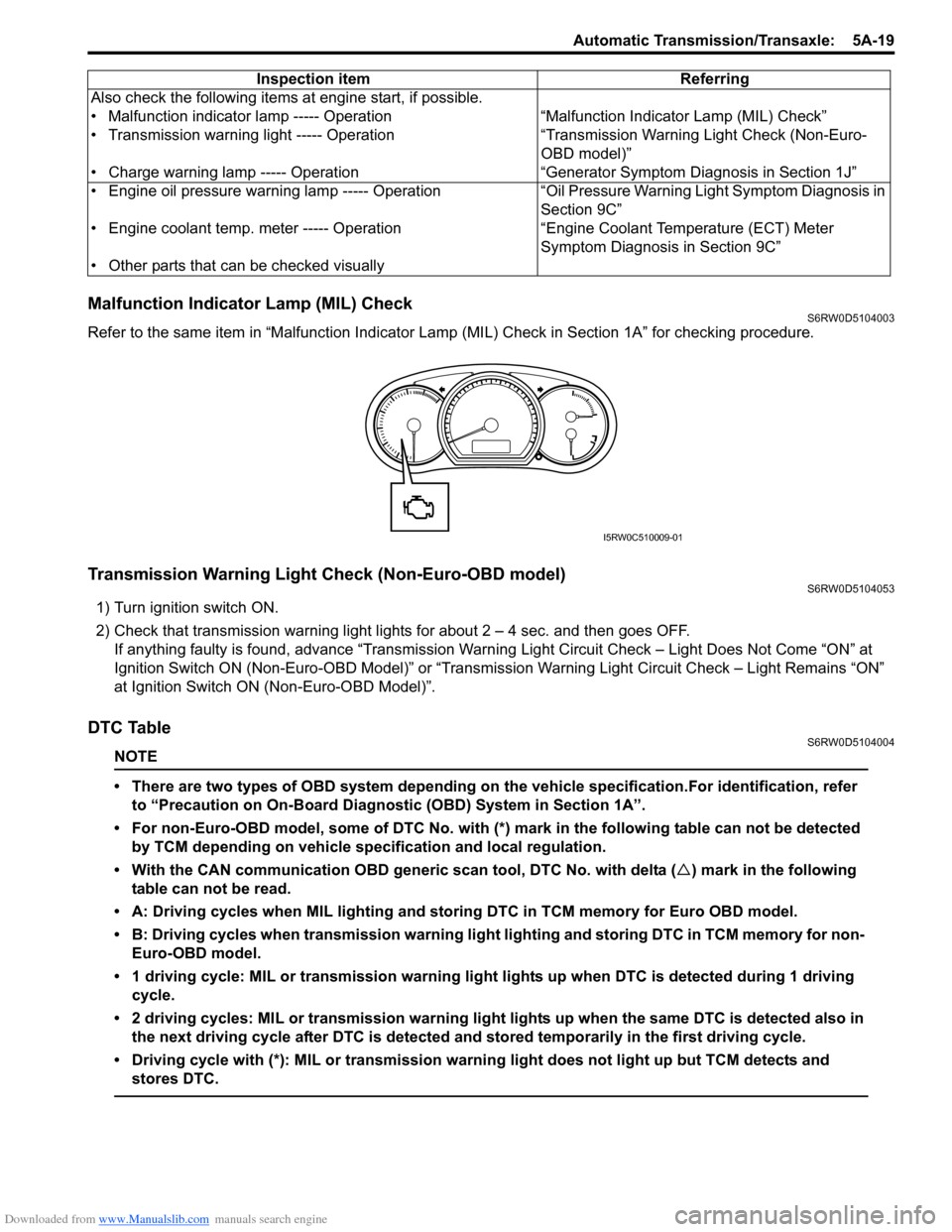
Malfunction Indicator Lamp (MIL) CheckS6RW0D5104003
Refer to the same item in “Malfunction Indicator Lamp (MIL) Check in Section 1A” for checking procedure.
Transmission Warning Light Check (Non-Euro-OBD model)S6RW0D5104053
1) Turn ignition switch ON.
2) Check that transmission warning light lights for about 2 – 4 sec. and then goes OFF.
If anything faulty is found, advance “Transmission Warning Light Circuit Check – Light Does Not Come “ON” at
Ignition Switch ON (Non-Euro-OBD Model)” or “Transmission Warning Light Circuit Check – Light Remains “ON”
at Ignition Switch ON (Non-Euro-OBD Model)”.
DTC TableS6RW0D5104004
NOTE
• There are two types of OBD system depending on the vehicle specification.For identification, refer
to “Precaution on On-Board Diagnostic (OBD) System in Section 1A”.
• For non-Euro-OBD model, some of DTC No. with (*) mark in the following table can not be detected
by TCM depending on vehicle specification and local regulation.
• With the CAN communication OBD generic scan tool, DTC No. with delta (U) mark in the following
table can not be read.
• A: Driving cycles when MIL lighting and storing DTC in TCM memory for Euro OBD model.
• B: Driving cycles when transmission warning light lighting and storing DTC in TCM memory for non-
Euro-OBD model.
• 1 driving cycle: MIL or transmission warning light lights up when DTC is detected during 1 driving
cycle.
• 2 driving cycles: MIL or transmission warning light lights up when the same DTC is detected also in
the next driving cycle after DTC is detected and stored temporarily in the first driving cycle.
• Driving cycle with (*): MIL or transmission warning light does not light up but TCM detects and
stores DTC.
Also check the following items at engine start, if possible.
• Malfunction indicator lamp ----- Operation “Malfunction Indicator Lamp (MIL) Check”
• Transmission warning light ----- Operation “Transmission Warning Light Check (Non-Euro-
OBD model)”
• Charge warning lamp ----- Operation “Generator Symptom Diagnosis in Section 1J”
• Engine oil pressure warning lamp ----- Operation “Oil Pressure Warning Light Symptom Diagnosis in
Section 9C”
• Engine coolant temp. meter ----- Operation “Engine Coolant Temperature (ECT) Meter
Symptom Diagnosis in Section 9C”
• Other parts that can be checked visuallyInspection item Referring
I5RW0C510009-01
Page 685 of 1556
Downloaded from www.Manualslib.com manuals search engine Automatic Transmission/Transaxle: 5A-37
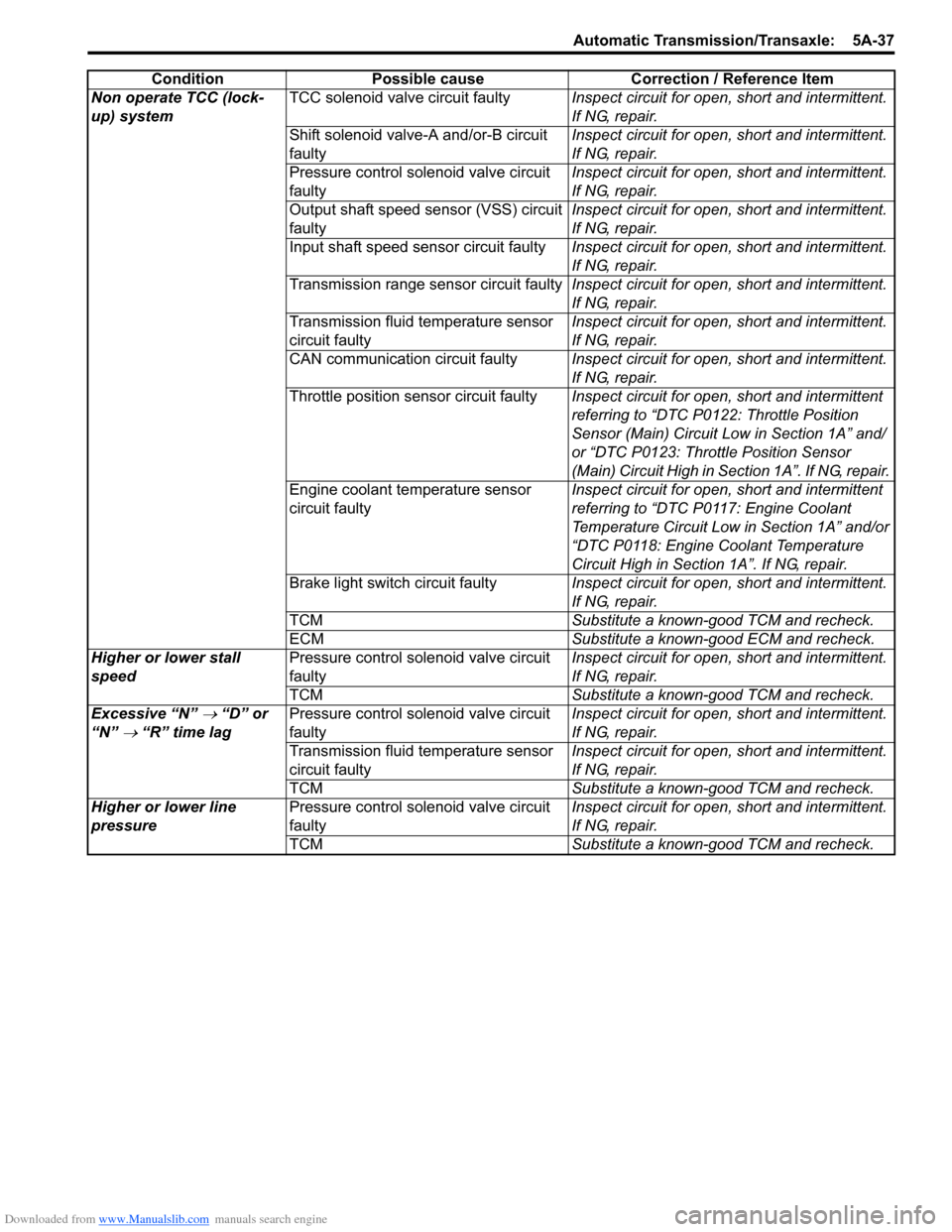
Non operate TCC (lock-
up) systemTCC solenoid valve circuit faultyInspect circuit for open, short and intermittent.
If NG, repair.
Shift solenoid valve-A and/or-B circuit
faultyInspect circuit for open, short and intermittent.
If NG, repair.
Pressure control solenoid valve circuit
faultyInspect circuit for open, short and intermittent.
If NG, repair.
Output shaft speed sensor (VSS) circuit
faulty Inspect circuit for open, short and intermittent.
If NG, repair.
Input shaft speed sensor circuit faulty Inspect circuit for open, short and intermittent.
If NG, repair.
Transmission range sensor circuit faultyInspect circuit for open, short and intermittent.
If NG, repair.
Transmission fluid temperature sensor
circuit faultyInspect circuit for open, short and intermittent.
If NG, repair.
CAN communication circuit faultyInspect circuit for open, short and intermittent.
If NG, repair.
Throttle position sensor circuit faultyInspect circuit for open, short and intermittent
referring to “DTC P0122: Throttle Position
Sensor (Main) Circuit Low in Section 1A” and/
or “DTC P0123: Throttle Position Sensor
(Main) Circuit High in Section 1A”. If NG, repair.
Engine coolant temperature sensor
circuit faultyInspect circuit for open, short and intermittent
referring to “DTC P0117: Engine Coolant
Temperature Circuit Low in Section 1A” and/or
“DTC P0118: Engine Coolant Temperature
Circuit High in Section 1A”. If NG, repair.
Brake light switch circuit faultyInspect circuit for open, short and intermittent.
If NG, repair.
TCMSubstitute a known-good TCM and recheck.
ECMSubstitute a known-good ECM and recheck.
Higher or lower stall
speedPressure control solenoid valve circuit
faultyInspect circuit for open, short and intermittent.
If NG, repair.
TCMSubstitute a known-good TCM and recheck.
Excessive “N”
→ “D” or
“N”
→ “R” time lagPressure control solenoid valve circuit
faultyInspect circuit for open, short and intermittent.
If NG, repair.
Transmission fluid temperature sensor
circuit faultyInspect circuit for open, short and intermittent.
If NG, repair.
TCMSubstitute a known-good TCM and recheck.
Higher or lower line
pressurePressure control solenoid valve circuit
faultyInspect circuit for open, short and intermittent.
If NG, repair.
TCMSubstitute a known-good TCM and recheck. Condition Possible cause Correction / Reference Item
Page 688 of 1556
Downloaded from www.Manualslib.com manuals search engine 5A-40 Automatic Transmission/Transaxle:
Trouble Diagnosis 3
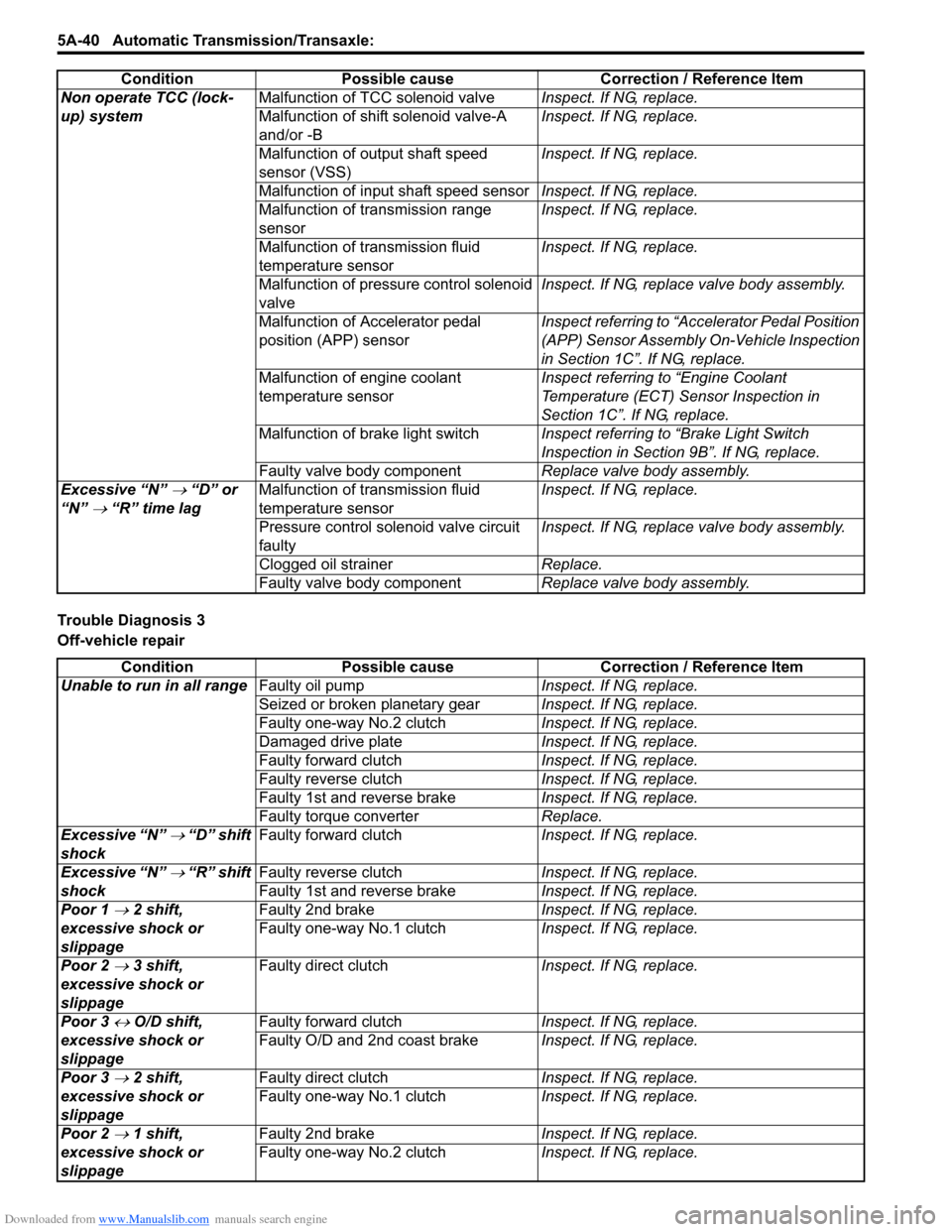
Off-vehicle repairNon operate TCC (lock-
up) systemMalfunction of TCC solenoid valveInspect. If NG, replace.
Malfunction of shift solenoid valve-A
and/or -BInspect. If NG, replace.
Malfunction of output shaft speed
sensor (VSS)Inspect. If NG, replace.
Malfunction of input shaft speed sensorInspect. If NG, replace.
Malfunction of transmission range
sensorInspect. If NG, replace.
Malfunction of transmission fluid
temperature sensorInspect. If NG, replace.
Malfunction of pressure control solenoid
valveInspect. If NG, replace valve body assembly.
Malfunction of Accelerator pedal
position (APP) sensorInspect referring to “Accelerator Pedal Position
(APP) Sensor Assembly On-Vehicle Inspection
in Section 1C”. If NG, replace.
Malfunction of engine coolant
temperature sensorInspect referring to “Engine Coolant
Temperature (ECT) Sensor Inspection in
Section 1C”. If NG, replace.
Malfunction of brake light switchInspect referring to “Brake Light Switch
Inspection in Section 9B”. If NG, replace.
Faulty valve body componentReplace valve body assembly.
Excessive “N”
→ “D” or
“N”
→ “R” time lagMalfunction of transmission fluid
temperature sensorInspect. If NG, replace.
Pressure control solenoid valve circuit
faultyInspect. If NG, replace valve body assembly.
Clogged oil strainerReplace.
Faulty valve body componentReplace valve body assembly. Condition Possible cause Correction / Reference Item
Condition Possible cause Correction / Reference Item
Unable to run in all rangeFaulty oil pumpInspect. If NG, replace.
Seized or broken planetary gearInspect. If NG, replace.
Faulty one-way No.2 clutchInspect. If NG, replace.
Damaged drive plateInspect. If NG, replace.
Faulty forward clutchInspect. If NG, replace.
Faulty reverse clutchInspect. If NG, replace.
Faulty 1st and reverse brakeInspect. If NG, replace.
Faulty torque converterReplace.
Excessive “N”
→ “D” shift
shockFaulty forward clutchInspect. If NG, replace.
Excessive “N”
→ “R” shift
shockFaulty reverse clutchInspect. If NG, replace.
Faulty 1st and reverse brakeInspect. If NG, replace.
Poor 1
→ 2 shift,
excessive shock or
slippageFaulty 2nd brakeInspect. If NG, replace.
Faulty one-way No.1 clutchInspect. If NG, replace.
Poor 2
→ 3 shift,
excessive shock or
slippageFaulty direct clutchInspect. If NG, replace.
Poor 3
↔ O/D shift,
excessive shock or
slippageFaulty forward clutchInspect. If NG, replace.
Faulty O/D and 2nd coast brakeInspect. If NG, replace.
Poor 3
→ 2 shift,
excessive shock or
slippageFaulty direct clutchInspect. If NG, replace.
Faulty one-way No.1 clutchInspect. If NG, replace.
Poor 2
→ 1 shift,
excessive shock or
slippageFaulty 2nd brakeInspect. If NG, replace.
Faulty one-way No.2 clutchInspect. If NG, replace.
Page 697 of 1556

Downloaded from www.Manualslib.com manuals search engine Automatic Transmission/Transaxle: 5A-49
DTC Confirmation Procedure
WARNING!
• When performing a road test, select a place where there is no traffic or possibility of a traffic
accident and be very careful during testing to avoid occurrence of an accident.
• Road test should be carried out with 2 persons, a driver and a tester, on a level road.
1) Connect scan tool to DLC with ignition switch OFF, if available.
2) Clear DTC in TCM memory and start engine.
3) Increase engine coolant temperature to about 50 °C (122 °F) and more.
4) Start vehicle and increase vehicle speed to about 20 km/h (12 mile/h) for 10 minutes or more.
5) Stop vehicle and check DTC.
DTC Troubleshooting
Step Action Yes No
1Was “A/T System Check” performed?Go to Step 2. Go to “A/T System
Check”.
2Check transmission fluid temperature circuit for open
1) Turn ignition switch OFF.
2) Disconnect TCM connectors from TCM.
3) Check for proper connection to transmission fluid
temperature sensor at terminals “C06-11” and “C06-12”.
4) If OK, check continuity between terminals “C06-11” and
“C06-12” of disconnected harness side TCM connector.
Is continuity indicated?Go to Step 3. “LT GRN” or “ORN”
circuit open.
3Check transmission fluid temperature circuit for IG
short
1) Cool down A/T fluid temperature under ambient
temperature.
2) Connect TCM connectors to TCM with ignition switch
OFF.
3) Turn ignition switch ON.
4) Measure voltage between terminal “C06-11” of TCM
connector and ground.
Is it 4.6 V or more?“LT GRN” circuit shorted
to power circuit.
If circuit is OK, go to
St ep 4 .Intermittent trouble or
faulty TCM.
Check for intermittent
referring to “Intermittent
and Poor Connection
Inspection in Section
00”.
If OK, substitute a
known-good TCM and
recheck.
4Inspect transmission fluid temperature sensor
1) Inspect transmission fluid temperature sensor referring
to “Transmission Fluid Temperature Sensor Inspection”.
Is result satisfactory?Intermittent trouble or
faulty TCM.
Check for intermittent
referring to “Intermittent
and Poor Connection
Inspection in Section
00”.
If OK, substitute a
known-good TCM and
recheck.Replace transmission
fluid temperature
sensor.
Page 932 of 1556
Downloaded from www.Manualslib.com manuals search engine 7A-4 Heater and Ventilation:
Repair Instructions
HVAC Unit ComponentsS6RW0D7106001
For non-A/C and manual A/C, refer to “HVAC Unit
Components in Section 7B”.
For auto A/C, refer to “HVAC Unit Components in
Section 7B”.
HVAC Unit Removal and Installation (Non-A/C)S6RW0D7106002
For manual A/C and auto A/C, refer to “HVAC Unit
Removal and Installation in Section 7B”.
Removal
1) Drain engine coolant referring to “Cooling System
Draining in Section 1F”, and then disconnect heater
hoses from HVAC unit.
2) Remove cowl top cover from vehicle body referring
to “Cowl Top and Front Lower Crossmember
Components in Section 9K”.
3) Remove instrument panel from vehicle body
referring to “Instrument Panel Removal and
Installation in Section 9C”.
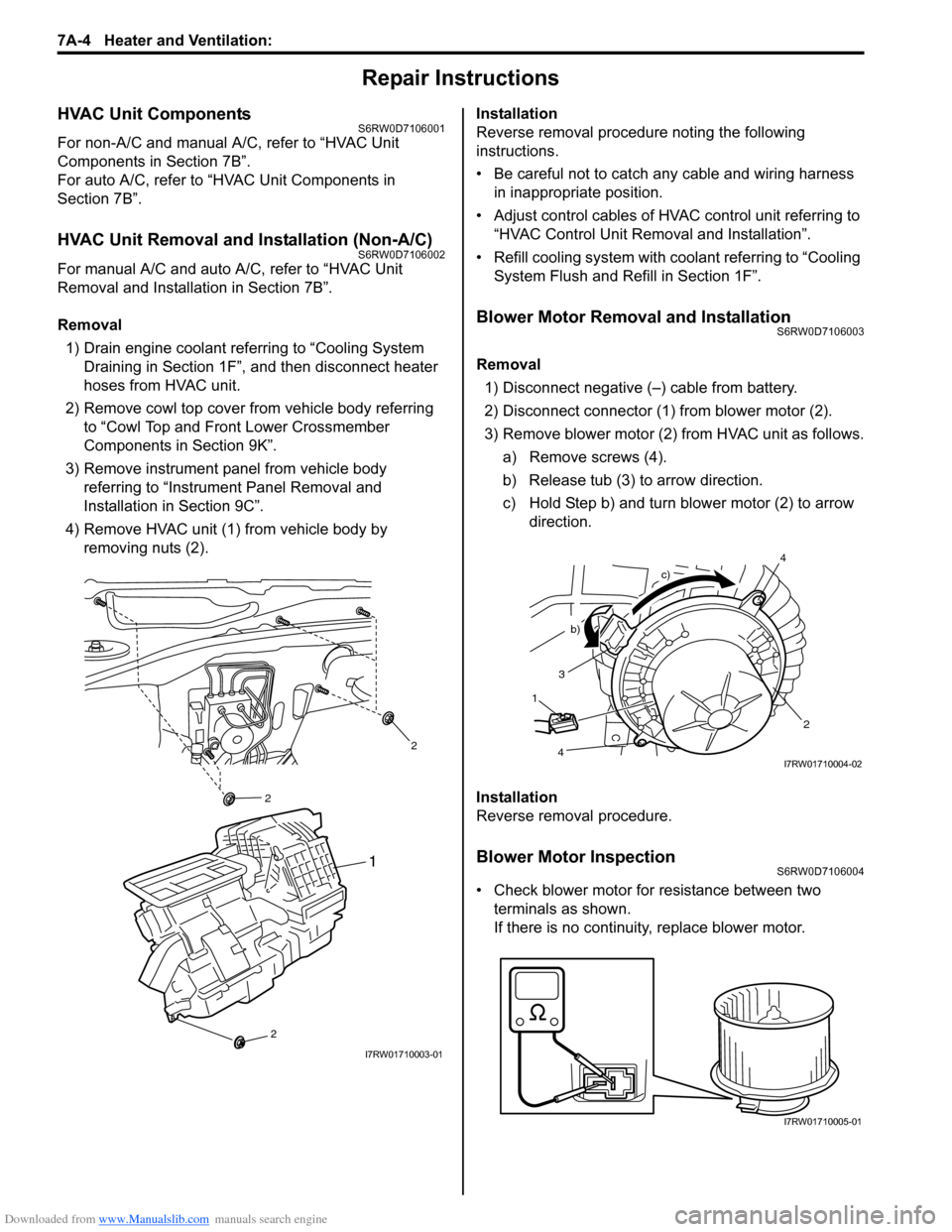
4) Remove HVAC unit (1) from vehicle body by
removing nuts (2).Installation
Reverse removal procedure noting the following
instructions.
• Be careful not to catch any cable and wiring harness
in inappropriate position.
• Adjust control cables of HVAC control unit referring to
“HVAC Control Unit Removal and Installation”.
• Refill cooling system with coolant referring to “Cooling
System Flush and Refill in Section 1F”.
Blower Motor Removal and InstallationS6RW0D7106003
Removal
1) Disconnect negative (–) cable from battery.
2) Disconnect connector (1) from blower motor (2).
3) Remove blower motor (2) from HVAC unit as follows.
a) Remove screws (4).
b) Release tub (3) to arrow direction.
c) Hold Step b) and turn blower motor (2) to arrow
direction.
Installation
Reverse removal procedure.
Blower Motor InspectionS6RW0D7106004
• Check blower motor for resistance between two
terminals as shown.
If there is no continuity, replace blower motor.
2
2
2
1
I7RW01710003-01
3
2
b)
c)
1
4
4I7RW01710004-02
I7RW01710005-01
Page 943 of 1556
Downloaded from www.Manualslib.com manuals search engine Air Conditioning System: Manual Type 7B-3
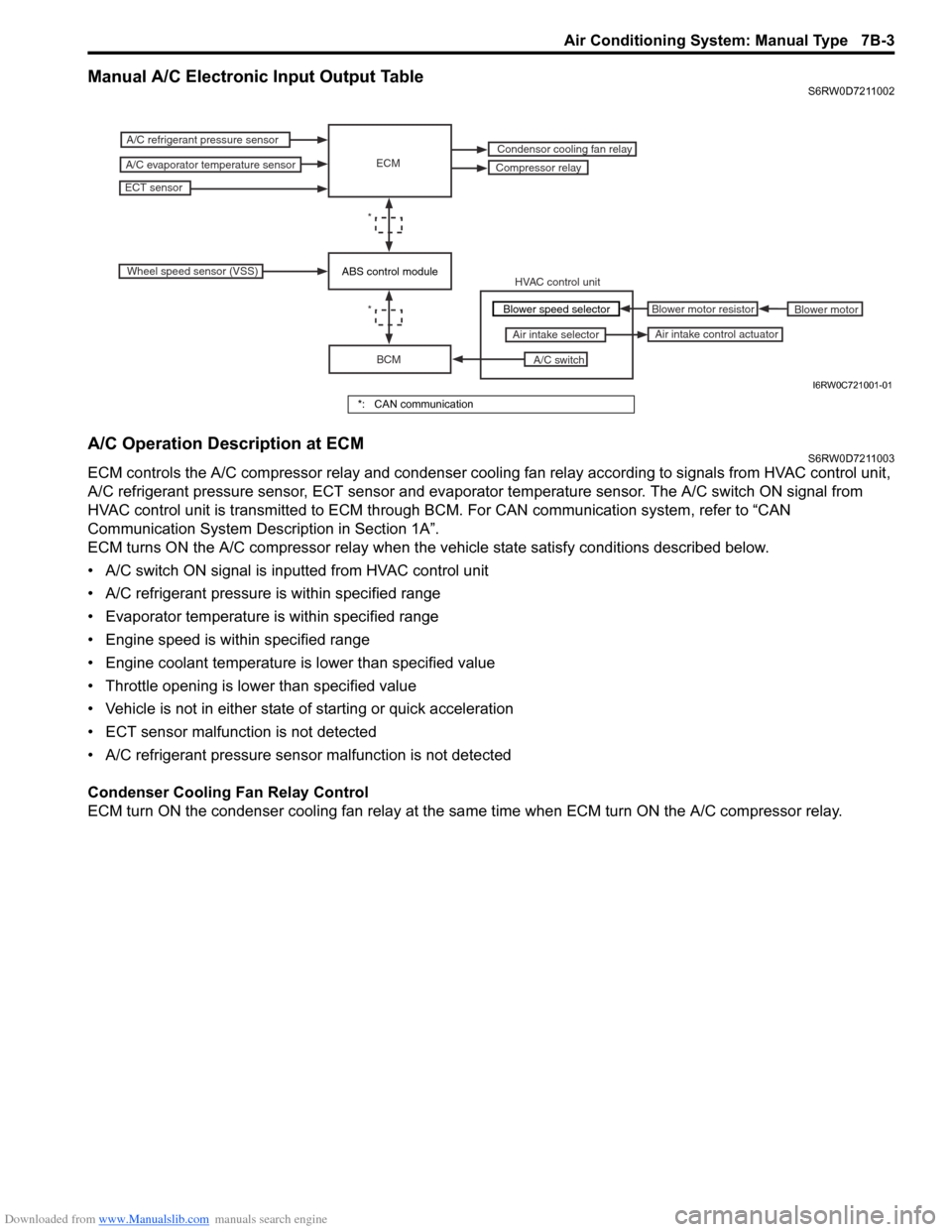
Manual A/C Electronic Input Output TableS6RW0D7211002
A/C Operation Description at ECMS6RW0D7211003
ECM controls the A/C compressor relay and condenser cooling fan relay according to signals from HVAC control unit,
A/C refrigerant pressure sensor, ECT sensor and evaporator temperature sensor. The A/C switch ON signal from
HVAC control unit is transmitted to ECM through BCM. For CAN communication system, refer to “CAN
Communication System Description in Section 1A”.
ECM turns ON the A/C compressor relay when the vehicle state satisfy conditions described below.
• A/C switch ON signal is inputted from HVAC control unit
• A/C refrigerant pressure is within specified range
• Evaporator temperature is within specified range
• Engine speed is within specified range
• Engine coolant temperature is lower than specified value
• Throttle opening is lower than specified value
• Vehicle is not in either state of starting or quick acceleration
• ECT sensor malfunction is not detected
• A/C refrigerant pressure sensor malfunction is not detected
Condenser Cooling Fan Relay Control
ECM turn ON the condenser cooling fan relay at the same time when ECM turn ON the A/C compressor relay.
ECM
BCM
A/C switch Air intake selector
A/C refrigerant pressure sensor
A/C evaporator temperature sensorCompressor relay
ECT sensor
Condensor cooling fan relay
*
Wheel speed sensor (VSS)
HVAC control unit
Blower motor Blower motor resistor
Air intake control actuator
*Blower speed selector
ABS control module
I6RW0C721001-01
*: CAN communication
Page 966 of 1556

Downloaded from www.Manualslib.com manuals search engine 7B-26 Air Conditioning System: Manual Type
HVAC Unit Removal and InstallationS6RW0D7216008
Removal
1) Recover refrigerant from A/C system with recovery
and recycling equipment referring to “Recovery” in
“Operation Procedure for Refrigerant Charge”.
2) Drain engine coolant referring to “Cooling System
Draining in Section 1F”, and then disconnect heater
hoses from HVAC unit.
3) Remove cowl top cover from vehicle body referring
to “Cowl Top and Front Lower Crossmember
Components in Section 9K”
4) Remove instrument panel from vehicle body
referring to “Instrument Panel Removal and
Installation in Section 9C”.
5) Loosen a bolt (1) and remove pipes from expansion
valve (2).6) Remove HVAC unit (1) from vehicle body by
removing nuts (2).
7. Cover (without HVAC air
filter)14. Heater core 21. Temperature control lever : Do not reuse.
1
2
I7RW01721016-01
2
2
2
1
I7RW01710003-01
Page 967 of 1556
Downloaded from www.Manualslib.com manuals search engine Air Conditioning System: Manual Type 7B-27
Installation
Reverse removal procedure noting the following
instructions.
• Replenish specified amount of compressor oil to
compressor suction side referring to “Replenishing
Compressor Oil” in “Operation Procedure for
Refrigerant Charge”.
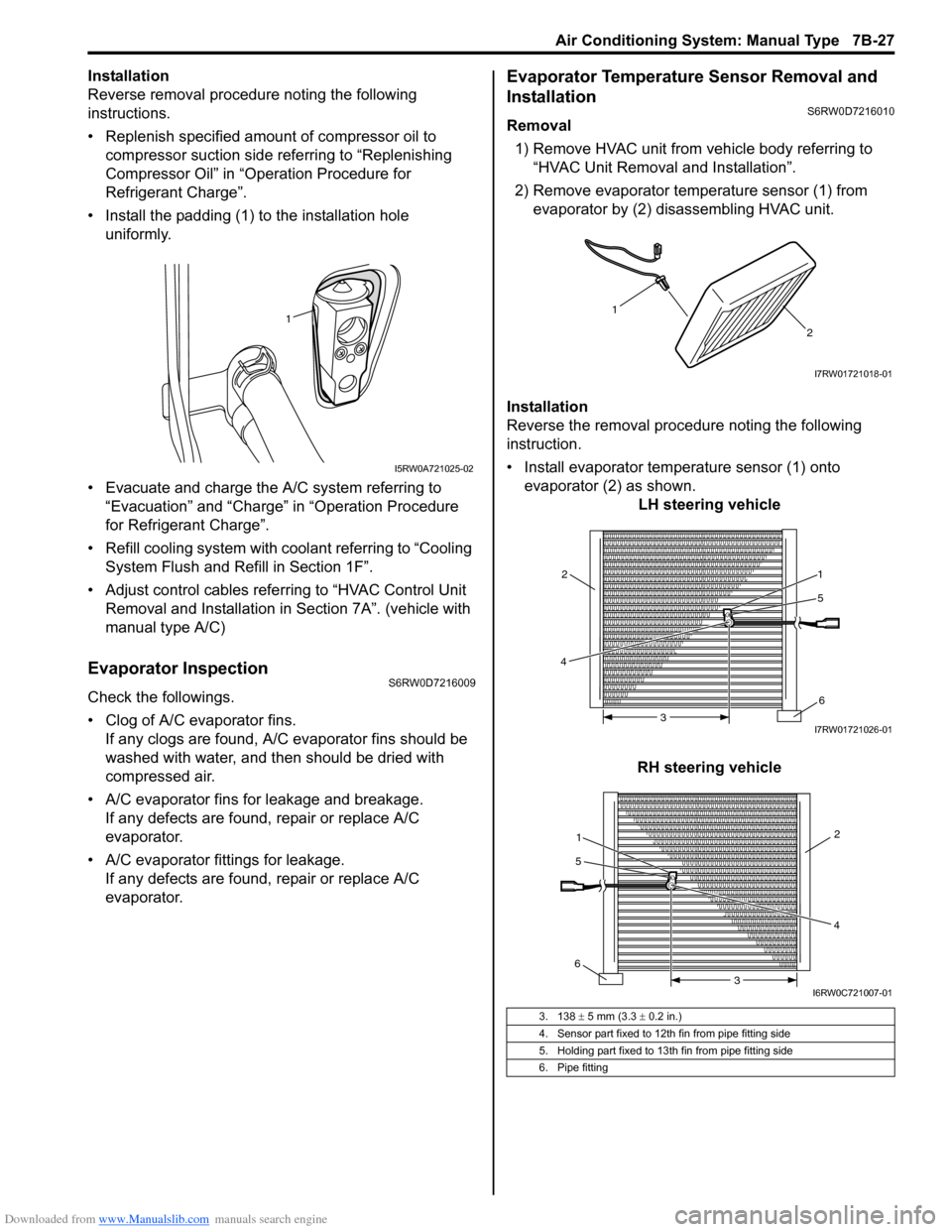
• Install the padding (1) to the installation hole
uniformly.
• Evacuate and charge the A/C system referring to
“Evacuation” and “Charge” in “Operation Procedure
for Refrigerant Charge”.
• Refill cooling system with coolant referring to “Cooling
System Flush and Refill in Section 1F”.
• Adjust control cables referring to “HVAC Control Unit
Removal and Installation in Section 7A”. (vehicle with
manual type A/C)
Evaporator InspectionS6RW0D7216009
Check the followings.
• Clog of A/C evaporator fins.
If any clogs are found, A/C evaporator fins should be
washed with water, and then should be dried with
compressed air.
• A/C evaporator fins for leakage and breakage.
If any defects are found, repair or replace A/C
evaporator.
• A/C evaporator fittings for leakage.
If any defects are found, repair or replace A/C
evaporator.
Evaporator Temperature Sensor Removal and
Installation
S6RW0D7216010
Removal
1) Remove HVAC unit from vehicle body referring to
“HVAC Unit Removal and Installation”.
2) Remove evaporator temperature sensor (1) from
evaporator by (2) disassembling HVAC unit.
Installation
Reverse the removal procedure noting the following
instruction.
• Install evaporator temperature sensor (1) onto
evaporator (2) as shown.
LH steering vehicle
RH steering vehicle
1
I5RW0A721025-02
3. 138 ± 5 mm (3.3 ± 0.2 in.)
4. Sensor part fixed to 12th fin from pipe fitting side
5. Holding part fixed to 13th fin from pipe fitting side
6. Pipe fitting
1
2
I7RW01721018-01
5
4
6 1
2
3I7RW01721026-01
1
5
642
3
I6RW0C721007-01
Page 979 of 1556
Downloaded from www.Manualslib.com manuals search engine Air Conditioning System: Automatic Type 7B-39
General Description
Auto A/C System DescriptionS6RW0D7221001
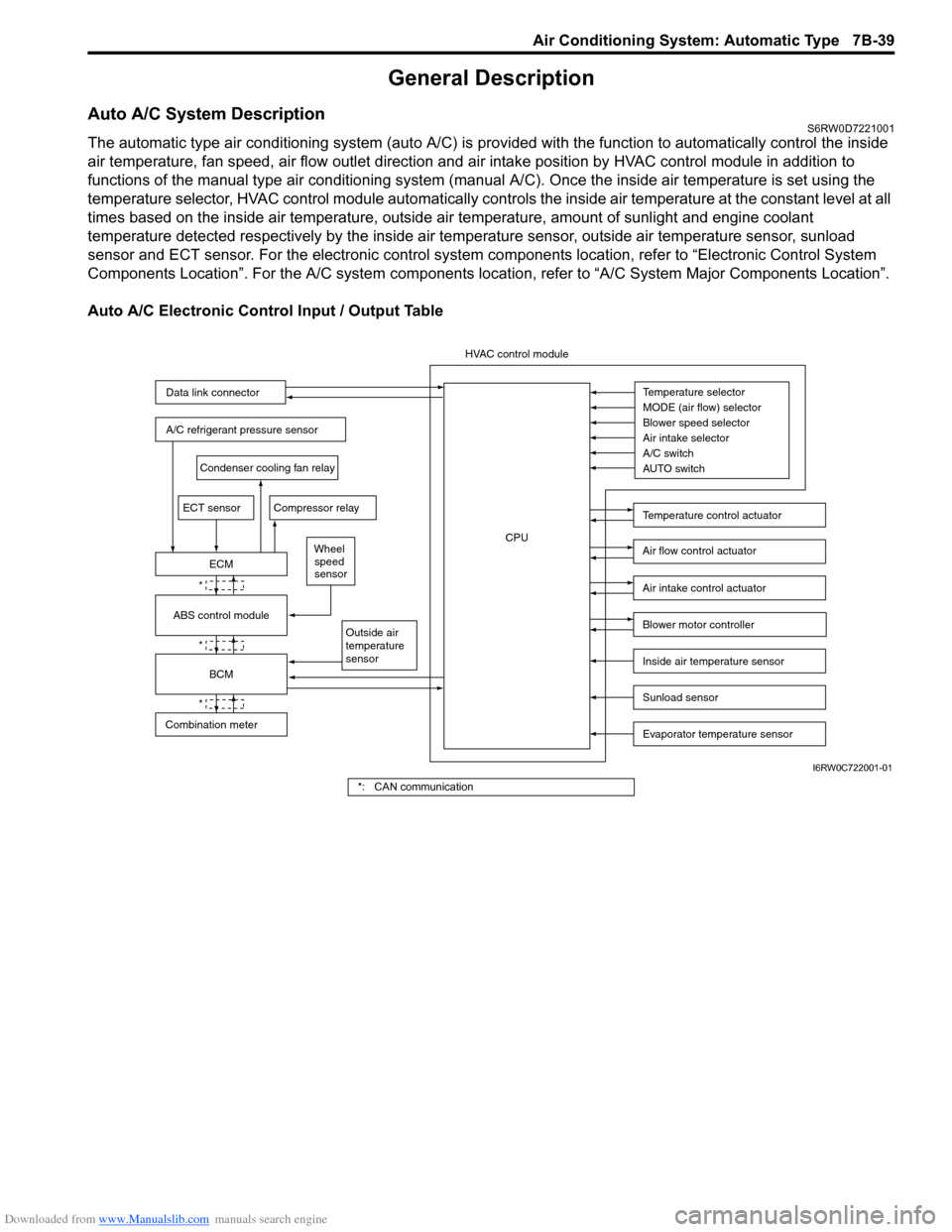
The automatic type air conditioning system (auto A/C) is provided with the function to automatically control the inside
air temperature, fan speed, air flow outlet direction and air intake position by HVAC control module in addition to
functions of the manual type air conditioning system (manual A/C). Once the inside air temperature is set using the
temperature selector, HVAC control module automatically controls the inside air temperature at the constant level at all
times based on the inside air temperature, outside air temperature, amount of sunlight and engine coolant
temperature detected respectively by the inside air temperature sensor, outside air temperature sensor, sunload
sensor and ECT sensor. For the electronic control system components location, refer to “Electronic Control System
Components Location”. For the A/C system components location, refer to “A/C System Major Components Location”.
Auto A/C Electronic Control Input / Output Table
Temperature selector
MODE (air flow) selector
Blower speed selector
Air intake selector
AUTO switch A/C switch
Outside air
temperature
sensor
A/C refrigerant pressure sensor
Compressor relay
Blower motor controller
Temperature control actuator
Air flow control actuator
Air intake control actuator
BCM
ECM
Data link connector
HVAC control module
CPU
ECT sensor
Sunload sensor
Inside air temperature sensor
Evaporator temperature sensor
Condenser cooling fan relay
Wheel
speed
sensor
*
*
*
Combination meterABS control module
I6RW0C722001-01
*: CAN communication
Page 980 of 1556
Downloaded from www.Manualslib.com manuals search engine 7B-40 Air Conditioning System: Automatic Type
HVAC Control DescriptionS6RW0D7221002
Temperature Control
HVAC control module calculates the target temperature
control door position based on signals from the
temperature selector, inside air temperature sensor,
outside air temperature sensor and sunload sensor and
controls the temperature control actuator so that the
current position of the temperature control door matches
its target position.
Fan Speed Control
HVAC control module calculates the target blower fan
speed based on signals from the temperature selector,
inside air temperature sensor, outside air temperature
sensor, ECT sensor and sunload sensor, compares it
with the current blower fan speed inputted from the
blower motor controller to control the current blower fan
speed to the target level.
Air Flow Outlet Control
HVAC control module calculates the target temperature
control door position based on signals from the
temperature selector, inside air temperature sensor,
outside air temperature sensor, ECT sensor and sunload
sensor. Using thus obtained target temperature control
door position, it further calculates the target air flow
control door position and controls the air flow control
actuator so that the current air flow control door position
becomes the target position.
Air Intake Position Control
HVAC control module determines the position of the air
intake control door based on signals from the
temperature selector, inside air temperature sensor,
outside air temperature sensor and sunload sensor and
selects any of the following positions by controlling the
position of the air intake control door.
• FRESH position (FRE)
• RECIRCULATION position (REC)
• MIX position (MIX)A/C Compressor Relay Control
HVAC control module outputs A/C switch ON signal to
ECM via BCM when the vehicle state satisfy conditions
described below.
• A/C switch is ON
• Evaporator temperature is higher than specified value
• Evaporator temperature sensor malfunction is not
detected
Communication of ECM and BCM is established by CAN
(Controller Area Network). (For more detail of CAN
communication, refer to “CAN Communication System
Description in Section 1A”).
ECM turns ON the A/C compressor relay when the
vehicle state satisfy conditions described below.
• A/C switch ON signal is inputted
• A/C refrigerant pressure is within specified range
• Engine speed is within specified range
• Engine coolant temperature is lower than specified
value
• Throttle opening is lower than specified value
• Vehicle is not in either state of starting or quick
acceleration
• ECT sensor malfunction is not detected
• A/C refrigerant pressure sensor malfunction is not
detected
Condenser Cooling Fan Relay Control
ECM turn ON the condenser cooling fan relay at the
same time when ECM turn ON the A/C compressor
relay.
Sub-Cool A/C System DescriptionS6RW0D7221003
Refer to “Sub-Cool A/C System Description”.