Pump SUZUKI SX4 2006 1.G Service Manual PDF
[x] Cancel search | Manufacturer: SUZUKI, Model Year: 2006, Model line: SX4, Model: SUZUKI SX4 2006 1.GPages: 1556, PDF Size: 37.31 MB
Page 390 of 1556
Downloaded from www.Manualslib.com manuals search engine 1G-13 Fuel System:
Fuel Tank Removal and InstallationS6RW0D1706011
WARNING!
Before starting the following procedure, be
sure to observe “Precautions on Fuel System
Service” in order to reduce the risk of fire and
personal injury.
Removal
1) Relieve fuel pressure in fuel feed line according to
“Fuel Pressure Relief Procedure”.
2) Disconnect negative cable at battery.
3) Remove fuel filler cap.
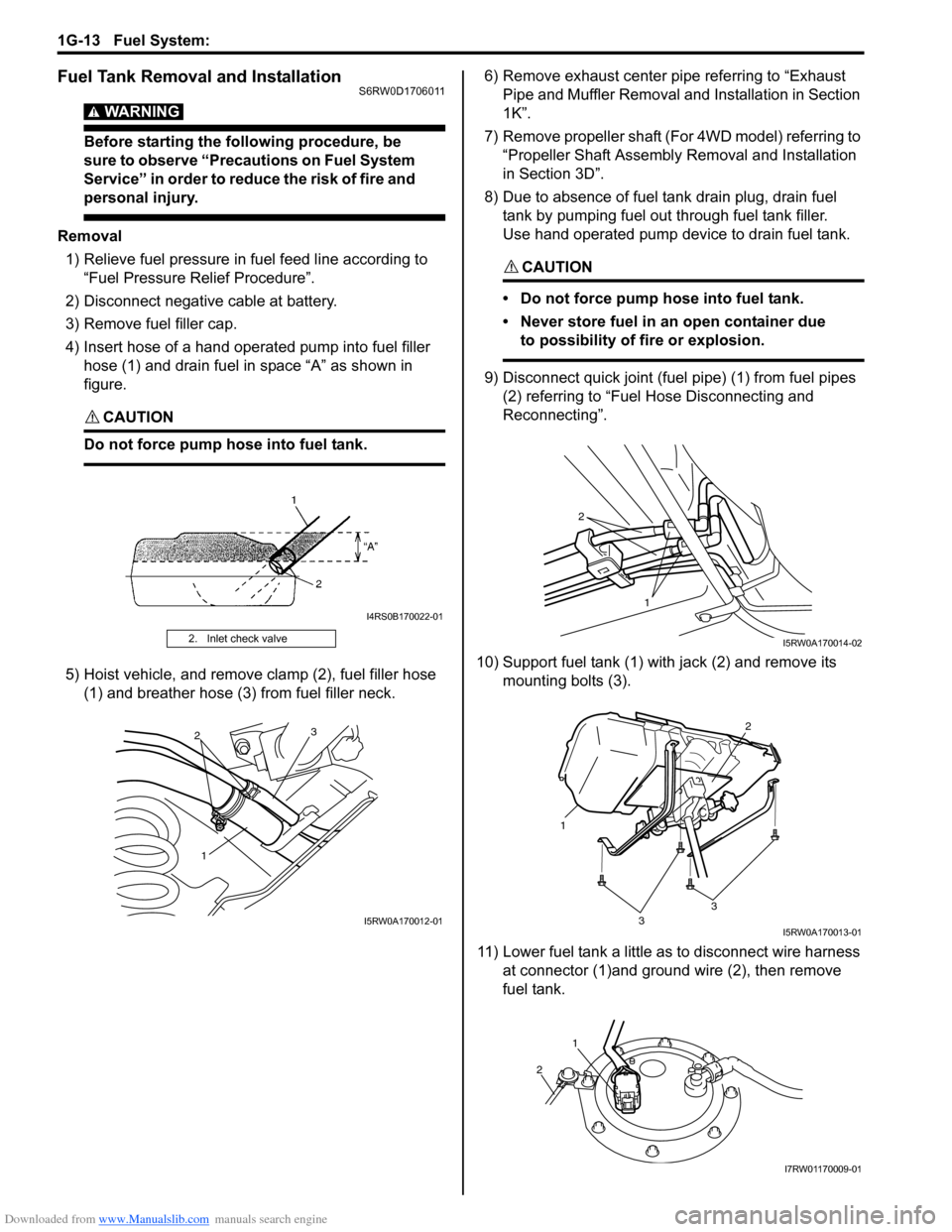
4) Insert hose of a hand operated pump into fuel filler
hose (1) and drain fuel in space “A” as shown in
figure.
CAUTION!
Do not force pump hose into fuel tank.
5) Hoist vehicle, and remove clamp (2), fuel filler hose
(1) and breather hose (3) from fuel filler neck.6) Remove exhaust center pipe referring to “Exhaust
Pipe and Muffler Removal and Installation in Section
1K”.
7) Remove propeller shaft (For 4WD model) referring to
“Propeller Shaft Assembly Removal and Installation
in Section 3D”.
8) Due to absence of fuel tank drain plug, drain fuel
tank by pumping fuel out through fuel tank filler.
Use hand operated pump device to drain fuel tank.
CAUTION!
• Do not force pump hose into fuel tank.
• Never store fuel in an open container due
to possibility of fire or explosion.
9) Disconnect quick joint (fuel pipe) (1) from fuel pipes
(2) referring to “Fuel Hose Disconnecting and
Reconnecting”.
10) Support fuel tank (1) with jack (2) and remove its
mounting bolts (3).
11) Lower fuel tank a little as to disconnect wire harness
at connector (1)and ground wire (2), then remove
fuel tank.
2. Inlet check valve
I4RS0B170022-01
1 23
I5RW0A170012-01
2
1
I5RW0A170014-02
1
2
33
I5RW0A170013-01
1
2
I7RW01170009-01
Page 391 of 1556
Downloaded from www.Manualslib.com manuals search engine Fuel System: 1G-14
Installation
CAUTION!
• When connecting joint, clean outside
surfaces of pipe where joint is to be
inserted, push joint into pipe till joint lock
clicks and check to ensure that pipes are
connected securely, or fuel leak may
occur.
• Never let the fuel hoses touch the ABS
sensor harness (if equipped).
1) If parts have been removed from fuel tank, install
them before installing fuel tank to vehicle.
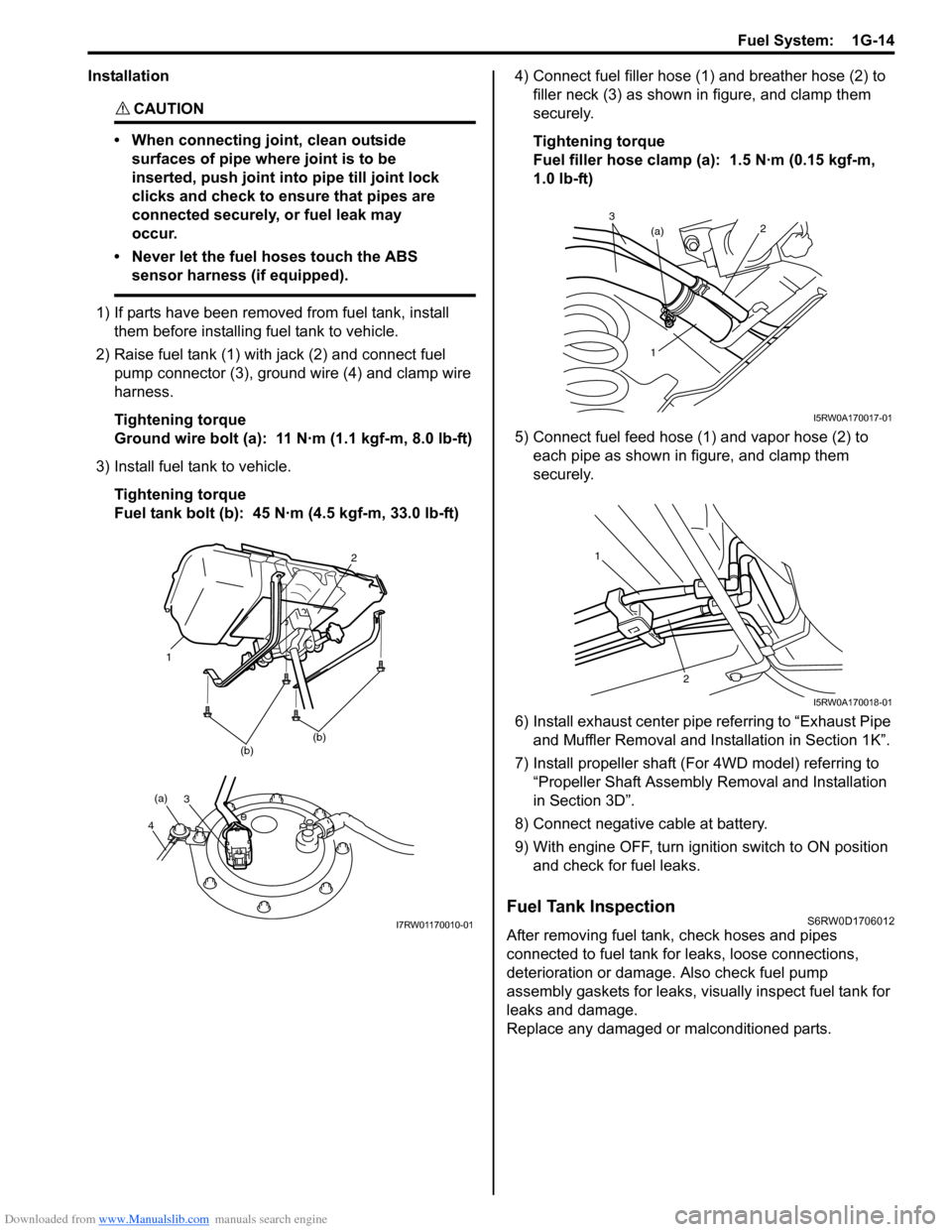
2) Raise fuel tank (1) with jack (2) and connect fuel
pump connector (3), ground wire (4) and clamp wire
harness.
Tightening torque
Ground wire bolt (a): 11 N·m (1.1 kgf-m, 8.0 lb-ft)
3) Install fuel tank to vehicle.
Tightening torque
Fuel tank bolt (b): 45 N·m (4.5 kgf-m, 33.0 lb-ft)4) Connect fuel filler hose (1) and breather hose (2) to
filler neck (3) as shown in figure, and clamp them
securely.
Tightening torque
Fuel filler hose clamp (a): 1.5 N·m (0.15 kgf-m,
1.0 lb-ft)
5) Connect fuel feed hose (1) and vapor hose (2) to
each pipe as shown in figure, and clamp them
securely.
6) Install exhaust center pipe referring to “Exhaust Pipe
and Muffler Removal and Installation in Section 1K”.
7) Install propeller shaft (For 4WD model) referring to
“Propeller Shaft Assembly Removal and Installation
in Section 3D”.
8) Connect negative cable at battery.
9) With engine OFF, turn ignition switch to ON position
and check for fuel leaks.
Fuel Tank InspectionS6RW0D1706012
After removing fuel tank, check hoses and pipes
connected to fuel tank for leaks, loose connections,
deterioration or damage. Also check fuel pump
assembly gaskets for leaks, visually inspect fuel tank for
leaks and damage.
Replace any damaged or malconditioned parts.
(b)(b)
1
2
3
4
(a)
I7RW01170010-01
1(a)2
3
I5RW0A170017-01
1
2
I5RW0A170018-01
Page 392 of 1556
Downloaded from www.Manualslib.com manuals search engine 1G-15 Fuel System:
Fuel Tank Purging ProcedureS6RW0D1706013
WARNING!
• Before starting the following procedure, be
sure to observe “Precautions on Fuel
System Service” in order to reduce the risk
of fire and personal injury.
• This purging procedure will not remove all
fuel vapor.
Do not attempt any repair on tank using
heat of flame as an explosion resulting in
personal injury could occur.
CAUTION!
Never remain water in fuel tank after washing,
or fuel tank inside will get corrosion.
The following procedure are used for purging fuel tank.
1) After removing fuel tank, remove all hoses, pipes
and fuel pump assembly from fuel tank.
2) Drain all remaining fuel from tank.
3) Place fuel tank to flushing area.
4) Fill tank with warm water or tap water, and agitate
vigorously and drain. Repeat this washing until
inside of tank is clean. Replace tank if its inside is
rusty.
5) Completely flush out remaining water after washing.
6) Be sure to dry fuel tank assembly thoroughly out of
direct sunlight after washing.
Fuel Pump On-Vehicle InspectionS6RW0D1706014
WARNING!
Before starting the following procedure, be
sure to observe “Precautions on Fuel System
Service” in order to reduce the risk of fire and
personal injury.
NOTE
The fuel pressure regulator is incorporated
with the fuel pump assembly so individual
inspection of it is impossible.
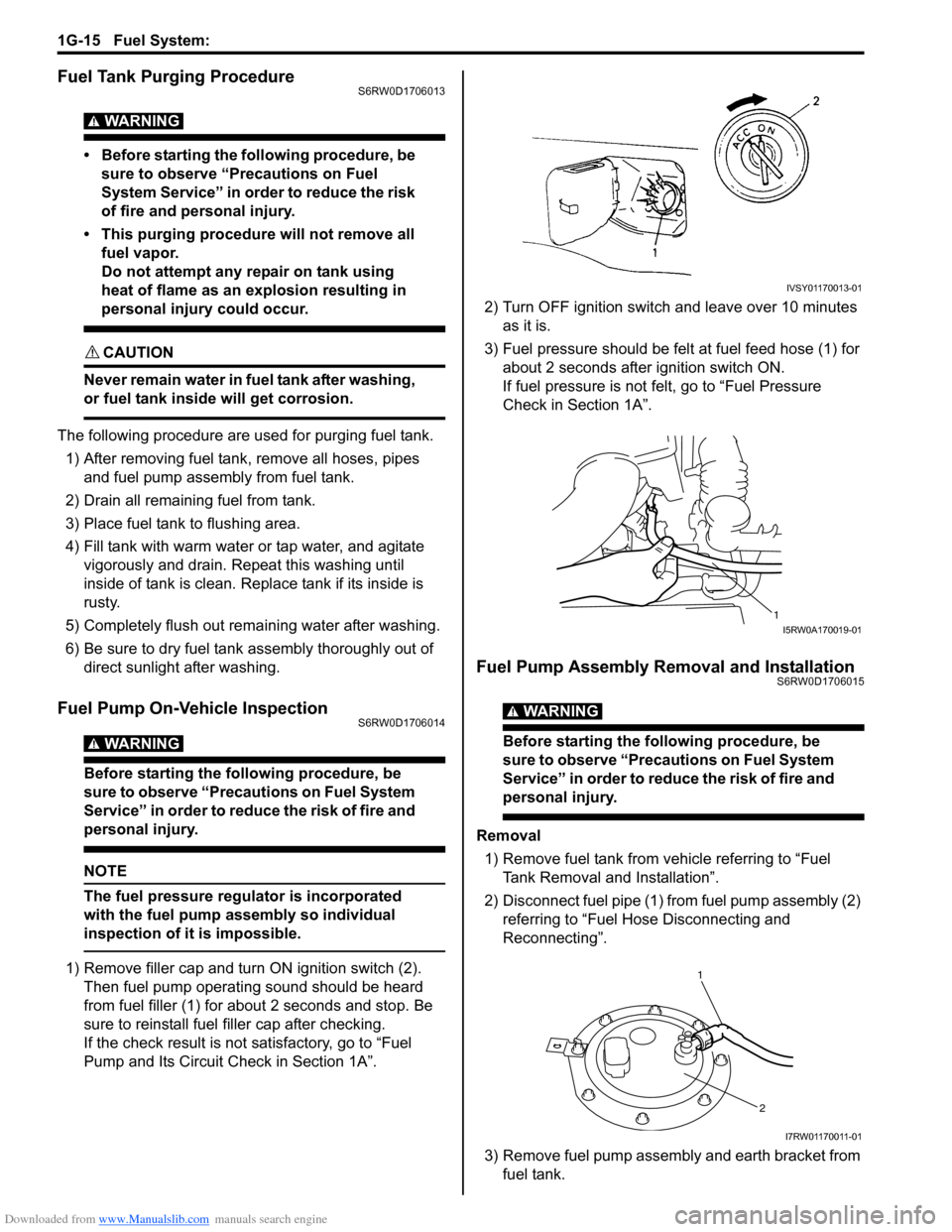
1) Remove filler cap and turn ON ignition switch (2).
Then fuel pump operating sound should be heard
from fuel filler (1) for about 2 seconds and stop. Be
sure to reinstall fuel filler cap after checking.
If the check result is not satisfactory, go to “Fuel
Pump and Its Circuit Check in Section 1A”.2) Turn OFF ignition switch and leave over 10 minutes
as it is.
3) Fuel pressure should be felt at fuel feed hose (1) for
about 2 seconds after ignition switch ON.
If fuel pressure is not felt, go to “Fuel Pressure
Check in Section 1A”.
Fuel Pump Assembly Removal and InstallationS6RW0D1706015
WARNING!
Before starting the following procedure, be
sure to observe “Precautions on Fuel System
Service” in order to reduce the risk of fire and
personal injury.
Removal
1) Remove fuel tank from vehicle referring to “Fuel
Tank Removal and Installation”.
2) Disconnect fuel pipe (1) from fuel pump assembly (2)
referring to “Fuel Hose Disconnecting and
Reconnecting”.
3) Remove fuel pump assembly and earth bracket from
fuel tank.
IVSY01170013-01
1I5RW0A170019-01
1
2
I7RW01170011-01
Page 393 of 1556
Downloaded from www.Manualslib.com manuals search engine Fuel System: 1G-16
Installation
CAUTION!
When connecting joint, clean outside surface
of pipe where joint is to be inserted, push
joint into pipe till joint lock clicks and check
to ensure that pipes are connected securely,
or fuel leak may occur.
1) Clean mating surfaces of fuel pump assembly and
fuel tank.
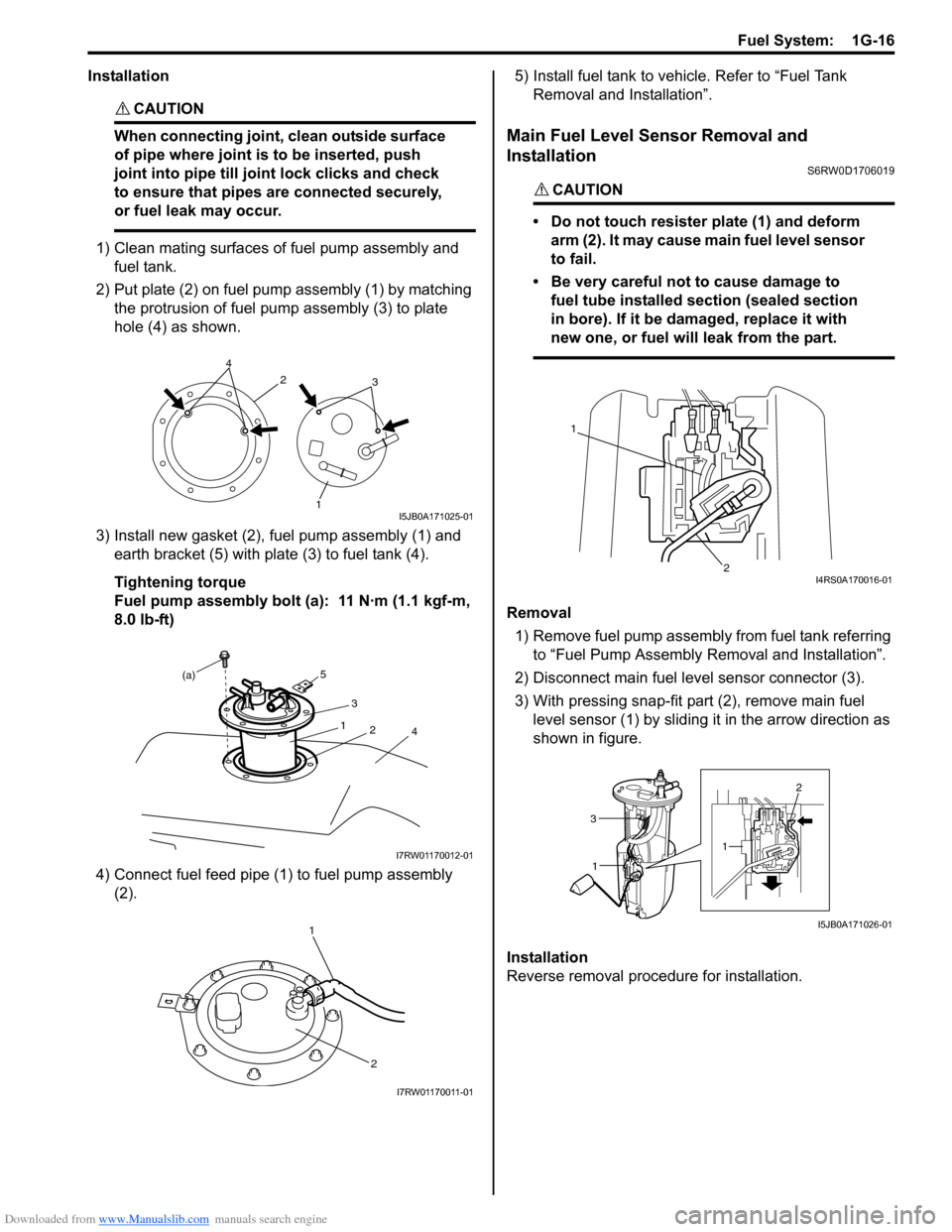
2) Put plate (2) on fuel pump assembly (1) by matching
the protrusion of fuel pump assembly (3) to plate
hole (4) as shown.
3) Install new gasket (2), fuel pump assembly (1) and
earth bracket (5) with plate (3) to fuel tank (4).
Tightening torque
Fuel pump assembly bolt (a): 11 N·m (1.1 kgf-m,
8.0 lb-ft)
4) Connect fuel feed pipe (1) to fuel pump assembly
(2).5) Install fuel tank to vehicle. Refer to “Fuel Tank
Removal and Installation”.
Main Fuel Level Sensor Removal and
Installation
S6RW0D1706019
CAUTION!
• Do not touch resister plate (1) and deform
arm (2). It may cause main fuel level sensor
to fail.
• Be very careful not to cause damage to
fuel tube installed section (sealed section
in bore). If it be damaged, replace it with
new one, or fuel will leak from the part.
Removal
1) Remove fuel pump assembly from fuel tank referring
to “Fuel Pump Assembly Removal and Installation”.
2) Disconnect main fuel level sensor connector (3).
3) With pressing snap-fit part (2), remove main fuel
level sensor (1) by sliding it in the arrow direction as
shown in figure.
Installation
Reverse removal procedure for installation.
3
1 2 4
I5JB0A171025-01
3
1
2
(a)
4
5
I7RW01170012-01
1
2
I7RW01170011-01
1
2I4RS0A170016-01
1 3
12
I5JB0A171026-01
Page 394 of 1556
Downloaded from www.Manualslib.com manuals search engine 1G-17 Fuel System:
Fuel Pump InspectionS6RW0D1706016
• Check fuel pump assembly for damage.
• Check fuel suction filter for evidence of dirt and
contamination.
If present, replace or clean and check for presence of
dirt in fuel tank.
• For electrical circuit, refer to “Fuel Pump and Its
Circuit Check in Section 1A”.
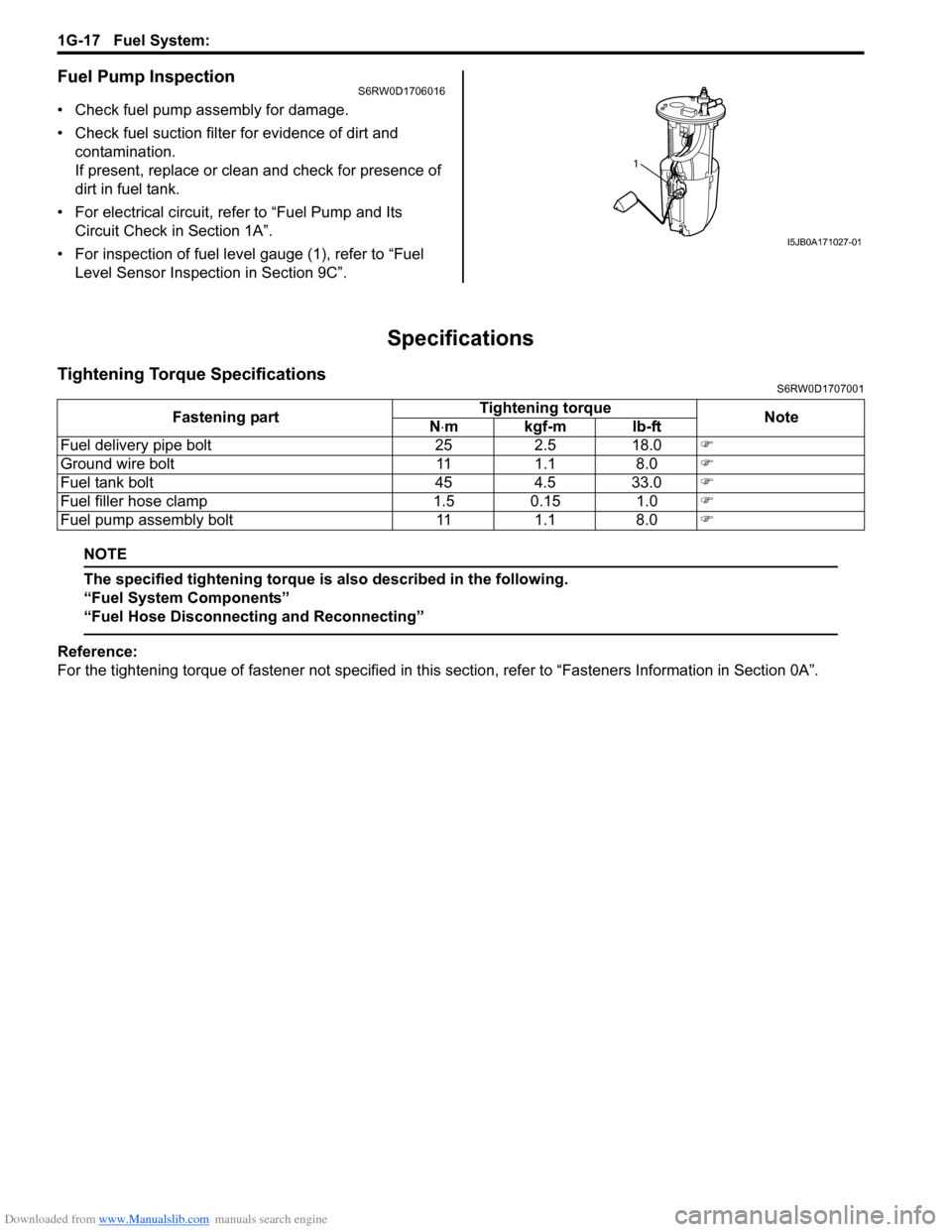
• For inspection of fuel level gauge (1), refer to “Fuel
Level Sensor Inspection in Section 9C”.
Specifications
Tightening Torque SpecificationsS6RW0D1707001
NOTE
The specified tightening torque is also described in the following.
“Fuel System Components”
“Fuel Hose Disconnecting and Reconnecting”
Reference:
For the tightening torque of fastener not specified in this section, refer to “Fasteners Information in Section 0A”.
1
I5JB0A171027-01
Fastening partTightening torque
Note
N⋅mkgf-mlb-ft
Fuel delivery pipe bolt 25 2.5 18.0)
Ground wire bolt 11 1.1 8.0)
Fuel tank bolt 45 4.5 33.0)
Fuel filler hose clamp 1.5 0.15 1.0)
Fuel pump assembly bolt 11 1.1 8.0)
Page 407 of 1556
Downloaded from www.Manualslib.com manuals search engine Starting System: 1I-2
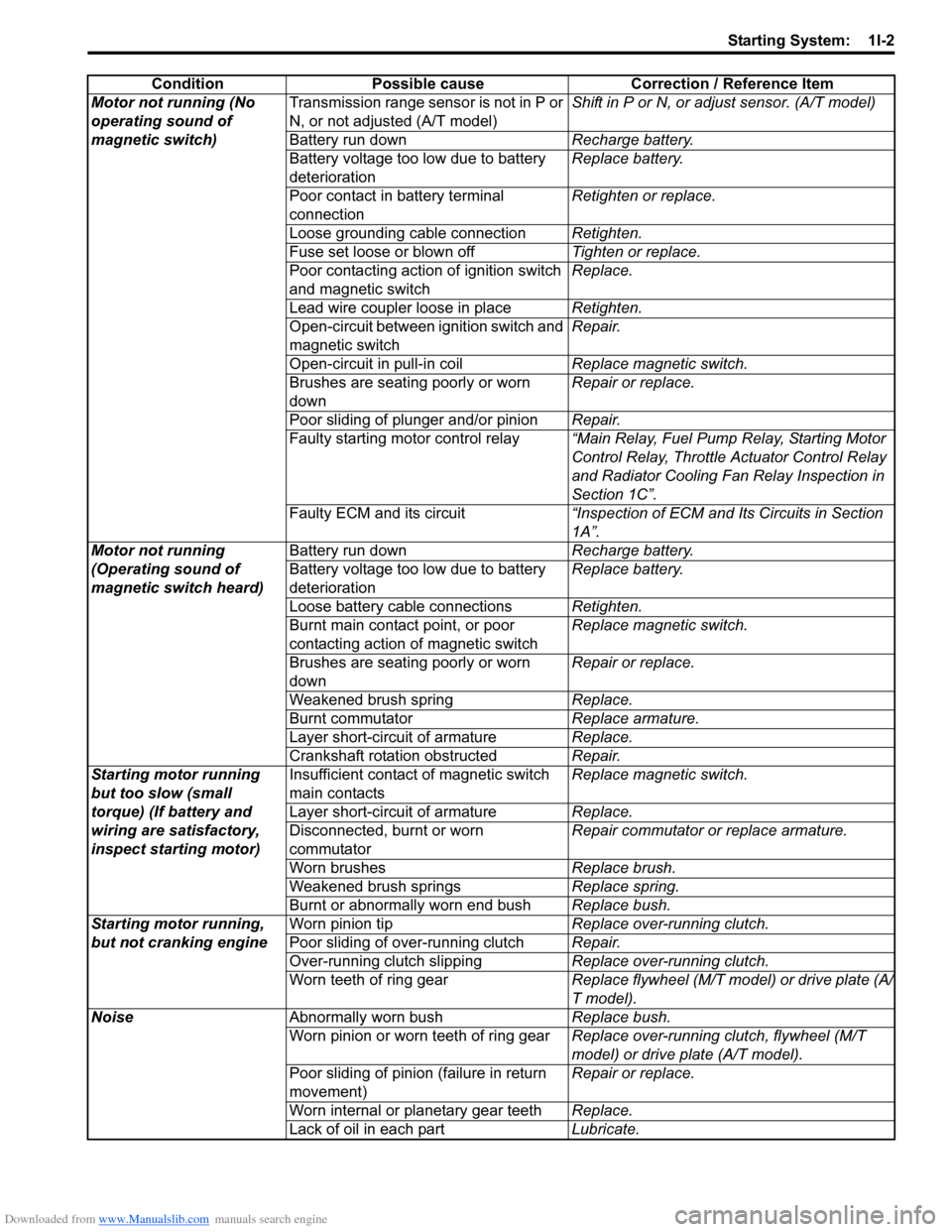
Condition Possible cause Correction / Reference Item
Motor not running (No
operating sound of
magnetic switch)Transmission range sensor is not in P or
N, or not adjusted (A/T model)Shift in P or N, or adjust sensor. (A/T model)
Battery run downRecharge battery.
Battery voltage too low due to battery
deteriorationReplace battery.
Poor contact in battery terminal
connectionRetighten or replace.
Loose grounding cable connectionRetighten.
Fuse set loose or blown offTighten or replace.
Poor contacting action of ignition switch
and magnetic switchReplace.
Lead wire coupler loose in placeRetighten.
Open-circuit between ignition switch and
magnetic switchRepair.
Open-circuit in pull-in coilReplace magnetic switch.
Brushes are seating poorly or worn
downRepair or replace.
Poor sliding of plunger and/or pinionRepair.
Faulty starting motor control relay“Main Relay, Fuel Pump Relay, Starting Motor
Control Relay, Throttle Actuator Control Relay
and Radiator Cooling Fan Relay Inspection in
Section 1C”.
Faulty ECM and its circuit“Inspection of ECM and Its Circuits in Section
1A”.
Motor not running
(Operating sound of
magnetic switch heard)Battery run downRecharge battery.
Battery voltage too low due to battery
deteriorationReplace battery.
Loose battery cable connectionsRetighten.
Burnt main contact point, or poor
contacting action of magnetic switchReplace magnetic switch.
Brushes are seating poorly or worn
downRepair or replace.
Weakened brush springReplace.
Burnt commutatorReplace armature.
Layer short-circuit of armatureReplace.
Crankshaft rotation obstructedRepair.
Starting motor running
but too slow (small
torque) (If battery and
wiring are satisfactory,
inspect starting motor)Insufficient contact of magnetic switch
main contactsReplace magnetic switch.
Layer short-circuit of armatureReplace.
Disconnected, burnt or worn
commutatorRepair commutator or replace armature.
Worn brushesReplace brush.
Weakened brush springsReplace spring.
Burnt or abnormally worn end bushReplace bush.
Starting motor running,
but not cranking engineWorn pinion tipReplace over-running clutch.
Poor sliding of over-running clutchRepair.
Over-running clutch slippingReplace over-running clutch.
Worn teeth of ring gearReplace flywheel (M/T model) or drive plate (A/
T model).
NoiseAbnormally worn bushReplace bush.
Worn pinion or worn teeth of ring gearReplace over-running clutch, flywheel (M/T
model) or drive plate (A/T model).
Poor sliding of pinion (failure in return
movement)Repair or replace.
Worn internal or planetary gear teethReplace.
Lack of oil in each partLubricate.
Page 421 of 1556
Downloaded from www.Manualslib.com manuals search engine Charging System: 1J-7
1) Set parking brake and place automatic transaxle in
PARK (NEUTRAL on manual transaxle). Turn off
ignition, turn off lights and all other electrical loads.
2) Check electrolyte level. If it is below low level line,
add distilled water.
3) Attach end of one jumper cable to positive terminal
of booster battery and the other end of the same
cable to positive terminal of discharged battery. (Use
12-volt battery only to jump start engine).
4) Attach one end of the remaining negative cable to
negative terminal of booster battery, and the other
end to a solid engine ground (such as exhaust
manifold) at least 45 cm (18 in.) away from battery of
vehicle being started.
5) Start engine of vehicle with booster battery and turn
off electrical accessories. Then start engine of the
vehicle with discharged battery.
6) Disconnect jumper cables in the exact reverse order.
With Charging Equipment
CAUTION!
When jump starting engine with charging
equipment, be sure equipment used is 12-
volt and negative ground. Do not use 24-volt
charging equipment. Using such equipment
can cause serious damage to electrical
system or electronic parts.
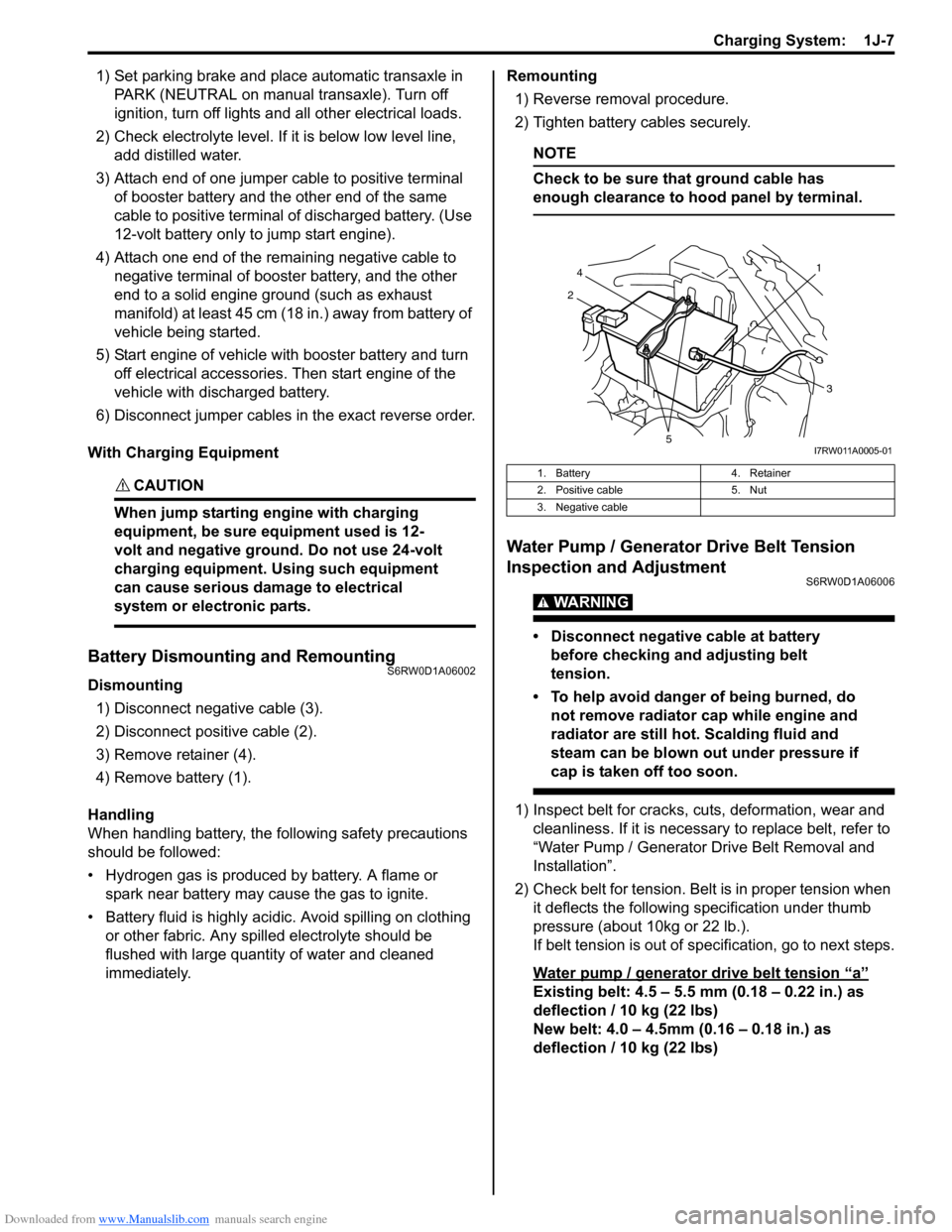
Battery Dismounting and RemountingS6RW0D1A06002
Dismounting
1) Disconnect negative cable (3).
2) Disconnect positive cable (2).
3) Remove retainer (4).
4) Remove battery (1).
Handling
When handling battery, the following safety precautions
should be followed:
• Hydrogen gas is produced by battery. A flame or
spark near battery may cause the gas to ignite.
• Battery fluid is highly acidic. Avoid spilling on clothing
or other fabric. Any spilled electrolyte should be
flushed with large quantity of water and cleaned
immediately.Remounting
1) Reverse removal procedure.
2) Tighten battery cables securely.
NOTE
Check to be sure that ground cable has
enough clearance to hood panel by terminal.
Water Pump / Generator Drive Belt Tension
Inspection and Adjustment
S6RW0D1A06006
WARNING!
• Disconnect negative cable at battery
before checking and adjusting belt
tension.
• To help avoid danger of being burned, do
not remove radiator cap while engine and
radiator are still hot. Scalding fluid and
steam can be blown out under pressure if
cap is taken off too soon.
1) Inspect belt for cracks, cuts, deformation, wear and
cleanliness. If it is necessary to replace belt, refer to
“Water Pump / Generator Drive Belt Removal and
Installation”.
2) Check belt for tension. Belt is in proper tension when
it deflects the following specification under thumb
pressure (about 10kg or 22 lb.).
If belt tension is out of specification, go to next steps.
Water pump / generator drive belt tension
“a”
Existing belt: 4.5 – 5.5 mm (0.18 – 0.22 in.) as
deflection / 10 kg (22 lbs)
New belt: 4.0 – 4.5mm (0.16 – 0.18 in.) as
deflection / 10 kg (22 lbs)
1. Battery 4. Retainer
2. Positive cable 5. Nut
3. Negative cable
21
4
3
5I7RW011A0005-01
Page 422 of 1556
Downloaded from www.Manualslib.com manuals search engine 1J-8 Charging System:
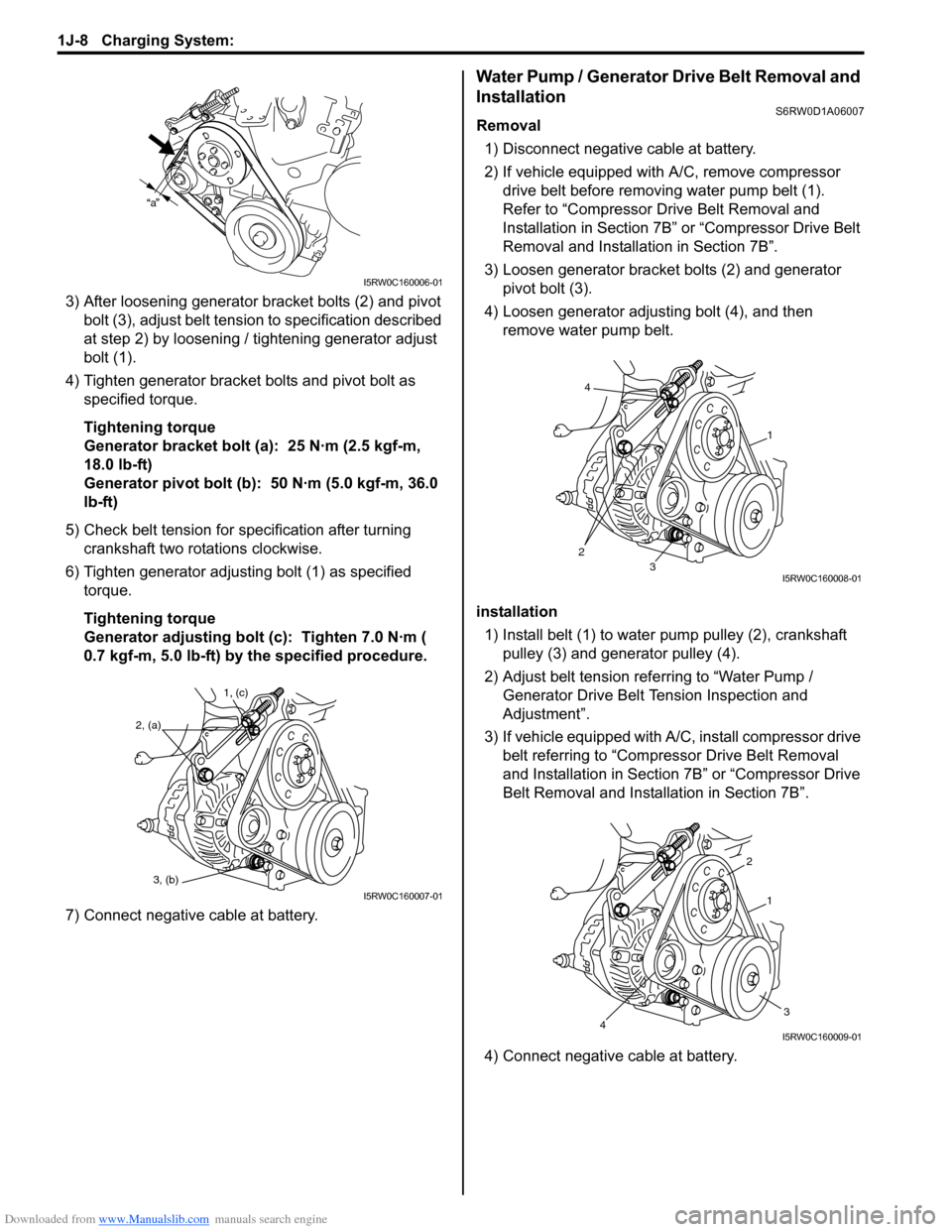
3) After loosening generator bracket bolts (2) and pivot
bolt (3), adjust belt tension to specification described
at step 2) by loosening / tightening generator adjust
bolt (1).
4) Tighten generator bracket bolts and pivot bolt as
specified torque.
Tightening torque
Generator bracket bolt (a): 25 N·m (2.5 kgf-m,
18.0 lb-ft)
Generator pivot bolt (b): 50 N·m (5.0 kgf-m, 36.0
lb-ft)
5) Check belt tension for specification after turning
crankshaft two rotations clockwise.
6) Tighten generator adjusting bolt (1) as specified
torque.
Tightening torque
Generator adjusting bolt (c): Tighten 7.0 N·m (
0.7 kgf-m, 5.0 lb-ft) by the specified procedure.
7) Connect negative cable at battery.
Water Pump / Generator Drive Belt Removal and
Installation
S6RW0D1A06007
Removal
1) Disconnect negative cable at battery.
2) If vehicle equipped with A/C, remove compressor
drive belt before removing water pump belt (1).
Refer to “Compressor Drive Belt Removal and
Installation in Section 7B” or “Compressor Drive Belt
Removal and Installation in Section 7B”.
3) Loosen generator bracket bolts (2) and generator
pivot bolt (3).
4) Loosen generator adjusting bolt (4), and then
remove water pump belt.
installation
1) Install belt (1) to water pump pulley (2), crankshaft
pulley (3) and generator pulley (4).
2) Adjust belt tension referring to “Water Pump /
Generator Drive Belt Tension Inspection and
Adjustment”.
3) If vehicle equipped with A/C, install compressor drive
belt referring to “Compressor Drive Belt Removal
and Installation in Section 7B” or “Compressor Drive
Belt Removal and Installation in Section 7B”.
4) Connect negative cable at battery.
a
I5RW0C160006-01
1, (c)
2, (a)
3, (b)
I5RW0C160007-01
4
23
1
I5RW0C160008-01
2
1
34I5RW0C160009-01
Page 552 of 1556
Downloaded from www.Manualslib.com manuals search engine 3C-5 Transfer:
Transfer Assembly Disassembly and
Reassembly
S6RW0D3306005
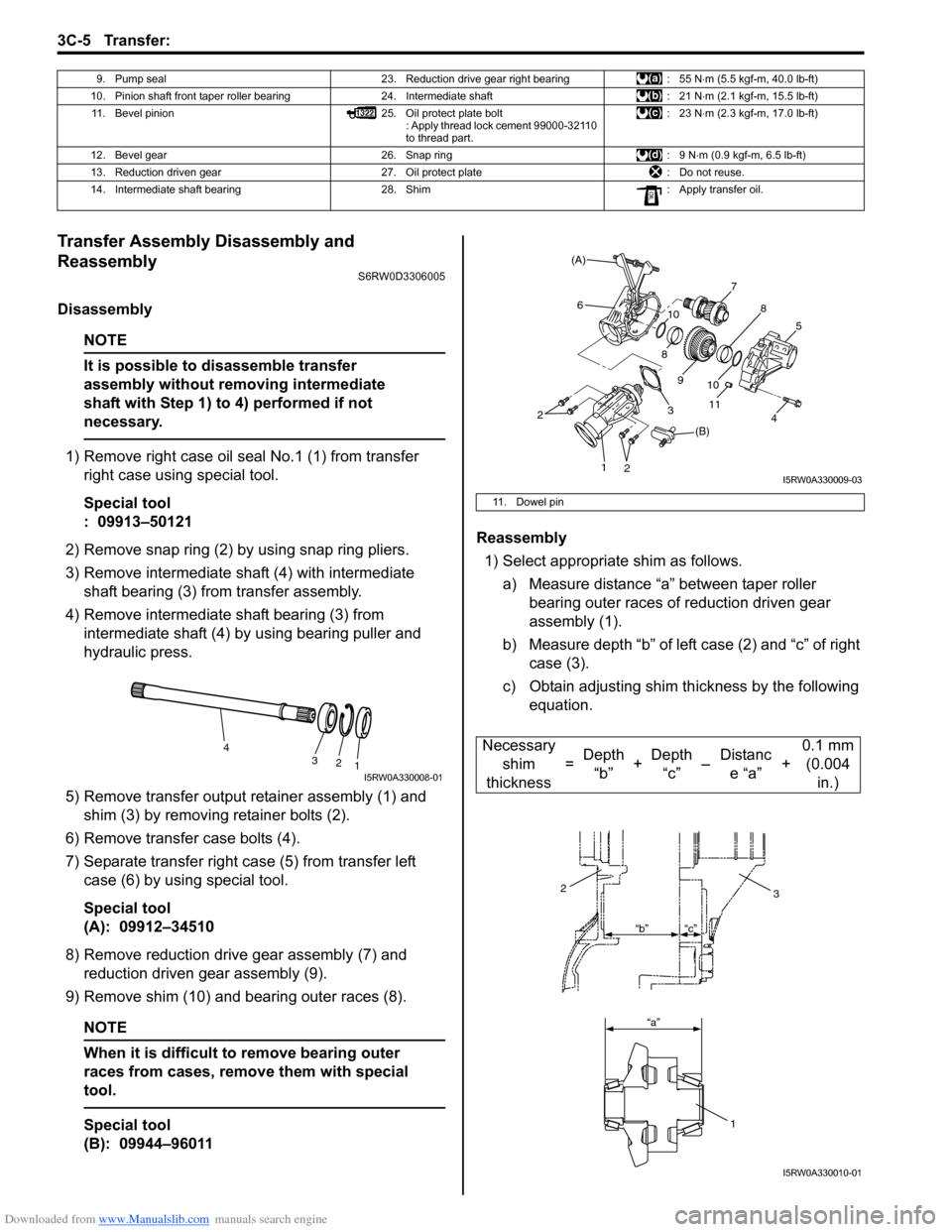
Disassembly
NOTE
It is possible to disassemble transfer
assembly without removing intermediate
shaft with Step 1) to 4) performed if not
necessary.
1) Remove right case oil seal No.1 (1) from transfer
right case using special tool.
Special tool
: 09913–50121
2) Remove snap ring (2) by using snap ring pliers.
3) Remove intermediate shaft (4) with intermediate
shaft bearing (3) from transfer assembly.
4) Remove intermediate shaft bearing (3) from
intermediate shaft (4) by using bearing puller and
hydraulic press.
5) Remove transfer output retainer assembly (1) and
shim (3) by removing retainer bolts (2).
6) Remove transfer case bolts (4).
7) Separate transfer right case (5) from transfer left
case (6) by using special tool.
Special tool
(A): 09912–34510
8) Remove reduction drive gear assembly (7) and
reduction driven gear assembly (9).
9) Remove shim (10) and bearing outer races (8).
NOTE
When it is difficult to remove bearing outer
races from cases, remove them with special
tool.
Special tool
(B): 09944–96011Reassembly
1) Select appropriate shim as follows.
a) Measure distance “a” between taper roller
bearing outer races of reduction driven gear
assembly (1).
b) Measure depth “b” of left case (2) and “c” of right
case (3).
c) Obtain adjusting shim thickness by the following
equation.
9. Pump seal 23. Reduction drive gear right bearing : 55 N⋅m (5.5 kgf-m, 40.0 lb-ft)
10. Pinion shaft front taper roller bearing 24. Intermediate shaft : 21 N⋅m (2.1 kgf-m, 15.5 lb-ft)
11. Bevel pinion 25. Oil protect plate bolt
: Apply thread lock cement 99000-32110
to thread part.: 23 N⋅m (2.3 kgf-m, 17.0 lb-ft)
12. Bevel gear 26. Snap ring : 9 N⋅m (0.9 kgf-m, 6.5 lb-ft)
13. Reduction driven gear 27. Oil protect plate : Do not reuse.
14. Intermediate shaft bearing 28. Shim : Apply transfer oil.
4
3
2
1
I5RW0A330008-01
11. Dowel pin
Necessary
shim
thickness=Depth
“b”+Depth
“c”–Distanc
e “a”+0.1 mm
(0.004
in.)
7
(B)
5
11
310 9 10
8 64
8
(A)
12
2
I5RW0A330009-03
23
1
“b”
“a”“c”
I5RW0A330010-01
Page 557 of 1556
Downloaded from www.Manualslib.com manuals search engine Transfer: 3C-10
Transfer Output Retainer Assembly
Disassembly and Reassembly
S6RW0D3306009
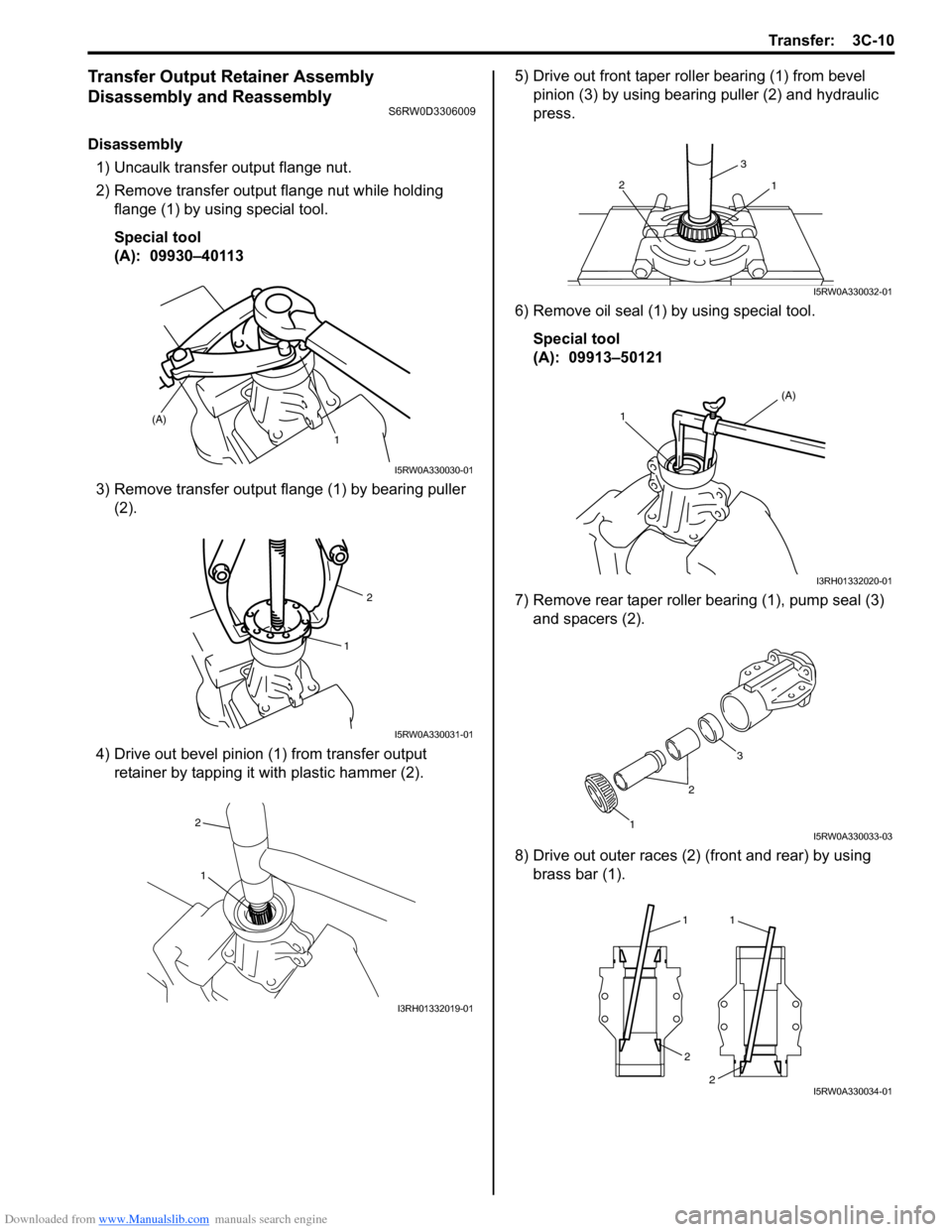
Disassembly
1) Uncaulk transfer output flange nut.
2) Remove transfer output flange nut while holding
flange (1) by using special tool.
Special tool
(A): 09930–40113
3) Remove transfer output flange (1) by bearing puller
(2).
4) Drive out bevel pinion (1) from transfer output
retainer by tapping it with plastic hammer (2).5) Drive out front taper roller bearing (1) from bevel
pinion (3) by using bearing puller (2) and hydraulic
press.
6) Remove oil seal (1) by using special tool.
Special tool
(A): 09913–50121
7) Remove rear taper roller bearing (1), pump seal (3)
and spacers (2).
8) Drive out outer races (2) (front and rear) by using
brass bar (1).
(A)
1
I5RW0A330030-01
2
1
I5RW0A330031-01
1 2
I3RH01332019-01
3
12
I5RW0A330032-01
1(A)
I3RH01332020-01
1
2
3
I5RW0A330033-03
11
2
2I5RW0A330034-01