ESP SUZUKI SX4 2008 1.G Owner's Guide
[x] Cancel search | Manufacturer: SUZUKI, Model Year: 2008, Model line: SX4, Model: SUZUKI SX4 2008 1.GPages: 278, PDF Size: 4.07 MB
Page 218 of 278
9-29INSPECTION AND MAINTENANCE
80J21-03E
Temperature – A, B, C
The temperature grades are A (the high-
est), B and C, representing the tire’s resis-
tance to the generation of heat and its
ability to dissipate heat when tested under
controlled conditions on a specified indoor
laboratory test wheel. Sustained high tem-
perature can cause the material of the tire
to degenerate and reduce tire life, and
excessive temperature can lead to sudden
tire failure. The grade C corresponds to a
level of performance which all passenger
car tires must meet under the Federal
Motor Vehicle Safety Standard No. 109.
Grades B and A represent higher levels of
performance on the laboratory test wheel
than the minimum required by law.
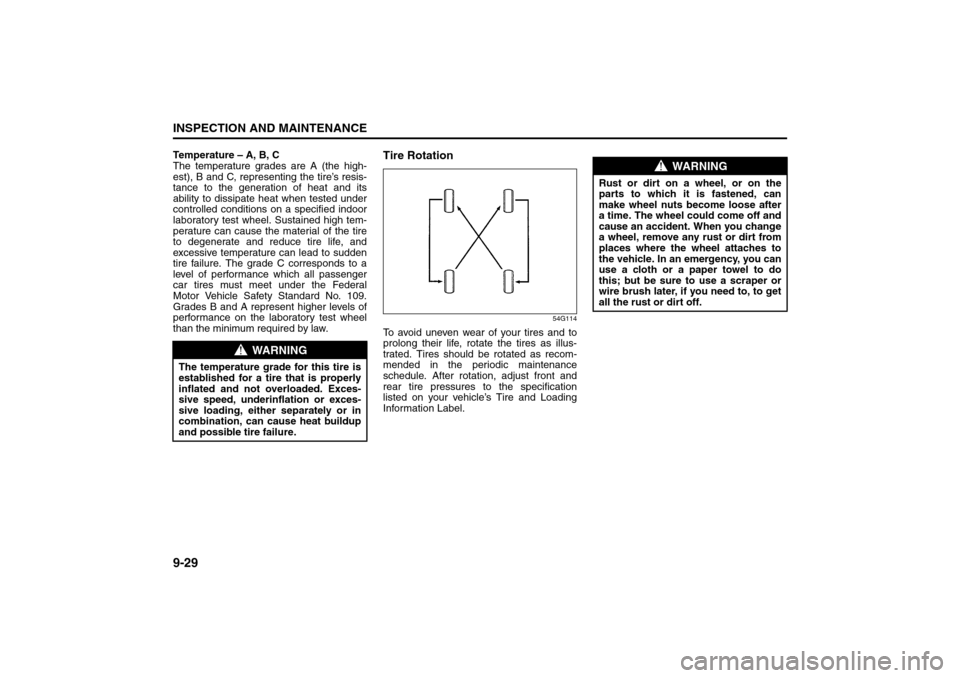
Tire Rotation
54G114
To avoid uneven wear of your tires and to
prolong their life, rotate the tires as illus-
trated. Tires should be rotated as recom-
mended in the periodic maintenance
schedule. After rotation, adjust front and
rear tire pressures to the specification
listed on your vehicle’s Tire and Loading
Information Label.
WARNING
The temperature grade for this tire is
established for a tire that is properly
inflated and not overloaded. Exces-
sive speed, underinflation or exces-
sive loading, either separately or in
combination, can cause heat buildup
and possible tire failure.
WARNING
Rust or dirt on a wheel, or on the
parts to which it is fastened, can
make wheel nuts become loose after
a time. The wheel could come off and
cause an accident. When you change
a wheel, remove any rust or dirt from
places where the wheel attaches to
the vehicle. In an emergency, you can
use a cloth or a paper towel to do
this; but be sure to use a scraper or
wire brush later, if you need to, to get
all the rust or dirt off.
Tires: 6
Page 228 of 278
9-39INSPECTION AND MAINTENANCE
80J21-03E
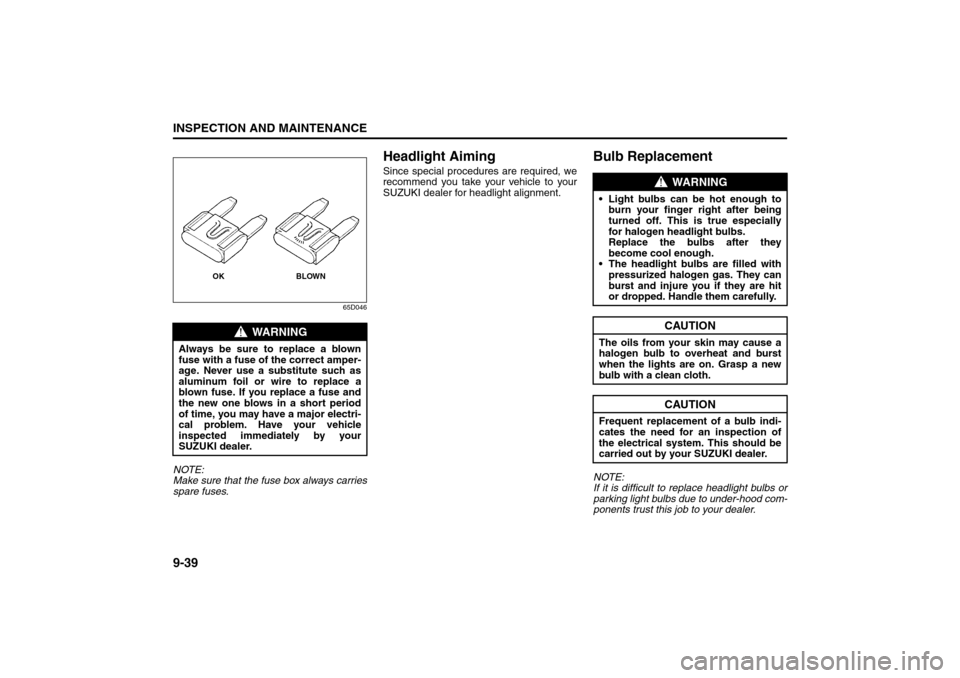
65D046
NOTE:
Make sure that the fuse box always carries
spare fuses.
Headlight AimingSince special procedures are required, we
recommend you take your vehicle to your
SUZUKI dealer for headlight alignment.
Bulb ReplacementNOTE:
If it is difficult to replace headlight bulbs or
parking light bulbs due to under-hood com-
ponents trust this job to your dealer.
WARNING
Always be sure to replace a blown
fuse with a fuse of the correct amper-
age. Never use a substitute such as
aluminum foil or wire to replace a
blown fuse. If you replace a fuse and
the new one blows in a short period
of time, you may have a major electri-
cal problem. Have your vehicle
inspected immediately by your
SUZUKI dealer.
BLOWN OK
WARNING
Light bulbs can be hot enough to
burn your finger right after being
turned off. This is true especially
for halogen headlight bulbs.
Replace the bulbs after they
become cool enough.
The headlight bulbs are filled with
pressurized halogen gas. They can
burst and injure you if they are hit
or dropped. Handle them carefully.
CAUTION
The oils from your skin may cause a
halogen bulb to overheat and burst
when the lights are on. Grasp a new
bulb with a clean cloth.
CAUTION
Frequent replacement of a bulb indi-
cates the need for an inspection of
the electrical system. This should be
carried out by your SUZUKI dealer.
Wiper Blades: 3
Page 248 of 278
11-1APPEARANCE CARE
80J21-03E
Corrosion PreventionIt is important to take good care of your
vehicle to protect it from corrosion.
Listed below are instructions for how to
maintain your vehicle to prevent corrosion.
Please read and follow these instructions
carefully.Important Information About
CorrosionCommon causes of corrosion
1) Accumulation of road salt, dirt, moisture
or chemicals in hard to reach areas of
the vehicle underbody or frame.
2) Chipping, scratches and any damage to
treated or painted metal surfaces
resulting from minor accidents or
impact from stones and gravel.
Environmental conditions which accel-
erate corrosion
1) Road salt, dust control chemicals, sea
air or industrial pollution will all acceler-
ate the corrosion of metal.
2) High humidity will increase the rate of
corrosion particularly when the temper-
ature range is just above the freezing
point.
3) Moisture in certain areas of a vehicle
for an extended period of time may pro-
mote corrosion even though other body
sections may be completely dry.
4) High temperatures will cause an accel-
erated rate of corrosion to parts of thevehicle which are not well ventilated to
permit quick drying.
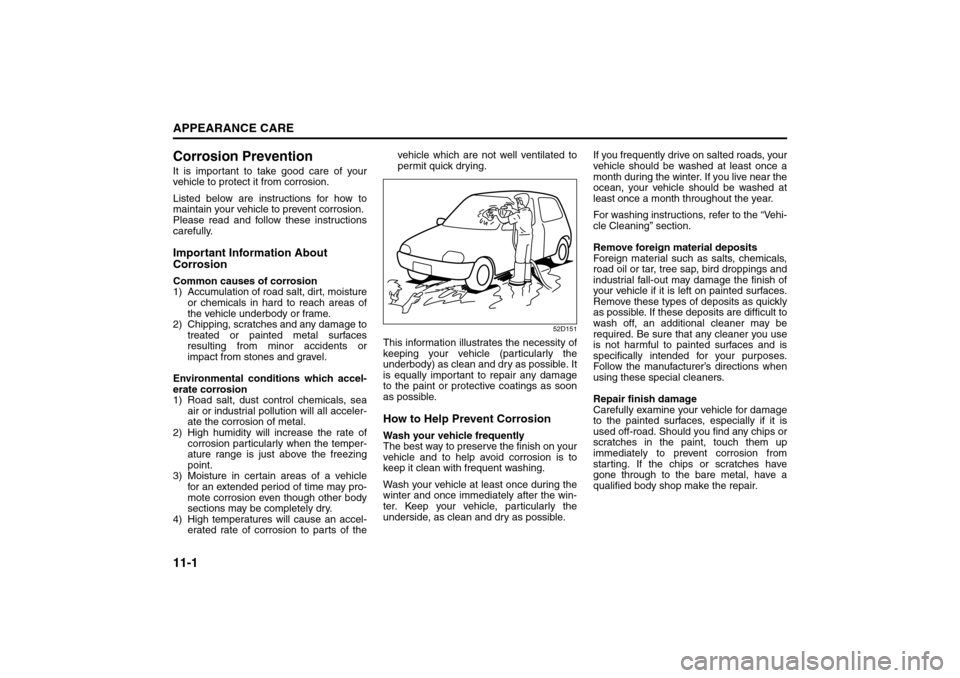
52D151
This information illustrates the necessity of
keeping your vehicle (particularly the
underbody) as clean and dry as possible. It
is equally important to repair any damage
to the paint or protective coatings as soon
as possible.How to Help Prevent CorrosionWash your vehicle frequently
The best way to preserve the finish on your
vehicle and to help avoid corrosion is to
keep it clean with frequent washing.
Wash your vehicle at least once during the
winter and once immediately after the win-
ter. Keep your vehicle, particularly the
underside, as clean and dry as possible.If you frequently drive on salted roads, your
vehicle should be washed at least once a
month during the winter. If you live near the
ocean, your vehicle should be washed at
least once a month throughout the year.
For washing instructions, refer to the “Vehi-
cle Cleaning” section.
Remove foreign material deposits
Foreign material such as salts, chemicals,
road oil or tar, tree sap, bird droppings and
industrial fall-out may damage the finish of
your vehicle if it is left on painted surfaces.
Remove these types of deposits as quickly
as possible. If these deposits are difficult to
wash off, an additional cleaner may be
required. Be sure that any cleaner you use
is not harmful to painted surfaces and is
specifically intended for your purposes.
Follow the manufacturer’s directions when
using these special cleaners.
Repair finish damage
Carefully examine your vehicle for damage
to the painted surfaces, especially if it is
used off-road. Should you find any chips or
scratches in the paint, touch them up
immediately to prevent corrosion from
starting. If the chips or scratches have
gone through to the bare metal, have a
qualified body shop make the repair.
Corrosion Prevention:
Page 249 of 278
11-2
APPEARANCE CARE
80J21-03E
Keep passenger and cargo compart-
ments clean
Moisture, dirt or mud can accumulate
under the floor mats and may cause corro-
sion. Occasionally, check under these
mats to ensure that this area is clean and
dry. More frequent checks are necessary if
the vehicle is used off road or in wet
weather.
Certain cargo such as chemicals, fertiliz-
ers, cleaners, salts, etc. are extremely cor-
rosive by nature. These products should
be transported in sealed containers. If a
spill or leak does occur, clean and dry the
area immediately.
Use the body trim
The use of the body trim will help protect
your vehicle, especially if you frequently
drive on gravel or salted roads. The fittings
for such guards should also be corrosion
resistant. Please check with your autho-
rized SUZUKI dealer for information on
these guards.
Store your vehicle in a dry, well-venti-
lated area
Do not park your vehicle in a damp, poorly
ventilated area. If you often wash your
vehicle in the garage or if you frequently
drive it in when wet, your garage may be
damp. The high humidity in the garage
may cause or accelerate corrosion. A wet
vehicle may corrode even in a heated
garage if the ventilation is poor.Cover your vehicle
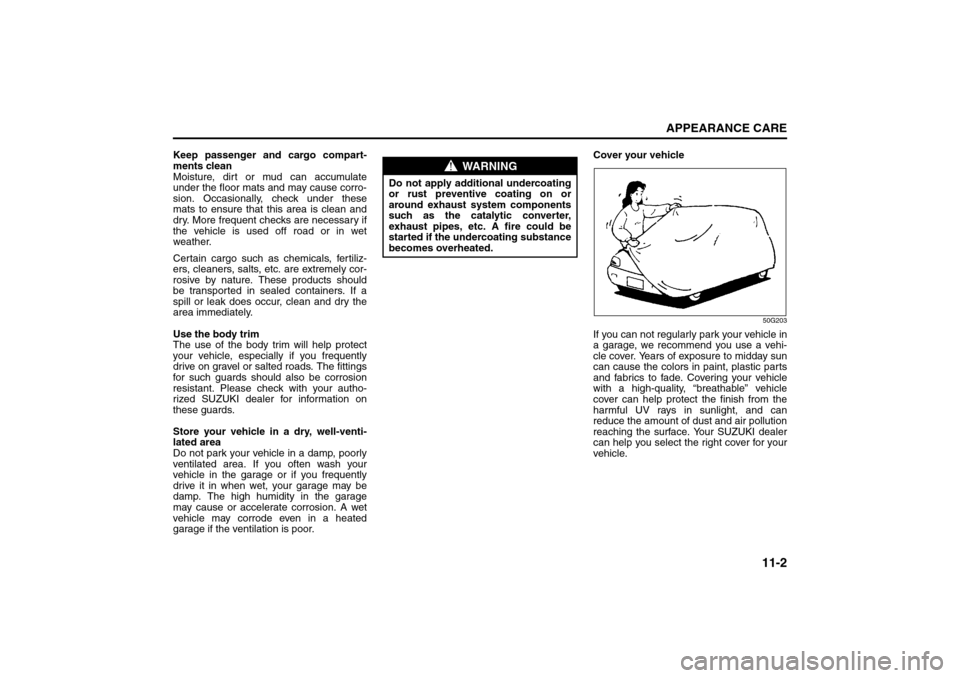
50G203
If you can not regularly park your vehicle in
a garage, we recommend you use a vehi-
cle cover. Years of exposure to midday sun
can cause the colors in paint, plastic parts
and fabrics to fade. Covering your vehicle
with a high-quality, “breathable” vehicle
cover can help protect the finish from the
harmful UV rays in sunlight, and can
reduce the amount of dust and air pollution
reaching the surface. Your SUZUKI dealer
can help you select the right cover for your
vehicle.
WARNING
Do not apply additional undercoating
or rust preventive coating on or
around exhaust system components
such as the catalytic converter,
exhaust pipes, etc. A fire could be
started if the undercoating substance
becomes overheated.
Corrosion Prevention:
Page 255 of 278
12-2
GENERAL INFORMATION
80J21-03E
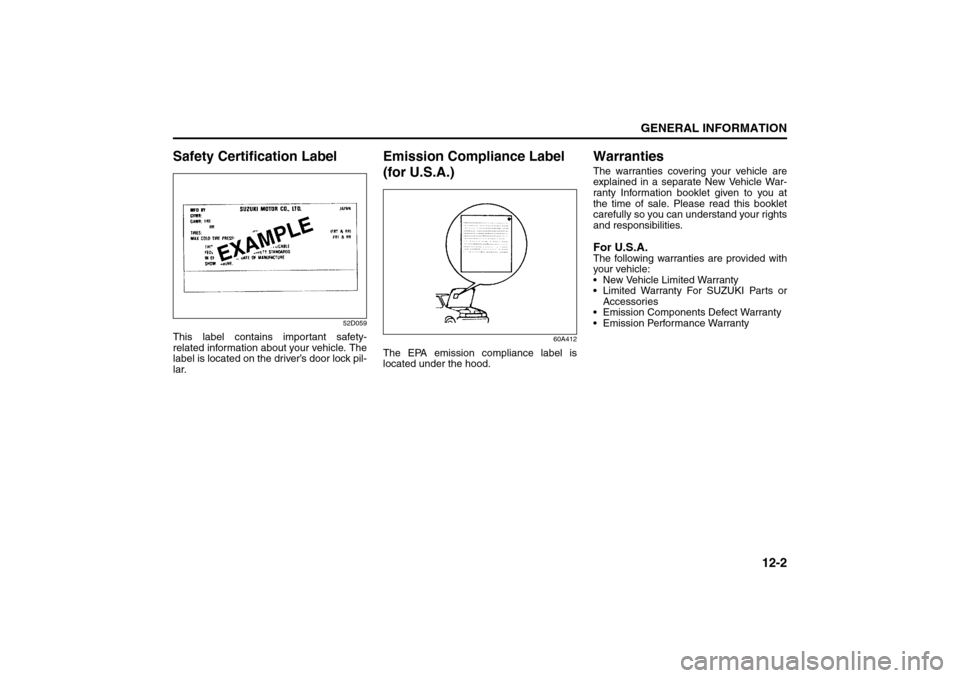
Safety Certification Label
52D059
This label contains important safety-
related information about your vehicle. The
label is located on the driver’s door lock pil-
lar.
Emission Compliance Label
(for U.S.A.)
60A412
The EPA emission compliance label is
located under the hood.
WarrantiesThe warranties covering your vehicle are
explained in a separate New Vehicle War-
ranty Information booklet given to you at
the time of sale. Please read this booklet
carefully so you can understand your rights
and responsibilities.For U.S.A.The following warranties are provided with
your vehicle:
New Vehicle Limited Warranty
Limited Warranty For SUZUKI Parts or
Accessories
Emission Components Defect Warranty
Emission Performance Warranty
Safety Certification Label: 6
Emission Compliance Label (For U.S.A.): 1, 2
Warranties: NO
Page 256 of 278
12-3GENERAL INFORMATION
80J21-03E
On-Board Vehicle Computers
and Event Data RecordersYour vehicle is equipped with on-board
computer systems which monitor and
control several aspects of vehicle per-
formance, including the following:
Emission-related components and
engine parameters such as engine
speed and throttle position are moni-
tored to provide emissions control
and to provide optimum fuel econ-
omy. Your vehicle also has an on-
board diagnostic system which mon-
itors and records information about
emission-related malfunctions.
Signals from various sensors are
monitored to provide air bag deploy-
ment.
If your vehicle is equipped with
antilock brakes, conditions such as
vehicle speed and brake perfor-
mance are monitored, so that the
ABS system can provide effective
antilock braking. If your vehicle has
an Electronic Stability Program
(ESP
®) system, conditions such as
yaw rate, lateral acceleration, and
brake fluid pressure are monitored,
so that the ESP
® system can help
the driver control the vehicle in diffi-
cult driving situations.
Some information may be stored by
the on-board computers during normaloperation of the vehicle. This stored
information can assist technicians in
repairing the vehicle when malfunc-
tions occur. Other information is stored
only in the event of crash, by computer
systems that are commonly called
Event Data Recorders (EDRs).
In a crash event, EDRs such as the
Airbag Sensing and Diagnostic Mod-
ule (SDM) in your vehicle may record
information about the condition of the
vehicle and how it was operated, such
as data related to airbag readiness,
airbag performance, safety belt usage,
and the severity of the collision. These
data can help provide a better under-
standing of the circumstances in which
crashes and injuries occur and lead to
the designing of safer vehicles. The
SDM in your vehicle does not collect
or store personal information.
To read the stored information, special
equipment is needed and access to
the vehicle or storage device is
required. SUZUKI will not access infor-
mation about a crash event or share it
with others other than with the consent
of the vehicle owner or lessee, in
response to an official request from
the police or similar government office,
as part of SUZUKI’s defense of litiga-
tion through the discovery process, or
as required by law.In addition, once SUZUKI collects or
receives data, SUZUKI may use the
data for research conducted by
SUZUKI, make the data available for
outside research if need is shown and
confidentiality is assured, or make
summary data which does not identify
specific vehicles available for outside
research.
Others, such as law enforcement per-
sonnel, may have access to the spe-
cial equipment that can read the
information if they have access to the
vehicle or storage device.
Reporting Safety Defects: NO
Page 271 of 278
15-1
INDEX
15
80J21-03E
INDEXSymbols“CRUISE” Indicator Light...................................................... 4-8
“ESP OFF” Indicator Light ........................................... 4-6, 6-14
“ESP OFF” Switch ............................................................... 4-13
“ESP” (Electronic Stability Program) Warning Light ......... 4-5
“ESP” Warning Light ........................................................... 6-13
“PASS AIRBAG OFF” Indicator .......................................... 4-20
“SET” Indicator Light ............................................................ 4-8Numerics2WD/i-AWD (intelligent All Wheel Drive) Switch ............... 4-14
4-Speed Automatic Transaxle .............................................. 6-5AA/T Selector Position Indicator .......................................... 4-10
Accelerator Pedal .................................................................. 5-2
Accessory Socket ................................................................ 5-11
Adding Coolant .................................................................... 9-18
Adjusting Seat Position ...................................................... 2-20
Adjusting Seatbacks ........................................................... 2-20
AIR BAG Light ........................................................................ 4-7
Air Cleaner............................................................................ 9-19
Air Conditioning System ..................................................... 9-48
All Seat Belts ........................................................................ 2-25
Anti-Lock Brake System (ABS) .......................................... 6-10
Anti-Lock Brake System (ABS) Warning Light ................... 4-5
Anti-Lock Braking System (ABS) ....................................... 6-12
Assist Grips............................................................................ 5-9
Audio Systems ..................................................................... 4-32
Automatic Heating and Air Conditioning System
(Climate Control).................................................................. 4-28Automatic Locking Retractor (ALR) ................................... 2-24
Automatic Transaxle Fluid .................................................. 9-16
BBasic Operations.................................................................. 4-35
Battery ................................................................................... 9-35
Brake Assist System............................................................ 6-10
Brake Fluid............................................................................ 9-21
Brake Pedal.................................................................... 5-2, 9-22
Brake System Warning Light ................................................ 4-4
Brakes ................................................................................... 9-21
Braking .................................................................................... 6-9
Break-In ................................................................................. 6-18
Bulb Replacement ................................................................ 9-39CCatalytic Converter .............................................................. 6-19
Changing Engine Oil and Filter........................................... 9-12
Changing Wheels ................................................................. 9-31
Charging Light........................................................................ 4-6
Child Lock System (rear doors) .......................................... 2-13
Child Restraint Systems ...................................................... 2-29
Cigarette Lighter and Ashtray............................................. 4-16
Clock ..................................................................................... 4-17
Clutch Pedal .................................................................. 5-2, 9-24
Compact Spare Tire ............................................................. 9-30
Coolant Level Check ............................................................ 9-18
Coolant Replacement .......................................................... 9-18
Corrosion Prevention .......................................................... 11-1
Cruise Control ........................................................................ 3-9
Cup Holder and Storage Area ............................................. 5-11DDaily Inspection Checklist..................................................... 6-1
Page 272 of 278
15-2INDEX
80J21-03E
Daytime Running Light (D.R.L.) Indicator Light................ 4-10
Daytime Running Light (D.R.L.) System .............................. 3-5
Door Locks ............................................................................. 2-1
Driver’s Seat Belt Reminder Light........................................ 4-6
Driving on Hills ...................................................................... 7-1
Driving on Slippery Roads .................................................... 7-2EElectric Power Steering Light ............................................... 4-8
Electronic Stability Program (ESP®) ................................. 6-12
Emergency Locking Retractor (ELR) ................................. 2-24
Emission Compliance Label (for U.S.A.) ........................... 12-2
Engine Block Heater .............................................................. 6-4
Engine Coolant .................................................................... 9-17
Engine Hood......................................................................... 5-10
Engine Oil and Filter ............................................................ 9-11
Engine Serial Number ......................................................... 12-1
Exhaust Gas Warning............................................................ 6-1
Eyeglasses Holder ............................................................... 5-10FFluid Level Check ................................................................ 9-16
Fog Light Switch .................................................................. 4-16
Folding Rear Seats ................................................................ 5-4
Frame Hooks ........................................................................ 5-12
Front Air Bags ...................................................................... 2-42
Front Passenger’s Seat Belt Reminder Light.................... 4-19
Fuel Consumption and Driving Range .............................. 4-17
Fuel Filler Cap ........................................................................ 5-3
Fuel Gauge ........................................................................... 4-12
Fuel Pump Labeling............................................................... 1-1
Fuel Recommendation .......................................................... 1-1
Fuses .................................................................................... 9-35FUSES AND PROTECTED CIRCUITS ................................. 13-1
Fuses in the Engine Compartment ..................................... 9-36
Fuses under the Dash Board .............................................. 9-37
GGasoline Containing MTBE ................................................... 1-1
Gasoline/Ethanol blends ....................................................... 1-1
Gasoline/Methanol blends..................................................... 1-1
Gear Oil ................................................................................. 9-14
Gear Oil Level Check ........................................................... 9-15
Gear Oil Replacement .......................................................... 9-15
Gearshift Lever ....................................................................... 5-2
GLOSSARY OF TIRE TERMINOLOGY ................................ 9-32
Glove Box ............................................................................. 4-20HHazard Warning Switch ....................................................... 4-13
Head Restraints .................................................................... 2-20
Headlight Aiming.................................................................. 9-39
Heated Rear Window and Heated Outside Rearview
Mirrors Switch ...................................................................... 4-15
Heating and Air Conditioning System................................ 4-21
Heating System .................................................................... 4-22
High Beam Indicator Light .................................................... 4-9
Highway Driving ..................................................................... 7-1
Horn ....................................................................................... 3-11
How the ABS Works............................................................. 6-11IIdentification Numbers ........................................................ 12-1
If the Engine is Flooded....................................................... 10-5
If the Engine Overheats ....................................................... 10-5
If the Starter Does Not Operate........................................... 10-4