height SUZUKI XL7 2007 2.G User Guide
[x] Cancel search | Manufacturer: SUZUKI, Model Year: 2007, Model line: XL7, Model: SUZUKI XL7 2007 2.GPages: 274, PDF Size: 6.12 MB
Page 202 of 274
5-18 SERVICE AND APPEARANCE CARE
78J00-03E
Brake Wear
Your vehicle has front and rear disc
brakes.
Disc brake pads have built-in wear indica-
tors that make a high-pitched warning
sound when the brake pads are worn and
new pads are needed. The sound maycome and go or be heard all the time your
vehicle is moving, except when you are
pushing on the brake pedal firmly.
Some driving conditions or climates may
cause a brake squeal when the brakes are
first applied or lightly applied. This does
not mean something is wrong with your
brakes.
Properly torqued wheel nuts are necessary
to help prevent brake pulsation. When tires
are rotated, inspect brake pads for wear
and evenly tighten wheel nuts in the proper
sequence to torque specifications.
Brake pads should always be replaced as
complete axle sets.
Brake Pedal Travel
See your dealer if the brake pedal does not
return to normal height, or if there is arapid increase in pedal travel. This could
be a sign of brake trouble.
Brake Adjustment
Every time you apply the brakes, with or
without the vehicle moving, your brakes
adjust for wear.
Replacing Brake System Parts
The braking system on a vehicle is com-
plex. Its many parts have to be of top qual-
ity and work well together if the vehicle is
to have really good braking. Your vehicle
was designed and tested with top-quality
brake parts. When you replace parts of
your braking system – for example, when
your brake pads wear down and you need
new ones put in – be sure you get new
approved replacement parts. If you do not,
your brakes may no longer work properly.
For example, if someone puts in brake
pads that are wrong for your vehicle, the
balance between your front and rear
brakes can change – for the worse. The
braking performance you have come to
expect can change in many other ways if
someone puts in the wrong replacement
brake parts.
BatteryYour vehicle has a maintenance free bat-
tery. When it is time for a new battery, get
one that has the replacement number
shown on the original battery’s label. We
recommend an ACDelco
® replacement
battery.
WARNING
With the wrong kind of fluid in the
brake system, the brakes may not
work well, or they may not even work
at all. This could cause a crash.
Always use the proper brake fluid.
CAUTION
Using the wrong fluid can badly
damage brake system parts. For
example, just a few drops of min-
eral-based oil, such as engine oil,
in the brake system can damage
brake system parts so badly that
they will have to be replaced. Do
not let someone put in the wrong
kind of fluid.
If you spill brake fluid on your vehi-
cle’s painted surfaces, the paint
finish can be damaged. Be careful
not to spill brake fluid on your vehi-
cle. If you do, wash it off immedi-
ately. Refer to “Washing Your
Vehicle” in this section.
WARNING
The brake wear warning sound
means that soon the brakes will not
work well. That could lead to an acci-
dent. When you hear the brake wear
warning sound, have your vehicle
serviced.
CAUTION
Continuing to drive with worn-out
brake pads could result in costly
brake repair.
Page 210 of 274
5-26 SERVICE AND APPEARANCE CARE
78J00-03E
TiresYour new vehicle comes with high-quality
tires made by a leading tire manufacturer.
If you ever have questions about your tire
warranty and where to obtain service, see
your Suzuki Warranty booklet for details.
For additional information refer to the tire
manufacturer’s booklet included with your
vehicle.
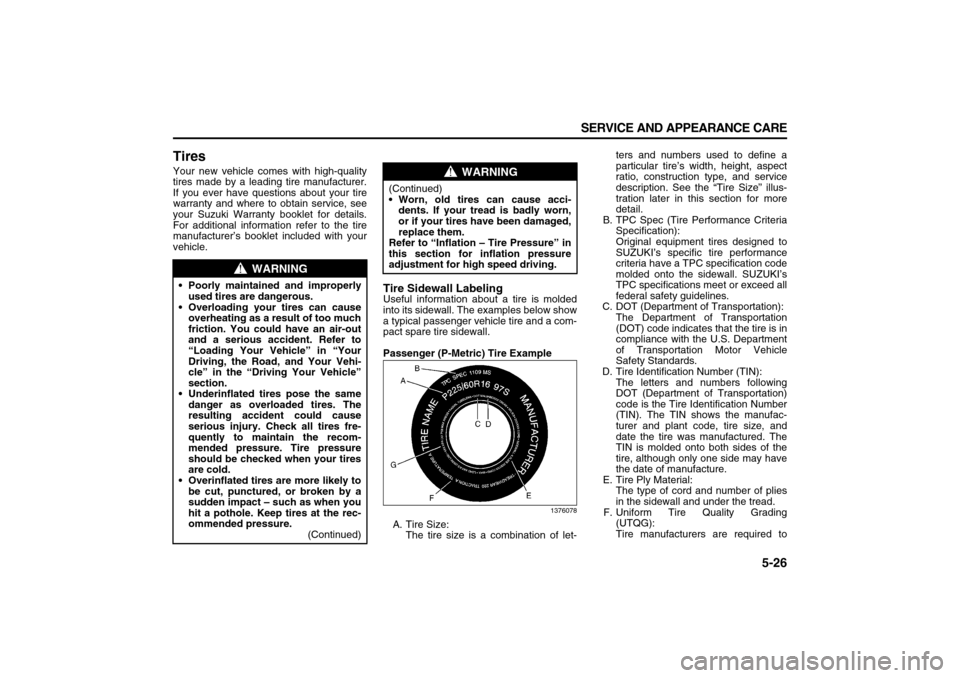
Tire Sidewall LabelingUseful information about a tire is molded
into its sidewall. The examples below show
a typical passenger vehicle tire and a com-
pact spare tire sidewall.
Passenger (P-Metric) Tire Example
1376078
A. Tire Size:
The tire size is a combination of let-ters and numbers used to define a
particular tire’s width, height, aspect
ratio, construction type, and service
description. See the “Tire Size” illus-
tration later in this section for more
detail.
B. TPC Spec (Tire Performance Criteria
Specification):
Original equipment tires designed to
SUZUKI’s specific tire performance
criteria have a TPC specification code
molded onto the sidewall. SUZUKI’s
TPC specifications meet or exceed all
federal safety guidelines.
C. DOT (Department of Transportation):
The Department of Transportation
(DOT) code indicates that the tire is in
compliance with the U.S. Department
of Transportation Motor Vehicle
Safety Standards.
D. Tire Identification Number (TIN):
The letters and numbers following
DOT (Department of Transportation)
code is the Tire Identification Number
(TIN). The TIN shows the manufac-
turer and plant code, tire size, and
date the tire was manufactured. The
TIN is molded onto both sides of the
tire, although only one side may have
the date of manufacture.
E. Tire Ply Material:
The type of cord and number of plies
in the sidewall and under the tread.
F. Uniform Tire Quality Grading
(UTQG):
Tire manufacturers are required to
WARNING
Poorly maintained and improperly
used tires are dangerous.
Overloading your tires can cause
overheating as a result of too much
friction. You could have an air-out
and a serious accident. Refer to
“Loading Your Vehicle” in “Your
Driving, the Road, and Your Vehi-
cle” in the “Driving Your Vehicle”
section.
Underinflated tires pose the same
danger as overloaded tires. The
resulting accident could cause
serious injury. Check all tires fre-
quently to maintain the recom-
mended pressure. Tire pressure
should be checked when your tires
are cold.
Overinflated tires are more likely to
be cut, punctured, or broken by a
sudden impact – such as when you
hit a pothole. Keep tires at the rec-
ommended pressure.
(Continued)
WARNING
(Continued)
Worn, old tires can cause acci-
dents. If your tread is badly worn,
or if your tires have been damaged,
replace them.
Refer to “Inflation – Tire Pressure” in
this section for inflation pressure
adjustment for high speed driving.
Page 211 of 274
5-27 SERVICE AND APPEARANCE CARE
78J00-03E
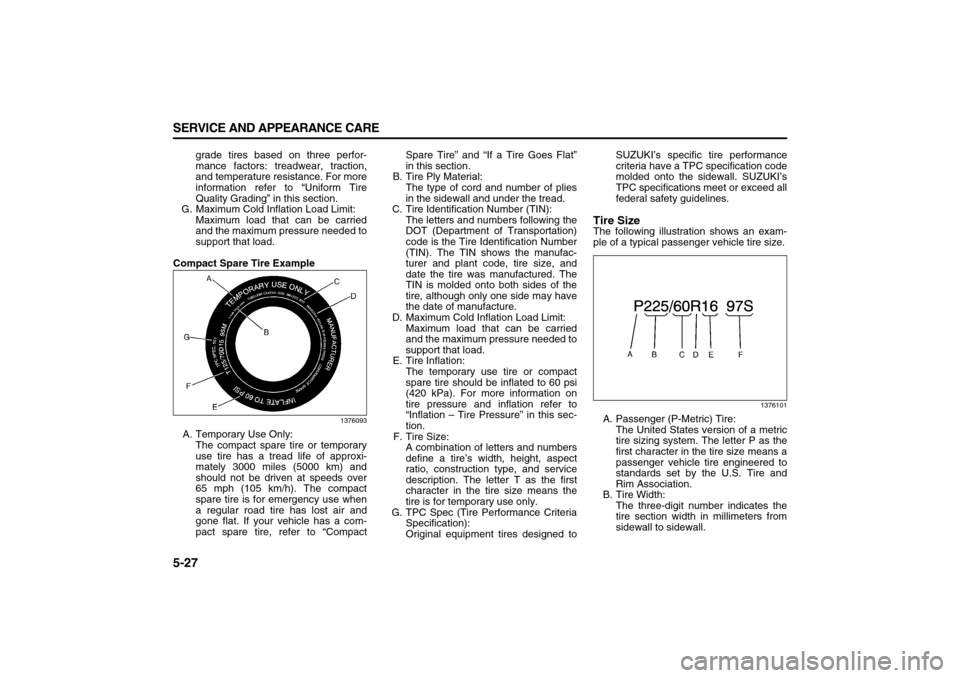
grade tires based on three perfor-
mance factors: treadwear, traction,
and temperature resistance. For more
information refer to “Uniform Tire
Quality Grading” in this section.
G. Maximum Cold Inflation Load Limit:
Maximum load that can be carried
and the maximum pressure needed to
support that load.
Compact Spare Tire Example
1376093
A. Temporary Use Only:
The compact spare tire or temporary
use tire has a tread life of approxi-
mately 3000 miles (5000 km) and
should not be driven at speeds over
65 mph (105 km/h). The compact
spare tire is for emergency use when
a regular road tire has lost air and
gone flat. If your vehicle has a com-
pact spare tire, refer to “CompactSpare Tire” and “If a Tire Goes Flat”
in this section.
B. Tire Ply Material:
The type of cord and number of plies
in the sidewall and under the tread.
C. Tire Identification Number (TIN):
The letters and numbers following the
DOT (Department of Transportation)
code is the Tire Identification Number
(TIN). The TIN shows the manufac-
turer and plant code, tire size, and
date the tire was manufactured. The
TIN is molded onto both sides of the
tire, although only one side may have
the date of manufacture.
D. Maximum Cold Inflation Load Limit:
Maximum load that can be carried
and the maximum pressure needed to
support that load.
E. Tire Inflation:
The temporary use tire or compact
spare tire should be inflated to 60 psi
(420 kPa). For more information on
tire pressure and inflation refer to
“Inflation – Tire Pressure” in this sec-
tion.
F. Tire Size:
A combination of letters and numbers
define a tire’s width, height, aspect
ratio, construction type, and service
description. The letter T as the first
character in the tire size means the
tire is for temporary use only.
G. TPC Spec (Tire Performance Criteria
Specification):
Original equipment tires designed toSUZUKI’s specific tire performance
criteria have a TPC specification code
molded onto the sidewall. SUZUKI’s
TPC specifications meet or exceed all
federal safety guidelines.
Tire SizeThe following illustration shows an exam-
ple of a typical passenger vehicle tire size.
1376101
A. Passenger (P-Metric) Tire:
The United States version of a metric
tire sizing system. The letter P as the
first character in the tire size means a
passenger vehicle tire engineered to
standards set by the U.S. Tire and
Rim Association.
B. Tire Width:
The three-digit number indicates the
tire section width in millimeters from
sidewall to sidewall.
Page 212 of 274

5-28 SERVICE AND APPEARANCE CARE
78J00-03E
C. Aspect Ratio:
A two-digit number that indicates the
tire height-to-width measurements.
For example, if the tire size aspect
ratio is 60, as shown in item C of the
illustration, it would mean that the
tire’s sidewall is 60 percent as high as
it is wide.
D. Construction Code:
A letter code is used to indicate the
type of ply construction in the tire. The
letter R means radial ply construction;
the letter D means diagonal or bias
ply construction; and the letter B
means belted-bias ply construction.
E. Rim Diameter:
Diameter of the wheel in inches.
F. Service Description:
These characters represent the load
range and speed rating of the tire.
The load index represents the load
carry capacity a tire is certified to
carry. The load index can range from
1 to 279. The speed rating is the max-
imum speed a tire is certified to carry
a load. Speed ratings range from A to
Z.
Tire Terminology and DefinitionsAir Pressure:
The amount of air inside the tire pressing
outward on each square inch of the tire. Air
pressure is expressed in pounds per
square inch (psi) or kilopascal (kPa).
Accessory Weight:
This means the combined weight of
optional accessories. Some examples of
optional accessories are, automatic trans-
mission/transaxle, power steering, power
brakes, power windows, power seats, and
air conditioning.
Aspect Ratio:
The relationship of a tire’s height to its
width.
Belt:
A rubber coated layer of cords that is
located between the plies and the tread.
Cords may be made from steel or other
reinforcing materials.
Bead:
The tire bead contains steel wires wrapped
by steel cords that hold the tire onto the
rim.
Bias Ply Tire:
A pneumatic tire in which the plies are laid
at alternate angles less than 90 degrees to
the centerline of the tread.
Cold Tire Pressure:
The amount of air pressure in a tire, mea-
sured in pounds per square inch (psi) orkilopascals (kPa) before a tire has built up
heat from driving. Refer to “Inflation – Tire
Pressure” in this section.
Curb Weight:
This means the weight of a motor vehicle
with standard and optional equipment
including the maximum capacity of fuel, oil,
and coolant, but without passengers and
cargo.
DOT Markings:
A code molded into the sidewall of a tire
signifying that the tire is in compliance with
the U.S. Department of Transportation
(DOT) motor vehicle safety standards. The
DOT code includes the Tire Identification
Number (TIN), an alphanumeric designator
which can also identify the tire manufac-
turer, production plant, brand, and date of
production.
GVWR:
Gross Vehicle Weight Rating. Refer to
“Loading Your Vehicle” in “Your Driving,
the Road, and Your Vehicle” in the “Driving
Your Vehicle” section.
GAWR FRT:
Gross Axle Weight Rating for the front
axle. Refer to “Loading Your Vehicle” in
“Your Driving, the Road, and Your Vehicle”
in the “Driving Your Vehicle” section.
GAWR RR:
Gross Axle Weight Rating for the rear axle.
Refer to “Loading Your Vehicle” in “Your
Page 221 of 274
5-37 SERVICE AND APPEARANCE CARE
78J00-03E
Wheel ReplacementReplace any wheel that is bent, cracked,
or badly rusted or corroded. If wheel nuts
keep coming loose, the wheel, wheel bolts,
and wheel nuts should be replaced. If the
wheel leaks air, replace it (except some
aluminum wheels, which can sometimes
be repaired). See your dealer if any of
these conditions exist.
Your dealer will know the kind of wheel you
need.
Each new wheel should have the same
load-carrying capacity, diameter, width,
offset, and be mounted the same way as
the one it replaces.
If you need to replace any of your wheels,
wheel bolts or wheel nuts, replace them
only with new original equipment parts.
This way, you will be sure to have the right
wheel, wheel bolts, and wheel nuts for
your vehicle.Refer to “Changing a Flat Tire” in this sec-
tion for more information.
Used Replacement Wheels
Tire Chains
If a Tire Goes FlatIt is unusual for a tire to blowout while you
are driving, especially if you maintain your
vehicle’s tires properly. If air goes out of a
tire, it is much more likely to leak out
slowly. But if you should ever have a blow-
out, here are a few tips about what to
expect and what to do:
WARNING
Using the wrong replacement wheels,
wheel bolts, or wheel nuts on your
vehicle can be dangerous. It could
affect the braking and handling of
your vehicle, make your tires lose air
and make you lose control. You
could have a collision in which you
or others could be injured. Always
use the correct wheel, wheel bolts,
and wheel nuts for replacement.
CAUTION
The wrong wheel can also cause
problems with bearing life, brake
cooling, speedometer or odometer
calibration, headlamp aim, bumper
height, vehicle ground clearance, and
tire or tire chain clearance to the
body and chassis.
WARNING
Putting a used wheel on your vehicle
is dangerous. You cannot know how
it has been used or how far it has
been driven. It could fail suddenly
and cause a crash. If you have to
replace a wheel, use a new original
equipment wheel.
WARNING
Do not use tire chains. There is not
enough clearance. Tire chains used
on a vehicle without the proper
amount of clearance can cause dam-
age to the brakes, suspension or
other vehicle parts. The area dam-
aged by the tire chains could cause
you to lose control of your vehicle
and you or others may be injured in a
crash.
Use another type of traction device
only if its manufacturer recommends
it for use on your vehicle and tire size
combination and road conditions.
Follow that manufacturer’s instruc-
tions. To help avoid damage to your
vehicle, drive slowly, readjust or
remove the device if it is contacting
your vehicle, and do not spin your
vehicle’s wheels. If you do find trac-
tion devices that will fit, install them
on the front tires.
Page 269 of 274

8-2 INDEX
78J00-03E
Child Restraints
...................................................................1-18
City Driving
..........................................................................4-11
Cleaning Exterior Lamps/Lenses
.......................................5-50
Cleaning the Inside of Your Vehicle ..................................5-48
Climate Controls
..................................................................3-10
Compact Spare Tire .............................................................5-47
Configurations for Use of Three Child Restraints
............1-25
Configurations for Use of Two Child Restraints
..............1-24
Control of a Vehicle
.............................................................4-3
Convenience Net
.................................................................2-23
Cooling System
...................................................................5-13
Cruise Control
......................................................................3-5
Cruise Control Light
............................................................3-24
Cupholder(s)
........................................................................2-21
DDaily Inspection Checklist
........................................ 2-11
, 2-12
Delayed Locking
..................................................................2-6
DIC Operation and Displays
...............................................3-27
DIC Vehicle Personalization ...............................................3-35
DIC Warnings and Messages .............................................3-30
Doing Your Own Service Work ...........................................5-1
Dome Lamp
..........................................................................3-8
Door Ajar Light ....................................................................3-25
Door Locks
...........................................................................2-5
Doors and Locks
.................................................................2-5
Driver Information Center (DIC)
.........................................3-27
Driver Position
.....................................................................1-11
Driver Seat Height Adjuster
................................................1-1
Driving at Night
....................................................................4-9
Driving in Rain and on Wet Roads
.....................................4-10
Drunken Driving
...................................................................4-1
EElectric Power Management
.............................................. 3-9
Electrical System
................................................................ 5-53
Electronic Stability Control
................................................ 4-5
Emission Compliance Label (for U.S.A.)
.......................... 7-2
Engine Air Cleaner/Filter
.................................................... 5-9
Engine Compartment Overview
......................................... 5-6
Engine Coolant
.................................................................... 5-11
Engine Coolant Heater
....................................................... 2-14
Engine Coolant Temperature Gage
................................... 3-21
Engine Coolant Temperature Warning Light
.................... 3-20
Engine Drive Belt Routing
.................................................. 6-17
Engine Exhaust
................................................................... 2-19
Engine Oil
............................................................................ 5-7
Engine Oil Life System
....................................................... 5-8
Engine Overheating
............................................................ 5-12
Engine Serial Number ......................................................... 7-1
FFabric/Carpet
....................................................................... 5-48
Filling a Portable Fuel Container
....................................... 5-4
Filling the Tank
.................................................................... 5-3
Finish Care
.......................................................................... 5-50
Finish Damage .................................................................... 5-51
Fog Lamp Light ................................................................... 3-24
Fog Lamps
........................................................................... 3-8
For CANADA Scheduled Maintenance
.............................. 6-8
Freeway Driving
.................................................................. 4-11
Front Seats
.......................................................................... 1-1
Fuel
....................................................................................... 5-2
Fuel Gage
............................................................................. 3-26
Fuels in Foreign Countries
................................................ 5-3