lock SUZUKI XL7 2007 2.G User Guide
[x] Cancel search | Manufacturer: SUZUKI, Model Year: 2007, Model line: XL7, Model: SUZUKI XL7 2007 2.GPages: 274, PDF Size: 6.12 MB
Page 24 of 274
1-12 SEATS AND RESTRAINT SYSTEMS
78J00-03E
It may be necessary to pull stitching on the
safety belt through the latch plate to fully
tighten the lap belt on smaller occupants.
809246
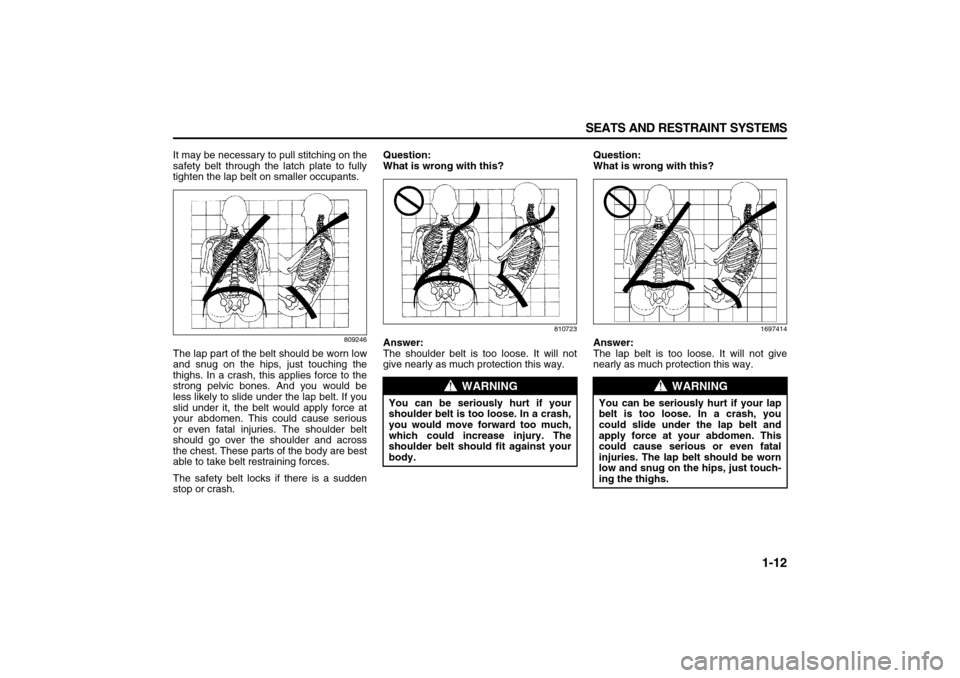
The lap part of the belt should be worn low
and snug on the hips, just touching the
thighs. In a crash, this applies force to the
strong pelvic bones. And you would be
less likely to slide under the lap belt. If you
slid under it, the belt would apply force at
your abdomen. This could cause serious
or even fatal injuries. The shoulder belt
should go over the shoulder and across
the chest. These parts of the body are best
able to take belt restraining forces.
The safety belt locks if there is a sudden
stop or crash.Question:
What is wrong with this?
810723
Answer:
The shoulder belt is too loose. It will not
give nearly as much protection this way.Question:
What is wrong with this?
1697414
Answer:
The lap belt is too loose. It will not give
nearly as much protection this way.
WARNING
You can be seriously hurt if your
shoulder belt is too loose. In a crash,
you would move forward too much,
which could increase injury. The
shoulder belt should fit against your
body.
WARNING
You can be seriously hurt if your lap
belt is too loose. In a crash, you
could slide under the lap belt and
apply force at your abdomen. This
could cause serious or even fatal
injuries. The lap belt should be worn
low and snug on the hips, just touch-
ing the thighs.
Page 26 of 274
1-14 SEATS AND RESTRAINT SYSTEMS
78J00-03E
1378915
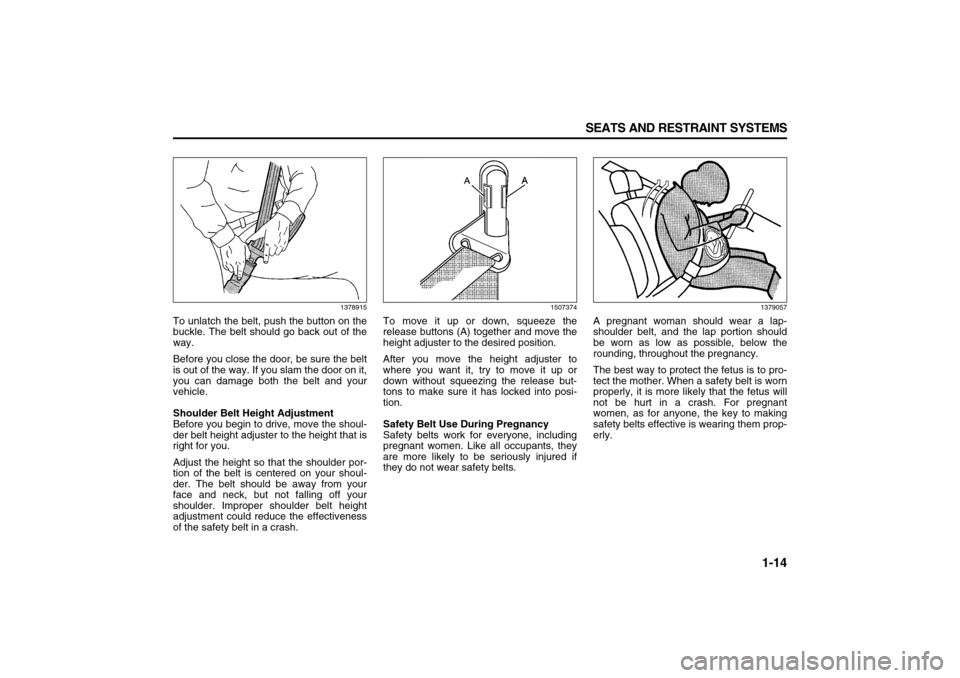
To unlatch the belt, push the button on the
buckle. The belt should go back out of the
way.
Before you close the door, be sure the belt
is out of the way. If you slam the door on it,
you can damage both the belt and your
vehicle.
Shoulder Belt Height Adjustment
Before you begin to drive, move the shoul-
der belt height adjuster to the height that is
right for you.
Adjust the height so that the shoulder por-
tion of the belt is centered on your shoul-
der. The belt should be away from your
face and neck, but not falling off your
shoulder. Improper shoulder belt height
adjustment could reduce the effectiveness
of the safety belt in a crash.
1507374
To move it up or down, squeeze the
release buttons (A) together and move the
height adjuster to the desired position.
After you move the height adjuster to
where you want it, try to move it up or
down without squeezing the release but-
tons to make sure it has locked into posi-
tion.
Safety Belt Use During Pregnancy
Safety belts work for everyone, including
pregnant women. Like all occupants, they
are more likely to be seriously injured if
they do not wear safety belts.
1379057
A pregnant woman should wear a lap-
shoulder belt, and the lap portion should
be worn as low as possible, below the
rounding, throughout the pregnancy.
The best way to protect the fetus is to pro-
tect the mother. When a safety belt is worn
properly, it is more likely that the fetus will
not be hurt in a crash. For pregnant
women, as for anyone, the key to making
safety belts effective is wearing them prop-
erly.
Page 27 of 274
1-15 SEATS AND RESTRAINT SYSTEMS
78J00-03E
Right Front Passenger PositionTo learn how to wear the right front pas-
senger’s safety belt properly, refer to
“Driver Position” in this section.
The right front passenger’s safety belt
works the same way as the driver’s safety
belt – except for the following.
If you ever pull the shoulder portion of the
belt out all the way, you will engage the
child restraint locking feature. If this hap-
pens, just let the belt go back all the way
and start again.
When the safety belt is not in use, slide the
latch plate up the safety belt webbing. The
latch plate should rest on the stitching on
the safety belt, near the guide loop.Rear Seat PassengersIt is very important for rear seat passen-
gers to buckle up! Accident statistics show
that unbelted people in the rear seat are
hurt more often in crashes than those who
are wearing safety belts.
Rear passengers who are not safety belted
can be thrown out of the vehicle in a crash.
And they can strike others in the vehicle
who are wearing safety belts.
Lap-Shoulder Belt
All rear seat positions have lap-shoulder
belts. Here is how to wear one properly.
1378723
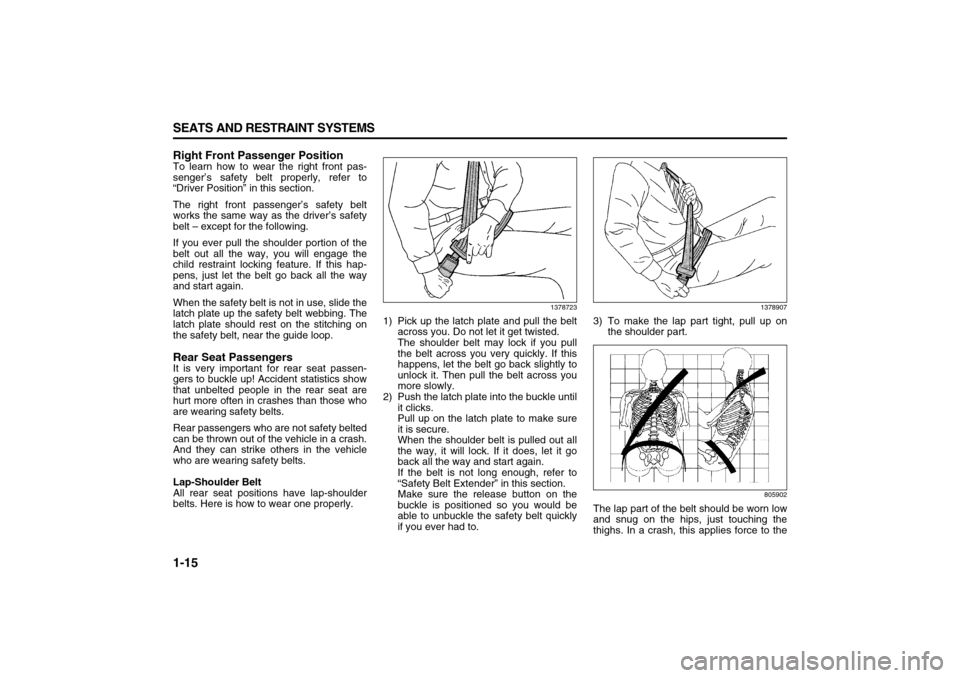
1) Pick up the latch plate and pull the belt
across you. Do not let it get twisted.
The shoulder belt may lock if you pull
the belt across you very quickly. If this
happens, let the belt go back slightly to
unlock it. Then pull the belt across you
more slowly.
2) Push the latch plate into the buckle until
it clicks.
Pull up on the latch plate to make sure
it is secure.
When the shoulder belt is pulled out all
the way, it will lock. If it does, let it go
back all the way and start again.
If the belt is not long enough, refer to
“Safety Belt Extender” in this section.
Make sure the release button on the
buckle is positioned so you would be
able to unbuckle the safety belt quickly
if you ever had to.
1378907
3) To make the lap part tight, pull up on
the shoulder part.
805902
The lap part of the belt should be worn low
and snug on the hips, just touching the
thighs. In a crash, this applies force to the
Page 28 of 274
1-16 SEATS AND RESTRAINT SYSTEMS
78J00-03E
strong pelvic bones. And you would be
less likely to slide under the lap belt. If you
slid under it, the belt would apply force at
your abdomen. This could cause serious
or even fatal injuries. The shoulder belt
should go over the shoulder and across
the chest. These parts of the body are best
able to take belt restraining forces.
The safety belt locks if there is a sudden
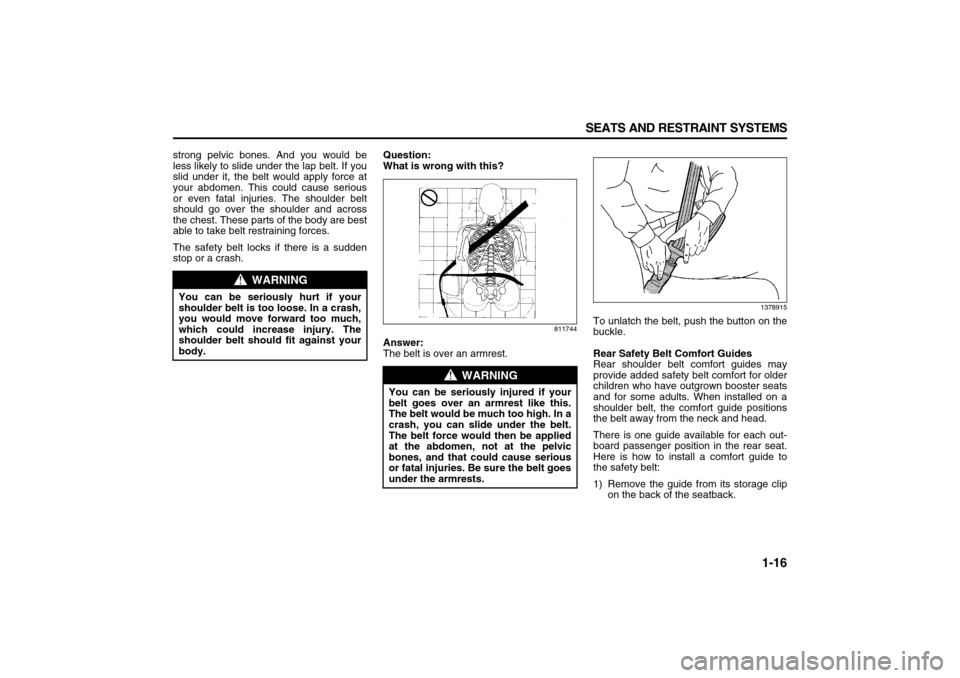
stop or a crash.Question:
What is wrong with this?
811744
Answer:
The belt is over an armrest.
1378915
To unlatch the belt, push the button on the
buckle.
Rear Safety Belt Comfort Guides
Rear shoulder belt comfort guides may
provide added safety belt comfort for older
children who have outgrown booster seats
and for some adults. When installed on a
shoulder belt, the comfort guide positions
the belt away from the neck and head.
There is one guide available for each out-
board passenger position in the rear seat.
Here is how to install a comfort guide to
the safety belt:
1) Remove the guide from its storage clip
on the back of the seatback.
WARNING
You can be seriously hurt if your
shoulder belt is too loose. In a crash,
you would move forward too much,
which could increase injury. The
shoulder belt should fit against your
body.
WARNING
You can be seriously injured if your
belt goes over an armrest like this.
The belt would be much too high. In a
crash, you can slide under the belt.
The belt force would then be applied
at the abdomen, not at the pelvic
bones, and that could cause serious
or fatal injuries. Be sure the belt goes
under the armrests.
Page 40 of 274
1-28 SEATS AND RESTRAINT SYSTEMS
78J00-03E
to Put the Restraint” in this section for
additional information.Securing a Child Restraint
Designed for the LATCH System
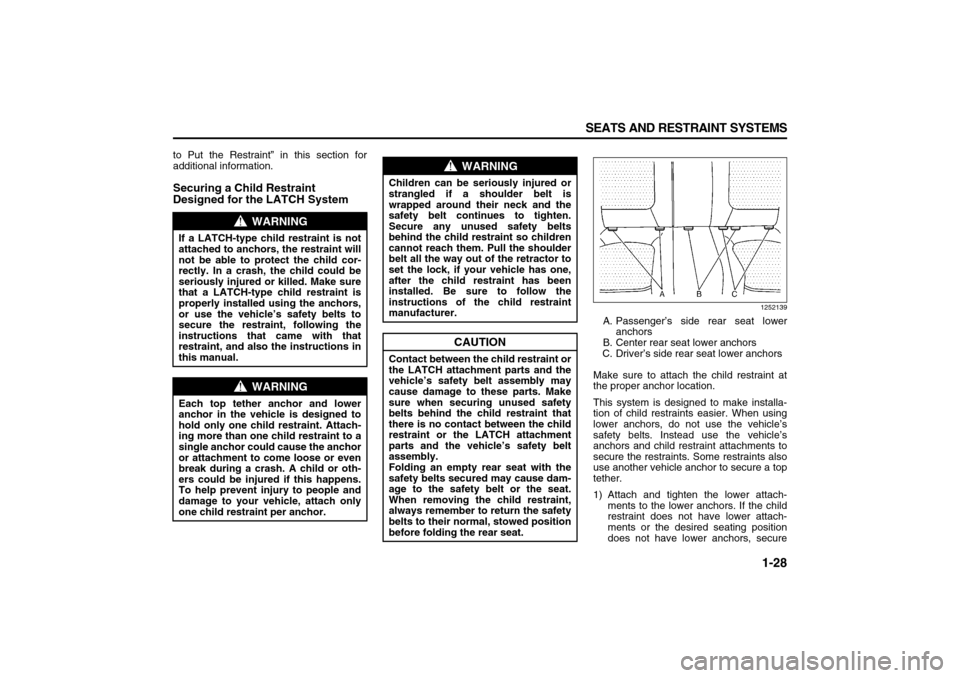
1252139
A. Passenger’s side rear seat lower
anchors
B. Center rear seat lower anchors
C. Driver’s side rear seat lower anchors
Make sure to attach the child restraint at
the proper anchor location.
This system is designed to make installa-
tion of child restraints easier. When using
lower anchors, do not use the vehicle’s
safety belts. Instead use the vehicle’s
anchors and child restraint attachments to
secure the restraints. Some restraints also
use another vehicle anchor to secure a top
tether.
1) Attach and tighten the lower attach-
ments to the lower anchors. If the child
restraint does not have lower attach-
ments or the desired seating position
does not have lower anchors, secure
WARNING
If a LATCH-type child restraint is not
attached to anchors, the restraint will
not be able to protect the child cor-
rectly. In a crash, the child could be
seriously injured or killed. Make sure
that a LATCH-type child restraint is
properly installed using the anchors,
or use the vehicle’s safety belts to
secure the restraint, following the
instructions that came with that
restraint, and also the instructions in
this manual.
WARNING
Each top tether anchor and lower
anchor in the vehicle is designed to
hold only one child restraint. Attach-
ing more than one child restraint to a
single anchor could cause the anchor
or attachment to come loose or even
break during a crash. A child or oth-
ers could be injured if this happens.
To help prevent injury to people and
damage to your vehicle, attach only
one child restraint per anchor.
WARNING
Children can be seriously injured or
strangled if a shoulder belt is
wrapped around their neck and the
safety belt continues to tighten.
Secure any unused safety belts
behind the child restraint so children
cannot reach them. Pull the shoulder
belt all the way out of the retractor to
set the lock, if your vehicle has one,
after the child restraint has been
installed. Be sure to follow the
instructions of the child restraint
manufacturer.
CAUTION
Contact between the child restraint or
the LATCH attachment parts and the
vehicle’s safety belt assembly may
cause damage to these parts. Make
sure when securing unused safety
belts behind the child restraint that
there is no contact between the child
restraint or the LATCH attachment
parts and the vehicle’s safety belt
assembly.
Folding an empty rear seat with the
safety belts secured may cause dam-
age to the safety belt or the seat.
When removing the child restraint,
always remember to return the safety
belts to their normal, stowed position
before folding the rear seat.
Page 42 of 274
1-30 SEATS AND RESTRAINT SYSTEMS
78J00-03E
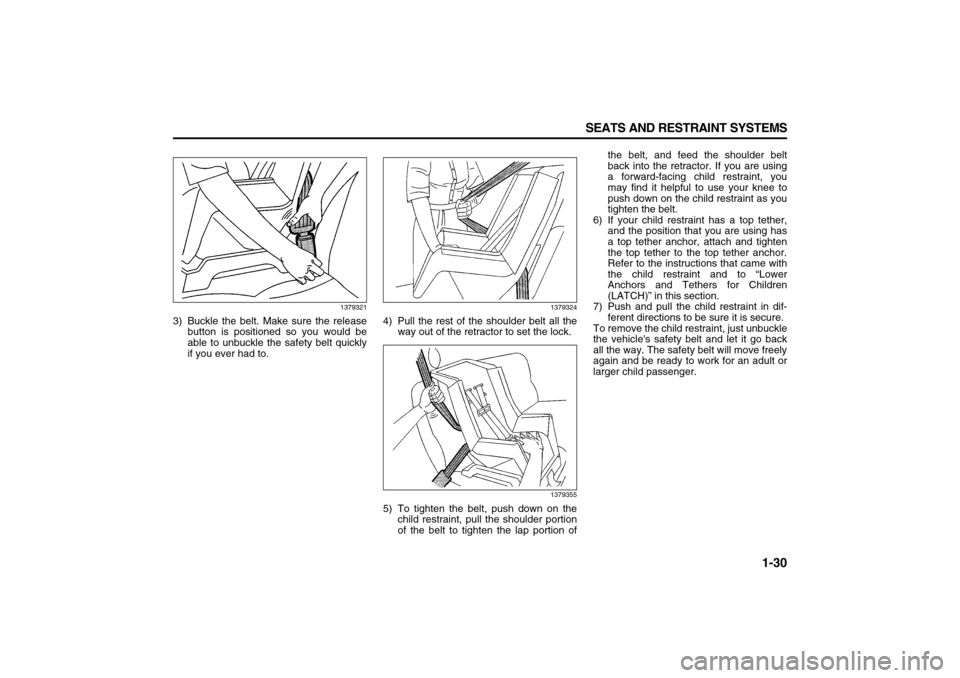
1379321
3) Buckle the belt. Make sure the release
button is positioned so you would be
able to unbuckle the safety belt quickly
if you ever had to.
1379324
4) Pull the rest of the shoulder belt all the
way out of the retractor to set the lock.
1379355
5) To tighten the belt, push down on the
child restraint, pull the shoulder portion
of the belt to tighten the lap portion ofthe belt, and feed the shoulder belt
back into the retractor. If you are using
a forward-facing child restraint, you
may find it helpful to use your knee to
push down on the child restraint as you
tighten the belt.
6) If your child restraint has a top tether,
and the position that you are using has
a top tether anchor, attach and tighten
the top tether to the top tether anchor.
Refer to the instructions that came with
the child restraint and to “Lower
Anchors and Tethers for Children
(LATCH)” in this section.
7) Push and pull the child restraint in dif-
ferent directions to be sure it is secure.
To remove the child restraint, just unbuckle
the vehicle's safety belt and let it go back
all the way. The safety belt will move freely
again and be ready to work for an adult or
larger child passenger.
Page 44 of 274
1-32 SEATS AND RESTRAINT SYSTEMS
78J00-03E
restraint. Refer to “Manual Seats” in this
section.
If your child restraint has the LATCH sys-
tem, refer to “Lower Anchors and Tethers
for Children (LATCH)” in this section.
There is no top tether anchor at the right
front seating position. Do not secure a
child seat in this position if a national or
local law requires that the top tether be
anchored or if the instructions that come
with the child restraint say that the top
tether must be anchored. Refer to “Lower
Anchors and Tethers for Children
(LATCH)” in this section if the child
restraint has a top tether.
You will be using the lap-shoulder belt to
secure the child restraint in this position.
Be sure to follow the instructions that came
with the child restraint. Secure the child in
the child restraint when and as the instruc-
tions say.
1) Your vehicle has a right front passen-
ger’s frontal airbag. Refer to “Passen-
ger Sensing System” in this section. We
recommend that rear-facing child
restraints be secured in a rear seat,
even if the airbag is off. If your child
restraint is for ward-facing, move the
seat as far back as it will go before
securing the child restraint in this seat.
Refer to “Manual Seats” in this section.
When the passenger sensing system
has turned off the right front passen-ger’s frontal airbag, the off indicator in
the passenger airbag status indicator
should light and stay lit when you turn
the ignition to RUN or START. Refer to
“Passenger Airbag Status Indicator” in
“Warning Lights, Gages, and Indica-
tors” in the “Instrument Panel” section.
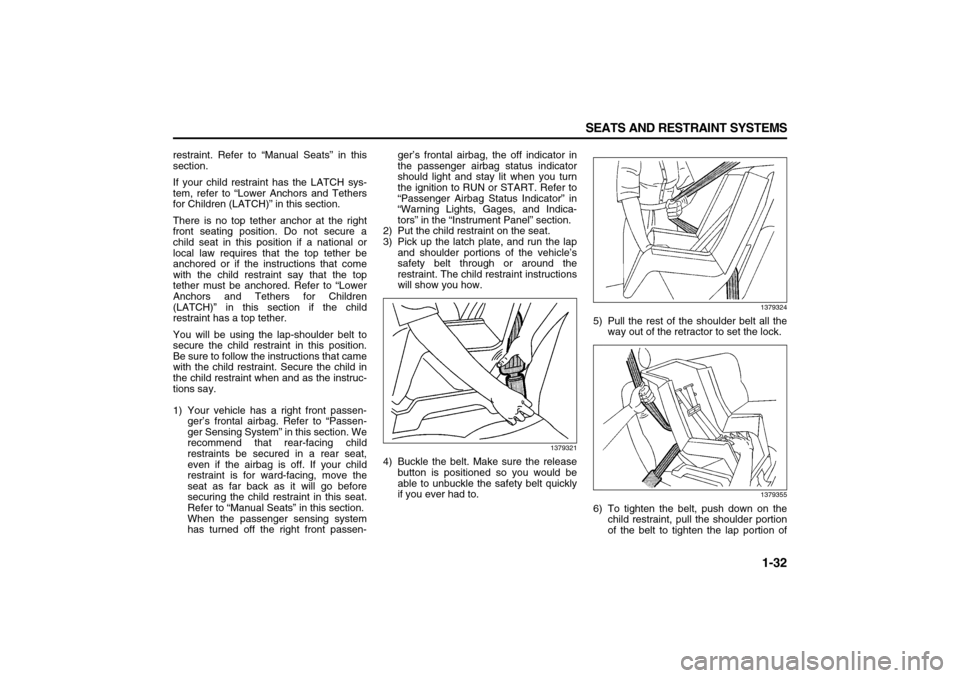
2) Put the child restraint on the seat.
3) Pick up the latch plate, and run the lap
and shoulder portions of the vehicle’s
safety belt through or around the
restraint. The child restraint instructions
will show you how.
1379321
4) Buckle the belt. Make sure the release
button is positioned so you would be
able to unbuckle the safety belt quickly
if you ever had to.
1379324
5) Pull the rest of the shoulder belt all the
way out of the retractor to set the lock.
1379355
6) To tighten the belt, push down on the
child restraint, pull the shoulder portion
of the belt to tighten the lap portion of
Page 45 of 274

1-33 SEATS AND RESTRAINT SYSTEMS
78J00-03E
the belt, and feed the shoulder belt
back into the retractor. If you are using
a forward-facing child restraint, you
may find it helpful to use your knee to
push down on the child restraint as you
tighten the belt. You should not be able
to pull more of the belt from the retrac-
tor once the lock has been set.
7) Push and pull the child restraint in dif-
ferent directions to be sure it is secure.
8) If the airbag is off, the off indicator on
the instrument panel will be lit and stay
lit when the key is turned to RUN or
START.
If a child restraint has been installed and
the on indicator is lit, turn the vehicle off.
Remove the child restraint from the vehicle
and reinstall the child restraint.
If, after reinstalling the child restraint and
restarting the vehicle, the on indicator is
still lit, check to make sure that the vehi-
cle’s seatback is not pressing the child
restraint into the seat cushion. If this hap-
pens, slightly recline the vehicle’s seatback
and adjust the seat cushion if possible.
Also make sure the child restraint is not
trapped under the vehicle head restraint. If
this happens, adjust the head restraint.
If the on indicator is still lit, secure the child
in the child restraint in a rear seat position
in the vehicle if one is available and check
with your dealer.To remove the child restraint, if the top
tether is attached to the top tether anchor,
disconnect it. Unbuckle the vehicle’s safety
belt and let it go back all the way. The
safety belt will move freely again and be
ready to work for an adult or larger child
passenger.
Airbag SystemYour vehicle has a frontal airbag for the
driver and a frontal airbag for the right front
passenger. Your vehicle also has roof-
mounted rollover airbags designed for
either side impact or rollover deployment.
Roof-mounted rollover airbags are avail-
able for the driver and the passenger
seated directly behind the driver and for
the right front passenger and the passen-
ger seated directly behind that passenger.
For roof-mounted rollover airbags, the
word AIRBAG will appear along the head-
liner or trim.
Also, if your vehicle has a third row pas-
senger seat, your vehicle will have third
row roof-mounted rollover airbags.
Airbags are designed to supplement the
protection provided by safety belts. Even
though today’s airbags are also designed
to help reduce the risk of injury from the
force of an inflating bag, all airbags must
inflate very quickly to do their job.
Here are the most important things to
know about the airbag system:
Page 49 of 274

1-37 SEATS AND RESTRAINT SYSTEMS
78J00-03E
When Should an Airbag Inflate?The driver’s and right front passenger’s
frontal airbags are designed to inflate in
moderate to severe frontal or near-frontal
crashes. But they are designed to inflate
only if the impact exceeds a predetermined
deployment threshold. Deployment thresh-
olds take into account a variety of desired
deployment and non-deployment events
and are used to predict how severe a crash
is likely to be in time for the airbags to
inflate and help restrain the occupants.
Whether your frontal airbags will or shoulddeploy is not based on how fast your vehi-
cle is traveling. It depends largely on what
you hit, the direction of the impact and how
quickly your vehicle slows down.
In addition, your vehicle has “dual-stage”
frontal airbags, which adjust the restraint
according to crash severity. Your vehicle
has electronic frontal sensors which help
the sensing system distinguish between a
moderate frontal impact and a more severe
frontal impact. For moderate frontal
impacts, these airbags inflate at a level
less than full deployment. For more severe
frontal impacts, full deployment occurs. If
the front of your vehicle goes straight into a
wall that does not move or deform, the
threshold level for the reduced deployment
is about 11 to 16 mph (17 to 26 km/h), and
the threshold level for a full deployment is
about 20 to 25 mph (32 to 40 km/h). The
threshold level can vary, however, with
specific vehicle design, so that it can be
somewhat above or below this range.
Frontal airbags may inflate at different
crash speeds. For example:
If the vehicle hits a stationary object, the
airbags could inflate at a different crash
speed than if the vehicle hits a moving
object.
If the vehicle hits an object that deforms,
the airbags could inflate at a different
crash speed than if the vehicle hits an
object that does not deform. If the vehicle hits a narrow object (like a
pole) the airbags could inflate at a differ-
ent crash speed than if the vehicle hits a
wide object (like a wall).
If the vehicle goes into an object at an
angle the airbags could inflate at a differ-
ent crash speed than if the vehicle goes
straight into the object.
The frontal airbags (driver and right front
passenger) are not intended to inflate dur-
ing vehicle rollovers, rear impacts, or in
many side impacts.
Your vehicle has roof-mounted rollover air-
bags and a rollover sensor. Refer to “Air-
bag System” in this section. These
“rollover capable” airbags are intended to
inflate in moderate to severe side crashes,
during a rollover or in a severe frontal
impact. A roof-mounted rollover airbag will
inflate if the crash severity is above the
system’s designed “threshold level.” The
threshold level can vary with specific vehi-
cle design. Roof-mounted rollover airbags
are not intended to inflate in rear impacts.
Both roof-mounted rollover airbags will
deploy when either side of the vehicle is
struck or during a rollover, or in a severe
frontal impact.
In any particular crash, no one can say
whether an airbag should have inflated
simply because of the damage to a vehicle
or because of what the repair costs were.
For frontal airbags, inflation is determined
by what the vehicle hits, the angle of the
WARNING
If something is between an occupant
and an airbag, the bag might not
inflate properly or it might force the
object into that person causing
severe injury or even death. The path
of an inflating airbag must be kept
clear. Do not put anything between
an occupant and an airbag, and do
not attach or put anything on the
steering wheel hub or on or near any
other airbag covering. And, if your
vehicle has roof-mounted rollover
airbags, never secure anything to the
roof of your vehicle by routing the
rope or tie down through any door or
window opening. If you do, the path
of an inflating side impact airbag will
be blocked. The path of an inflating
airbag must be kept clear.
Page 50 of 274

1-38 SEATS AND RESTRAINT SYSTEMS
78J00-03E
impact, and how quickly the vehicle slows
down. For roof-mounted rollover airbags,
inflation is determined by the location and
severity of the impact or a rollover event.What Makes an Airbag Inflate?In an impact of sufficient severity, the air-
bag sensing system detects that the vehi-
cle is in a crash. In the case of a roof-
mounted rollover airbag, the sensing sys-
tem detects that the vehicle is about to roll
over or has been in a severe frontal or side
impact. The sensing system triggers a
release of gas from the inflator, which
inflates the airbag. The inflator, airbag, and
related hardware are all part of the airbag
modules inside the steering wheel and in
the instrument panel in front of the right
front passenger. For vehicles with roof-
mounted rollover airbags, the airbag mod-
ules are located in the ceiling of the vehi-
cle, near the side windows.
If your vehicle has a third row seat with
roof-mounted rollover airbags, the airbag
modules are located inside the rear-most
pillar trim and above in the ceiling above
the fixed rear glass.How Does an Airbag Restrain?In moderate to severe frontal or near fron-
tal collisions, even belted occupants can
contact the steering wheel or the instru-
ment panel. In moderate to severe side
collisions, even belted occupants can con-
tact the inside of the vehicle. Airbags sup-plement the protection provided by safety
belts. Airbags distribute the force of the
impact more evenly over the occupant's
upper body, stopping the occupant more
gradually. But the frontal airbags would not
help you in many types of collisions,
including rollovers, rear impacts, and many
side impacts, primarily because an occu-
pant's motion is not toward the airbag.
Roof-mounted rollover airbags would not
help you in many types of collisions,
including many frontal or near frontal colli-
sions, and rear impacts.
Airbags should never be regarded as any-
thing more than a supplement to safety
belts, and then only in moderate to severe
frontal or near-frontal collisions for the
driver's and right front passenger’s frontal
airbags, and only in moderate to severe
side collisions or rollovers for vehicles with
roof-mounted rollover airbags.
What Will You See After an Airbag
Inflates?After a frontal airbag inflates, it quickly
deflates, so quickly that some people may
not even realize an airbag inflated. Roof-
mounted rollover airbags may still be at
least partially inflated minutes after the
vehicle comes to rest. Some components
of the airbag module – the steering wheel
hub for the driver's airbag, the instrument
panel for the right front passenger's airbag,
and the area along the ceiling of the vehi-
cle near the side windows for vehicles withroof-mounted side impact airbags – may
be hot for a short time. The parts of the air-
bag that come into contact with you may
be warm, but not too hot to touch. There
may be some smoke and dust coming from
the vents in the deflated airbags. Airbag
inflation does not prevent the driver from
seeing out of the windshield or being able
to steer the vehicle, nor does it prevent
people from leaving the vehicle.
Your vehicle has a feature that may auto-
matically unlock the doors, turn the interior
lamps on, and flash the hazard warning
flashers when the airbags inflate. You can
lock the doors again, turn the interior
lamps off, and turn off the hazard warning
flashers by using the controls for those
features.
WARNING
When an airbag inflates, there may be
dust in the air. This dust could cause
breathing problems for people with a
history of asthma or other breathing
trouble. To avoid this, everyone in the
vehicle should get out as soon as it is
safe to do so. If you have breathing
problems but cannot get out of the
vehicle after an airbag inflates, then
get fresh air by opening a window or
a door. If you experience breathing
problems following an airbag deploy-
ment, you should seek medical atten-
tion.