service schedule SUZUKI XL7 2007 2.G User Guide
[x] Cancel search | Manufacturer: SUZUKI, Model Year: 2007, Model line: XL7, Model: SUZUKI XL7 2007 2.GPages: 274, PDF Size: 6.12 MB
Page 194 of 274
5-10 SERVICE AND APPEARANCE CARE
78J00-03E
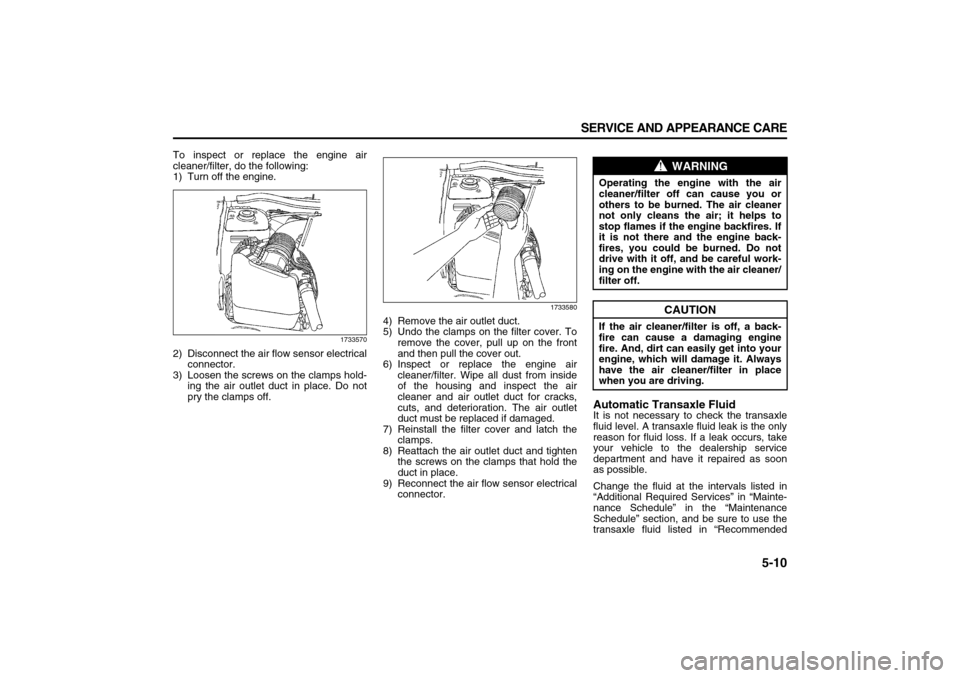
To inspect or replace the engine air
cleaner/filter, do the following:
1) Turn off the engine.
1733570
2) Disconnect the air flow sensor electrical
connector.
3) Loosen the screws on the clamps hold-
ing the air outlet duct in place. Do not
pry the clamps off.
1733580
4) Remove the air outlet duct.
5) Undo the clamps on the filter cover. To
remove the cover, pull up on the front
and then pull the cover out.
6) Inspect or replace the engine air
cleaner/filter. Wipe all dust from inside
of the housing and inspect the air
cleaner and air outlet duct for cracks,
cuts, and deterioration. The air outlet
duct must be replaced if damaged.
7) Reinstall the filter cover and latch the
clamps.
8) Reattach the air outlet duct and tighten
the screws on the clamps that hold the
duct in place.
9) Reconnect the air flow sensor electrical
connector.
Automatic Transaxle FluidIt is not necessary to check the transaxle
fluid level. A transaxle fluid leak is the only
reason for fluid loss. If a leak occurs, take
your vehicle to the dealership service
department and have it repaired as soon
as possible.
Change the fluid at the intervals listed in
“Additional Required Services” in “Mainte-
nance Schedule” in the “Maintenance
Schedule” section, and be sure to use the
transaxle fluid listed in “Recommended
WARNING
Operating the engine with the air
cleaner/filter off can cause you or
others to be burned. The air cleaner
not only cleans the air; it helps to
stop flames if the engine backfires. If
it is not there and the engine back-
fires, you could be burned. Do not
drive with it off, and be careful work-
ing on the engine with the air cleaner/
filter off.
CAUTION
If the air cleaner/filter is off, a back-
fire can cause a damaging engine
fire. And, dirt can easily get into your
engine, which will damage it. Always
have the air cleaner/filter in place
when you are driving.
Page 195 of 274
5-11 SERVICE AND APPEARANCE CARE
78J00-03E
Fluids and Lubricants” in “Maintenance
Schedule” in the “Maintenance Schedule”
section.Engine CoolantThe cooling system in your vehicle is filled
with DEX-COOL
® engine coolant. This
coolant is designed to remain in your vehi-
cle for five years or 150,000 miles (240
000 km), whichever occurs first, if you add
only DEX-COOL® extended life coolant.
The following explains your cooling system
and how to add coolant when it is low. If
you have a problem with engine overheat-
ing, refer to “Engine Overheating” in this
section.
A 50/50 mixture of clean, drinkable water
and DEX-COOL® coolant will:
Give freezing protection down to –34°F
(–37°C).
Give boiling protection up to 265°F
(129°C).
Protect against rust and corrosion. Help keep the proper engine tempera-
ture.
Let the warning lights and gages work as
they should.What to Use
Use a mixture of one-half clean, drinkable
water and one-half DEX-COOL
® coolant
which will not damage aluminum parts. If
you use this coolant mixture, you do not
need to add anything else.
CAUTION
Use of the incorrect automatic tran-
saxle fluid may damage your vehicle,
and the damages may not be covered
by your warranty. Always use the
automatic transaxle fluid listed in
“Recommended Fluids and Lubri-
cants” in “Maintenance Schedule” in
the “Maintenance Schedule” section.
CAUTION
Using coolant other than DEX-COOL
®
may cause premature engine, heater
core, or radiator corrosion. In addi-
tion, the engine coolant may require
changing sooner, at the first mainte-
nance service after each 30000 miles
(50000 km) or 24 months, whichever
occurs first. Any repairs would not be
covered by your warranty. Always
use DEX-COOL
® (silicate-free) cool-
ant in your vehicle.
WARNING
Adding only plain water to your cool-
ing system can be dangerous. Plain
water, or some other liquid such as
alcohol, can boil before the proper
coolant mixture will. Your vehicle’s
coolant warning system is set for the
proper coolant mixture. With plain
water or the wrong mixture, your
engine could get too hot but you
would not get the overheat warning.
Your engine could catch fire and you
or others could be burned. Use a 50/
50 mixture of clean, drinkable water
and DEX-COOL
® coolant.
CAUTION
If you use an improper coolant mix-
ture, your engine could overheat and
be badly damaged. The repair cost
would not be covered by your war-
ranty. Too much water in the mixture
can freeze and crack the engine, radi-
ator, heater core, and other parts.
Page 196 of 274
5-12 SERVICE AND APPEARANCE CARE
78J00-03E
If you have to add coolant more than four
times a year, have your dealer check your
cooling system.
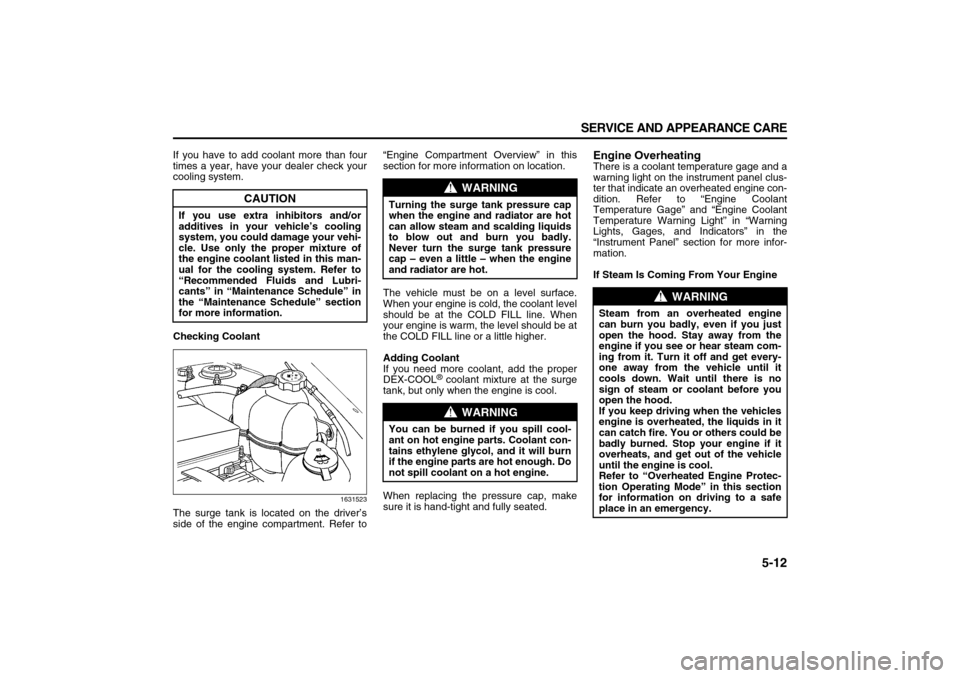
Checking Coolant
1631523
The surge tank is located on the driver’s
side of the engine compartment. Refer to“Engine Compartment Overview” in this
section for more information on location.
The vehicle must be on a level surface.
When your engine is cold, the coolant level
should be at the COLD FILL line. When
your engine is warm, the level should be at
the COLD FILL line or a little higher.
Adding Coolant
If you need more coolant, add the proper
DEX-COOL
® coolant mixture at the surge
tank, but only when the engine is cool.
When replacing the pressure cap, make
sure it is hand-tight and fully seated.
Engine OverheatingThere is a coolant temperature gage and a
warning light on the instrument panel clus-
ter that indicate an overheated engine con-
dition. Refer to “Engine Coolant
Temperature Gage” and “Engine Coolant
Temperature Warning Light” in “Warning
Lights, Gages, and Indicators” in the
“Instrument Panel” section for more infor-
mation.
If Steam Is Coming From Your Engine
CAUTION
If you use extra inhibitors and/or
additives in your vehicle’s cooling
system, you could damage your vehi-
cle. Use only the proper mixture of
the engine coolant listed in this man-
ual for the cooling system. Refer to
“Recommended Fluids and Lubri-
cants” in “Maintenance Schedule” in
the “Maintenance Schedule” section
for more information.
WARNING
Turning the surge tank pressure cap
when the engine and radiator are hot
can allow steam and scalding liquids
to blow out and burn you badly.
Never turn the surge tank pressure
cap – even a little – when the engine
and radiator are hot.
WARNING
You can be burned if you spill cool-
ant on hot engine parts. Coolant con-
tains ethylene glycol, and it will burn
if the engine parts are hot enough. Do
not spill coolant on a hot engine.
WARNING
Steam from an overheated engine
can burn you badly, even if you just
open the hood. Stay away from the
engine if you see or hear steam com-
ing from it. Turn it off and get every-
one away from the vehicle until it
cools down. Wait until there is no
sign of steam or coolant before you
open the hood.
If you keep driving when the vehicles
engine is overheated, the liquids in it
can catch fire. You or others could be
badly burned. Stop your engine if it
overheats, and get out of the vehicle
until the engine is cool.
Refer to “Overheated Engine Protec-
tion Operating Mode” in this section
for information on driving to a safe
place in an emergency.
Page 200 of 274
5-16 SERVICE AND APPEARANCE CARE
78J00-03E
6) Reinstall the coolant recovery tank cap
and the pressure cap.
7) If the coolant in the recovery tank is
constantly low, you should have your
dealership service department inspect
the vehicle for leaks.Power Steering Fluid
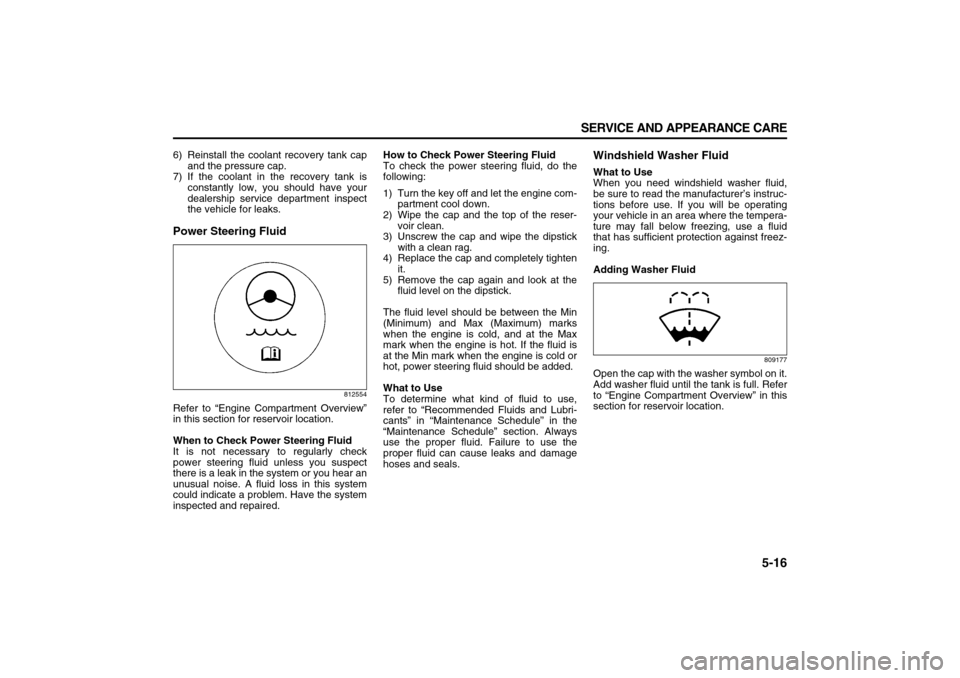
812554
Refer to “Engine Compartment Overview”
in this section for reservoir location.
When to Check Power Steering Fluid
It is not necessary to regularly check
power steering fluid unless you suspect
there is a leak in the system or you hear an
unusual noise. A fluid loss in this system
could indicate a problem. Have the system
inspected and repaired.How to Check Power Steering Fluid
To check the power steering fluid, do the
following:
1) Turn the key off and let the engine com-
partment cool down.
2) Wipe the cap and the top of the reser-
voir clean.
3) Unscrew the cap and wipe the dipstick
with a clean rag.
4) Replace the cap and completely tighten
it.
5) Remove the cap again and look at the
fluid level on the dipstick.
The fluid level should be between the Min
(Minimum) and Max (Maximum) marks
when the engine is cold, and at the Max
mark when the engine is hot. If the fluid is
at the Min mark when the engine is cold or
hot, power steering fluid should be added.
What to Use
To determine what kind of fluid to use,
refer to “Recommended Fluids and Lubri-
cants” in “Maintenance Schedule” in the
“Maintenance Schedule” section. Always
use the proper fluid. Failure to use the
proper fluid can cause leaks and damage
hoses and seals.
Windshield Washer FluidWhat to Use
When you need windshield washer fluid,
be sure to read the manufacturer’s instruc-
tions before use. If you will be operating
your vehicle in an area where the tempera-
ture may fall below freezing, use a fluid
that has sufficient protection against freez-
ing.
Adding Washer Fluid
809177
Open the cap with the washer symbol on it.
Add washer fluid until the tank is full. Refer
to “Engine Compartment Overview” in this
section for reservoir location.
Page 201 of 274
5-17 SERVICE AND APPEARANCE CARE
78J00-03E
BrakesBrake Fluid
809919
Your brake master cylinder reservoir is
filled with DOT-3 brake fluid. Refer to
“Engine Compartment Overview” in this
section for the location of the reservoir.
There are only two reasons why the brake
fluid level in the reservoir might go down.
The first is that the brake fluid goes down
to an acceptable level during normal brake
lining wear. When new linings are put in,
the fluid level goes back up. The other rea-
son is that fluid is leaking out of the brake
system. If it is, you should have your brake
system fixed, since a leak means that
sooner or later your brakes will not work
well, or will not work at all.
So, it is not a good idea to top off your
brake fluid. Adding brake fluid will not cor-rect a leak. If you add fluid when your lin-
ings are worn, then you will have too much
fluid when you get new brake linings. You
should add or remove brake fluid, as nec-
essary, only when work is done on the
brake hydraulic system.
When your brake fluid falls to a low level,
your brake warning light will come on.
Refer to “Brake System Warning Light” in
“Warning Lights, Gages, and Indicators” in
the “Instrument Panel” section.
What to Add
When you do need brake fluid, use only
DOT-3 brake fluid. Use new brake fluid
from a sealed container only. Refer to
“Recommended Fluids and Lubricants” in
“Maintenance Schedule” in the “Mainte-
nance Schedule” section.
Always clean the brake fluid reservoir cap
and the area around the cap before remov-
ing it. This will help keep dirt from entering
the reservoir.
CAUTION
When using concentrated washer
fluid, follow the manufacturer’s
instructions for adding water.
Do not mix water with ready-to-use
washer fluid. Water can cause the
solution to freeze and damage your
washer fluid tank and other parts of
the washer system. Also, water
does not clean as well as washer
fluid.
Fill your washer fluid tank only
three-quarters full when it is very
cold. This allows for expansion if
freezing occurs, which could dam-
age the tank if it is completely full.
Do not use engine coolant (anti-
freeze) in your windshield washer.
It can damage your washer system
and paint.
WARNING
If your vehicle has too much brake
fluid, it can spill on the engine. The
fluid will burn if the engine is hot
enough. You or others could be
burned, and your vehicle could be
damaged. Add brake fluid only when
work is done on the brake hydraulic
system.
Page 206 of 274
5-22 SERVICE AND APPEARANCE CARE
78J00-03E
To disconnect the jumper cables from both
vehicles, do the following:
1) Disconnect the black negative (–) cable
from the vehicle that had the dead bat-
tery.
2) Disconnect the black negative (–) cable
from the vehicle with the good battery.
3) Disconnect the red positive (+) cable
from the vehicle with the good battery.
4) Disconnect the red positive (+) cable
from the other vehicle.
5) Return the fuse block cover to its origi-
nalposition.
All-Wheel DriveIf you have an all-wheel-drive vehicle, be
sure to perform the lubricant checks
described in this section. However, there
are two additional systems that need lubri-
cation.Transfer Case (Power Transfer Unit)When to Check Lubricant
Refer to the Maintenance Schedule to
determine how often to check the lubricant.
Refer to “Scheduled Maintenance” in
“Maintenance Schedule” in the “Mainte-
nance Schedule” section.
How to Check Lubricant
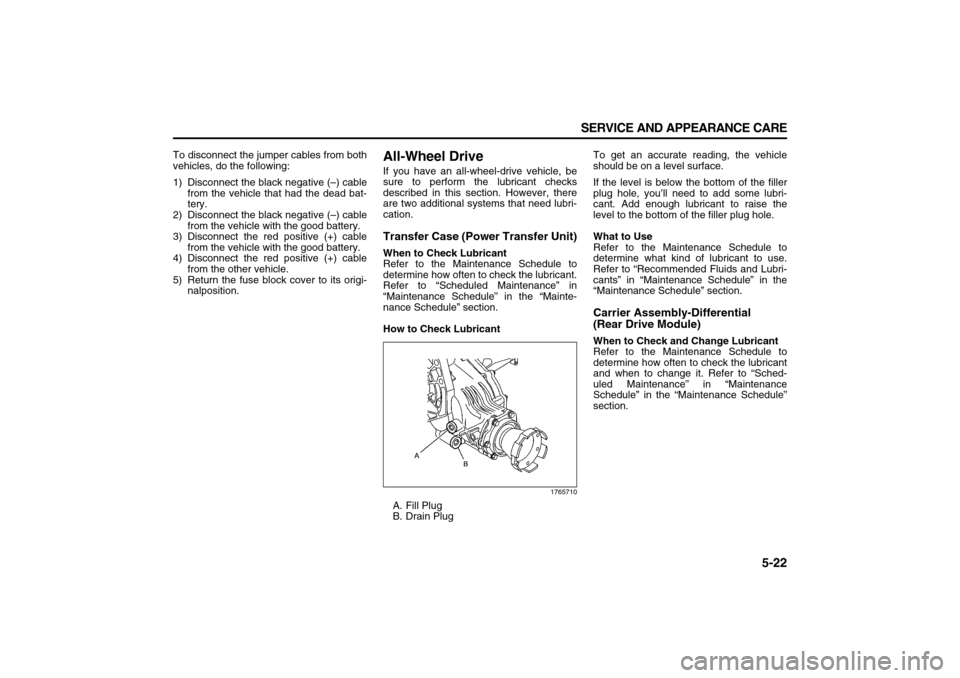
1765710
A. Fill Plug
B. Drain PlugTo get an accurate reading, the vehicle
should be on a level surface.
If the level is below the bottom of the filler
plug hole, you’ll need to add some lubri-
cant. Add enough lubricant to raise the
level to the bottom of the filler plug hole.
What to Use
Refer to the Maintenance Schedule to
determine what kind of lubricant to use.
Refer to “Recommended Fluids and Lubri-
cants” in “Maintenance Schedule” in the
“Maintenance Schedule” section.
Carrier Assembly-Differential
(Rear Drive Module)When to Check and Change Lubricant
Refer to the Maintenance Schedule to
determine how often to check the lubricant
and when to change it. Refer to “Sched-
uled Maintenance” in “Maintenance
Schedule” in the “Maintenance Schedule”
section.
Page 207 of 274
5-23 SERVICE AND APPEARANCE CARE
78J00-03E
How to Check Lubricant
AWD Differential Case
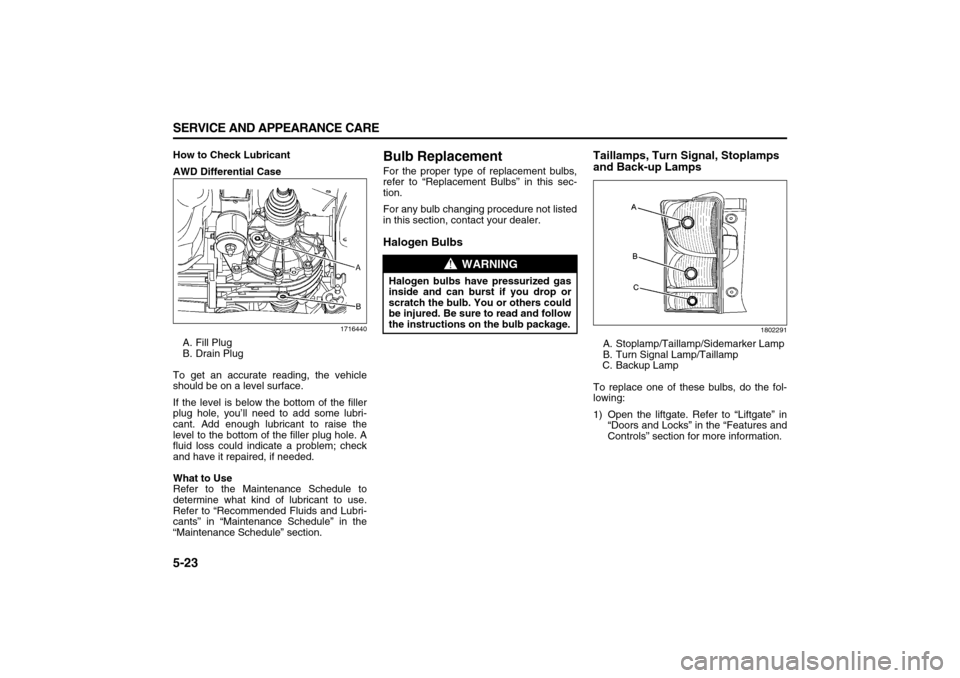
1716440
A. Fill Plug
B. Drain Plug
To get an accurate reading, the vehicle
should be on a level surface.
If the level is below the bottom of the filler
plug hole, you’ll need to add some lubri-
cant. Add enough lubricant to raise the
level to the bottom of the filler plug hole. A
fluid loss could indicate a problem; check
and have it repaired, if needed.
What to Use
Refer to the Maintenance Schedule to
determine what kind of lubricant to use.
Refer to “Recommended Fluids and Lubri-
cants” in “Maintenance Schedule” in the
“Maintenance Schedule” section.
Bulb ReplacementFor the proper type of replacement bulbs,
refer to “Replacement Bulbs” in this sec-
tion.
For any bulb changing procedure not listed
in this section, contact your dealer.Halogen BulbsTaillamps, Turn Signal, Stoplamps
and Back-up Lamps
1802291
A. Stoplamp/Taillamp/Sidemarker Lamp
B. Turn Signal Lamp/Taillamp
C. Backup Lamp
To replace one of these bulbs, do the fol-
lowing:
1) Open the liftgate. Refer to “Liftgate” in
“Doors and Locks” in the “Features and
Controls” section for more information.
WARNING
Halogen bulbs have pressurized gas
inside and can burst if you drop or
scratch the bulb. You or others could
be injured. Be sure to read and follow
the instructions on the bulb package.
Page 209 of 274
5-25 SERVICE AND APPEARANCE CARE
78J00-03E
Windshield Wiper Blade
ReplacementWindshield wiper blades should be
inspected for wear or cracking. Refer to
“Scheduled Maintenance” in “Mainte-
nance Schedule” in the “Maintenance
Schedule” section for more information.
Replacement blades come in different
types and are removed in different ways.
For proper type and length, refer to “Nor-
mal Maintenance Replacement Parts” in
“Maintenance Schedule” in the “Mainte-
nance Schedule” section.
Here’s how to replace the windshield wiper
blades:
1) Make sure the front wipers are turned
off.
2) Pull the windshield wiper arm away
from the windshield.
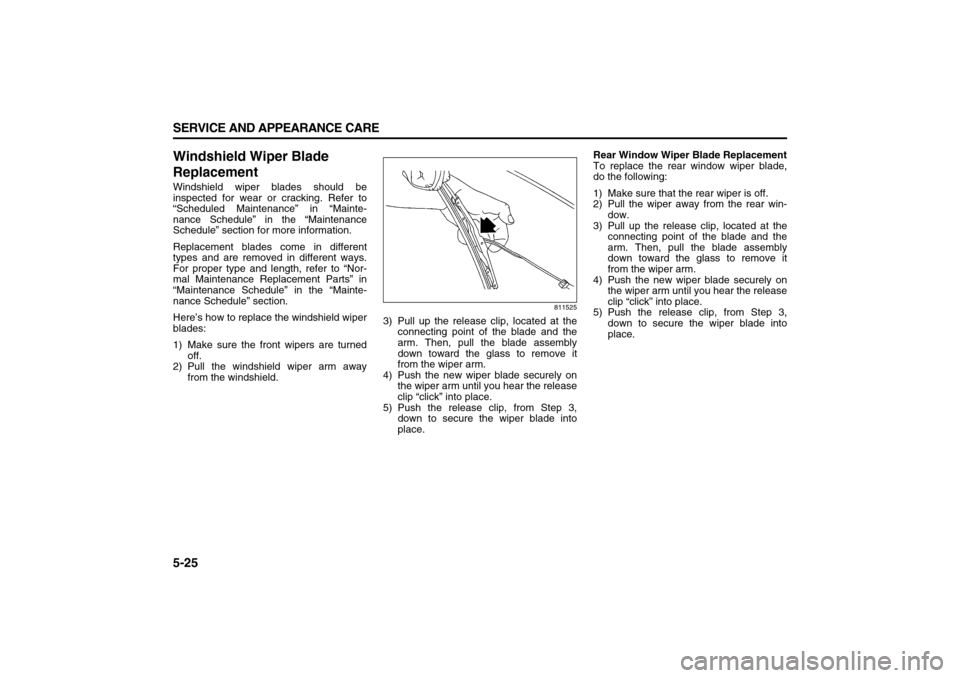
811525
3) Pull up the release clip, located at the
connecting point of the blade and the
arm. Then, pull the blade assembly
down toward the glass to remove it
from the wiper arm.
4) Push the new wiper blade securely on
the wiper arm until you hear the release
clip “click” into place.
5) Push the release clip, from Step 3,
down to secure the wiper blade into
place.Rear Window Wiper Blade Replacement
To replace the rear window wiper blade,
do the following:
1) Make sure that the rear wiper is off.
2) Pull the wiper away from the rear win-
dow.
3) Pull up the release clip, located at the
connecting point of the blade and the
arm. Then, pull the blade assembly
down toward the glass to remove it
from the wiper arm.
4) Push the new wiper blade securely on
the wiper arm until you hear the release
clip “click” into place.
5) Push the release clip, from Step 3,
down to secure the wiper blade into
place.
Page 217 of 274
5-33 SERVICE AND APPEARANCE CARE
78J00-03E
The TPMS system is ready for the sen-
sor matching process to begin.
5) Start with the driver side front tire.
6) Remove the valve cap from the tire’s
valve stem. Activate the TPMS sensor
by increasing or decreasing the tire’s
air pressure for five seconds, or until a
horn chirp sounds. The horn chirp,
which may take up to 30 seconds to
sound, confirms that the sensor identifi-
cation code has been matched to the
tire/wheel position. To decrease the
tire’s air-pressure use the pointed end
of the valve cap, a pencil-style air pres-
sure gage, or a key.
7) Proceed to the passenger side front
tire, and repeat the procedure in Step 6.
8) Proceed to the passenger side rear tire,
and repeat the procedure in Step 6.
9) Proceed to the driver side rear tire, and
repeat the procedure in Step 6.
10)After hearing the confirming horn chirp
for the driver side rear tire, the tire
learning process ends. Turn the ignition
switch to LOCK.
11)Set all four tires to the recommended
air pressure level as indicated on the
tire and loading information label.
12)Put the valve caps back on the valve
stems.
Federal Communications Commission
(FCC) and Industry and Science Canada
The Tire Pressure Monitor System (TPMS)
operates on a radio frequency and com-
plies with Part 15 of the FCC Rules. Oper-ation is subject to the following two
conditions:
1) This device may not cause harmful
interference.
2) This device must accept any interfer-
ence received, including interference
that may cause undesired operation.
The Tire Pressure Monitor System (TPMS)
operates on a radio frequency and com-
plies with RSS-210 of Industry and Sci-
ence Canada. Operation is subject to the
following two conditions:
1) This device may not cause interfer-
ence.
2) This device must accept any interfer-
ence received, including interference
that may cause undesired operation of
the device.
Changes or modifications to this system by
other than an authorized service facility
could void authorization to use this equip-
ment.
Tire Inspection and RotationTires should be rotated every 5000 to 8000
miles (8000 to 13000 km).
Any time you notice unusual wear, rotate
your tires as soon as possible and check
wheel alignment. Also check for damaged
tires or wheels. Refer to “When It Is Time
for New Tires” and “Wheel Replacement”
in this section for more information.The purpose of regular rotation is to
achieve more uniform wear for all tires on
the vehicle. The first rotation is the most
important. Refer to “Scheduled Mainte-
nance” in “Maintenance Schedule” in the
“Maintenance Schedule” section for sched-
uled rotation intervals.
811106
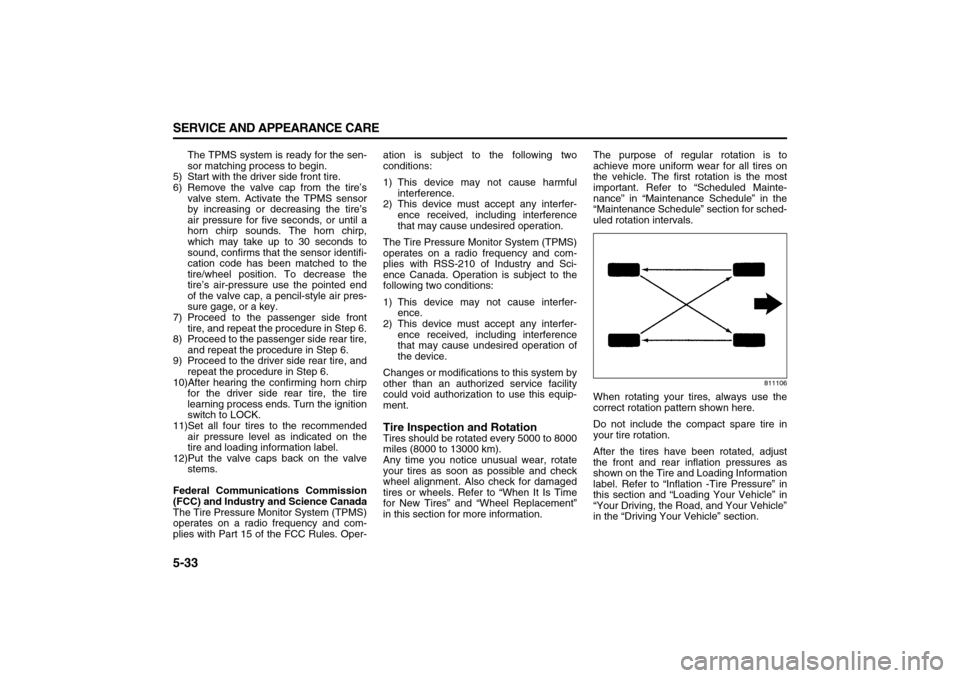
When rotating your tires, always use the
correct rotation pattern shown here.
Do not include the compact spare tire in
your tire rotation.
After the tires have been rotated, adjust
the front and rear inflation pressures as
shown on the Tire and Loading Information
label. Refer to “Inflation -Tire Pressure” in
this section and “Loading Your Vehicle” in
“Your Driving, the Road, and Your Vehicle”
in the “Driving Your Vehicle” section.
Page 233 of 274
5-49 SERVICE AND APPEARANCE CARE
78J00-03E
For solid dry soils: remove as much as
possible and then vacuum.
To clean, use the following instructions:
1) Saturate a lint-free, clean white cloth
with water or club soda.
2) Wring the cloth to remove excess mois-
ture.
3) Start on the outside edge of the soil and
gently rub toward the center. Continue
cleaning, using a clean area of the cloth
each time it becomes soiled.
4) Continue to gently rub the soiled area
until the cleaning cloth remains clean.
5) If the soil is not completely removed,
use a mild soap solution and repeat the
cleaning process that was used with
plain water.
If any of the soil remains, a commercial
fabric cleaner or spot lifter may be neces-
sary. When a commercial upholstery
cleaner or spot lifter is to be used, test a
small hidden area for colorfastness first. If
the locally cleaned area gives any impres-
sion that a ring formation may result, clean
the entire surface.
After the cleaning process has been com-
pleted, a paper towel can be used to blot
excess moisture from the fabric or carpet.LeatherA soft cloth dampened with water may be
used to remove dust. If a more thorough
cleaning is necessary, a soft cloth damp-ened with a mild soap solution can be
used. Allow the leather to dry naturally. Do
not use heat to dry. Never use steam to
clean leather. Never use spot lifters or spot
removers on leather. Many commercial
leather cleaners and coatings that are sold
to preserve and protect leather may per-
manently change the appearance and feel
of your leather and are not recommended.
Do not use silicone or wax-based prod-
ucts, or those containing organic solvents
to clean your vehicle’s interior because
they can alter the appearance by increas-
ing the gloss in a non-uniform manner.
Never use shoe polish on your leather.
Instrument Panel, Vinyl, and Other
Plastic SurfacesA soft cloth dampened with water may be
used to remove dust. If a more thorough
cleaning is necessary, a clean soft cloth
dampened with a mild soap solution can
be used to gently remove dust and dirt.
Never use spot lifters or removers on plas-
tic surfaces. Many commercial cleaners
and coatings that are sold to preserve and
protect soft plastic surfaces may perma-
nently change the appearance and feel of
your interior and are not recommended.
Do not use silicone or wax-based prod-
ucts, or those containing organic solvents
to clean your vehicle’s interior because
they can alter the appearance by increas-
ing the gloss in a non-uniform manner.Some commercial products may increase
gloss on your instrument panel. The
increase in gloss may cause annoying
reflections in the windshield and even
make it difficult to see through the wind-
shield under certain conditions.
Care of Safety BeltsKeep belts clean and dry.WeatherstripsSilicone grease on weatherstrips will make
them last longer, seal better, and not stick
or squeak. Apply silicone grease with a
clean cloth. During very cold, damp
weather frequent application may be
required. Refer to “Recommended Fluids
and Lubricants” in “Maintenance Sched-
ule” in the “Maintenance Schedule” sec-
tion.Washing Your VehicleThe paint finish on the vehicle provides
beauty, depth of color, gloss retention, and
durability.
WARNING
Do not bleach or dye safety belts. If
you do, it may severely weaken them.
In a crash, they might not be able to
provide adequate protection. Clean
safety belts only with mild soap and
lukewarm water.