ESP SUZUKI XL7 2007 2.G Owner's Manual
[x] Cancel search | Manufacturer: SUZUKI, Model Year: 2007, Model line: XL7, Model: SUZUKI XL7 2007 2.GPages: 274, PDF Size: 6.12 MB
Page 213 of 274

5-29 SERVICE AND APPEARANCE CARE
78J00-03E
Driving, the Road, and Your Vehicle” in the
“Driving Your Vehicle” section.
Intended Outboard Sidewall:
The side of an asymmetrical tire, that must
always face outward when mounted on a
vehicle.
Kilopascal (kPa):
The metric unit for air pressure.
Light Truck (LT-Metric) Tire:
A tire used on light duty trucks and some
multipurpose passenger vehicles.
Load Index:
An assigned number ranging from 1 to 279
that corresponds to the load carrying
capacity of a tire.
Maximum Inflation Pressure:
The maximum air pressure to which a cold
tire may be inflated. The maximum air
pressure is molded onto the sidewall.
Maximum Load Rating:
The load rating for a tire at the maximum
permissible inflation pressure for that tire.
Maximum Loaded Vehicle Weight:
The sum of curb weight, accessory weight,
vehicle capacity weight, and production
options weight.
Normal Occupant Weight:
The number of occupants a vehicle is
designed to seat multiplied by 150 lbs (68
kg). Refer to “Loading Your Vehicle” in
“Your Driving, the Road, and Your Vehicle”
in the “Driving Your Vehicle” section.Occupant Distribution:
Designated seating positions.
Outward Facing Sidewall:
The side of an asymmetrical tire that has a
particular side that faces outward when
mounted on a vehicle. The side of the tire
that contains a whitewall, bears white let-
tering, or bears manufacturer, brand, and/
or model name molding that is higher or
deeper than the same moldings on the
other sidewall of the tire.
Passenger (P-Metric) Tire:
A tire used on passenger cars and some
light duty trucks and multipurpose vehicles.
Recommended Inflation Pressure:
Vehicle manufacturer’s recommended tire
inflation pressure as shown on the tire
placard. Refer to “Inflation – Tire Pressure”
in this section and “Loading Your Vehicle”
in “Your Driving, the Road, and Your Vehi-
cle” in the “Driving Your Vehicle” section.
Radial Ply Tire:
A pneumatic tire in which the ply cords that
extend to the beads are laid at 90 degrees
to the centerline of the tread.
Rim:
A metal support for a tire and upon which
the tire beads are seated.
Sidewall:
The portion of a tire between the tread and
the bead.Speed Rating:
An alphanumeric code assigned to a tire
indicating the maximum speed at which a
tire can operate.
Traction:
The friction between the tire and the road
surface. The amount of grip provided.
Tread:
The portion of a tire that comes into con-
tact with the road.
Treadwear Indicators:
Narrow bands, sometimes called wear
bars, that show across the tread of a tire
when only 1/16 inch (1.6 mm) of tread
remains. Refer to “When It Is Time for New
Tires” in this section.
UTQGS (Uniform Tire Quality Grading
Standards):
A tire information system that provides
consumers with ratings for a tire’s traction,
temperature, and treadwear. Ratings are
determined by tire manufacturers using
government testing procedures. The rat-
ings are molded into the sidewall of the
tire. Refer to “Uniform Tire Quality Grad-
ing” in this section.
Vehicle Capacity Weight:
The number of designated seating posi-
tions multiplied by 150 lbs (68 kg) plus the
rated cargo load. Refer to “Loading Your
Vehicle” in “Your Driving, the Road, and
Your Vehicle” in the “Driving Your Vehicle”
section.
Page 215 of 274
5-31 SERVICE AND APPEARANCE CARE
78J00-03E
If you overfill the tire, release air by push-
ing on the metal stem in the center of the
tire valve. Re-check the tire pressure with
the tire gage.
Be sure to put the valve caps back on the
valve stems. They help prevent leaks by
keeping out dirt and moisture.Tire Pressure Monitor SystemYour vehicle has a Tire Pressure Monitor
System (TPMS). This system uses radio
and sensor technology to check tire pres-
sure levels. TPMS sensors are mounted
onto each tire and wheel assembly, except
for the spare tire. The TPMS sensors mon-
itor the air pressure in your vehicle's tires
and transmit tire pressure readings to a
receiver located in the vehicle.
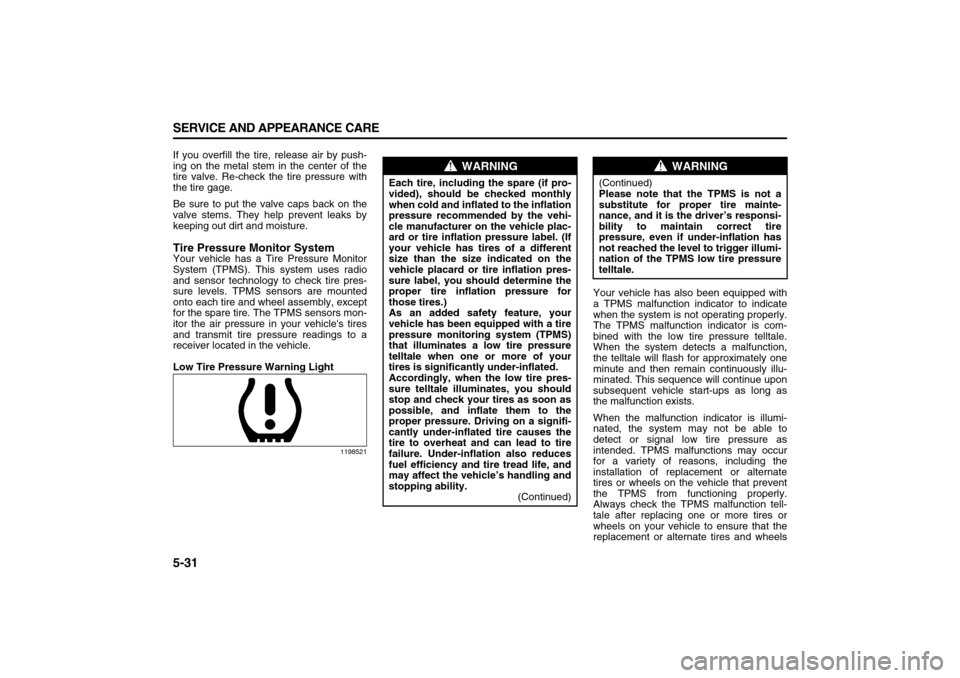
Low Tire Pressure Warning Light
1198521
Your vehicle has also been equipped with
a TPMS malfunction indicator to indicate
when the system is not operating properly.
The TPMS malfunction indicator is com-
bined with the low tire pressure telltale.
When the system detects a malfunction,
the telltale will flash for approximately one
minute and then remain continuously illu-
minated. This sequence will continue upon
subsequent vehicle start-ups as long as
the malfunction exists.
When the malfunction indicator is illumi-
nated, the system may not be able to
detect or signal low tire pressure as
intended. TPMS malfunctions may occur
for a variety of reasons, including the
installation of replacement or alternate
tires or wheels on the vehicle that prevent
the TPMS from functioning properly.
Always check the TPMS malfunction tell-
tale after replacing one or more tires or
wheels on your vehicle to ensure that the
replacement or alternate tires and wheels
WARNING
Each tire, including the spare (if pro-
vided), should be checked monthly
when cold and inflated to the inflation
pressure recommended by the vehi-
cle manufacturer on the vehicle plac-
ard or tire inflation pressure label. (If
your vehicle has tires of a different
size than the size indicated on the
vehicle placard or tire inflation pres-
sure label, you should determine the
proper tire inflation pressure for
those tires.)
As an added safety feature, your
vehicle has been equipped with a tire
pressure monitoring system (TPMS)
that illuminates a low tire pressure
telltale when one or more of your
tires is significantly under-inflated.
Accordingly, when the low tire pres-
sure telltale illuminates, you should
stop and check your tires as soon as
possible, and inflate them to the
proper pressure. Driving on a signifi-
cantly under-inflated tire causes the
tire to overheat and can lead to tire
failure. Under-inflation also reduces
fuel efficiency and tire tread life, and
may affect the vehicle’s handling and
stopping ability.
(Continued)
WARNING
(Continued)
Please note that the TPMS is not a
substitute for proper tire mainte-
nance, and it is the driver’s responsi-
bility to maintain correct tire
pressure, even if under-inflation has
not reached the level to trigger illumi-
nation of the TPMS low tire pressure
telltale.
Page 220 of 274

5-36 SERVICE AND APPEARANCE CARE
78J00-03E
deep tread, winter-type snow tires, space-
saver, or temporary use spare tires, tires
with nominal rim diameters of 10 to 12
inches (25 to 30 cm), or, to some limited-
production tires.
While the tires available may vary with
respect to these grades, they must also
conform to federal safety requirements.
Treadwear
The treadwear grade is a comparative rat-
ing based on the wear rate of the tire when
tested under controlled conditions on a
specified government test course. For
example, a tire graded 150 would wear
one and a half (1.5) times as well on the
government course as a tire graded 100.
The relative performance of tires depends
upon the actual conditions of their use,
however, and may depart significantly from
the norm due to variations in driving habits,
service practices, and differences in road
characteristics and climate.
Traction – AA, A, B, C
The traction grades, from highest to low-
est, are AA, A, B, and C. Those grades
represent the tire’s ability to stop on wet
pavement as measured under controlled
conditions on specified government test
surfaces of asphalt and concrete. A tire
marked C may have poor traction perfor-
mance.Temperature – A, B, C
The temperature grades are A (the high-
est), B, and C, representing the tire’s resis-
tance to the generation of heat and its
ability to dissipate heat when tested under
controlled conditions on a specified indoor
laboratory test wheel. Sustained high tem-
perature can cause the material of the tire
to degenerate and reduce tire life, and
excessive temperature can lead to sudden
tire failure. The grade C corresponds to a
level of performance which all passenger
car tires must meet under the Federal
Motor Vehicle Safety Standard No. 109.
Grades B and A represent higher levels of
performance on the laboratory test wheel
than the minimum required by law.
Wheel Alignment and Tire BalanceThe tires and wheels on your vehicle were
aligned and balanced carefully at the fac-
tory to give you the longest tire life and
best overall performance. Adjustments to
wheel alignment and tire balancing will not
be necessary on a regular basis. However,
if you notice unusual tire wear or your vehi-
cle pulling to one side or the other, the
alignment may need to be checked. If you
notice your vehicle vibrating when driving
on a smooth road, your tires and wheels
may need to be rebalanced. See your
dealer for proper diagnosis.
WARNING
The traction grade assigned to this
tire is based on straight-ahead brak-
ing traction tests, and does not
include acceleration, cornering,
hydroplaning, or peak traction char-
acteristics.
WARNING
The temperature grade for this tire is
established for a tire that is properly
inflated and not overloaded. Exces-
sive speed, underinflation, or exces-
sive loading, either separately or in
combination, can cause heat buildup
and possible tire failure.
Page 221 of 274

5-37 SERVICE AND APPEARANCE CARE
78J00-03E
Wheel ReplacementReplace any wheel that is bent, cracked,
or badly rusted or corroded. If wheel nuts
keep coming loose, the wheel, wheel bolts,
and wheel nuts should be replaced. If the
wheel leaks air, replace it (except some
aluminum wheels, which can sometimes
be repaired). See your dealer if any of
these conditions exist.
Your dealer will know the kind of wheel you
need.
Each new wheel should have the same
load-carrying capacity, diameter, width,
offset, and be mounted the same way as
the one it replaces.
If you need to replace any of your wheels,
wheel bolts or wheel nuts, replace them
only with new original equipment parts.
This way, you will be sure to have the right
wheel, wheel bolts, and wheel nuts for
your vehicle.Refer to “Changing a Flat Tire” in this sec-
tion for more information.
Used Replacement Wheels
Tire Chains
If a Tire Goes FlatIt is unusual for a tire to blowout while you
are driving, especially if you maintain your
vehicle’s tires properly. If air goes out of a
tire, it is much more likely to leak out
slowly. But if you should ever have a blow-
out, here are a few tips about what to
expect and what to do:
WARNING
Using the wrong replacement wheels,
wheel bolts, or wheel nuts on your
vehicle can be dangerous. It could
affect the braking and handling of
your vehicle, make your tires lose air
and make you lose control. You
could have a collision in which you
or others could be injured. Always
use the correct wheel, wheel bolts,
and wheel nuts for replacement.
CAUTION
The wrong wheel can also cause
problems with bearing life, brake
cooling, speedometer or odometer
calibration, headlamp aim, bumper
height, vehicle ground clearance, and
tire or tire chain clearance to the
body and chassis.
WARNING
Putting a used wheel on your vehicle
is dangerous. You cannot know how
it has been used or how far it has
been driven. It could fail suddenly
and cause a crash. If you have to
replace a wheel, use a new original
equipment wheel.
WARNING
Do not use tire chains. There is not
enough clearance. Tire chains used
on a vehicle without the proper
amount of clearance can cause dam-
age to the brakes, suspension or
other vehicle parts. The area dam-
aged by the tire chains could cause
you to lose control of your vehicle
and you or others may be injured in a
crash.
Use another type of traction device
only if its manufacturer recommends
it for use on your vehicle and tire size
combination and road conditions.
Follow that manufacturer’s instruc-
tions. To help avoid damage to your
vehicle, drive slowly, readjust or
remove the device if it is contacting
your vehicle, and do not spin your
vehicle’s wheels. If you do find trac-
tion devices that will fit, install them
on the front tires.
Page 264 of 274
7-2 GENERAL INFORMATION
78J00-03E
Emission Compliance Label
(for U.S.A.)
60A412
The EPA emission compliance label is
located under the hood. It provides much
of the information needed to perform an
engine tune-up on your vehicle.
WarrantiesThe warranties covering your vehicle are
explained in a separate New Vehicle War-
ranty Information booklet given to you at
the time of sale. Please read this booklet
carefully so you can understand your rights
and responsibilities.For U.S.A.The following warranties are provided with
your vehicle:
New Vehicle Limited Warranty
Limited Warranty For SUZUKI Parts or
Accessories
Emission Components Defect Warranty
Emission Performance Warranty
On-Board Vehicle Computers
and Event Data RecordersYour vehicle, like other modern motor
vehicles, has a number of sophisti-
cated computer systems that monitor
and control several aspects of the
vehicle’s performance. Your vehicle
uses on-board vehicle computers to
monitor emission control components
to optimize fuel economy, to monitor
conditions for airbag deployment and,
if so equipped, to provide anti-lock
braking and to help the driver control
the vehicle in difficult driving situa-
tions. Some information may be stored
during regular operations to facilitate
repair of detected malfunctions; other
information is stored only in a crash
event by computer systems, such as
those commonly called event data
recorders (EDR).
In a crash event, computer systems,
such as the Airbag Sensing and Diag-
nostic Module (SDM) in your vehicle
may record information about the con-
dition of the vehicle and how it was
operated, such as data related to
engine speed, brake application, throt-
tle position, vehicle speed, safety belt
usage, airbag readiness, airbag per-
formance, and the severity of a colli-
sion. This information has been used
to improve vehicle crash performance
Page 265 of 274

7-3 GENERAL INFORMATION
78J00-03E
and may be used to improve crash
performance of future vehicles and
driving safety. Unlike the data record-
ers on many airplanes, these on-board
systems do not record sounds, such
as conversation of vehicle occupants.
To read this information, special
equipment is needed and access to
the vehicle or the device that stores
the data is required. Suzuki will not
access information about a crash
event or share it with others other
than:
with the consent of the vehicle
owner or, if the vehicle is leased,
with the consent of the lessee,
in response to an official request of
police or similar government office,
as part of Suzuki’s defense of litiga-
tion through the discovery process,
or
as required by law.
In addition, once Suzuki collects or
receives data, Suzuki may:
use the data for Suzuki research
needs,
make it available for research where
appropriate confidentiality is to be
maintained and need is shown, or
share summary data which is not
tied to a specific vehicle with non-
Suzuki organizations for research
purposes.Others, such as law enforcement, may
have access to the special equipment
that can read the information if they
have access to the vehicle or the
device that stores the data.
Reporting Safety DefectsIf you believe that your vehicle has a
defect which could cause a crash or
could cause injury or death, you
should immediately inform the
National Highway Traffic Safety
Administration (NHTSA) in addition to
notifying American Suzuki Motor Corp.
If NHTSA receives similar complaints,
it may open an investigation, and if it
finds that a safety defect exists in a
group of vehicles, it may order a recall
and remedy campaign. However,
NHTSA cannot become involved in
individual problems between you, your
dealer, or American Suzuki Motor
Corp.
To contact NHTSA, you may call the
Vehicle Safety Hotline toll-free at 1-
888-327-4236 (TTY: 1-800-424-9153);
go to http://www.safercar.gov; or write
to: Administrator, NHTSA, 400 Sev-
enth Street, SW., Washington, D.C.
20590. You can also obtain other
information about motor vehicle safety
from http://www.safercar.gov.