ESP SUZUKI XL7 2007 2.G User Guide
[x] Cancel search | Manufacturer: SUZUKI, Model Year: 2007, Model line: XL7, Model: SUZUKI XL7 2007 2.GPages: 274, PDF Size: 6.12 MB
Page 156 of 274

3-74 INSTRUMENT PANEL
78J00-03E
(Seek):
Press the seek arrow to go to the next
radio station while in AM, FM, or XM (if
equipped). Press this button to go to the
next track or chapter while sourced to the
CD/DVD slot.
Radio ReceptionXM
TM Satellite Radio Service
XMTM Satellite Radio Service gives digital
radio reception from coast-to-coast in the
48 contiguous United States, and in Can-
ada.
You may experience interference with sat-
ellite radio signals, while driving near tall
buildings or through hilly areas, causing
the sound to fade in and out. In addition,
driving or standing under heavy foliage,
bridges, garages, or tunnels may cause
loss of the XM
TM signal for a period of time.
The radio screen may display NO XM to
indicate interference.
AM
The range for most AM stations is greater
than for FM, especially at night. The longer
range can cause station frequencies to
interfere with each other. For better radio
reception, most AM radio stations will
boost the power levels during the day, and
then reduce these levels during the night.
Static can also occur when things like
storms and power lines interfere with radio
reception. When this happens, try reducing
the treble on your radio.FM
FM stereo will give the best sound, but FM
signals will reach only about 10 to 40 miles
(16 to 65 km). Tall buildings or hills can
interfere with FM signals, causing the
sound to fade in and out.
Care of Your CDs and DVDsHandle CDs carefully. Store them in their
original cases or other protective cases
and away from direct sunlight and dust.
The CD player scans the bottom surface of
the disc. If the surface of a CD is damaged,
such as cracked, broken, or scratched, the
CD does not play properly or not at all. If
the surface of a CD is soiled, take a soft,
lint free cloth or dampen a clean, soft cloth
in a mild, neutral detergent solution mixed
with water, and clean it. Make sure the
wiping process starts from the center to
the edge.
Do not touch the bottom side of a CD while
handling it; this could damage the surface.
Pick up CDs by grasping the outer edges
or the edge of the hole and the outer edge.Care of the CD and DVD PlayerThe use of CD lens cleaners for CDs is not
advised, due to the risk of contaminating
the lens of the CD optics with lubricants
internal to the CD mechanism.
Multi-Band AntennaThe multi-band antenna is located on the
roof of your vehicle. This type of antenna is
used with the AM/FM radio and the XM
TM
Satellite Radio Service System. Keep this
antenna clear of snow and ice build up for
clear radio reception.
If your vehicle has a sunroof, the perfor-
mance of the radio system may be affected
if the sunroof is open.
The roof rack crossrails may cause inter-
ference with the radio reception if items are
kept in the rear most position. Keep objects
that have been loaded on the roof of the
vehicle at least one foot (0.31 meter) away
from the antenna. Make sure the multi-
band antenna is not obstructed.
Page 161 of 274

4-3 DRIVING YOUR VEHICLE
78J00-03E
There is something else about drinking
and driving that many people do not know.
Medical research shows that alcohol in a
person’s system can make crash injuries
worse, especially injuries to the brain, spi-
nal cord, or heart. This means that when
anyone who has been drinking – driver or
passenger – is in a crash, that person’s
chance of being killed or permanently dis-
abled is higher than if the person had not
been drinking.Control of a VehicleYou have three systems that make your
vehicle go where you want it to go. They
are the brakes, the steering, and the accel-
erator. All three systems have to do their
work at the places where the tires meet the
road.
Sometimes, as when you are driving on
snow or ice, it is easy to ask more of those
control systems than the tires and roadcan provide. That means you can lose con-
trol of your vehicle.
Adding non-Suzuki accessories can affect
your vehicle’s performance. Refer to
“Accessories and Modifications” in “Ser-
vice” in the “Service and Appearance
Care” section.
BrakingRefer to “Brake System Warning Light” in
“Warning Lights, Gages, and Indicators” in
the “Instrument Panel” section.
Braking action involves perception time
and reaction time.
First, you have to decide to push on the
brake pedal. That is perception time. Then
you have to bring up your foot and do it.
That is reaction time.
Average reaction time is about three-
fourths of a second. But that is only an
average. It might be less with one driver
and as long as two or three seconds or
more with another. Age, physical condition,
alertness, coordination, and eyesight all
play a part. So do alcohol, drugs, and frus-
tration. But even in three-fourths of a sec-
ond, a vehicle moving at 60 mph (100 km/
h) travels 66 feet (20 m). That could be a
lot of distance in an emergency, so keeping
enough space between your vehicle and
others is important.
And, of course, actual stopping distances
vary greatly with the surface of the road,whether it is pavement or gravel; the con-
dition of the road, whether it is wet, dry, or
icy; tire tread; the condition of the brakes;
the weight of the vehicle; and the amount
of brake force applied.
Avoid needless heavy braking. Some peo-
ple drive in spurts – heavy acceleration fol-
lowed by heavy braking – rather than
keeping pace with traffic. This is a mistake.
The brakes may not have time to cool
between hard stops. The brakes will wear
out much faster if you do a lot of heavy
braking. If you keep pace with the traffic
and allow realistic following distances, you
will eliminate a lot of unnecessary braking.
That means better braking and longer
brake life.
If your vehicle’s engine ever stops while
you are driving, brake normally but do not
pump the brakes. If you do, the pedal may
get harder to push down. If the engine
stops, you will still have some power brake
assist. But you will use it when you brake.
Once the power assist is used up, it may
take longer to stop and the brake pedal will
be harder to push.
Adding non-Suzuki accessories can affect
your vehicle’s performance. Refer to
“Accessories and Modifications” in “Ser-
vice” in the “Service and Appearance
Care” section.
WARNING
Drinking and then driving is very dan-
gerous. Your reflexes, perceptions,
attentiveness, and judgment can be
affected by even a small amount of
alcohol. You can have a serious – or
even fatal – collision if you drive after
drinking. Please do not drink and
drive or ride with a driver who has
been drinking. Ride home in a cab; or
if you are with a group, designate a
driver who will not drink.
Page 163 of 274
4-5 DRIVING YOUR VEHICLE
78J00-03E
Braking in Emergencies
With ABS, you can steer and brake at the
same time. In many emergencies, steering
can help you more than even the very best
braking.Traction Control System (TCS)Your vehicle has a traction control system
that limits wheel spin. This is especially
useful in slippery road conditions. The sys-
tem operates only if it senses that one or
both of the front wheels are spinning or
beginning to lose traction. When this hap-
pens, the system reduces engine power to
limit wheel spin.
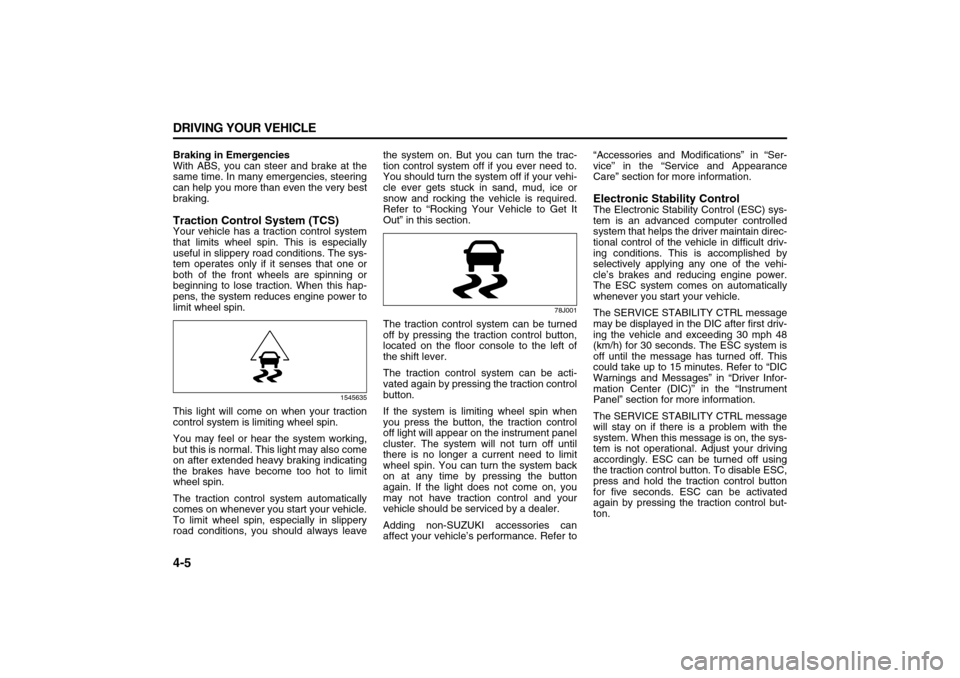
1545635
This light will come on when your traction
control system is limiting wheel spin.
You may feel or hear the system working,
but this is normal. This light may also come
on after extended heavy braking indicating
the brakes have become too hot to limit
wheel spin.
The traction control system automatically
comes on whenever you start your vehicle.
To limit wheel spin, especially in slippery
road conditions, you should always leavethe system on. But you can turn the trac-
tion control system off if you ever need to.
You should turn the system off if your vehi-
cle ever gets stuck in sand, mud, ice or
snow and rocking the vehicle is required.
Refer to “Rocking Your Vehicle to Get It
Out” in this section.
78J001
The traction control system can be turned
off by pressing the traction control button,
located on the floor console to the left of
the shift lever.
The traction control system can be acti-
vated again by pressing the traction control
button.
If the system is limiting wheel spin when
you press the button, the traction control
off light will appear on the instrument panel
cluster. The system will not turn off until
there is no longer a current need to limit
wheel spin. You can turn the system back
on at any time by pressing the button
again. If the light does not come on, you
may not have traction control and your
vehicle should be serviced by a dealer.
Adding non-SUZUKI accessories can
affect your vehicle’s performance. Refer to“Accessories and Modifications” in “Ser-
vice” in the “Service and Appearance
Care” section for more information.
Electronic Stability ControlThe Electronic Stability Control (ESC) sys-
tem is an advanced computer controlled
system that helps the driver maintain direc-
tional control of the vehicle in difficult driv-
ing conditions. This is accomplished by
selectively applying any one of the vehi-
cle’s brakes and reducing engine power.
The ESC system comes on automatically
whenever you start your vehicle.
The SERVICE STABILITY CTRL message
may be displayed in the DIC after first driv-
ing the vehicle and exceeding 30 mph 48
(km/h) for 30 seconds. The ESC system is
off until the message has turned off. This
could take up to 15 minutes. Refer to “DIC
Warnings and Messages” in “Driver Infor-
mation Center (DIC)” in the “Instrument
Panel” section for more information.
The SERVICE STABILITY CTRL message
will stay on if there is a problem with the
system. When this message is on, the sys-
tem is not operational. Adjust your driving
accordingly. ESC can be turned off using
the traction control button. To disable ESC,
press and hold the traction control button
for five seconds. ESC can be activated
again by pressing the traction control but-
ton.
Page 166 of 274

4-8 DRIVING YOUR VEHICLE
78J00-03E
into the right lane again. A simple maneu-
ver?
Not necessarily! Passing another vehicle
on a two-lane highway is a potentially dan-
gerous move, since the passing vehicle
occupies the same lane as oncoming traf-
fic for several seconds. A miscalculation,
an error in judgment, or a brief surrender to
frustration or anger can suddenly put the
passing driver face to face with the worst of
all traffic accidents – the head-on collision.
So here are some tips for passing:
Drive ahead. Look down the road, to the
sides, and to crossroads for situations
that might affect your passing patterns. If
you have any doubt whatsoever about
making a successful pass, wait for a bet-
ter time.
Watch for traffic signs, pavement mark-
ings, and lines. If you can see a sign up
ahead that might indicate a turn or an
intersection, delay your pass. A broken
center line usually indicates it is all right
to pass, providing the road ahead is
clear. Never cross a solid line on your
side of the lane or a double solid line,
even if the road seems empty of
approaching traffic.
Do not get too close to the vehicle you
want to pass while you are awaiting an
opportunity. For one thing, following too
closely reduces your area of vision,
especially if you are following a larger
vehicle. Also, you will not have adequatespace if the vehicle ahead suddenly
slows or stops. Keep back a reasonable
distance.
When it looks like a chance to pass is
coming up, start to accelerate but stay in
the right lane and do not get too close.
Time your move so you will be increas-
ing speed as the time comes to move
into the other lane. If the way is clear to
pass, you will have a running start that
more than makes up for the distance you
would lose by dropping back. And if
something happens to cause you to can-
cel your pass, you need only slow down
and drop back again and wait for another
opportunity.
If other vehicles are lined up to pass a
slow vehicle, wait your turn. But take
care that someone is not trying to pass
you as you pull out to pass the slow vehi-
cle. Remember to glance over your
shoulder and check the blind spot.
Check your vehicle’s mirrors, glance
over your shoulder, and start your left
lane change signal before moving out of
the right lane to pass. When you are far
enough ahead of the passed vehicle to
see its front in your vehicle’s inside mir-
ror, activate the right lane change signal
and move back into the right lane.
Remember that your vehicle’s passen-
ger side outside mirror is convex. The
vehicle you just passed may seem to be
farther away from you than it really is. Try not to pass more than one vehicle at
a time on two-lane roads. Reconsider
before passing the next vehicle.
Do not overtake a slowly moving vehicle
too rapidly. Even though the brake lamps
are not flashing, it may be slowing down
or starting to turn.
If you are being passed, make it easy for
the following driver to get ahead of you.
Perhaps you can ease a little to the right.
Loss of ControlLet us review what driving experts say
about what happens when the three con-
trol systems – brakes, steering, and accel-
eration – do not have enough friction
where the tires meet the road to do what
the driver has asked.
In any emergency, do not give up. Keep
trying to steer and constantly seek an
escape route or area of less danger.
Skidding
In a skid, a driver can lose control of the
vehicle. Defensive drivers avoid most skids
by taking reasonable care suited to exist-
ing conditions, and by not overdriving
those conditions. But skids are always pos-
sible.
The three types of skids correspond to
your vehicle’s three control systems. In the
braking skid, your wheels are not rolling. In
the steering or cornering skid, too much
speed or steering in a curve causes tires to
slip and lose cornering force. And in the
Page 167 of 274

4-9 DRIVING YOUR VEHICLE
78J00-03E
acceleration skid, too much throttle causes
the driving wheels to spin.
A cornering skid is best handled by easing
your foot off the accelerator pedal.
Remember: Any traction control system
helps avoid only the acceleration skid. If
your traction system is off, then an acceler-
ation skid is also best handled by easing
your foot off the accelerator pedal. Refer to
“Traction Control System (TCS)” and
“Electronic Stability Control” in this section.
If your vehicle starts to slide, ease your
foot off the accelerator pedal and quickly
steer the way you want the vehicle to go. If
you start steering quickly enough, your
vehicle may straighten out. Always be
ready for a second skid if it occurs.
Of course, traction is reduced when water,
snow, ice, gravel, or other material is on
the road. For safety, you will want to slow
down and adjust your driving to these con-
ditions. It is important to slow down on slip-
pery surfaces because stopping distance
will be longer and vehicle control more lim-
ited.
While driving on a surface with reduced
traction, try your best to avoid sudden
steering, acceleration, or braking, including
reducing vehicle speed by shifting to a
lower gear. Any sudden changes could
cause the tires to slide. You may not realize
the surface is slippery until your vehicle is
skidding. Learn to recognize warning clues– such as enough water, ice, or packed
snow on the road to make a mirrored sur-
face – and slow down when you have any
doubt.
If you have the Anti-Lock Brake System
(ABS), remember: It helps avoid only the
braking skid. If you do not have ABS, then
in a braking skid, where the wheels are no
longer rolling, release enough pressure on
the brakes to get the wheels rolling again.
This restores steering control. Push the
brake pedal down steadily when you have
to stop suddenly. As long as the wheels
are rolling, you will have steering control.
Remember: Any Anti-Lock Brake System
(ABS) helps avoid only the braking skid.
Driving at NightNight driving is more dangerous than day
driving. One reason is that some drivers
are likely to be impaired – by alcohol or
drugs, with night vision problems, or by
fatigue.
Here are some tips on night driving.
Drive defensively.
Do not drink and drive.
Adjust the inside rearview mirror to
reduce glare from headlamps behind
you.
Since you cannot see as well, you may
need to slow down and keep more space
between you and other vehicles. Slow down, especially on higher speed
roads. Your vehicle’s headlamps can
light up only much road ahead.
In remote areas, watch for animals.
If you are tired, pull off the road in a safe
place and rest.
No one can see as well at night as in the
daytime. But as we get older these differ-
ences increase. A 50-year-old driver may
require at least twice much light to see the
same thing at night as a 20-year-old.
What you do in the daytime can also affect
your night vision. For example, if you
spend the day in bright sunshine you are
wise to wear sunglasses. Your eyes will
have less trouble adjusting to night. But if
you are driving, do not wear sunglasses at
night. They may cut down on glare from
headlamps, but they also make a lot of
things invisible.
You can be temporarily blinded by
approaching headlamps. It can take a sec-
ond or two, or even several seconds, for
your eyes to re-adjust to the dark. When
you are faced with severe glare, as from a
driver who does not lower the high beams,
or a vehicle with misaimed headlamps,
slow down a little. Avoid staring directly
into the approaching headlamps.
Keep the windshield and all the glass on
your vehicle clean – inside and out. Glare
at night is made much worse by dirt on the
glass. Even the inside of the glass can
Page 169 of 274

4-11 DRIVING YOUR VEHICLE
78J00-03E
Driving Through Deep Standing Water
Driving Through Flowing Water
Some Other Rainy Weather Tips
Turn on your low-beam headlamps – not
just your parking lamps – to help make
you more visible to others. Besides slowing down, allow some extra
following distance. And be especially
careful when you pass another vehicle.
Allow yourself more clear room ahead,
and be prepared to have your view
restricted by road spray.
Have good tires with proper tread depth.
Refer to “Tires” in the “Service and
Appearance Care” section.
City Driving
1527452
One of the biggest problems with city
streets is the amount of traffic on them.
You will want to watch out for what the
other drivers are doing and pay attention to
traffic signals.
Here are ways to increase your safety in
city driving:
Know the best way to get to where you
are going. Get a city map and plan yourtrip into an unknown part of the city just
as you would for a cross-country trip.
Try to use the freeways that rim and
crisscross most large cities. You will
save time and energy. Refer to “Freeway
Driving” in this section.
Treat a green light as a warning signal. A
traffic light is there because the corner is
busy enough to need it. When a light
turns green, and just before you start to
move, check both ways for vehicles that
have not cleared the intersection or may
be running the red light.
Freeway Driving
808373
Mile for mile, freeways – also called thru-
ways, parkways, expressways, turnpikes,
or superhighways – are the safest of all
roads. But they have their own special
rules.
CAUTION
If you drive too quickly through deep
puddles or standing water, water can
come in through the engine’s air
intake and badly damage the engine.
Never drive through water that is
slightly lower than the underbody of
your vehicle. If you cannot avoid
deep puddles or standing water,
drive through them very slowly.
WARNING
Flowing or rushing water creates
strong forces. If you try to drive
through flowing water, as you might
at a low water crossing, your vehicle
can be carried away. As little as six
inches of flowing water can carry
away a smaller vehicle. If this hap-
pens, you and other vehicle occu-
pants could drown. Do not ignore
police warning signs, and otherwise
be very cautious about trying to drive
through flowing water.
Page 173 of 274
4-15 DRIVING YOUR VEHICLE
78J00-03E
vehicle has a traction system, you will want
to slow down and adjust your driving to the
road conditions. Under certain conditions,
you may want to turn the traction system
off, such as when driving through deep
snow and loose gravel, to help maintain
vehicle motion at lower speeds. Refer to
“Traction Control System (TCS)” and
“Electronic Stability Control” in this section.
The Anti-Lock Brake System (ABS)
improves your vehicle’s stability when you
make a hard stop on a slippery road. Even
though you have ABS, you will want to
begin stopping sooner than you would on
dry pavement. Refer to “Anti-Lock Brake
System (ABS)” in this section.
Allow greater following distance on any
slippery road.
Watch for slippery spots. The road might
be fine until you hit a spot that is covered
with ice. On an otherwise clear road, ice
patches may appear in shaded areas
where the sun cannot reach, such as
around clumps of trees, behind build-
ings, or under bridges. Sometimes the
surface of a curve or an overpass may
remain icy when the surrounding roads
are clear. If you see a patch of ice ahead
of you, brake before you are on it. Try not
to brake while you are actually on the
ice, and avoid sudden steering maneu-
vers.If You Are Caught in a Blizzard
If you are stopped by heavy snow, you
could be in a serious situation. You should
probably stay with your vehicle unless you
know for sure that you are near help and
you can hike through the snow. Here are
some things to do to summon help and
keep yourself and your passengers safe:
Turn on your hazard flashers.
Tie a red cloth to your vehicle to alert
police that you have been stopped by the
snow.
Put on extra clothing or wrap a blanket
around you. If you do not have blankets
or extra clothing, make body insulators
from newspapers, burlap bags, rags,
floor mats – anything you can wrap
around yourself or tuck under your cloth-
ing to keep warm.
808411
You can run the engine to keep warm, but
be careful.
Run your engine only as long as you must.
This saves fuel. When you run the engine,
make it go a little faster than just idle. That
is, push the accelerator slightly. This uses
less fuel for the heat that you get and it
keeps the battery charged.
You will need a well-charged battery to
restart the vehicle, and possibly for signal-
ing later on with your headlamps. Let the
heater run for a while.
Then, shut the engine off and close the
window almost all the way to preserve the
heat. Start the engine again and repeat
this only when you feel really uncomfort-
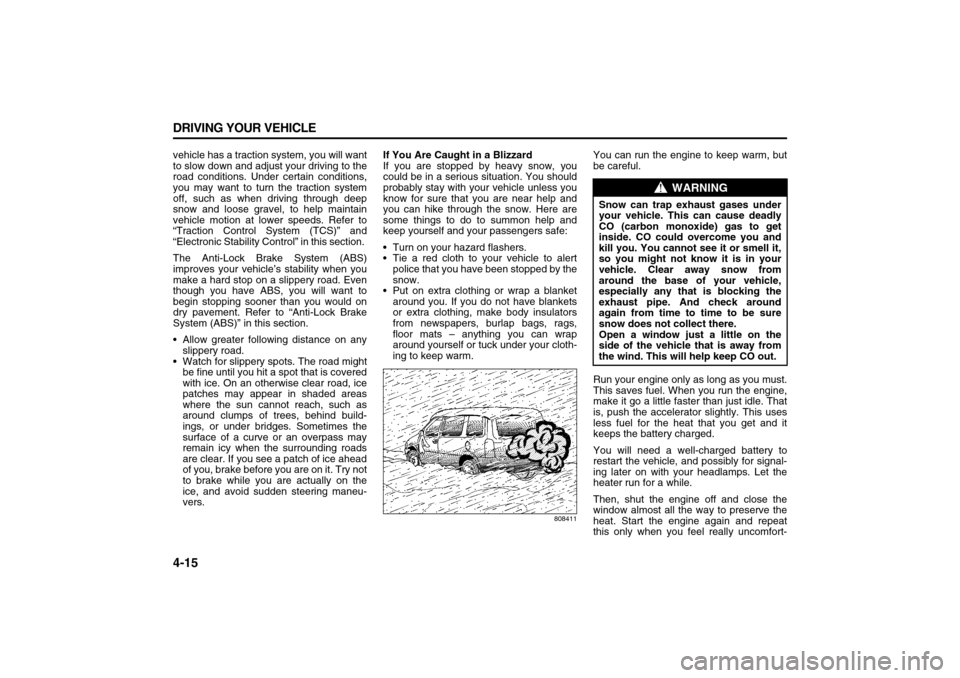
WARNING
Snow can trap exhaust gases under
your vehicle. This can cause deadly
CO (carbon monoxide) gas to get
inside. CO could overcome you and
kill you. You cannot see it or smell it,
so you might not know it is in your
vehicle. Clear away snow from
around the base of your vehicle,
especially any that is blocking the
exhaust pipe. And check around
again from time to time to be sure
snow does not collect there.
Open a window just a little on the
side of the vehicle that is away from
the wind. This will help keep CO out.
Page 179 of 274

4-21 DRIVING YOUR VEHICLE
78J00-03E
the ground. It can be towed with car carrier
equipment.Level ControlYour vehicle may have this feature. This
self-adjusting type of level control is fully
automatic and will provide a better leveled
riding position as well as better handling
under a variety of passenger and loading
conditions. The system is activated when
sufficient weight is added to the vehicle,
and will automatically adjust vehicle height
thereafter. A hydraulic pump inside each
rear shock absorber raises the rear of the
vehicle to the proper height, based on
inputs from the road surface, while the
vehicle is being driven. It takes approxi-
mately two miles (3.2 km) of driving for the
leveling to complete, depending on the
road surface conditions.
If the loaded vehicle is not moved for
approximately twelve hours, the leveling
system may bleed down to a lower height.
This can be especially apparent if a trailer
is left attached to a parked vehicle for long
periods of time. The vehicle must be driven
to re-level the vehicle. If a self-equalizing
hitch is being used, the vehicle should be
driven approximately two miles (3.2 km)
with the trailer prior to adjusting (leveling)
the hitch.
Towing a TrailerTo identify the trailering capacity of your
vehicle, you should read the information in
“Weight of the Trailer” that appears later in
this section. Trailering is different than just
driving your vehicle by itself. Trailering
means changes in handling, acceleration,
braking, durability, and fuel economy. Suc-cessful, safe trailering takes correct equip-
ment, and it has to be used properly.
That is the reason for this section. In it are
many time-tested, important trailering tips
and safety rules. Many of these are impor-
tant for your safety and that of your pas-
sengers. So please read this section
carefully before you pull a trailer.
If You Do Decide To Pull A Trailer
If you do, here are some important points:
There are many different laws, including
speed limit restrictions, having to do with
trailering. Make sure your rig will be
legal, not only where you live but also
where you will be driving. A good source
for this information can be state or pro-
vincial police.
Consider using a sway control. Refer to
“Hitches” later in this section.
Do not tow a trailer at all during the first
500 miles (800 km) your new vehicle is
driven. Your engine, axle or other parts
could be damaged.
During the first 500 miles (800 km) that
you tow a trailer, do not drive over 50
mph (80 km/h) and do not make starts at
full throttle. This helps your engine and
other parts of your vehicle wear in at the
heavier loads.
WARNING
If you do not use the correct equip-
ment and drive properly, you can lose
control when you pull a trailer. For
example, if the trailer is too heavy,
the brakes may not work well – or
even at all. You and your passengers
could be seriously injured. Pull a
trailer only if you have followed all
the steps in this section. Ask your
dealer for advice and information
about towing a trailer with your vehi-
cle.
CAUTION
Pulling a trailer improperly can dam-
age your vehicle and result in costly
repairs that would not be covered by
your warranty. Always follow the
instructions in this section and check
with your dealer for more information
about towing a trailer with your vehi-
cle.
Page 182 of 274

4-24 DRIVING YOUR VEHICLE
78J00-03E
your rig. Acquaint yourself with the feel of
handling and braking with the added
weight of the trailer. And always keep in
mind that the vehicle you are driving is now
a good deal longer and not nearly as
responsive as your vehicle is by itself.
Before you start, check all trailer hitch
parts and attachments, safety chains, elec-
trical connector, lamps, tires and mirror
adjustment. If the trailer has electric
brakes, start your vehicle and trailer mov-
ing and then apply the trailer brake control-
ler by hand to be sure the brakes are
working. This lets you check your electrical
connection at the same time.
During your trip, check occasionally to be
sure that the load is secure, and that the
lamps and any trailer brakes are still work-
ing.
Following Distance
Stay at least twice as far behind the vehicle
ahead as you would when driving your
vehicle without a trailer. This can help you
avoid situations that require heavy braking
and sudden turns.
Passing
You will need more passing distance up
ahead when you are towing a trailer. And,
because you are a good deal longer, you
will need to go much farther beyond the
passed vehicle before you can return to
your lane.Backing Up
Hold the bottom of the steering wheel with
one hand. Then, to move the trailer to the
left, just move that hand to the left. To
move the trailer to the right, move your
hand to the right. Always back up slowly
and, if possible, have someone guide you.
Making Turns
When you are turning with a trailer, make
wider turns than normal. Do this so your
trailer will not strike soft shoulders, curbs,
road signs, trees or other objects. Avoid
jerky or sudden maneuvers. Signal well in
advance.
Turn Signals When Towing a Trailer
When you tow a trailer, your vehicle has to
have extra wiring.
The arrows on your instrument panel will
flash whenever you signal a turn or lane
change. Properly hooked up, the trailer
lamps will also flash, telling other drivers
you are about to turn, change lanes or
stop.When towing a trailer, the arrows on your
instrument panel will flash for turns even if
the bulbs on the trailer are burned out.
Thus, you may think drivers behind you are
seeing your signal when they are not. It’s
important to check occasionally to be sure
the trailer bulbs are still working.
Driving On Grades
Reduce speed and shift to a lower gear
before you start down a long or steep
downgrade. If you do not shift down, you
might have to use your brakes so much
that they would get hot and no longer work
well.
Parking on Hills
But if you ever have to park your rig on a
hill, do the following:
1) Apply your regular brakes, but do not
shift into PARK (P) yet.
2) Have someone place chocks under the
trailer wheels.
3) When the wheel chocks are in place,
release the regular brakes until the
chocks absorb the load.
CAUTION
Making very sharp turns while traile-
ring could cause the trailer to come
in contact with the vehicle. Your vehi-
cle could be damaged. Avoid making
very sharp turns while trailering.
WARNING
You really should not park your vehi-
cle, with a trailer attached, on a hill. If
something goes wrong, your rig
could start to move. People can be
injured, and both your vehicle and
the trailer can be damaged.
Page 183 of 274

4-25 DRIVING YOUR VEHICLE
78J00-03E
4) Reapply the regular brakes. Then apply
your parking brake, and then shift to
PARK (P).
5) Release the regular brakes.
When You Are Ready to Leave After
Parking on a Hill
1) Apply your regular brakes and hold the
pedal down while you do the following:
1. Start your engine.
2. Shift into a gear.
3. Release the parking brake.
2) Let up on the brake pedal.
3) Drive slowly until the trailer is clear of
the chocks.
4) Stop and have someone pick up and
store the chocks.
Maintenance When Trailer Towing
Your vehicle will need service more often
when you are pulling a trailer. See the
Maintenance Schedule for more on this.
Things that are especially important in
trailer operation are automatic transaxle
fluid, engine oil, belts, cooling system and
brake system. Each of these is covered in
this manual, and the Index will help you
find them quickly. If you are trailering, it is a
good idea to review these sections before
you start your trip.
Check periodically to see that all hitch nuts
and bolts are tight.