airbag off SUZUKI XL7 2007 2.G Owners Manual
[x] Cancel search | Manufacturer: SUZUKI, Model Year: 2007, Model line: XL7, Model: SUZUKI XL7 2007 2.GPages: 274, PDF Size: 6.12 MB
Page 7 of 274
78J00-03E
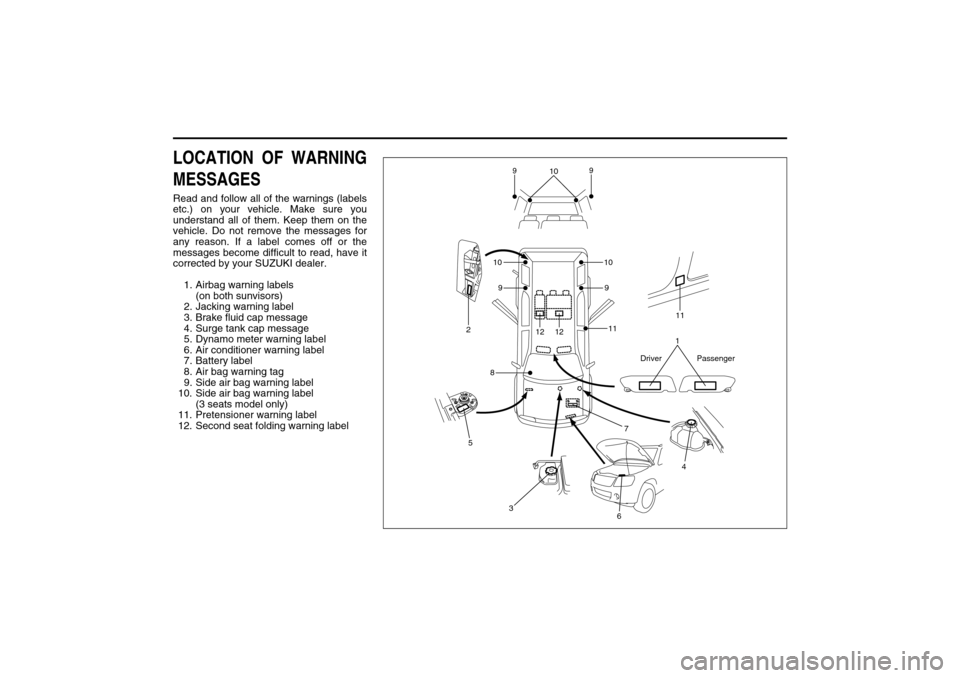
LOCATION OF WARNING
MESSAGESRead and follow all of the warnings (labels
etc.) on your vehicle. Make sure you
understand all of them. Keep them on the
vehicle. Do not remove the messages for
any reason. If a label comes off or the
messages become difficult to read, have it
corrected by your SUZUKI dealer.
1. Airbag warning labels
(on both sunvisors)
2. Jacking warning label
3. Brake fluid cap message
4. Surge tank cap message
5. Dynamo meter warning label
6. Air conditioner warning label
7. Battery label
8. Air bag warning tag
9. Side air bag warning label
10. Side air bag warning label
(3 seats model only)
11. Pretensioner warning label
12. Second seat folding warning label
9
109
12 12
9 10
9 10
11
1114
67
3
5
8
2
Driver Passenger
Page 22 of 274

1-10 SEATS AND RESTRAINT SYSTEMS
78J00-03E
805928
Get it up to speed. Then stop the vehicle.
The rider does not stop.
805931
The person keeps going until stopped by
something. In a real vehicle, it could be the
windshield...
809245
or the instrument panel...
805935
or the safety belts!
With safety belts, you slow down as the
vehicle does. You get more time to stop.
You stop over more distance, and yourstrongest bones take the forces. That is
why safety belts make such good sense.
Questions and Answers About
Safety BeltsQuestion:
Will I be trapped in the vehicle after an
accident if I am wearing a safety belt?
Answer:
You could be – whether you are wearing a
safety belt or not. But you can unbuckle a
safety belt, even if you are upside down.
And your chance of being conscious dur-
ing and after an accident, so you can
unbuckle and get out, is much greater if
you are belted.
Question:
If my vehicle has airbags, why should I
have to wear safety belts?
Answer:
Airbags are supplemental systems only; so
they work with safety belts – not instead of
them. Every airbag system ever offered for
sale has required the use of safety belts.
Even if you are in a vehicle that has air-
bags, you still have to buckle up to get the
most protection. That is true not only in
frontal collisions, but especially in side and
other collisions.
Page 32 of 274
1-20 SEATS AND RESTRAINT SYSTEMS
78J00-03E
1379304 1379315
Question:
What are the different types of add-on
child restraints?
Answer:
Add-on child restraints, which are pur-
chased by the vehicle’s owner, are avail-
able in four basic types. Selection of a
particular restraint should take into consid-
eration not only the child’s weight, height,
and age but also whether or not the
restraint will be compatible with the motor
vehicle in which it will be used.
For most basic types of child restraints,
there are many different models available.
When purchasing a child restraint, be sure
it is designed to be used in a motor vehicle.
If it is, the restraint will have a label saying
that it meets federal motor vehicle safety
standards.
WARNING
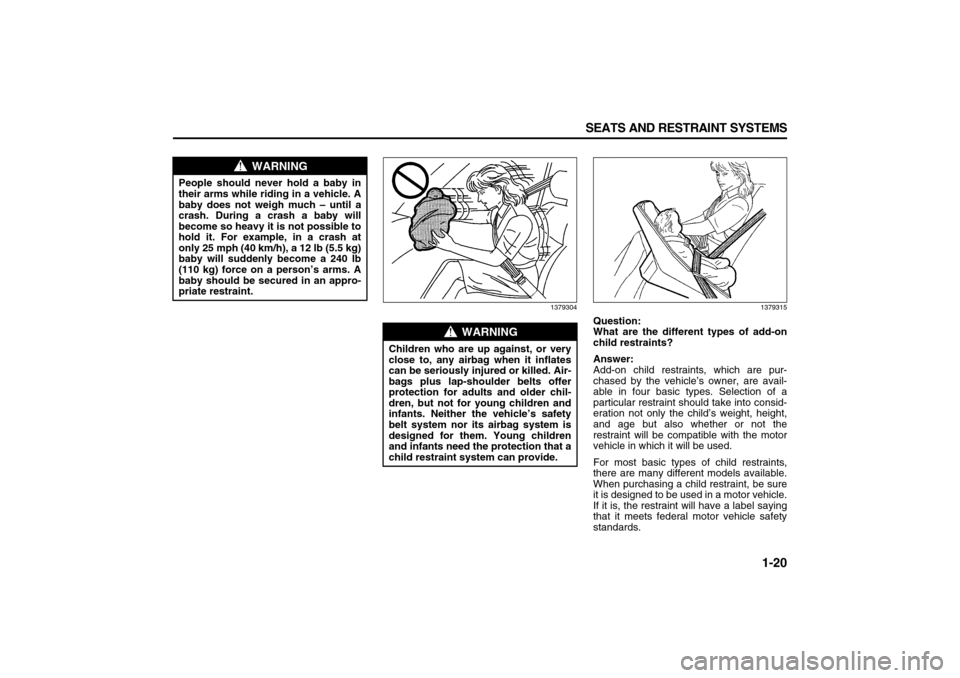
People should never hold a baby in
their arms while riding in a vehicle. A
baby does not weigh much – until a
crash. During a crash a baby will
become so heavy it is not possible to
hold it. For example, in a crash at
only 25 mph (40 km/h), a 12 lb (5.5 kg)
baby will suddenly become a 240 lb
(110 kg) force on a person’s arms. A
baby should be secured in an appro-
priate restraint.
WARNING
Children who are up against, or very
close to, any airbag when it inflates
can be seriously injured or killed. Air-
bags plus lap-shoulder belts offer
protection for adults and older chil-
dren, but not for young children and
infants. Neither the vehicle’s safety
belt system nor its airbag system is
designed for them. Young children
and infants need the protection that a
child restraint system can provide.
Page 36 of 274
1-24 SEATS AND RESTRAINT SYSTEMS
78J00-03E
endangered in a crash if the child is not
properly secured in the child restraint.Where to Put the RestraintAccident statistics show that children are
safer if they are restrained in the rear
rather than the front seat. We recommend
that child restraints be secured in a rear
seat, including an infant riding in a rear-
facing infant seat, a child riding in a for-
ward-facing child seat and an older child
riding in a booster seat. Never put a rear-
facing child restraint in the front passenger
seat. Here is why:There is limited space in the third row rear
seating area. If you want to secure a child
restraint in a rear seating position in the
third row, be sure to study the instructions
that came with your child restraint to see if
there is enough room to secure your seat
properly. If the length of the seat cushion is
too short for your child restraint and you
cannot install it in accordance with the
child restraint manufacturers instructions,
secure it in the second row.
If you need to secure more than one child
restraint in the rear seat, review the follow-
ing illustrations.
NOTE:
Depending on where you place the child
restraint or the size of the child restraint,
you may not be able to access certain
safety belt assemblies for additional pas-
sengers or LATCH anchors for child
restraints. For more information about
where to place the child restraint, refer to
“Lower Anchor and Top Tether Anchor
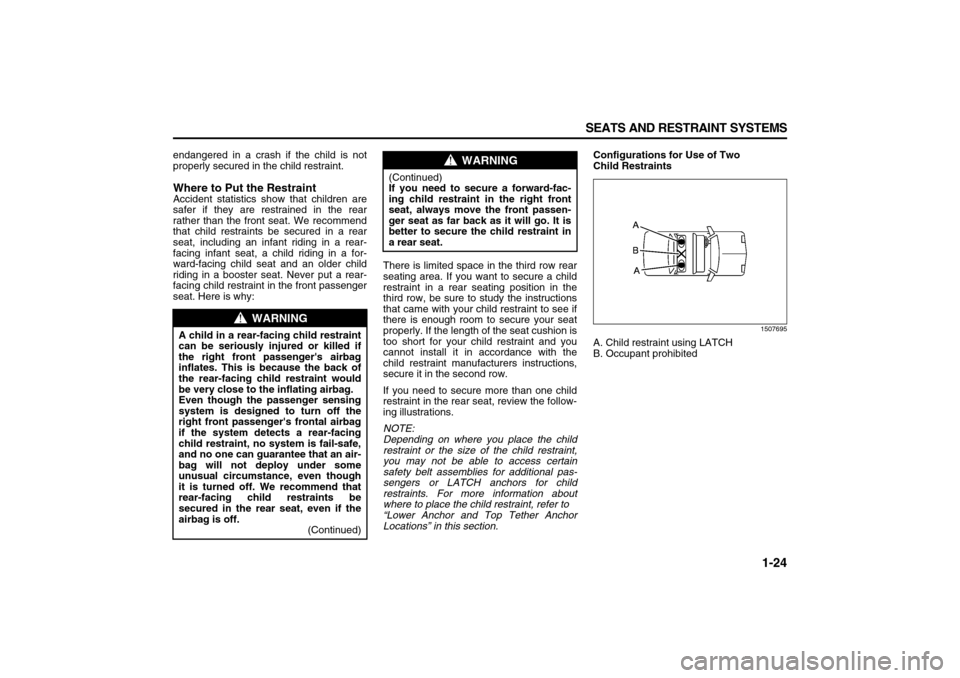
Locations” in this section.Configurations for Use of Two
Child Restraints
1507695
A. Child restraint using LATCH
B. Occupant prohibited
WARNING
A child in a rear-facing child restraint
can be seriously injured or killed if
the right front passenger's airbag
inflates. This is because the back of
the rear-facing child restraint would
be very close to the inflating airbag.
Even though the passenger sensing
system is designed to turn off the
right front passenger's frontal airbag
if the system detects a rear-facing
child restraint, no system is fail-safe,
and no one can guarantee that an air-
bag will not deploy under some
unusual circumstance, even though
it is turned off. We recommend that
rear-facing child restraints be
secured in the rear seat, even if the
airbag is off.
(Continued)
WARNING
(Continued)
If you need to secure a forward-fac-
ing child restraint in the right front
seat, always move the front passen-
ger seat as far back as it will go. It is
better to secure the child restraint in
a rear seat.
Page 43 of 274

1-31 SEATS AND RESTRAINT SYSTEMS
78J00-03E
Securing a Child Restraint in the
Right Front Seat PositionYour vehicle has a right front passenger's
airbag. A rear seat is a safer place to
secure a forward-facing child restraint.
Refer to “Where to Put the Restraint” in
this section.
In addition, your vehicle has a passenger
sensing system. The passenger sensing
system is designed to turn off the right
front passenger’s frontal airbag when an
infant in a rear-facing infant seat or a small
child in a forward-facing child restraint or
booster seat is detected. Refer to “Passen-
ger Sensing System” in this section and
“Passenger Airbag Status Indicator” in
“Warning Lights, Gages, and Indicators” in
the “Instrument Panel” section for more
information on this including important
safety information.
A label on your sun visor says, “Never put
a rear-facing child seat in the front.” This is
because the risk to the rear-facing child is
so great, if the airbag deploys.
If your vehicle does not have a rear seat
that will accommodate a rear-facing child
restraint, never put a child in a rear-facing
child restraint in the right front passenger
seat unless the passenger airbag status
indicator shows off and the airbag is off.
Here is why:If you need to secure a forward-facing
child restraint in the right front seat posi-
tion, move the seat as far back as it will go
before securing the forward-facing child
WARNING
A child in a rear-facing child restraint
can be seriously injured or killed if
the right front passenger's airbag
inflates. This is because the back of
the rear-facing child restraint would
be very close to the inflating airbag.
Even though the passenger sensing
system is designed to turn off the
right front passenger's frontal airbag
if the system detects a rear-facing
child restraint, no system is fail-safe,
and no one can guarantee that an air-
bag will not deploy under some
unusual circumstance, even though it
is turned off. We recommend that
rear-facing child restraints be
secured in the rear seat, even if the
airbag is off.
If you need to secure a forward-fac-
ing child restraint in the right front
seat, always move the front passen-
ger seat as far back as it will go. It is
better to secure the child restraint in
a rear seat.
WARNING
A child in a rear-facing child restraint
can be seriously injured or killed if
the right front passenger's airbag
inflates. This is because the back of
the rear-facing child restraint would
be very close to the inflating airbag.
Be sure the airbag is off before using
a rear-facing child restraint in the
right front seat position.
Even though the passenger sensing
system is designed to turn off the
passenger's frontal airbag if the sys-
tem detects a rear-facing child
restraint, no system is fail-safe, and
no one can guarantee that an airbag
will not deploy under some unusual
circumstance, even though it is
turned off. We recommend that rear-
facing child restraints be transported
in vehicles with a rear seat that will
accommodate a rear-facing child
restraint, whenever possible.
If you need to secure a forward-fac-
ing child restraint in the right front
seat, always move the front passen-
ger seat as far back as it will go. It is
better to secure the child restraint in
a rear seat.
Page 44 of 274
1-32 SEATS AND RESTRAINT SYSTEMS
78J00-03E
restraint. Refer to “Manual Seats” in this
section.
If your child restraint has the LATCH sys-
tem, refer to “Lower Anchors and Tethers
for Children (LATCH)” in this section.
There is no top tether anchor at the right
front seating position. Do not secure a
child seat in this position if a national or
local law requires that the top tether be
anchored or if the instructions that come
with the child restraint say that the top
tether must be anchored. Refer to “Lower
Anchors and Tethers for Children
(LATCH)” in this section if the child
restraint has a top tether.
You will be using the lap-shoulder belt to
secure the child restraint in this position.
Be sure to follow the instructions that came
with the child restraint. Secure the child in
the child restraint when and as the instruc-
tions say.
1) Your vehicle has a right front passen-
ger’s frontal airbag. Refer to “Passen-
ger Sensing System” in this section. We
recommend that rear-facing child
restraints be secured in a rear seat,
even if the airbag is off. If your child
restraint is for ward-facing, move the
seat as far back as it will go before
securing the child restraint in this seat.
Refer to “Manual Seats” in this section.
When the passenger sensing system
has turned off the right front passen-ger’s frontal airbag, the off indicator in
the passenger airbag status indicator
should light and stay lit when you turn
the ignition to RUN or START. Refer to
“Passenger Airbag Status Indicator” in
“Warning Lights, Gages, and Indica-
tors” in the “Instrument Panel” section.
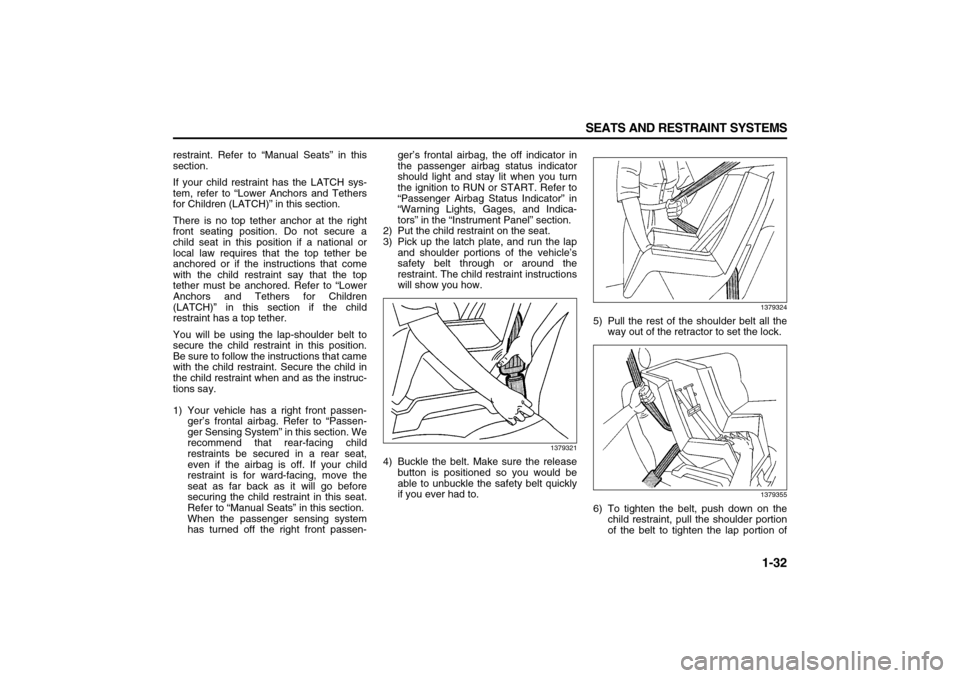
2) Put the child restraint on the seat.
3) Pick up the latch plate, and run the lap
and shoulder portions of the vehicle’s
safety belt through or around the
restraint. The child restraint instructions
will show you how.
1379321
4) Buckle the belt. Make sure the release
button is positioned so you would be
able to unbuckle the safety belt quickly
if you ever had to.
1379324
5) Pull the rest of the shoulder belt all the
way out of the retractor to set the lock.
1379355
6) To tighten the belt, push down on the
child restraint, pull the shoulder portion
of the belt to tighten the lap portion of
Page 45 of 274

1-33 SEATS AND RESTRAINT SYSTEMS
78J00-03E
the belt, and feed the shoulder belt
back into the retractor. If you are using
a forward-facing child restraint, you
may find it helpful to use your knee to
push down on the child restraint as you
tighten the belt. You should not be able
to pull more of the belt from the retrac-
tor once the lock has been set.
7) Push and pull the child restraint in dif-
ferent directions to be sure it is secure.
8) If the airbag is off, the off indicator on
the instrument panel will be lit and stay
lit when the key is turned to RUN or
START.
If a child restraint has been installed and
the on indicator is lit, turn the vehicle off.
Remove the child restraint from the vehicle
and reinstall the child restraint.
If, after reinstalling the child restraint and
restarting the vehicle, the on indicator is
still lit, check to make sure that the vehi-
cle’s seatback is not pressing the child
restraint into the seat cushion. If this hap-
pens, slightly recline the vehicle’s seatback
and adjust the seat cushion if possible.
Also make sure the child restraint is not
trapped under the vehicle head restraint. If
this happens, adjust the head restraint.
If the on indicator is still lit, secure the child
in the child restraint in a rear seat position
in the vehicle if one is available and check
with your dealer.To remove the child restraint, if the top
tether is attached to the top tether anchor,
disconnect it. Unbuckle the vehicle’s safety
belt and let it go back all the way. The
safety belt will move freely again and be
ready to work for an adult or larger child
passenger.
Airbag SystemYour vehicle has a frontal airbag for the
driver and a frontal airbag for the right front
passenger. Your vehicle also has roof-
mounted rollover airbags designed for
either side impact or rollover deployment.
Roof-mounted rollover airbags are avail-
able for the driver and the passenger
seated directly behind the driver and for
the right front passenger and the passen-
ger seated directly behind that passenger.
For roof-mounted rollover airbags, the
word AIRBAG will appear along the head-
liner or trim.
Also, if your vehicle has a third row pas-
senger seat, your vehicle will have third
row roof-mounted rollover airbags.
Airbags are designed to supplement the
protection provided by safety belts. Even
though today’s airbags are also designed
to help reduce the risk of injury from the
force of an inflating bag, all airbags must
inflate very quickly to do their job.
Here are the most important things to
know about the airbag system:
Page 47 of 274
1-35 SEATS AND RESTRAINT SYSTEMS
78J00-03E
808302
There is an airbag readiness light on the
instrument panel cluster, which shows the
airbag symbol.
The system checks the airbag electrical
system for malfunctions. The light tells you
if there is an electrical problem. Refer to
“Airbag Readiness Light” in “Warning
Lights, Gages, and Indicators” in the
“Instrument Panel” section for more infor-
mation.
Where Are the Airbags?
1177656
The driver’s airbag is in the middle of the
steering wheel.
809967
The right front passenger’s airbag is in the
instrument panel on the passenger’s side.
WARNING
Anyone who is up against, or very
close to, any airbag when it inflates
can be seriously injured or killed. Air-
bags plus lap-shoulder belts offer the
best protection for adults, but not for
young children and infants. Neither
the vehicle’s safety belt system nor
its airbag system is designed for
them. Young children and infants
need the protection that a child
restraint system can provide. Always
secure children properly in your vehi-
cle. To read how, refer to “Older Chil-
dren” or “Infants and Young
Children” in this section.
Occupants should not lean on or
sleep against the door in the first or
second row seats, or the rear win-
dows in the third row seat, if your
vehicle has roof-mounted rollover
airbags.
Page 50 of 274

1-38 SEATS AND RESTRAINT SYSTEMS
78J00-03E
impact, and how quickly the vehicle slows
down. For roof-mounted rollover airbags,
inflation is determined by the location and
severity of the impact or a rollover event.What Makes an Airbag Inflate?In an impact of sufficient severity, the air-
bag sensing system detects that the vehi-
cle is in a crash. In the case of a roof-
mounted rollover airbag, the sensing sys-
tem detects that the vehicle is about to roll
over or has been in a severe frontal or side
impact. The sensing system triggers a
release of gas from the inflator, which
inflates the airbag. The inflator, airbag, and
related hardware are all part of the airbag
modules inside the steering wheel and in
the instrument panel in front of the right
front passenger. For vehicles with roof-
mounted rollover airbags, the airbag mod-
ules are located in the ceiling of the vehi-
cle, near the side windows.
If your vehicle has a third row seat with
roof-mounted rollover airbags, the airbag
modules are located inside the rear-most
pillar trim and above in the ceiling above
the fixed rear glass.How Does an Airbag Restrain?In moderate to severe frontal or near fron-
tal collisions, even belted occupants can
contact the steering wheel or the instru-
ment panel. In moderate to severe side
collisions, even belted occupants can con-
tact the inside of the vehicle. Airbags sup-plement the protection provided by safety
belts. Airbags distribute the force of the
impact more evenly over the occupant's
upper body, stopping the occupant more
gradually. But the frontal airbags would not
help you in many types of collisions,
including rollovers, rear impacts, and many
side impacts, primarily because an occu-
pant's motion is not toward the airbag.
Roof-mounted rollover airbags would not
help you in many types of collisions,
including many frontal or near frontal colli-
sions, and rear impacts.
Airbags should never be regarded as any-
thing more than a supplement to safety
belts, and then only in moderate to severe
frontal or near-frontal collisions for the
driver's and right front passenger’s frontal
airbags, and only in moderate to severe
side collisions or rollovers for vehicles with
roof-mounted rollover airbags.
What Will You See After an Airbag
Inflates?After a frontal airbag inflates, it quickly
deflates, so quickly that some people may
not even realize an airbag inflated. Roof-
mounted rollover airbags may still be at
least partially inflated minutes after the
vehicle comes to rest. Some components
of the airbag module – the steering wheel
hub for the driver's airbag, the instrument
panel for the right front passenger's airbag,
and the area along the ceiling of the vehi-
cle near the side windows for vehicles withroof-mounted side impact airbags – may
be hot for a short time. The parts of the air-
bag that come into contact with you may
be warm, but not too hot to touch. There
may be some smoke and dust coming from
the vents in the deflated airbags. Airbag
inflation does not prevent the driver from
seeing out of the windshield or being able
to steer the vehicle, nor does it prevent
people from leaving the vehicle.
Your vehicle has a feature that may auto-
matically unlock the doors, turn the interior
lamps on, and flash the hazard warning
flashers when the airbags inflate. You can
lock the doors again, turn the interior
lamps off, and turn off the hazard warning
flashers by using the controls for those
features.
WARNING
When an airbag inflates, there may be
dust in the air. This dust could cause
breathing problems for people with a
history of asthma or other breathing
trouble. To avoid this, everyone in the
vehicle should get out as soon as it is
safe to do so. If you have breathing
problems but cannot get out of the
vehicle after an airbag inflates, then
get fresh air by opening a window or
a door. If you experience breathing
problems following an airbag deploy-
ment, you should seek medical atten-
tion.
Page 51 of 274
1-39 SEATS AND RESTRAINT SYSTEMS
78J00-03E
In many crashes severe enough to inflate
the airbag, windshields are broken by vehi-
cle deformation. Additional windshield
breakage may also occur from the right
front passenger airbag.
Airbags are designed to inflate only
once. After an airbag inflates, you will
need some new parts for your airbag
system. If you do not get them, the air-
bag system will not be there to help pro-
tect you in another crash. A new system
will include airbag modules and possibly
other parts. The service manual for your
vehicle covers the need to replace other
parts.
Your vehicle has a crash sensing and
diagnostic module which records infor-
mation after a crash.
Let only qualified technicians work on
the airbag system. Improper service can
mean that an airbag system will not work
properly. See your dealer for service.Passenger Sensing SystemYour vehicle has a passenger sensing sys-
tem for the right front passenger. The pas-
senger airbag status indicator will be
visible when you start your vehicle in the
instrument panel.United States
1476572
Canada
1476529
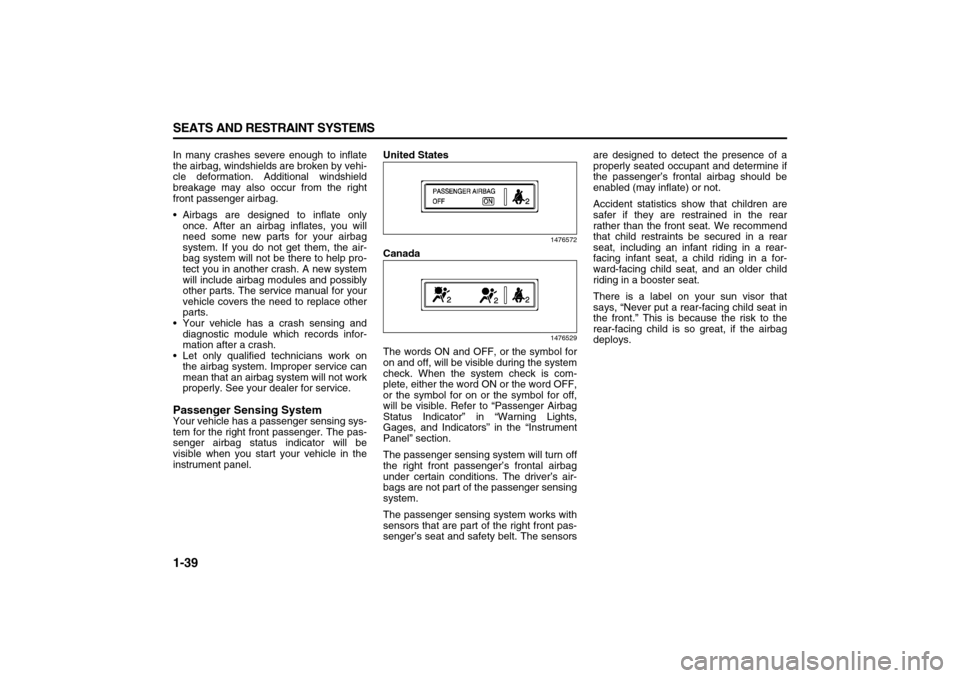
The words ON and OFF, or the symbol for
on and off, will be visible during the system
check. When the system check is com-
plete, either the word ON or the word OFF,
or the symbol for on or the symbol for off,
will be visible. Refer to “Passenger Airbag
Status Indicator” in “Warning Lights,
Gages, and Indicators” in the “Instrument
Panel” section.
The passenger sensing system will turn off
the right front passenger’s frontal airbag
under certain conditions. The driver’s air-
bags are not part of the passenger sensing
system.
The passenger sensing system works with
sensors that are part of the right front pas-
senger’s seat and safety belt. The sensorsare designed to detect the presence of a
properly seated occupant and determine if
the passenger’s frontal airbag should be
enabled (may inflate) or not.
Accident statistics show that children are
safer if they are restrained in the rear
rather than the front seat. We recommend
that child restraints be secured in a rear
seat, including an infant riding in a rear-
facing infant seat, a child riding in a for-
ward-facing child seat, and an older child
riding in a booster seat.
There is a label on your sun visor that
says, “Never put a rear-facing child seat in
the front.” This is because the risk to the
rear-facing child is so great, if the airbag
deploys.