door lock SUZUKI XL7 2007 2.G Owners Manual
[x] Cancel search | Manufacturer: SUZUKI, Model Year: 2007, Model line: XL7, Model: SUZUKI XL7 2007 2.GPages: 274, PDF Size: 6.12 MB
Page 1 of 274

Part No. 99011-78J00-03E
September, 2006
OWNER’S MANUAL
99011-78J00-03E XL7
Printed in U.S.A.
See page 5-2
Keep With Vehicle At All Times.
Contains Important Information
On Safety, Operation & Maintenance. SERVICE STATION INFORMATION
Fuel recommendation: Brake and clutch fluid:
Tire cold pressure:
DOT3
See the “Tire Information Label” located on the
driver’s door lock pillar.
ENGLISH
Suzuki Red: Magenta 100%, Yellow 100%
Suzuki Blue: Cyan 100%, Magenta 70%
Engine oil recommendation:
Standard: GM6094M
Viscosity: SAE 5W-30
For further details, see “Engine Oil” in the
“SERVICE AND APPEARANCE CARE” section.2007Engine oil with “Starburst” symbol
12.0 mm
Page 5 of 274
78J00-03E
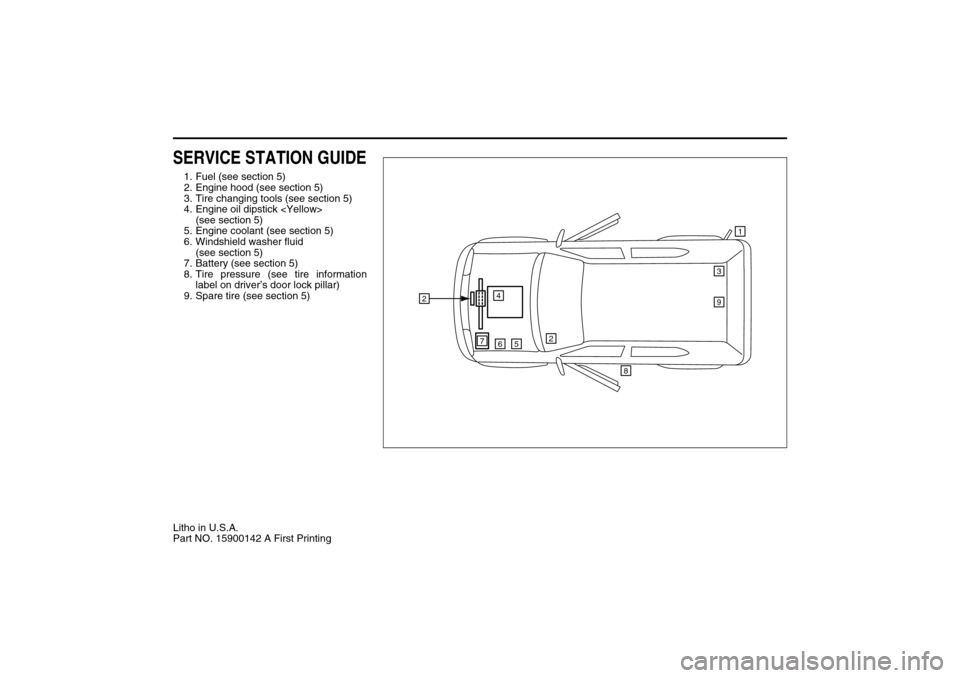
SERVICE STATION GUIDE1. Fuel (see section 5)
2. Engine hood (see section 5)
3. Tire changing tools (see section 5)
4. Engine oil dipstick
(see section 5)
5. Engine coolant (see section 5)
6. Windshield washer fluid
(see section 5)
7. Battery (see section 5)
8. Tire pressure (see tire information
label on driver’s door lock pillar)
9. Spare tire (see section 5)
Litho in U.S.A.
Part NO. 15900142 A First Printing
2
2
46
5
1
8
39
7
Page 23 of 274
1-11 SEATS AND RESTRAINT SYSTEMS
78J00-03E
Question:
If I am a good driver, and I never drive
far from home, why should I wear safety
belts?
Answer:
You may be an excellent driver, but if you
are in an accident – even one that is not
your fault – you and your passengers can
be hurt. Being a good driver does not pro-
tect you from things beyond your control,
such as bad drivers.
Most accidents occur within 25 miles (40
km) of home. And the greatest number of
serious injuries and deaths occur at
speeds of less than 40 mph (65 km/h).
Safety belts are for everyone.How to Wear Safety Belts ProperlyThis part is only for people of adult size.
Be aware that there are special things to
know about safety belts and children. And
there are different rules for smaller children
and babies. If a child will be riding in your
vehicle, refer to “Older Children” or “Infants
and Young Children” in this section. Follow
those rules for everyone’s protection.
First, you will want to know which restraint
systems your vehicle has.
We will start with the driver position.
Driver PositionLap-Shoulder Belt
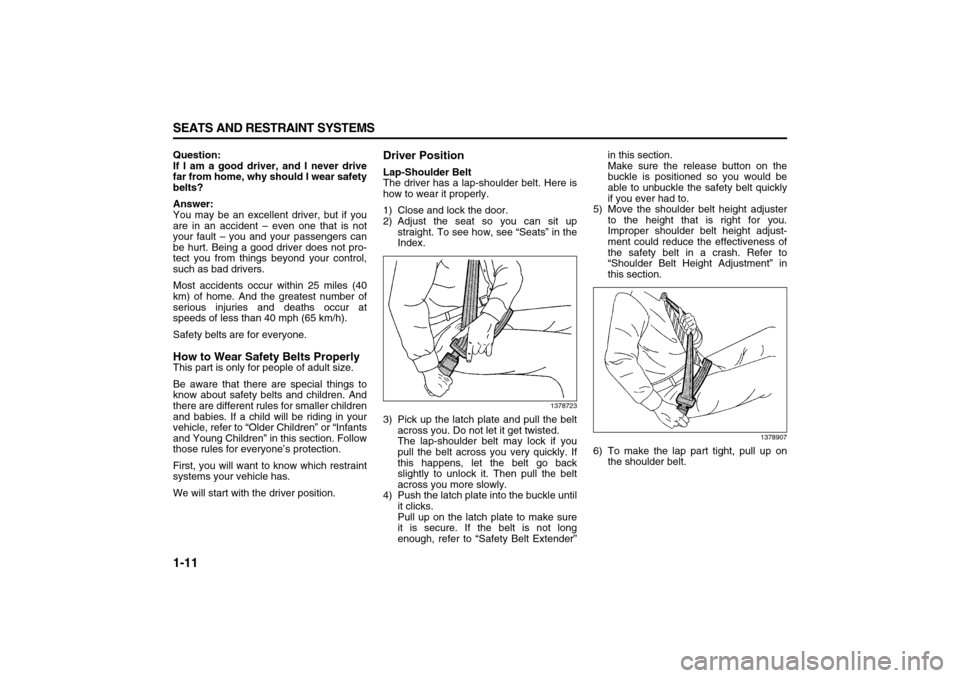
The driver has a lap-shoulder belt. Here is
how to wear it properly.
1) Close and lock the door.
2) Adjust the seat so you can sit up
straight. To see how, see “Seats” in the
Index.
1378723
3) Pick up the latch plate and pull the belt
across you. Do not let it get twisted.
The lap-shoulder belt may lock if you
pull the belt across you very quickly. If
this happens, let the belt go back
slightly to unlock it. Then pull the belt
across you more slowly.
4) Push the latch plate into the buckle until
it clicks.
Pull up on the latch plate to make sure
it is secure. If the belt is not long
enough, refer to “Safety Belt Extender”in this section.
Make sure the release button on the
buckle is positioned so you would be
able to unbuckle the safety belt quickly
if you ever had to.
5) Move the shoulder belt height adjuster
to the height that is right for you.
Improper shoulder belt height adjust-
ment could reduce the effectiveness of
the safety belt in a crash. Refer to
“Shoulder Belt Height Adjustment” in
this section.
1378907
6) To make the lap part tight, pull up on
the shoulder belt.
Page 26 of 274
1-14 SEATS AND RESTRAINT SYSTEMS
78J00-03E
1378915
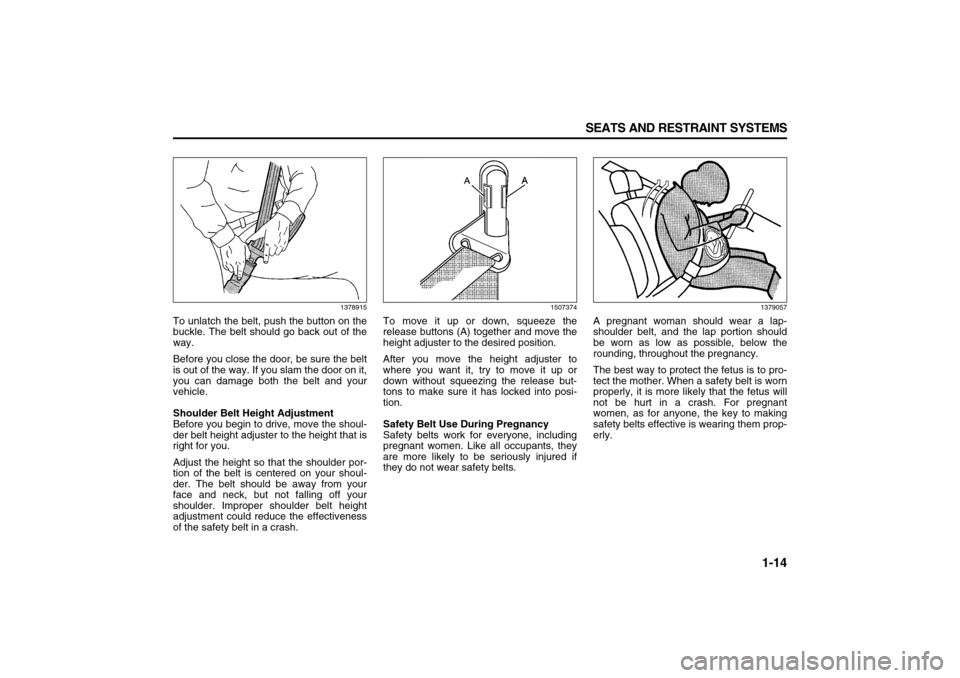
To unlatch the belt, push the button on the
buckle. The belt should go back out of the
way.
Before you close the door, be sure the belt
is out of the way. If you slam the door on it,
you can damage both the belt and your
vehicle.
Shoulder Belt Height Adjustment
Before you begin to drive, move the shoul-
der belt height adjuster to the height that is
right for you.
Adjust the height so that the shoulder por-
tion of the belt is centered on your shoul-
der. The belt should be away from your
face and neck, but not falling off your
shoulder. Improper shoulder belt height
adjustment could reduce the effectiveness
of the safety belt in a crash.
1507374
To move it up or down, squeeze the
release buttons (A) together and move the
height adjuster to the desired position.
After you move the height adjuster to
where you want it, try to move it up or
down without squeezing the release but-
tons to make sure it has locked into posi-
tion.
Safety Belt Use During Pregnancy
Safety belts work for everyone, including
pregnant women. Like all occupants, they
are more likely to be seriously injured if
they do not wear safety belts.
1379057
A pregnant woman should wear a lap-
shoulder belt, and the lap portion should
be worn as low as possible, below the
rounding, throughout the pregnancy.
The best way to protect the fetus is to pro-
tect the mother. When a safety belt is worn
properly, it is more likely that the fetus will
not be hurt in a crash. For pregnant
women, as for anyone, the key to making
safety belts effective is wearing them prop-
erly.
Page 49 of 274

1-37 SEATS AND RESTRAINT SYSTEMS
78J00-03E
When Should an Airbag Inflate?The driver’s and right front passenger’s
frontal airbags are designed to inflate in
moderate to severe frontal or near-frontal
crashes. But they are designed to inflate
only if the impact exceeds a predetermined
deployment threshold. Deployment thresh-
olds take into account a variety of desired
deployment and non-deployment events
and are used to predict how severe a crash
is likely to be in time for the airbags to
inflate and help restrain the occupants.
Whether your frontal airbags will or shoulddeploy is not based on how fast your vehi-
cle is traveling. It depends largely on what
you hit, the direction of the impact and how
quickly your vehicle slows down.
In addition, your vehicle has “dual-stage”
frontal airbags, which adjust the restraint
according to crash severity. Your vehicle
has electronic frontal sensors which help
the sensing system distinguish between a
moderate frontal impact and a more severe
frontal impact. For moderate frontal
impacts, these airbags inflate at a level
less than full deployment. For more severe
frontal impacts, full deployment occurs. If
the front of your vehicle goes straight into a
wall that does not move or deform, the
threshold level for the reduced deployment
is about 11 to 16 mph (17 to 26 km/h), and
the threshold level for a full deployment is
about 20 to 25 mph (32 to 40 km/h). The
threshold level can vary, however, with
specific vehicle design, so that it can be
somewhat above or below this range.
Frontal airbags may inflate at different
crash speeds. For example:
If the vehicle hits a stationary object, the
airbags could inflate at a different crash
speed than if the vehicle hits a moving
object.
If the vehicle hits an object that deforms,
the airbags could inflate at a different
crash speed than if the vehicle hits an
object that does not deform. If the vehicle hits a narrow object (like a
pole) the airbags could inflate at a differ-
ent crash speed than if the vehicle hits a
wide object (like a wall).
If the vehicle goes into an object at an
angle the airbags could inflate at a differ-
ent crash speed than if the vehicle goes
straight into the object.
The frontal airbags (driver and right front
passenger) are not intended to inflate dur-
ing vehicle rollovers, rear impacts, or in
many side impacts.
Your vehicle has roof-mounted rollover air-
bags and a rollover sensor. Refer to “Air-
bag System” in this section. These
“rollover capable” airbags are intended to
inflate in moderate to severe side crashes,
during a rollover or in a severe frontal
impact. A roof-mounted rollover airbag will
inflate if the crash severity is above the
system’s designed “threshold level.” The
threshold level can vary with specific vehi-
cle design. Roof-mounted rollover airbags
are not intended to inflate in rear impacts.
Both roof-mounted rollover airbags will
deploy when either side of the vehicle is
struck or during a rollover, or in a severe
frontal impact.
In any particular crash, no one can say
whether an airbag should have inflated
simply because of the damage to a vehicle
or because of what the repair costs were.
For frontal airbags, inflation is determined
by what the vehicle hits, the angle of the
WARNING
If something is between an occupant
and an airbag, the bag might not
inflate properly or it might force the
object into that person causing
severe injury or even death. The path
of an inflating airbag must be kept
clear. Do not put anything between
an occupant and an airbag, and do
not attach or put anything on the
steering wheel hub or on or near any
other airbag covering. And, if your
vehicle has roof-mounted rollover
airbags, never secure anything to the
roof of your vehicle by routing the
rope or tie down through any door or
window opening. If you do, the path
of an inflating side impact airbag will
be blocked. The path of an inflating
airbag must be kept clear.
Page 50 of 274

1-38 SEATS AND RESTRAINT SYSTEMS
78J00-03E
impact, and how quickly the vehicle slows
down. For roof-mounted rollover airbags,
inflation is determined by the location and
severity of the impact or a rollover event.What Makes an Airbag Inflate?In an impact of sufficient severity, the air-
bag sensing system detects that the vehi-
cle is in a crash. In the case of a roof-
mounted rollover airbag, the sensing sys-
tem detects that the vehicle is about to roll
over or has been in a severe frontal or side
impact. The sensing system triggers a
release of gas from the inflator, which
inflates the airbag. The inflator, airbag, and
related hardware are all part of the airbag
modules inside the steering wheel and in
the instrument panel in front of the right
front passenger. For vehicles with roof-
mounted rollover airbags, the airbag mod-
ules are located in the ceiling of the vehi-
cle, near the side windows.
If your vehicle has a third row seat with
roof-mounted rollover airbags, the airbag
modules are located inside the rear-most
pillar trim and above in the ceiling above
the fixed rear glass.How Does an Airbag Restrain?In moderate to severe frontal or near fron-
tal collisions, even belted occupants can
contact the steering wheel or the instru-
ment panel. In moderate to severe side
collisions, even belted occupants can con-
tact the inside of the vehicle. Airbags sup-plement the protection provided by safety
belts. Airbags distribute the force of the
impact more evenly over the occupant's
upper body, stopping the occupant more
gradually. But the frontal airbags would not
help you in many types of collisions,
including rollovers, rear impacts, and many
side impacts, primarily because an occu-
pant's motion is not toward the airbag.
Roof-mounted rollover airbags would not
help you in many types of collisions,
including many frontal or near frontal colli-
sions, and rear impacts.
Airbags should never be regarded as any-
thing more than a supplement to safety
belts, and then only in moderate to severe
frontal or near-frontal collisions for the
driver's and right front passenger’s frontal
airbags, and only in moderate to severe
side collisions or rollovers for vehicles with
roof-mounted rollover airbags.
What Will You See After an Airbag
Inflates?After a frontal airbag inflates, it quickly
deflates, so quickly that some people may
not even realize an airbag inflated. Roof-
mounted rollover airbags may still be at
least partially inflated minutes after the
vehicle comes to rest. Some components
of the airbag module – the steering wheel
hub for the driver's airbag, the instrument
panel for the right front passenger's airbag,
and the area along the ceiling of the vehi-
cle near the side windows for vehicles withroof-mounted side impact airbags – may
be hot for a short time. The parts of the air-
bag that come into contact with you may
be warm, but not too hot to touch. There
may be some smoke and dust coming from
the vents in the deflated airbags. Airbag
inflation does not prevent the driver from
seeing out of the windshield or being able
to steer the vehicle, nor does it prevent
people from leaving the vehicle.
Your vehicle has a feature that may auto-
matically unlock the doors, turn the interior
lamps on, and flash the hazard warning
flashers when the airbags inflate. You can
lock the doors again, turn the interior
lamps off, and turn off the hazard warning
flashers by using the controls for those
features.
WARNING
When an airbag inflates, there may be
dust in the air. This dust could cause
breathing problems for people with a
history of asthma or other breathing
trouble. To avoid this, everyone in the
vehicle should get out as soon as it is
safe to do so. If you have breathing
problems but cannot get out of the
vehicle after an airbag inflates, then
get fresh air by opening a window or
a door. If you experience breathing
problems following an airbag deploy-
ment, you should seek medical atten-
tion.
Page 56 of 274

FEATURES AND CONTROLS
2
78J00-03E
FEATURES AND CONTROLSKeys ...................................................................................... 2-1
Doors and Locks ................................................................. 2-5
Windows .............................................................................. 2-8
Theft-Deterrent Systems .................................................... 2-9
Daily Inspection Checklist .................................................. 2-11
Starting and Operating Your Vehicle ................................ 2-12
Mirrors .................................................................................. 2-20
Storage Areas ...................................................................... 2-21
Sunroof ................................................................................ 2-24
Page 58 of 274
2-2 FEATURES AND CONTROLS
78J00-03E
Remote Keyless Entry (RKE)
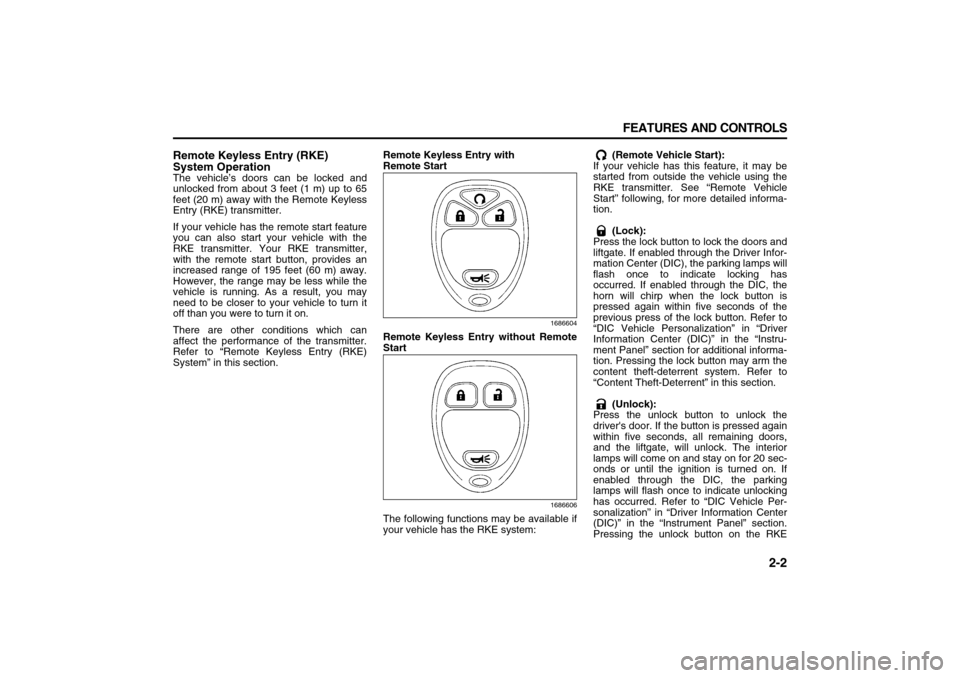
System OperationThe vehicle’s doors can be locked and
unlocked from about 3 feet (1 m) up to 65
feet (20 m) away with the Remote Keyless
Entry (RKE) transmitter.
If your vehicle has the remote start feature
you can also start your vehicle with the
RKE transmitter. Your RKE transmitter,
with the remote start button, provides an
increased range of 195 feet (60 m) away.
However, the range may be less while the
vehicle is running. As a result, you may
need to be closer to your vehicle to turn it
off than you were to turn it on.
There are other conditions which can
affect the performance of the transmitter.
Refer to “Remote Keyless Entry (RKE)
System” in this section.Remote Keyless Entry with
Remote Start
1686604
Remote Keyless Entry without Remote
Start
1686606
The following functions may be available if
your vehicle has the RKE system: (Remote Vehicle Start):
If your vehicle has this feature, it may be
started from outside the vehicle using the
RKE transmitter. See “Remote Vehicle
Start” following, for more detailed informa-
tion.
(Lock):
Press the lock button to lock the doors and
liftgate. If enabled through the Driver Infor-
mation Center (DIC), the parking lamps will
flash once to indicate locking has
occurred. If enabled through the DIC, the
horn will chirp when the lock button is
pressed again within five seconds of the
previous press of the lock button. Refer to
“DIC Vehicle Personalization” in “Driver
Information Center (DIC)” in the “Instru-
ment Panel” section for additional informa-
tion. Pressing the lock button may arm the
content theft-deterrent system. Refer to
“Content Theft-Deterrent” in this section.
(Unlock):
Press the unlock button to unlock the
driver's door. If the button is pressed again
within five seconds, all remaining doors,
and the liftgate, will unlock. The interior
lamps will come on and stay on for 20 sec-
onds or until the ignition is turned on. If
enabled through the DIC, the parking
lamps will flash once to indicate unlocking
has occurred. Refer to “DIC Vehicle Per-
sonalization” in “Driver Information Center
(DIC)” in the “Instrument Panel” section.
Pressing the unlock button on the RKE
Page 60 of 274

2-4 FEATURES AND CONTROLS
78J00-03E
Remote Vehicle StartYour vehicle may have the remote start
feature. This feature allows you to start the
engine from outside the vehicle. Refer to
“REMOTE START” under “DIC Vehicle
Personalization” in “Driver Information
Center (DIC)” in the “Instrument Panel”
section for instructions on how to enable
and disable this feature.
During a remote start, the climate control
system will turn on at the fan, temperature,
and mode settings the vehicle was set to
when the vehicle was last turned off and
will also turn on the rear window defogger.
Laws in some local communities may
restrict the use of remote starters. For
example, some laws may require a person
using remote start to have the vehicle in
view when doing so. Check local regula-
tions for any requirements on remote start-
ing of vehicles.
(Remote Vehicle Start):
Press and release the lock button and then
press and hold the remote start button to
start the vehicle.
Your RKE transmitter, with the remote start
button, provides an increased range of
operation. However, the range may be less
while the vehicle is running. As a result,
you may need to be closer to your vehicle
to turn it off, than you were to turn it on.If your vehicle is low on fuel, do not use the
remote start feature. The vehicle may run
out of fuel.
To start the engine using the remote start
feature, do the following:
1) Aim the RKE transmitter, that has a
remote vehicle start button, at the vehi-
cle.
2) Press and release the transmitter’s lock
button, then immediately press and
hold the remote vehicle start button
until the vehicle’s turn signal lamps
flash, or for at least four seconds, if the
vehicle’s lights are not visible. The vehi-
cle’s doors will be locked. Pressing the
remote start button again after the vehi-
cle has started will turn off the ignition.
3) When the vehicle’s engine starts, the
parking lamps will turn on and remain
on while the engine is running.
4) If it is your first remote start since last
driving, repeat these steps while the
engine is still running for a 10 minute
time extension.
When you enter the vehicle during a
remote start, and the engine is still running,
turn the key to the RUN position to drive
the vehicle
.After a remote start, the engine will auto-
matically shut off after 10 minutes unless a
time extension has been done or the vehi-
cle’s key is inserted into the ignition switch
and turned to RUN.The maximum number of remote starts or
remote start attempts between ignition
cycles with the key is two.
If the remote start procedure is used again
before the first 10 minute time frame has
ended, the first 10 minutes will immediately
expire and the second 10 minute time
frame will start.
For example, if the lock button and then
the remote start buttons are pressed again
after the vehicle has been running for five
minutes, 10 minutes are added, allowing
the engine to run for 15 minutes.
After your vehicle’s engine has been
started two times using the remote vehicle
start button, the vehicle’s ignition switch
must be turned to RUN and then back to
LOCK using the key before the remote
start procedure can be used again.
If you enter the vehicle after a remote start,
and the engine is running, insert the key
into the ignition switch and turn it to the
RUN position to drive the vehicle.
To manually shut off the engine after a
remote start, do any of the following:
Aim the RKE transmitter at the vehicle
and press the remote start button until
the parking lamps turn off.
Turn on the hazard warning flashers.
Insert the vehicle’s key into the ignition
switch and turn the switch to RUN and
then back to LOCK.
Page 61 of 274

2-5 FEATURES AND CONTROLS
78J00-03E
The remote vehicle start feature will not
operate if:
The vehicle’s key is in the ignition.
The vehicle’s hood, liftgate or doors are
not closed.
The hazard warning flashers are on.
There is an emission control system
malfunction.
The engine coolant temperature is too
high.
The oil pressure is low.
Two remote vehicle starts have already
been used. The maximum number of
remote starts or remote start attempts
between ignition cycles with the key is
two.
Vehicles that have the remote vehicle start
feature are shipped from the factory with
the remote vehicle start system enabled.
The system may be enabled or disabled
through the DIC. Refer to “REMOTE
START” under “DIC Vehicle Personaliza-
tion” in “Driver Information Center (DIC)” in
the “Instrument Panel” section for addi-
tional information.
Doors and LocksDoor LocksThere are a couple of ways to manually
lock or unlock your vehicle.
From the outside, use the key in the
driver’s door.
From the inside, use the lock control on the
door.
Power Door LocksThe power door lock switches are located
on the driver’s and front passenger’s
doors.
(Unlock):
To unlock the doors, press the unlock sym-
bol.
(Lock):
Remove the ignition key and press the lock
symbol to lock all of the doors.
WARNING
Unlocked doors can be dangerous.
Passengers, especially children,
can easily open the doors and fall
out of a moving vehicle. When a
door is locked, the handle will not
open it. You increase the chance of
being thrown out of the vehicle in a
crash if the doors are not locked.
So, wear safety belts properly and
lock the doors whenever you drive.
Young children who get into
unlocked vehicles may be unable
to get out. A child can be overcome
by extreme heat and can suffer per-
manent injuries or even death from
heat stroke. Always lock your vehi-
cle whenever you leave it.
Outsiders can easily enter through
an unlocked door when you slow
down or stop your vehicle. Locking
your doors can help prevent this
from happening.