instrument panel TATA SAFARI 2015 User Guide
[x] Cancel search | Manufacturer: TATA, Model Year: 2015, Model line: SAFARI, Model: TATA SAFARI 2015Pages: 161, PDF Size: 2.55 MB
Page 77 of 161
77
D R I V I N GPREP PREPPREP PREP
PREP
ARING ARING ARING ARING
ARING
T TT T
T
O DRIVE & R O DRIVE & RO DRIVE & R O DRIVE & R
O DRIVE & R
UNNING IN PERIOD UNNING IN PERIODUNNING IN PERIOD UNNING IN PERIOD
UNNING IN PERIOD
Preparing to Drive Preparing to DrivePreparing to Drive Preparing to Drive
Preparing to Drive
The following checks and adjustments should be done
before you start driving the vehicle.
1 . Ensure all mirrors, windows and outside lights are clean
and unobstructed. Remove dust, frost, snow or ice if
any, on these.
2 . Ensure bonnet is fully closed.
3 . Check that any items you may be carrying inside with
you are stored properly or fastened down securely.
4 . Check adjustment of seat. If required adjust to your
convenience.
5 . Check adjustment of all rear view mirrors.
6 . Check adjustment of steering wheel.
7 . If the doors are not properly closed you will get a audio
warning/indicator light as soon as you insert the ignition
key in the switch. Make sure all doors are properly closed
and locked.
8 . If the seat belts of driver & co-driver are not fastened you
will get an audio warning as soon as you turn the key to
ignition position. Fasten your seat belt, ensure co-driver
seat passenger has also fastened the seat belt (see
Your Safety).9 . Check and ensure that all the gauges and indicator lights
in the instrument panel are working.
Running-in Period Running-in PeriodRunning-in Period Running-in Period
Running-in Period
Avoid rapid acceleration and prolonged high speed running
of the engine while using the new vehicle for the first 1500-
1800 km of operation.
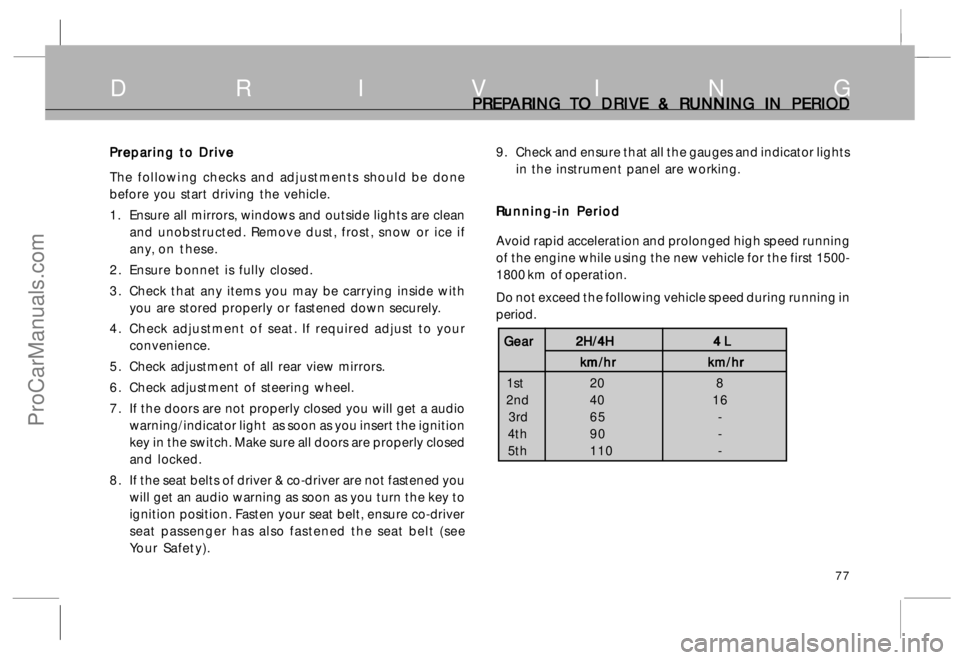
Do not exceed the following vehicle speed during running in
period.
Gear GearGear Gear
Gear
2H/4H 2H/4H 2H/4H 2H/4H
2H/4H
4 L 4 L 4 L 4 L
4 L
km/hr km/hr km/hr km/hr
km/hr
km/hr km/hr km/hr km/hr
km/hr
1st 20 8
2nd 40 16
3rd 65 -
4th 90 -
5th 110 -
ProCarManuals.com
Page 80 of 161
80
D R I V I N GANTI-LOCK BRAKE SYSTEM ANTI-LOCK BRAKE SYSTEMANTI-LOCK BRAKE SYSTEM ANTI-LOCK BRAKE SYSTEM
ANTI-LOCK BRAKE SYSTEM
lock when the speed of rotation of any one wheel becomes
too low in relation to the vehicle speed.) It actuates
an
Electro Hydraulic Control Unit (HU) to reduce, maintain or
increase the pressure on the brake control cylinder in order
to prevent the wheel from locking. The ABS comes into play
when the car is braked heavily during emergency.
The driver feels the effort of the ABS through the The driver feels the effort of the ABS through theThe driver feels the effort of the ABS through the The driver feels the effort of the ABS through the
The driver feels the effort of the ABS through the
pulsating of the brake pedal and audible noise in the pulsating of the brake pedal and audible noise in thepulsating of the brake pedal and audible noise in the pulsating of the brake pedal and audible noise in the
pulsating of the brake pedal and audible noise in the
brake system. brake system.brake system. brake system.
brake system.
T TT T
T
his is absolut his is absoluthis is absolut his is absolut
his is absolut
ely N ely Nely N ely N
ely N
or oror or
or
mal. mal.mal. mal.
mal.
T TT T
T
his should not b his should not bhis should not b his should not b
his should not b
e ee e
e
in inin in
in
t tt t
t
er erer er
er
pr prpr pr
pr
et etet et
et
ed as a fault in the br ed as a fault in the bred as a fault in the br ed as a fault in the br
ed as a fault in the br
ak akak ak
ak
es eses es
es
.. ..
.
On the c On the c On the c On the c
On the c
on onon on
on
tr trtr tr
tr
ar arar ar
ar
y it y ity it y it
y it
’’ ’’
’
s ss s
s
the indic the indicthe indic the indic
the indic
a aa a
a
tion tha tion thation tha tion tha
tion tha
t the ABS is w t the ABS is wt the ABS is w t the ABS is w
t the ABS is w
or oror or
or
k kk k
k
ing inging ing
ing
.. ..
. This is an intentional
warning to the driver that a wheel or wheels are tending to lock
up due to the limit of tyre to road adhesion.
In this situation it is important to keep the brake pedal In this situation it is important to keep the brake pedalIn this situation it is important to keep the brake pedal In this situation it is important to keep the brake pedal
In this situation it is important to keep the brake pedal
depressed fully so that the ABS can regulate the brake depressed fully so that the ABS can regulate the brakedepressed fully so that the ABS can regulate the brake depressed fully so that the ABS can regulate the brake
depressed fully so that the ABS can regulate the brake
application. On No account pump the brake pedal application. On No account pump the brake pedalapplication. On No account pump the brake pedal application. On No account pump the brake pedal
application. On No account pump the brake pedal
The ABS is addition to the basic brake system.
It is activated It is activated It is activated It is activated
It is activated
automatically every time the engine is started. automatically every time the engine is started. automatically every time the engine is started. automatically every time the engine is started.
automatically every time the engine is started. If there is a
malfunction the system turns off automatically indicated by a
‘(ABS)’ ‘(ABS)’ ‘(ABS)’ ‘(ABS)’
‘(ABS)’ warning lamp on the dash board, still the ordinary brake
system continues to work.ABS Activation ABS ActivationABS Activation ABS Activation
ABS Activation
ABS activation varies with various road surfaces i.e. the
amount of traction your tyre have on a particular surface.
On dry surface you will need more pedal effort to activate
ABS. However you may feel ABS activates immediately if you
try to stop on snow, ice or slippery surface.
ABS Indicators ABS IndicatorsABS Indicators ABS Indicators
ABS Indicators
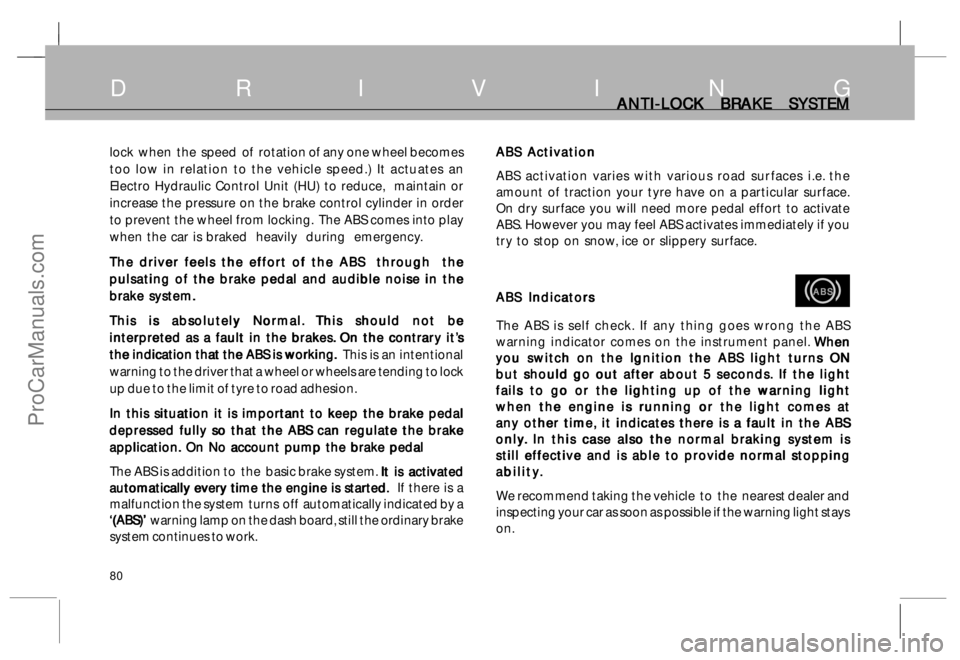
The ABS is self check. If any thing goes wrong the ABS
warning indicator comes on the instrument panel.
W WW W
W
hen henhen hen
hen
you switch on the Ignition the ABS light turns ON you switch on the Ignition the ABS light turns ONyou switch on the Ignition the ABS light turns ON you switch on the Ignition the ABS light turns ON
you switch on the Ignition the ABS light turns ON
but should go out after about 5 seconds. but should go out after about 5 seconds.but should go out after about 5 seconds. but should go out after about 5 seconds.
but should go out after about 5 seconds.
If the light If the lightIf the light If the light
If the light
fails to go or the lighting up of the warning light fails to go or the lighting up of the warning lightfails to go or the lighting up of the warning light fails to go or the lighting up of the warning light
fails to go or the lighting up of the warning light
when the engine is running or the light comes at when the engine is running or the light comes atwhen the engine is running or the light comes at when the engine is running or the light comes at
when the engine is running or the light comes at
any other time, it indicates there is a fault in the ABS any other time, it indicates there is a fault in the ABSany other time, it indicates there is a fault in the ABS any other time, it indicates there is a fault in the ABS
any other time, it indicates there is a fault in the ABS
only onlyonly only
only
.. ..
.
In this c In this c In this c In this c
In this c
ase also the nor ase also the norase also the nor ase also the nor
ase also the nor
mal br mal brmal br mal br
mal br
ak akak ak
ak
ing sy ing sying sy ing sy
ing sy
st stst
st
st
em is em isem is em is
em is
still effective and is able to provide normal stopping still effective and is able to provide normal stoppingstill effective and is able to provide normal stopping still effective and is able to provide normal stopping
still effective and is able to provide normal stopping
abilit abilitabilit abilit
abilit
y yy y
y
.. ..
.
We recommend taking the vehicle to the nearest dealer and
inspecting your car as soon as possible if the warning light stays
on.
ABS ABSABS ABS
ABS
ProCarManuals.com
Page 83 of 161
83
D R I V I N GLIMITED SLIP DIFFERENTIAL AND FOUR LIMITED SLIP DIFFERENTIAL AND FOUR LIMITED SLIP DIFFERENTIAL AND FOUR LIMITED SLIP DIFFERENTIAL AND FOUR
LIMITED SLIP DIFFERENTIAL AND FOUR
WHEEL DRIVING WHEEL DRIVINGWHEEL DRIVING WHEEL DRIVING
WHEEL DRIVING
Thus unnecessary spinning of one wheel is avoided and torque
is transmitted to both wheels, thus assisting the vehicle to traverse
loose terrain. However during normal driving, the differential
action takes place in the same manner as in a standard differential.
1. 1.1. 1.
1.
Four Wheel Drive Operation Four Wheel Drive OperationFour Wheel Drive Operation Four Wheel Drive Operation
Four Wheel Drive Operation
In 2-H mode, only the rear two wheels of the vehicle are
powered by the engine and the front wheels are merely
pushed. By shifting to four wheel drive mode (4H or 4L)
the rear as well as the front axles get geared to the engine
through transfer case and transmit the engine power to all
four wheels. This gives the vehicle increased traction.
In 4H mode, the transmitted engine torque and vehicle
speed remain the same as in 2H. However, when you shift
to 4L mode engine torque is multiplied and vehicle moves
at low speed in the same gears with increased traction. 4L
mode is provided for negotiating sharp gradients or driving
through loose soil/sand.
2. 2.2. 2.
2.
Shifting from 2H to 4H Shifting from 2H to 4HShifting from 2H to 4H Shifting from 2H to 4H
Shifting from 2H to 4H
Turn the selector knob from 2H to 4H position. 4H indicator
on instrument panel will light up. Changing from 2H to 4H
can be done at any speed upto 65 km/h (40 mph). No
pressing of clutch pedal is required.3. 3.3. 3.
3.
Shifting from 4H to 2H Shifting from 4H to 2HShifting from 4H to 2H Shifting from 4H to 2H
Shifting from 4H to 2H
Turn the selector knob from 4H to 2H position. 4H indicator
on instrument panel will go off. Changing from 4H to 2H
can be done at any speed upto 65 km/h (40 mph). No
pressing of clutch pedal is required.
Free Wheeling of Front Hub Free Wheeling of Front HubFree Wheeling of Front Hub Free Wheeling of Front Hub
Free Wheeling of Front Hub
After shifting from 4H to 2H, for effecting free wheeling of front
wheels, direction of vehicle motion needs to be changed. If
the vehicle was moving forward in 4H then bring it to halt and
engage reverse gear of main gear box. (If it was moving reverse
in 4H mode then stop it, and then engage forward gear of
main gear box.) After stopping and changing the gear the
vehicle must travel in opposite direction for a minimum of three
meters, before free wheeling takes place.
4. 4.4. 4.
4.
Shifting from 4H to 4L Shifting from 4H to 4LShifting from 4H to 4L Shifting from 4H to 4L
Shifting from 4H to 4L
Stop the vehicle. Press clutch pedal. Turn the selector knob
from 4H to 4L position. 4L indicator light on instrument panel
will blink few times and remain on.
5. 5.5. 5.
5.
Shifting from 4L to 4H Shifting from 4L to 4HShifting from 4L to 4H Shifting from 4L to 4H
Shifting from 4L to 4H
Stop the vehicle. Press clutch pedal. Turn the selector knob
from 4L to 4H position. 4H indicator light on instrument panel
will blink few times and will remain on.
ProCarManuals.com