warning TATA SAFARI 2015 User Guide
[x] Cancel search | Manufacturer: TATA, Model Year: 2015, Model line: SAFARI, Model: TATA SAFARI 2015Pages: 161, PDF Size: 2.55 MB
Page 77 of 161
77
D R I V I N GPREP PREPPREP PREP
PREP
ARING ARING ARING ARING
ARING
T TT T
T
O DRIVE & R O DRIVE & RO DRIVE & R O DRIVE & R
O DRIVE & R
UNNING IN PERIOD UNNING IN PERIODUNNING IN PERIOD UNNING IN PERIOD
UNNING IN PERIOD
Preparing to Drive Preparing to DrivePreparing to Drive Preparing to Drive
Preparing to Drive
The following checks and adjustments should be done
before you start driving the vehicle.
1 . Ensure all mirrors, windows and outside lights are clean
and unobstructed. Remove dust, frost, snow or ice if
any, on these.
2 . Ensure bonnet is fully closed.
3 . Check that any items you may be carrying inside with
you are stored properly or fastened down securely.
4 . Check adjustment of seat. If required adjust to your
convenience.
5 . Check adjustment of all rear view mirrors.
6 . Check adjustment of steering wheel.
7 . If the doors are not properly closed you will get a audio
warning/indicator light as soon as you insert the ignition
key in the switch. Make sure all doors are properly closed
and locked.
8 . If the seat belts of driver & co-driver are not fastened you
will get an audio warning as soon as you turn the key to
ignition position. Fasten your seat belt, ensure co-driver
seat passenger has also fastened the seat belt (see
Your Safety).9 . Check and ensure that all the gauges and indicator lights
in the instrument panel are working.
Running-in Period Running-in PeriodRunning-in Period Running-in Period
Running-in Period
Avoid rapid acceleration and prolonged high speed running
of the engine while using the new vehicle for the first 1500-
1800 km of operation.
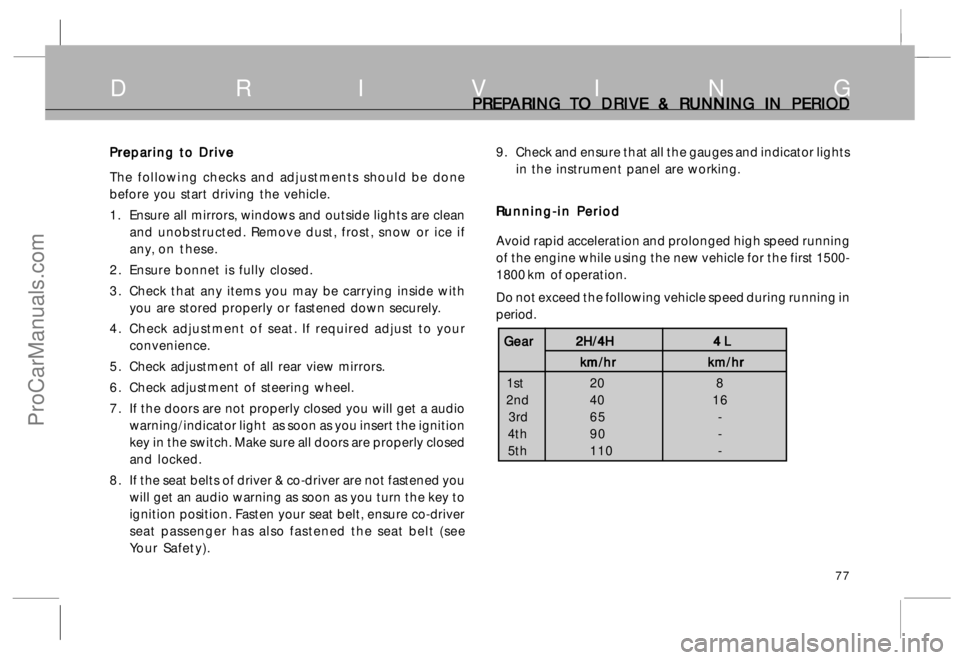
Do not exceed the following vehicle speed during running in
period.
Gear GearGear Gear
Gear
2H/4H 2H/4H 2H/4H 2H/4H
2H/4H
4 L 4 L 4 L 4 L
4 L
km/hr km/hr km/hr km/hr
km/hr
km/hr km/hr km/hr km/hr
km/hr
1st 20 8
2nd 40 16
3rd 65 -
4th 90 -
5th 110 -
ProCarManuals.com
Page 80 of 161
80
D R I V I N GANTI-LOCK BRAKE SYSTEM ANTI-LOCK BRAKE SYSTEMANTI-LOCK BRAKE SYSTEM ANTI-LOCK BRAKE SYSTEM
ANTI-LOCK BRAKE SYSTEM
lock when the speed of rotation of any one wheel becomes
too low in relation to the vehicle speed.) It actuates
an
Electro Hydraulic Control Unit (HU) to reduce, maintain or
increase the pressure on the brake control cylinder in order
to prevent the wheel from locking. The ABS comes into play
when the car is braked heavily during emergency.
The driver feels the effort of the ABS through the The driver feels the effort of the ABS through theThe driver feels the effort of the ABS through the The driver feels the effort of the ABS through the
The driver feels the effort of the ABS through the
pulsating of the brake pedal and audible noise in the pulsating of the brake pedal and audible noise in thepulsating of the brake pedal and audible noise in the pulsating of the brake pedal and audible noise in the
pulsating of the brake pedal and audible noise in the
brake system. brake system.brake system. brake system.
brake system.
T TT T
T
his is absolut his is absoluthis is absolut his is absolut
his is absolut
ely N ely Nely N ely N
ely N
or oror or
or
mal. mal.mal. mal.
mal.
T TT T
T
his should not b his should not bhis should not b his should not b
his should not b
e ee e
e
in inin in
in
t tt t
t
er erer er
er
pr prpr pr
pr
et etet et
et
ed as a fault in the br ed as a fault in the bred as a fault in the br ed as a fault in the br
ed as a fault in the br
ak akak ak
ak
es eses es
es
.. ..
.
On the c On the c On the c On the c
On the c
on onon on
on
tr trtr tr
tr
ar arar ar
ar
y it y ity it y it
y it
’’ ’’
’
s ss s
s
the indic the indicthe indic the indic
the indic
a aa a
a
tion tha tion thation tha tion tha
tion tha
t the ABS is w t the ABS is wt the ABS is w t the ABS is w
t the ABS is w
or oror or
or
k kk k
k
ing inging ing
ing
.. ..
. This is an intentional
warning to the driver that a wheel or wheels are tending to lock
up due to the limit of tyre to road adhesion.
In this situation it is important to keep the brake pedal In this situation it is important to keep the brake pedalIn this situation it is important to keep the brake pedal In this situation it is important to keep the brake pedal
In this situation it is important to keep the brake pedal
depressed fully so that the ABS can regulate the brake depressed fully so that the ABS can regulate the brakedepressed fully so that the ABS can regulate the brake depressed fully so that the ABS can regulate the brake
depressed fully so that the ABS can regulate the brake
application. On No account pump the brake pedal application. On No account pump the brake pedalapplication. On No account pump the brake pedal application. On No account pump the brake pedal
application. On No account pump the brake pedal
The ABS is addition to the basic brake system.
It is activated It is activated It is activated It is activated
It is activated
automatically every time the engine is started. automatically every time the engine is started. automatically every time the engine is started. automatically every time the engine is started.
automatically every time the engine is started. If there is a
malfunction the system turns off automatically indicated by a
‘(ABS)’ ‘(ABS)’ ‘(ABS)’ ‘(ABS)’
‘(ABS)’ warning lamp on the dash board, still the ordinary brake
system continues to work.ABS Activation ABS ActivationABS Activation ABS Activation
ABS Activation
ABS activation varies with various road surfaces i.e. the
amount of traction your tyre have on a particular surface.
On dry surface you will need more pedal effort to activate
ABS. However you may feel ABS activates immediately if you
try to stop on snow, ice or slippery surface.
ABS Indicators ABS IndicatorsABS Indicators ABS Indicators
ABS Indicators
The ABS is self check. If any thing goes wrong the ABS
warning indicator comes on the instrument panel.
W WW W
W
hen henhen hen
hen
you switch on the Ignition the ABS light turns ON you switch on the Ignition the ABS light turns ONyou switch on the Ignition the ABS light turns ON you switch on the Ignition the ABS light turns ON
you switch on the Ignition the ABS light turns ON
but should go out after about 5 seconds. but should go out after about 5 seconds.but should go out after about 5 seconds. but should go out after about 5 seconds.
but should go out after about 5 seconds.
If the light If the lightIf the light If the light
If the light
fails to go or the lighting up of the warning light fails to go or the lighting up of the warning lightfails to go or the lighting up of the warning light fails to go or the lighting up of the warning light
fails to go or the lighting up of the warning light
when the engine is running or the light comes at when the engine is running or the light comes atwhen the engine is running or the light comes at when the engine is running or the light comes at
when the engine is running or the light comes at
any other time, it indicates there is a fault in the ABS any other time, it indicates there is a fault in the ABSany other time, it indicates there is a fault in the ABS any other time, it indicates there is a fault in the ABS
any other time, it indicates there is a fault in the ABS
only onlyonly only
only
.. ..
.
In this c In this c In this c In this c
In this c
ase also the nor ase also the norase also the nor ase also the nor
ase also the nor
mal br mal brmal br mal br
mal br
ak akak ak
ak
ing sy ing sying sy ing sy
ing sy
st stst
st
st
em is em isem is em is
em is
still effective and is able to provide normal stopping still effective and is able to provide normal stoppingstill effective and is able to provide normal stopping still effective and is able to provide normal stopping
still effective and is able to provide normal stopping
abilit abilitabilit abilit
abilit
y yy y
y
.. ..
.
We recommend taking the vehicle to the nearest dealer and
inspecting your car as soon as possible if the warning light stays
on.
ABS ABSABS ABS
ABS
ProCarManuals.com
Page 87 of 161
87
Night Driving Night DrivingNight Driving Night Driving
Night Driving
•Dip the head lamp for oncoming traffic during night driving.
•Maintain a speed such that you can stop within illuminated distance of head lamps.
•Use head lamp main/dip beam to alert other road users on turns/cross roads etc.
•Use side indicators for lane change or turning.
•Put on hazard warning switch in case of hazardous parking or if your vehicle is disabled
to warn the passing traffic.
Climbing Sharp Gradients on Loose Surfaces Climbing Sharp Gradients on Loose SurfacesClimbing Sharp Gradients on Loose Surfaces Climbing Sharp Gradients on Loose Surfaces
Climbing Sharp Gradients on Loose Surfaces
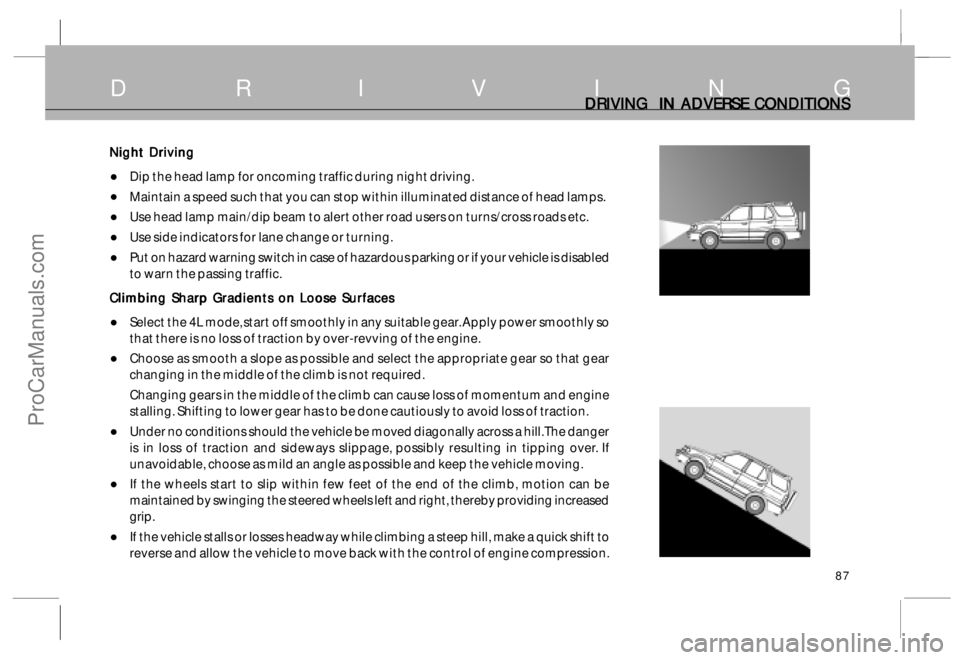
•Select the 4L mode, start off smoothly in any suitable gear. Apply power smoothly so
that there is no loss of traction by over-revving of the engine.
•Choose as smooth a slope as possible and select the appropriate gear so that gear
changing in the middle of the climb is not required.
Changing gears in the middle of the climb can cause loss of momentum and engine
stalling. Shifting to lower gear has to be done cautiously to avoid loss of traction.
•Under no conditions should the vehicle be moved diagonally across a hill. The danger
is in loss of traction and sideways slippage, possibly resulting in tipping over. If
unavoidable, choose as mild an angle as possible and keep the vehicle moving.
•If the wheels start to slip within few feet of the end of the climb, motion can be
maintained by swinging the steered wheels left and right, thereby providing increased
grip.
•If the vehicle stalls or losses headway while climbing a steep hill, make a quick shift to
reverse and allow the vehicle to move back with the control of engine compression.
D R I V I N GDRIVING IN ADVERSE CONDITIONS DRIVING IN ADVERSE CONDITIONSDRIVING IN ADVERSE CONDITIONS DRIVING IN ADVERSE CONDITIONS
DRIVING IN ADVERSE CONDITIONS
ProCarManuals.com
Page 88 of 161
88
Descending Sharp Gradients Descending Sharp GradientsDescending Sharp Gradients Descending Sharp Gradients
Descending Sharp Gradients
•Select the 4L mode and depending on the severity of the gradient, shift into
appropriate gear. Use engine braking judiciously without over-revving the engine.
•Brake application under such situations should be done very smoothly to avoid loss of
control.
Select appropriate gear so that gear changing or clutch disengagement is not involved
while descending the gradient.
T TT T
T
o oo o
o
wing the wing the wing the wing the
wing the
V VV V
V
ehicle ehicleehicle ehicle
ehicle
•For towing the vehicle, the best way is to use a recovery van.
•Alternatively use a rigid tow bar.
•Avoid using flexible cable or rope as your vehicle may crash into towing vehicle when
it stops suddenly.
•Switch ‘ON’ Hazard warning switch to warn the other road users.
•Keep the engine in idling so that power steering assistance is available. This will also
built the vacuum for the brakes.
•In case of brake failure, use parking brake to control the vehicle.
Roof Rail Roof RailRoof Rail Roof Rail
Roof Rail
The provision for mounting roof racks is made on the vehicle. This can be done with
the help of roof and roof header mouldings provided above the rear fixed glass. The
max. load on this including roof rack load should not exceed 100 kg.
D R I V I N GDRIVING IN ADVERSE CONDITIONS DRIVING IN ADVERSE CONDITIONSDRIVING IN ADVERSE CONDITIONS DRIVING IN ADVERSE CONDITIONS
DRIVING IN ADVERSE CONDITIONS
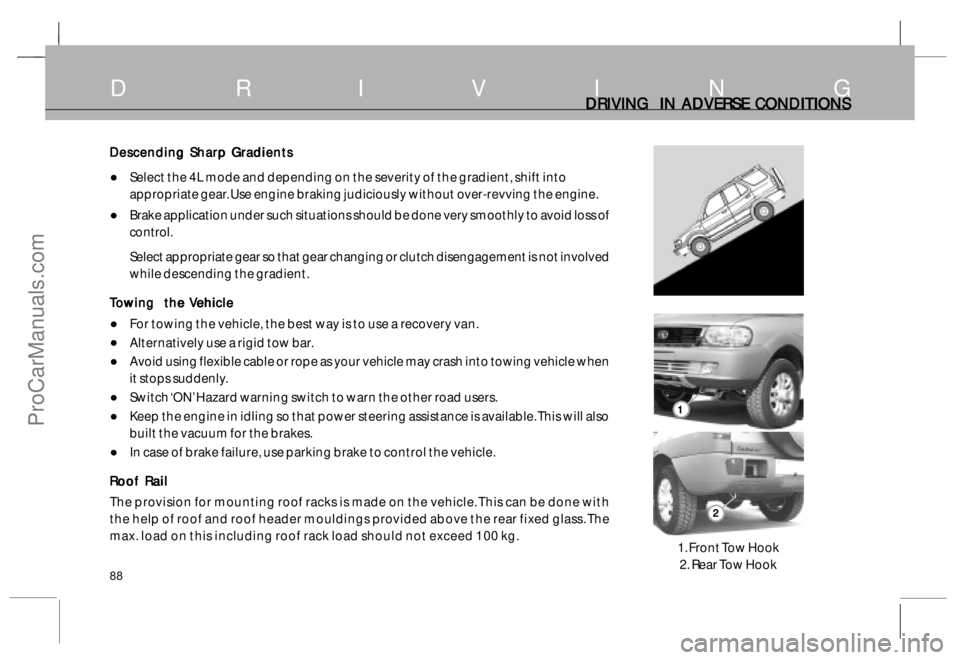
1 11 1
1
2 22 2
2
1. Front Tow Hook
2. Rear Tow Hook
ProCarManuals.com
Page 90 of 161
90
D R I V I N GDRIVING SAFET DRIVING SAFETDRIVING SAFET DRIVING SAFET
DRIVING SAFET
Y YY Y
Y
Side indicators / Hazard warning Side indicators / Hazard warningSide indicators / Hazard warning Side indicators / Hazard warning
Side indicators / Hazard warning
Ensure that all side indicators/
hazard warning lights are always in
working condition and they are used
when required.
Horn HornHorn Horn
Horn
Ensure the horn is working properly.
Horn provides safety to other road
users by alerting your presence.
Brakes BrakesBrakes Brakes
Brakes
Ensure brakes are working properly.
Check brake fluid level in reservoir.
Don not drive the car when brake
warning lamp is 'ON'.
T TT T
T
yr yryr yr
yr
es eses es
es
Check the condition of tyres for any
abnormalities. Maintain correct
tyre pressure, it is very importantparticularly when subjected to
extreme condition, such as high
speed, high load and high outside
temperature. Do not use worn or
bald tyres on the front wheels.
First Aid Kit First Aid KitFirst Aid Kit First Aid Kit
First Aid Kit
First aid kit is provided in your
vehicle. This is for use in case of
minor injuries. It is to be regularly
checked for any disintegration and
should be updated regularly.
A AA A
A
d dd d
d
v vv v
v
anc ancanc anc
anc
e e e e
e
W WW W
W
ar arar ar
ar
ning ning ning ning
ning
T TT T
T
r rr r
r
iangle iangleiangle iangle
iangle
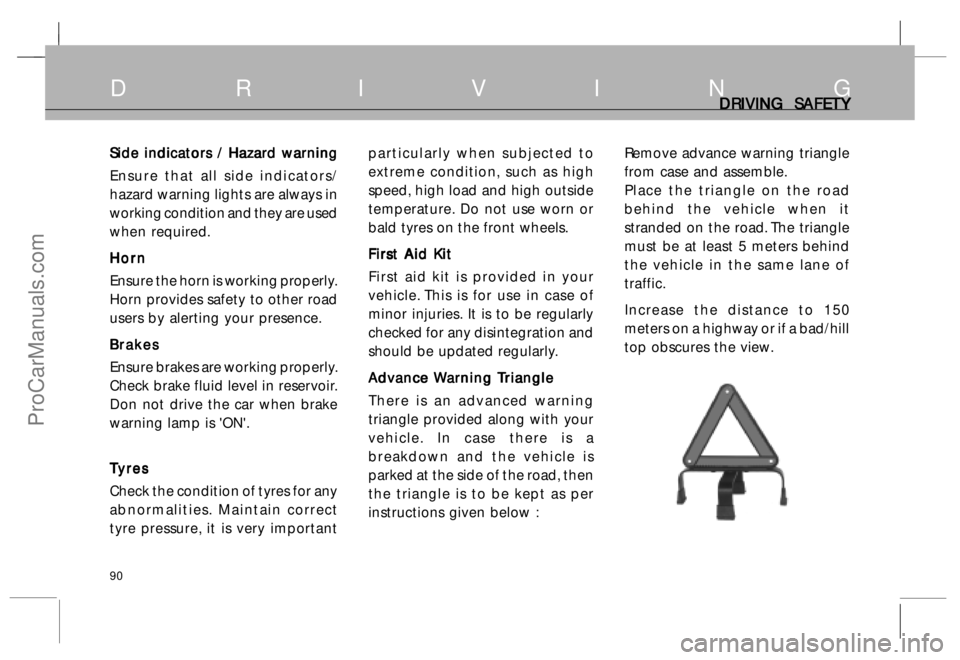
There is an advanced warning
triangle provided along with your
vehicle. In case there is a
breakdown and the vehicle is
parked at the side of the road, then
the triangle is to be kept as per
instructions given below :Remove advance warning triangle
from case and assemble.
Place the triangle on the road
behind the vehicle when it
stranded on the road. The triangle
must be at least 5 meters behind
the vehicle in the same lane of
traffic.
Increase the distance to 150
meters on a highway or if a bad/hill
top obscures the view.
ProCarManuals.com
Page 120 of 161
120
ST STST ST
ST
AR ARAR AR
AR
TING TING TING TING
TING
THE ENGINE THE ENGINE THE ENGINE THE ENGINE
THE ENGINE
WITH JUMP LEADS, WITH JUMP LEADS,WITH JUMP LEADS, WITH JUMP LEADS,
WITH JUMP LEADS,
WHEELS & WHEELS & WHEELS & WHEELS &
WHEELS &
T TT T
T
YRES YRESYRES YRES
YRES
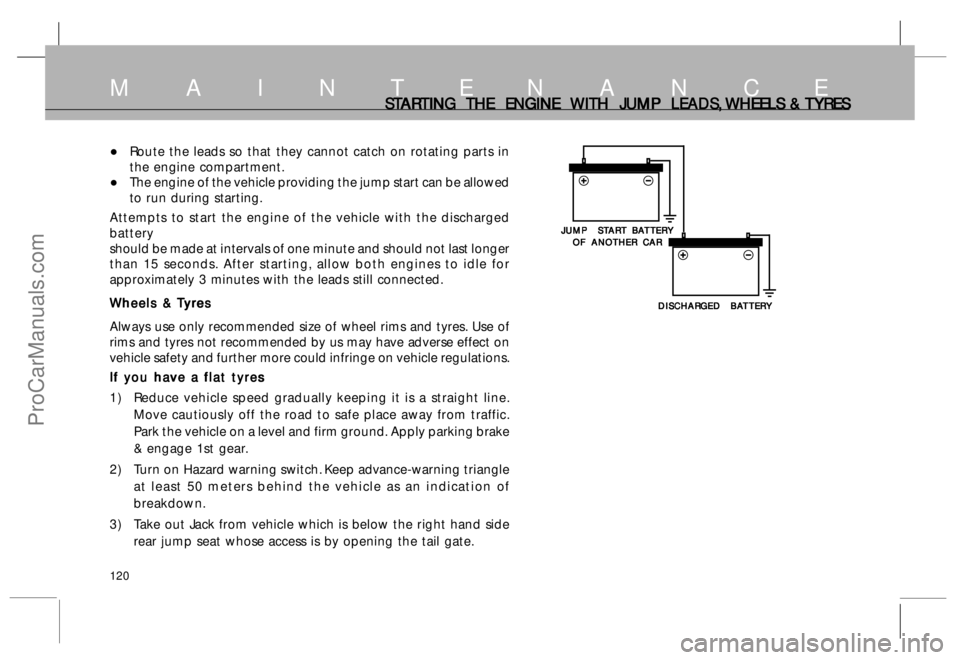
•Route the leads so that they cannot catch on rotating parts in
the engine compartment.
•The engine of the vehicle providing the jump start can be allowed
to run during starting.
Attempts to start the engine of the vehicle with the discharged
battery
should be made at intervals of one minute and should not last longer
than 15 seconds. After starting, allow both engines to idle for
approximately 3 minutes with the leads still connected.
W WW W
W
heels & heels & heels & heels &
heels &
T TT T
T
yr yryr yr
yr
es eses es
es
Always use only recommended size of wheel rims and tyres. Use of
rims and tyres not recommended by us may have adverse effect on
vehicle safety and further more could infringe on vehicle regulations.
If you have a flat tyres If you have a flat tyresIf you have a flat tyres If you have a flat tyres
If you have a flat tyres
1) Reduce vehicle speed gradually keeping it is a straight line.
Move cautiously off the road to safe place away from traffic.
Park the vehicle on a level and firm ground. Apply parking brake
& engage 1st gear.
2) Turn on Hazard warning switch. Keep advance-warning triangle
at least 50 meters behind the vehicle as an indication of
breakdown.
3) Take out Jack from vehicle which is below the right hand side
rear jump seat whose access is by opening the tail gate.
M A I N T E N A N C E
JUMP ST JUMP STJUMP ST JUMP ST
JUMP ST
AR ARAR AR
AR
T B T BT B T B
T B
A AA A
A
T TT T
T
TER TERTER TER
TER
Y YY Y
Y
OF ANOTHER CAR OF ANOTHER CAROF ANOTHER CAR OF ANOTHER CAR
OF ANOTHER CAR
DISCHAR DISCHARDISCHAR DISCHAR
DISCHAR
GED B GED BGED B GED B
GED B
A AA A
A
T TT T
T
TER TERTER TER
TER
Y YY Y
Y
ProCarManuals.com
Page 140 of 161
140
SR. NO. SR. NO.SR. NO. SR. NO.
SR. NO.
PROBLEM OBSERVED PROBLEM OBSERVEDPROBLEM OBSERVED PROBLEM OBSERVED
PROBLEM OBSERVED
PROBABLE CAUSE PROBABLE CAUSEPROBABLE CAUSE PROBABLE CAUSE
PROBABLE CAUSE
A AA A
A
CTION CTION CTION CTION
CTION
T TT T
T
O BE O BE O BE O BE
O BE
T TT T
T
AKEN AKENAKEN AKEN
AKEN
ANTI-LOCK BRAKING SYSTEM ANTI-LOCK BRAKING SYSTEMANTI-LOCK BRAKING SYSTEM ANTI-LOCK BRAKING SYSTEM
ANTI-LOCK BRAKING SYSTEM
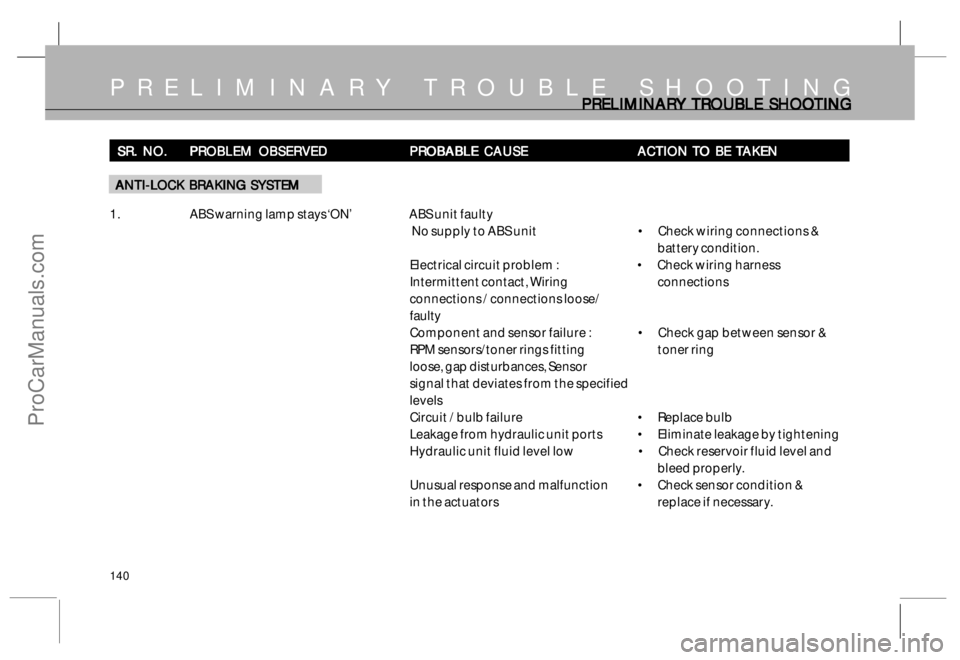
1. ABS warning lamp stays ‘ON’ ABS unit faulty
No supply to ABS unit • Check wiring connections &
battery condition.
Electrical circuit problem : • Check wiring harness
Intermittent contact, Wiring connections
connections / connections loose/
faulty
Component and sensor failure : • Check gap between sensor &
RPM sensors/toner rings fitting toner ring
loose, gap disturbances, Sensor
signal that deviates from the specified
levels
Circuit / bulb failure • Replace bulb
Leakage from hydraulic unit ports • Eliminate leakage by tightening
Hydraulic unit fluid level low • Check reservoir fluid level and
bleed properly.
Unusual response and malfunction • Check sensor condition &
in the actuators replace if necessary.
PRELIMINAR PRELIMINARPRELIMINAR PRELIMINAR
PRELIMINAR
Y Y Y Y
Y
TR TRTR TR
TR
OUBLE SHOO OUBLE SHOOOUBLE SHOO OUBLE SHOO
OUBLE SHOO
TING TINGTING TING
TING
PRELIMINARY TROUBLE SHOOTING
ProCarManuals.com
Page 146 of 161
146
S E R V I C E S C H E D U L ESERVICE SCHEDULE SERVICE SCHEDULESERVICE SCHEDULE SERVICE SCHEDULE
SERVICE SCHEDULE
SR SRSR SR
SR
x 1000 km x 1000 kmx 1000 km x 1000 km
x 1000 km
NO NONO NO
NO
OPER OPEROPER OPER
OPER
A AA A
A
TIONS TIONSTIONS TIONS
TIONS
FREQUENCY FREQUENCYFREQUENCY FREQUENCY
FREQUENCY
1-1.5 1-1.51-1.5 1-1.5
1-1.5
15 1515 15
15
30 3030 30
30
45 4545 45
45
60 6060 60
60
75 7575 75
75
90 9090 90
90
105 105105 105
105
GENERAL GENERALGENERAL GENERAL
GENERAL
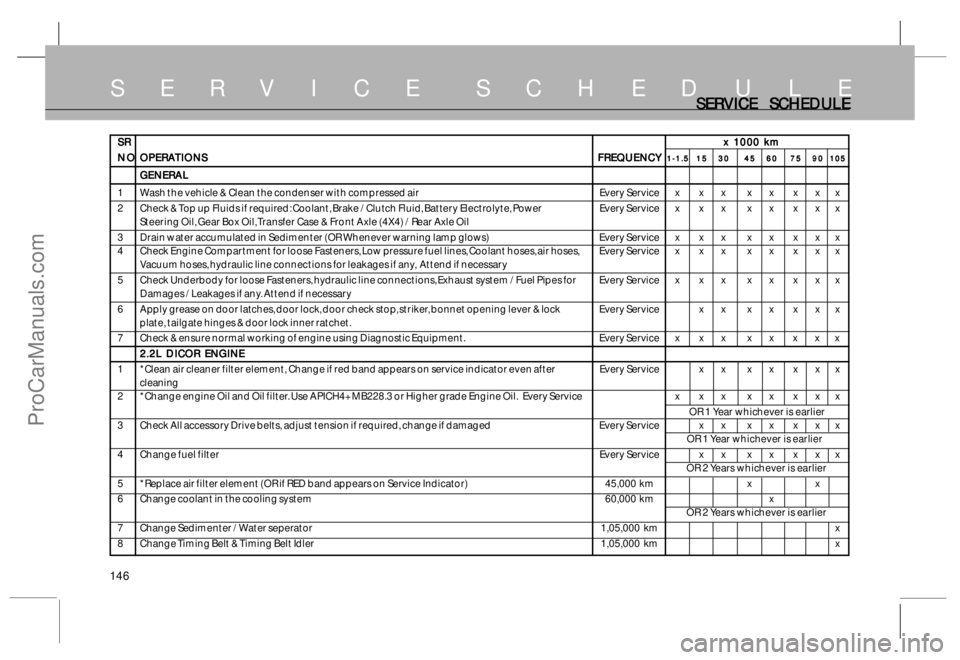
1 Wash the vehicle & Clean the condenser with compressed air Every Service x x x x x x x x
2 Check & Top up Fluids if required: Coolant, Brake / Clutch Fluid, Battery Electrolyte, Power Every Service x x x x x x x x
Steering Oil, Gear Box Oil, Transfer Case & Front Axle (4X4) / Rear Axle Oil
3 Drain water accumulated in Sedimenter (OR Whenever warning lamp glows) Every Service x x x x x x x x
4 Check Engine Compartment for loose Fasteners, Low pressure fuel lines, Coolant hoses, air hoses, Every Service x x x x x x x x
Vacuum hoses, hydraulic line connections for leakages if any, Attend if necessary
5 Check Underbody for loose Fasteners, hydraulic line connections, Exhaust system / Fuel Pipes for Every Service x x x x x x x x
Damages / Leakages if any. Attend if necessary
6 Apply grease on door latches, door lock, door check stop, striker, bonnet opening lever & lock Every Service x x x x x x x
plate, tailgate hinges & door lock inner ratchet.
7 Check & ensure normal working of engine using Diagnostic Equipment. Every Service x x x x x x x x
2.2L DICOR ENGINE 2.2L DICOR ENGINE2.2L DICOR ENGINE 2.2L DICOR ENGINE
2.2L DICOR ENGINE
1 *Clean air cleaner filter element, Change if red band appears on service indicator even after Every Service x x x x x x x
cleaning
2 *Change engine Oil and Oil filter. Use APICH4+MB228.3 or Higher grade Engine Oil.Every Service x x x x x x x x
OR 1 Year whichever is earlier
3 Check All accessory Drive belts, adjust tension if required, change if damaged Every Service x x x x x x x
OR 1 Year whichever is earlier
4 Change fuel filterEvery Service x x x x x x x
OR 2 Years whichever is earlier
5 *Replace air filter element (OR if RED band appears on Service Indicator) 45,000 km x x
6 Change coolant in the cooling system 60,000 km x
OR 2 Years whichever is earlier
7 Change Sedimenter / Water seperator1,05,000 km x
8 Change Timing Belt & Timing Belt Idler1,05,000 km x
ProCarManuals.com
Page 155 of 161
155
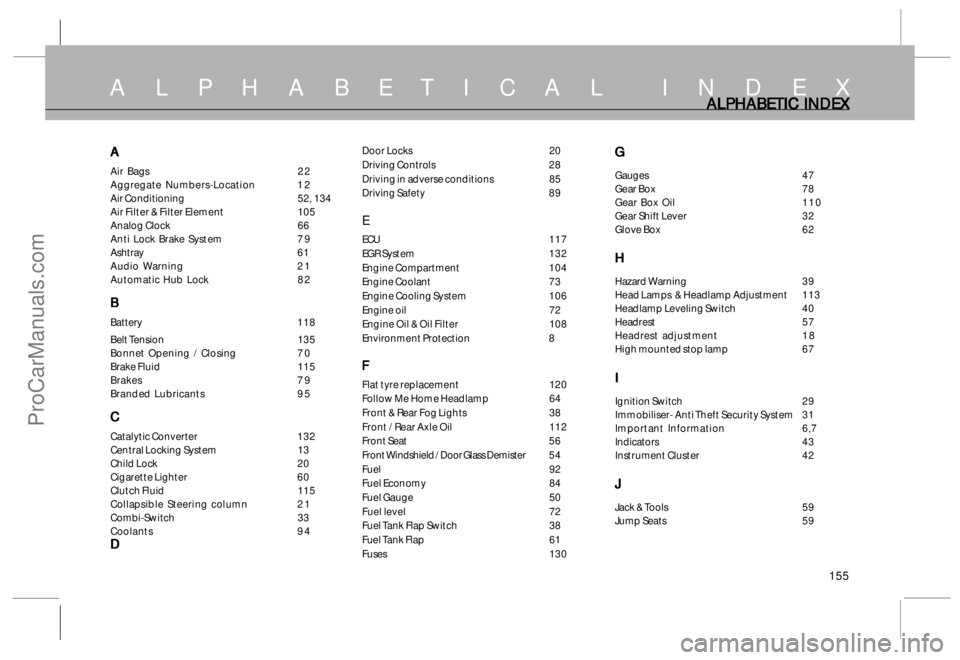
A L P H A B E T I C A L I N D E X ALPHABETIC INDEX ALPHABETIC INDEX ALPHABETIC INDEX ALPHABETIC INDEX
ALPHABETIC INDEX
A AA A
A
Air Bags 2 2
Aggregate Numbers-Location 1 2
Air Conditioning52, 134
Air Filter & Filter Element 105
Analog Clock 66
Anti Lock Brake System 7 9
Ashtray 6 1
Audio Warning 2 1
Automatic Hub Lock 8 2
B BB B
B
Battery 118
Belt Tension 135
Bonnet Opening / Closing 7 0
Brake Fluid 115
Brakes 7 9
Branded Lubricants 9 5
C CC C
C
Catalytic Converter 132
Central Locking System 13
Child Lock 20
Cigarette Lighter 60
Clutch Fluid 115
Collapsible Steering column 2 1
Combi-Switch 33
Coolants 9 4
D DD D
D
Door Locks 20
Driving Controls 28
Driving in adverse conditions 85
Driving Safety 89
E
ECU 1 1 7
EGR System 132
Engine Compartment 104
Engine Coolant 73
Engine Cooling System 106
Engine oil 72
Engine Oil & Oil Filter 108
Environment Protection 8
F FF F
F
Flat tyre replacement 120
Follow Me Home Headlamp 64
Front & Rear Fog Lights 38
Front / Rear Axle Oil 112
Front Seat 56
Front Windshield / Door Glass Demister 5 4
Fuel 92
Fuel Economy 84
Fuel Gauge 50
Fuel level 72
Fuel Tank Flap Switch 38
Fuel Tank Flap 61
Fuses 130
G GG G
G
Gauges 4 7
Gear Box 78
Gear Box Oil 1 1 0
Gear Shift Lever 32
Glove Box 62
H HH H
H
Hazard Warning 39
Head Lamps & Headlamp Adjustment 113
Headlamp Leveling Switch 40
Headrest 57
Headrest adjustment 1 8
High mounted stop lamp 67
I II I
I
Ignition Switch 29
Immobiliser- Anti Theft Security System 31
Important Information 6,7
Indicators 43
Instrument Cluster 42
J JJ J
J
Jack & Tools 59
Jump Seats 59
ProCarManuals.com
Page 161 of 161
161
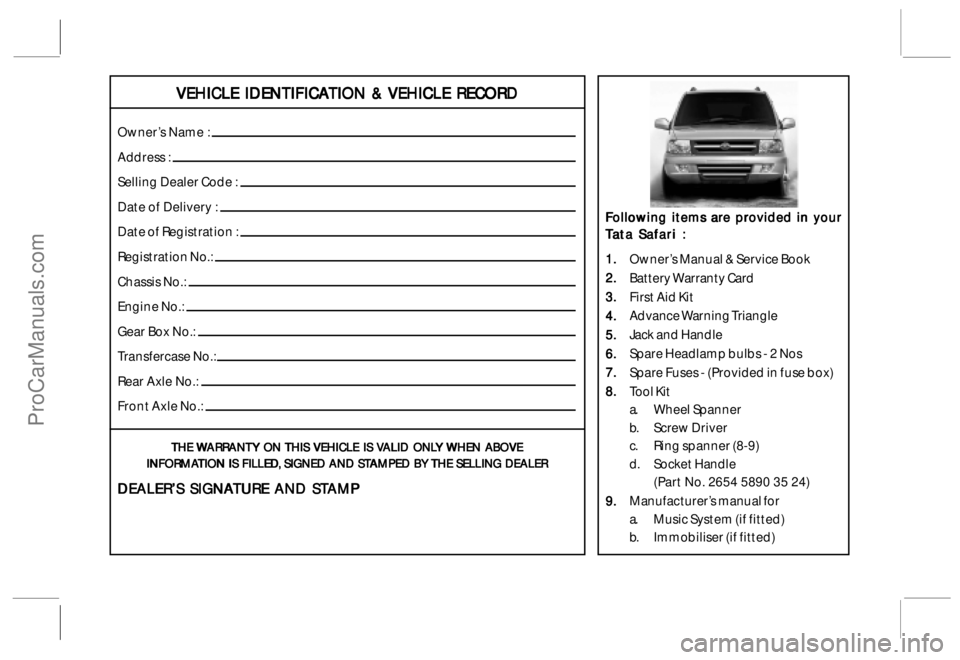
VEHICLE IDENTIFIC VEHICLE IDENTIFICVEHICLE IDENTIFIC VEHICLE IDENTIFIC
VEHICLE IDENTIFIC
A AA A
A
TION & TION & TION & TION &
TION &
VEHICLE REC VEHICLE RECVEHICLE REC VEHICLE REC
VEHICLE REC
ORD ORDORD ORD
ORD
Owner’s Name :
Address :
Selling Dealer Code :
Date of Delivery :
Date of Registration :
Registration No.:
Chassis No.:
Engine No.:
Gear Box No.:
Transfercase No.:
Rear Axle No.:
Front Axle No.:
THE THE THE THE
THE
W WW W
W
ARR ARRARR ARR
ARR
ANT ANTANT ANT
ANT
Y ON Y ON Y ON Y ON
Y ON
THIS THIS THIS THIS
THIS
VEHICLE IS VEHICLE IS VEHICLE IS VEHICLE IS
VEHICLE IS
V VV V
V
ALID ONL ALID ONLALID ONL ALID ONL
ALID ONL
Y Y Y Y
Y
WHEN ABOVE WHEN ABOVEWHEN ABOVE WHEN ABOVE
WHEN ABOVE
INFORMA INFORMAINFORMA INFORMA
INFORMA
TION IS FILLED TION IS FILLEDTION IS FILLED TION IS FILLED
TION IS FILLED
,, ,,
,
SIGNED AND ST SIGNED AND ST SIGNED AND ST SIGNED AND ST
SIGNED AND ST
AMPED BY AMPED BY AMPED BY AMPED BY
AMPED BY
THE SELLING DEALER THE SELLING DEALERTHE SELLING DEALER THE SELLING DEALER
THE SELLING DEALER
DEALER DEALERDEALER DEALER
DEALER
’S SIGNA ’S SIGNA’S SIGNA ’S SIGNA
’S SIGNA
TURE AND ST TURE AND STTURE AND ST TURE AND ST
TURE AND ST
AMP AMPAMP AMP
AMP
Following items are provided in your Following items are provided in yourFollowing items are provided in your Following items are provided in your
Following items are provided in your
T TT T
T
a aa a
a
ta S ta Sta S ta S
ta S
afar afarafar afar
afar
i : i :i : i :
i :
1. 1.1. 1.
1. Owner’s Manual & Service Book
2. 2.2. 2.
2. Battery Warranty Card
3. 3.3. 3.
3. First Aid Kit
4. 4.4. 4.
4. Advance Warning Triangle
5. 5.5. 5.
5. Jack and Handle
6. 6.6. 6.
6. Spare Headlamp bulbs - 2 Nos
7. 7.7. 7.
7. Spare Fuses - (Provided in fuse box)
8. 8.8. 8.
8. Tool Kit
a. Wheel Spanner
b. Screw Driver
c. Ring spanner (8-9)
d. Socket Handle
(Part No. 2654 5890 35 24)
9. 9.9. 9.
9. Manufacturer’s manual for
a. Music System (if fitted)
b. Immobiliser (if fitted)
ProCarManuals.com