air condition TESLA ROADSTER 2008 User Guide
[x] Cancel search | Manufacturer: TESLA, Model Year: 2008, Model line: ROADSTER, Model: TESLA ROADSTER 2008Pages: 115, PDF Size: 46.35 MB
Page 80 of 115
Tire repair10-4
Roadside emergencies
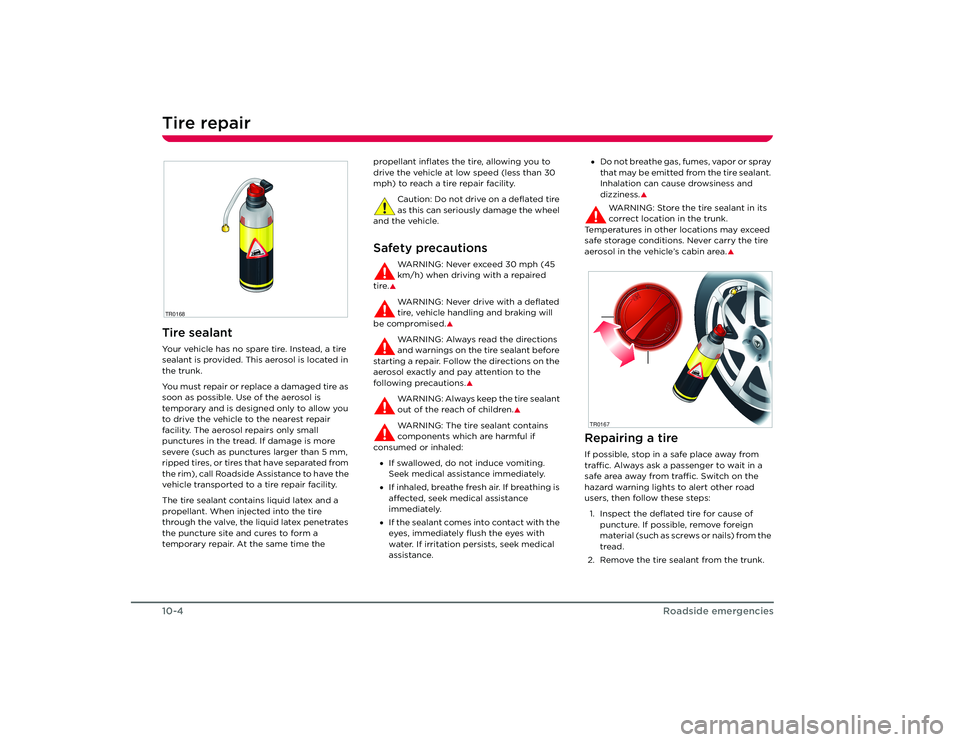
Tire repairTire sealantYour vehicle has no spare tire. Instead, a tire
sealant is provided. This aerosol is located in
the trunk.
You must repair or replace a damaged tire as
soon as possible. Use of the aerosol is
temporary and is designed only to allow you
to drive the vehicle to the nearest repair
facility. The aerosol repairs only small
punctures in the tread. If damage is more
severe (such as punctures larger than 5 mm,
ripped tires, or tires that have separated from
t h e r i m ) , c a l l R o a d s i d e A s s i s t a n c e t o h a ve t h e
vehicle transported to a tire repair facility.
The tire sealant contains liquid latex and a
propellant. When injected into the tire
through the valve, the liquid latex penetrates
the puncture site and cures to form a
temporary repair. At the same time the propellant inflates the tire, allowing you to
drive the vehicle at low speed (less than 30
mph) to reach a tire repair facility.
Caution: Do not drive on a deflated tire
as this can seriously damage the wheel
and the vehicle.
Safety precautions
WARNING: Never exceed 30 mph (45
km/h) when driving with a repaired
tire.SWARNING: Never drive with a deflated
tire, vehicle handling and braking will
be compromised.
S
WARNING: Always read the directions
and warnings on the tire sealant before
starting a repair. Follow the directions on the
aerosol exactly and pay attention to the
following precautions.
S
WARNING: Always keep the tire sealant
out of the reach of children.
S
WARNING: The tire sealant contains
components which are harmful if
consumed or inhaled:
• If swallowed, do not induce vomiting.
Seek medical assistance immediately.
• If inhaled, breathe fresh air. If breathing is
affected, seek medical assistance
immediately.
• If the sealant comes into contact with the
eyes, immediately flush the eyes with
water. If irritation persists, seek medical
assistance. •
Do not breathe gas, fumes, vapor or spray
that may be emitted from the tire sealant.
Inhalation can cause drowsiness and
dizziness.
S
WARNING: Store the tire sealant in its
correct location in the trunk.
Temperatures in other locations may exceed
safe storage conditions. Never carry the tire
aerosol in the vehicle’s cabin area.
S
Repairing a tireIf possible, stop in a safe place away from
traffic. Always ask a passenger to wait in a
safe area away from traffic. Switch on the
hazard warning lights to alert other road
users, then follow these steps:
1. Inspect the deflated tire for cause of puncture. If possible, remove foreign
material (such as screws or nails) from the
tread.
2. Remove the tire sealant from the trunk.
TR0168
TR0167
Roadster OHB.book Page 4 Th ursday, October 2, 2008 8:59 AM
Page 81 of 115
Tire repair
10-5
Roadside emergencies
Note: In cold conditions, use the vehicle’s
heater to warm the aerosol.
3. Position the wheel (if possible) so that the puncture is at the bottom.
4. Remove the valve cap and clean the valve thread.
5. Vigorously shake the tire sealant for approximately 30 seconds.
6. Screw the filler tube onto the tire valve and break the safety seal.
7. Hold the tire sealant upright and turn the knob one-quarter turn clockwise. If you
need to stop the process, simply turn the
knob back to the ‘OFF’ position.
8. Empty the entire contents of the tire sealant into the tire. When the sealant
stops flowing through the filler tube, turn
the knob to the ‘OFF’ position and
unscrew the filler tube from the tire valve.
Note: If tire sealant comes into contact
with the vehicle’s paint, immediately
wash the area with water to avoid
permanent damage.
9. If the wheel rim has lifted from the ground, drive immediately for 6 to 12
miles (10 to 20 km) to distribute the
sealant evenly inside the tire. Then drive
gently and do not exceed 30 mph
(45 km/h).
WARNING: If the wheel rim has not
lifted from the ground, call
Roadside Assistance to have the vehicle
transported to a repair facility.
S
10. Drive to the nearest service station and inflate the tire to the correct pressure (see
Specifications and tire pressures,
page 11-4 .) If the required pressure
cannot be reached, then the tire is too
severely damaged and you should have
the vehicle transported to a tire repair
facility. Do not drive!
Note: When adjusting tire pressures, you
can display tire pressure values on the
Touch Screen’s tire pressure screen.
However, the values displayed by the
Touch Screen will not be updated until
you place the car in drive long enough for
the tire pressure monitoring sensors to
take new readings. For details, refer to the
Touch Screen Users Manual provided in
your owners package.
11. If the correct tire pressure was achieved, continue driving. Drive carefully and do
not exceed 30 mph (45 km/h). At the
earliest opportunity, have the tire
repaired or replaced and replace the used
tire sealant.
WARNING: Always inform the tire
repairer that tire sealant has been
used. If the tire is to be subsequently
deflated, only do so in a well ventilated
area. The aerosol sealant can damage the
wheel sensor that measures tire pressure.
Therefore, the wheel sensor must be
replaced.
S
Replacing the tire sealantAlways replace the used tire sealant with one
of the same type and capacity (400 ml). Tire
sealants are available through most reputable
automotive retailers.
Roadster OHB.book Page 5 Th ursday, October 2, 2008 8:59 AM
Page 100 of 115
Wheels and tires11-10
Technical specifications
Note: If tire wear is uneven (on one side of the
tire only) or becomes abnormally excessive,
the wheel alignment should be checked.Age degradationTires degrade over time due to the effects of
ultraviolet light, extreme temperatures, high
loads, and environmental conditions. It is
recommended that tires are replaced every
six years, or sooner if required.Punctured tiresYour vehicle is fitted with tubeless tires,
which may not leak when penetrated,
provided the object remains in the tire.
If, however, you feel a sudden vibration or ride
disturbance while driving, reduce your speed
and when safe to do so, stop and check for
the cause of the vibration.
A puncture will eventually cause the tire to
lose pressure, which is why frequent checking
of tire pressures is important. Punctured or
damaged tires must be permanently repaired
or replaced as soon as possible.
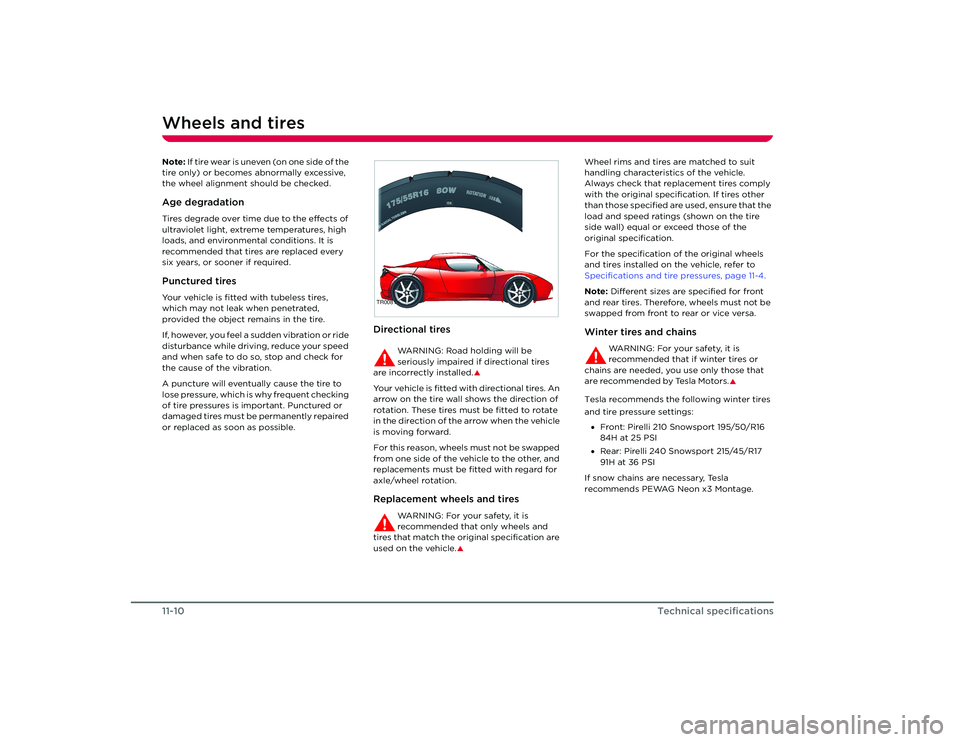
Directional tires
WARNING: Road holding will be
seriously impaired if directional tires
are incorrectly installed.
S
Your vehicle is fitted with directional tires. An
arrow on the tire wall shows the direction of
rotation. These tires must be fitted to rotate
in the direction of the arrow when the vehicle
is moving forward.
For this reason, wheels must not be swapped
from one side of the vehicle to the other, and
replacements must be fitted with regard for
axle/wheel rotation.Replacement wheels and tires
WARNING: For your safety, it is
recommended that only wheels and
tires that match the original specification are
used on the vehicle.
S
Wheel rims and tires are matched to suit
handling characteristics of the vehicle.
Always check that replacement tires comply
with the original specification. If tires other
than those specified are used, ensure that the
load and speed ratings (shown on the tire
side wall) equal or exceed those of the
original specification.
For the specification of the original wheels
and tires installed on the vehicle, refer to
Specifications and tire pressures, page 11-4.
Note: Different sizes are specified for front
and rear tires. Therefore, wheels must not be
swapped from front to rear or vice versa.Winter tires and chains
WARNING: For your safety, it is
recommended that if winter tires or
chains are needed, you use only those that
are recommended by Tesla Motors.
S
Tesla recommends the following winter tires
and tire pressure settings:
• Front: Pirelli 210 Snowsport 195/50/R16
84H at 25 PSI
• Rear: Pirelli 240 Snowsport 215/45/R17
91H at 36 PSI
If snow chains are necessary, Tesla
recommends PEWAG Neon x3 Montage.
ED RADIAL TUBELESS
G6
D
175/55R16 8OW ROTATION
ED RADIAL TUBELESS
G6
D
175/55R16 8OW ROTATION
ED RADIAL TUBELESS
G6
D
TR0081
Roadster OHB.book Page 10 Thursday, October 2, 2008 8:59 AM
Page 101 of 115
Wheels and tires
11-11
Technical specifications
Tire Pressure Monitoring
System
WARNING: The TPMS is not a substitute
for manually checking tire pressures.
The TPMS only provides a tire pressure
warning and does not re-inflate the tires.
S
WARNING: The TPMS cannot register
damage to a tire. Regularly check the
condition of your tires.
S
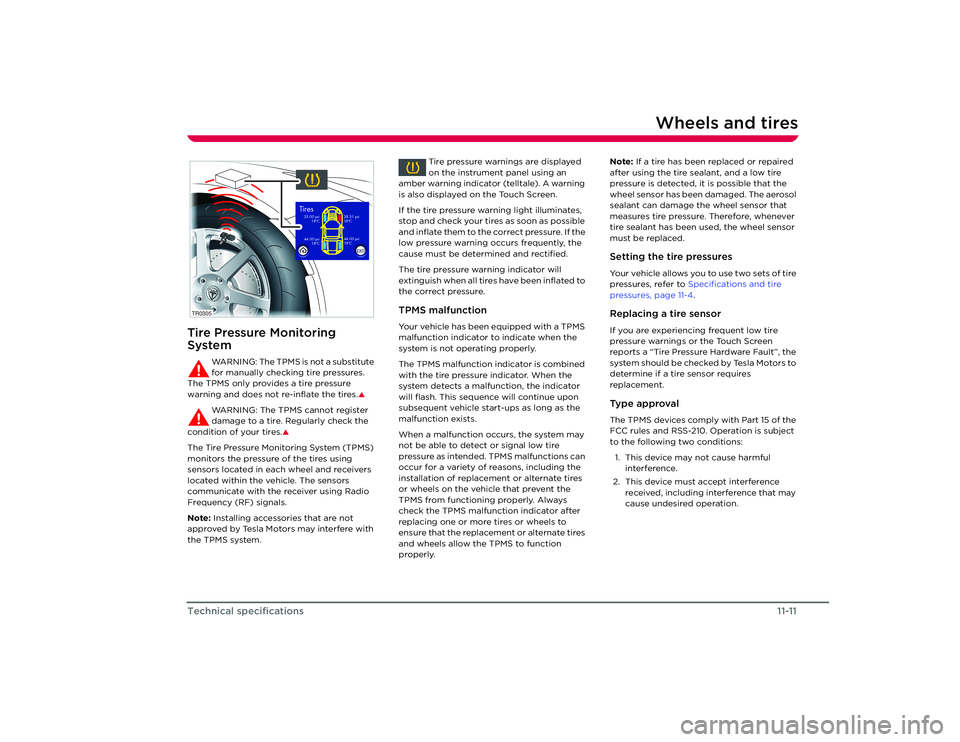
The Tire Pressure Monitoring System (TPMS)
monitors the pressure of the tires using
sensors located in each wheel and receivers
located within the vehicle. The sensors
communicate with the receiver using Radio
Frequency (RF) signals.
Note: Installing accessories that are not
approved by Tesla Motors may interfere with
the TPMS system. Tire pressure warnings are displayed
on the instrument panel using an
amber warning indicator (telltale). A warning
is also displayed on the Touch Screen.
If the tire pressure warning light illuminates,
stop and check your tires as soon as possible
and inflate them to the correct pressure. If the
low pressure warning occurs frequently, the
cause must be determined and rectified.
The tire pressure warning indicator will
extinguish when all tires have been inflated to
the correct pressure.
TPMS malfunctionYour vehicle has been equipped with a TPMS
malfunction indicator to indicate when the
system is not operating properly.
The TPMS malfunction indicator is combined
with the tire pressure indicator. When the
system detects a malfunction, the indicator
will flash. This sequence will continue upon
subsequent vehicle start-ups as long as the
malfunction exists.
When a malfunction occurs, the system may
not be able to detect or signal low tire
pressure as intended. TPMS malfunctions can
occur for a variety of reasons, including the
installation of replacement or alternate tires
or wheels on the vehicle that prevent the
TPMS from functioning properly. Always
check the TPMS malfunction indicator after
replacing one or more tires or wheels to
ensure that the replacement or alternate tires
and wheels allow the TPMS to function
properly. Note:
If a tire has been replaced or repaired
after using the tire sealant, and a low tire
pressure is detected, it is possible that the
wheel sensor has been damaged. The aerosol
sealant can damage the wheel sensor that
measures tire pressure. Therefore, whenever
tire sealant has been used, the wheel sensor
must be replaced.
Setting the tire pressuresYour vehicle allows you to use two sets of tire
pressures, refer to Specifications and tire
pressures, page 11-4 .Replacing a tire sensorIf you are experiencing frequent low tire
pressure warnings or the Touch Screen
reports a “Tire Pressure Hardware Fault”, the
system should be checked by Tesla Motors to
determine if a tire sensor requires
replacement.Type approvalThe TPMS devices comply with Part 15 of the
FCC rules and RSS-210. Operation is subject
to the following two conditions:
1. This device may not cause harmful interference.
2. This device must accept interference received, including interference that may
cause undesired operation.
TR0305
44.00 psi 18 Co33.00 psi18 Co
28.31 psi
18 Co44.00 psi
18 Co
Tires
EXIT
Roadster OHB.book Page 11 Thursday, October 2, 2008 8:59 AM
Page 104 of 115
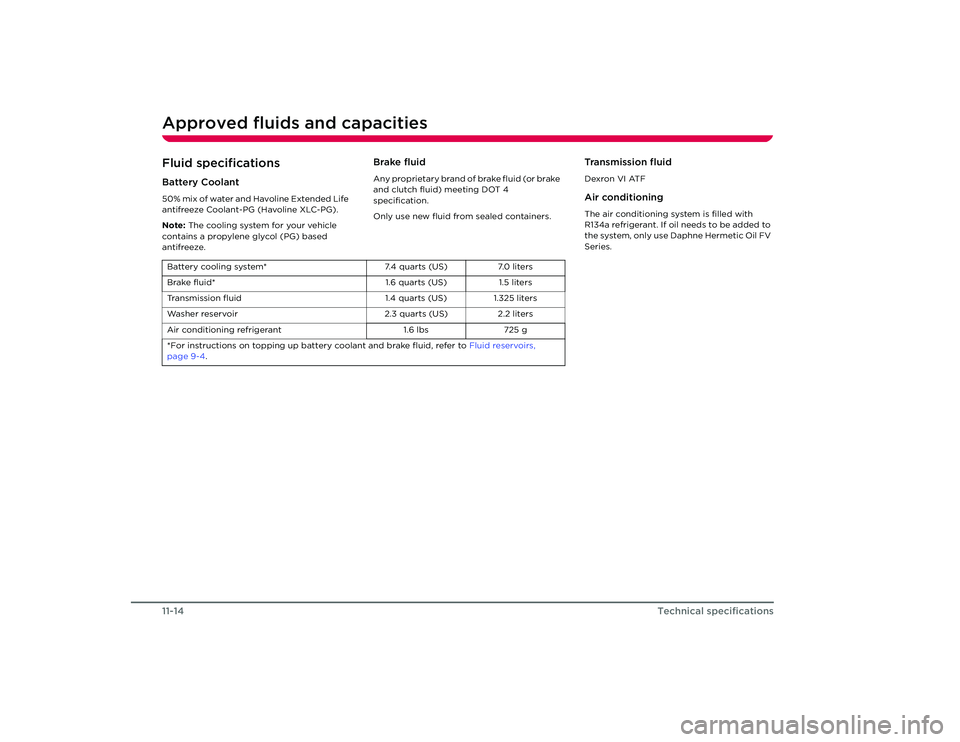
Approved fluids and capacities11-14
Technical specifications
Approved fluids and capacitiesFluid specificationsBattery Coolant50% mix of water and Havoline Extended Life
antifreeze Coolant-PG (Havoline XLC-PG).
Note: The cooling system for your vehicle
contains a propylene glycol (PG) based
antifreeze.
Brake fluidAny proprietary brand of brake fluid (or brake
and clutch fluid) meeting DOT 4
specification.
Only use new fluid from sealed containers.
Transmission fluidDexron VI ATFAir conditioningThe air conditioning system is filled with
R134a refrigerant. If oil needs to be added to
the system, only use Daphne Hermetic Oil FV
Series.
Battery cooling system* 7.4 quarts (US)7.0 liters
Brake fluid* 1.6 quarts (US)1.5 liters
Transmission fluid 1.4 quarts (US)1.325 liters
Washer reservoir 2.3 quarts (US)2.2 liters
Air conditioning refrigerant 1.6 lbs725 g
*For instructions on topping up batt ery coolant and brake fluid, refer to Fluid reservoirs,
page 9-4 .
Roadster OHB.book Page 14 Thursday, October 2, 2008 8:59 AM
Page 110 of 115
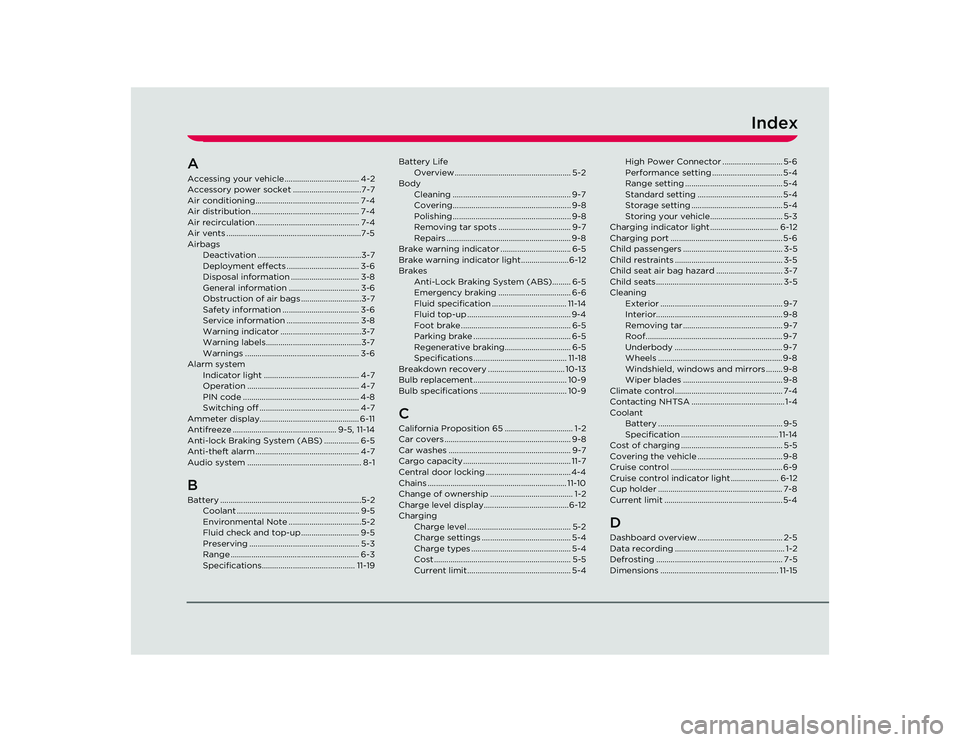
Index
AAccessing your vehicle.................................... 4-2
Accessory power socket .................................7-7
Air conditioning.................................................. 7-4
Air distribution .................................................... 7-4
Air recirculation .................................................. 7-4
Air vents .................................................................7-5
AirbagsDeactivation ..................................................3-7
Deployment effects ................................... 3-6
Disposal information ................................. 3-8
General information .................................. 3-6
Obstruction of air bags .............................3-7
Safety information ..................................... 3-6
Service information ................................... 3-8
Warning indicator .......................................3-7
Warning labels..............................................3-7
Warnings ....................................................... 3-6
Alarm system Indicator light .............................................. 4-7
Operation ...................................................... 4-7
PIN code ........................................................ 4-8
Switching off ................................................ 4-7
Ammeter display................................................ 6-11
Antifreeze .................................................. 9-5, 11-14
Anti-lock Braking System (ABS) ................. 6-5
Anti-theft alarm .................................................. 4-7
Audio system ....................................................... 8-1BBattery ....................................................................5-2 Coolant ........................................................... 9-5
Environmental Note ...................................5-2
Fluid check and top-up ............................ 9-5
Preserving ..................................................... 5-3
Range .............................................................. 6-3
Specifications............................................. 11-19 Battery Life
Overview ........................................................ 5-2
Body Cleaning ......................................................... 9-7
Covering......................................................... 9-8
Polishing ......................................................... 9-8
Removing tar spots ................................... 9-7
Repairs ............................................................ 9-8
Brake warning indicator .................................. 6-5
Brake warning indicator light .......................6-12
Brakes Anti-Lock Braking System (ABS)......... 6-5
Emergency braking ................................... 6-6
Fluid specification .................................... 11-14
Fluid top-up .................................................. 9-4
Foot brake ..................................................... 6-5
Parking brake ............................................... 6-5
Regenerative braking................................ 6-5
Specifications ............................................. 11-18
Breakdown recovery ..................................... 10-13
Bulb replacement............................................. 10-9
Bulb specifications .......................................... 10-9
CCalifornia Proposition 65 ................................. 1-2
Car covers ............................................................. 9-8
Car washes ........................................................... 9-7
Cargo capacity.................................................... 11-7
Central door locking ......................................... 4-4
Chains ................................................................... 11-10
Change of ownership ........................................ 1-2
Charge level display.........................................6-12
Charging Charge level .................................................. 5-2
Charge settings ........................................... 5-4
Charge types ................................................ 5-4
Cost .................................................................. 5-5
Current limit.................................................. 5-4 High Power Connector ............................. 5-6
Performance setting .................................. 5-4
Range setting ............................................... 5-4
Standard setting ......................................... 5-4
Storage setting ............................................ 5-4
Storing your vehicle................................... 5-3
Charging indicator light ................................. 6-12
Charging port ...................................................... 5-6
Child passengers ................................................ 3-5
Child restraints .................................................... 3-5
Child seat air bag hazard ................................ 3-7
Child seats............................................................. 3-5
Cleaning Exterior ........................................................... 9-7
Interior............................................................. 9-8
Removing tar ................................................ 9-7
Roof.................................................................. 9-7
Underbody .................................................... 9-7
Wheels ............................................................ 9-8
Windshield, windows and mirrors ........ 9-8
Wiper blades ................................................ 9-8
Climate control.................................................... 7-4
Contacting NHTSA ............................................. 1-4
Coolant Battery ............................................................ 9-5
Specification ............................................... 11-14
Cost of charging ................................................. 5-5
Covering the vehicle ......................................... 9-8
Cruise control ...................................................... 6-9
Cruise control indicator lig ht ....................... 6-12
Cup holder ............................................................ 7-8
Current limit ......................................................... 5-4
DDashboard overview ......................................... 2-5
Data recording ..................................................... 1-2
Defrosting ............................................................. 7-5
Dimensions ......................................................... 11-15
Roadster OHB.book Page 1 Th ursday, October 2, 2008 8:59 AM