light TESLA ROADSTER 2008 Owner's Manual
[x] Cancel search | Manufacturer: TESLA, Model Year: 2008, Model line: ROADSTER, Model: TESLA ROADSTER 2008Pages: 115, PDF Size: 46.35 MB
Page 67 of 115
HomeLink®
7-15
Comfort and convenience
HomeLink
®
HomeLink
® Universal
Transceiver
Your vehicle is equipped with a HomeLink
®
Universal Transceiver that you can use to
operate most Radio Frequency (RF) devices
such as garage doors, gates, lights and
security systems. Your transceiver can be
programmed using the Touch Screen to
operate up to three individual devices.
Devices can be operated by touching a
button on the Touch Screen. You can also set
up the third button on the key fob to operate
a device. For details on how to program
HomeLink, refer to the Touch Screen Users
Manual, provided in your owners package.
For security purposes, when you sell your
vehicle, you should erase your HomeLink
settings.
WARNING: Do not use the HomeLink
Universal Transceiver with any garage
door opener that la cks safety stop and
reverse features as required by federal safety
standards. A garage door opener which
cannot detect an object in the path of a
closing garage door and then automatically
stop and reverse, does not meet current
federal safety standards. Using a garage door
opener without these features increases the
risk of injury or death.
S
You’re vehicle should be turned off
while programming the HomeLink
Universal Transceiver.
S
During programming, your garage
door or gate may open or close. Make
sure that people and objects are clear of the
garage door or gate that you are
programming.
S
FCC ComplianceThis device complies with Part 15 of the FCC
Rules. Operation is subject to the following
two conditions:
1. This device may not cause harmful interference, and
2. This device must accept any interference received, including interference that may
cause undesired operation.
Any unauthorized modification to this device
could void the user’s authority to operate the
equipment.
Roadster OHB.book Page 15 Thursday, October 2, 2008 8:59 AM
Page 70 of 115
Maintenance9-2
Maintenance and care
Maintenance and care
MaintenanceGeneral informationRegular maintenance is the key to ensuring
the continued reliability and efficiency of
your vehicle.
Maintenance is the owner's responsibility and
you must ensure that the appropriate
maintenance is carried out when required
and according to the recommendations
specified by Tesla Motors.Routine maintenanceTake your vehicle to Tesla Motors at the
regularly scheduled maintenance intervals of
every 12 months, or every 12,000 miles,
whichever comes first.
Maintenance and service must be performed
by Tesla-certified technicians. Damages or
failures caused by maintenance or repairs
performed by non-Tesla certified technicians
are not covered under the New Vehicle
Limited Warranty.
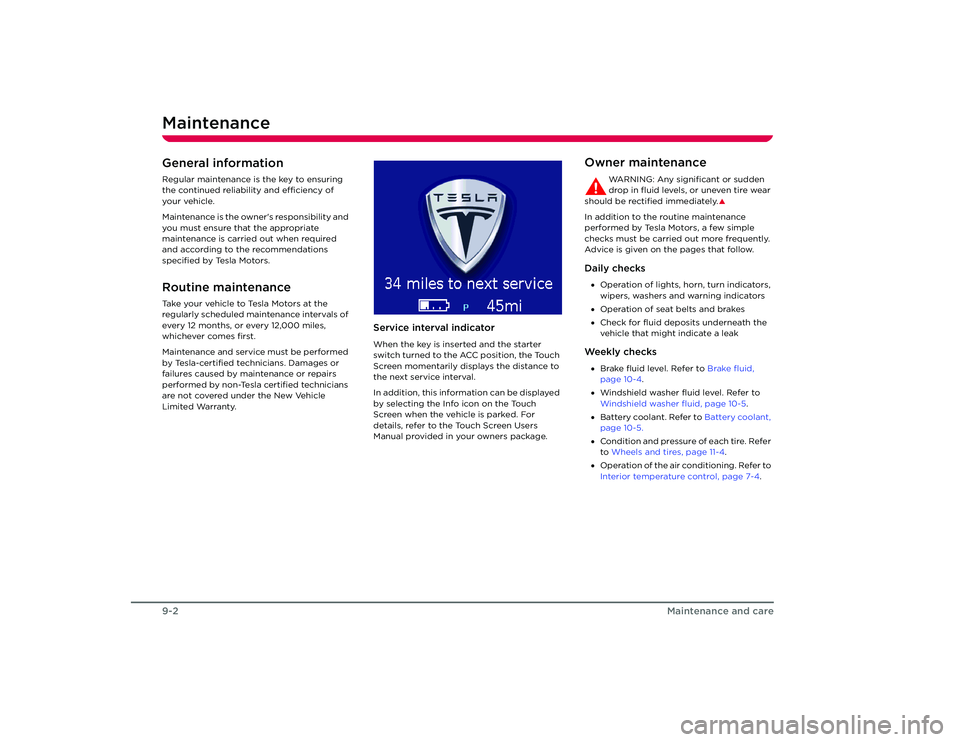
Service interval indicatorWhen the key is inserted and the starter
switch turned to the ACC position, the Touch
Screen momentarily displays the distance to
the next service interval.
In addition, this information can be displayed
by selecting the Info icon on the Touch
Screen when the vehicle is parked. For
details, refer to the Touch Screen Users
Manual provided in your owners package.
Owner maintenance
WARNING: Any significant or sudden
drop in fluid levels, or uneven tire wear
should be rectified immediately.
S
In addition to the routine maintenance
performed by Tesla Motors, a few simple
checks must be carried out more frequently.
Advice is given on the pages that follow.Daily checks• Operation of lights, horn, turn indicators,
wipers, washers and warning indicators
• Operation of seat belts and brakes
• Check for fluid deposits underneath the
vehicle that might indicate a leakWe e k l y c h e c k s•Brake fluid level. Refer to Brake fluid,
page 10-4 .
• Windshield washer fluid level. Refer to
Windshield washer fluid, page 10-5 .
• Battery coolant. Refer to Battery coolant,
page 10-5.
• Condition and pressure of each tire. Refer
to Wheels and tires, page 11-4 .
• Operation of the air conditioning. Refer to
Interior temperature control, page 7-4.
Roadster OHB.book Page 2 Th ursday, October 2, 2008 8:59 AM
Page 75 of 115
Cleaning and vehicle care
9-7
Maintenance and care
Cleaning and vehicle careEnvironmental precautions
Some cleaning products contain
chemicals that are hazardous to the
environment. Always take precautions
to prevent fluids from spilling.
It is illegal to pollute drains, rivers and
waterways. Used toxic chemicals must be
disposed of at authorized waste disposal
sites only.
Cleaning the vehicle exteriorHand washing
Caution: Substances that are corrosive,
such as bird droppings, tree resin, dead
insects, tar spots, road salt and industrial
fall-out can damage the vehicle's paint.
Remove such deposits as soon as possible to
prevent damage. To preserve the paint finish, observe the
following:
• Before washing, use a hose to remove
heavy deposits of mud and dirt.
• Never wash a vehicle that is “hot to the
touch” or during exposure to strong,
direct sunlight.
• Wash the body using cold or lukewarm
water containing a good quality wash and
wax shampoo.
• Never use strong household detergents
or soap. These products can discolor and
spot painted surfaces.
• For best results, always use a clean
sponge or car wash mitt with plenty of
water.
• After washing, rinse with clean water and
thoroughly wipe dry with a chamois. Do
not allow cleaning agents to dry on the
finish.
Automatic car washers and pressure
washers
Caution: Tesla Motors recommends that
you hand wash your vehicle.
Do not use an automatic car washer or
pressure washer as these may damage your
vehicle’s paint finish, soft top, or other
components. The use of a pressure washer to
clean components in the Battery
compartment may damage critical seals on
the Battery and other electrical components.
Note: Vehicle or paint damage caused by
using an automatic car washer or pressure
washer is not covered under the New Vehicle
Limited Warranty.
Underbody maintenanceIf salt has been used on the highways (such as
during winter months), thoroughly remove all
traces of road salt. Use a hose to rinse salt
from the underside of the vehicle.
Flush away accumulations of mud in areas
where debris easily collects (such as wheel
arches and panel seams).Removing tar spotsUse denatured alcohol to remove tar spots
and stubborn grease stains from paint. After
cleaning, immediately wash the area with
soapy water to remove the alcohol.Washing the soft-top
Caution: Scrubbing or brushing with a
hard bristle brush will damage the
fibers of the fabric, causing fabric
deterioration and impairing its cosmetic
appearance.
When washing the soft-top, follow these
guidelines:
1. Before washing, vacuum the soft-top using a soft brush attachment to remove
dust and dirt.
2. Soften encrusted dirt using soap and water, then rinse with clean water.
3. Wash using mild soap and water. Never use solvent, petroleum or chemical-based
cleaners, detergents, or wash/wax
compounds.
TR0159
Roadster OHB.book Page 7 Th ursday, October 2, 2008 8:59 AM
Page 76 of 115
Cleaning and vehicle care9-8
Maintenance and care
WheelsWash wheels with warm, fresh water
containing a good quality wash and wax
shampoo. Thoroughly rinse the wheels to
remove any soap residue.Windshield, windows and mirrorsRegularly clean all windows inside and out
using a window cleaning solution. An
automotive glass cleaner is recommended.
After washing the vehicle with wash/wax
products, clean the outside of the windshield
with glass cleaner.
Mirror glass is particularly susceptible to
damage. Do not use abrasive cleaning
compounds.Wiper bladesClean wiper blades using mild soap and warm
water only. Do not use petroleum or
alcohol-based cleaners.
Polishing the bodyTo preserve the cosmetic appearance of the
body, occasionally apply a good quality
polish. A good polish should contain a very
mild abrasive that removes surface
contamination without damaging the
surface, a mild filling compound to reduce the
appearance of scratches, and wax to provide
a barrier between the cleaned body surface
and airborne contaminants.
Do not use cutting paste, color restoration
compounds, or polishes containing a harsh
abrasive. These can scour the surface and
permanently degrade the body.Using a car coverTo preserve the cosmetic appearance of the
body, you may want to use a car cover. Only
an approved Tesla Motors car cover should be
used. DONOT use the car cover when
charging the vehicle. Doing so can interfere
with adequate cooling during charging.Paint damage and rectificationTreat chips and scratches to the paint using a
paint touch-up pen. Use the touch-up pen
after washing but before polishing or waxing.
More extensive repairs to the body should
only be carried out by a facility approved by
Tesla Motors. Contact Tesla Motors for a list of
approved body repair facilities.
Cleaning the vehicle interiorPlastic materials
Caution: Do not polish the upper
surfaces of the dashboard. Polished
surfaces are reflective and may interfere with
the driver's view.
Clean with diluted upholstery cleaner, then
wipe with a damp cloth.
Carpet and fabricsClean with diluted upholstery cleaner. Test a
concealed area first.LeatherClean with warm water and a non-detergent
soap. Dry and polish with a dry, clean,
lint-free cloth.Seat beltsExtend the belts and clean with warm, soapy,
fresh water only. Do not use any type of
detergent or chemical cleaning agent. Allow
the belts to dry naturally while extended,
preferably away from direct sunlight.Instruments and display screensClean the instrument panel, Touch Screen,
and audio system screen using a damp cloth.
Do not use cleaning co mpounds or solutions.
Roadster OHB.book Page 8 Th ursday, October 2, 2008 8:59 AM
Page 77 of 115
10-1
Roadside emergenciesTool kitTool kit location 9-2
Tool kit components 9-2
Energy Depletion Dealing with a discharged Battery 9-3
Getting a few extra miles 9-3
Tire repair Tire sealant 9-4
Safety precautions 9-4
Repairing a tire 9-4
Replacing the tire sealant 9-5
Wheels Removing the wheel 9-6
Replacing the wheel 9-6
Fuse replacement Replacing a fuse 9-7
Fuse specification chart 9-8
Bulb replacement Replacing a bulb 9-9
Interior light 9-9
Trunk light 9-10
License plate light 9-10
Raising the vehicle Vehicle jacking points 9-11
Vehicle lifting points 9-12
Vehicle recovery Transporting the vehicle 9-13
Transporter tie down straps 9-14
Roadster OHB.book Page 1 Th ursday, October 2, 2008 8:59 AM
Page 80 of 115
Tire repair10-4
Roadside emergencies
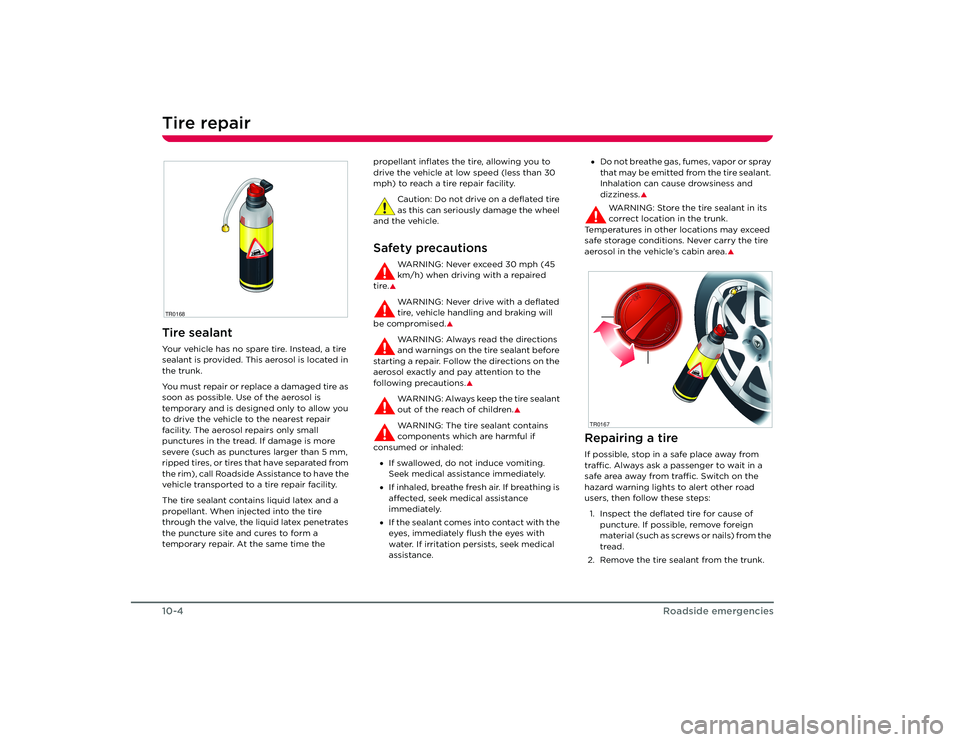
Tire repairTire sealantYour vehicle has no spare tire. Instead, a tire
sealant is provided. This aerosol is located in
the trunk.
You must repair or replace a damaged tire as
soon as possible. Use of the aerosol is
temporary and is designed only to allow you
to drive the vehicle to the nearest repair
facility. The aerosol repairs only small
punctures in the tread. If damage is more
severe (such as punctures larger than 5 mm,
ripped tires, or tires that have separated from
t h e r i m ) , c a l l R o a d s i d e A s s i s t a n c e t o h a ve t h e
vehicle transported to a tire repair facility.
The tire sealant contains liquid latex and a
propellant. When injected into the tire
through the valve, the liquid latex penetrates
the puncture site and cures to form a
temporary repair. At the same time the propellant inflates the tire, allowing you to
drive the vehicle at low speed (less than 30
mph) to reach a tire repair facility.
Caution: Do not drive on a deflated tire
as this can seriously damage the wheel
and the vehicle.
Safety precautions
WARNING: Never exceed 30 mph (45
km/h) when driving with a repaired
tire.SWARNING: Never drive with a deflated
tire, vehicle handling and braking will
be compromised.
S
WARNING: Always read the directions
and warnings on the tire sealant before
starting a repair. Follow the directions on the
aerosol exactly and pay attention to the
following precautions.
S
WARNING: Always keep the tire sealant
out of the reach of children.
S
WARNING: The tire sealant contains
components which are harmful if
consumed or inhaled:
• If swallowed, do not induce vomiting.
Seek medical assistance immediately.
• If inhaled, breathe fresh air. If breathing is
affected, seek medical assistance
immediately.
• If the sealant comes into contact with the
eyes, immediately flush the eyes with
water. If irritation persists, seek medical
assistance. •
Do not breathe gas, fumes, vapor or spray
that may be emitted from the tire sealant.
Inhalation can cause drowsiness and
dizziness.
S
WARNING: Store the tire sealant in its
correct location in the trunk.
Temperatures in other locations may exceed
safe storage conditions. Never carry the tire
aerosol in the vehicle’s cabin area.
S
Repairing a tireIf possible, stop in a safe place away from
traffic. Always ask a passenger to wait in a
safe area away from traffic. Switch on the
hazard warning lights to alert other road
users, then follow these steps:
1. Inspect the deflated tire for cause of puncture. If possible, remove foreign
material (such as screws or nails) from the
tread.
2. Remove the tire sealant from the trunk.
TR0168
TR0167
Roadster OHB.book Page 4 Th ursday, October 2, 2008 8:59 AM
Page 84 of 115
Fuse replacement10-8
Roadside emergencies
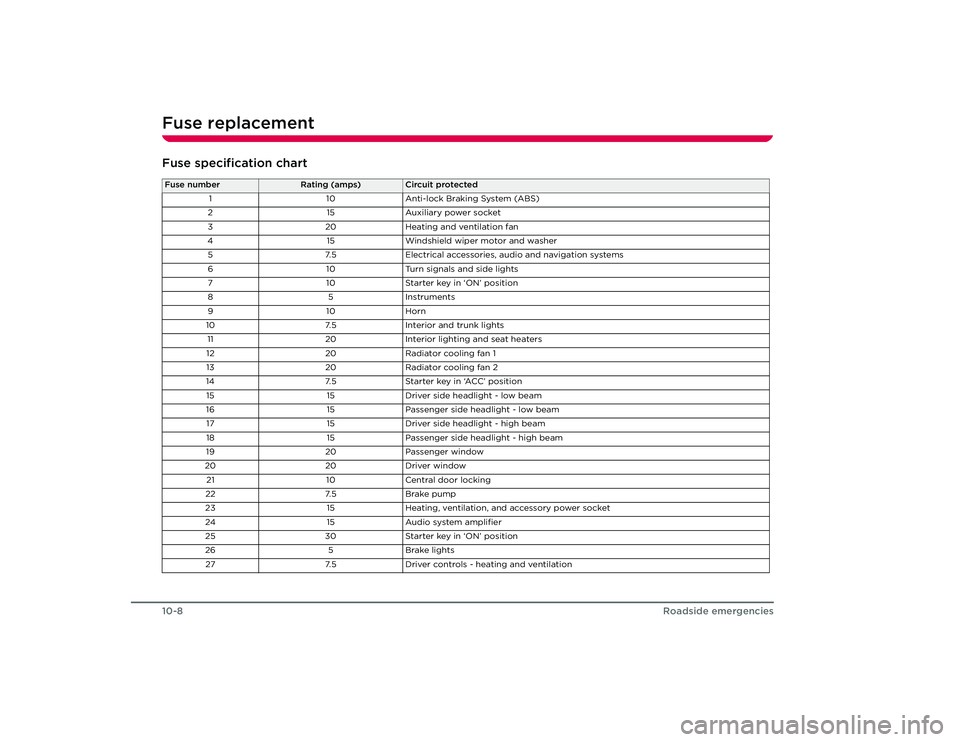
Fuse specification chartFuse number
Rating (amps)
Circuit protected
1 10Anti-lock Braking System (ABS)
2 15Auxiliary power socket
3 20Heating and ventilation fan
4 15Windshield wiper motor and washer
5 7.5Electrical accessories, audio and navigation systems
6 10Turn signals and side lights
7 10Starter key in ‘ON’ position
85 In stru m en ts
91 0Horn
10 7.5Interior and trunk lights
11 20Interior lighting and seat heaters
12 20Radiator cooling fan 1
13 20Radiator cooling fan 2
14 7.5Starter key in ‘ACC’ position
15 15Driver side headlight - low beam
16 15Passenger side headlight - low beam
17 15Driver side headlight - high beam
18 15Passenger side headlight - high beam
19 20Passenger window
20 20Driver window
21 10Central door locking
22 7.5Brake pump
23 15Heating, ventilation, and accessory power socket
24 15Audio system amplifier
25 30Starter key in ‘ON’ position
26 5Brake lights
27 7.5Driver controls - heating and ventilation
Roadster OHB.book Page 8 Th ursday, October 2, 2008 8:59 AM
Page 85 of 115
Bulb replacement
10-9
Roadside emergencies
Bulb replacementReplacing a bulbAlways check the operation of all exterior
lights before driving the vehicle. Replace a
bulb only with one of the same type and
specification.Light Emitting Diode (LED) lightsThe following lights on your vehicle use the
latest LED technology and if any of these
lights stop working, it must be replaced by
Te s l a M o t o r s :
• Front side marker light
• Rear side marker light
• Reverse lights
• Tail/brake lights
• Rear turn signals
Unlike traditional filament bulbs, these lights
have a long life and low power consumption
while providing the same amount of
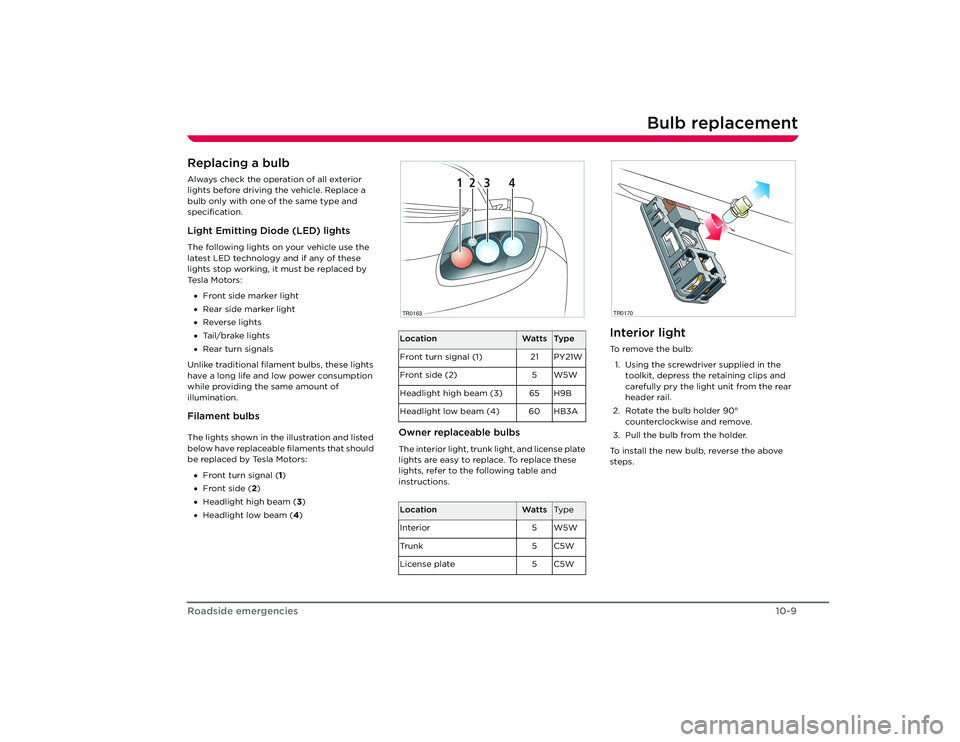
illumination.Filament bulbsThe lights shown in the illustration and listed
below have replaceable filaments that should
be replaced by Tesla Motors:
• Front turn signal ( 1)
• Front side (2 )
• Headlight high beam ( 3)
• Headlight low beam (4 )
Owner replaceable bulbsThe interior light, trunk light, and license plate
lights are easy to replace. To replace these
lights, refer to the following table and
instructions.
Interior lightTo r e m o v e t h e b u l b :
1. Using the screwdriver supplied in the toolkit, depress the retaining clips and
carefully pry the light unit from the rear
header rail.
2. Rotate the bulb holder 90° counterclockwise and remove.
3. Pull the bulb from the holder.
To install the new bulb, reverse the above
steps.
Location
Watts
Ty p e
Front turn signal (1) 21 PY21W
Front side (2) 5 W5W
Headlight high beam (3) 65 H9B
Headlight low beam (4) 60 HB3A
Location
Watts
Ty p e
Interior 5 W5W
Tr u n k 5 C 5 W
License plate 5 C5W
1
2
3
4
1
2
3
4
TR0163
TR0170
Roadster OHB.book Page 9 Th ursday, October 2, 2008 8:59 AM
Page 86 of 115
Bulb replacement10-10
Roadside emergencies
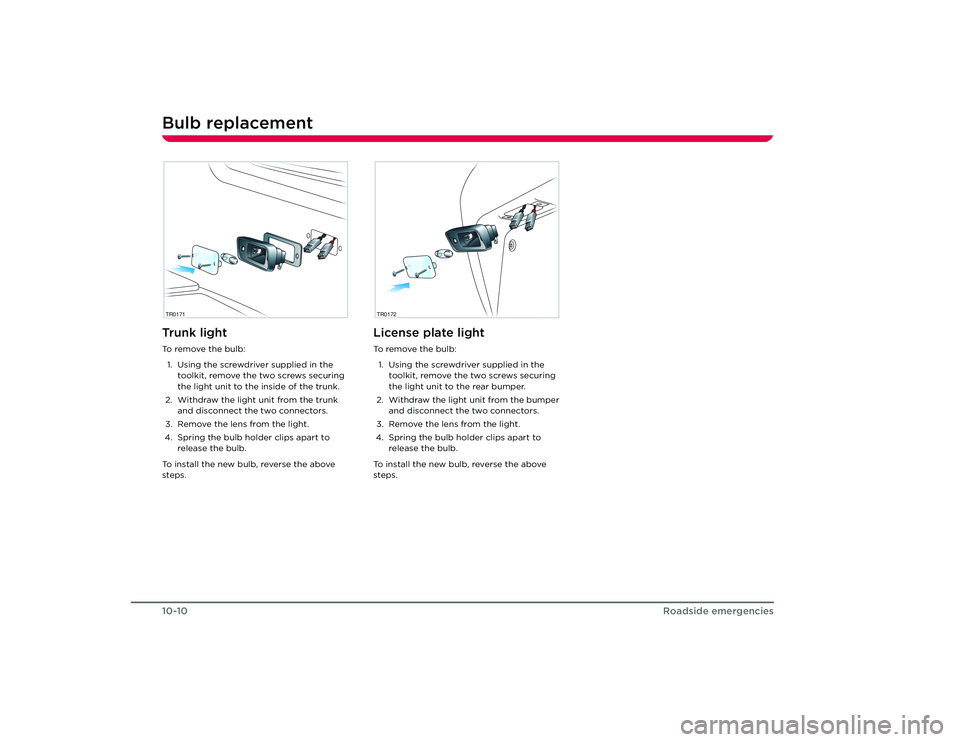
Tr u n k l i g h tTo r e m o v e t h e b u l b :1. Using the screwdriver supplied in the toolkit, remove the two screws securing
the light unit to the inside of the trunk.
2. Withdraw the light unit from the trunk and disconnect the two connectors.
3. Remove the lens from the light.
4. Spring the bulb holder clips apart to release the bulb.
To install the new bulb, reverse the above
steps.
License plate lightTo r e m o v e t h e b u l b : 1. Using the screwdriver supplied in the toolkit, remove the two screws securing
the light unit to the rear bumper.
2. Withdraw the light unit from the bumper and disconnect the two connectors.
3. Remove the lens from the light.
4. Spring the bulb holder clips apart to release the bulb.
To install the new bulb, reverse the above
steps.
TR0171
TR0172
Roadster OHB.book Page 10 Thursday, October 2, 2008 8:59 AM
Page 90 of 115
Vehicle recovery10-14
Roadside emergencies
4. Touch To w M o d e , then touch OK to
confirm. The Touch Screen displays the
following message to indicate that the
vehicle is in Tow Mode.
5. Release the hand brake, if appropriate.
Note: Although Tow Mode is activated, the
steering column lock will be engaged. To
disengage the steering column, turn the key
to the ACC position. If it is difficult to turn the
key, move the steering wheel slightly.
Caution: The car can roll freely when
Tow Mode is active. If the vehicle is not
on a flat surface, do not release the hand
brake until the vehicle is ready to be pulled. Note:
The vehicle can not be charged or
started until you exit Tow Mode.
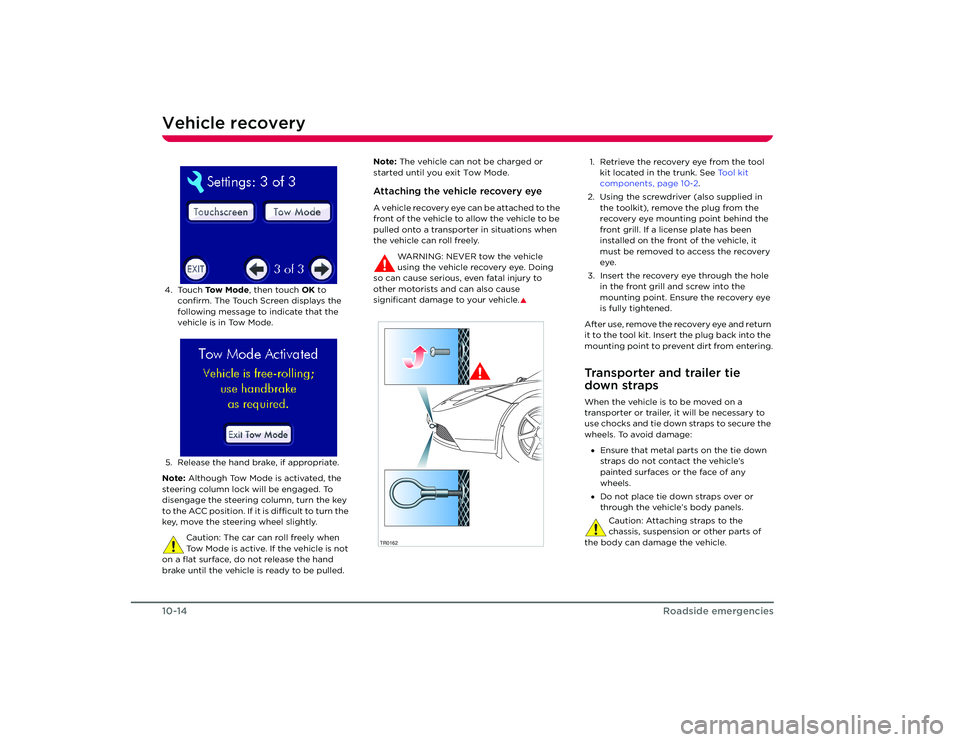
Attaching the vehicle recovery eyeA vehicle recovery eye can be attached to the
front of the vehicle to allow the vehicle to be
pulled onto a transporter in situations when
the vehicle can roll freely.
WARNING: NEVER tow the vehicle
using the vehicle recovery eye. Doing
so can cause serious, even fatal injury to
other motorists and can also cause
significant damage to your vehicle.
S
1. Retrieve the recovery eye from the tool kit located in the trunk. See Tool kit
components, page 10-2.
2. Using the screwdriver (also supplied in the toolkit), remove the plug from the
recovery eye mounting point behind the
front grill. If a license plate has been
installed on the front of the vehicle, it
must be removed to access the recovery
eye.
3. Insert the recovery eye through the hole in the front grill and screw into the
mounting point. Ensure the recovery eye
is fully tightened.
After use, remove the recovery eye and return
it to the tool kit. Insert the plug back into the
mounting point to prevent dirt from entering.Transporter and trailer tie
down strapsWhen the vehicle is to be moved on a
transporter or trailer, it will be necessary to
use chocks and tie down straps to secure the
wheels. To avoid damage: • Ensure that metal parts on the tie down
straps do not contact the vehicle’s
painted surfaces or the face of any
wheels.
• Do not place tie down straps over or
through the vehicle’s body panels.
Caution: Attaching straps to the
chassis, suspension or other parts of
the body can damage the vehicle.
TR0162
Roadster OHB.book Page 14 Thursday, October 2, 2008 8:59 AM