head TOYOTA 4RUNNER 1997 User Guide
[x] Cancel search | Manufacturer: TOYOTA, Model Year: 1997, Model line: 4RUNNER, Model: TOYOTA 4RUNNER 1997Pages: 223, PDF Size: 4.66 MB
Page 65 of 223
68If either of the following conditions occurs, this indicates a malfunction somewhere in the parts monitored by the warning light
system. Contact your Toyota dealer as
soon as possible to service the vehicle.
The light does not come on when the
ignition key is turned to the ACCº or
ONº position or remains on.
The light comes on while driving.
(j) Light Reminder Buzzer
This buzzer will sound if the driver's door is opened while the ignition switch is turned to the LOCKº position with the
headlight switch on. Removing the key will
not stop the buzzer as long as the head-light switch is on.
(k) Key Reminder Buzzer
This buzzer reminds you to remove the
key when you open the driver's door with the ignition key in the ACCº or LOCKº position.
(l) Unengaged Parkº Warning Light
(vehicles with automatic transmis-sion)
This light warns that the transmission
Parkº mechanism is not engaged. If the
front drive control lever is in the Nº posi-
tion while the selector lever is in the Pº
position, the transmission will disengage
and the wheels will not lock.
To restore the park function, shift
the front drive control lever out of
Nº, or the vehicle can move. CAUTION
!
(m) Automatic Transmission Fluid
Temperature Warning Light
This light warns that the automatic trans- mission fluid temperature is too high.
If this light comes on while you are driving,
slow down and pull off the road. Stop the
vehicle at a safe place and put the selector
lever in Pº. With the engine idling, wait
until the light goes off. If the light goes off,
you may start the vehicle again. If the light
does not go off, call a Toyota dealer or
qualified repair shop for assistance.
NOTICE
Continued driving with the warning light on may damage the automatic
transmission.
(n)Low Windshield Washer Fluid Level
Warning Light (Canada)
The light warns that the windshield wash-
er fluid level is too low. Add washer fluid at
your earliest opportunity. (For instruc-
tions, see Adding washer fluidº in Chap-ter 7-3.)
CHECKING SERVICE REMINDER INDI-
CATORS
1. Apply the parking brake.
2. Open one of the side doors or the back
door.
The open door warning light should come on.
3. Close the door. The open door warning light should go
off.
4. Turn ignition key to ACCº. The SRS airbag warning light should
come on. It goes off after about 6 sec-onds.
5. Turn the ignition key to ONº, but do not start the engine.
All the service reminder indicators ex-
cept the open door warning light and
SRS airbag warning light should come
on. The ABSº warning light goes off
after about 3 seconds.
Page 80 of 223

83
Steel wheels
Aluminum wheelsThe A.D.D. can be engaged or disen-
gaged by the shifting operations de-
scribed in (c) Shifting procedureº.
You should drive in four-wheel drive for at least 16 km (10 miles) each month. This
will assure that the front drive compo- nents are lubricated.
SHIFTING BETWEEN H2º AND H4º With free-wheeling hubs
To shift from H2º to H4º
, move the
front drive control lever. Also, engage both the free-wheeling hubs.
This can be done when the vehicle is stopped, or moving straight ahead at
speeds of 40 km/h (25 mph) or less. You need not depress the clutch pedal. If you
have trouble shifting, depress or releasethe accelerator pedal momentarily while
pushing the front drive control lever.
Never move the front drive control
lever if wheels are slipping. Stop the slipping or spinning before shifting. CAUTION
!
To shift from H4º to H2º , simply move
the front drive control lever.
This can be done at any vehicle speed.
You need not depress the clutch pedal.
If the indicator light does not go off when you shift the transfer into H2º, drive
straight ahead while accelerating or de- celerating, or drive in reverse.
(b) A.D.D. (automatic discon- necting differential)
(c) Shifting procedure (levertype with automatic transmis- sion)
Page 81 of 223
84With A.D.D.
To shift from H2º to H4º, reduce your
speed to less than 80 km/h (50 mph) and
move the front drive control lever. You
need not depress the clutch pedal.
If you have trouble shifting in cold weath-
er, reduce your speed or stop the vehicle and reshift.
Never move the front drive control
lever if wh
eels are slipping. Stop the
slipping or spinning before shifting. CAUTION
!
To shift from H4º to H2º , simply move
the front drive control lever. Also, disen-
gage both the free-wheeling hubs for con-
tinued H2º use.
This can be done at any vehicle speed.
You Need not depress the clutch pedal.
If the indicator light does not go off when you shift the transfer into H2º, drive
straight ahead while accelerating or de- celerating, or drive in reverse. SHIFTING BETWEEN H4º AND l4º
To shift from H4º to L4º
, stop the ve-
hicle or reduce your speed to less than 8
km/h (5 mph). With your foot off the accel-
erator pedal. depress the clutch pedal and
move the front drive control lever.
To shift from L4º to H4º , depress the
clutch pedal and move the front drive con-
trol lever.This can be done at any vehicle speed. SHIFTING BETWEEN H2º AND H4º
To shift from H2º to H4º
, move the
front drive control lever.
This can be done when the vehicle is stopped, or moving straight ahead at
speeds of 40 km/h (25 mph) or less. If you
have trouble shifting, depress or release the accelerator pedal momentarily while
pushing the front drive control lever.
Never move the front drive control
lever if wheels are slipping. Stop the slipping or spinning before shifting. CAUTION
!
To shift from H4º to H2º , simply move
the front drive control lever. This can be done at any vehicle speed.
If the indicator light does not go off when you shift the transfer into H2º, drive
straight ahead while accelerating or de-celerating, or drive in reverse.
(c) Shifting procedure (lever type with automatic transmis- sion)
Page 82 of 223
85
With A.D.D.
To shift from H2º to H4º
, reduce your
speed to less than 80 km/h (50 mph) and
move the front drive control lever.
If you have trouble shifting in cold weath-
er, reduce your speed or stop the vehicle and reshift.
Never move the front drive control
lever if wh eels are slipping. Stop the
slipping or spinning before shifting. CAUTION
!
To shift from H4º to H2º , simply move
the front drive control lever. Also, disen-
gage both the free-wheeling hubs for con-
tinued H2º use. This can be done at any vehicle speed.
If the indicator light does not go off when you shift the transfer into H2º, drive
straight ahead while accelerating or de- celerating, or drive in reverse. SHIFTING BETWEEN H4º AND L4º
To shift between H4º and L4º , stop
the vehicle and put the transmission in
Nº. With your foot holding down the brake
pedal, move the front drive control lever. SHIFTING BETWEEN H2º AND H4º
To shift from H2º to H4º
, reduce your
speed to less than 100 km/h (62 mph) and
push in the 4WDº button. You need not depress the clutch pedal.
If the indicator light does not come on
when you push in the 4WDº button, drive
straight ahead while accelerating or de-celerating.
If the indicator light flashes and the buzzer
sounds when you push in the 4WDº but-
ton, reduce your speed or stop the vehicle
and reset.
Never push the 4WDº button if
wheels are slipping. Stop the
slipping or spinning before shifting. CAUTION
! To shift from H4º to H2º
, push the
4WDº button aging to turn it off.
This can be done at any vehicle speed.
You need not depress the clutch pedal.
If the indicator light does not go off when you shift the transfer into H2º, drive
straight ahead while accelerating or de- celerating, or drive in reverse.
SHIFTING BETWEEN H2º OR H4º
AND L4º
To shift from H2º or H4º to L4º , stop
the vehicle or reduce your speed to less
than 8 km/h (5 mph). With your foot off the
accelerator pedal, depress the clutch
pedal and move the front drive control le-
ver.
To shift from L4º to H2º or H4º , de-
press the clutch pedal and move the front
drive control lever. When the 4WDº but-ton is pushed in, the transfer shifts into
H4º; when the button is left out, the trans-
fer shifts into H2º This can be done at any vehicle speed.
If the indicator light does not go off when you shift the transfer into H2º, drive
straight ahead while accelerating or de- celerating, or drive in reverse.
(c) Shifting procedure (lever/button type)
Page 116 of 223

11 9
NOTICE
To ensure the correct audio system operation:
Be careful not to spill beveragesover the audio system.
Do not put anything other than acassette tape or Compact Disc
into the slot.
ILLUMINATION CONTROL LOGIC
On some audio-units, when the instru-
ment panel lights are on, the letters on op-
erable buttons of the mode in current use
light up together with the mode selectionand eject buttons. RADIO RECEPTION
Usually, a problem with radio reception
does not mean there is a problem with
your radioÐit is just the normal result of
conditions outside the vehicle.
For example, nearby buildings and terrain
can interfere with FM reception. Power
lines or telephone wires can interfere with
AM signals. And of course, radio signals
have a limited range, and the farther you are from a station, the weaker its signal
will be. In addition, reception conditions
change constantly as your vehicle moves. Here are some common reception prob-lems
that probably do not indicate a prob-
lem with your radio: FM
Fading and driving stationsÐGenerally,
the effective range of FM is about 40 km
(25 miles). Once outside this range, you
may notice fading and drifting, which in- crease with the distance from the radio
transmitter. They are often accompanied by distortion.
Multi-pathÐFM signals are reflective,
making it possible for two signals to reach
your antenna at the same time. If this hap-
pens, the signals will cancel each other
out, causing a momentary flutter or loss of
reception.
Static and flutteringÐThese occur when
signals are blocked by buildings, trees, or other large objects. Increasing the bass
level may reduce static and fluttering.
Station swappingÐIf the FM signal you are listening to is interrupted or weak-
ened, and there is another strong station
nearby on the FM band, your radio may
tune in the second station until the original
signal can be picked up again. AM FadingÐAM broadcasts are reflected by the upper atmosphere-especially atnight. These reflected signals can inter-
fere with those received directly from the radio station, causing the radio station tosound alternately strong and weak.
Station interferenceÐWhen a reflected
signal and a signal received directly from a radio station are very nearly the same
frequency, they can interfere with each
other,
making it difficult to hear the broad-
cast.
StaticÐAM is easily affected by external sources of electrical noise, such as high
tension power lines, lightening, or electri-cal motors. This results in static.
CARING FOR YOUR CASSETTE PLAY-
ER AND TAPES
For high performance from your cassette
player and tapes:
Clean the tape head and other parts regu-
larly. A dirty tape head or tape path can de-
crease sound quality and tangle your
cassette tapes. The easiest way to
clean them is by using a cleaning tape.
(A wet type is recommended.)
ÐCar audio system operating hints
Page 130 of 223

133
To remove the luggage cover:
1. Detach its hooks from the head re-strains.
2. Lift it up.Use a floor mat of the correct size.
If the floor mat has a hole, then it is de-
signed for use with a locking clip. Fix thefloor mat and locking clip into the hole in the floor carpet.
Make sure the floor mat is properly
placed on the floor carpet. If the
floor mat slips and interferes with
the movement of the pedals during driving, it may cause an accident. CAUTION
!
Floor mat
Page 146 of 223

Part 3How to start the engineÐ
(a) Before cranking
Before starting the engine
149
STARTING AND DRIVING
Before starting the engine
How to start the engine
Tips for driving in various conditions
Off-road driving precautions
Winter driving tips
Trailer towing
How to save fuel and make your
vehicle last longer, too
1. Check
the area around the vehicle be-
fore entering it.
2. Adjust seat position, seatback angle, seat cushion angle, head restraint
height and steering wheel angle.
3. Adjust inside and outside rear view mirrors.
4. Lock all doors.
5. Fasten seat belts. 1. Apply the parking brake firmly.
2. Turn off unnecessary lights and acces-
sories.
3. Manual transmission: Press the
clutch pedal to the floor and shift the
transmission into neutral. Hold theclutch pedal to the floor until the engine
is started. A starter safety device willprevent the starter from operating if
the clutch pedal is not fully depressed.
Automatic transmission: Put the se-
lector lever in Pº. If you need to restart
the engine while the vehicle is moving, put the selector lever in Nº. A starter
safety device will prevent the starter
from operating if the selector lever is in
any drive position.
4. Automatic transmission only: De-
press the brake pedal and hold it to the
floor until driving off.
Page 154 of 223

157
Because stopping distance may be in-
creased, vehicle-to-vehicle distance
should be increased when towing a
trailer. For each 16 km/h (10 mph) of speed, allow at least one vehicle and
trailer length between you and the ve-
hicle ahead. Avoid sudden braking as you may skid, resulting in jackknifing
and loss of control. This is especially
true on wet or slippery surfaces.
Avoid jerky starts or sudden accelera-tion. If your vehicle has manual trans-
mission, prevent excessive clutch slip-
page by keeping engine rpm low and
not racing the engine. Always start out
in first gear.
Avoid jerky steering and sharp turns.
The trailer could hit your vehicle in a
tight turn. Slow down before making a
turn to avoid the necessity of sudden braking.
Remember that when making a turn, the trailer wheels will be closer than the vehicle wheels to the inside of the
turn. Therefore, compensate for this
by making a larger than normal turning
radius with your vehicle.
Crosswinds and rough roads will ad-
versely affect handling of your vehicle
and trailer, causing sway. Pay atten-
tion to the rear from time to time to pre-
pare yourself for being passed by largetrucks or buses, which may cause your
vehicle and trailer to sway. If swaying
happens, firmly grip the steering wheel
and reduce speed immediately but
gradually. Never increase speed.
Steer straight ahead. If you make no
extreme correction with the steering or
brakes, the vehicle and trailer will sta-bilize.
Be careful when passing other ve-hicles. Passing requires considerable
distance. After passing a vehicle, do
not forget the length of your trailer and
be sure you have plenty of room be-
fore changing lanes.
In order to maintain engine braking ef-
ficiency, do not use fifth gear (manual
transmission) or overdrive (automatic transmission).
Because of the added load of the trail-
er, your vehicle's engine may overheat
on hot days (at temperatures over 30 5C [85 5F]) when going up a long or
steep grade with a trailer. If the engine
coolant temperature gauge indicates
overheating, immediately turn off the
air conditioning (if in use), pull off the
road and stop in a safe spot. Refer to
If your vehicle overheatsº in Part 4 of this manual.
Always place wheel blocks under both
the vehicle and trailer wheels whenparking. Apply the parking brake firm-
ly. Put the transmission in Pº (auto-
matic) or in first or reverse (manual).
Avoid parking on a slope with a trailer,but if it cannot be avoided, do so only after performing the following:
1. Apply the brakes and hold.
2. Have someone place wheel blocks un-
der both the vehicle and trailer wheels.
3. When the wheel blocks are in place, release your brakes slowly until the blocks absorb the load.
4. Apply the parking brake firmly.
5. Shift into first or reverse (manual) or Pº (automatic) and turn off the engine.
Page 172 of 223
175
CAUTION!
Use extreme caution when towing
vehicles. Avoid sudden starts or
erratic driving maneuvers which
would place excessive stress on the
emergency towing hook and towing
cable or chain. The hook and towing
cable or chain may break and cause
serious injury or damage.
NOTICE
Use only a cable or chain specific- ally intended for use in towing
vehicles. Securely fasten the cableor chain to the towing eyelet provided.
Before towing, release the parking brake
and put the transmission in neutral
(manual) or Nº (automatic)And transfer in
H2º (four-wheel drive models). The key
must be in ACCº (engine off) or ONº (en-
gine running).
CAUTION!
If the engine is not running, the
power assist for the brakes and
steering will not work so steering
and braking will be much harder
than usual.
Before emergency towing, check that
the hook is not broken or damaged and
that the installation bolts are not loose.
Fasten the towing cable or chain se-curely to the hook.
Do not jerk the hook. Apply steady and
even force.
To avoid damaging the hook, do not
pull from the side or at a vertical angle.
Always pull straight ahead.
ÐEmergency towing hook precautions
Page 173 of 223
176
If the emergency towing hook is
used to get out when your vehicle
becomes stuck in the mud, sand or
other condition from which the
vehicle can not be driven out under
its own power, make sure to observe
the precautions mentioned below.
Otherwise, excessive stress will be
put on the hook and the towing
cable or chain may break, causing
serious injury or damage. If the towing vehicle can hardly
move, do not forcibly continue the
towing. Contact your Toyota deal-
er or a commercial tow truck ser- vice for assistance.
Tow the vehicle as straight ahead as possible.
Keep away from the vehicle during
towing. CAUTION
!
The following methods are effective to
use when your vehicle is stuck in the mud, sand or other condition from which the ve-
hicle cannot be driven out under its own
power. Use extreme caution when
towing
the vehicle. In addition, keep away from
the vehicles and towing cable or chain
when towing. Remove the soil and sand in the front and the back of the tires.
Place stones or wood under the tires.
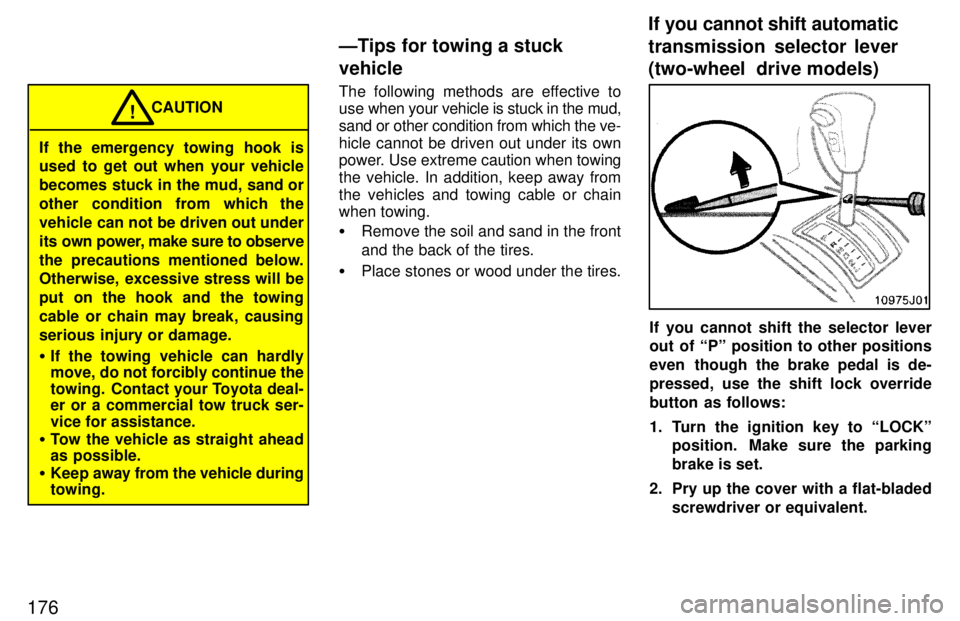
If you cannot shift the selector lever
out of Pº position to other positions
even though the brake pedal is de-pressed, use the shift lock override
button as follows:
1. Turn the ignition key to LOCKº
position. Make sure the parking brake is set.
2. Pry up the cover with a flat-bladed screwdriver or equivalent.
ÐTips for towing a stuck vehicle
If you cannot shift automatic
transmission selector lever
(two-wheel drive models)