head TOYOTA 4RUNNER 1997 Owners Manual
[x] Cancel search | Manufacturer: TOYOTA, Model Year: 1997, Model line: 4RUNNER, Model: TOYOTA 4RUNNER 1997Pages: 223, PDF Size: 4.66 MB
Page 4 of 223

3
1. Clutch start cancel switch
2. Headlight and turn signal switch
3. Wiper and washer switches
4. Back window defogger switch
5. Emergency flasher switch
6. Clock
7. Cup holder
8. Air conditioning controls
9. Car audio
10. Ashtray 11. Cigarette lighter
12. Ignition switch
13. Cruise control switch
14. Rear differential lock button
15. Instrument panel light control knob
16. Power rear view mirror control switch (without power windows)
17. Power back window lock switch (without power windows)
Page 6 of 223

Indicator symbols on the instrument panel5
Unengaged Parkº warning light *1
Brake system warning light *1
Seat belt reminder light* 1
Discharge warning light* 1
Low oil pressure warning light* 1
Malfunction indicator light* 1
Low fuel level warning light * 1 Open door warning light*
1
SRS airbag warning light* 1
Automatic transmission fluid
temperature warning light* 1
Turn signal indicator lights
Headlight high beam indicator light
Over-drive indicator light
Anti-lock brake system warning
light * 1 Low windshield washer fluid level
warning light*
1
Page 12 of 223
11
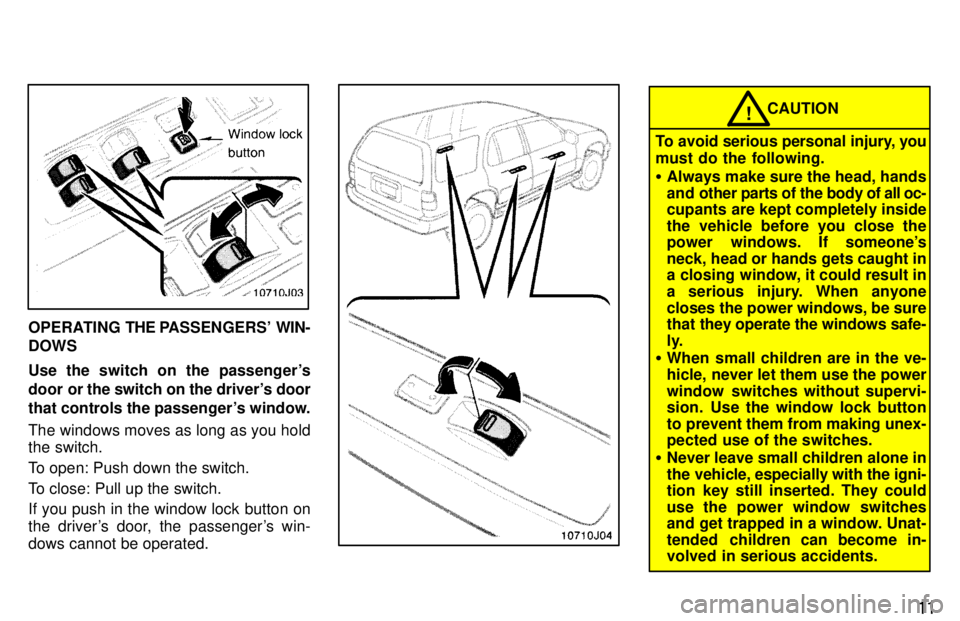
OPERATING THE PASSENGERS' WIN-
DOWS
Use the switch on the passenger's
door or the switch on the driver's door
that controls the passenger's window.
The windows moves as long as you hold the switch.
To open: Push down the switch.
To close: Pull up the switch.
If you push in the window lock button on
the driver's door, the passenger's win-
dows cannot be operated.
CAUTION!
To avoid serious personal injury, you
must do the following. Always make sure the head, hands
and other parts of the body of all oc-
cupants are kept completely inside
the vehicle before you close the
power windows. If someone's
neck, head or hands gets caught in
a closing window, it could result in
a serious injury. When anyone
closes the power windows, be sure
that they operate the windows safe-
ly.
When small children are in the ve-
hicle, never let them use the power
window switches without supervi-
sion. Use the window lock button
to prevent them from making unex-
pected use of the switches.
Never leave small children alone in
the vehicle, especially with the igni-
tion key still inserted. They could
use the power window switches
and get trapped in a window. Unat-
tended children can become in-
volved in serious accidents.
Page 14 of 223
13
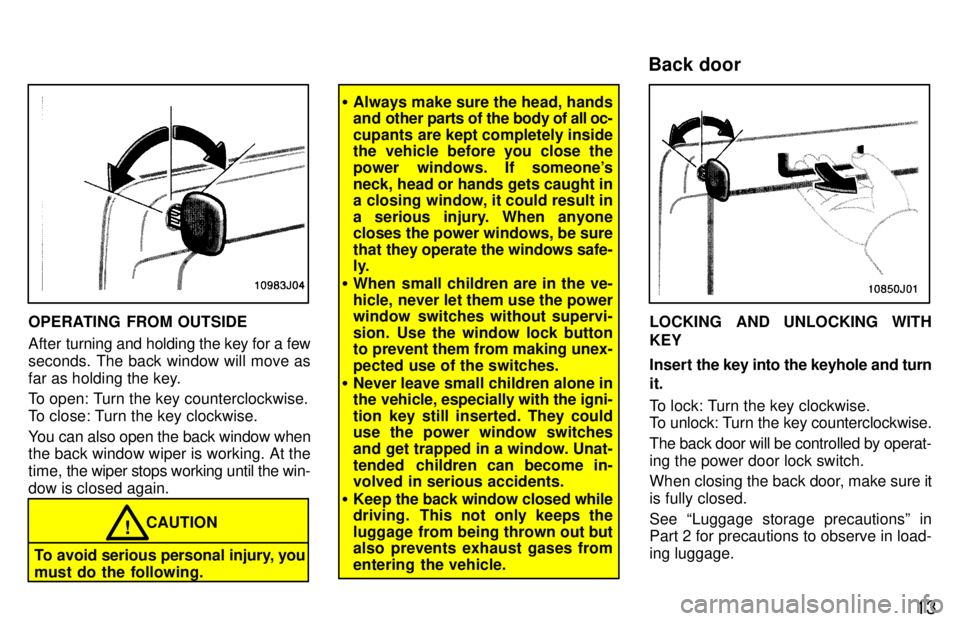
OPERATING FROM OUTSIDE
After turning and holding the key for a few
seconds. The back window will move as
far as holding the key.
To open: Turn the key counterclockwise.
To close: Turn the key clockwise.
You can also open the back window when the back window wiper is working. At the
time, the wiper st ops working until the win-
dow is closed again.
CAUTION!
To avoid serious personal injury, you
must do the following.
Always make sure the head, hands
and other parts of the body of all oc-
cupants are kept completely inside
the vehicle before you close the
power windows. If someone's
neck, head or hands gets caught in
a closing window, it could result in
a serious injury. When anyone
closes the power windows, be sure
that they operate the windows safe-
ly.
When small children are in the ve-
hicle, never let them use the power
window switches without supervi-
sion. Use the window lock button
to prevent them from making unex-
pected use of the switches.
Never leave small children alone in
the vehicle, especially with the igni-
tion key still inserted. They could
use the power window switches
and get trapped in a window. Unat-
tended children can become in-
volved in serious accidents.
Keep the back window closed while
driving. This not only keeps the
luggage from being thrown out but
also prevents exhaust gases from
entering the vehicle.
LOCKING AND UNLOCKING WITH KEY
Insert the key into the keyhole and turn
it.
To lock: Turn the key clockwise.
To unlock: Turn the key counterclockwise. The back door will be controlled by operat-
ing the power door lock switch.
When closing the back door, make sure it is fully closed. See Luggage storage precautionsº in
Part 2 for precautions to observe in load- ing luggage.
Back door
Page 19 of 223
18You may stop the moon roof at any de-
sired
position. The roof will move while the
switch is being pushed and stop when re- leased.
CAUTION!
To avoid serious personal injury, you
must do the following. While the vehicle is moving, always
keep the head, hands and other
parts of the body of all occupants away from the roof opening.
Otherwise, you could be seriously
injured if the vehicle stops sudden-
ly or if the vehicle is involve in an accident.
Always make sure nobody places
his/her head, hands and other parts
of the body in the roof opening be-
fore you close the roof. If some-
one's neck, head or hands get
caught in the closing roof, it could
result in a seri ous injury. When any-
one closes the roof, first make sure
it is safe to do so.
Never leave small children alone in
the vehicle, especially with the
ignition key still inserted. They
could use the moon roof switches
and get trapped in the roof open-
ing. Unattended children can be- come involved in serious acci- dents.
Never sit on top of the vehicle
around the roof opening.
Page 20 of 223
24
Front
RearFor your s
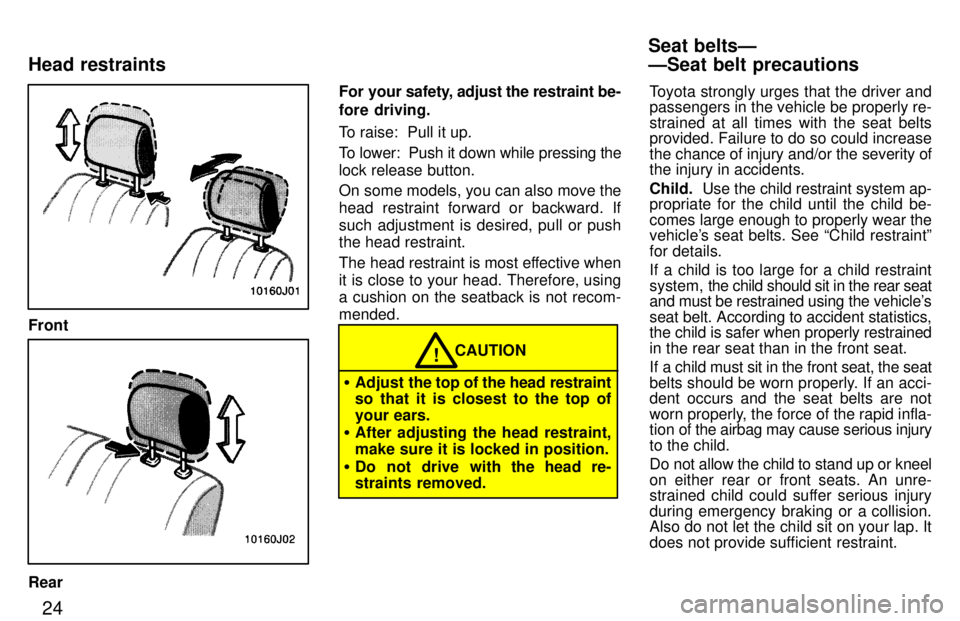
afety, adjust the restraint be-
fore driving.
To raise: Pull it up.
To lower: Push it down while pressing the lock release button.
On some models, you can also move the
head restraint forward or backward. If
such adjustment is desired, pull or push the head restraint.
The head restraint is most effective when
it is close to your head. Therefore, using a cushion on the seatback is not recom- mended.
CAUTION!
Adjust the top of the head restraint
so that it is closest to the top of
your ears.
After adjusting the head restraint,
make sure it is locked in position.
Do not drive with the head re-
straints removed. Toyota strongly urges that the driver and passengers in the vehicle be properly re- strained at all times with the seat belts
provided. Failure to do so could increase
the chance of injury and/or the severity of the injury in accidents. Child.
Use the child restraint system ap-
propriate for the child until the child be-
comes large enough to properly wear the
vehicle's seat belts. See Child restraintº
for details.
If a child is too large for a child restraint
system, the child should sit in the rear seat
and must be restrained using the vehicle's
seat belt. According to accident statistics, the child is safer when properly restrained
in the rear seat than in the front seat.
If a child must sit in the front seat, the seat
belts should be worn properly. If an acci- dent occurs and the seat belts are not
worn properly, the force of the rapid infla-
tion of the airbag may cause serious injury
to the child.
Do not allow the child to stand up or kneel
on either rear or front seats. An unre-
strained child could suffer serious injury
during emergency braking or a collision.
Also do not let the child sit on your lap. It
does not provide sufficient restraint.
Seat beltsÐ ÐSeat belt precautions
Head restraints
Page 27 of 223

31
The SRS (Supplemental Restraint Sys-
tem) airbags are designed to provide
further protection to the driver and
front passenger when added to the pri-
mary protection provided by the seatbelts.
In response to a severe frontal impact, the
SRS airbags work together with the seat
belt to help preventing or reduce injury by inflating, in order to decrease the likeli-
hood of the driver's or front passenger's
head or chest directly hitting the steering
wheel or dashboard. The passenger air-
bag is activated even with no passenger
in the front seat.This indicator comes on when the
ignition key is turned to the ACCº or
ONº position. It goes off after about 6
seconds. This means the SRS airbag
is operating properly.
The SRS airbag warning light system
monitors the airbag sensor assembly, in-
flators, warning light, interconnecting wir-
ing and power sources.The SRS airbag system is designed to
activate in response to a severe frontal
impact within the shaded area be-
tween the arrows in the illustration.
The SRS airbags will deploy if the severity
of the impact is above the designed
threshold level, comparable to an approxi-
mate 20 km/h (14 mph) collision when im-
pacting straight into a fixed barrier that
does not move or deform.
If the severity of the impact is below the
above threshold level, the SRS airbags
may not deploy.
SRS airbag
Page 51 of 223

54
To adjust a mirror, use the switches.
1. Master switchÐTo select the m
irror to
be adjusted.
Place the switch at Lº (le ft) or Rº (rightº).
2. Control switchÐTo move the mirror
Push the switch in the desired direc- tion.
If the engine is not running, the key mustbe in the ACCº position.
NOTICE
If ice should jam the mirror, do not operate the control or scrape the
mirror face. Use a spray de-icer tofree the mirror.
The rear view mirrors can be folded
backward for parking in restriced areas.
To fold the rear view mirror, push back- ward.To reduce glare from the headlights of
the vehicle behind you during night
driving, operate the lever on the lower
edge of the mirror. Daylight drivingÐLever at position 1
The reflection in the mirror has greater
clarity at this position. Night drivingÐLever at position 2 Remember that by reducing glare you
also lose some rear view clarity.
ÐFolding rear view mirrors
Anti-glare inside rear view mirror
Page 52 of 223

Part 1Headlights and turn signals
55
OPERATION OF INSTRUMENTS ANDCONTROLSÐ
Chapter 1-4
Lights, Wipers and Defogger
Headlights and turn signals
Emergency flashers
Instrument panel light control
Interior lights
Personal lights
Luggage compartment light
Ignition switch light
Windshield wipers and washer
Back window wiper and washer
Back window defogger
HEADLIGHTS
To turn on the following lights: Twist
the headlight/turn signal lever knob. Position 1ÐParking, tail, license plate,
side marker and instrument panel lights Position 2ÐHeadlights and all of the above
If you turn the ignition switch to the lockº
position with the headlights left on, a
buzzer reminds you to turn the lights off
when you open the driver's door.
NOTICE
To prevent the battery from being discharged, do not leave the lights
on for a long period when theengine is not running.
Daytime running light system (Canada only)
The headlights turn on when the parking brake is released with the engine started,
even with the light switch in the OFFº position. They will not go off until the igni-
tion switch is turned off.
To turn on the other exterior lights and in-
strument panel lights, twist the knob to the
position 1.
Under the daytime running light system,
the headlights turn on at reduced intensi-
ty. Twist the knob to the position 2 to turn
to full intensity for driving at night.
Page 53 of 223

56
High-Low beamsÐFor high beams,
turn the headlights on and push the lever away from you (position 1). Pull the lever
toward you (position 2) for low beams.
The headlight high beam indicator light
(blue light) on the instrument panel will tell
you that the high beams are on.
Flashing the high beam headlights
(position 3)ÐPull the lever all the way
back. The high beam headlights turn off
when you release the lever.
You can flash the high beam headlights with knob turned to OFFº.TURN SIGNAL
To signal a turn, push the headlight/
turn signal lever up or down to posi-
tion 1. The key must be in the ONº position. The lever automatically returns after you make a turn, but you may have to return it by hand after you change lanes.
To signal a lane change, move the lever
up or down to the pressure point (position 2) and hold it.
If the turn signal indicator lights (green
lights) on the instrument panel flash faster
than normal, a front or rear turn signal bulbis burned out.To turn on the emergency flashers,
push the switch.
All the turn signal lights will flash. To turn
them off, push the switch once again.
Turn on the emergency flashers to warn other drivers if your vehicle must be
stopped where it might be a traf fic hazard.
Always pull as far off the road as possible.
The turn signal light switch will not work
when the emergency flashers are operat- ing.
Emergency flashers