brake TOYOTA 4RUNNER 2011 N280 / 5.G Workshop Manual
[x] Cancel search | Manufacturer: TOYOTA, Model Year: 2011, Model line: 4RUNNER, Model: TOYOTA 4RUNNER 2011 N280 / 5.GPages: 680, PDF Size: 12.58 MB
Page 488 of 680
488 4-2. Maintenance
4RUNNER_U
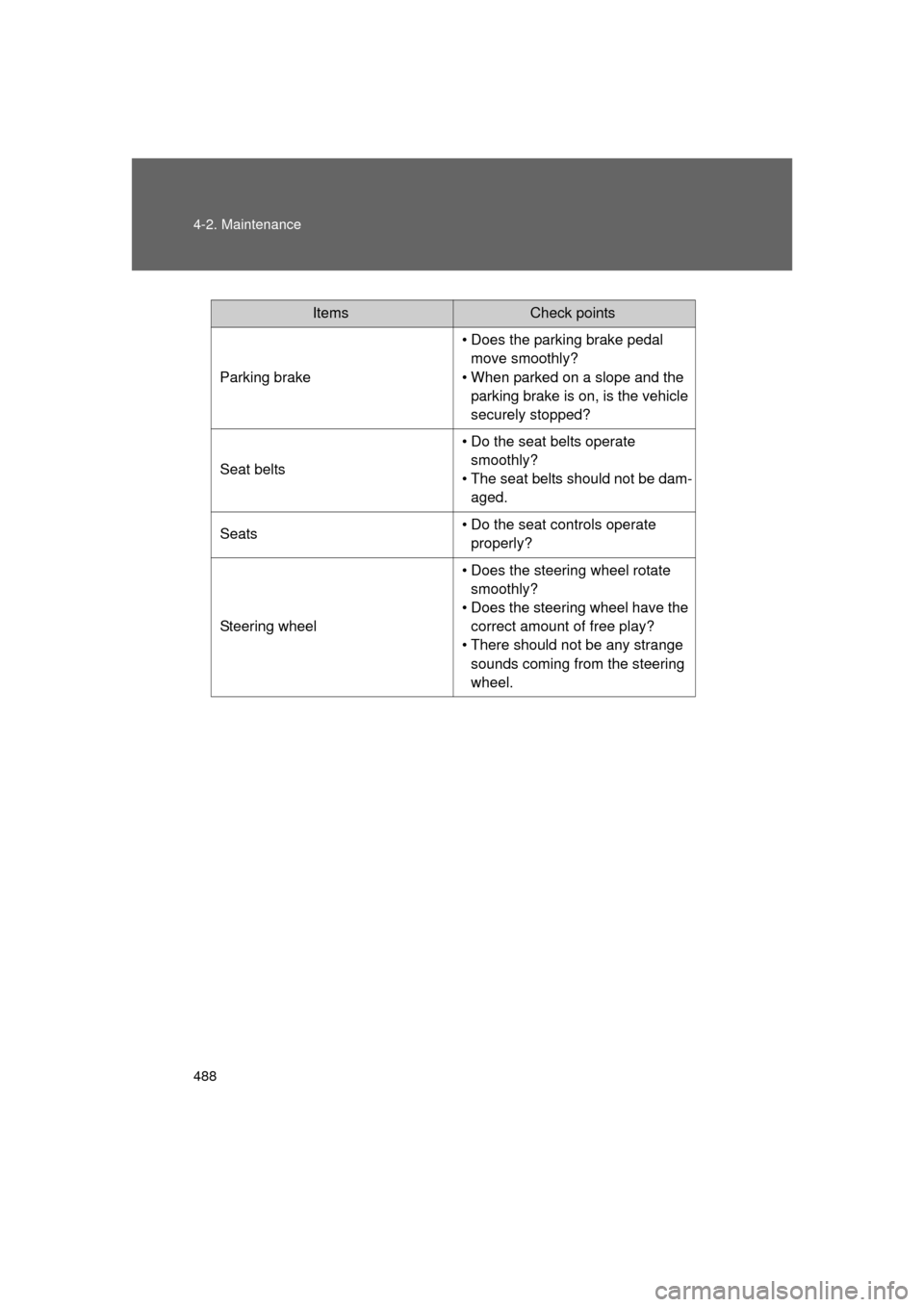
ItemsCheck points
Parking brake • Does the parking brake pedal
move smoothly?
• When parked on a slope and the parking brake is on, is the vehicle
securely stopped?
Seat belts • Do the seat belts operate
smoothly?
• The seat belts should not be dam- aged.
Seats • Do the seat controls operate
properly?
Steering wheel • Does the steering wheel rotate
smoothly?
• Does the steering wheel have the correct amount of free play?
• There should not be any strange sounds coming from the steering
wheel.
Page 491 of 680
491
4
Maintenance and care
4RUNNER_U
4-3. Do-it-yourself maintenance
Do-it-yourself ser vice precautions
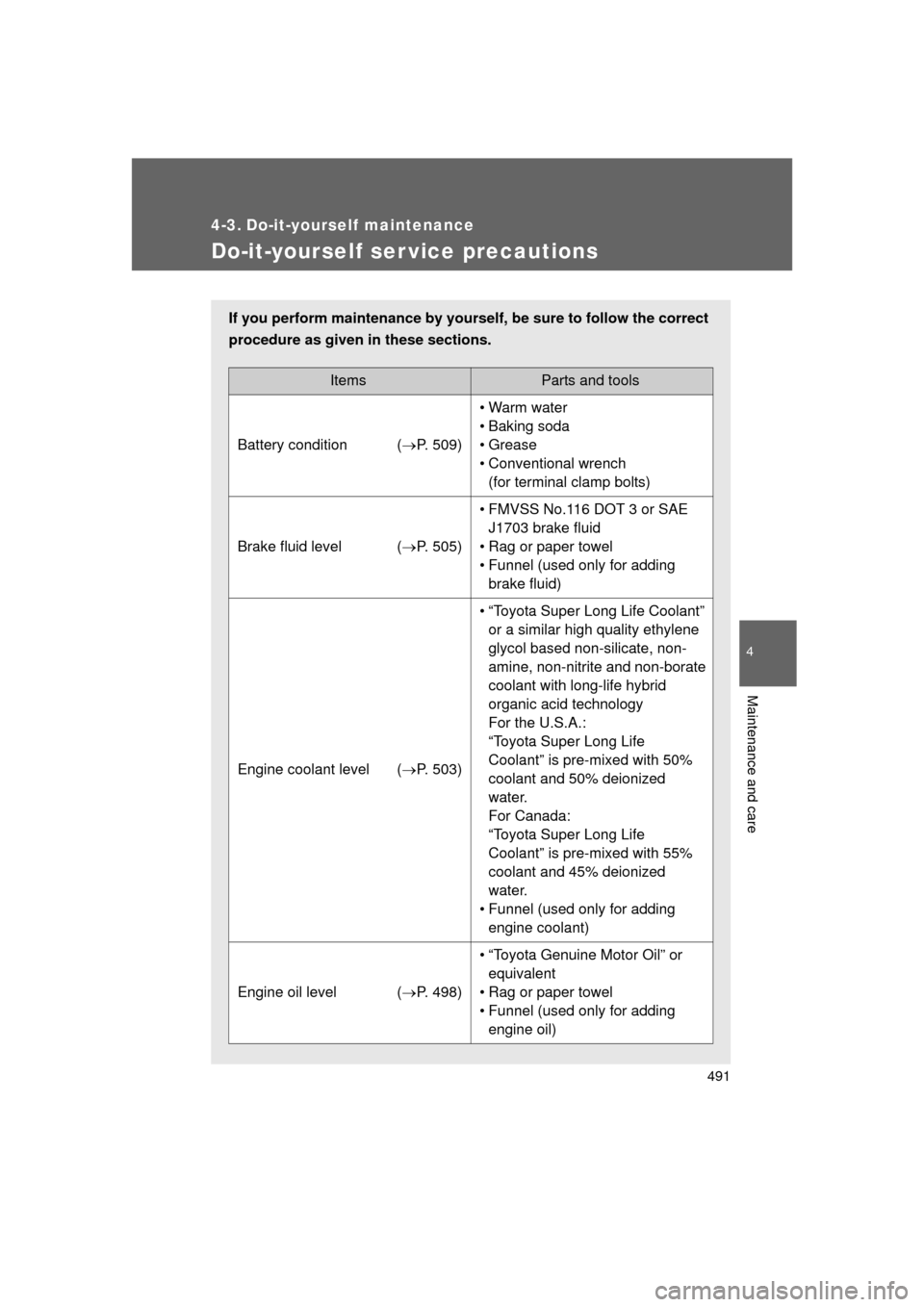
If you perform maintenance by yourself, be sure to follow the correct
procedure as given in these sections.
ItemsParts and tools
Battery condition ( P. 509)
•Warm water
• Baking soda
• Grease
• Conventional wrench
(for terminal clamp bolts)
Brake fluid level ( P. 505)
• FMVSS No.116 DOT 3 or SAE
J1703 brake fluid
• Rag or paper towel
• Funnel (used only for adding brake fluid)
Engine coolant level ( P. 503)
• “Toyota Super Long Life Coolant”
or a similar high quality ethylene
glycol based non-silicate, non-
amine, non-nitrite and non-borate
coolant with long-life hybrid
organic acid technology
For the U.S.A.:
“Toyota Super Long Life
Coolant” is pre-mixed with 50%
coolant and 50% deionized
water.
For Canada:
“Toyota Super Long Life
Coolant” is pre-mixed with 55%
coolant and 45% deionized
water.
• Funnel (used only for adding engine coolant)
Engine oil level ( P. 498)
• “Toyota Genuine Motor Oil” or
equivalent
• Rag or paper towel
• Funnel (used only for adding engine oil)
Page 495 of 680
495
4-3. Do-it-yourself maintenance
4
Maintenance and care
4RUNNER_U
Engine compar tment
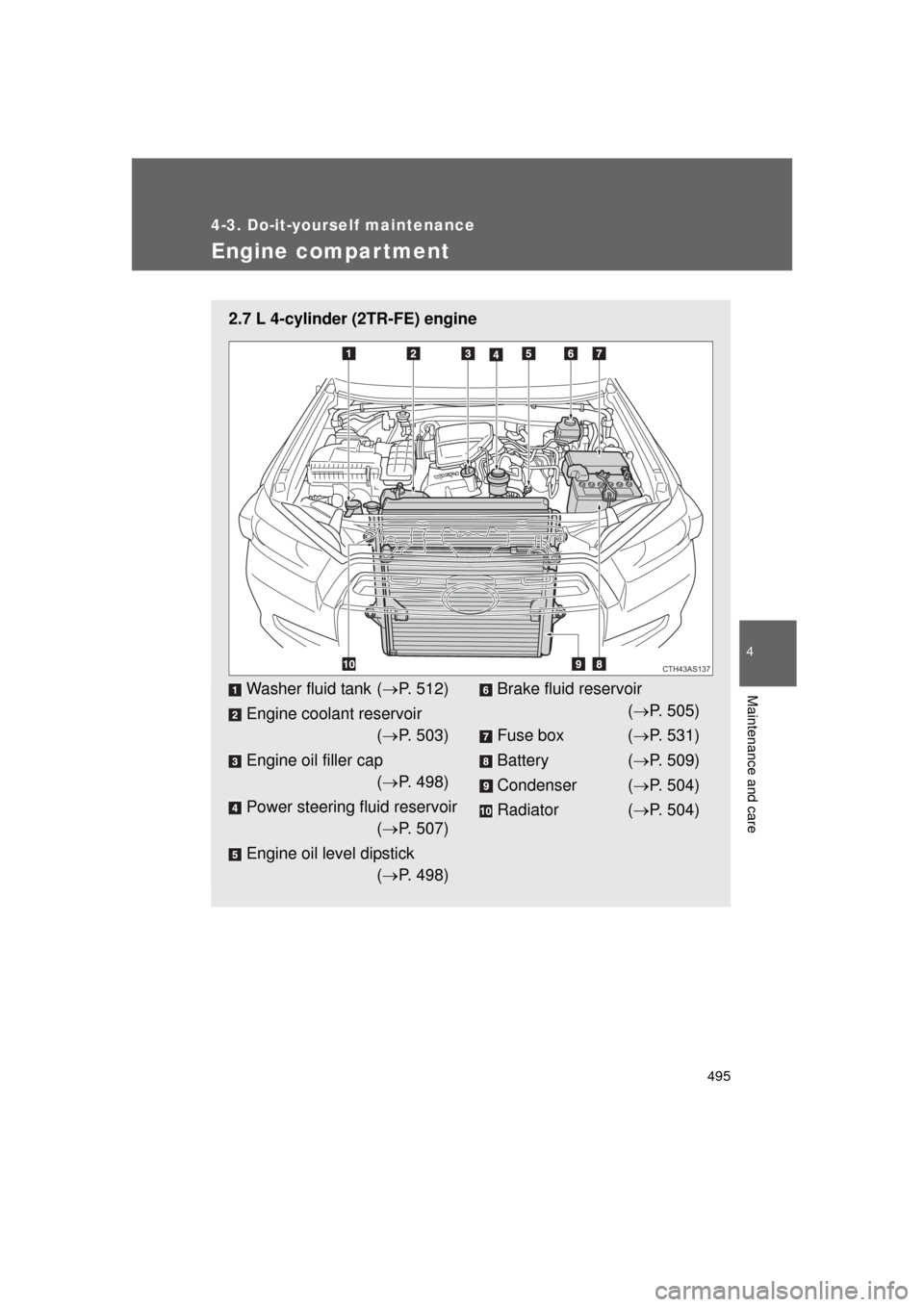
2.7 L 4-cylinder (2TR-FE) engine
Washer fluid tank (P. 512)
Engine coolant reservoir ( P. 503)
Engine oil filler cap ( P. 498)
Power steering fluid reservoir ( P. 507)
Engine oil level dipstick ( P. 498)Brake fluid reservoir
( P. 505)
Fuse box ( P. 531)
Battery ( P. 509)
Condenser ( P. 504)
Radiator ( P. 504)
CTH43AS137
Page 496 of 680
496 4-3. Do-it-yourself maintenance
4RUNNER_U
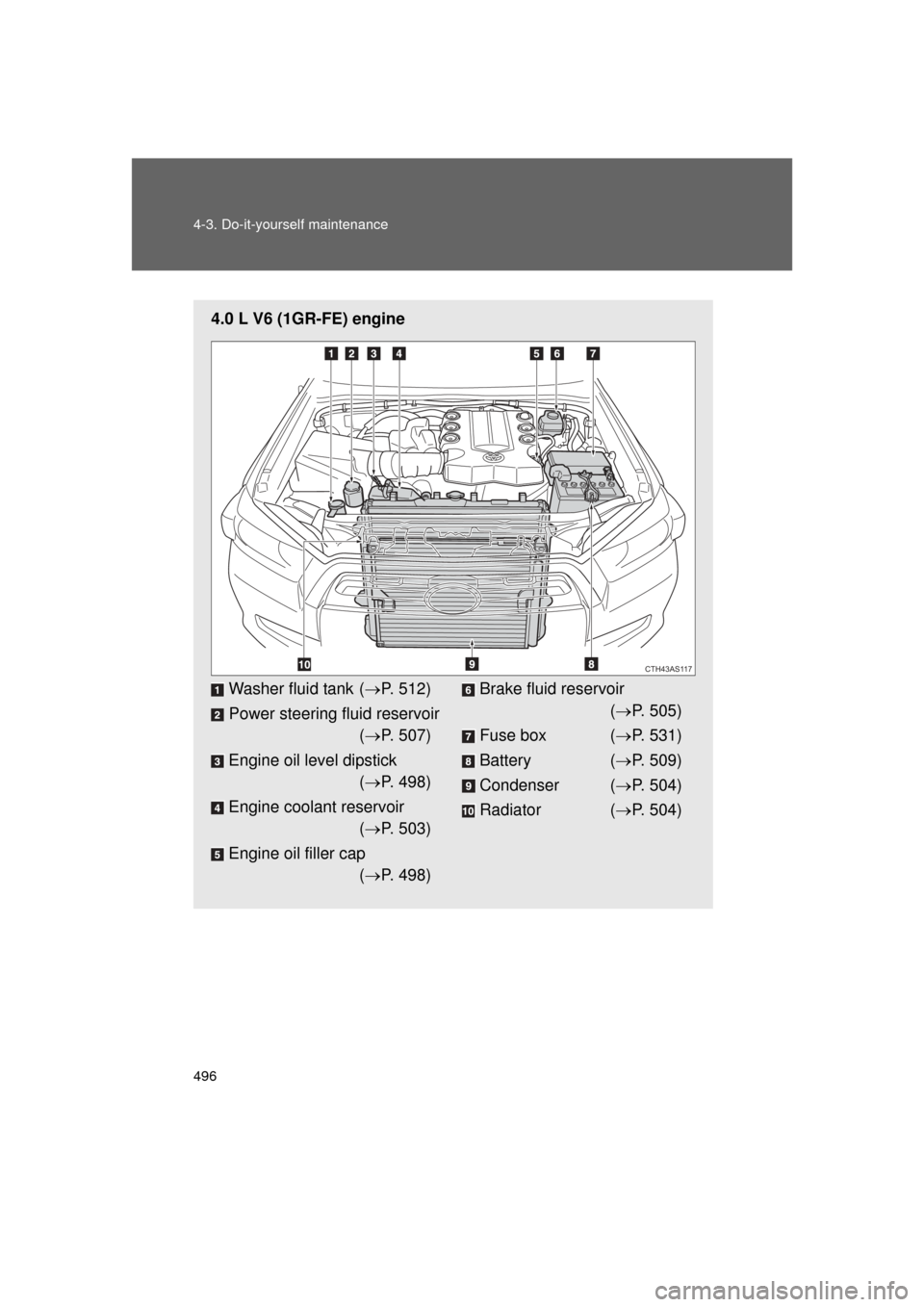
4.0 L V6 (1GR-FE) engine
Washer fluid tank (P. 512)
Power steering fluid reservoir ( P. 507)
Engine oil level dipstick ( P. 498)
Engine coolant reservoir ( P. 503)
Engine oil filler cap ( P. 498)Brake fluid reservoir
( P. 505)
Fuse box ( P. 531)
Battery ( P. 509)
Condenser ( P. 504)
Radiator ( P. 504)
CTH43AS117
Page 505 of 680
505
4-3. Do-it-yourself maintenance
4
Maintenance and care
4RUNNER_U
Brake fluid
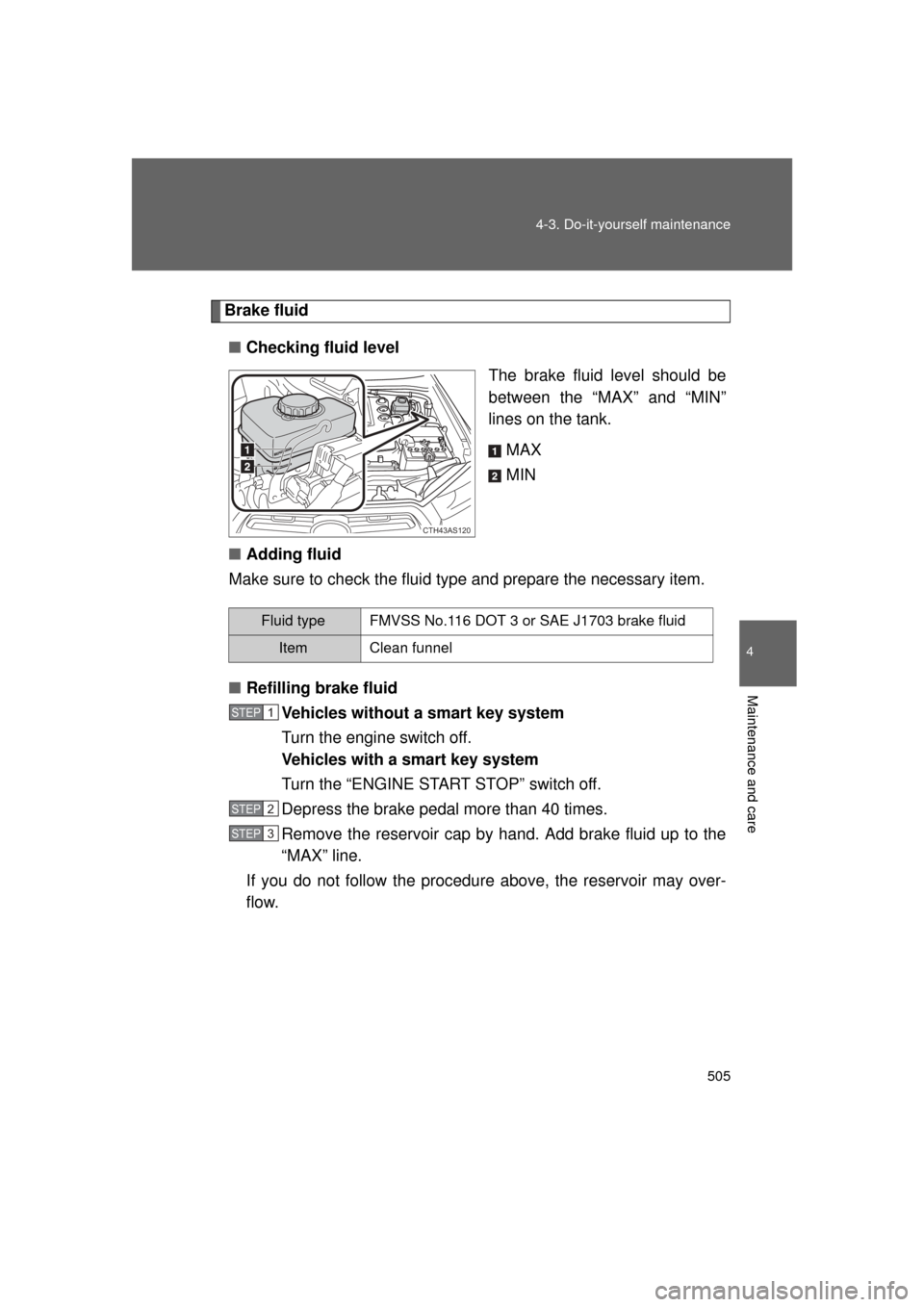
■ Checking fluid level
The brake fluid level should be
between the “MAX” and “MIN”
lines on the tank.
MAX
MIN
■ Adding fluid
Make sure to check the fluid type and prepare the necessary item.
■ Refilling brake fluid
Vehicles without a smart key system
Turn the engine switch off.
Vehicles with a smart key system
Turn the “ENGINE START STOP” switch off.
Depress the brake pedal more than 40 times.
Remove the reservoir cap by hand. Add brake fluid up to the
“MAX” line.
If you do not follow the procedure above, the reservoir may over-
flow.
CTH43AS120
Fluid typeFMVSS No.116 DOT 3 or SAE J1703 brake fluid
ItemClean funnel
STEP 1
STEP 2
STEP 3
Page 506 of 680
506 4-3. Do-it-yourself maintenance
4RUNNER_U
■Brake fluid can absorb moisture from the air
Excess moisture in the brake fluid can cause a dangerous loss of braking
efficiency. Use only newly opened brake fluid.
CAUTION
■When filling the reservoir
Take care as brake fluid can harm your hands and eyes and damage painted
surfaces.
If fluid gets on your hands or in your eyes, flush the affected area with clean
water immediately.
If you still experience discomfort, see a doctor.
NOTICE
■If the fluid level is low or high
It is normal for the brake fluid level to go down slightly as the brake pads
wear out or when the fluid level in the accumulator is high.
If the reservoir needs frequent refilling, there may be a serious proble\
m.
Page 537 of 680
537
4-3. Do-it-yourself maintenance
4
Maintenance and care
4RUNNER_U
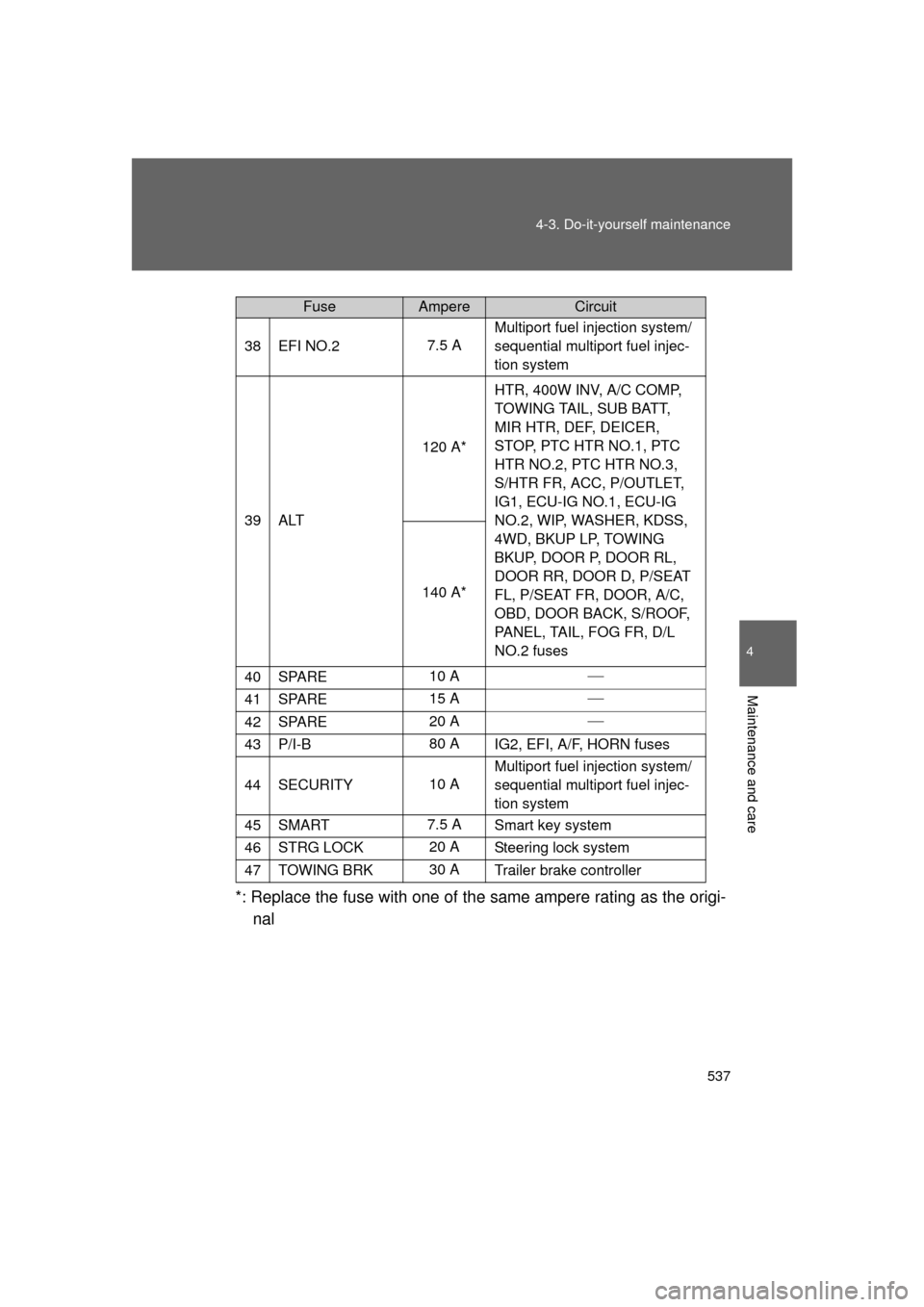
*: Replace the fuse with one of th
e same ampere rating as the origi-
nal
38EFI NO.27.5 A Multiport fuel injection system/
sequential multiport fuel injec-
tion system
39ALT
120 A* HTR, 400W INV, A/C COMP,
TOWING TAIL, SUB BATT,
MIR HTR, DEF, DEICER,
STOP, PTC HTR NO.1, PTC
HTR NO.2, PTC HTR NO.3,
S/HTR FR, ACC, P/OUTLET,
IG1, ECU-IG NO.1, ECU-IG
NO.2, WIP, WASHER, KDSS,
4WD, BKUP LP, TOWING
BKUP, DOOR P, DOOR RL,
DOOR RR, DOOR D, P/SEAT
FL, P/SEAT FR, DOOR, A/C,
OBD, DOOR BACK, S/ROOF,
PANEL, TAIL, FOG FR, D/L
NO.2 fuses
140 A*
40SPARE10 A
41SPARE15 A
42SPARE20 A
43P/I-B80 A
IG2, EFI, A/F, HORN fuses
44SECURITY10 AMultiport fuel injection system/
sequential multiport fuel injec-
tion system
45SMART 7.5 A
Smart key system
46STRG LOCK 20 ASteering lock system
47TOWING BRK30 A
Trailer brake controller
FuseAmpereCircuit
Page 555 of 680
5
When trouble arises
555
5-1. Essential information
4RUNNER_U
If your vehicle needs to be towed
Before towingThe following may indicate a problem with your transmission. Contact
your Toyota dealer before towing.
● The engine is running but the vehicle will not move.
● The vehicle makes an abnormal sound.
Emergency towing
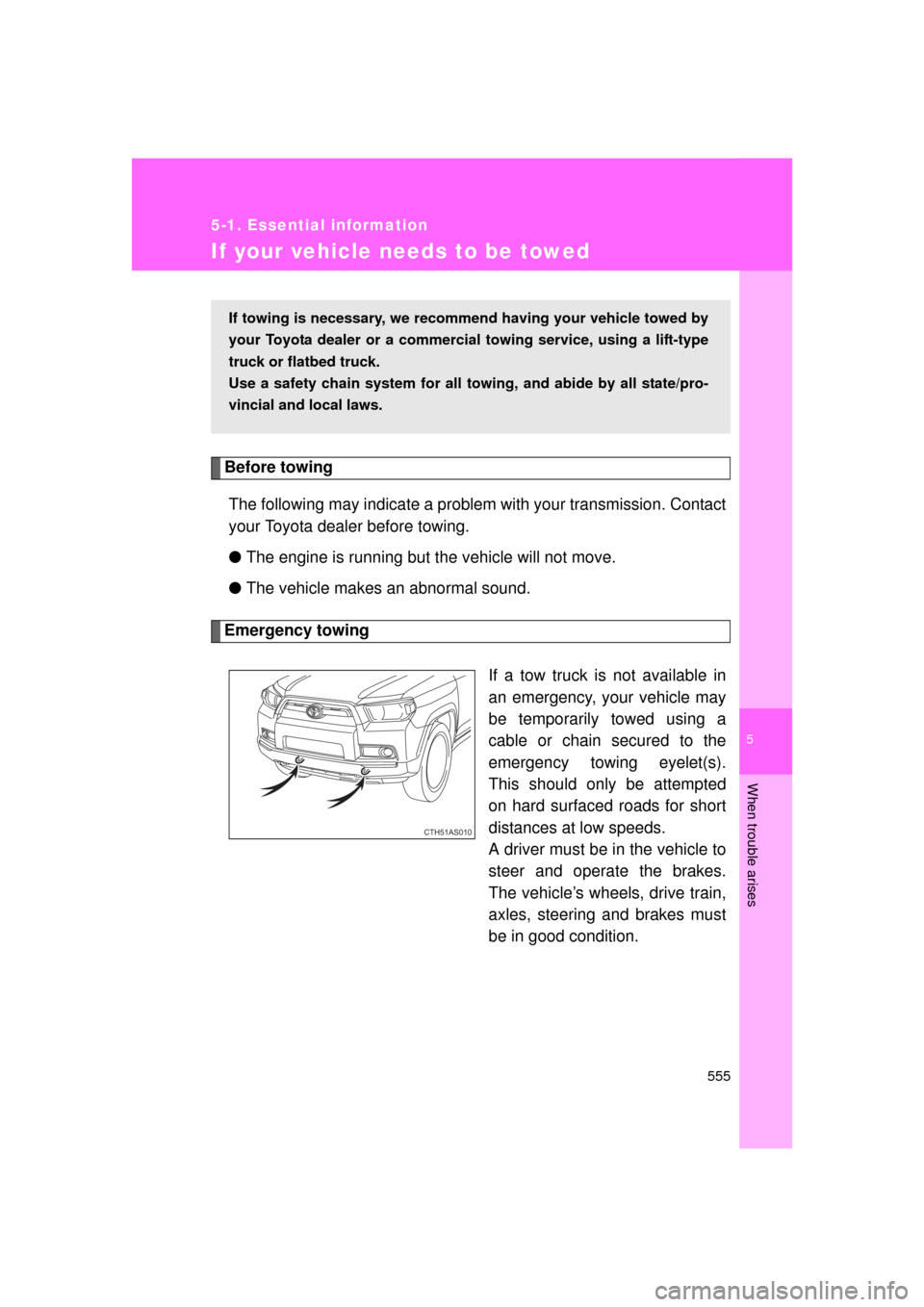
If a tow truck is not available in
an emergency, your vehicle may
be temporarily towed using a
cable or chain secured to the
emergency towing eyelet(s).
This should only be attempted
on hard surfaced roads for short
distances at low speeds.
A driver must be in the vehicle to
steer and operate the brakes.
The vehicle’s wheels, drive train,
axles, steering and brakes must
be in good condition.
If towing is necessary, we recommend having your vehicle towed by
your Toyota dealer or a commerci al towing service, using a lift-type
truck or flatbed truck.
Use a safety chain system for all to wing, and abide by all state/pro-
vincial and local laws.
CTH51AS010
Page 558 of 680
558 5-1. Essential information
4RUNNER_U
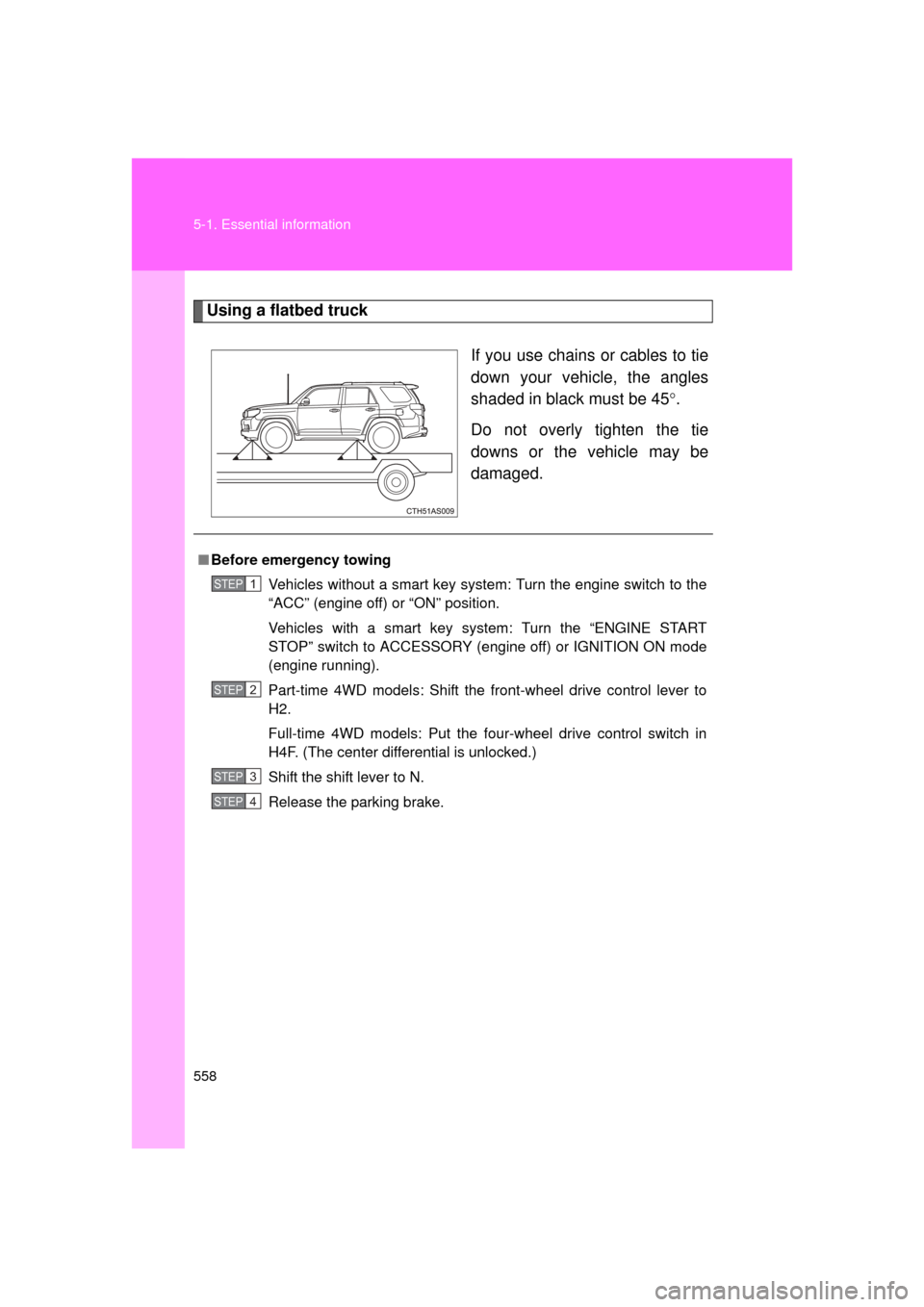
Using a flatbed truckIf you use chains or cables to tie
down your vehicle, the angles
shaded in black must be 45.
Do not overly tighten the tie
downs or the vehicle may be
damaged.
■ Before emergency towing
Vehicles without a smart key system: Turn the engine switch to the
“ACC” (engine off) or “ON” position.
Vehicles with a smart key system: Turn the “ENGINE START STOP” switch to ACCESSORY (engine off) or IGNITION ON mode
(engine running).
Part-time 4WD models: Shift the front-wheel drive control lever to
H2.
Full-time 4WD models: Put the four-wheel drive control switch in
H4F. (The center differential is unlocked.)
Shift the shift lever to N.
Release the parking brake.
STEP 1
STEP 2
STEP 3
STEP 4
Page 559 of 680
5
When trouble arises
559
5-1. Essential information
4RUNNER_U
CAUTION
■
Caution while towing
● Use extreme caution when towing the vehicle.
Avoid sudden starts or erratic driving maneuvers which place excessive
stress on the emergency towing eyelets and the cables or chains. Always
use caution for the surroundings and other vehicles while towing.
● Vehicles with a smart key system: Do not turn the “ENGINE START
STOP” switch off.
Doing so will lock the steering wheel and prevent operation, possibly caus-
ing an accident and resulting in death or serious injury.
● If the engine is not running, the power assist for the brakes and steering
will not function, making steering and braking more difficult.
NOTICE
■To prevent causing serious damage to the transmission and transfer
(4WD models) when towing using a wheel-lift type truck
2WD models: Never tow this vehicle from the front with the rear wheels on
the ground.
4WD models: Never tow this vehicle with any of the wheels in contact with
the ground.
■ To prevent damage to the vehicle when towing using a wheel-lift type
truck
● 2WD models without a smart key system: Do not tow the vehicle from the
rear when the engine switch is in the “LOCK” position or the key is
removed. The steering lock mechanism is not strong enough to hold the
front wheels straight.
● 2WD models with a smart key system: Do not tow the vehicle from the rear
when the “ENGINE START STOP” switch is off. The steering lock mecha-
nism is not strong enough to hold the front wheels straight.
● When raising the vehicle, ensure adequate ground clearance for towing at
the opposite end of the raised vehicle. Without adequate clearance, the
vehicle could be damaged while being towed.