instrument panel TOYOTA 4RUNNER 2011 N280 / 5.G Owners Manual
[x] Cancel search | Manufacturer: TOYOTA, Model Year: 2011, Model line: 4RUNNER, Model: TOYOTA 4RUNNER 2011 N280 / 5.GPages: 680, PDF Size: 12.58 MB
Page 14 of 680
4RUNNER_U
14
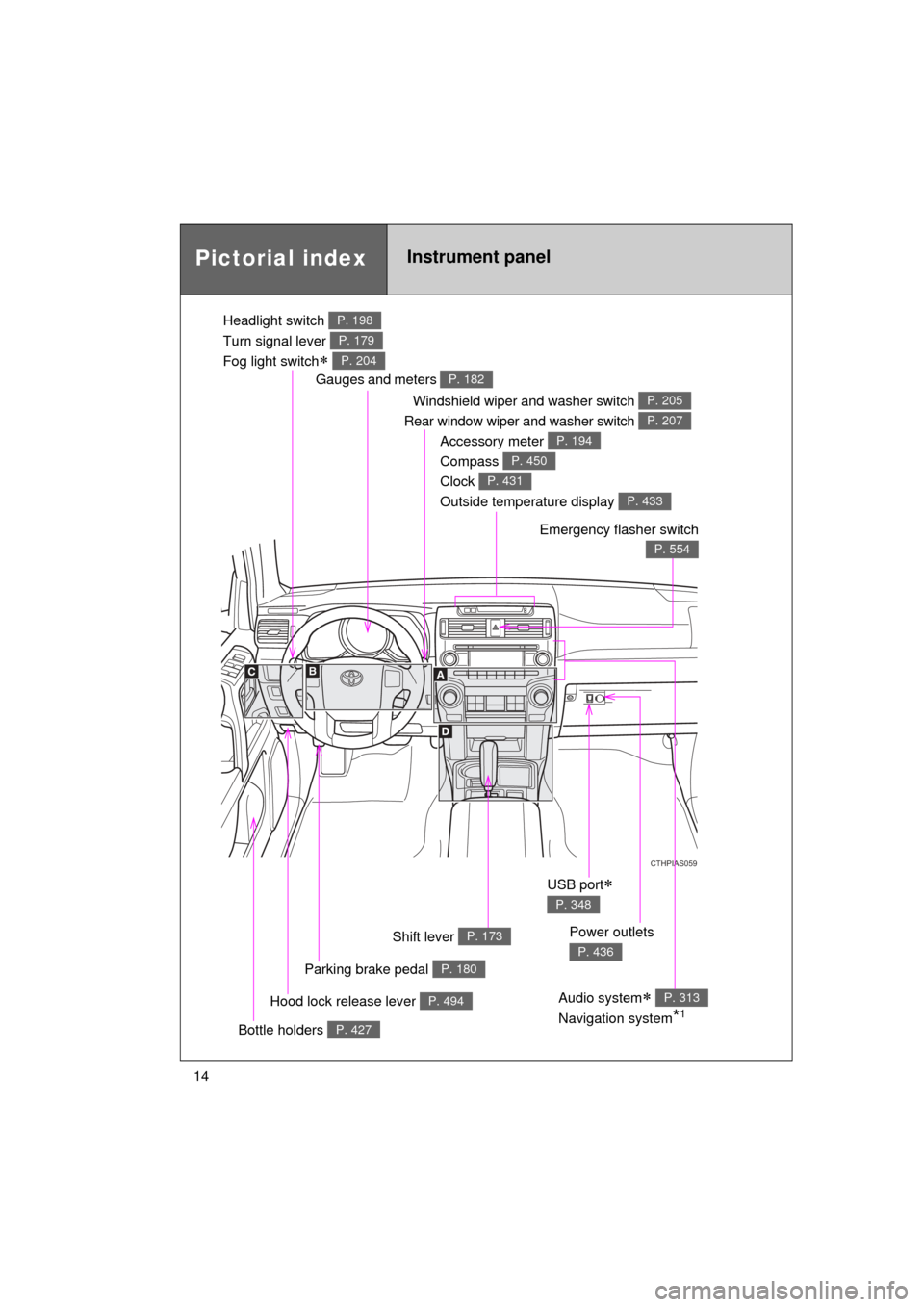
Pictorial indexInstrument panel
Headlight switch
Turn signal lever
Fog light switch
P. 198
P. 179
P. 204
Windshield wiper and washer switch
Rear window wiper and washer switch P. 205
P. 207
Gauges and meters P. 182
Glove box
P. 417
Hood lock release lever P. 494
CTHPIAS059
Accessory meter
Compass
Clock
Outside temperature display P. 194
P. 450
P. 431
P. 433
Parking brake pedal P. 180
Emergency flasher switch
P. 554
Shift lever P. 173
Audio system
Navigation system
*1
P. 313
USB port
P. 348
Power outlets
P. 436
Bottle holders P. 427
Page 16 of 680
4RUNNER_U
16
CTHPIAS079
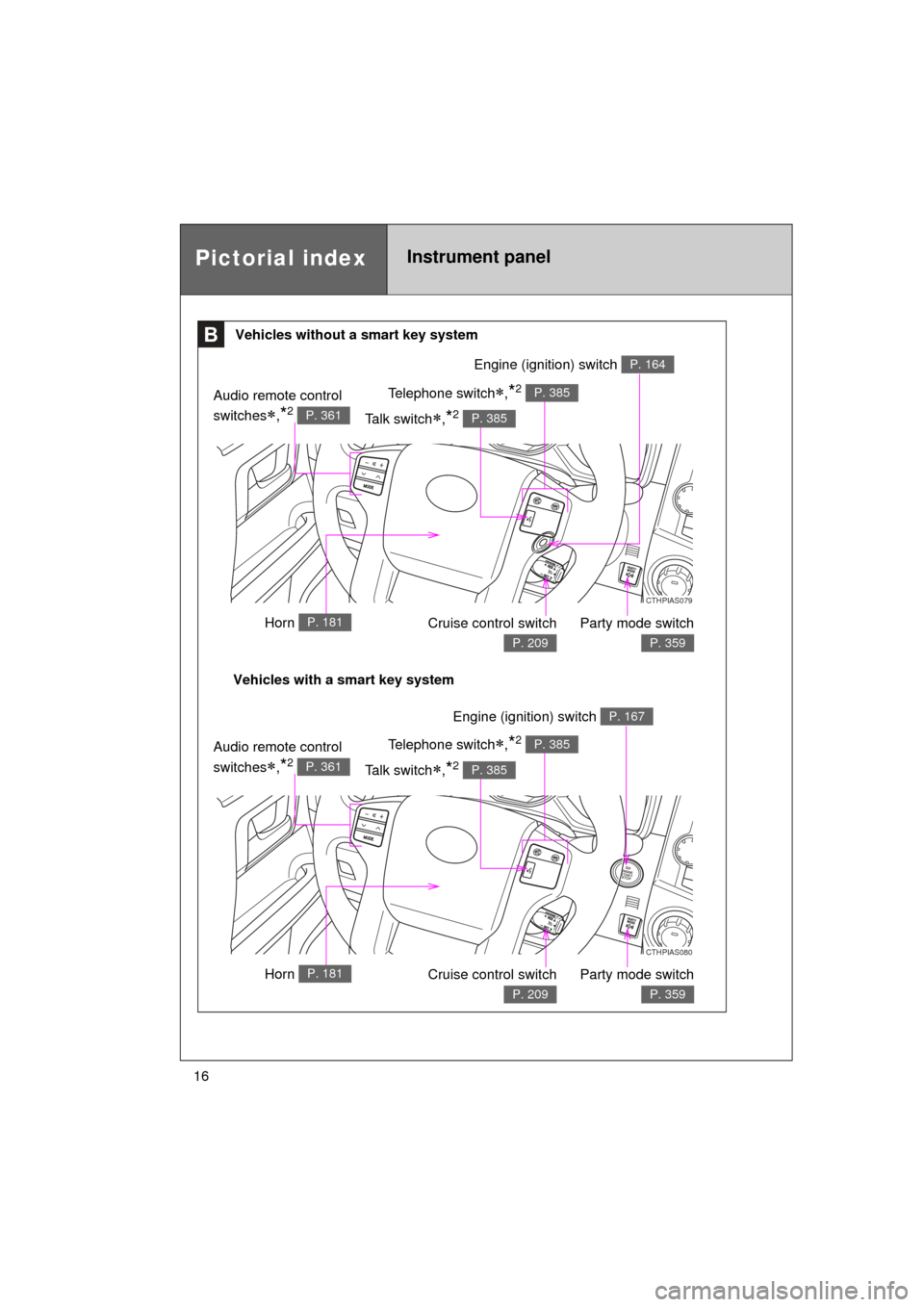
Pictorial indexInstrument panel
BVehicles without a smart key system
Vehicles with a smart key system Party mode switch
P. 359
Audio remote control
switches
,*2 P. 361
Cruise control switch
P. 209
Horn P. 181
Talk switch,*2 P. 385
Telephone switch,*2 P. 385
Engine (ignition) switch P. 164
CTHPIAS080
Party mode switch
P. 359
Audio remote control
switches
,*2 P. 361
Cruise control switch
P. 209
Horn P. 181
Talk switch,*2 P. 385
Telephone switch,*2 P. 385
Engine (ignition) switch P. 167
Page 17 of 680
4RUNNER_U
17
CTHPIAS062
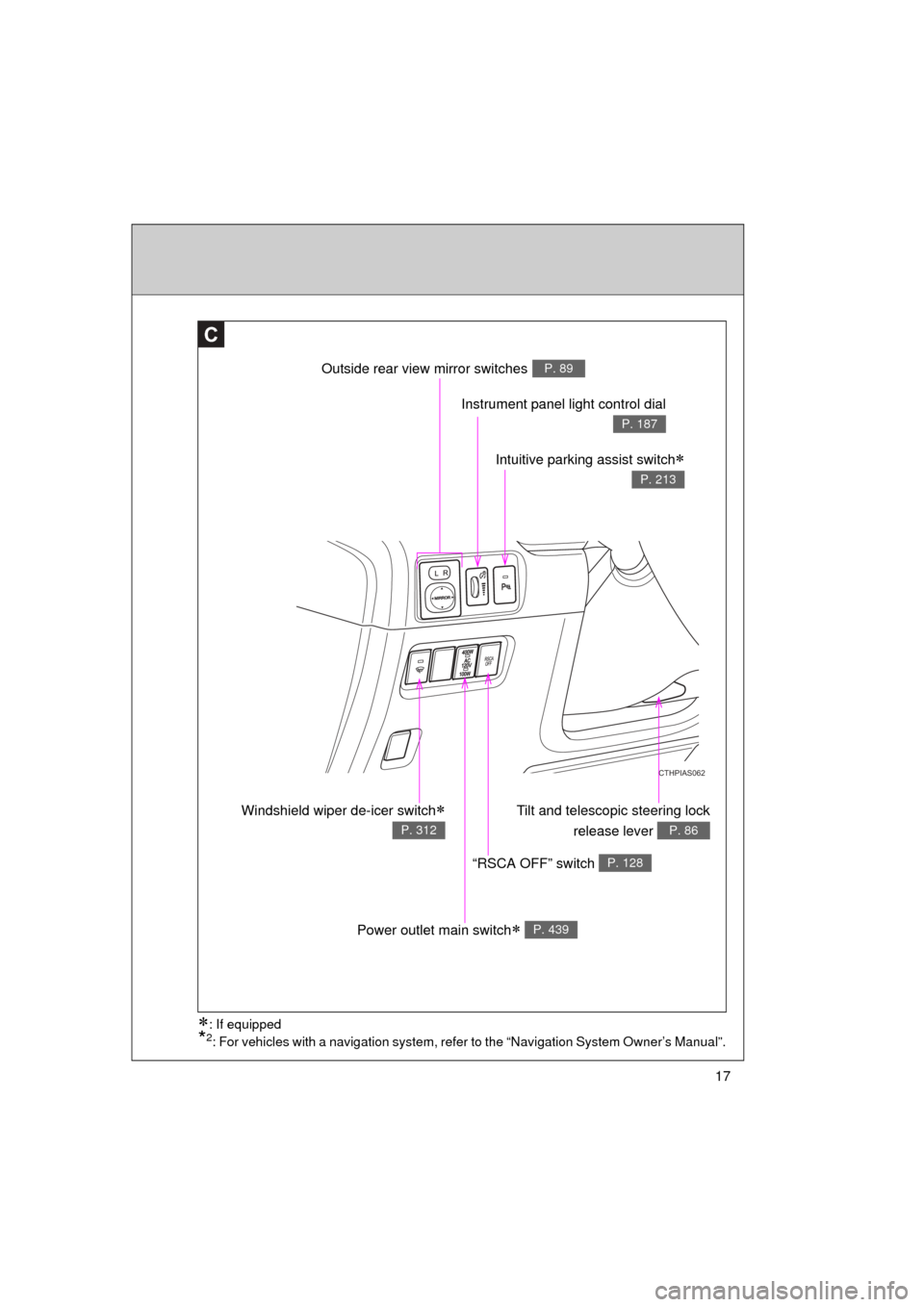
C
Outside rear view mirror switchesP. 89
Instrument panel light control dial
P. 187
Intuitive parking assist switch
P. 213
Tilt and telescopic steering lockrelease lever
P. 86
“RSCA OFF” switch P. 128
Power outlet main switch P. 439
Windshield wiper de-icer switch
P. 312
: If equipped
*2: For vehicles with a navigation system, refer to the “Navigation System Owner’s Manual”.
Page 18 of 680
4RUNNER_U
18
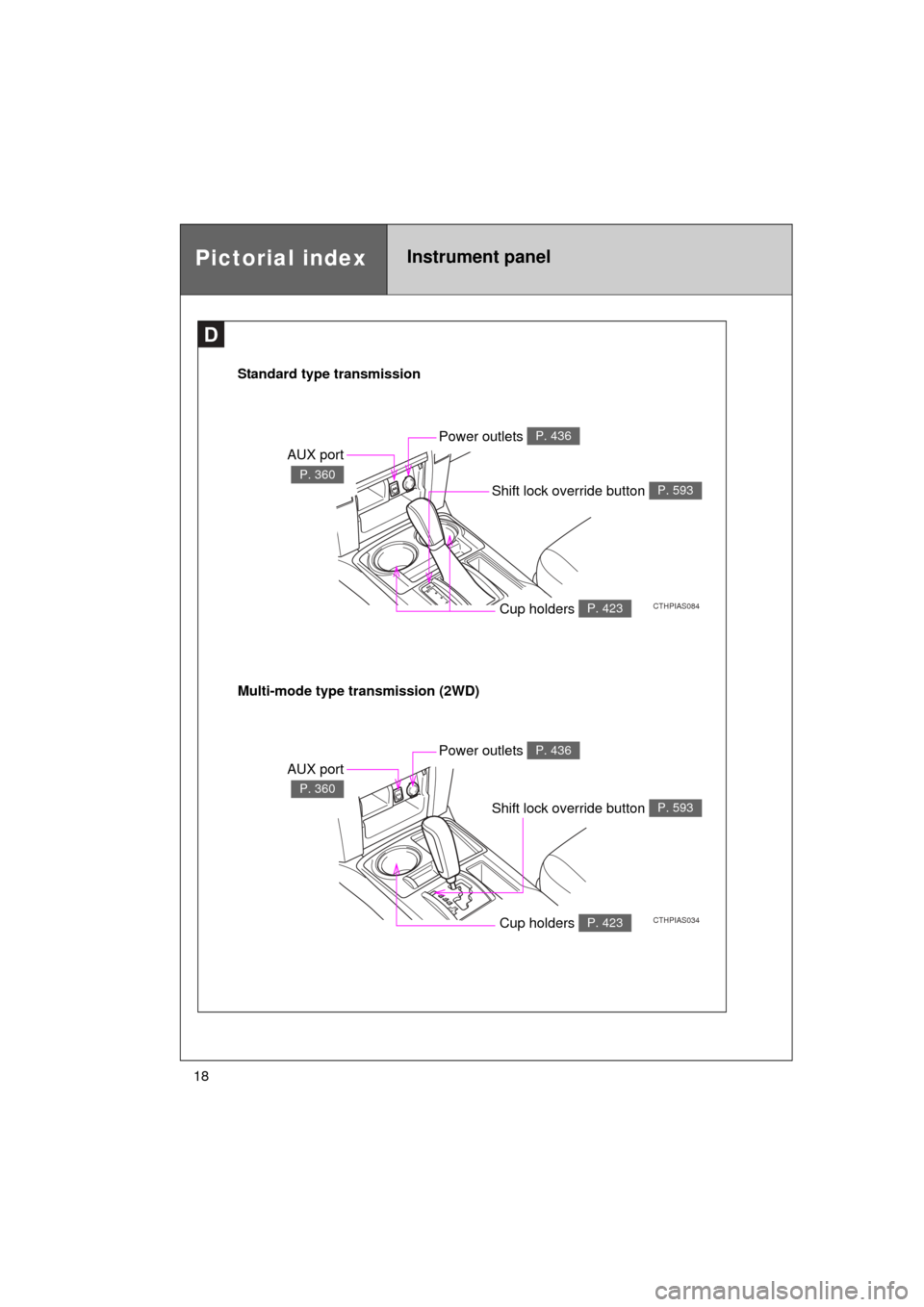
Pictorial indexInstrument panel
D
Standard type transmission
CTHPIAS084
AUX port
P. 360
Cup holders P. 423
Power outlets P. 436
Shift lock override button P. 593
Multi-mode type transmission (2WD)
CTHPIAS034
AUX port
P. 360
Cup holders P. 423
Power outlets P. 436
Shift lock override button P. 593
Page 42 of 680

42 1-2. Opening, closing and locking the doors
4RUNNER_U
■Note for the entry function
● Even when the electronic key is within the effective range (detection
areas), the system may not operate properly in the following cases:
• The electronic key is too close to the window or outside door handle,
near the ground, or in a high place when the doors are locked or
unlocked.
• The electronic key is on the instrument panel or floor, in the glove box, or in the auxiliary box of the instrument panel.
● As long as the electronic key is within the effective range, the doors may
be locked or unlocked by anyone. However, only the doors detecting the
electronic key can be used to unlock the vehicle.
● The doors may lock or unlock if the electronic key is within the effective
range and a large amount of water splashes on the door handle, such as
in the rain or in a car wash. The doors will automatically be locked after
approximately 60 seconds if a door is not opened and closed.
● If the wireless remote control is used to lock the doors when the elec-
tronic key is near the vehicle, there is a possibility that the door may not
be unlocked by the entry function. (Use the wireless remote control to
unlock the doors.)
■ Notes for locking the doors
● Touching the door lock sensor while wearing gloves may delay or prevent
lock operation. Remove the gloves and touch the lock sensor again.
● When the lock operation is performed using the lock sensor, recognition
signals will be shown up to two consecutive times. After this, no recogni-
tion signals will be given.
● If the door handle becomes wet while the electronic key is within the
effective range, the door may lock and unlock repeatedly. Place the key
in a position 6 ft. (2 m) or more separate from the vehicle while the vehi-
cle is being washed. (Take care to ensure that the key is not stolen.)
● If the electronic key is inside the vehicle and a door handle becomes wet
during a car wash, a buzzer will sound outside the vehicle. To turn off the
alarm, lock all the doors.
Page 121 of 680
121
1-7. Safety information
1
Before driving
4RUNNER_U
■
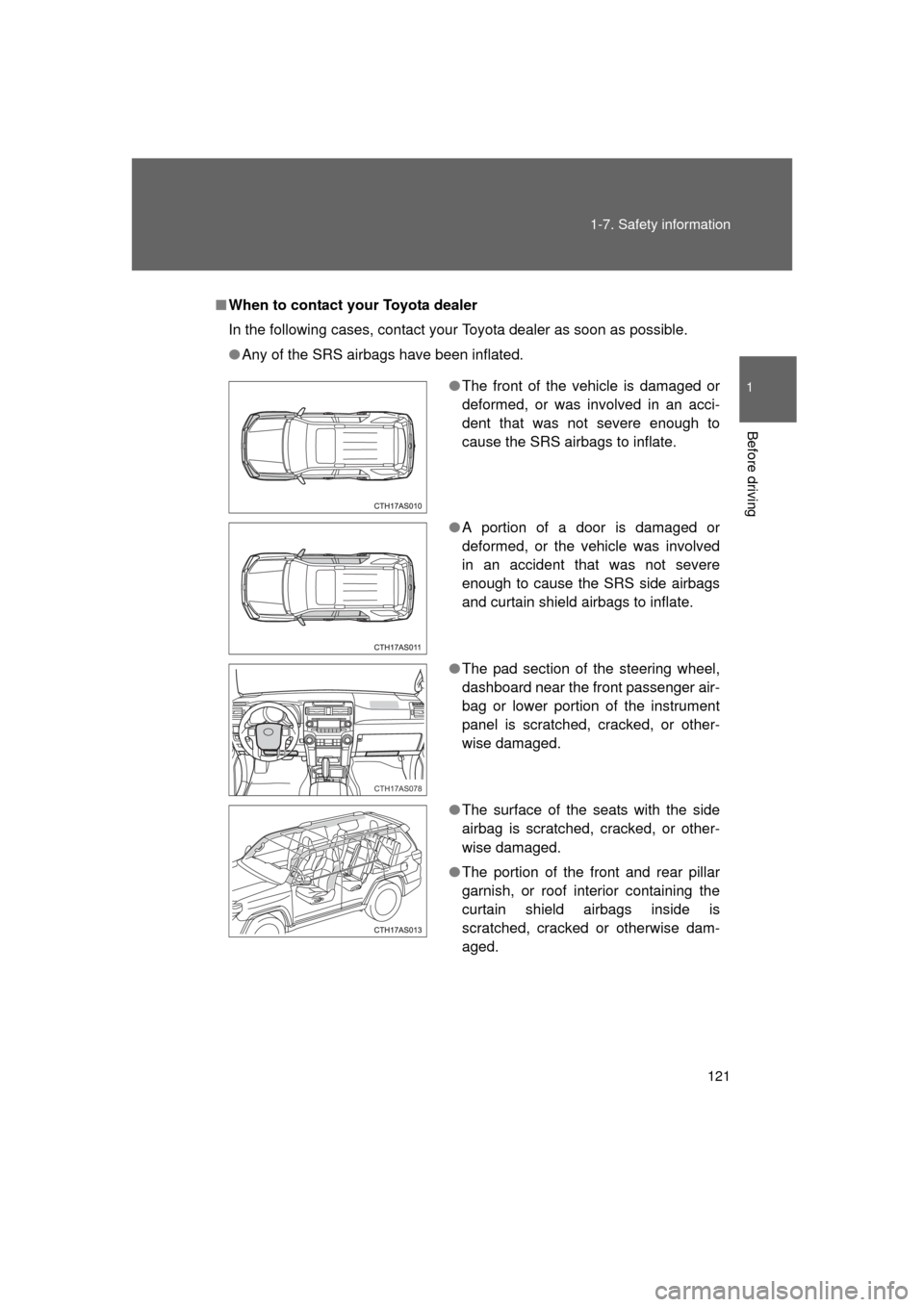
When to contact your Toyota dealer
In the following cases, contact your Toyota dealer as soon as possible.
● Any of the SRS airbags have been inflated.
●The front of the vehicle is damaged or
deformed, or was involved in an acci-
dent that was not severe enough to
cause the SRS airbags to inflate.
● A portion of a door is damaged or
deformed, or the vehicle was involved
in an accident that was not severe
enough to cause the SRS side airbags
and curtain shield airbags to inflate.
● The pad section of the steering wheel,
dashboard near the front passenger air-
bag or lower portion of the instrument
panel is scratched, cracked, or other-
wise damaged.
● The surface of the seats with the side
airbag is scratched, cracked, or other-
wise damaged.
● The portion of the front and rear pillar
garnish, or roof interior containing the
curtain shield airbags inside is
scratched, cracked or otherwise dam-
aged.
CTH17AS078
Page 122 of 680

122 1-7. Safety information
4RUNNER_U
CAUTION
■SRS airbag precautions
Observe the following precautions regarding the SRS airbags.
Failure to do so may cause death or serious injury.
● The driver and all passengers in the vehicle must wear their seat belts
properly.
The SRS airbags are supplemental devices to be used with the seat belts.
● The SRS driver airbag deploys with considerable force, and can cause
death or serious injury especially if the driver is very close to the airbag.
The National Highway Traffic Safety Administration (NHTSA) advises:
Since the risk zone for the driver’s airbag is the first 2 - 3 in. (50 - 75 mm)
of inflation, placing yourself 10 in. (250 mm) from your driver airbag pro-
vides you with a clear margin of safety. This distance is measured from the
center of the steering wheel to your breastbone. If you sit less than 10 in.
(250 mm) away now, you can change your driving position in several
ways:
• Move your seat to the rear as far as you can while still reaching the pedals comfortably.
• Slightly recline the back of the seat. Although vehicle designs vary, many drivers can achieve the 10 in.
(250 mm) distance, even with the driver seat all the way forward, sim-
ply by reclining the back of the seat somewhat. If reclining the back of
your seat makes it hard to see the road, raise yourself by using a firm,
non-slippery cushion, or raise the seat if your vehicle has that feature\
.
• If your steering wheel is adjustable, tilt it downward. This points the air- bag toward your chest instead of your head and neck.
The seat should be adjusted as recommended by NHTSA above, while
still maintaining control of the foot pedals, steering wheel, and your view of
the instrument panel controls.
Page 125 of 680
125
1-7. Safety information
1
Before driving
4RUNNER_U
CAUTION
■
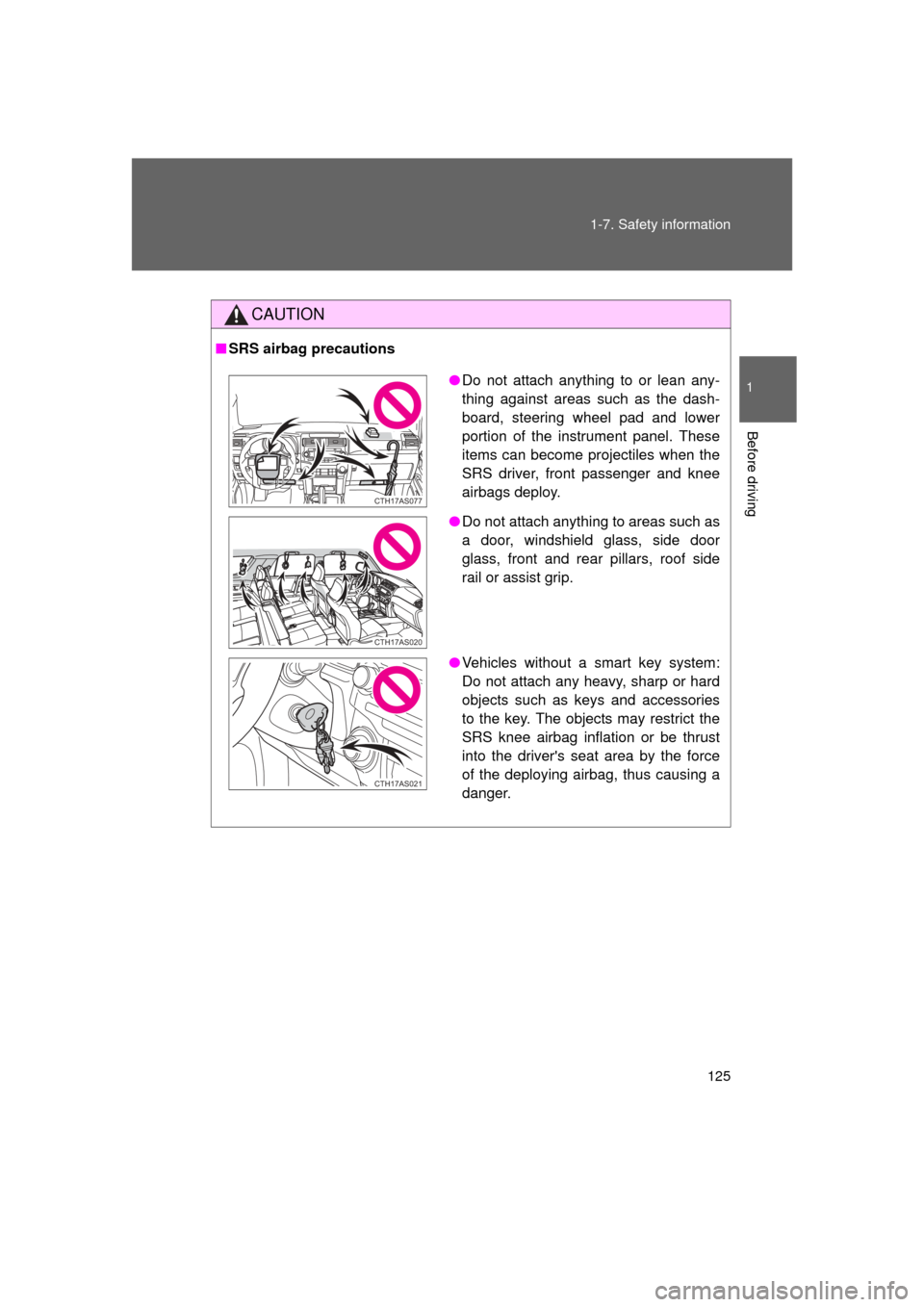
SRS airbag precautions
●Do not attach anything to or lean any-
thing against areas such as the dash-
board, steering wheel pad and lower
portion of the instrument panel. These
items can become projectiles when the
SRS driver, front passenger and knee
airbags deploy.
● Do not attach anything to areas such as
a door, windshield glass, side door
glass, front and rear pillars, roof side
rail or assist grip.
● Vehicles without a smart key system:
Do not attach any heavy, sharp or hard
objects such as keys and accessories
to the key. The objects may restrict the
SRS knee airbag inflation or be thrust
into the driver's seat area by the force
of the deploying airbag, thus causing a
danger.
CTH17AS077
CTH17AS020
CTH17AS021
Page 127 of 680

127
1-7. Safety information
1
Before driving
4RUNNER_U
CAUTION
■
Modification and disposal of SRS airbag system components
Do not dispose of your vehicle or per form any of the following modifications
without consulting your Toyota dealer. The SRS airbags may malfunction or
deploy (inflate) accidentally, causing death or serious injury.
● Installation, removal, disassembly and repair of the SRS airbags
● Repairs, modifications, removal or replacement of the steering wheel,
instrument panel, dashboard, seats or seat upholstery, front and rear pil-
lars, roof side rails or roof head lining
● Repairs or modifications of the front fender, front bumper, or side of the
occupant compartment
● Installation of snow plows, winches, etc. to the front grille (bull bars, or
kangaroo bar etc.)
● Modifications to the vehicle’s suspension system
● Installation of electronic devices such as mobile two-way radios and CD
players
● Modifications to your vehicle for a person with a physical disability
Page 159 of 680

159
2-1. Driving procedures
2
When driving
4RUNNER_U
CAUTION
■
When the vehicle is stopped
● Do not race the engine.
If the vehicle is in any gear other than P or N, the vehicle may accelerate
suddenly and unexpectedly, causing an accident.
● Do not leave the vehicle with the engine running for a long time.
If such a situation cannot be avoided, park the vehicle in an open space
and check that exhaust fumes do not enter the vehicle interior.
● In order to prevent accidents due to the vehicle rolling away, always keep
depressing the brake pedal while the engine is running, and apply the
parking brake as necessary.
● If the vehicle is stopped on an incline, in order to prevent accidents caused
by the vehicle rolling forward or ba ckward, always depress the brake pedal
and securely apply the parking brake as needed.
● Avoid revving or racing the engine.
Running the engine at high speed while the vehicle is stopped may cause
the exhaust system to overheat, which could result in a fire if combustible
material is nearby.
■ When the vehicle is parked
● Do not leave glasses, cigarette lighters, spray cans, or soft drink cans in
the vehicle when it is in the sun.
Doing so may result in the following:
• Gas may leak from a cigarette lighter or spray can, and may lead to a
fire.
• The temperature inside the vehicle may cause the plastic lenses and plastic material of glasses to deform or crack.
• Soft drink cans may fracture, causing the contents to spray over the interior of the vehicle, and may also cause a short circuit in the vehi-
cle's electrical components.
● Do not leave cigarette lighters in the vehicle. If a cigarette lighter is in a
place such as the glove box or on the floor, it may be lit accidentally when
luggage is loaded or the seat is adjusted, causing a fire.
● Do not attach adhesive discs to the windshield or windows. Do not place
containers such as air fresheners on the instrument panel or dashboard.
Adhesive discs or containers may act as lenses, causing a fire in the vehi-
cle.