ECU TOYOTA 4RUNNER 2012 N280 / 5.G Repair Manual
[x] Cancel search | Manufacturer: TOYOTA, Model Year: 2012, Model line: 4RUNNER, Model: TOYOTA 4RUNNER 2012 N280 / 5.GPages: 700, PDF Size: 10.76 MB
Page 560 of 700
560 4-3. Do-it-yourself maintenance
4RUNNER_U
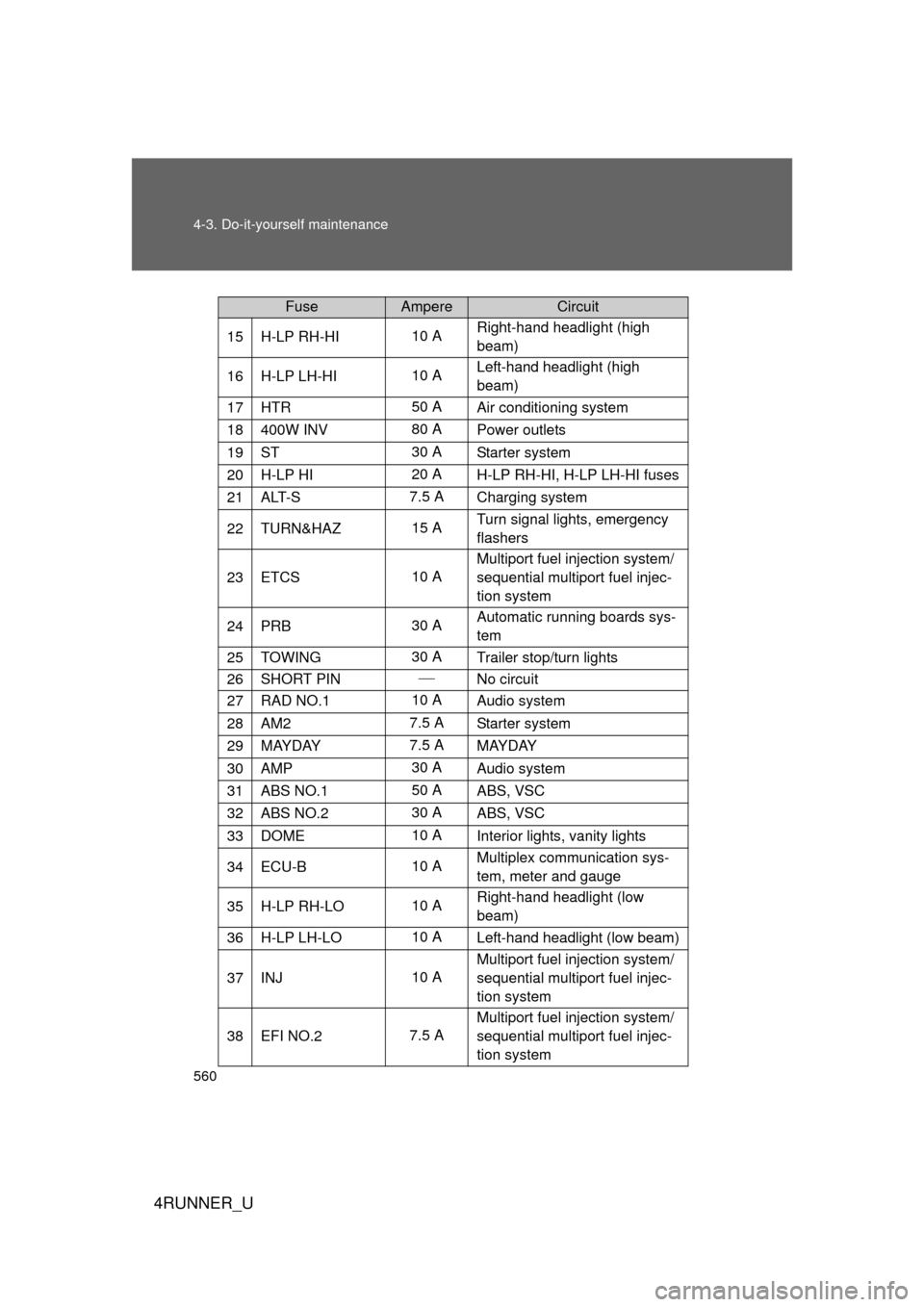
15H-LP RH-HI10 ARight-hand headlight (high
beam)
16H-LP LH-HI10 ALeft-hand headlight (high
beam)
17HTR50 A
Air conditioning system
18400W INV 80 APower outlets
19ST30 AStarter system
20H-LP HI20 A
H-LP RH-HI, H-LP LH-HI fuses
21ALT-S7.5 A Charging system
22TURN&HAZ15 ATurn signal lights, emergency
flashers
23ETCS10 AMultiport fuel injection system/
sequential multiport fuel injec-
tion system
24PRB30 A
Automatic running boards sys-
tem
25TOWING30 A
Trailer stop/turn lights
26SHORT PIN
No circuit
27RAD NO.1 10 A Audio system
28AM27.5 A Starter system
29MAYDAY 7.5 AMAYDAY
30AMP30 A
Audio system
31ABS NO.150 AABS, VSC
32ABS NO.230 AABS, VSC
33DOME10 A
Interior lights, vanity lights
34ECU-B10 AMultiplex communication sys-
tem, meter and gauge
35H-LP RH-LO10 ARight-hand headlight (low
beam)
36H-LP LH-LO10 A
Left-hand headlight (low beam)
37INJ10 AMultiport fuel injection system/
sequential multiport fuel injec-
tion system
38EFI NO.27.5 A Multiport fuel injection system/
sequential multiport fuel injec-
tion system
FuseAmpereCircuit
Page 561 of 700
561
4-3. Do-it-yourself maintenance
4
Maintenance and care
4RUNNER_U
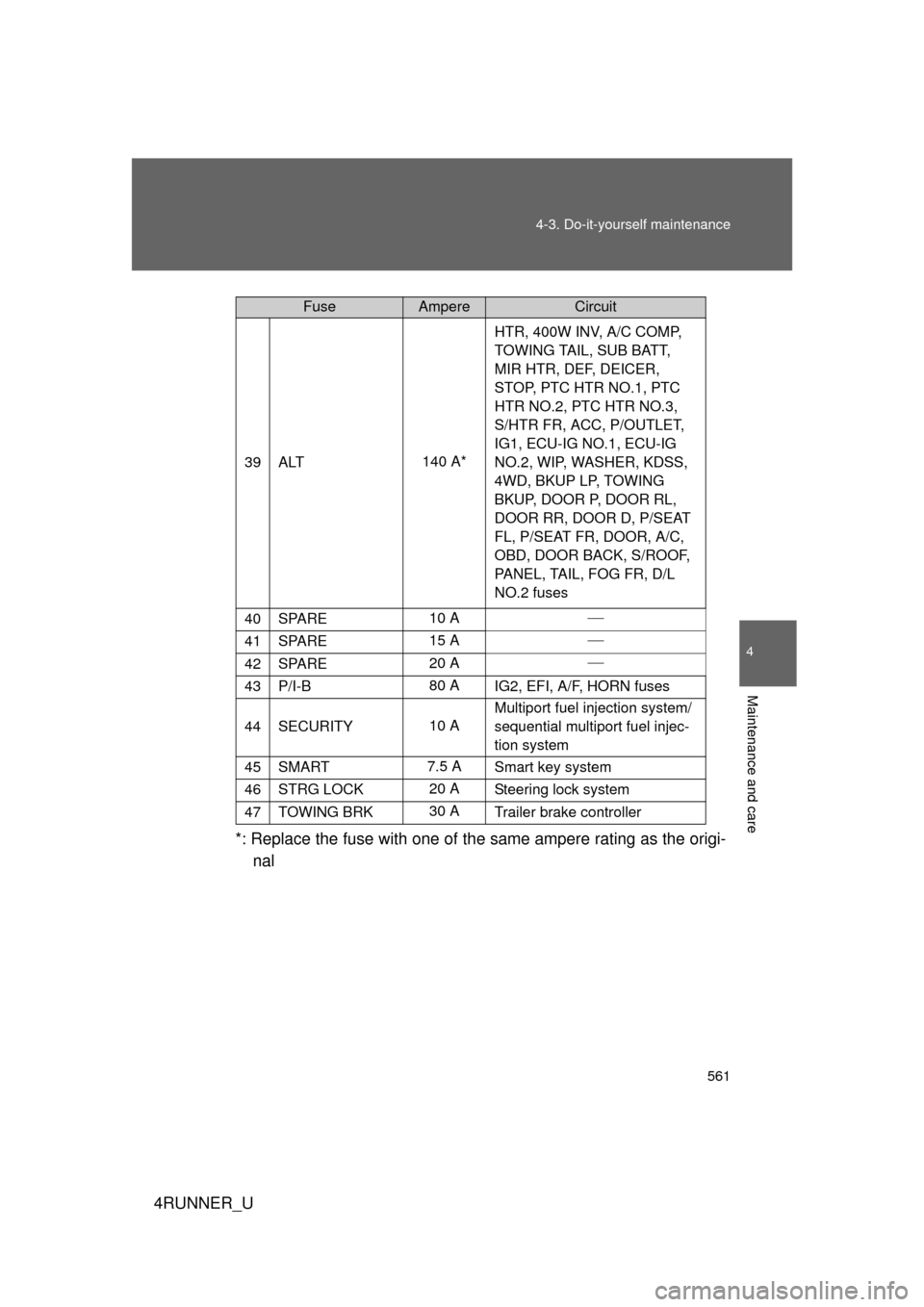
*: Replace the fuse with one of th
e same ampere rating as the origi-
nal
39ALT140 A* HTR, 400W INV, A/C COMP,
TOWING TAIL, SUB BATT,
MIR HTR, DEF, DEICER,
STOP, PTC HTR NO.1, PTC
HTR NO.2, PTC HTR NO.3,
S/HTR FR, ACC, P/OUTLET,
IG1, ECU-IG NO.1, ECU-IG
NO.2, WIP, WASHER, KDSS,
4WD, BKUP LP, TOWING
BKUP, DOOR P, DOOR RL,
DOOR RR, DOOR D, P/SEAT
FL, P/SEAT FR, DOOR, A/C,
OBD, DOOR BACK, S/ROOF,
PANEL, TAIL, FOG FR, D/L
NO.2 fuses
40SPARE10 A
41SPARE15 A
42SPARE20 A
43P/I-B80 A
IG2, EFI, A/F, HORN fuses
44SECURITY10 AMultiport fuel injection system/
sequential multiport fuel injec-
tion system
45SMART 7.5 A
Smart key system
46STRG LOCK 20 ASteering lock system
47TOWING BRK30 A
Trailer brake controller
FuseAmpereCircuit
Page 562 of 700
562 4-3. Do-it-yourself maintenance
4RUNNER_U■
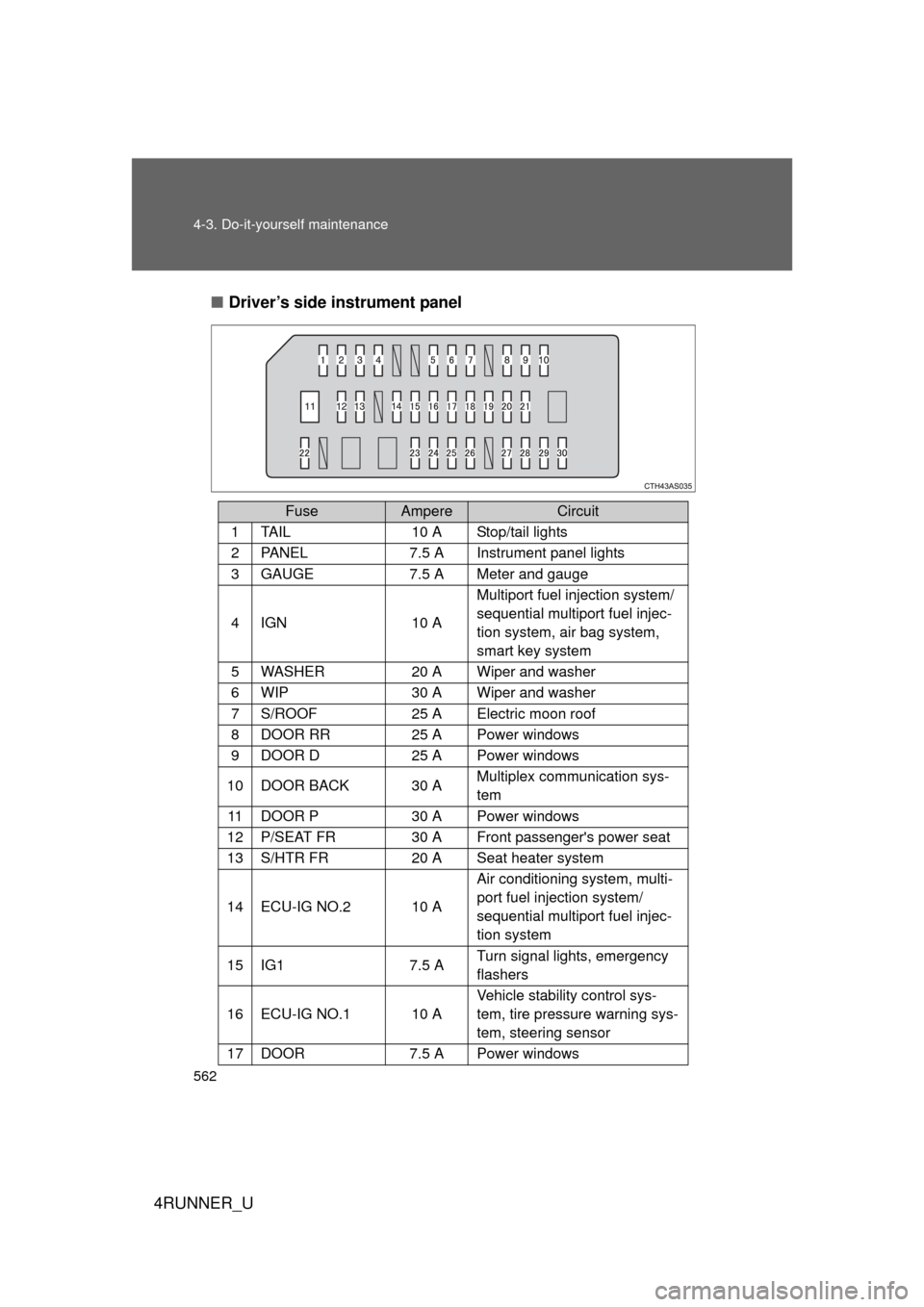
Driver’s side instrument panel
FuseAmpereCircuit
1TA I L10 A Stop/tail lights
2PA N E L7.5 A Instrument panel lights
3GAUGE7.5 A Meter and gauge
4IGN10 A Multiport fuel injection system/
sequential multiport fuel injec-
tion system, air bag system,
smart key system
5WASHER20 A Wiper and washer
6WIP30 A Wiper and washer
7S/ROOF 25 A Electric moon roof
8DOOR RR25 A Power windows
9DOOR D25 A Power windows
10DOOR BACK30 A
Multiplex communication sys-
tem
11DOOR P30 A Power windows
12P/SEAT FR 30 A Front passenger's power seat
13S/HTR FR 20 A Seat heater system
14ECU-IG NO.210 AAir conditioning system, multi-
port fuel injection system/
sequential multiport fuel injec-
tion system
15IG17.5 A
Turn signal lights, emergency
flashers
16ECU-IG NO.110 AVehicle stability control sys-
tem, tire pressure warning sys-
tem, steering sensor
17DOOR7.5 A Power windows
Page 575 of 700
575
4-3. Do-it-yourself maintenance
4
Maintenance and care
4RUNNER_U
■
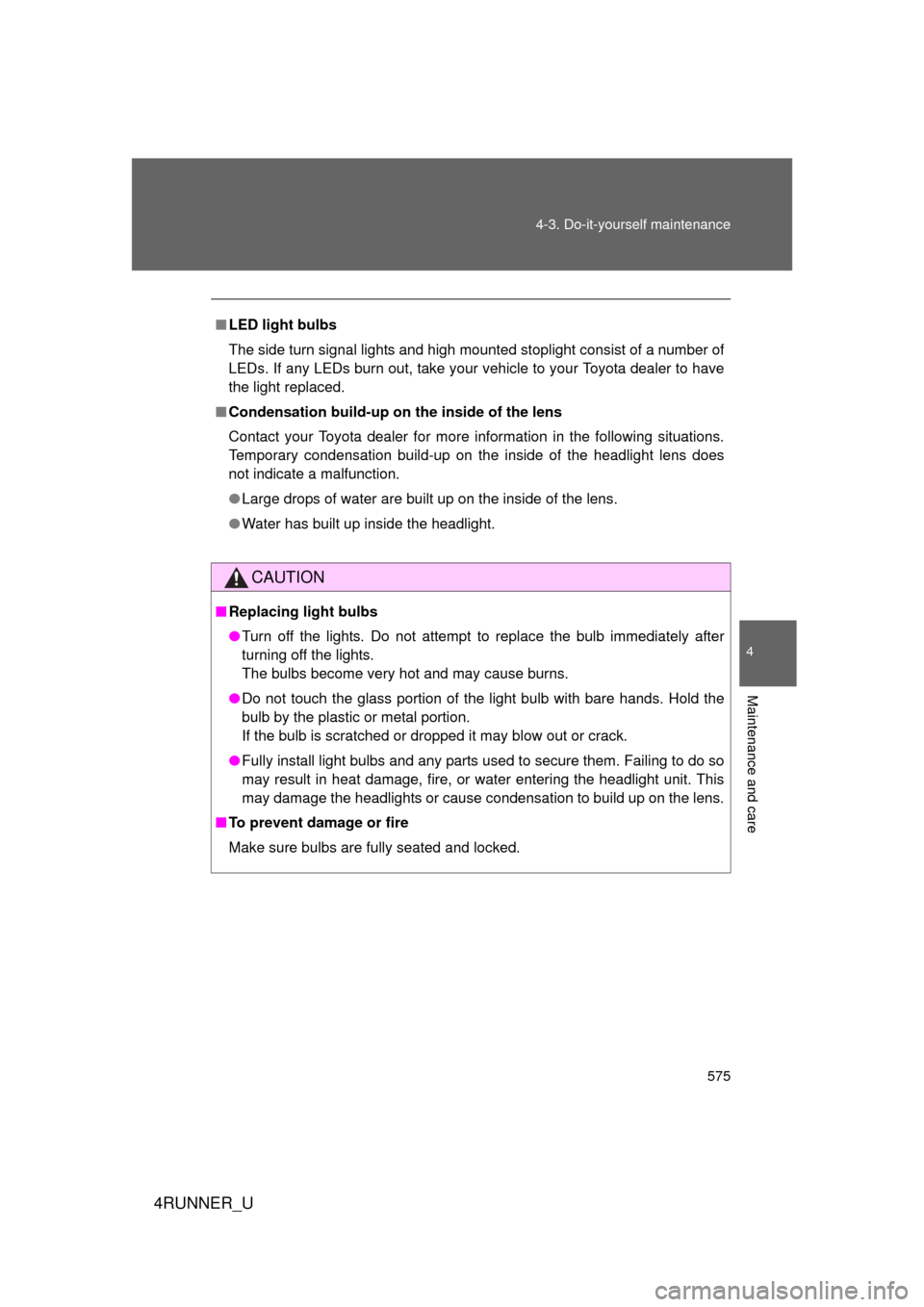
LED light bulbs
The side turn signal lights and high mounted stoplight consist of a number of
LEDs. If any LEDs burn out, take your vehicle to your Toyota dealer to have
the light replaced.
■ Condensation build-up on th e inside of the lens
Contact your Toyota dealer for more information in the following situations.
Temporary condensation build-up on the inside of the headlight lens does
not indicate a malfunction.
● Large drops of water are built up on the inside of the lens.
● Water has built up inside the headlight.
CAUTION
■Replacing light bulbs
● Turn off the lights. Do not attempt to replace the bulb immediately after
turning off the lights.
The bulbs become very hot and may cause burns.
● Do not touch the glass portion of the light bulb with bare hands. Hold the
bulb by the plastic or metal portion.
If the bulb is scratched or dropped it may blow out or crack.
● Fully install light bulbs and any parts used to secure them. Failing to do so
may result in heat damage, fire, or water entering the headlight unit. This
may damage the headlights or cause condensation to build up on the lens.
■ To prevent damage or fire
Make sure bulbs are fully seated and locked.
Page 579 of 700
5
When trouble arises
579
5-1. Essential information
4RUNNER_U
If your vehicle needs to be towed
Before towingThe following may indicate a problem with your transmission. Contact
your Toyota dealer before towing.
● The engine is running but the vehicle will not move.
● The vehicle makes an abnormal sound.
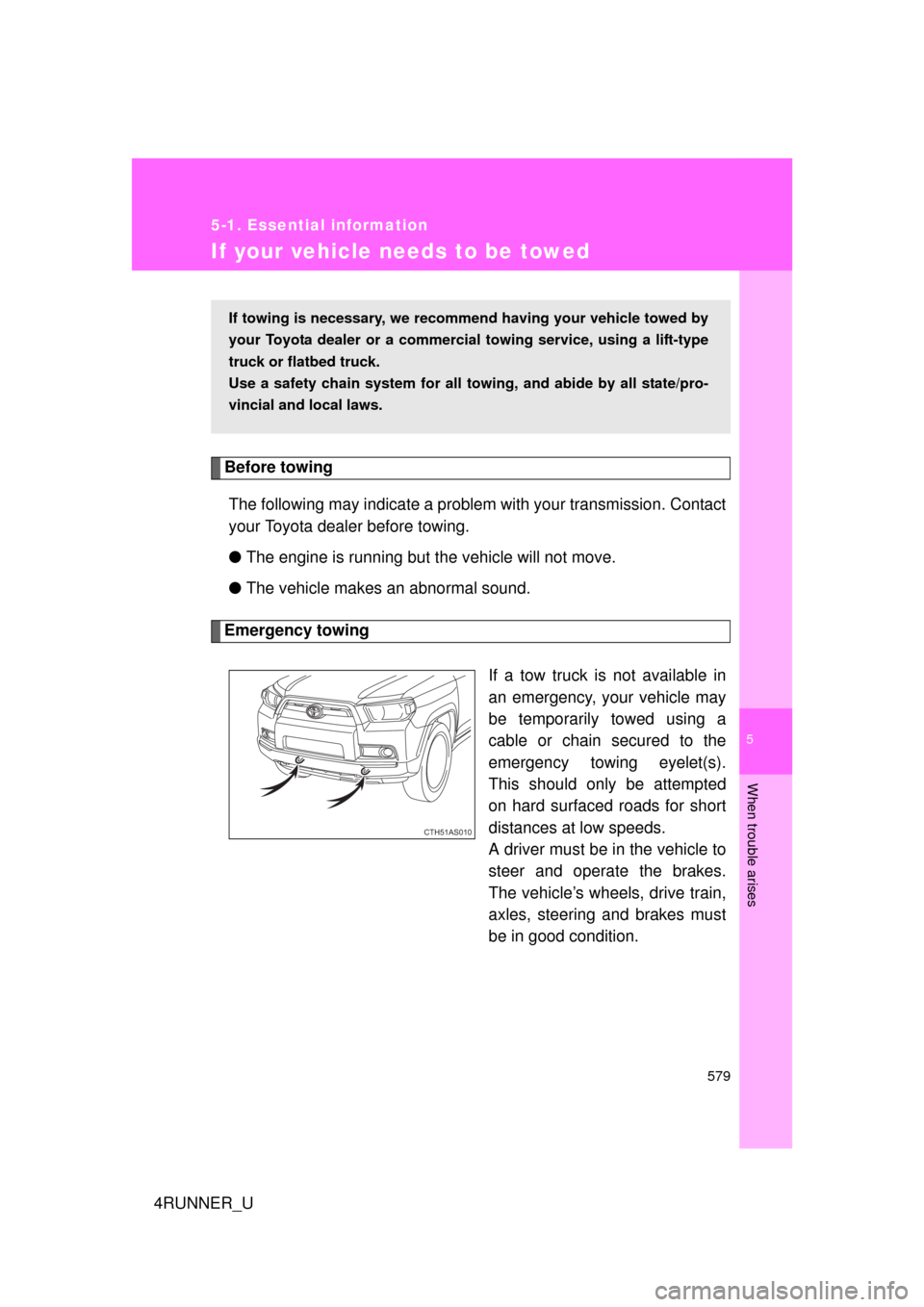
Emergency towing
If a tow truck is not available in
an emergency, your vehicle may
be temporarily towed using a
cable or chain secured to the
emergency towing eyelet(s).
This should only be attempted
on hard surfaced roads for short
distances at low speeds.
A driver must be in the vehicle to
steer and operate the brakes.
The vehicle’s wheels, drive train,
axles, steering and brakes must
be in good condition.
If towing is necessary, we recommend having your vehicle towed by
your Toyota dealer or a commerci al towing service, using a lift-type
truck or flatbed truck.
Use a safety chain system for all to wing, and abide by all state/pro-
vincial and local laws.
CTH51AS010
Page 597 of 700
5
When trouble arises
597
5-2. Steps to take in an emergency
4RUNNER_U
■
SRS warning light
This warning light system monitors the airbag sensor assembly, front airbag
sensors, side and curtain shield airbag sensors, curtain shield airbag sen-
sors, floor sensor, driver's seat belt buckle switch, front passenger occupant
classification system, SRS airbag on-off indicator, roll sensing of curtain
shield airbags off indicator, front passenger's seat belt buckle switch, seat
belt pretensioner assemblies, inflators, interconnecting wiring and power
sources. ( P. 121)
■ Key reminder buzzer (vehicl es without a smart key system)
The buzzer indicates that the key has not been removed with the engine off
and the driver’s door opened.
■ Open moon roof reminder buzzer (if equipped)
The buzzer indicates that the moon roof is not fully closed with the engine off
and the driver’s door opened.
■ Front passenger detection sensor, passenger seat belt reminder and
warning buzzer
● If luggage is placed on the front passenger seat, the front passenger
detection sensor may cause the warning light to flash and the warning
buzzer to sound even if a passenger is not sitting in the seat.
● If a cushion is placed on the seat, the sensor may not detect a passen-
ger, and the warning light may not operate properly.
■ If the malfunction indicator lamp comes on while driving
First check the following:
● Is the fuel tank empty?
If it is, fill the fuel tank immediately.
● Is the fuel tank cap loose?
If it is, tighten it securely.
The light will go off after several driving trips.
If the light does not go off even after several trips, contact your Toyota dealer
as soon as possible.
Page 612 of 700
612 5-2. Steps to take in an emergency
4RUNNER_U
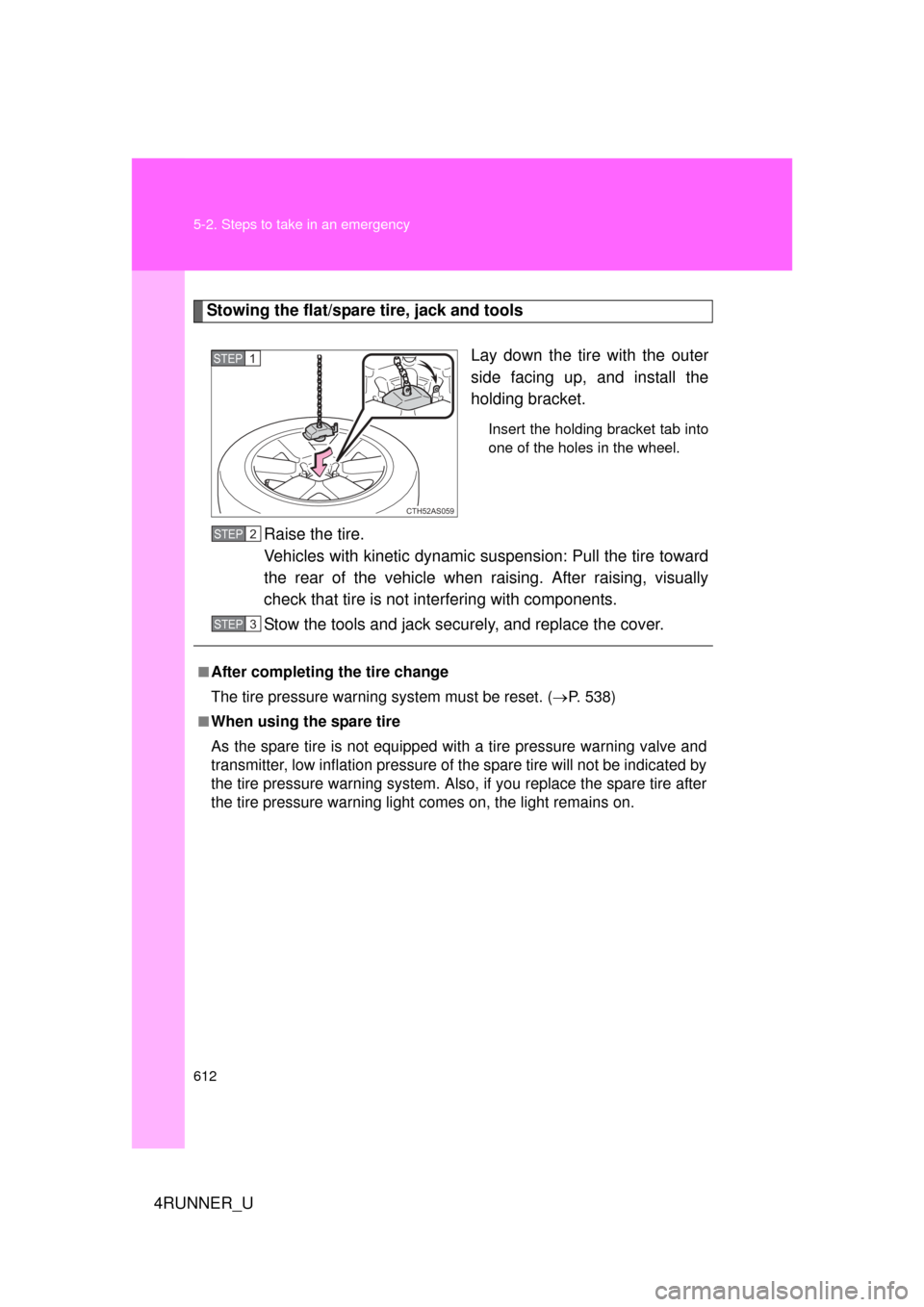
Stowing the flat/spare tire, jack and toolsLay down the tire with the outer
side facing up, and install the
holding bracket.
Insert the holding bracket tab into
one of the holes in the wheel.
Raise the tire.
Vehicles with kinetic dynamic suspension: Pull the tire toward
the rear of the vehicle when raising. After raising, visually
check that tire is not interfering with components.
Stow the tools and jack securely, and replace the cover.
CTH52AS059
STEP 1
■After completing the tire change
The tire pressure warnin g system must be reset. ( P. 538)
■When using the spare tire
As the spare tire is not equipped with a tire pressure warning valve and
transmitter, low inflation pressure of the spare tire will not be indicated by
the tire pressure warning system. Also, if you replace the spare tire after
the tire pressure warning light comes on, the light remains on.
STEP 2
STEP 3
Page 613 of 700
5
When trouble arises
613
5-2. Steps to take in an emergency
4RUNNER_U
CAUTION
■Using the tire jack
Improper use of the tire jack may cause the vehicle to suddenly fall off the
jack, leading to death or serious injury.
●
Do not use the tire jack for any pu
rpose other than replacing tires or
installing and removing tire chains.
●Only use the tire jack that comes wi th this vehicle for replacing a flat
tire.
Do not use it on other vehicles, and do not use other tire jacks for
replacing tires on this vehicle.
●Always check that the tire jack is securely set to the jack point.
●Do not put any part of your body under the vehicle while it is supported
by the jack.
●Do not start or run the engine while your vehicle is supported by the
jack.
●Do not raise the vehicle while someone is inside.
●When raising the vehicle, do not put an object on or under the jack.
●Do not raise the vehicle to a hei ght greater than that required to
replace the tire.
●Use a jack stand if it is necessary to get under the vehicle.
Vehicles with Automatic running boards
● Observe the following precautions. Failure to do so may result in serious
injury:
•
When jacking up the vehicle, always turn the Automatic running
boards switch off.
•When jacking up the vehicle, do not use an Automatic running
board as a jack point. The Automatic running board may break,
causing injuries.
Take particular care when lowering the vehicle to ensure that no one
working on or near the vehicle may be injured.
Page 614 of 700

614 5-2. Steps to take in an emergency
4RUNNER_U
CAUTION
■Using the jack handle
Tighten all the jack handle bolts securely using a Phillips-head screw-
driver, to prevent the extension parts from coming apart unexpectedly.
■Replacing a flat tire
●Observe the following precautions.
Failure to do so may result in serious injury:
• Lower the spare tire completely to the ground before removing it from
under the vehicle.
• Do not try to remove the wheel ornament by hand. Take due care in handling the ornament to avoid unexpected personal injury.
• Do not attach a heavily damaged wheel ornament, as it may fly off the wheel while the vehicle is moving.
• Do not touch the disc wheels or the area around the brakes immedi- ately after the vehicle has been driven.
After the vehicle has been driven the disc wheels and the area around
the brakes will be extremely hot. Touching these areas with hands, feet
or other body parts while changing a tire, etc. may result in burns.
● Failure to follow these precautions could cause the wheel nuts to loosen
and the tire to fall off, resulting in death or serious injury.
• Have the wheel nuts tightened with a torque wrench to 81 ft•lbf (110
N•m, 11.2 kgf•m) as soon as possible after changing wheels.
• When installing a tire, only use wheel nuts that have been specifically designed for that wheel.
• If there are any cracks or deformations in the bolt screws, nut threads or bolt holes of the wheel, have the vehicle inspected by your Toyota
dealer.
• When installing the wheel nuts, be sure to install them with the tapered ends facing inward. ( P. 548)
Page 632 of 700
632 5-2. Steps to take in an emergency
4RUNNER_U
CAUTION
■If the engine has to be turned off while driving
● Power assist for the brakes and steering wheel will be lost, making the
brake pedal harder to depress and the steering wheel heavier to turn.
Decelerate as much as possible before turning off the engine.
● Vehicles without a smart key system: Never attempt to remove the key, as
doing so will lock the steering wheel.
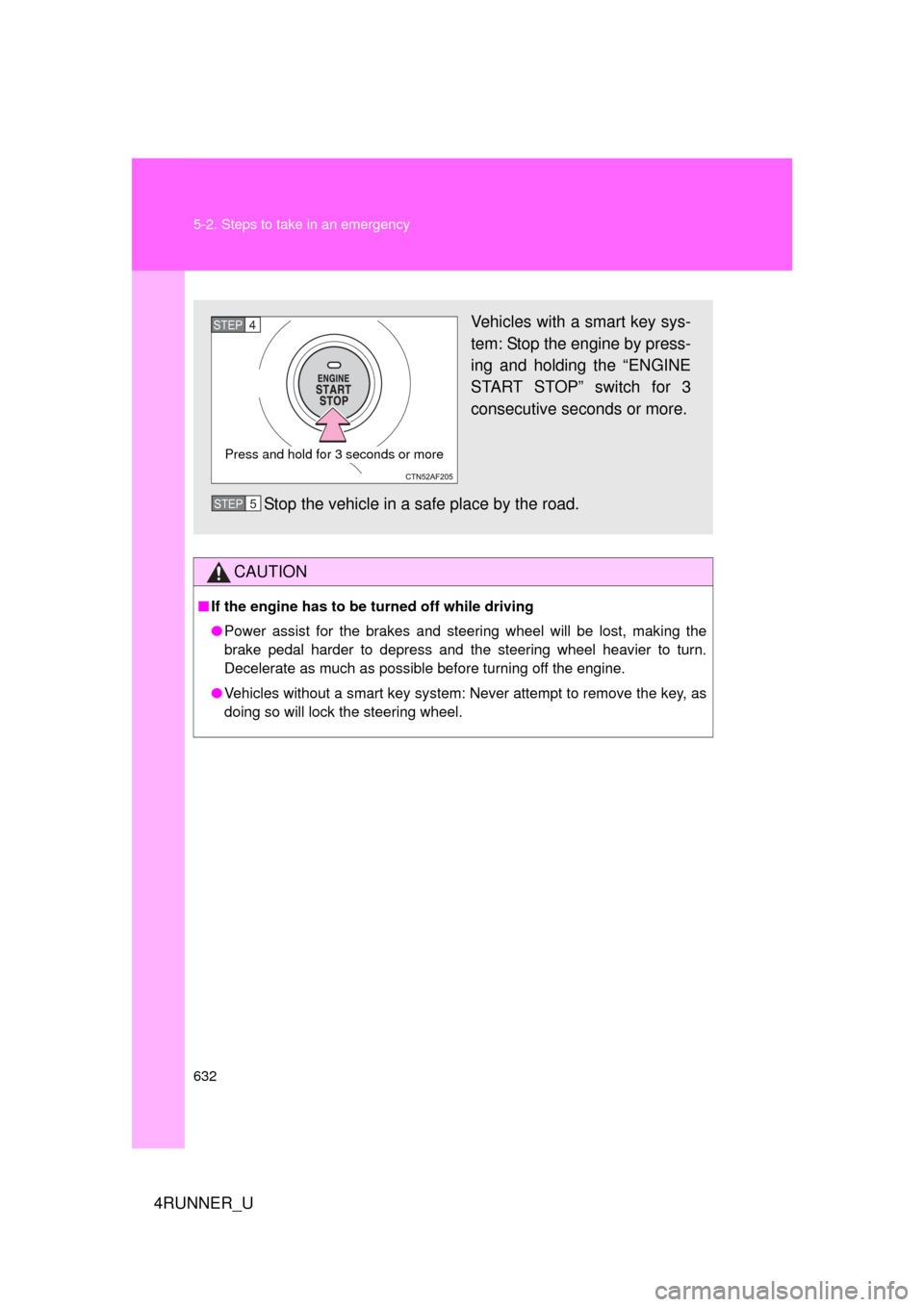
Vehicles with a smart key sys-
tem: Stop the engine by press-
ing and holding the “ENGINE
START STOP” switch for 3
consecutive seconds or more.
Stop the vehicle in a safe place by the road.
Press and hold for 3 seconds or more
STEP 4
STEP 5