coolant temperature TOYOTA 4RUNNER 2016 N280 / 5.G Owners Manual
[x] Cancel search | Manufacturer: TOYOTA, Model Year: 2016, Model line: 4RUNNER, Model: TOYOTA 4RUNNER 2016 N280 / 5.GPages: 528, PDF Size: 12.12 MB
Page 81 of 528
812. Instrument cluster
2
Instrument cluster
4RUNNER (U)_(OM35B23U)
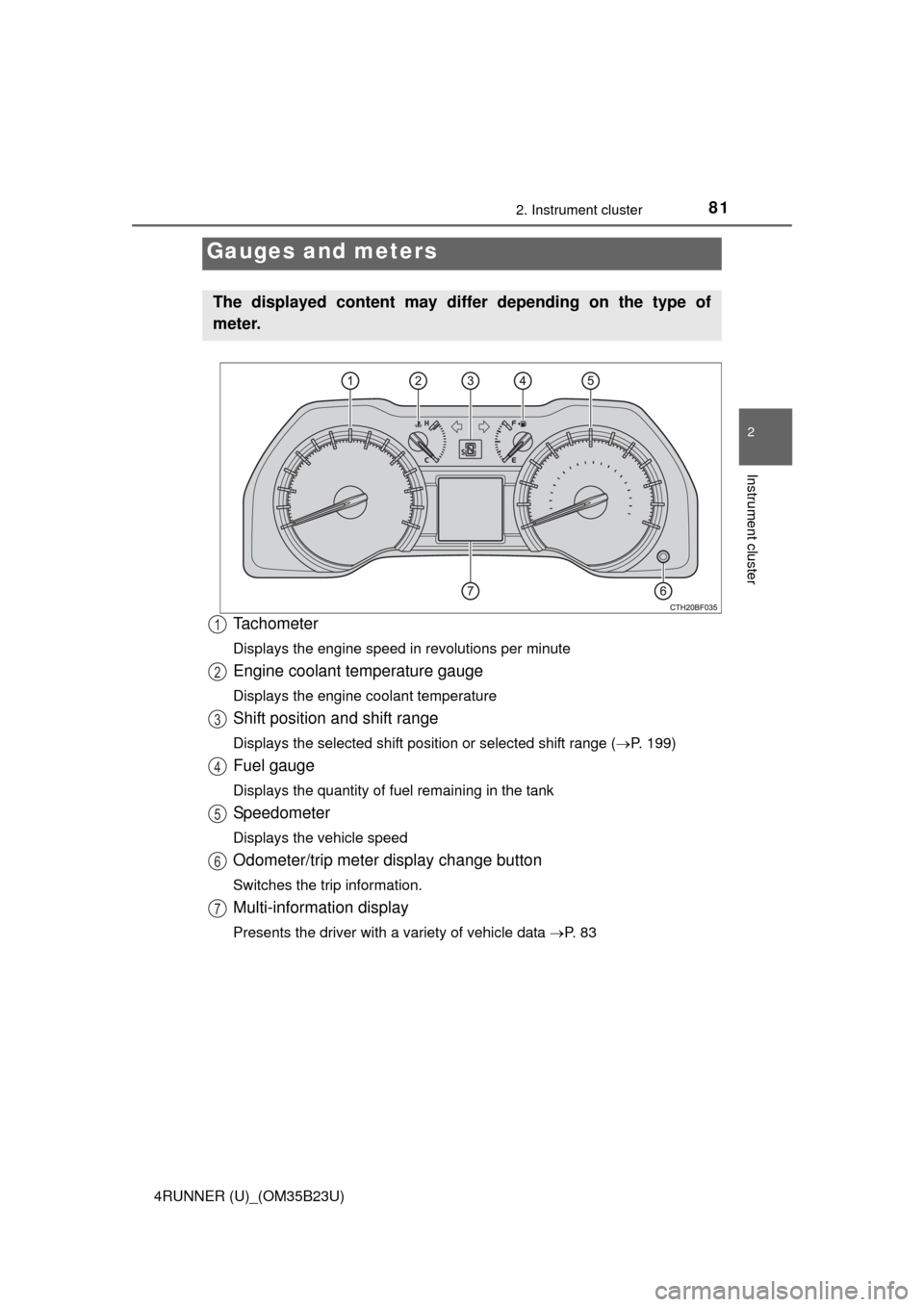
Tachometer
Displays the engine speed in revolutions per minute
Engine coolant temperature gauge
Displays the engine coolant temperature
Shift position and shift range
Displays the selected shift position or selected shift range (P. 199)
Fuel gauge
Displays the quantity of fuel remaining in the tank
Speedometer
Displays the vehicle speed
Odometer/trip meter display change button
Switches the trip information.
Multi-information display
Presents the driver with a variety of vehicle data P. 8 3
Gauges and meters
The displayed content may differ depending on the type of
meter.
1
2
3
4
5
6
7
Page 82 of 528
822. Instrument cluster
4RUNNER (U)_(OM35B23U)
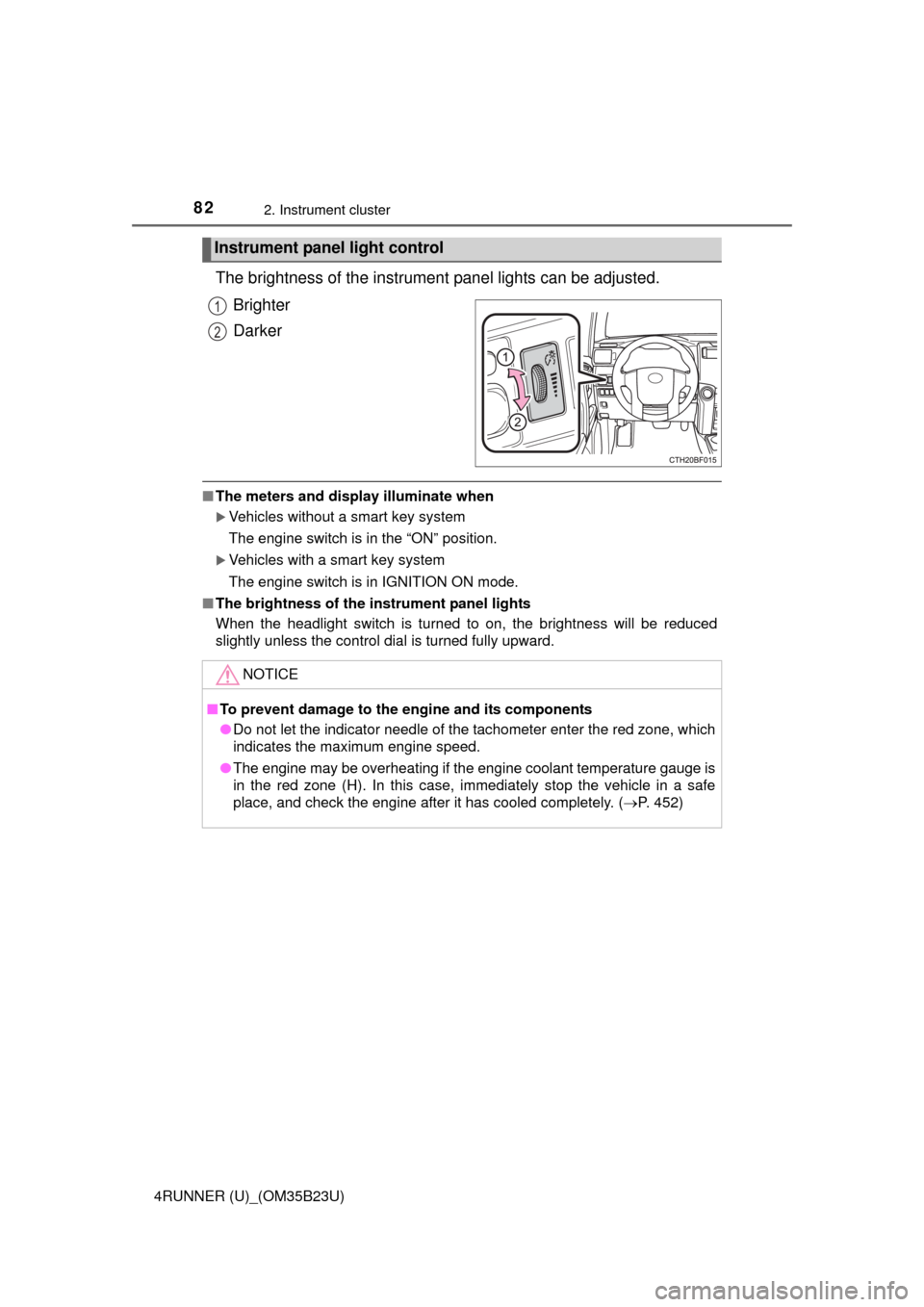
The brightness of the instrument panel lights can be adjusted.
Brighter
Darker
■The meters and display illuminate when
Vehicles without a smart key system
The engine switch is in the “ON” position.
Vehicles with a smart key system
The engine switch is in IGNITION ON mode.
■The brightness of the instrument panel lights
When the headlight switch is turned to on, the brightness will be reduced
slightly unless the control dial is turned fully upward.
Instrument panel light control
1
2
NOTICE
■To prevent damage to the engine and its components
●Do not let the indicator needle of the tachometer enter the red zone, which
indicates the maximum engine speed.
●The engine may be overheating if the engine coolant temperature gauge is
in the red zone (H). In this case, immediately stop the vehicle in a safe
place, and check the engine after it has cooled completely. (P. 452)
Page 184 of 528

1844-1. Before driving
4RUNNER (U)_(OM35B23U)
●Avoid jerky starts or sudden acceleration.
●Avoid jerky steering and sharp turns, and slow down before making
turn.
●Note that when making a turn, the trailer wheels will be closer than
the vehicle wheels to the inside of the turn. Compensate by making
a wider than normal turning radius.
●Slow down before making a turn, in cross winds, on wet or slippery
surfaces, etc.
Increasing vehicle speed can destabilize the trailer.
●Take care when passing other vehicles. Passing requires consider-
able distance. After passing a vehicle, do not forget the length of
your trailer, and be sure you have plenty of room before changing
lanes.
●To maintain engine braking efficiency and charging system perfor-
mance when using engine braking, do not put the transmission in
D.
●Instability happens more frequently when descending steep or long
downhill grades. Before descending, slow down and downshift. Do
not make sudden downshifts while descending steep or long down-
hill grades.
●Avoid holding the brake pedal down too long or applying the brakes
too frequently. This could cause the brakes to overheat and result in
reduced braking efficiency.
●Due to the added load of the trailer, your vehicle’s engine may over-
heat on hot days (at temperatures over 85°F [30°C]) when driving
up a long or steep grade. If the engine coolant temperature gauge
indicates overheating, immediately turn off the air conditioning (if in
use), pull your vehicle off the road and stop in a safe spot.
(P. 452)
Page 288 of 528
2885-1. Using the air conditioning system and defogger
4RUNNER (U)_(OM35B23U)
■Using automatic mode
Fan speed is adjusted automatically according to the temperature setting and
the ambient conditions.
Therefore, the fan may stop for a while until warm or cool air is ready to flow
immediately after is pressed.
■Fogging up of the windows
●The windows will easily fog up when the humidity in the vehicle is high.
Turning on will dehumidify the air from the outlets and defog the wind-
shield effectively.
●If you turn off, the windows may fog up more easily.
●The windows may fog up if the recirculated air mode is used.
■Outside/recirculated air mode
●When driving on dusty roads such as tunnels or in heavy traffic, set the out-
side/recirculated air mode to the recirculated air mode. This is effective in
preventing outside air from entering the vehicle interior. During cooling oper-
ation, setting the recirculated air mode will also cool the vehicle interior
effectively.
●Outside/recirculated air mode may automatically switch depending on the
temperature setting, outside temperature, pressure, engine coolant temper-
ature or inside temperature.
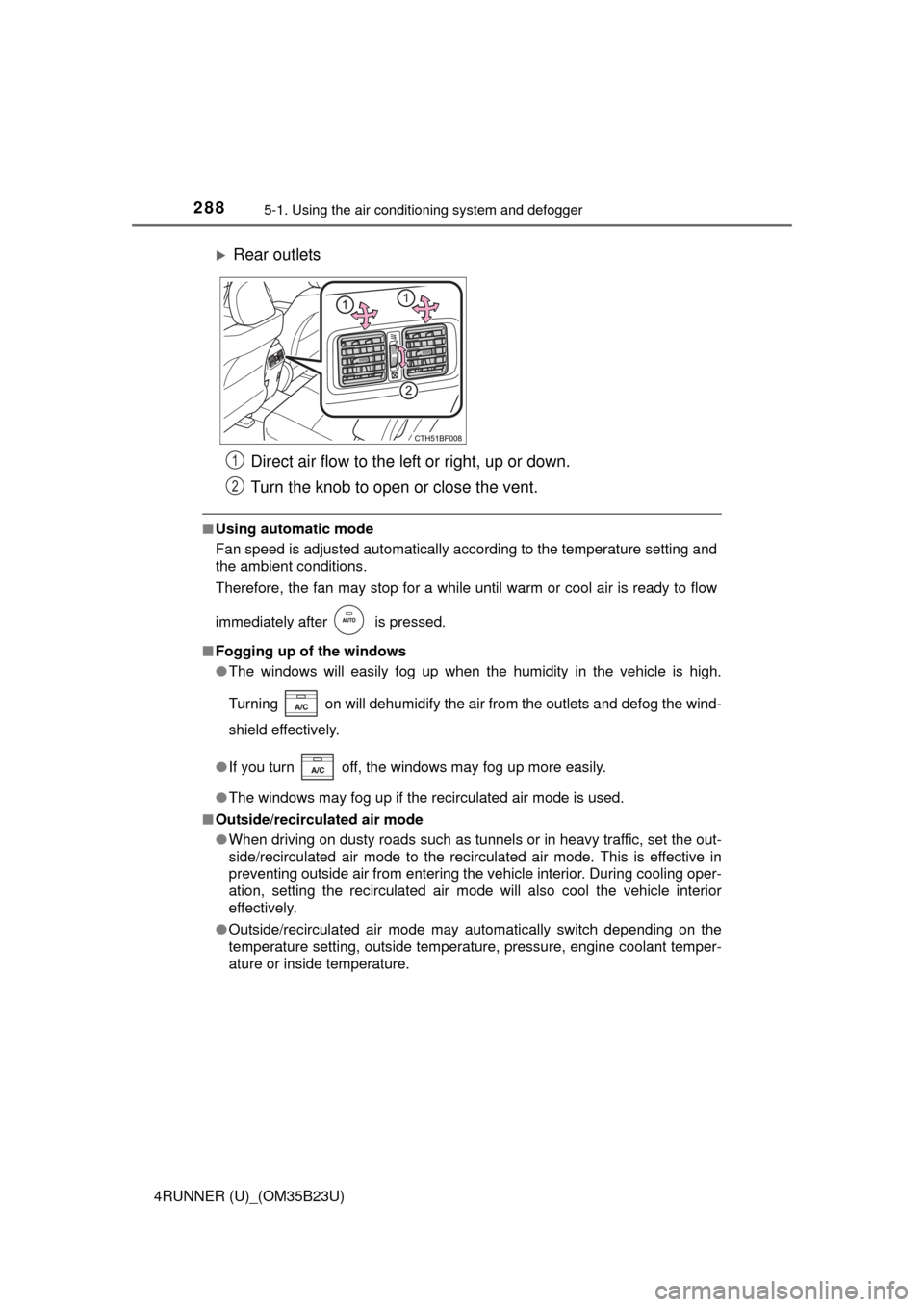
Rear outlets
Direct air flow to the left or right, up or down.
Turn the knob to open or close the vent.
1
2
Page 355 of 528
3556-3. Do-it-yourself maintenance
6
Maintenance and care
4RUNNER (U)_(OM35B23U)
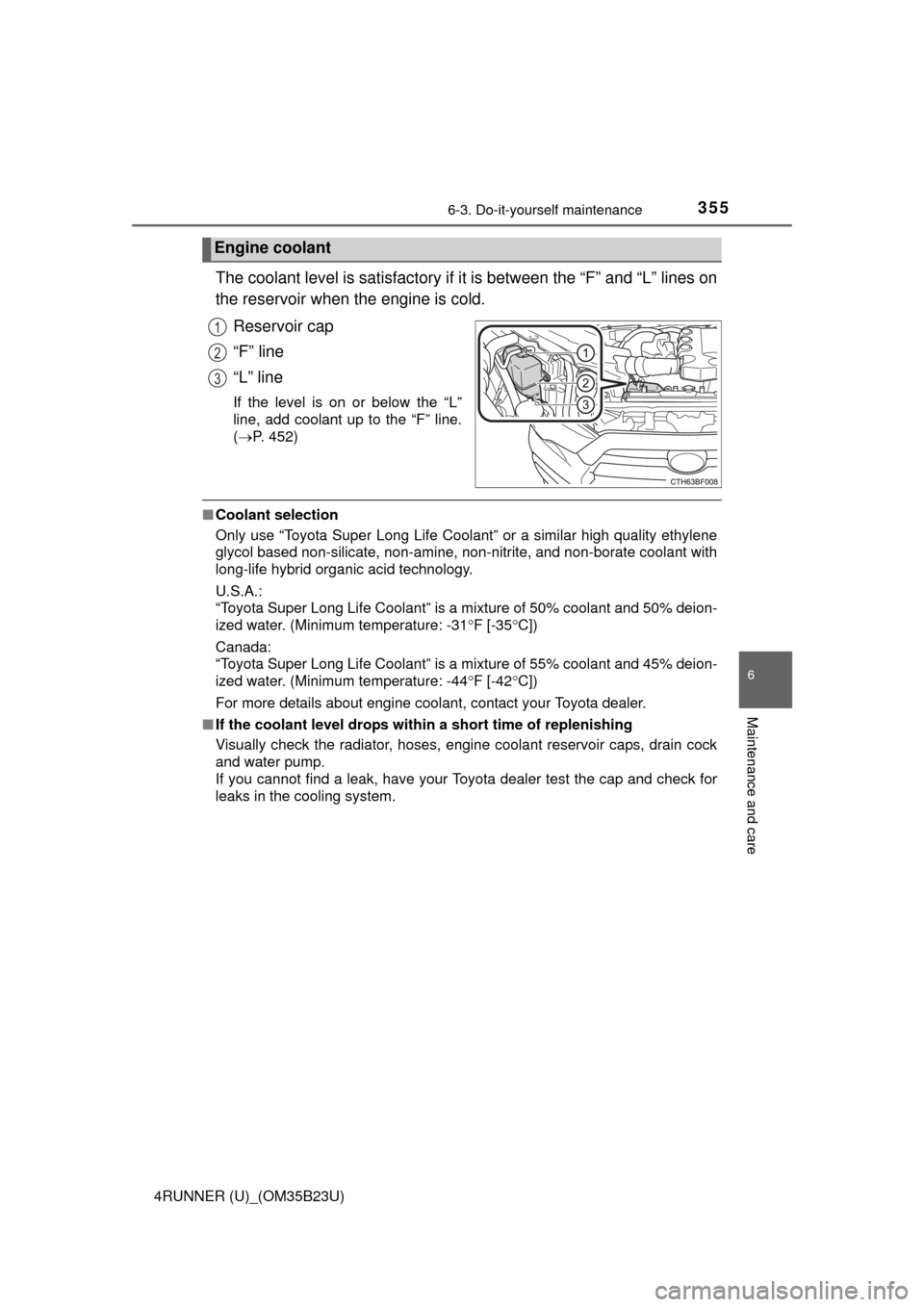
The coolant level is satisfactory if it is between the “F” and “L” lines on
the reservoir when the engine is cold.
Reservoir cap
“F” line
“L” line
If the level is on or below the “L”
line, add coolant up to the “F” line.
(P. 452)
■Coolant selection
Only use “Toyota Super Long Life Coolant” or a similar high quality ethylene
glycol based non-silicate, non-amine, non-nitrite, and non-borate coolant with
long-life hybrid organic acid technology.
U.S.A.:
“Toyota Super Long Life Coolant” is a mixture of 50% coolant and 50% deion-
ized water. (Minimum temperature: -31F [-35C])
Canada:
“Toyota Super Long Life Coolant” is a mixture of 55% coolant and 45% deion-
ized water. (Minimum temperature: -44F [-42C])
For more details about engine coolant, contact your Toyota dealer.
■If the coolant level drops within a short time of replenishing
Visually check the radiator, hoses, engine coolant reservoir caps, drain cock
and water pump.
If you cannot find a leak, have your Toyota dealer test the cap and check for
leaks in the cooling system.
Engine coolant
1
2
3
Page 411 of 528
4117-2. Steps to take in an emergency
7
When trouble arises
4RUNNER (U)_(OM35B23U)
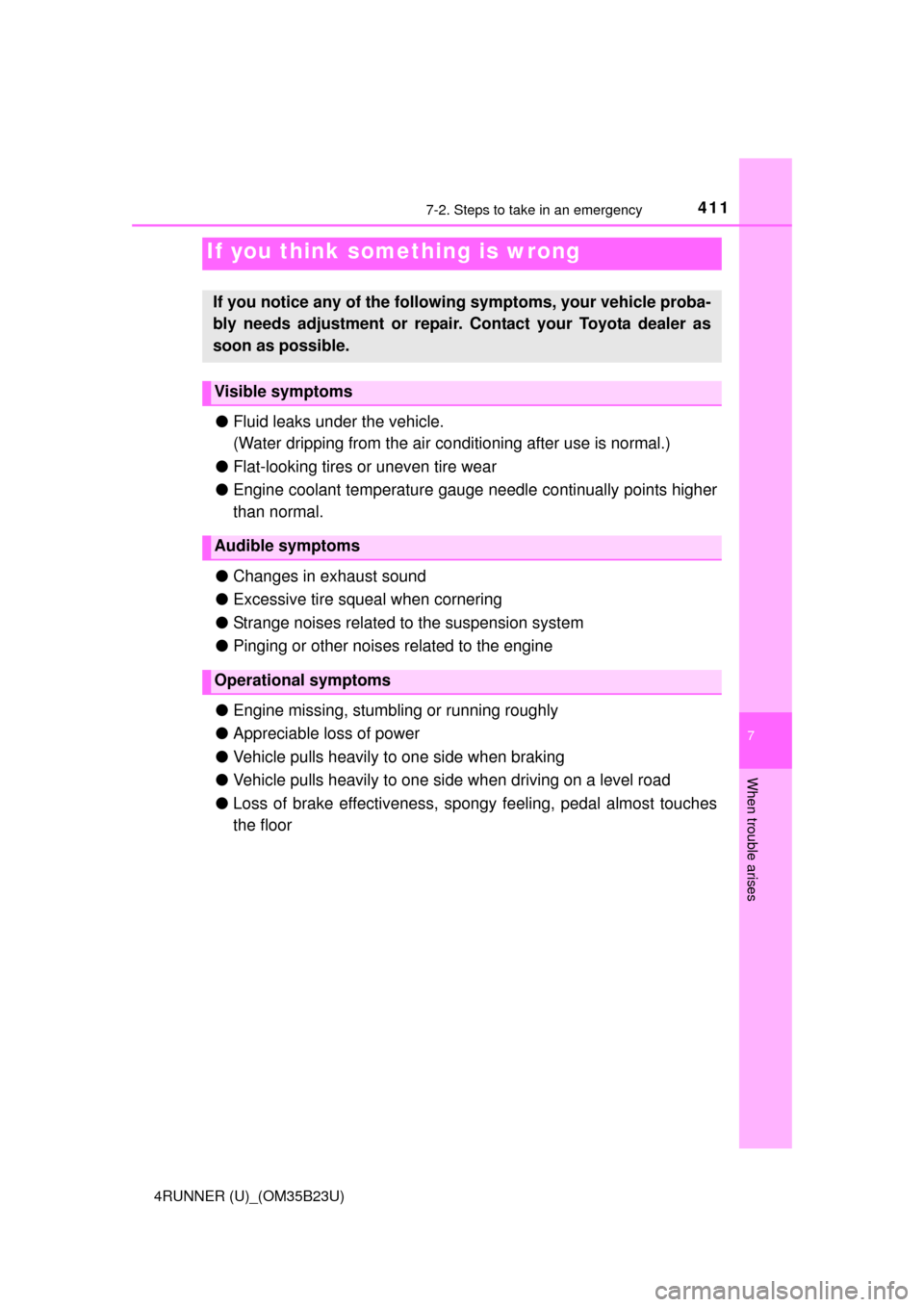
●Fluid leaks under the vehicle.
(Water dripping from the air conditioning after use is normal.)
●Flat-looking tires or uneven tire wear
●Engine coolant temperature gauge needle continually points higher
than normal.
●Changes in exhaust sound
●Excessive tire squeal when cornering
●Strange noises related to the suspension system
●Pinging or other noises related to the engine
●Engine missing, stumbling or running roughly
●Appreciable loss of power
●Vehicle pulls heavily to one side when braking
●Vehicle pulls heavily to one side when driving on a level road
●Loss of brake effectiveness, spongy feeling, pedal almost touches
the floor
If you think something is wrong
If you notice any of the following symptoms, your vehicle proba-
bly needs adjustment or repair. Contact your Toyota dealer as
soon as possible.
Visible symptoms
Audible symptoms
Operational symptoms
Page 452 of 528
4527-2. Steps to take in an emergency
4RUNNER (U)_(OM35B23U)
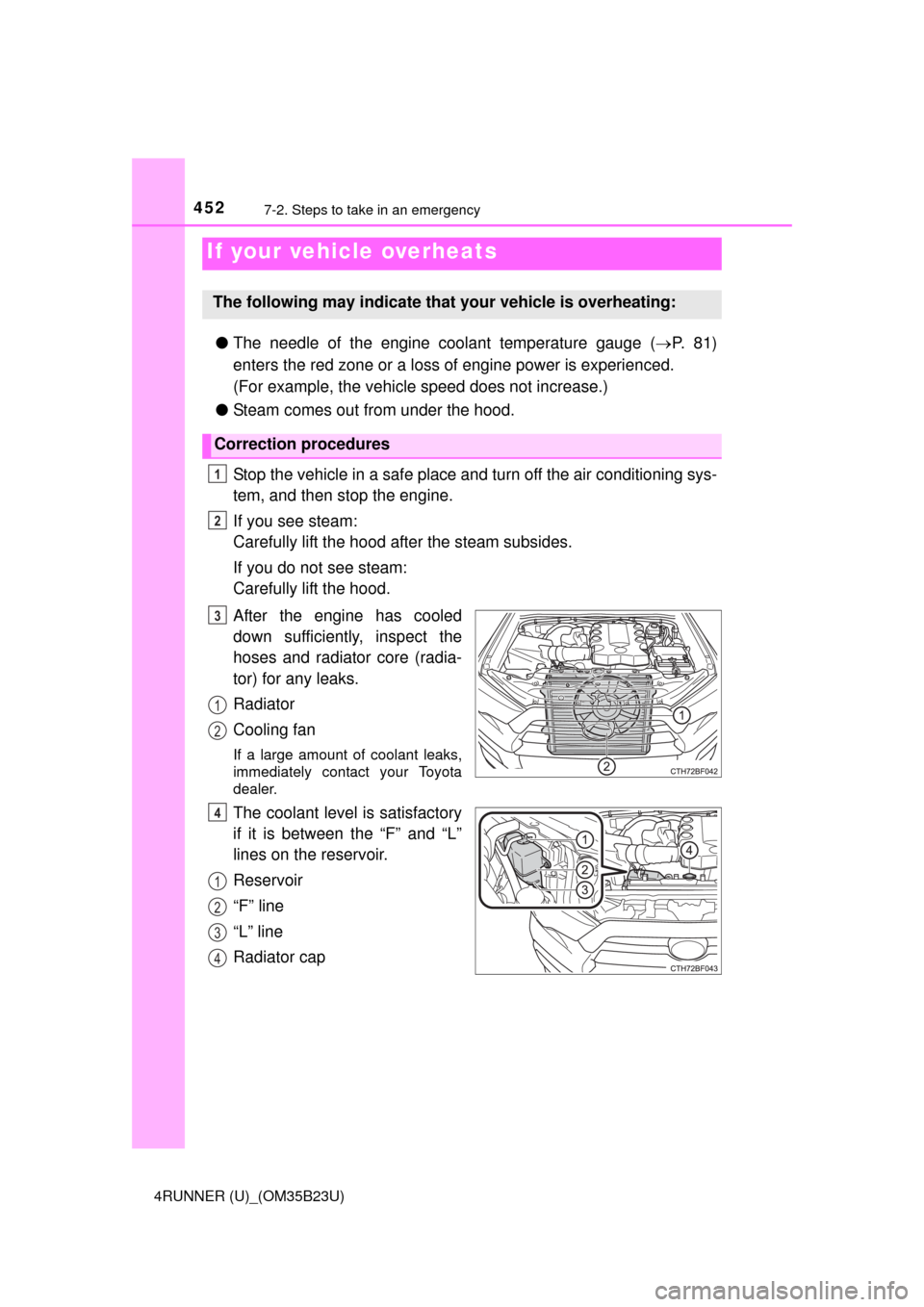
●The needle of the engine coolant temperature gauge (P. 8 1 )
enters the red zone or a loss of engine power is experienced.
(For example, the vehicle speed does not increase.)
●Steam comes out from under the hood.
Stop the vehicle in a safe place and turn off the air conditioning sys-
tem, and then stop the engine.
If you see steam:
Carefully lift the hood after the steam subsides.
If you do not see steam:
Carefully lift the hood.
After the engine has cooled
down sufficiently, inspect the
hoses and radiator core (radia-
tor) for any leaks.
Radiator
Cooling fan
If a large amount of coolant leaks,
immediately contact your Toyota
dealer.
The coolant level is satisfactory
if it is between the “F” and “L”
lines on the reservoir.
Reservoir
“F” line
“L” line
Radiator cap
If your vehicle overheats
The following may indicate that your vehicle is overheating:
Correction procedures
1
2
3
1
2
4
1
2
3
4
Page 453 of 528
4537-2. Steps to take in an emergency
7
When trouble arises
4RUNNER (U)_(OM35B23U)
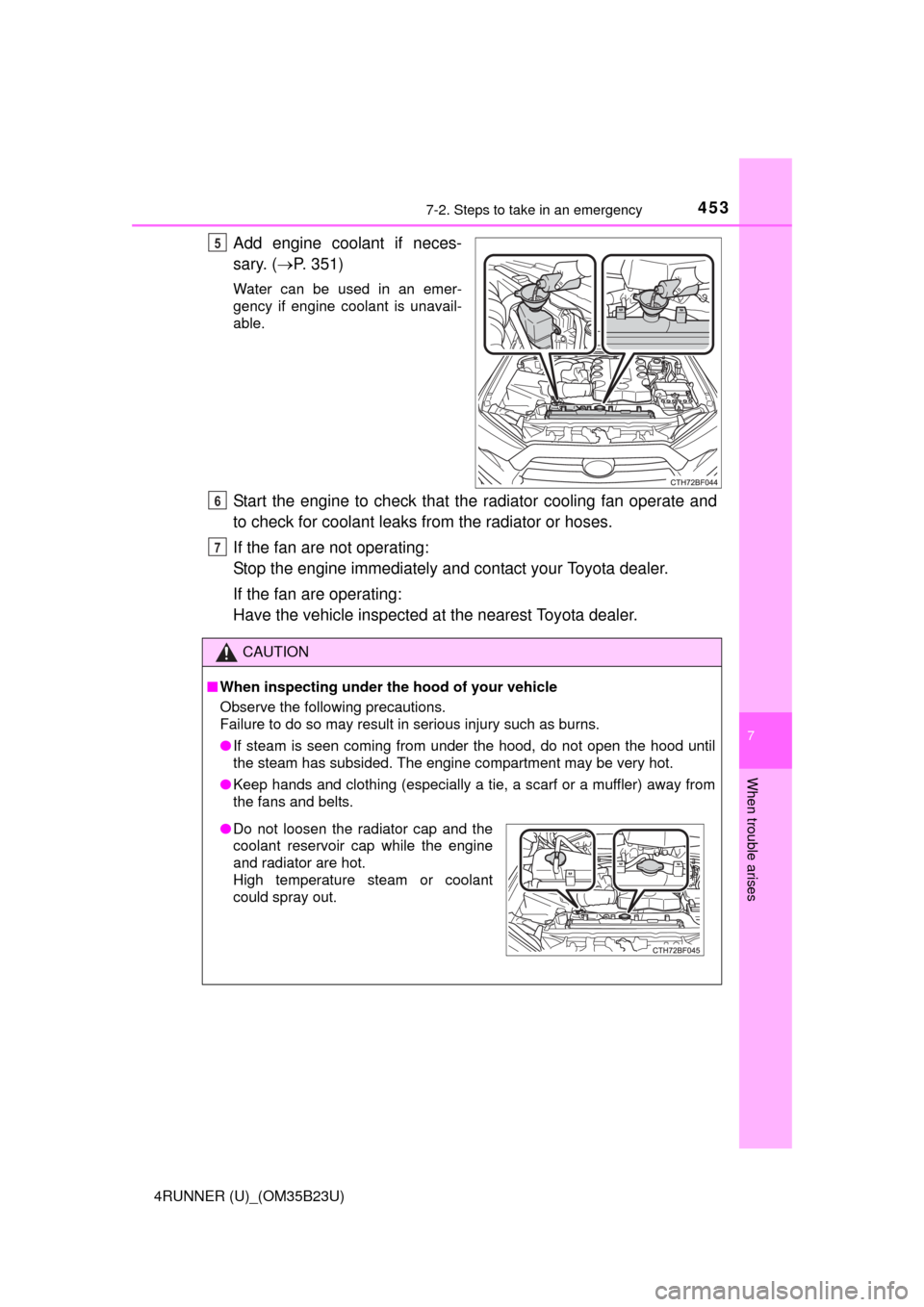
Add engine coolant if neces-
sary. (P. 351)
Water can be used in an emer-
gency if engine coolant is unavail-
able.
Start the engine to check that the radiator cooling fan operate and
to check for coolant leaks from the radiator or hoses.
If the fan are not operating:
Stop the engine immediately and contact your Toyota dealer.
If the fan are operating:
Have the vehicle inspected at the nearest Toyota dealer.
5
CAUTION
■When inspecting under the hood of your vehicle
Observe the following precautions.
Failure to do so may result in serious injury such as burns.
●If steam is seen coming from under the hood, do not open the hood until
the steam has subsided. The engine compartment may be very hot.
●Keep hands and clothing (especially a tie, a scarf or a muffler) away from
the fans and belts.
6
7
●Do not loosen the radiator cap and the
coolant reservoir cap while the engine
and radiator are hot.
High temperature steam or coolant
could spray out.
Page 517 of 528
517Alphabetical index
4RUNNER (U)_(OM35B23U)
Eco Driving Indicator ................ 83
EDR (Event data recorder) ........ 10
Electronic key ............................ 90
Battery-saving function ......... 106
If the electronic key does not
operate properly ................. 446
Replacing the battery ............ 379
Emergency flashers ................ 402
Emergency, in case of
If the electronic key
does not operate
properly .............................. 446
If the engine will not start ...... 442
If the shift lever
cannot be shifted from P .... 444
If the vehicle battery is
discharged .......................... 448
If the warning buzzer
sounds ................................ 413
If the warning light turns
on ....................................... 413
If the warning message
is displayed......................... 422
If you cannot operate
back door opener ............... 445
If you have a flat tire ............. 429
If you think something
is wrong .............................. 411
If your vehicle becomes
stuck ................................... 455
If your vehicle has to be
stopped in an emergency ... 403
If your vehicle needs
to be towed ......................... 405
If your vehicle overheats ....... 452Engine
ACCESSORY mode ............. 195
Compartment ........................ 350
Engine switch ............... 191, 194
Hood ..................................... 349
How to start the
engine ........................ 191, 194
Identification number ............ 459
If the engine will not start ...... 442
Ignition switch
(engine switch) ........... 191, 194
Overheating .......................... 452
Engine coolant......................... 355
Capacity................................ 464
Checking............................... 355
Preparing and checking
before winter ...................... 268
Engine coolant temperature
gauge ....................................... 81
Engine immobilizer system ...... 70
Engine oil ................................. 352
Capacity................................ 461
Checking............................... 352
Preparing and checking
before winter ...................... 268
Engine switch .................. 191, 194
Event data recorder (EDR)........ 10
E