warning TOYOTA 4RUNNER 2020 Owners Manual (in English)
[x] Cancel search | Manufacturer: TOYOTA, Model Year: 2020, Model line: 4RUNNER, Model: TOYOTA 4RUNNER 2020Pages: 596, PDF Size: 13.35 MB
Page 491 of 596
4917-2. Steps to take in an emergency
7
When trouble arises
4RUNNER (U)■
If “Oil Maintenance Required” is displayed (U.S.A. only)
Indicates that all maintenance is required to correspond to the driven distance
on the maintenance schedule*.
Comes on approximately 5000 miles (8000 km) after the message has been
reset.
(The indicator will not work properly unless the message has been reset.)
Perform the necessary maintenance. Please reset the message aft er the
maintenance is performed. ( P. 397)
*: Refer to the separate “Scheduled Maintenance Guide” or “Owner’ s Manual
Supplement” for the maintenance interval applicable to your veh icle.
■ If “Visit Your Dealer” is shown
The system or part shown on the multi-information display is ma lfunctioning.
Have the vehicle inspected by your Toyota dealer immediately.
■ Warning buzzer
In some cases, the buzzer may not be heard due to being in a no isy location
or audio sound.
NOTICE
■ While the engine oil level warning is displayed
Continued engine operation with low engine oil will damage the engine.
Page 492 of 596
4927-2. Steps to take in an emergency
4RUNNER (U)
●Phillips screwdriver
● Stop the vehicle in a safe place on a hard, flat surface.
● Set the parking brake.
● Shift the shift lever to P.
● Stop the engine.
● Turn on the emergency flashers. ( P. 464)
If you have a flat tire
Your vehicle is equipped with a spare tire. The flat tire can b e
replaced with the spare tire.
For details about tires: P. 4 2 0
WARNING
■If you have a flat tire
Do not continue driving with a flat tire.
Driving even a short distance wit h a flat tire can damage the tire and the
wheel beyond repair, which cou ld result in an accident.
You will need the following item:
Before jacking up the vehicle
Page 494 of 596

4947-2. Steps to take in an emergency
4RUNNER (U)
WARNING
■Using the tire jack
Improper use of the tire jack may cause the vehicle to suddenly fall off
the jack, leading to death or serious injury.
●Do not use the tire jack for any purpose other than replacing t ires or
installing and removing tire chains.
●Only use the tire jack that comes with this vehicle for replacing a flat
tire.
Do not use it on other vehicles, and do not use other tire jack s for
replacing tires on this vehicle.
●Always check that the tire jack is securely set to the jack poi nt.
●Do not put any part of your body under the vehicle while it is supported
by the jack.
●Do not start or run the engine while your vehicle is supported by the
jack.
●Do not raise the vehicle w hile someone is inside.
●When raising the vehicle, do not put an object on or under the jack.
●Do not raise the vehicle to a height greater than that required to
replace the tire.
●Use a jack stand if it is nece ssary to get under the vehicle.
Vehicles with Automatic running boards
●Observe the following precautions. Failure to do so may result in seri-
ous injury:
• When jacking up the vehicle, always turn the Automatic running boards switch off.
• When jacking up the vehicle, do not use an Automatic running b oard
as a jack point. The Automatic running board may break, causing
injuries.
Take particular care when lowering the vehicle to ensure that n o one
working on or near the vehicle may be injured.
■Using the jack handle
Tighten all the jack handle bol ts securely using a Phillips-hea d screw-
driver, to prevent the extension parts from coming apart unexpe ctedly.
Page 501 of 596
5017-2. Steps to take in an emergency
7
When trouble arises
4RUNNER (U)
WARNING
■Replacing a flat tire
●Observe the following precautions.
Failure to do so may result in serious injury:
• Lower the spare tire completely to the ground before removing it
from under the vehicle.
• Do not try to remove the wheel ornament by hand. Take due care in
handling the ornament to avoi d unexpected personal injury.
• Do not attach a heavily damaged wheel ornament, as it may fly off
the wheel while the vehicle is moving.
• Do not touch the disc wheels or the area around the brakes imm edi-
ately after the vehicle has been driven.
After the vehicle has been driven the disc wheels and the area
around the brakes will be extreme ly hot. Touching these areas with
hands, feet or other body parts while changing a tire, etc. may result
in burns.
●Failure to follow these precautions could cause the wheel nuts to
loosen and the t ire to fall off, resulting in death or serious injury.
• Have the wheel nuts tightened with a torque wrench to 83 ft•lbf (112
N•m, 11.4 kgf•m) steel wheels, 7 6 ft•lbf (103 N•m, 10.5 kgf•m) alumi-
num wheels, as soon as possi ble after changing wheels.
• When installing a tire, only use wheel nuts that have been spe cifi-
cally designed for that wheel.
• If there are any cracks or deformations in the bolt screws, nu t
threads or bolt holes of the wheel, have the vehicle inspected by
your Toyota dealer.
• When installing the wheel nuts, b e sure to install them with the
tapered ends facing inward. ( P. 438)
Page 504 of 596
5047-2. Steps to take in an emergency
4RUNNER (U)
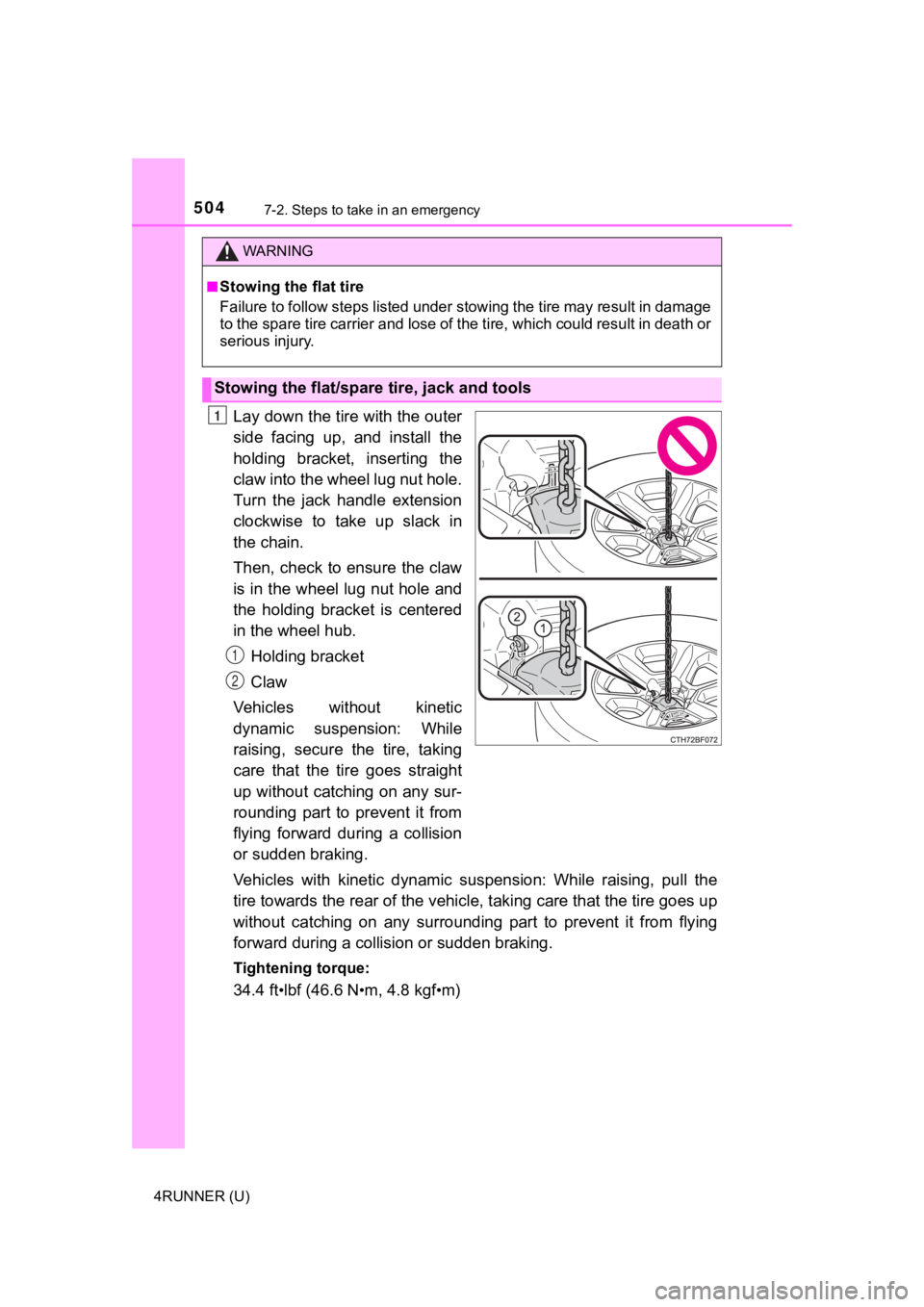
Lay down the tire with the outer
side facing up, and install the
holding bracket, inserting the
claw into the wheel lug nut hole.
Turn the jack handle extension
clockwise to take up slack in
the chain.
Then, check to ensure the claw
is in the wheel lug nut hole and
the holding bracket is centered
in the wheel hub.
Holding bracket
Claw
Vehicles wit hout kinetic
dynamic suspension: While
raising, secure the tire, taking
care that the tire goes straight
up without catching on any sur-
rounding part to prevent it from
flying forward during a collision
or sudden braking.
Vehicles with kinetic dynamic su spension: While raising, pull the
tire towards the rear of the vehi cle, taking care that the tire goes up
without catching on any surrounding part to prevent it from fly ing
forward during a collis ion or sudden braking.
Tightening torque:
34.4 ft•lbf (46.6 N•m, 4.8 kgf•m)
WARNING
■Stowing the flat tire
Failure to follow steps listed under stowing the tire may resul t in damage
to the spare tire carrier and lose of the tire, which could res ult in death or
serious injury.
Stowing the flat/spare tire, jack and tools
1
1
2
Page 505 of 596
5057-2. Steps to take in an emergency
7
When trouble arises
4RUNNER (U)
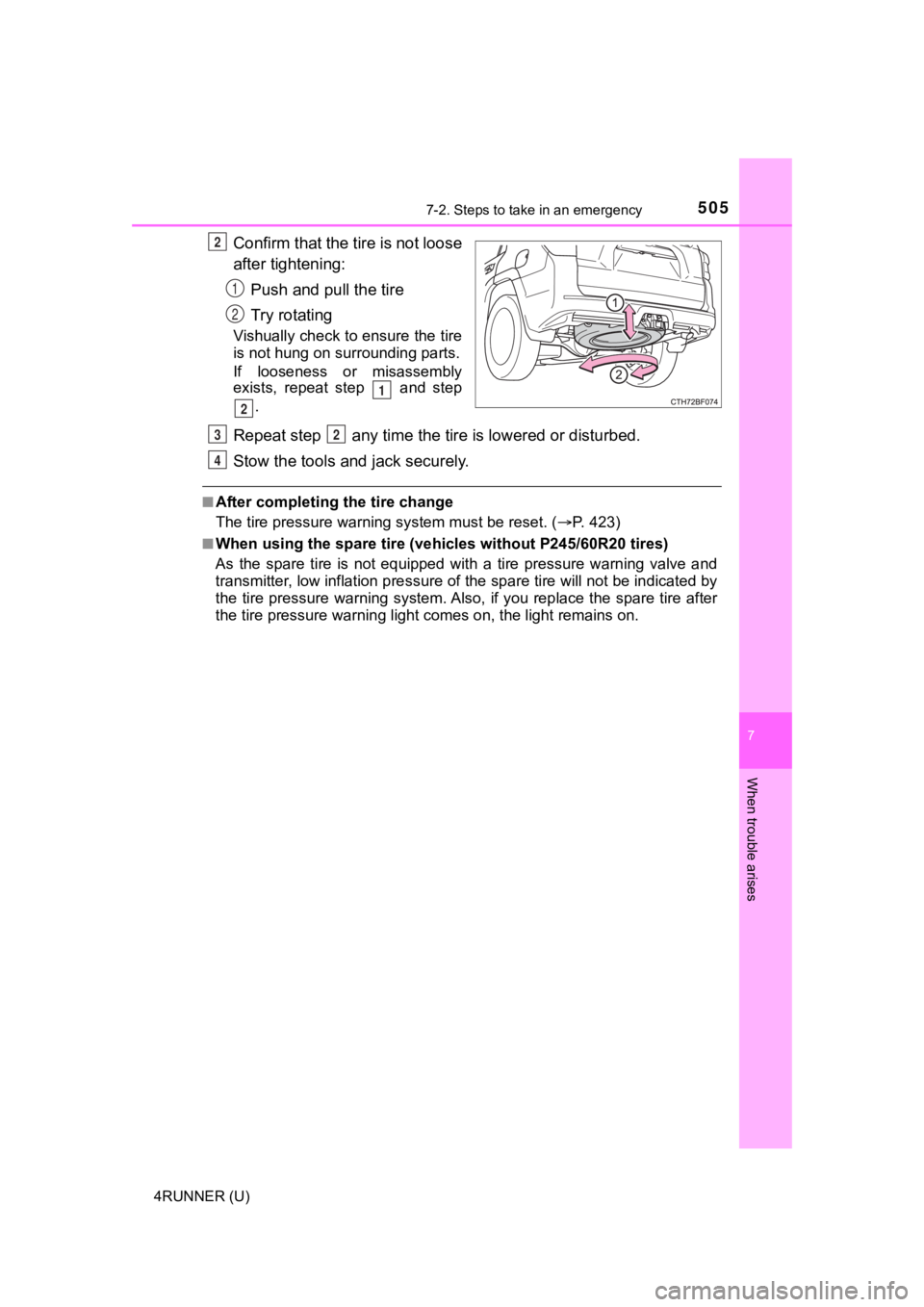
Confirm that the tire is not loose
after tightening:Push and pull the tire
Try rotating
Vishually check to ensure the tire
is not hung on su rrounding parts.
If looseness or misassembly
exists, repeat step and step
.
Repeat step any time the tire is lowered or disturbed.
Stow the tools and jack securely.
■After completing the tire change
The tire pressure warni ng system must be reset. ( P. 423)
■When using the spare tire (veh icles without P245/60R20 tires)
As the spare tire is not equipped with a tire pressure warning valve and
transmitter, low inflation pre ssure of the spare tire will not be indicated by
the tire pressure warning system. Also, if you replace the spar e tire after
the tire pressure wa rning light comes on, the light remains on.
2
1
2
1
2
32
4
Page 506 of 596
5067-2. Steps to take in an emergency
4RUNNER (U)
NOTICE
■Do not drive the vehicle with a flat tire
Do not continue driving with a flat tire.
Driving even a short distance with a flat tire can damage the tire and the
wheel beyond repair.
■When stowing the flat tire
Ensure that there is no object c aught between the tire and the vehicle
underbody.
■When replacing the tires
●When removing or fitting the wheels, tires or the tire pressure warning
valve and transmitter, contact your Toyota dealer as the tire p ressure
warning valve and transmitter may be damaged if not handled cor -
rectly.
●Replace the grommets for the tire pressure warning valves and t rans-
mitters as well.
■To avoid damage to the tire pressure warning valves and transmi t-
ters
When a tire is repaired with liqui d sealants, the tire pressure warning
valve and transmitter may not operate properly. If a liquid sea lant is
used, contact your Toyota dealer or other qualified service shop as soon
as possible. Make sure to replac e the tire pressure warning valve and
transmitter when replacing the tire. ( P. 4 2 3 )
Page 512 of 596

5127-2. Steps to take in an emergency
4RUNNER (U)
WARNING
■When using the mechanical key a nd operating the power windows,
power back window or moon roof
Operate the power windows, power back window or moon roof after check-
ing to make sure that there is no possibility of any passenger having any of
their body parts caught in the window or moon roof.
Also, do not allow children to operate the mechanical key. It is possible for
children and other passengers to get caught in the power window s, power
back window or moon roof.
Page 516 of 596
5167-2. Steps to take in an emergency
4RUNNER (U)
WARNING
■Avoiding battery fires or explosions
Observe the following precautions to prevent accidentally ignit ing the flam-
mable gas that may be emitted from the battery:
● Make sure each jumper cable is connected to the correct terminal and that
it is not unintentionally in contact with any other than the in tended terminal.
● Do not allow the other end of the jumper cable connected to the “+” termi-
nal to come into contact with any other parts or metal surfaces in the area,
such as brackets or unpainted metal.
● Do not allow the + and - clamps of the jumper cables to come in to contact
with each other.
● Do not smoke, use matches, cigarette lighters or allow open fla me near
the battery.
■ Battery precautions
The battery contains poisonous and corrosive acidic electrolyte , while
related parts contain lead and lead compounds. Observe the foll owing pre-
cautions when handling the battery:
● When working with the battery, always wear safety glasses and t ake care
not to allow any battery fluids (acid) to come into contact wit h skin, clothing
or the vehicle body.
● Do not lean over the battery.
● In the event that battery fluid comes into contact with the skin or eyes,
immediately wash the affected area with water and seek medical attention.
Place a wet sponge or cloth over the affected area until medica l attention
can be received.
● Always wash your hands after handling the battery support, term inals, and
other battery-related parts.
● Do not allow children near the battery.
NOTICE
■When handling jumper cables
When connecting the jumper cables, ensure that they do not beco me entan-
gled in the cooling fans or engine drive belt.
Page 518 of 596
5187-2. Steps to take in an emergency
4RUNNER (U)
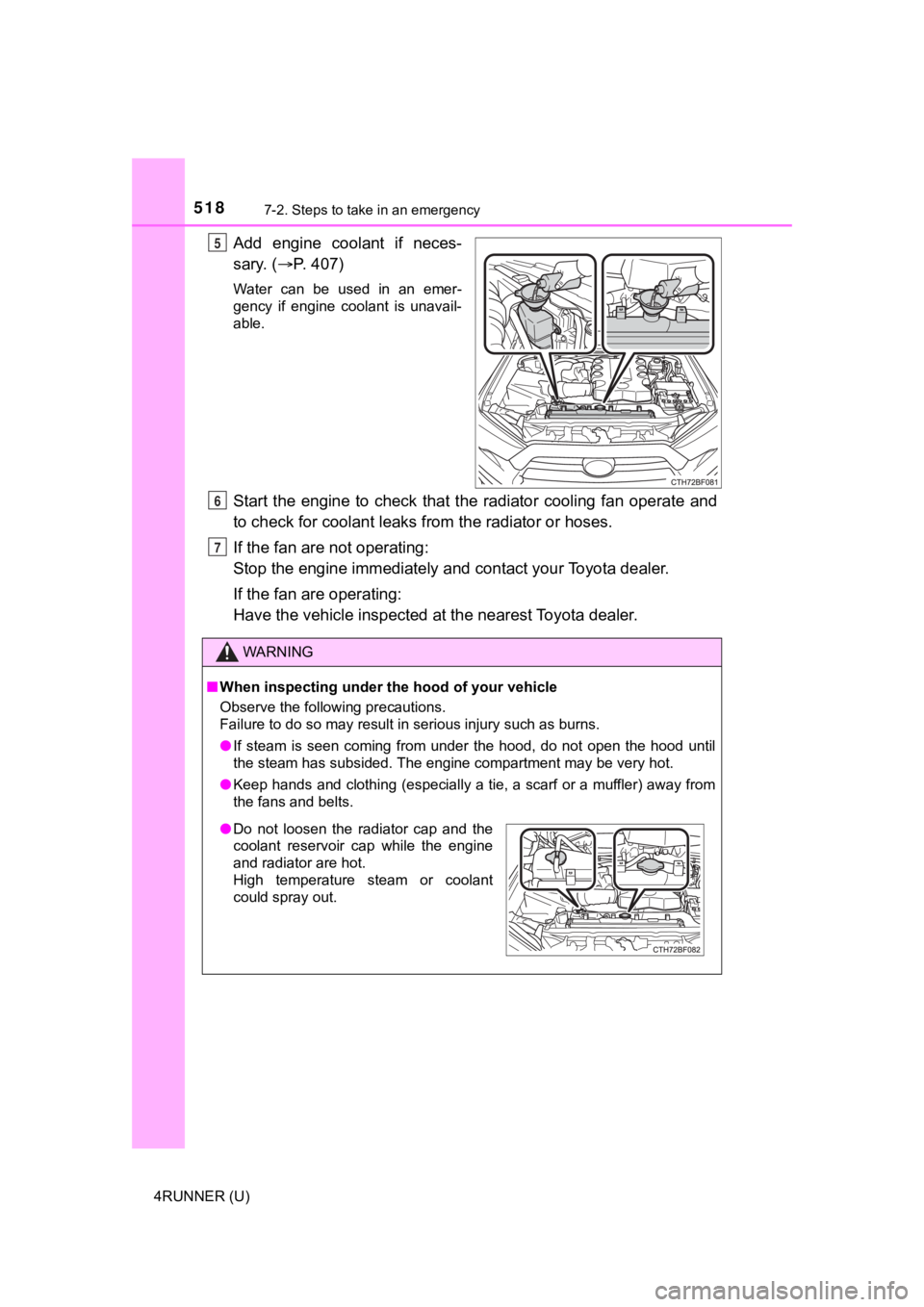
Add engine coolant if neces-
sary. (P. 407)
Water can be used in an emer-
gency if engine coolant is unavail-
able.
Start the engine to check that the radiator cooling fan operate and
to check for coolant leaks from the radiator or hoses.
If the fan are not operating:
Stop the engine immediately and contact your Toyota dealer.
If the fan are operating:
Have the vehicle ins pected at the nearest Toyota dealer.
5
WARNING
■When inspecting under th e hood of your vehicle
Observe the following precautions.
Failure to do so may result in serious injury such as burns.
● If steam is seen coming from under the hood, do not open the ho od until
the steam has subsided. The engine compartment may be very hot.
● Keep hands and clothing (especially a tie, a scarf or a muffler ) away from
the fans and belts.
6
7
● Do not loosen the radiator cap and the
coolant reservoir cap while the engine
and radiator are hot.
High temperature steam or coolant
could spray out.