Compartment TOYOTA 4RUNNER 2020 Owners Manual (in English)
[x] Cancel search | Manufacturer: TOYOTA, Model Year: 2020, Model line: 4RUNNER, Model: TOYOTA 4RUNNER 2020Pages: 596, PDF Size: 13.35 MB
Page 4 of 596

TABLE OF CONTENTS4
4RUNNER (U)5-1. Using the
air conditioning system
and defogger
Manual air conditioning system............................. 340
Automatic air conditioning system............................. 346
Seat heaters/ seat ventilators ................ 353
5-2. Using the interior lights Interior lights list ................ 355
• Interior lights ................. 356
• Personal lights .............. 356
5-3. Using the storage features
List of storage features...... 358
• Glove box...................... 359
• Console box .................. 359
• Cup holders .................. 360
• Auxiliary box ................. 362
• Coin holder/tissue pocket/
pen holder ..................... 363
• Bottle holders ................ 364
Luggage compartment features ........................... 365 5-4. Other interior features
Other interior features........ 370
• Sun visors ..................... 370
• Vanity mirrors ................ 370
• Clock ............................. 371
• Power outlets (120 V AC) .................... 372
• Power outlets ................ 376
• USB charging ports ....... 379
• Armrest.......................... 381
• Assist grips .................... 381
Garage door opener .......... 382
5Interior features
Page 5 of 596
5
1
8 7
6
5
4
3
2
9
4RUNNER (U)6-1. Maintenance and care
Cleaning and protecting the vehicle exterior .......... 390
Cleaning and protecting the vehicle interior ........... 393
6-2. Maintenance Maintenance requirements ................... 396
General maintenance ........ 398
Emission inspection and maintenance (I/M)
programs ......................... 401
6-3. Do-it-yourself maintenance
Do-it-yourself service precautions ..................... 402
Hood.................................. 405
Engine compartment ......... 406
Tires .................................. 420
Tire inflation pressure........ 434
Wheels .............................. 437
Air conditioning filter .......... 440
Wireless remote control/ electronic key battery ...... 442
Checking and replacing fuses ............................... 445
Light bulbs ......................... 448 7-1. Essential information
Emergency flashers ........... 464
If your vehicle has to be stopped in
an emergency.................. 465
If the vehicle is trapped in rising water .................. 467
7-2. Steps to take in an emergency
If your vehicle needs to be towed ...................... 468
If you think something is wrong ........................... 475
Fuel pump shut off system ............................. 476
If a warning light turns on or a warning buzzer
sounds ............................. 477
If a warning message is displayed...................... 487
If you have a flat tire .......... 492
If the engine will not start ................................. 507
If you cannot operate back door opener ............ 509
If the electronic key does not operate
properly ........................... 510
If the vehicle battery is discharged ................... 513
If your vehicle overheats......................... 517
If the vehicle becomes stuck ................................ 520
6Maintenance and care7When trouble arises
Page 23 of 596
23Pictorial index
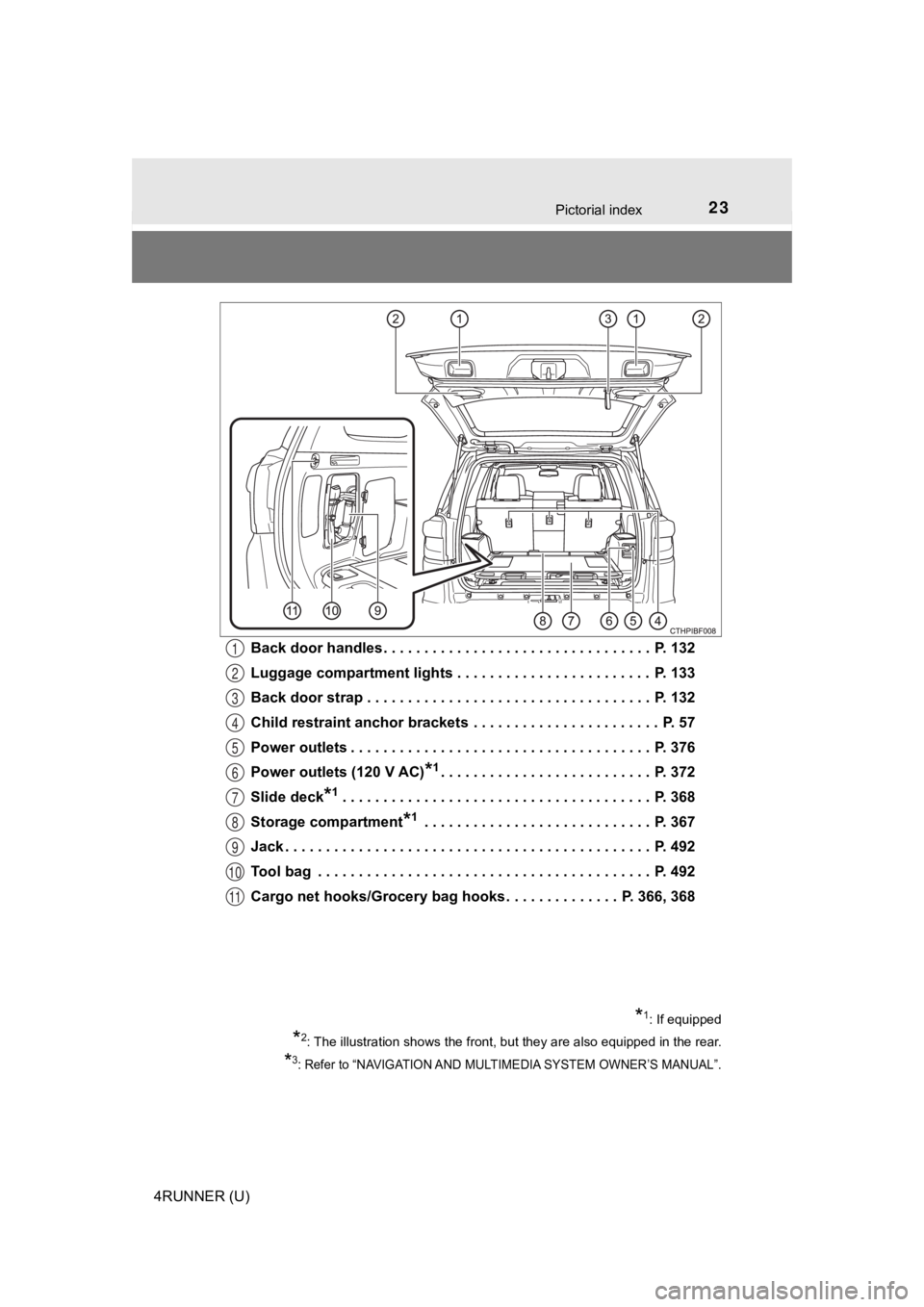
4RUNNER (U)Back door handles. . . . . . . . . . . . . . . . . . . . . . . . . . . . . . . . . P. 132
Luggage compartment lights . . . . . . . . . . . . . . . . . . . . . . . . P. 133
Back door strap . . . . . . . . . . . . . . . . . . . . . . . . . . . . . . . . . . . P. 132
Child restraint anchor brackets . . . . . . . . . . . . . . . . . . . . . . . P. 57
Power outlets . . . . . . . . . . . . . . . . . . . . . . . . . . . . . . . . . . . . . P. 376
Power outlets (120 V AC)
*1. . . . . . . . . . . . . . . . . . . . . . . . . . P. 372
Slide deck
*1 . . . . . . . . . . . . . . . . . . . . . . . . . . . . . . . . . . . . . . P. 368
Storage compartment
*1 . . . . . . . . . . . . . . . . . . . . . . . . . . . . P. 367
Jack . . . . . . . . . . . . . . . . . . . . . . . . . . . . . . . . . . . . . . . . . . . . . P. 492
Tool bag . . . . . . . . . . . . . . . . . . . . . . . . . . . . . . . . . . . . . . . . . P. 492
Cargo net hooks/Grocery bag hooks . . . . . . . . . . . . . . P. 366, 368
*1: If equipped
*2: The illustration shows the front, but they are also equipped in the rear.
*3: Refer to “NAVIGATION AND MULTIMEDIA SYSTEM OWNER’S MANUAL”.
1
2
3
4
5
6
7
8
9
10
11
Page 41 of 596
411-1. For safe use
1
For safety and security
4RUNNER (U)
■If the SRS airbags deploy (inflate)
●Slight abrasions, burns, bruising etc., may be sustained from S RS airbags,
due to the extremely high speed deployment (inflation) by hot g ases.
● A loud noise and white powder will be emitted.
● Parts of the airbag module (steering wheel hub, airbag cover an d inflator) as
well as the front seats, parts of the front and rear pillars, and roof side rails
may be hot for several minutes. The airbag itself may also be h ot.
● The windshield may crack.
● Fuel supply to the engine will be stopped. ( P. 476)
● For Safety Connect subscribers, if any of the following situations occur, the
system is designed to send an emergency call to the response center, noti-
fying them of the vehicle's location (without needing to push t he “SOS” but-
ton) and an agent will attempt to speak with the occupants to a scertain the
level of emergency and assistance required. If the occupants are unable to
communicate, the agent automatically treats the call as an emer gency and
helps to dispatch the necessary emergency services. ( P. 70)
• An SRS airbag is deployed.
• A seat belt pretensioner is activated.
• The vehicle is involved in a severe rear-end collision.
• The vehicle is involved in a rollover accident.
WARNING
■ Modification and disposal of SRS airbag system components
Do not dispose of your vehicle or perform any of the following modifications
without consulting your Toyota dealer. The SRS airbags may malfunction or
deploy (inflate) accidentally, causing death or serious injury.
● Installation, removal, disassembly and repair of the SRS airbag s
● Repairs, modifications, removal or replacement of the steering wheel,
instrument panel, dashboard, seats or seat upholstery, front, s ide and rear
pillars or roof side rails
● Repairs or modifications of the front fender, front bumper, or side of the
occupant compartment
● Installation of a grill guard (bull bars, kangaroo bar etc.), s now plows,
winches or roof luggage carrier.
● Modifications to the vehicle’s suspension system
● Installation of electronic devices such as mobile two-way radio s and CD
players
● Modifications to your vehicle for a person with a physical disa bility
Page 44 of 596
441-1. For safe use
4RUNNER (U)■
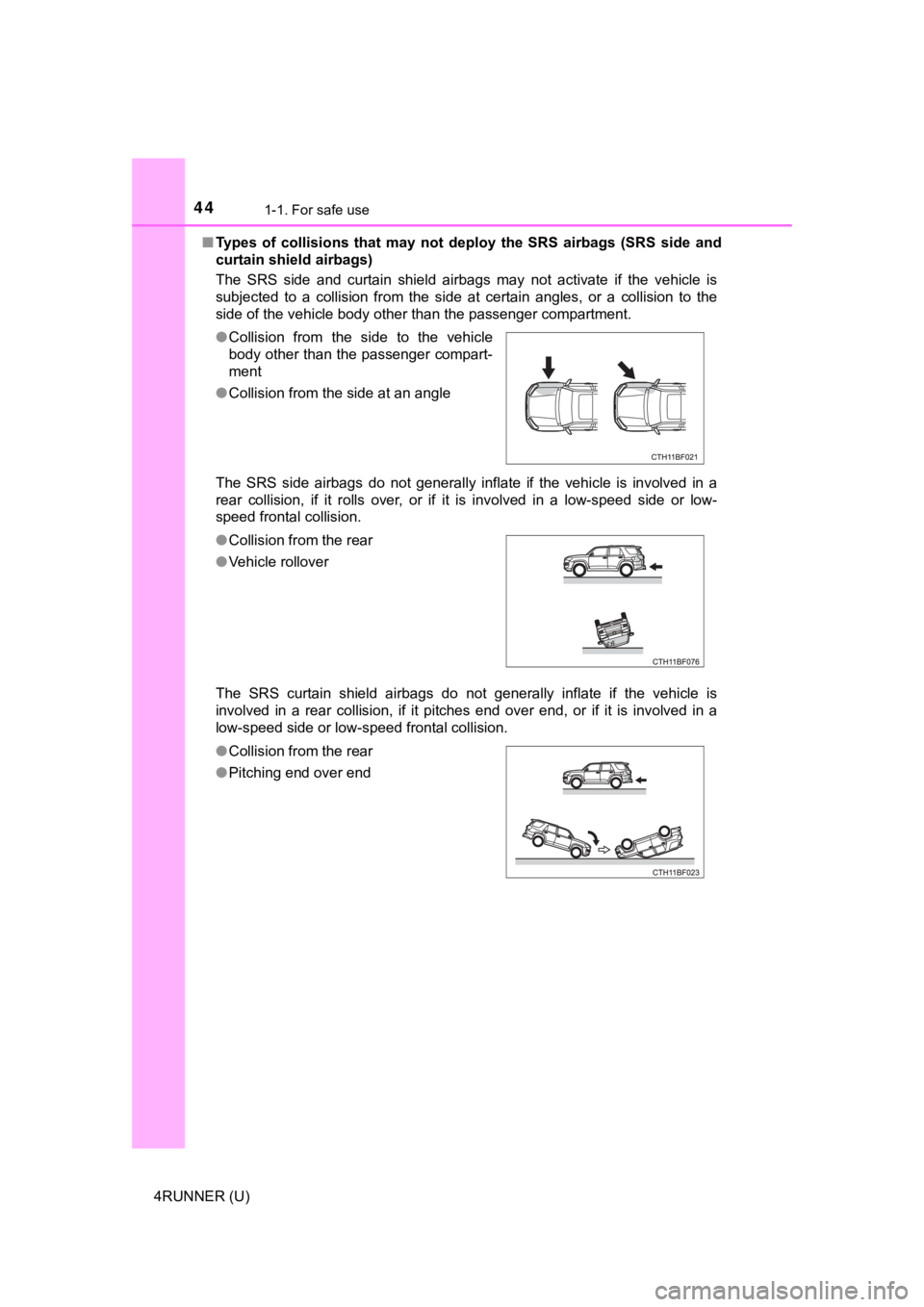
Types of collisions that may not deploy the SRS airbags (SRS si de and
curtain shield airbags)
The SRS side and curtain shield airbags may not activate if the vehicle is
subjected to a collision from the side at certain angles, or a collision to the
side of the vehicle body other than the passenger compartment.
The SRS side airbags do not generally inflate if the vehicle is involved in a
rear collision, if it rolls over, or if it is involved in a low -speed side or low-
speed frontal collision.
The SRS curtain shield airbags do not generally inflate if the vehicle is
involved in a rear collision, if it pitches end over end, or if it is involved in a
low-speed side or low-speed frontal collision. ● Collision from the side to the vehicle
body other than the passenger compart-
ment
● Collision from the side at an angle
● Collision from the rear
● Vehicle rollover
●Collision from the rear
● Pitching end over end
Page 56 of 596
561-1. For safe use
4RUNNER (U)
WARNING
■When children are in the vehicle
Do not allow children to play with the seat belt. If the seat belt becomes
twisted around a child’s neck, it may lead to choking or other serious injuries
that could result in death.
If this occurs and the buckle cannot be unfastened, scissors sh ould be used
to cut the belt.
■ When the child restraint system is not in use
● Keep the child restraint system properly secured on the seat ev en if it is
not in use. Do not store the child restraint system unsecured in the pas-
senger compartment.
● If it is necessary to detach the child restraint system, remove it from the
vehicle or store it securely in the luggage compartment. This will prevent it
from injuring passengers in the event of a sudden stop, sudden swerve or
accident.
Page 118 of 596
118
4RUNNER (U)
3-2. Opening, closing and locking the doors
●Locks and unloc ks the doors (P. 110)
● Starts the engine ( P. 2 1 2 )
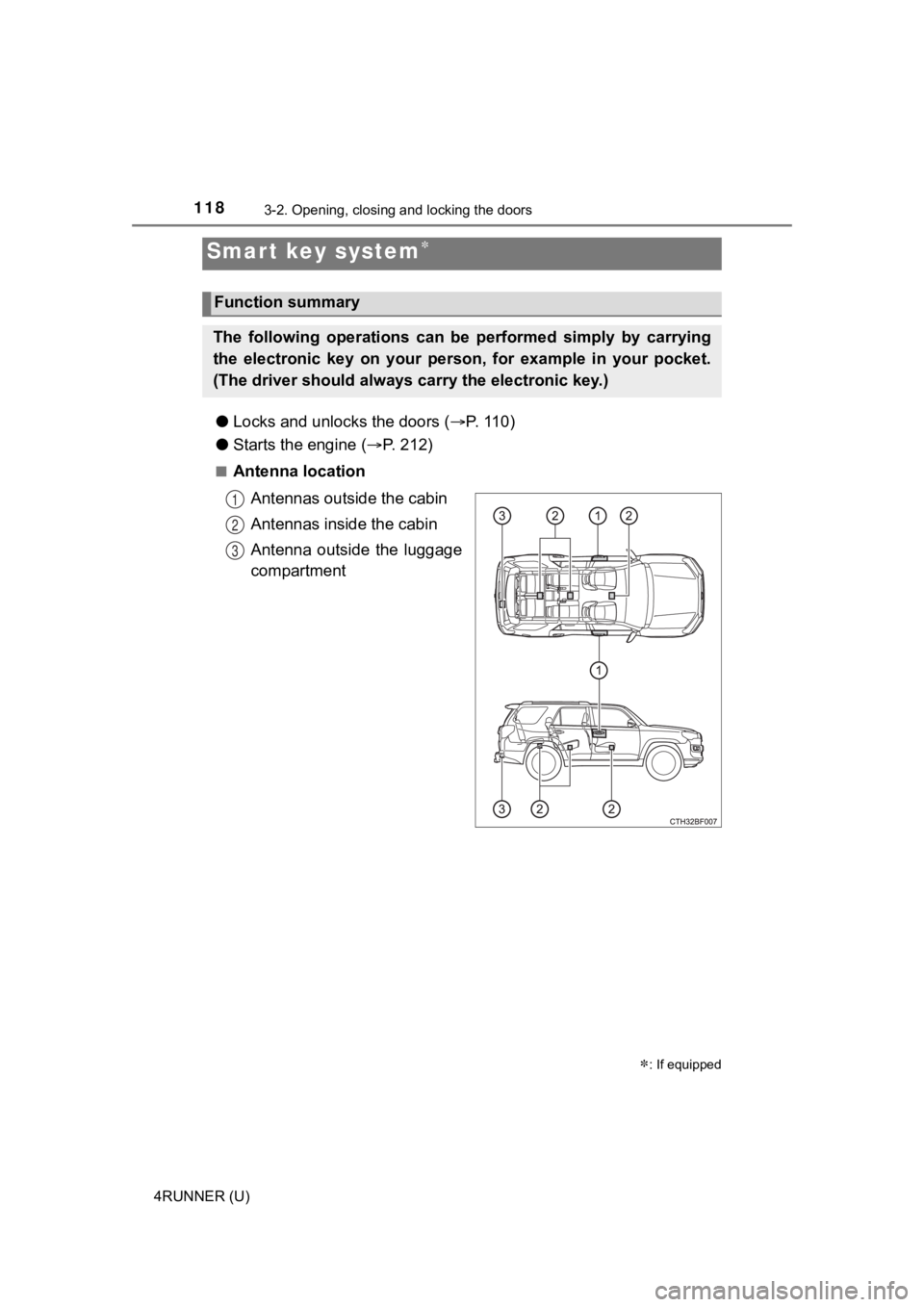
■Antenna location
Antennas outside the cabin
Antennas inside the cabin
Antenna outside the luggage
compartment
Smart key system
: If equipped
Function summary
The following operations can be performed simply by carrying
the electronic key on your person, for example in your pocket.
(The driver should always ca rry the electronic key.)
1
2
3
Page 133 of 596
1333-2. Opening, closing and locking the doors
3
Operation of each component
4RUNNER (U)
■Luggage compartment lights
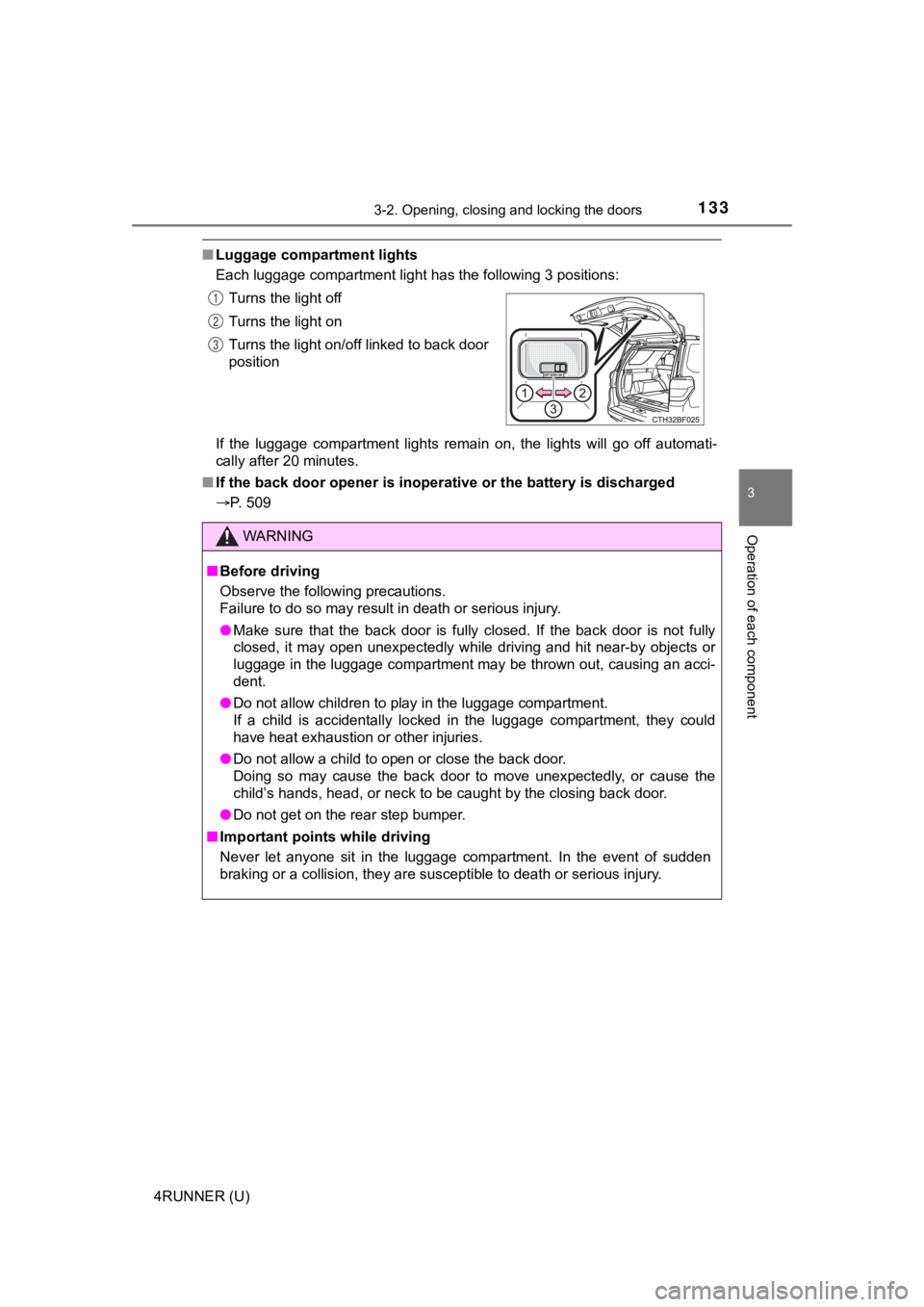
Each luggage compartment light has the following 3 positions:
If the luggage compartment lights remain on, the lights will go off automati-
cally after 20 minutes.
■ If the back door opener is inoperative or the battery is discha rged
P. 509 Turns the light off
Turns the light on
Turns the light on/off linked to back door
position
WARNING
■
Before driving
Observe the following precautions.
Failure to do so may result in death or serious injury.
● Make sure that the back door is fully closed. If the back door is not fully
closed, it may open unexpectedly while driving and hit near-by objects or
luggage in the luggage compartment may be thrown out, causing a n acci-
dent.
● Do not allow children to play in the luggage compartment.
If a child is accidentally locked in the luggage compartment, they could
have heat exhaustion or other injuries.
● Do not allow a child to open or close the back door.
Doing so may cause the back door to move unexpectedly, or cause the
child’s hands, head, or neck to be caught by the closing back d oor.
● Do not get on the rear step bumper.
■ Important points while driving
Never let anyone sit in the luggage compartment. In the event of sudden
braking or a collision, they are susceptible to death or seriou s injury.
1
2
3
Page 148 of 596
1483-3. Adjusting the seats
4RUNNER (U)
WARNING
■When folding the rear seatbacks down
Observe the following precautions. Failure to do so may result in death or
serious injury.
● Do not fold the seatbacks down while driving.
● Stop the vehicle on level ground, set the parking brake and shi ft the shift
lever to P.
● Do not allow anyone to sit on a folded seatback or in the lugga ge compart-
ment while driving.
● Do not allow children to enter the luggage compartment.
■ Seat adjustment
● To reduce the risk of sliding under the lap belt during a colli sion, do not
recline the seat more than necessary.
If the seat is too reclined, the lap belt may slide past the hi ps and apply
restraint forces directly to the abdomen, or your neck may cont act the
shoulder belt, increasing the risk of death or serious injury i n the event of
an accident.
Adjustments should not be made while driving as the seat may un expect-
edly move and cause the driver to lose control of the vehicle.
● Take care when adjusting the seat position to ensure that other passen-
gers are not injured by the moving seat.
● Do not put your hands under the seat or near the moving parts t o avoid
injury.
Fingers or hands may become jammed in the seat mechanism.
■ After returning the rear seat back to the upright position
Observe the following precautions. Failure to do so may result in death or
serious injury.
● Make sure the seatback is securely locked by pushing it forward and rear-
ward on the top.
● Check that the seat belts are not twisted or caught in the seat back.
NOTICE
■Stowing the seat belts
The seat belts and the buckles must be stowed before you fold d own the
rear seatbacks.
Page 186 of 596
1864-1. Before driving
4RUNNER (U)
Cargo and luggage
Take notice of the following information about storage precau-
tions, cargo capacity and load:● Stow cargo and luggage in the luggage compartment whenever
possible.
● Be sure all items are secured in place.
● To maintain vehicle balance while driving, position luggage evenly
within the luggage compartment.
● For better fuel economy, do no t carry unnecessary weight.