engine TOYOTA 4RUNNER 2023 Owners Manual
[x] Cancel search | Manufacturer: TOYOTA, Model Year: 2023, Model line: 4RUNNER, Model: TOYOTA 4RUNNER 2023Pages: 608, PDF Size: 11.8 MB
Page 436 of 608

4366-3. Do-it-yourself maintenance
4RUNNER (U)■
The initialization operation
●Make sure to carry out initializ
ation after adjusting the tire inflation pres-
sure.
Also, make sure the tires are co ld before carrying out initialization or tire
inflation pressure adjustment.
●If you have accidentally turned the engine switch off during in itialization,
it is not necessary to press the reset swit ch again as initialization will
restart automatically when the engine switch has been turned to IGNI-
TION ON mode for the next time.
●If you accidentally press the reset switch when initialization is not neces-
sary, adjust the tire inflation pressure to the specified level when the
tires are cold, and cond uct initialization again.
●While the position of each tire is being determined and the inf lation pres-
sures are not being displayed on the multi-information display, if the
inflation pressure of a tire drops, the tire pressure warning l ight will come
on.
■When initialization of the tire pressure warning system has fai led
●Do not move the vehicle backward during initialization. Initialization is
started again from the beginning and it may take longer than usual.
●Initialization may take longer to complete if the vehicle is driven on an
unpaved road.
When performing initialization, drive on a paved road if possib le.
Depending on the driving environment and condition of the tires , initial-
ization will be complet ed in approximately 10 to 30 minutes.
• If initialization is not complet e after driving approximately 30 minutes,
continue driving for a while.
• If initialization is not complet e after driving approximately 1 hour, park
the vehicle in a safe place for approximately 20 minutes. Then drive
straight (with occasional left a nd right turns) at approximatel y 25 mph
(40 km/h) or more
* for approximately 10 to 30 minutes.
• If initialization is still not co mplete, have the vehicle inspected by your
Toyota dealer.
*: Except when making a left/right turn
●In the following situations, the tire inflation pressure will n ot be recorded
and the system will not operate p roperly. Perform initialization again.
• When operating the tire pressure warning reset switch, the tir e pres-
sure warning light does not blink 3 times.
• After performing initialization, the tire pressure warning light blinks for
1 minute then stays on after driving for about 20 minutes.
Page 437 of 608

4376-3. Do-it-yourself maintenance
6
Maintenance and care
4RUNNER (U)■
When ID code registration has failed
●Registration may take long time or the ID codes may not be regi
stered in
the following situations.
• When the vehicle is moved backward during registration.
Registration is started again from the beginning and it may tak e lon-
ger than usual.
• When another vehicle is running the side of the vehicle such a s in
heavy traffic.
It may take longer to detect the vehicle’ tire pressure warning valves
and transmitters.
• If tire pressure warning valves and transmitters are in the vehicle.
The ID codes may n ot be registered.
●When performing registration, drive on a paved road if possible .
Depending on the driving environment and condition of the tires, regis-
tration will be complet ed in approximately 10 to 30 minutes.
• If registration is not complete after driving approximately 30 minutes,
continue driving for a while.
• If registration is not complete after driving approximately 1 hour, park
the vehicle in a safe place for approximately 20 minutes. Then drive
straight (with occasional left and right turns) at approximatel y 40 km/h
(25 mph) or more
* for approximately 10 to 30 minutes.
If registration is still not comp lete, have the vehicle inspected by your
Toyota dealer.
*: Except when making a left/right turn
●When the tire pressure warning light does not blink slowly 3 ti mes, the
ID code will not be registered and the system will not operate properly.
Perform registration again.
■When registering ID codes
●Initialize the tire pressure war ning system after ID code regis tration. Ini-
tialization is disable d if the system was initialized before re gistration.
●After ID code registration, the tires are hot by driving. Initi alize the tire
pressure warning system af ter the tires become cold.
■Canceling the change wheel set mode
●If turning the engine switch off when in the change wheel set m ode
before driving, the change wheel set mode is canceled.
●After driving when in the change wheel set mode, the change whe el set
mode cannot be canceled. To cancel the mode, perform the proced ure
for ID code registration again and turn the engine switch off before driv-
ing.
●If the change wheel set mode is canceled, the ID codes that hav e
already been registered are commu nicated. When communication is fin-
ished, the tir e pressure warning light will turn off.
Page 445 of 608
4456-3. Do-it-yourself maintenance
6
Maintenance and care
4RUNNER (U)
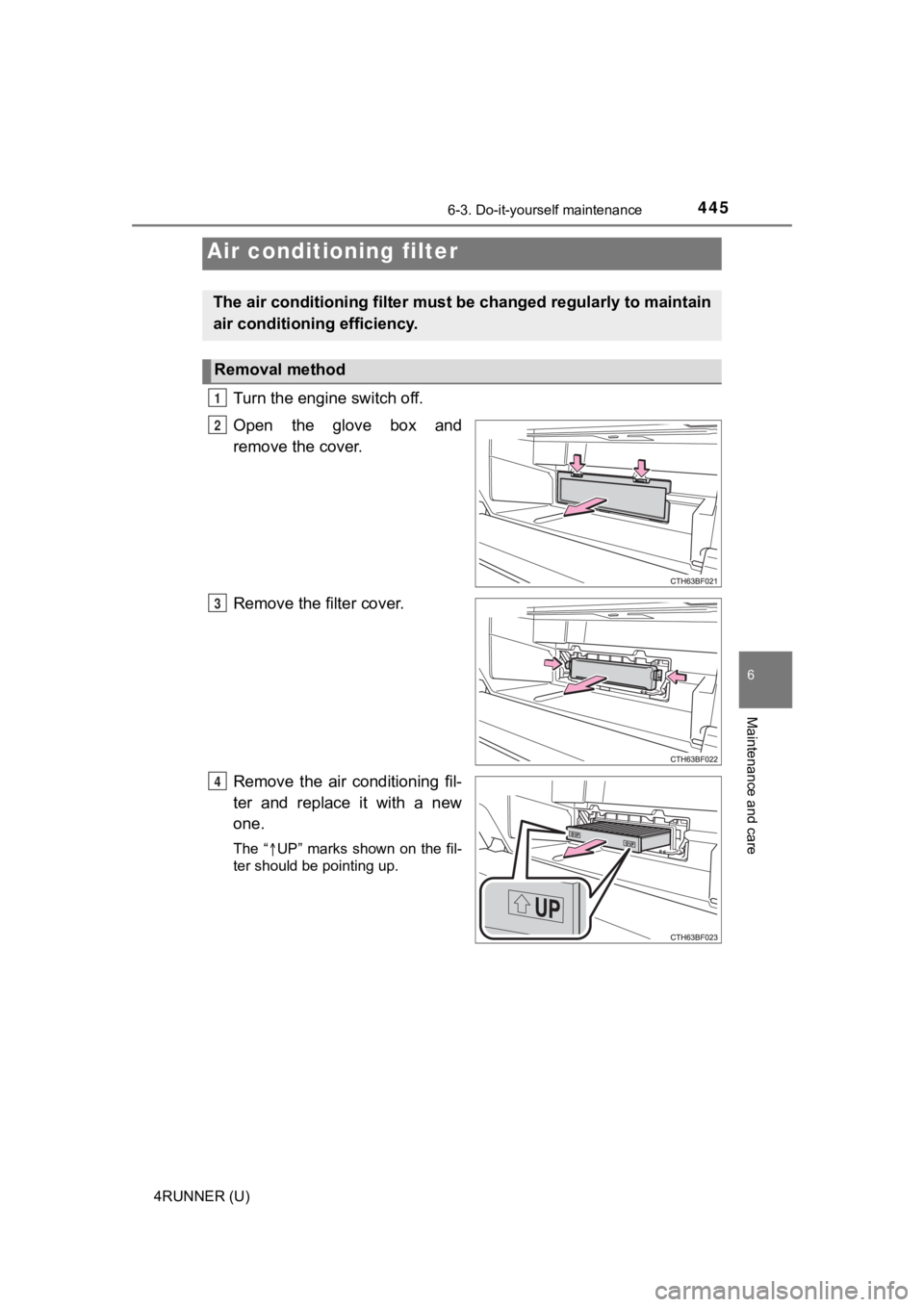
Turn the engine switch off.
Open the glove box and
remove the cover.
Remove the filter cover.
Remove the air conditioning fil-
ter and replace it with a new
one.
The “UP” marks shown on the fil-
ter should be pointing up.
Air conditioning filter
The air conditioning filter must b e changed regularly to maintain
air conditioning efficiency.
Removal method
1
2
3
4
Page 450 of 608
4506-3. Do-it-yourself maintenance
4RUNNER (U)
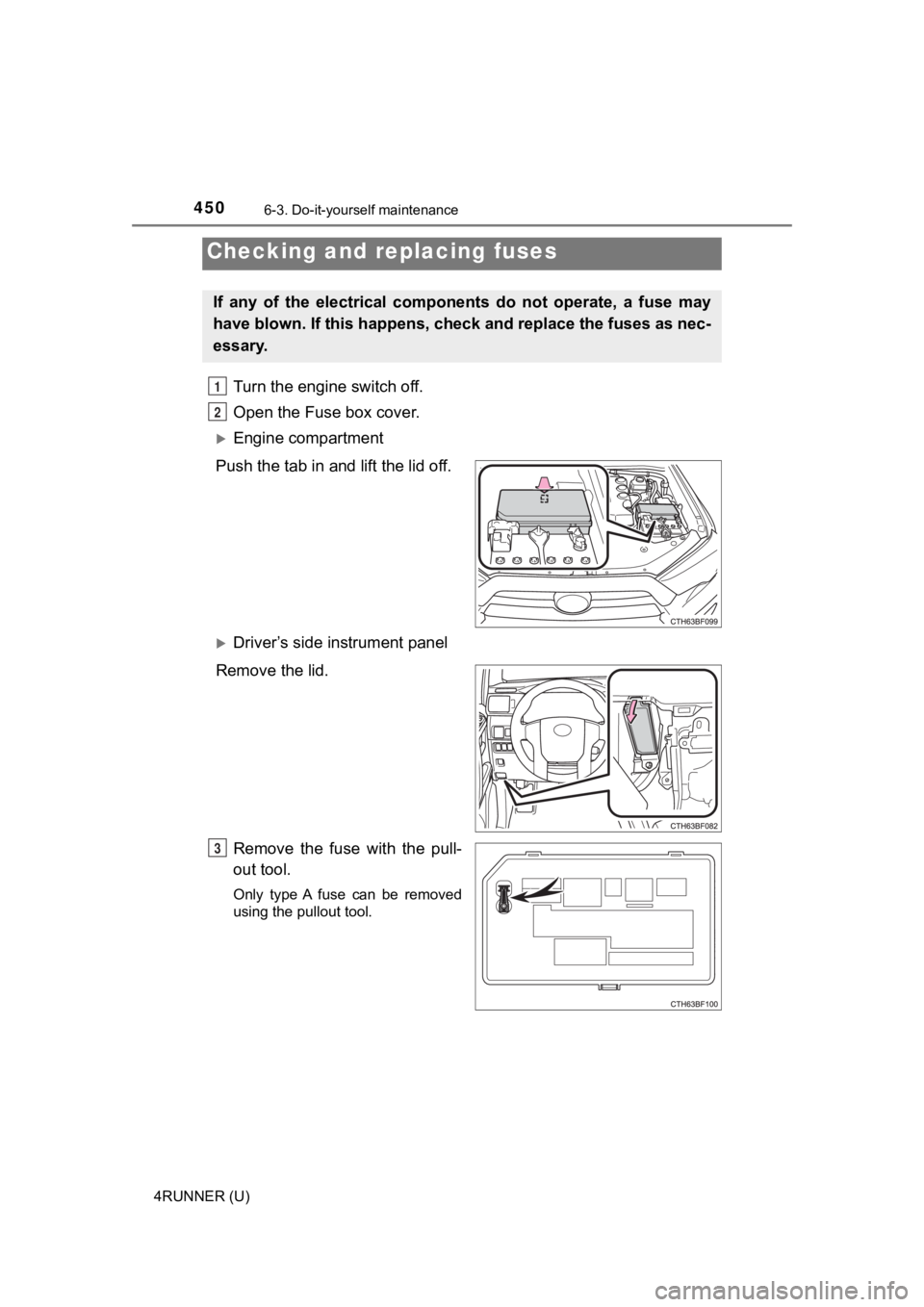
Turn the engine switch off.
Open the Fuse box cover.
Engine compartment
Push the tab in and lift the lid off.
Driver’s side instrument panel
Remove the lid.
Remove the fuse with the pull-
out tool.
Only type A fuse can be removed
using the pullout tool.
Checking and replacing fuses
If any of the electrical components do not operate, a fuse may
have blown. If this happens, che ck and replace the fuses as nec-
essary.
1
2
3
Page 465 of 608

465
When trouble arises7
4RUNNER (U)7-1. Essential information
Emergency flashers .......... 466
If your vehicle has to be stopped in
an emergency ................. 467
If the vehicle is submerged or water
on the road is rising ........ 468
7-2. Steps to take in an emergency
If your vehicle needs to be towed ..................... 469
If you think something is wrong .......................... 475
Fuel pump shut off system ............................ 476
If a warning light turns on or a warning
buzzer sounds ................ 477
If a warning message is displayed ..................... 488
If you have a flat tire.......... 493
If the engine will not start ................................. 509
If you cannot operate back door opener ............ 511
If the electronic key does not operate
properly ........................... 512
If the vehicle battery is discharged ................... 515
If your vehicle overheats ........................ 519
If the vehicle becomes stuck ............................... 522
Page 467 of 608
4677-1. Essential information
7
When trouble arises
4RUNNER (U)
Steadily step on the brake pedal with both feet and firmly depress it.
Do not pump the brake pedal repeatedly as this will increase th e effort
required to slow the vehicle.
Shift the shift lever to N.
If the shift lever is shifted to N
After slowing down, stop the vehi cle in a safe place by the road.
Stop the engine.
If the shift lever cann ot be shifted to N
Keep depressing the brake pedal with both feet to reduce vehicl e
speed as much as possible.
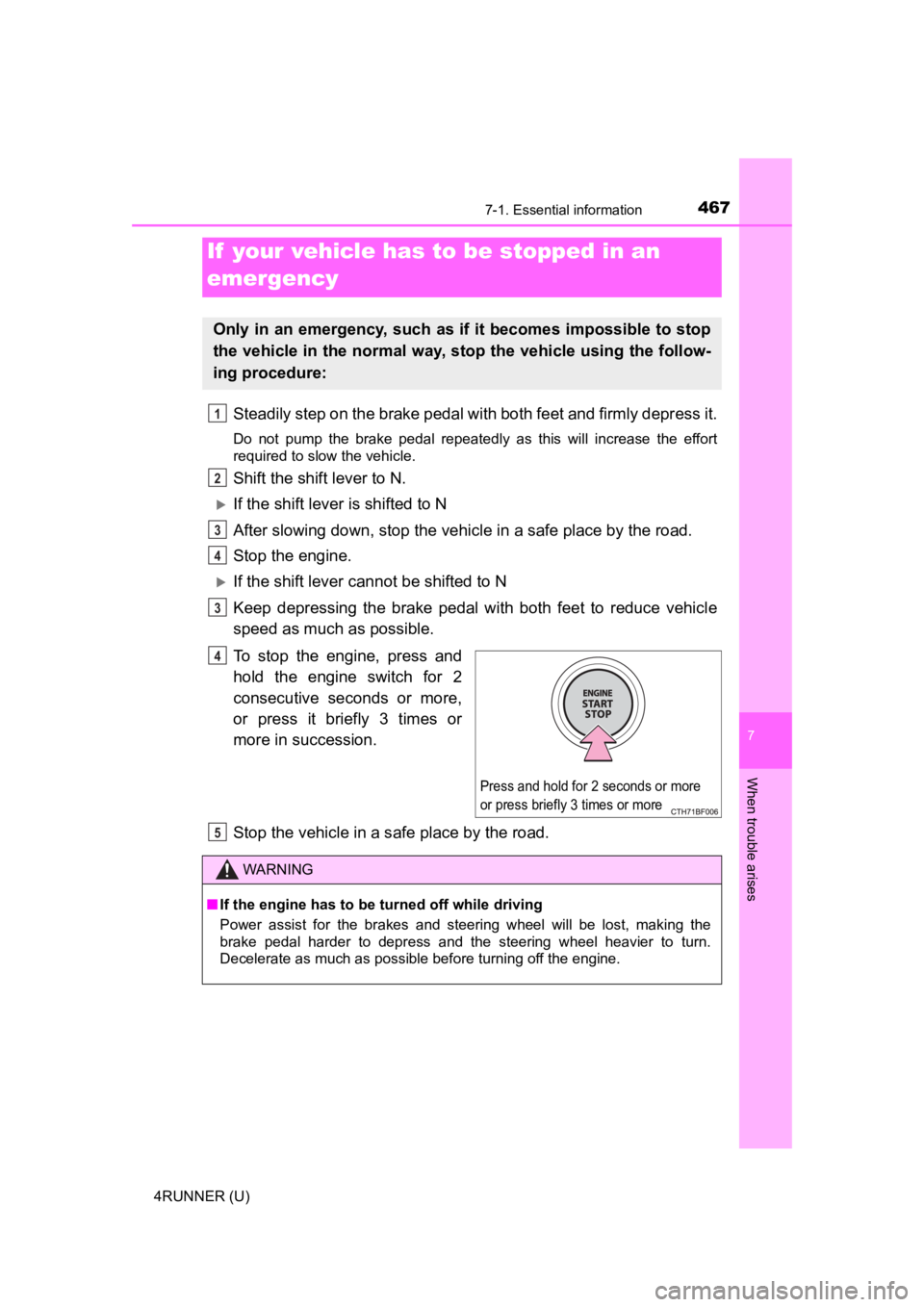
To stop the engine, press and
hold the engine switch for 2
consecutive seconds or more,
or press it briefly 3 times or
more in succession.
Stop the vehicle in a s afe place by the road.
If your vehicle has to be stopped in an
emergency
Only in an emergency, such as if it becomes impossible to stop
the vehicle in the normal way, st op the vehicle using the follow-
ing procedure:
1
2
3
4
3
Press and hold for 2 seconds or more
or press briefly 3 times or more
4
WARNING
■ If the engine has to be turned off while driving
Power assist for the brakes and steering wheel will be lost, making the
brake pedal harder to depress and the steering wheel heavier to turn.
Decelerate as much as possible before turning off the engine.
5
Page 468 of 608
4687-1. Essential information
4RUNNER (U)
●If the door can be opened, open the door and exit the vehicle.
● If the door can not be opened, open the window using the power
window switch and ens ure an escape route.
● If the window can be opened, exit the vehicle through the windo w.
● If the door and window cannot be opened due to the rising water ,
remain calm, wait until the water level inside the vehicle rises to the
point that the water pressure inside of the vehicle equals the water
pressure outside of the vehicle and then open the door after wa iting
for the rising water to enter the vehicle, and exit the vehicle . When
the outside water level exc eeds half the height of the door, the door
cannot be opened from the inside due to water pressure.
■ Water level exceeds the floor
When the water level exceeds the floor and time has passed, the electrical
equipment will get damaged, the power windows will not operate, the engine
stop, and the vehicle may not be able to get moving.
■ Using an emergency escape hammer
*
Laminated glass is used in the windshield on this vehicle. Laminated glass
cannot be shattered with an emergency hammer
*.
Tempered glass is used in the windows on this vehicle.
*: Contact your Toyota dealer or aftermarket accessory manufacturer for fur-
ther information about an emergency hammer.
If the vehicle is submerged or water on the
road is rising
This vehicle is not designed to be able to drive on roads that are
deeply flooded with water. Do not drive on roads where the
roads may be submerged or the water may be rising. It is dan-
gerous to remain in the vehicle, if it anticipated that the veh icle
will be flooded or set a drift. Re main calm and follow the follow-
ing.
WARNING
■ Caution while driving
Do not drive on roads where the roads may be submerged or the w ater may
be rising. Otherwise the vehicle may be damaged and cannot move, as well
as become flooded and set a drift, which may lead to death.
Page 470 of 608
4707-2. Steps to take in an emergency
4RUNNER (U)
NOTICE
■To prevent damage to the vehicle when towing using a wheel-lift type
truck
● Do not tow the vehicle from the rear when the engine switch is off.
● When raising the vehicle, ensure adequate ground clearance for towing at
the opposite end of the raised vehicle. Without adequate clearance, the
vehicle could be damaged while being towed.
■ To prevent damage to the vehicle when towing with a sling-type truck
Do not tow with a sling-type truck, either from the front or re a r.
■ To prevent damage to the vehicle during emergency towing
Do not secure cables or chains to the suspension components.
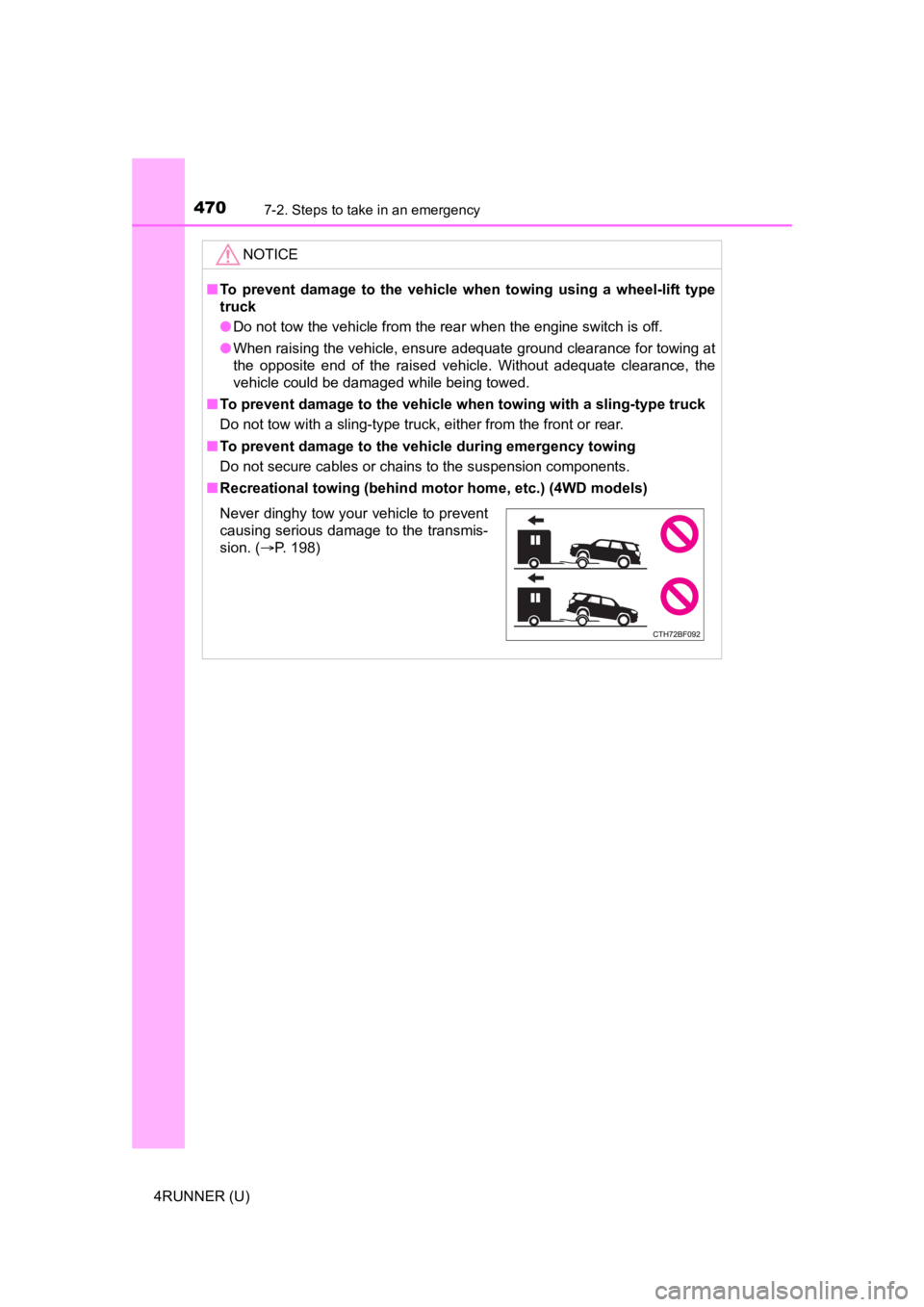
■ Recreational towing (behind motor home, etc.) (4WD models)
Never dinghy tow your vehicle to prevent
causing serious damage to the transmis-
sion. ( P. 198)
Page 471 of 608
4717-2. Steps to take in an emergency
7
When trouble arises
4RUNNER (U)
The following may indicate a problem with your transmission. Contact
your Toyota dealer or commercial towing service before towing.
● The engine is running but t he vehicle does not move.
● The vehicle makes an abnormal sound.
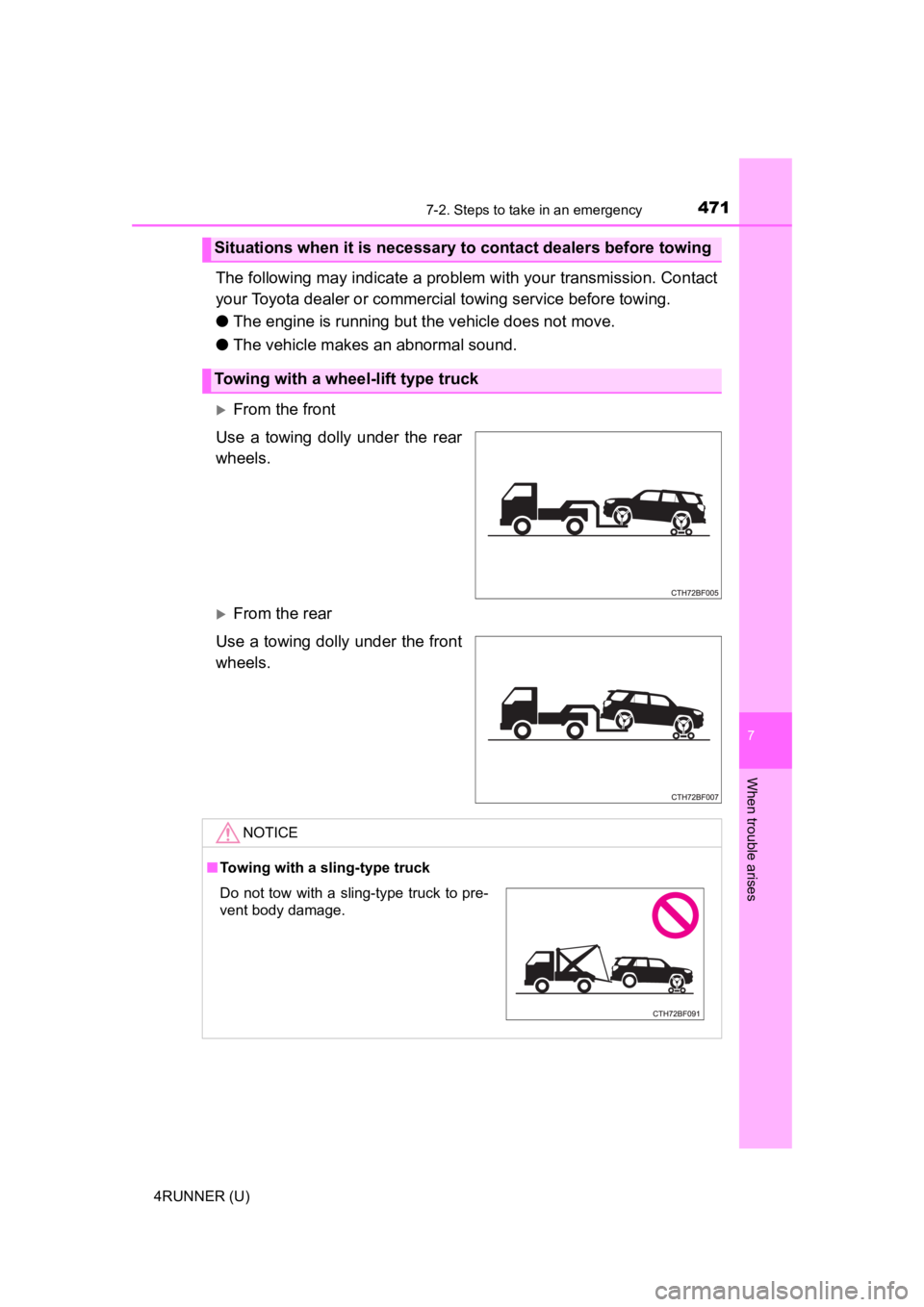
From the front
Use a towing dolly under the rear
wheels.
From the rear
Use a towing dolly under the front
wheels.
Situations when it is necessary to contact dealers before towing
Towing with a wheel-lift type truck
NOTICE
■ Towing with a sling-type truck
Do not tow with a sling-type truck to pre-
vent body damage.
Page 472 of 608

4727-2. Steps to take in an emergency
4RUNNER (U)
When using a flat-bed truck to transport the vehicle, use tire strapping
belts. Refer to the owner's manual of the flat-bed truck for th e tire
strapping method.
In order to suppress vehicle movement during transportation, se t the
parking brake and turn the engine switch off.
If a tow truck is not available in an emergency, your vehicle m ay be
temporarily towed using cables or chains secured to the emergen cy
towing hooks. This should only be attempted on hard surfaced roads
for at most 50 miles (80 km) at under 18 mph (30 km/h).
A driver must be in the vehicle to steer and operate the brakes . The
vehicle’s wheels, drive train, a xles, steering and brakes must be in
good condition.
Using a flatbed truck
Emergency towing