suspension TOYOTA 4RUNNER 2023 User Guide
[x] Cancel search | Manufacturer: TOYOTA, Model Year: 2023, Model line: 4RUNNER, Model: TOYOTA 4RUNNER 2023Pages: 608, PDF Size: 11.8 MB
Page 470 of 608
4707-2. Steps to take in an emergency
4RUNNER (U)
NOTICE
■To prevent damage to the vehicle when towing using a wheel-lift type
truck
● Do not tow the vehicle from the rear when the engine switch is off.
● When raising the vehicle, ensure adequate ground clearance for towing at
the opposite end of the raised vehicle. Without adequate clearance, the
vehicle could be damaged while being towed.
■ To prevent damage to the vehicle when towing with a sling-type truck
Do not tow with a sling-type truck, either from the front or re a r.
■ To prevent damage to the vehicle during emergency towing
Do not secure cables or chains to the suspension components.
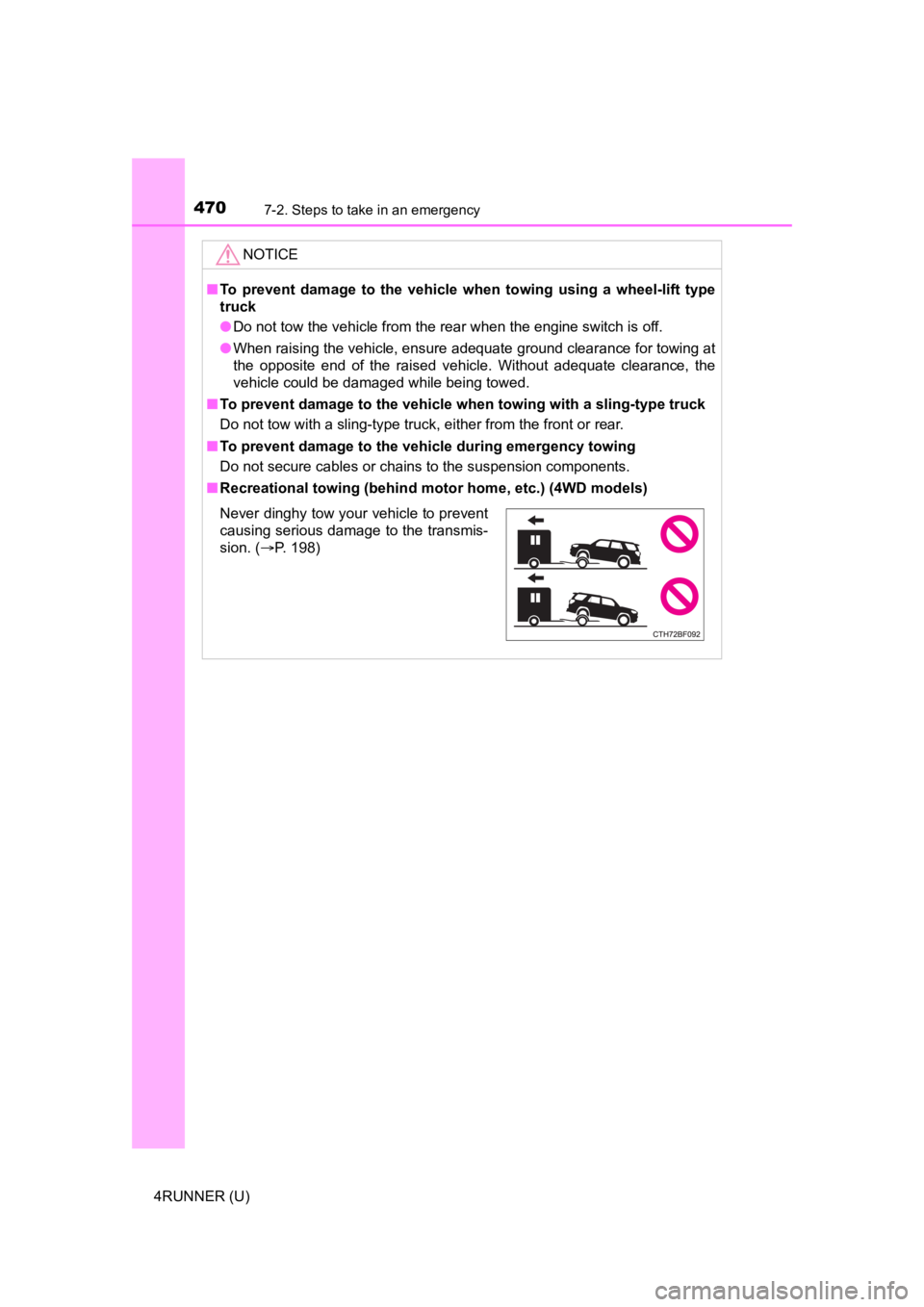
■ Recreational towing (behind motor home, etc.) (4WD models)
Never dinghy tow your vehicle to prevent
causing serious damage to the transmis-
sion. ( P. 198)
Page 475 of 608
4757-2. Steps to take in an emergency
7
When trouble arises
4RUNNER (U)
●Fluid leaks un der the vehicle.
(Water dripping from the air conditioning a fter use is normal.)
● Flat-looking tires or uneven tire wear
● Engine coolant temperature gauge needle continually points high er
than normal.
● Changes in exhaust sound
● Excessive tire squeal when cornering
● Strange noises related to the suspension system
● Pinging or other noises related to the engine
● Engine missing, stumb ling or running roughly
● Appreciable loss of power
● Vehicle pulls heavily to one side when braking
● Vehicle pulls heavily to one s ide when driving on a level road
● Loss of brake effectiveness, spongy feeling, pedal almost touch es
the floor
If you think something is wrong
If you notice any of the followi ng symptoms, your vehicle proba -
bly needs adjustment or repair. Contact your Toyota dealer as
soon as possible.
Visible symptoms
Audible symptoms
Operational symptoms
Page 507 of 608
5077-2. Steps to take in an emergency
7
When trouble arises
4RUNNER (U)
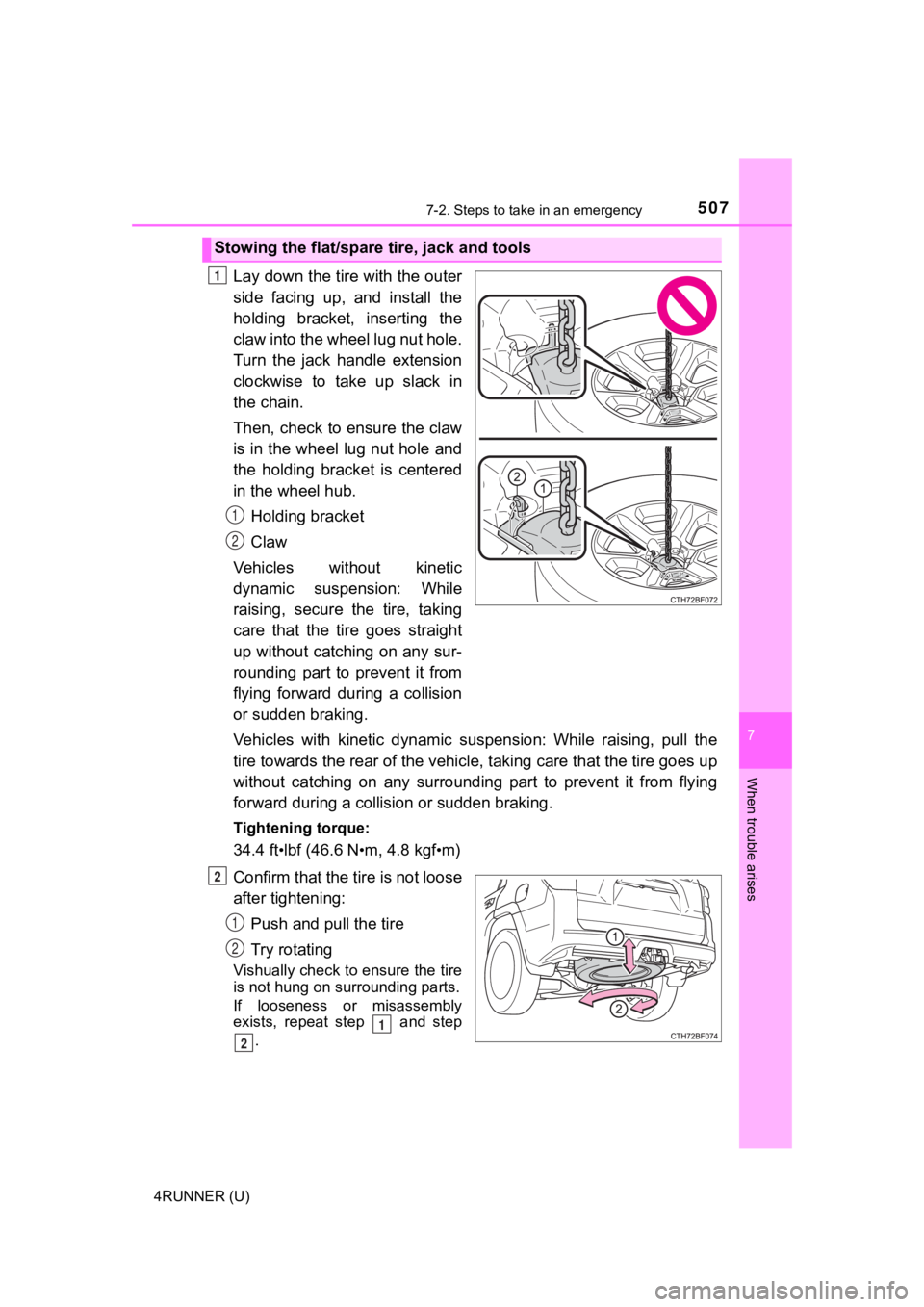
Lay down the tire with the outer
side facing up, and install the
holding bracket, inserting the
claw into the wheel lug nut hole.
Turn the jack handle extension
clockwise to take up slack in
the chain.
Then, check to ensure the claw
is in the wheel lug nut hole and
the holding bracket is centered
in the wheel hub.
Holding bracket
Claw
Vehicles wit hout kinetic
dynamic suspension: While
raising, secure the tire, taking
care that the tire goes straight
up without catching on any sur-
rounding part to prevent it from
flying forward during a collision
or sudden braking.
Vehicles with kinetic dynamic su spension: While raising, pull the
tire towards the rear of the vehi cle, taking care that the tire goes up
without catching on any surrounding part to prevent it from fly ing
forward during a collis ion or sudden braking.
Tightening torque:
34.4 ft•lbf (46.6 N•m, 4.8 kgf•m)
Confirm that the tire is not loose
after tightening: Push and pull the tire
Try rotating
Vishually check to ensure the tire
is not hung on su rrounding parts.
If looseness or misassembly
exists, repeat step and step .
Stowing the flat/spare tire, jack and tools
1
1
2
2
1
2
1
2
Page 576 of 608

576
4RUNNER (U)
WARNING
■Précautions avec le coussin gonflable SRS
● Ne placez rien sur le siège du passager avant, comme un coussin par
exemple. Cela a pour conséquence de répartir le poids du passag er sur
toute la surface du siège, ce qui empêche le capteur de détecte r correcte-
ment le poids du passager. En conséquence, les coussins gonflables fron-
taux SRS du passager avant risquent de ne pas se déployer en cas de
collision.
■ Modification et mise au rebut des éléments du système de coussi ns
gonflables SRS
Consultez impérativement votre concessionnaire Toyota si vous a vez
besoin d’intervenir sur votre véhicule ou de procéder à l’une des modifica-
tions suivantes. Les coussins gonflables SRS peuvent être défai llants ou se
déployer (se gonfler) accidentellement, provoquant la mort ou d e graves
blessures.
● Installation, dépose, démontage et réparation des coussins gonf lables
SRS
● Réparations, modifications, démontage ou remplacement du volant, du
tableau de bord, de la planche de bord, des sièges ou de leur garniture,
des montants avant, latéraux et arrière ou des rails latéraux d e toit
● Réparations ou modifications des ailes avant, du pare-chocs ava nt ou des
flancs de l’habitacle
● Installation d’un protège-calandre (pare-buffle, pare-kangourou , etc.), de
chasse-neiges, de treuils ou d’une galerie de pavillon
● Modifications du système de suspension du véhicule
● Installation d’appareils électroniques, tels qu’une radio émetteur/récepteur
ou un lecteur CD
● Aménagements du véhicule visant à permettre sa conduite par une per-
sonne atteinte d’un handicap physique