service TOYOTA 4RUNNER 2023 Owner's Manual
[x] Cancel search | Manufacturer: TOYOTA, Model Year: 2023, Model line: 4RUNNER, Model: TOYOTA 4RUNNER 2023Pages: 608, PDF Size: 11.8 MB
Page 469 of 608
469
7
When trouble arises
4RUNNER (U)
7-2. Steps to take in an emergency
If your vehicle needs to be towed
If towing is necessary, we recommend having your vehicle
towed by your Toyota dealer or commercial towing service,
using a wheel-lift type t ruck or flatbed truck.
Use a safety chain system for all towing, and abide by all stat e/
provincial and local laws.
WARNING
Observe the following precautions.
Failure to do so may result in death or serious injury.
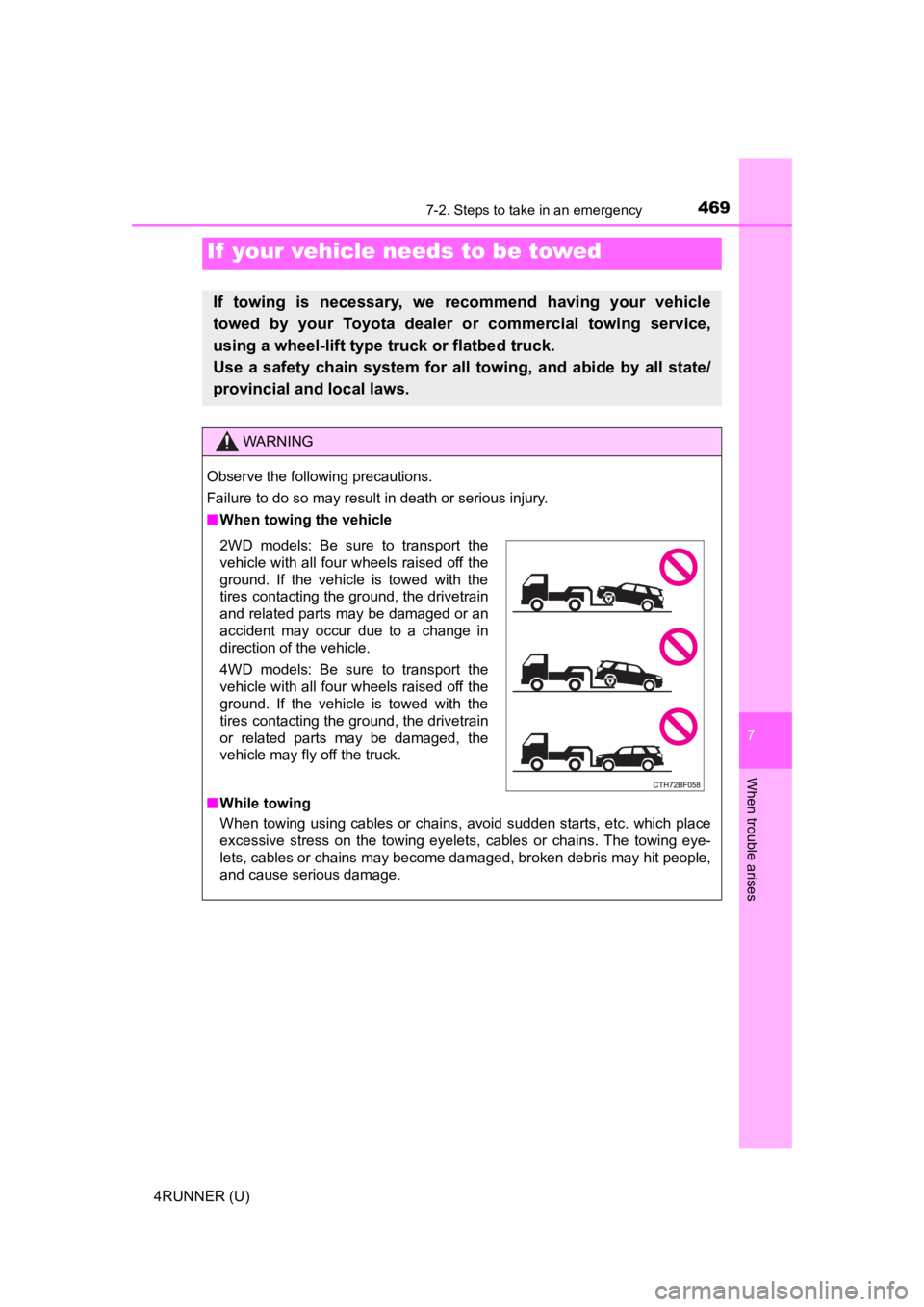
■ When towing the vehicle
■ While towing
When towing using cables or chains, avoid sudden starts, etc. w hich place
excessive stress on the towing eyelets, cables or chains. The towing eye-
lets, cables or chains may become damaged, broken debris may hit people,
and cause serious damage.
2WD models: Be sure to transport the
vehicle with all four wheels raised off the
ground. If the vehicle is towed with the
tires contacting the ground, the drivetrain
and related parts may be damaged or an
accident may occur due to a change in
direction of the vehicle.
4WD models: Be sure to transport the
vehicle with all four wheels raised off the
ground. If the vehicle is towed with the
tires contacting the ground, the drivetrain
or related parts may be damaged, the
vehicle may fly off the truck.
Page 471 of 608
4717-2. Steps to take in an emergency
7
When trouble arises
4RUNNER (U)
The following may indicate a problem with your transmission. Contact
your Toyota dealer or commercial towing service before towing.
● The engine is running but t he vehicle does not move.
● The vehicle makes an abnormal sound.
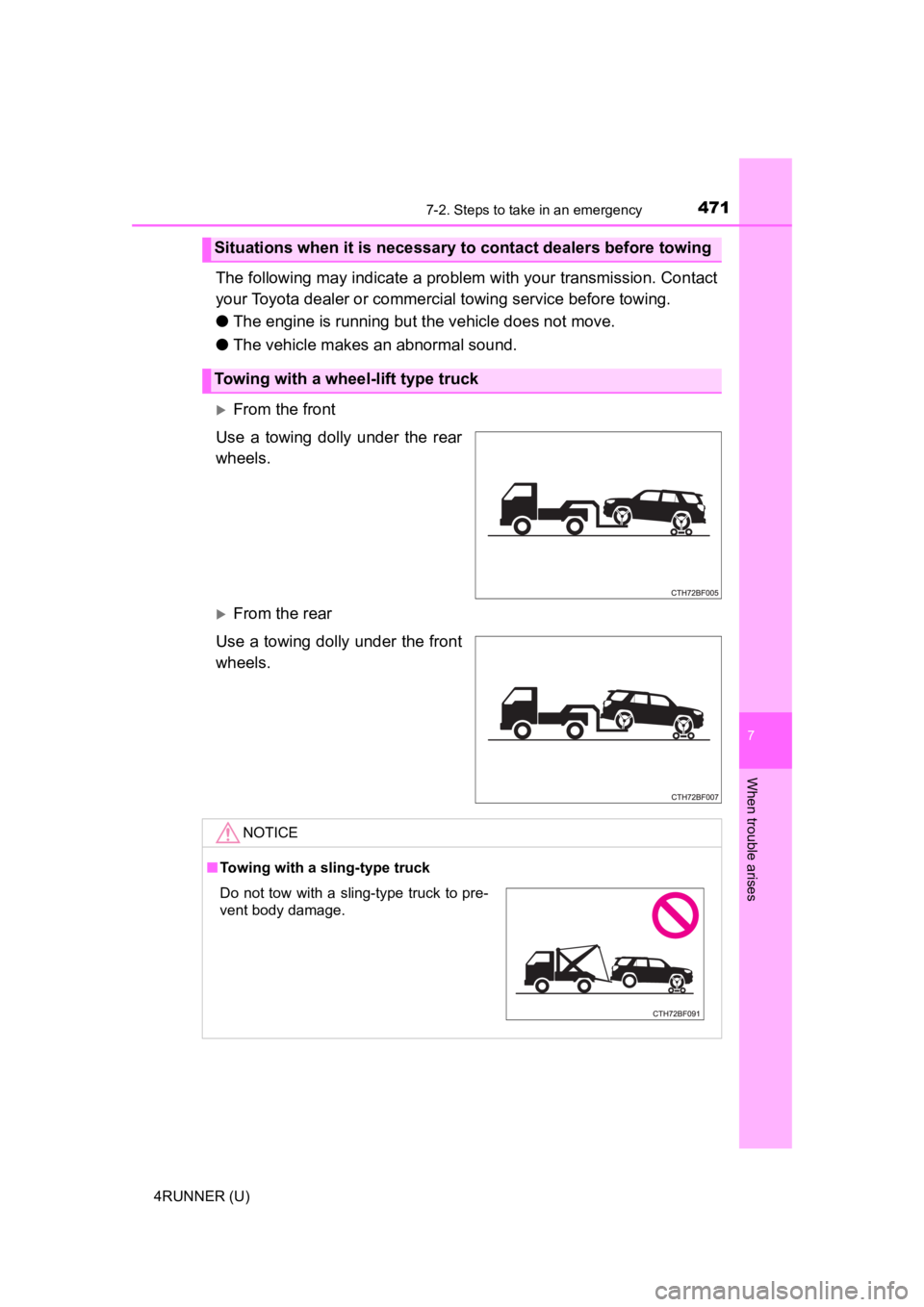
From the front
Use a towing dolly under the rear
wheels.
From the rear
Use a towing dolly under the front
wheels.
Situations when it is necessary to contact dealers before towing
Towing with a wheel-lift type truck
NOTICE
■ Towing with a sling-type truck
Do not tow with a sling-type truck to pre-
vent body damage.
Page 508 of 608
5087-2. Steps to take in an emergency
4RUNNER (U)
Repeat step any time the tire is lowered or disturbed.
Stow the tools and jack securely.
■After completing the tire change
The tire pressure warni ng system must be reset. ( P. 430)
■When using the spare tire (veh icles without P245/60R20 tires)
As the spare tire is not equipped with a tire pressure warning valve and
transmitter, low inflation pressure of the spare tire will not be indicated by
the tire pressure warning system. Also, if you replace the spar e tire after
the tire pressure wa rning light comes on, the light remains on.
NOTICE
■Do not drive the vehicle with a flat tire
Do not continue driving with a flat tire.
Driving even a short distance wit h a flat tire can damage the tire and the
wheel beyond repair.
■When stowing the flat tire
Ensure that there is no object c aught between the tire and the vehicle
underbody.
■When replacing the tires
●When removing or fitting the wheels, tires or the tire pressure warning
valve and transmitter, contact your Toyota dealer as the tire p ressure
warning valve and transmitter may be damaged if not handled cor -
rectly.
●Replace the grommets for the tire pressure warning valves and trans-
mitters as well.
■To avoid damage to the tire pressure warning valves and transmi t-
ters
When a tire is repaired with liquid sealants, the tire pressure warning valve and transmitter may not operate properly. If a liquid sea lant is
used, contact your Toyota dealer or other qualified service shop as soon
as possible. Make sure to replace the tire pressure warning valve and
transmitter when replacing the tire. ( P. 430)
32
4
Page 536 of 608
5368-1. Specifications
4RUNNER (U)■
Non-recommendation of the use of gasoline containing MMT
Some gasoline contains an octane enhancing additive called MMT (Methylcy-
clopentadienyl Manganese Tricarbonyl).
Toyota does not recommend the use of gasoline that contains MMT . If fuel
containing MMT is used, your emission control system may be adversely
affected.
The malfunction indicator lamp on the instrument cluster may come on. If this
happens, contact your Toyota dealer for service.
■ If your engine knocks
●Consult your Toyota dealer.
● You may occasionally notice light knocking for a short time while accelerat-
ing or driving uphill. This is normal and there is no need for concern.
NOTICE
■Notice on fuel quality
● Do not use improper fuels. If improper fuels are used, the engi ne will be
damaged.
● Do not use leaded gasoline.
Leaded gasoline can cause damage to your vehicle’s three-way ca talytic
converters causing the emission control system to malfunction.
● Do not use gasohol other than the type previously stated.
Other gasohol may cause fuel system damage or vehicle performance
problems.
● Using unleaded gasoline with an octane number or rating lower than the
level previously stated will cause persistent heavy knocking.
At worst, this will lead to engine damage.
■ Fuel-related poor driveability
If poor driveability (poor hot starting, vaporization, engine k nocking, etc.) is
encountered after using a different type of fuel, discontinue the use of that
type of fuel.
■ When refueling with gasohol
Take care not to spill gasohol. It can damage your vehicle’s paint.
Page 541 of 608

5418-1. Specifications
8
Vehicle specifications
4RUNNER (U)
This information has been prepared in accordance with regulations
issued by the National Highway Tr affic Safety Administration of the
U.S. Department of Transportation.
It provides the purchasers and/or prospective purchasers of Toyota
vehicles with info rmation on uniform ti re quality grading.
Your Toyota dealer will help answer any questions you may have as
you read this information.
■DOT quality grades
All passenger vehicle tires must conform to Federal Safety Requ ire-
ments in addition to these grades. Quality grades can be found
where applicable on the tire sidewall between tread shoulder an d
maximum section width.
For example: Treadwear 200 Traction AA Temperature A
■Treadwear
The treadwear grade is a comparative rating based on the wear
rate of the tire when tested under controlled conditions on a s peci-
fied government t est course.
For example, a tire graded 150 would wear one and a half (1 - 1 /2)
times as well on the governmen t course as a tire graded 100.
The relative performance of tires depends upon the actual condi -
tions of their use. Performance ma y differ significantly from the norm
due to variations in driving habits, service practices and diff erences
in road characteristics and climate.
■Traction AA, A, B, C
The traction grades, from highest to lowest, are AA, A, B and C ,
and they represent the tire’s ability to stop on wet pavement a s
measured under controlled conditions on specified government te st
surfaces of asphalt and concrete.
A tire marked C may have p oor traction performance.
Warning: The traction grade assigned to this tire is based on b raking
(straight ahead) traction tests and does not include cornering (turn-
ing) traction.
Uniform Tire Quality Grading
Page 591 of 608
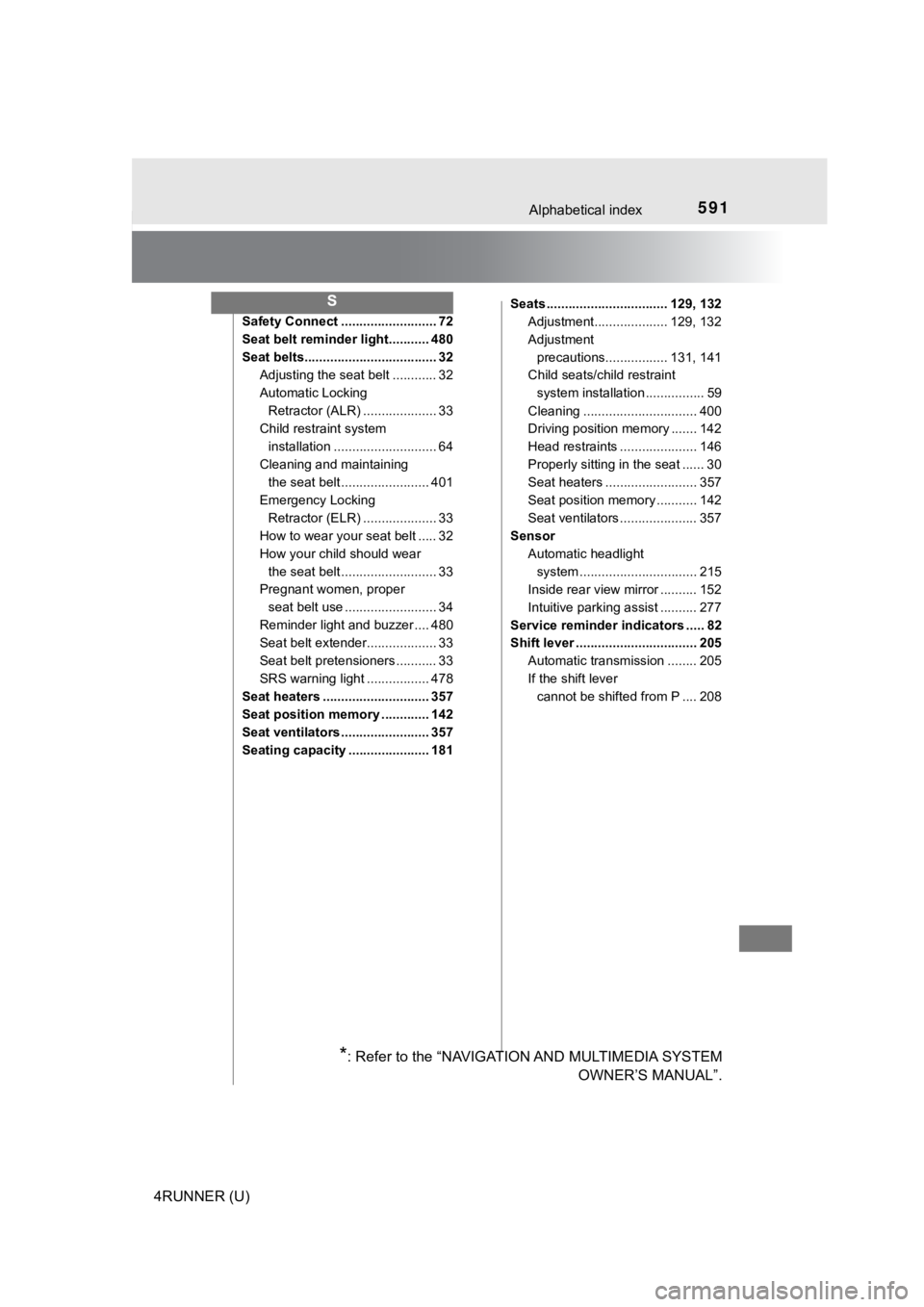
591Alphabetical index
4RUNNER (U)
Safety Connect .......................... 72
Seat belt reminder light........... 480
Seat belts.................................... 32Adjusting the seat belt ............ 32
Automatic Locking
Retractor (ALR) .................... 33
Child restra int system
installation ............................ 64
Cleaning and maintaining the seat belt ........................ 401
Emergency Locking Retractor (ELR) .................... 33
How to wear your seat belt ..... 32
How your child should wear
the seat belt .......................... 33
Pregnant women, proper
seat belt use ......................... 34
Reminder light and buzzer .... 480
Seat belt extender................... 33
Seat belt pretensioners ........... 33
SRS warning light ................. 478
Seat heaters ............................. 357
Seat position memory ............. 142
Seat ventilators ........................ 357
Seating capacity ...................... 181 Seats ................................. 129, 132
Adjustment.................... 129, 132
Adjustment
precautions................. 131, 141
Child seats/child restraint
system installation . ............... 59
Cleaning ............................... 400
Driving position memory ....... 142
Head restraints ..................... 146
Properly sitting in the seat ...... 30
Seat heaters ......................... 357
Seat position memory ........... 142
Seat ventilators ..................... 357
Sensor
Automatic headlight system .......... ...................... 215
Inside rear view mirror .......... 152
Intuitive parking assist .......... 277
Service reminder indicators ..... 82
Shift lever ................................. 205 Automatic transmission ........ 205
If the shift lever cannot be shifted from P .... 208
S
*: Refer to the “NAVIGATION AND MULTIMEDIA SYSTEM OWNER’S MANUAL”.