weight TOYOTA 4RUNNER 2023 Owner's Manual
[x] Cancel search | Manufacturer: TOYOTA, Model Year: 2023, Model line: 4RUNNER, Model: TOYOTA 4RUNNER 2023Pages: 608, PDF Size: 11.8 MB
Page 374 of 608

3745-3. Using the storage features
4RUNNER (U)
WARNING
■When the cargo hooks are not in use
To avoid injury, always return the cargo hooks to their stowed positions.
■ Slide deck operating precaution (if equipped)
● Be careful not to get hands or feet pinched by the slide deck.
● Be careful not to allow the slide deck to hit any persons or lu ggage while
sliding the deck.
● Do not operate the slide deck while someone is on it.
Doing so may cause an accident.
● If operating the slide deck when the vehicle is stopped on an incline, the
slide deck may move faster. Be careful not to allow the slide d eck to hit
you or pinch your fingers etc.
● After sliding the deck, make sure it is securely locked in posi tion.
● Do not close the back door while any person is sitting on the s lide deck or
any person is between the slide deck and back door.
● Do not stow any objects into the space between the slide deck rails.
NOTICE
■To prevent damage to the cargo net hooks
Avoid hanging things other than a cargo net on them.
■ Slide deck weight capacity (if equipped)
Do not load anything heavier than 440 lb. (200 kg) on the slidi ng deck.
■ Grocery bag hook weight capacity
Do not hang any object heavier than 8.8 lb. (4 kg) on the groce ry bag hooks.
■ When using the slide deck (if equipped)
● Do not close the back door while the slide deck is sliding out. Doing so
may cause the back door or slide deck to break.
● If operating the slide deck when the vehicle is stopped on an incline, the
slide deck may move faster. Be careful as luggage may become damaged
or fly out and damage the cabin.
Page 430 of 608

4306-3. Do-it-yourself maintenance
4RUNNER (U)
◆Installing tire pressure warning valve and transmitters
When replacing the tires or wheels, the tire pressure warning v alve
and transmitters must be install ed to the wheels which will be
installed to the vehicle.
When new tire pressure warning valve and transmitters are
installed, new ID codes must be registered in the tire pressure
warning computer and the tire pressure warning system must be
initialized. ( P. 431)
◆Initializing the tire pressure warning system
■The tire pressure warning system must be initialized in the fol-
lowing circumstances:
● When the tire inflation pressure is changed such as when chang-
ing traveling speed or load weight.
● When the tire inflation pressure is changed such as when the ti re
size is changed.
● When rotating the tires.
● After performing the transmitter ID code registration procedure .
( P. 431)
When the tire pressure warning sy stem is initialized, the current tire
inflation pressure is set as the benchmark pressure.
■How to initialize the tire pressure warning system
Park the vehicle in a safe place and turn the engine switch off .
The initialization procedure cannot be started while the vehicle is
moving.
Adjust the tire inflation pressure to the specified cold tire i nflation
pressure level. ( P. 532)
Make sure to adjust the tire pre ssure to the specified cold tire infla-
tion pressure level. The tire pressure warning system will oper ate
based on this pr essure level.
Start the engine. ( P. 1 9 9 )
Select on the multi-information display using the meter con-
trol switches on the steering wheel. ( P. 9 6 )
Select “Vehicle Settings” and then press and hold .
Select “TPWS” and then press .
1
2
3
4
5
6
Page 433 of 608
4336-3. Do-it-yourself maintenance
6
Maintenance and care
4RUNNER (U)
■When to replace your vehicle’s tires
Tires should be replaced if:
●The treadwear indicators are showing on a tire.
●You have tire damage such as cuts, splits, cracks deep enough t o
expose the fabric, and bulges indicating internal damage
●A tire goes flat repeatedly or c annot be properly repaired due to the size
or location of a cut or other damage
If you are not sure, consult with your Toyota dealer.
■Replacing tires and wheels
If the ID code of the tire press ure warning valve and transmitt er is not reg-
istered, the tire pressure warni ng system will not work properly. A f t e r d r i v -
ing for about 20 minutes, the tire pressure warning light blink s for 1
minute and stays on to indi cate a system malfunction.
■Tire life
Any tire over 6 years old must be checked by a qualified techni cian even
if it has seldom or never been u sed or damage is not obvious.
■Routine tire inflation pressure checks
The tire pressure warning system does not replace routine tire inflation
pressure checks. Make sure to chec k tire inflation pressure as part of
your routine of daily vehicle checks.
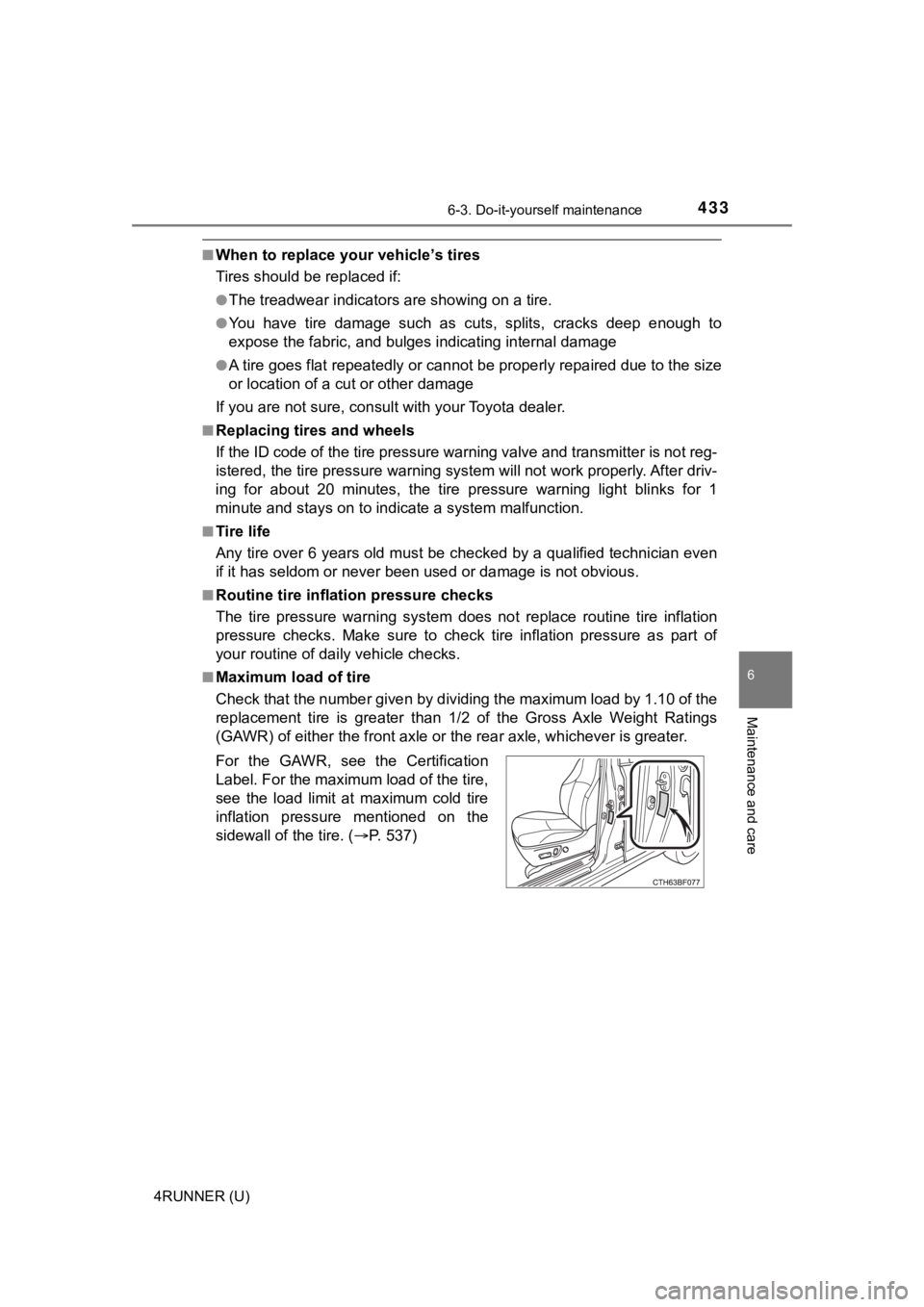
■Maximum load of tire
Check that the number given by dividing the maximum load by 1.1 0 of the
replacement tire is greater than 1/2 of the Gross Axle Weight R atings
(GAWR) of either the front axle or the rear axle, whichever is greater.
For the GAWR, see the Certification
Label. For the maximum load of the tire,
see the load limit at maximum cold tire
inflation pressure mentioned on the
sidewall of the tire. ( P. 5 3 7 )
Page 442 of 608

4426-3. Do-it-yourself maintenance
4RUNNER (U)■
Instructions for checking tire inflation pressure
When checking tire inflation pressure, observe the following:
●Check only when the tires are cold.
If your vehicle has been parked for at least 3 hours or has not
been
driven for more than 1 mile or 1.5 km, you will get an accurate cold tire
inflation pressure reading.
●Always use a tire pressure gauge.
It is difficult to judge if a tire is properly inflated based o nly on its appear-
ance.
●It is normal for the tire inflation pressure to be higher after driving as
heat is generated in the tire. Do not reduce tire inflation pre ssure after
driving.
●Never exceed the vehicle capacity weight.
Passengers and luggage weight should be placed so that the vehi cle is
balanced.
WARNING
■Proper inflation is critical to save tire performance
Keep your tires properly inflated.
If the tires are not properly in flated, the following conditions may occur
which could lead to an accident resulting in death or serious i njury:
●Excessive wear
●Uneven wear
●Poor handling
●Possibility of blowouts resulting from overheated tires
●Air leaking from between tire and wheel
●Wheel deformation and/or tire damage
●Greater possibility of tire damage while driving (due to road h azards,
expansion joints, sharp edges in the road, etc.)
NOTICE
■When inspecting and adjusti ng tire inflation pressure
Be sure to put the tire valve caps back on.
If a valve cap is not installed , dirt or moisture may get into the valve and
cause an air leak, resulting in decreased tire inflation pressu re.
Page 524 of 608
524
4RUNNER (U)
8-1. Specifications
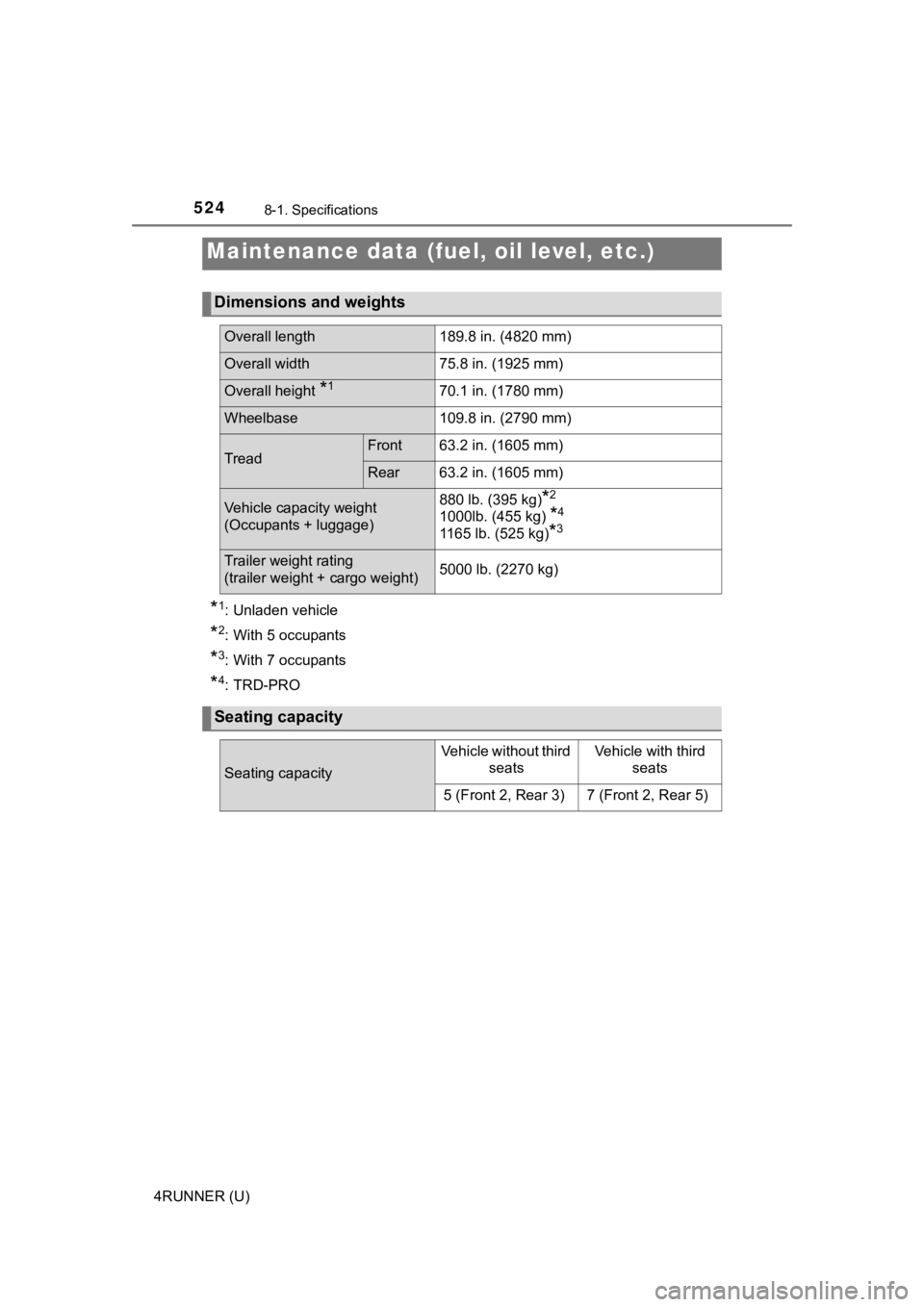
*1: Unladen vehicle
*2: With 5 occupants
*3: With 7 occupants
*4: TRD-PRO
Maintenance data (fuel, oil level, etc.)
Dimensions and weights
Overall length189.8 in. (4820 mm)
Overall width75.8 in. (1925 mm)
Overall height *170.1 in. (1780 mm)
Wheelbase109.8 in. (2790 mm)
TreadFront63.2 in. (1605 mm)
Rear63.2 in. (1605 mm)
Vehicle capacity weight
(Occupants + luggage)880 lb. (395 kg)*2
1000lb. (455 kg) *4
1165 lb. (525 kg)*3
Trailer weight rating
(trailer weight + cargo weight)5000 lb. (2270 kg)
Seating capacity
Seating capacity
Vehicle without third seatsVehicle with third seats
5 (Front 2, Rear 3) 7 (Front 2, Rear 5)
Page 543 of 608
5438-1. Specifications
8
Vehicle specifications
4RUNNER (U)
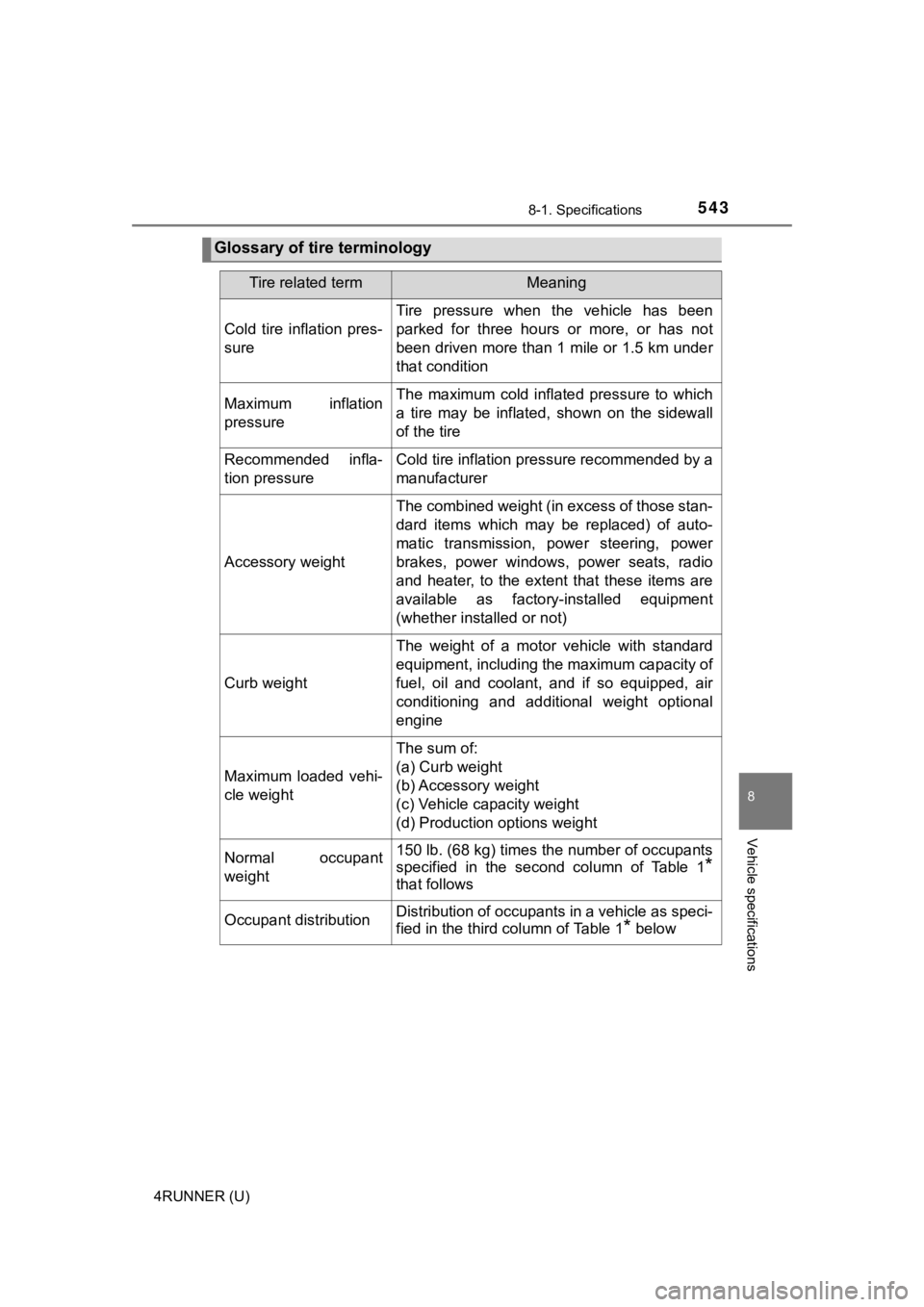
Glossary of tire terminology
Tire related termMeaning
Cold tire inflation pres-
sure
Tire pressure when the vehicle has been
parked for three hours or more, or has not
been driven more than 1 mile or 1.5 km under
that condition
Maximum inflation
pressureThe maximum cold inflated pressure to which
a tire may be inflated, shown on the sidewall
of the tire
Recommended infla-
tion pressureCold tire inflation pressure recommended by a
manufacturer
Accessory weight
The combined weight (in excess of those stan-
dard items which may be replaced) of auto-
matic transmission, power steering, power
brakes, power windows, power seats, radio
and heater, to the extent that these items are
available as factory-installed equipment
(whether installed or not)
Curb weight
The weight of a motor vehicle with standard
equipment, including the maximum capacity of
fuel, oil and coolant, and if so equipped, air
conditioning and additional weight optional
engine
Maximum loaded vehi-
cle weight
The sum of:
(a) Curb weight
(b) Accessory weight
(c) Vehicle capacity weight
(d) Production options weight
Normal occupant
weight150 lb. (68 kg) times the number of occupants
specified in the second column of Table 1
*
that follows
Occupant distributionDistribution of occupants in a vehicle as speci-
fied in the third column of Table 1
* below
Page 544 of 608
5448-1. Specifications
4RUNNER (U)
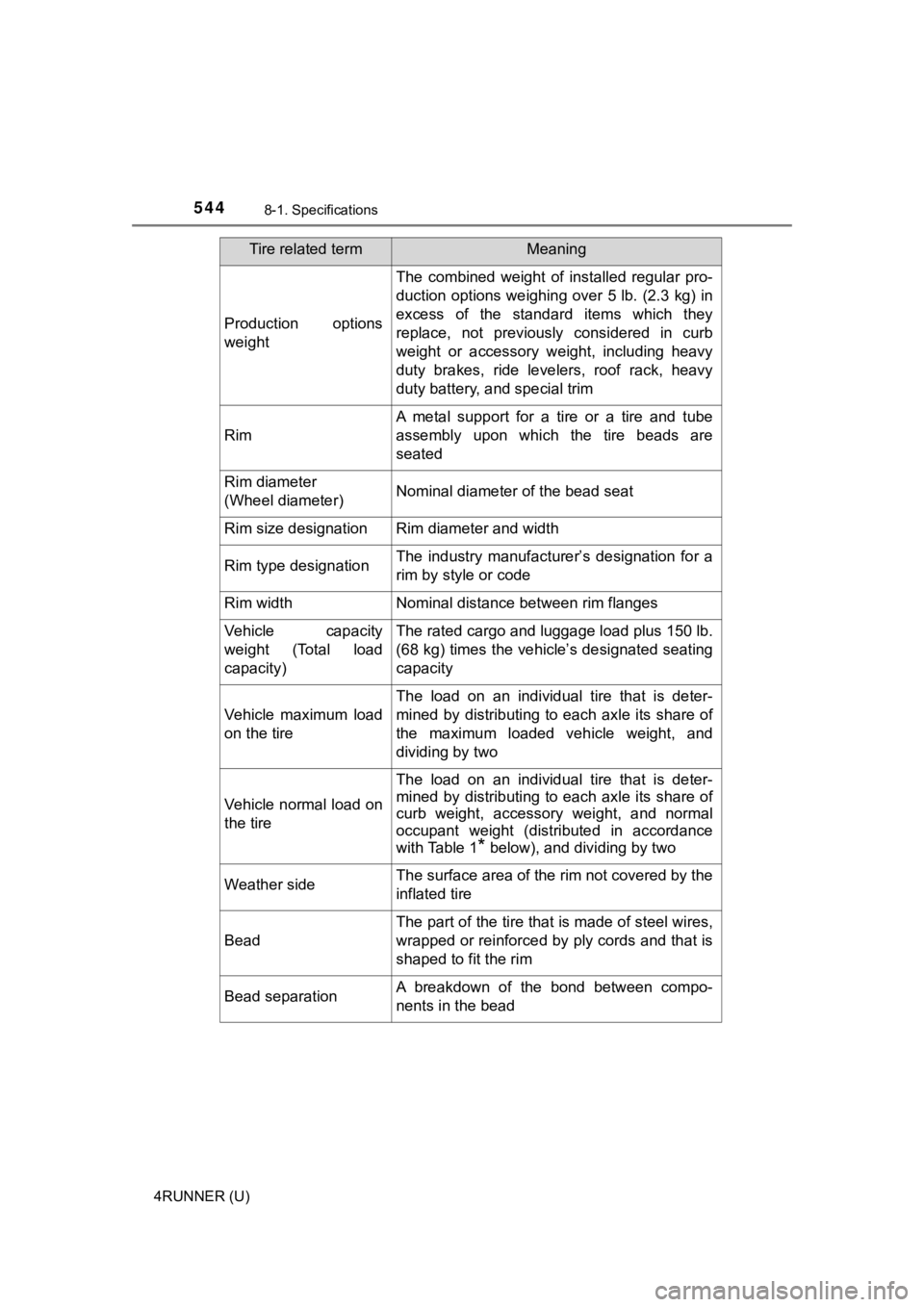
Production options
weight
The combined weight of installed regular pro-
duction options weighing over 5 lb. (2.3 kg) in
excess of the standard items which they
replace, not previously considered in curb
weight or accessory weight, including heavy
duty brakes, ride levelers, roof rack, heavy
duty battery, and special trim
Rim
A metal support for a tire or a tire and tube
assembly upon which the tire beads are
seated
Rim diameter
(Wheel diameter)Nominal diameter of the bead seat
Rim size designationRim diameter and width
Rim type designationThe industry manufacturer’s designation for a
rim by style or code
Rim widthNominal distance between rim flanges
Vehicle capacity
weight (Total load
capacity)The rated cargo and l uggage load plus 150 lb.
(68 kg) times the vehicle’s designated seating
capacity
Vehicle maximum load
on the tire
The load on an individual tire that is deter-
mined by distributing to each axle its share of
the maximum loaded vehicle weight, and
dividing by two
Vehicle normal load on
the tire
The load on an individual tire that is deter-
mined by distributing to each axle its share of
curb weight, accessory weight, and normal
occupant weight (distributed in accordance
with Table 1
* below), and dividing by two
Weather sideThe surface area of the rim not covered by the
inflated tire
Bead
The part of the tire that is made of steel wires,
wrapped or reinforced by ply cords and that is
shaped to fit the rim
Bead separationA breakdown of the bond between compo-
nents in the bead
Tire related termMeaning
Page 546 of 608
5468-1. Specifications
4RUNNER (U)
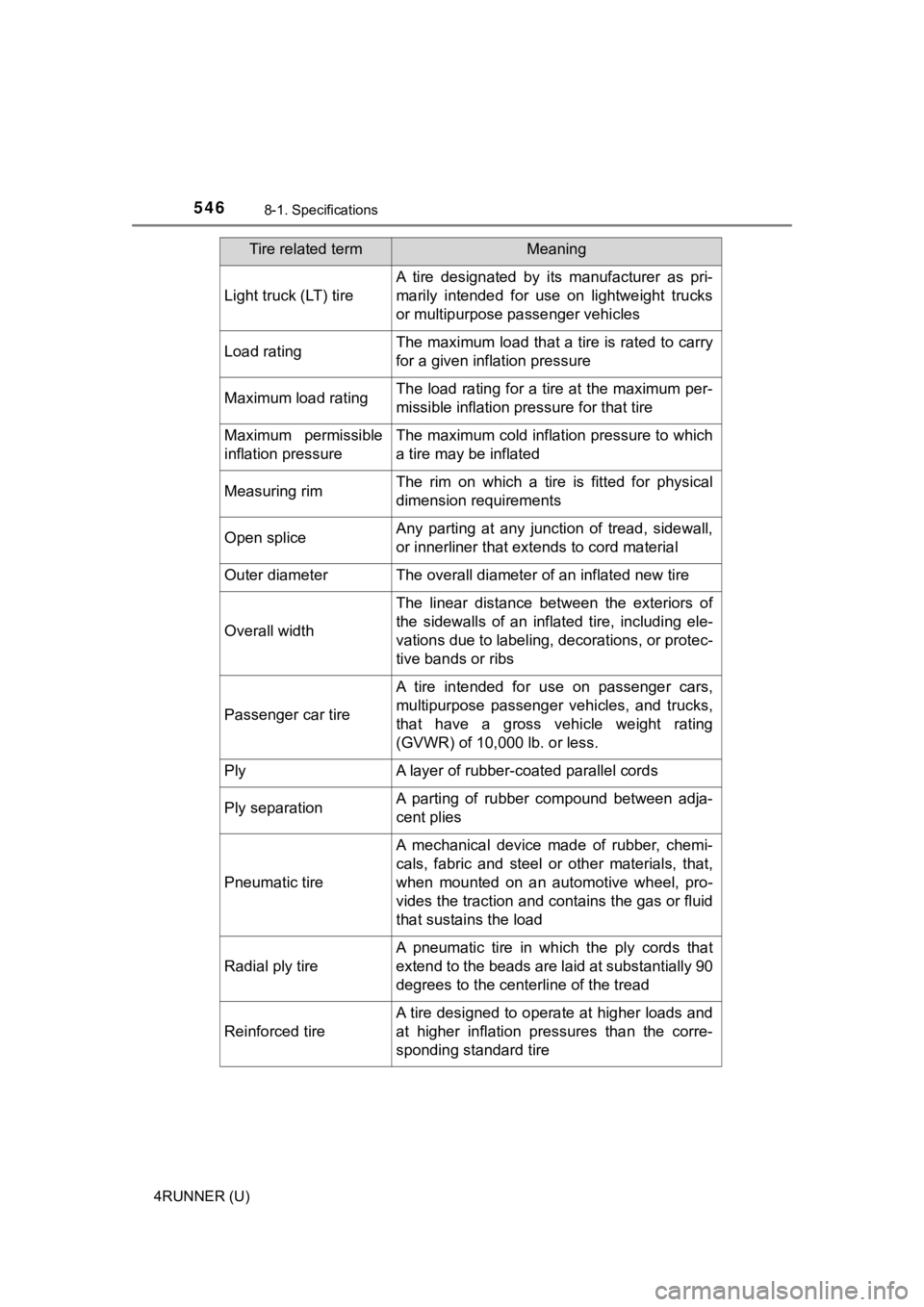
Light truck (LT) tire
A tire designated by its manufacturer as pri-
marily intended for use on lightweight trucks
or multipurpose passenger vehicles
Load ratingThe maximum load that a tire is rated to carry
for a given inflation pressure
Maximum load ratingThe load rating for a tire at the maximum per-
missible inflation pressure for that tire
Maximum permissible
inflation pressureThe maximum cold inflation pressure to which
a tire may be inflated
Measuring rimThe rim on which a tire is fitted for physical
dimension requirements
Open spliceAny parting at any junction of tread, sidewall,
or innerliner that extends to cord material
Outer diameterThe overall diameter of an inflated new tire
Overall width
The linear distance between the exteriors of
the sidewalls of an inflated tire, including ele-
vations due to labeling, decorations, or protec-
tive bands or ribs
Passenger car tire
A tire intended for use on passenger cars,
multipurpose passenger vehicles, and trucks,
that have a gross vehicle weight rating
(GVWR) of 10,000 lb. or less.
PlyA layer of rubber-coated parallel cords
Ply separationA parting of rubber compound between adja-
cent plies
Pneumatic tire
A mechanical device made of rubber, chemi-
cals, fabric and steel or other materials, that,
when mounted on an automotive wheel, pro-
vides the traction and co ntains the gas or fluid
that sustains the load
Radial ply tire
A pneumatic tire in which the ply cords that
extend to the beads are laid at substantially 90
degrees to the centerline of the tread
Reinforced tire
A tire designed to operate at higher loads and
at higher inflation pressures than the corre-
sponding standard tire
Tire related termMeaning
Page 562 of 608
562
4RUNNER (U)
8-3. Items to initialize
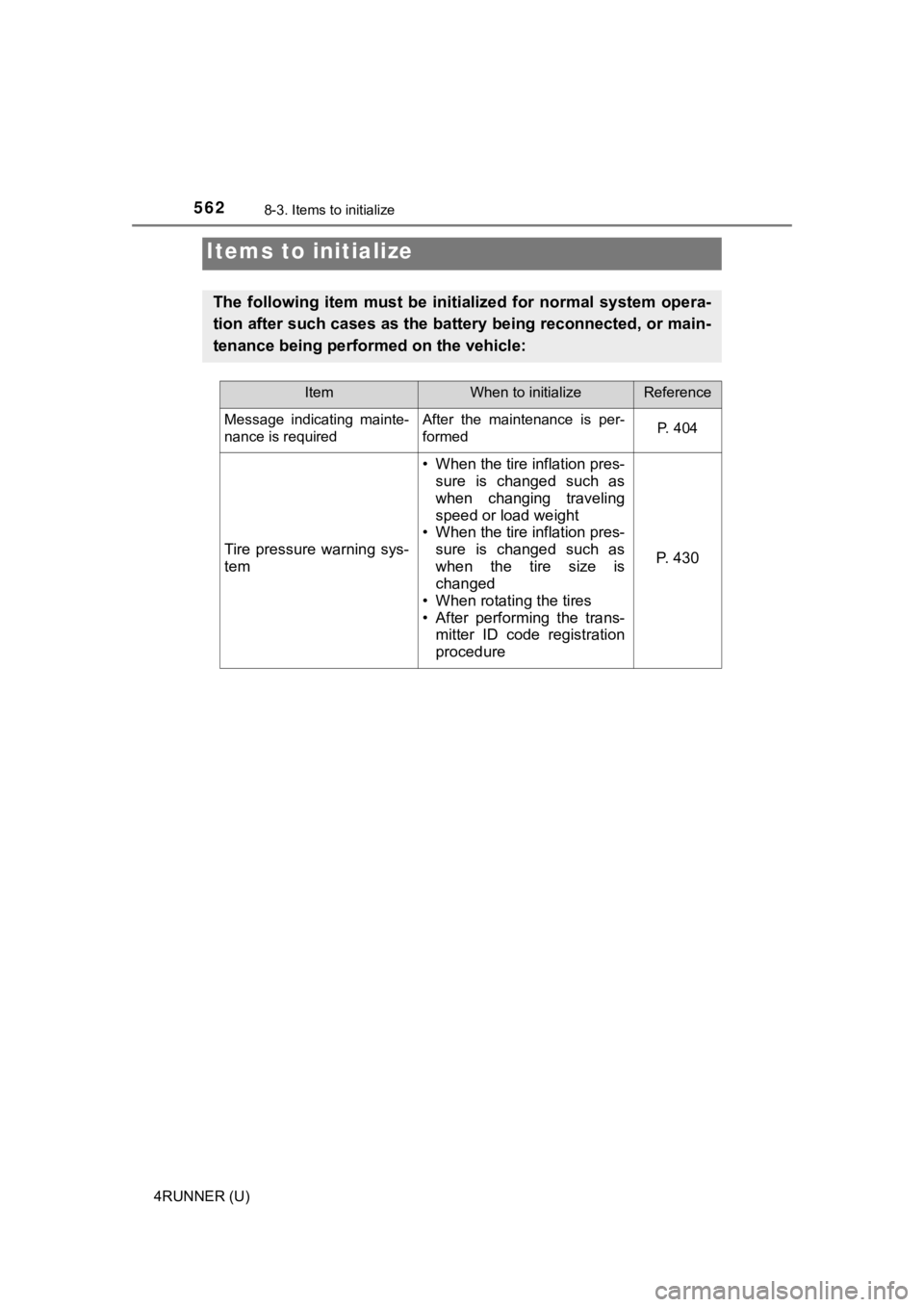
Items to initialize
The following item must be initialized for normal system opera-
tion after such cases as the battery being reconnected, or main -
tenance being performed on the vehicle:
ItemWhen to initializeReference
Message indicating mainte-
nance is requiredAfter the maintenance is per-
formedP. 404
Tire pressure warning sys-
tem
• When the tire inflation pres- sure is changed such as
when changing traveling
speed or load weight
• When the tire inflation pres-
sure is changed such as
when the tire size is
changed
• When rotating the tires
• After performing the trans- mitter ID code registration
procedure
P. 430
Page 595 of 608
595Alphabetical index
4RUNNER (U)
Slip indicator ......................... 478
SRS ...................................... 478
Tire pressure......................... 481
Unengaged “Park” ................ 479
Warning messages .................. 488
Washer...................................... 223
Checking ............................... 425
Preparing and checking before winter....................... 331
Switch ........................... 223, 226
Washing and waxing ............... 396
Weight
Cargo capacity ...................... 181
Load limits............................. 181
Weight................................... 524
Wheels ...................................... 443 Replacing wheels.................. 443
Size ....................................... 532
Window glasses....................... 155
Window lock switch ................ 155
Windows ................................... 155 Power back window .............. 158
Power windows ..................... 155
Rear window defogger ..................... 344, 351
Washer ......................... 223, 226
Windshield wiper
de-icer ............................ 344, 352
Windshield wipers ........... 223, 226 Intermittent wiper .................. 223
Winter driving tips ................... 331
Wireless remote control key .......................................... 102
Locking/Unlocking................. 106
Replacing the battery ............ 447
*: Refer to the “NAVIGATION AND MULTIMEDIA SYSTEM OWNER’S MANUAL”.