wheel TOYOTA 86 2018 Owner's Manual
[x] Cancel search | Manufacturer: TOYOTA, Model Year: 2018, Model line: 86, Model: TOYOTA 86 2018Pages: 532, PDF Size: 6.48 MB
Page 69 of 532
69
1
1-3. Adjustable components (seats, mirrors, steering wheel)
Before driving
Outside rear view mirrors
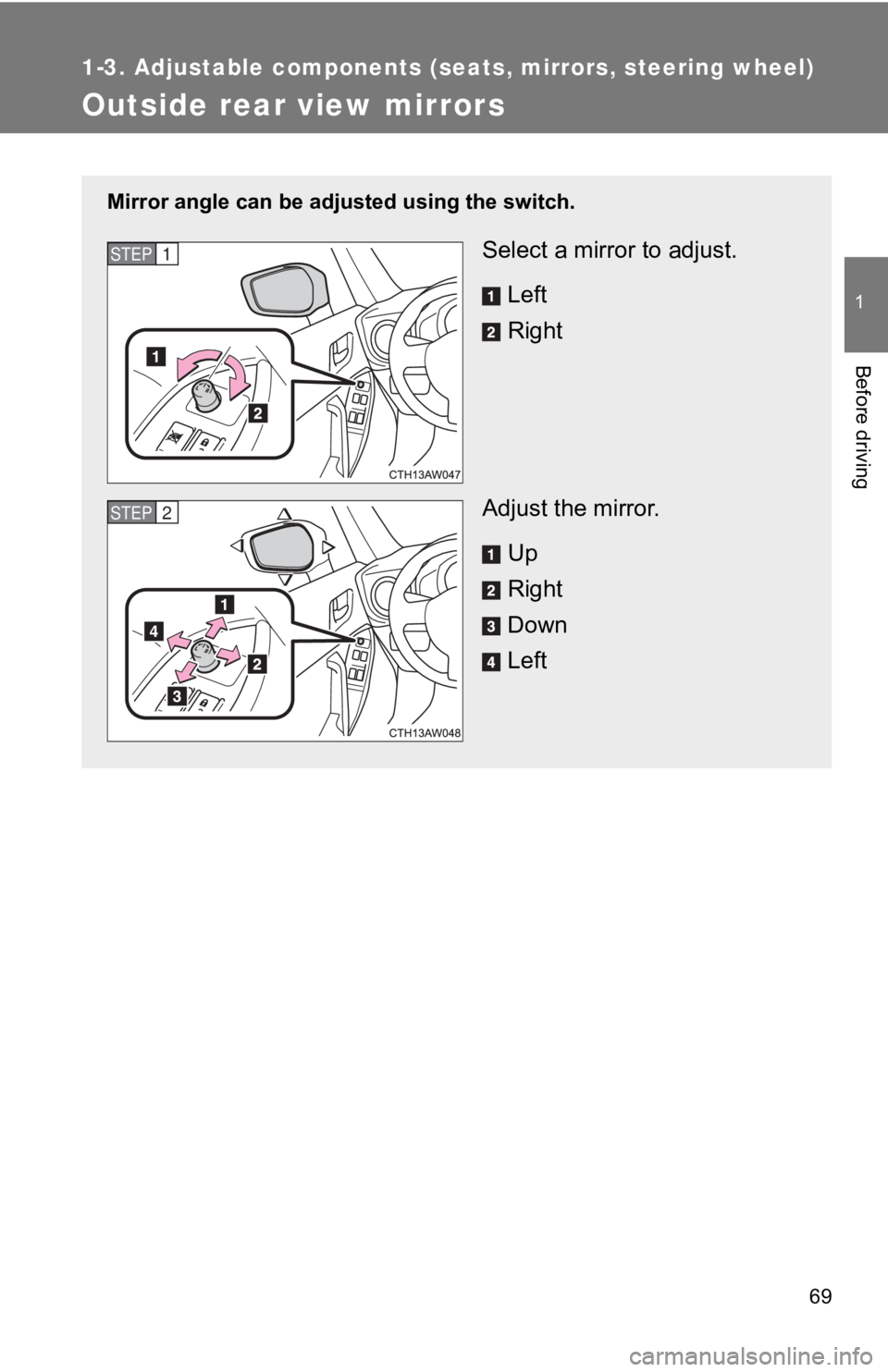
Mirror angle can be adjusted using the switch.
Select a mirror to adjust.
Left
Right
Adjust the mirror. Up
Right
Down
LeftSTEP 1
STEP 2
Page 70 of 532
70 1-3. Adjustable components (seats, mirrors, steering wheel)
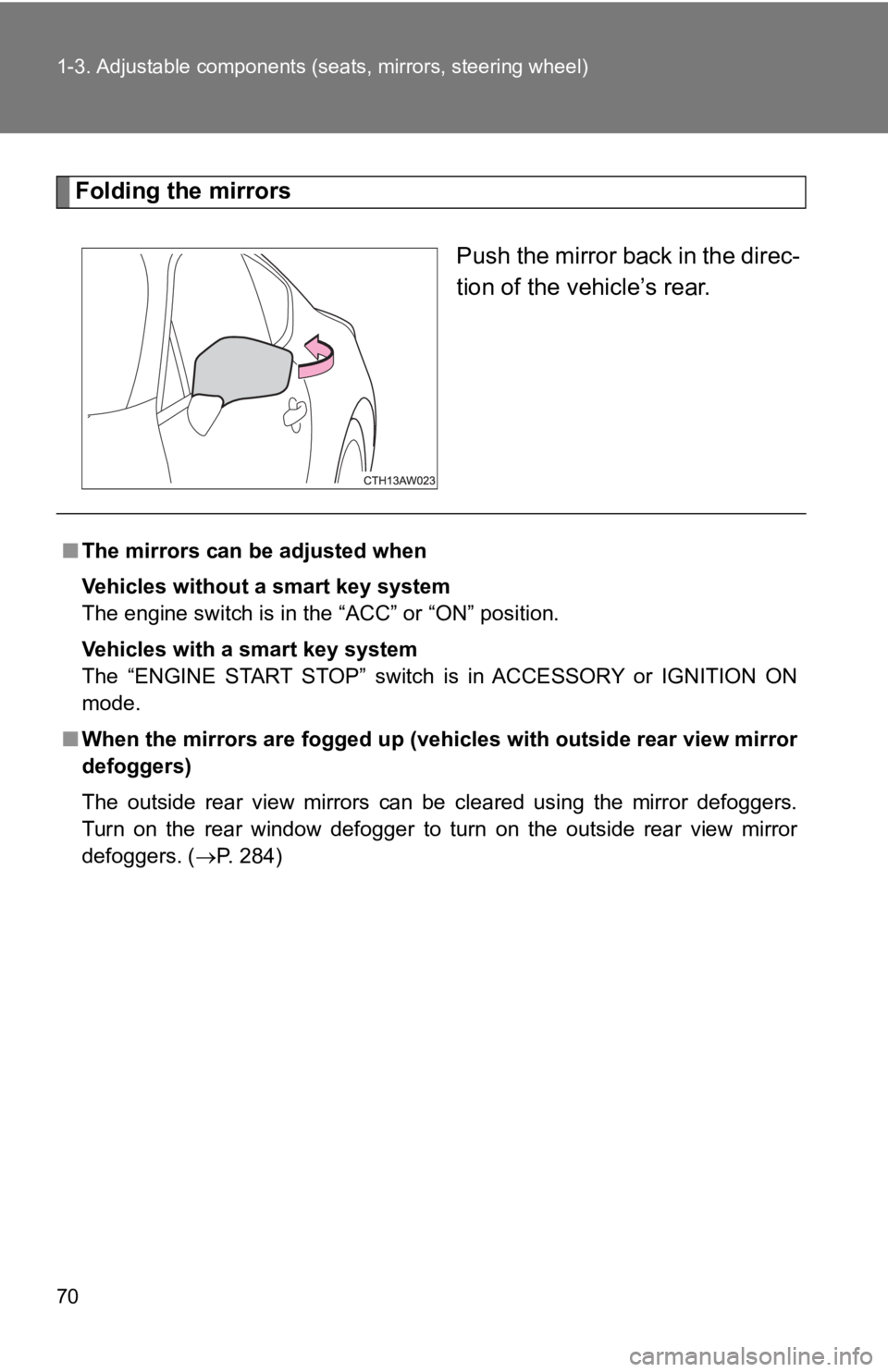
Folding the mirrors
Push the mirror back in the direc-
tion of the vehicle’s rear.
■The mirrors can be adjusted when
Vehicles without a smart key system
The engine switch is in the “ACC” or “ON” position.
Vehicles with a smart key system
The “ENGINE START STOP” switch is in ACCESSORY or IGNITION ON
mode.
■ When the mirrors are fogged up (vehicles with outside rear view mirror
defoggers)
The outside rear view mirrors can be cleared using the mirror d efoggers.
Turn on the rear window defogger to turn on the outside rear view mirror
defoggers. ( P. 284)
Page 71 of 532

71
1-3. Adjustable components (s
eats, mirrors, steering wheel)
1
Before driving
WARNING
■When driving the vehicle
Observe the following precautions while driving.
Failure to do so may result in loss of control of the vehicle a nd cause an
accident, resulting in death or serious injury.
● Do not adjust the mirrors while driving.
● Do not drive with the mirrors folded.
● Both the driver and passenger side mirrors must be extended and properly
adjusted before driving.
■ When a mirror is moving
To avoid personal injury and mirror malfunction, be careful not to get your
hand caught by the moving mirror.
■ When the mirror defoggers are operating (vehicles with outside rear
view mirror defoggers)
Do not touch the rear view mirror surfaces, as they can become very hot and
burn you.
Page 87 of 532
87
1
Before driving
1-7. Safety information
Correct driving posture
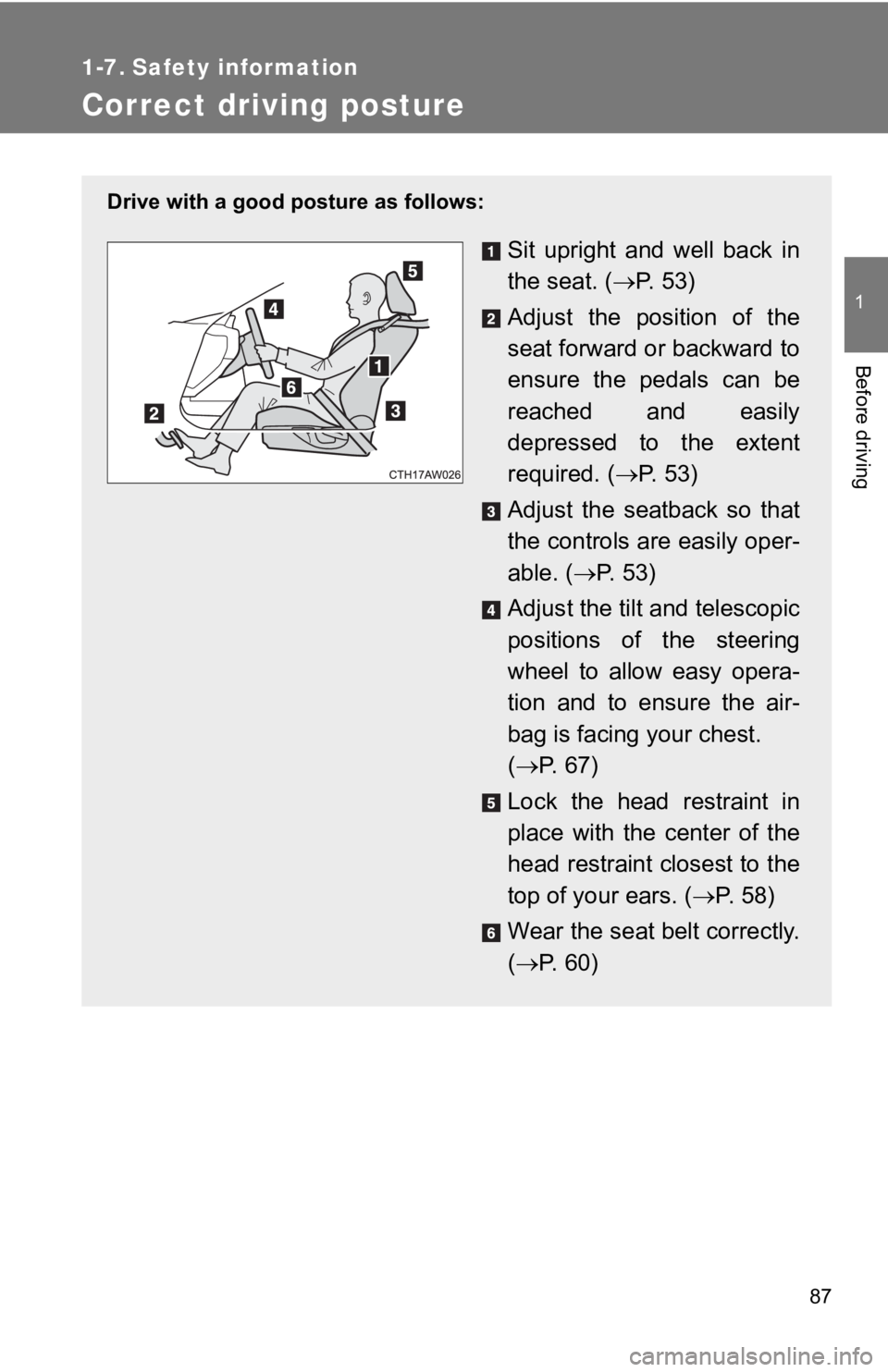
Drive with a good posture as follows:
Sit upright and well back in
the seat. (P. 5 3 )
Adjust the position of the
seat forward or backward to
ensure the pedals can be
reached and easily
depressed to the extent
required. ( P. 53)
Adjust the seatback so that
the controls are easily oper-
able. ( P. 53)
Adjust the tilt and telescopic
positions of the steering
wheel to allow easy opera-
tion and to ensure the air-
bag is facing your chest.
( P. 67)
Lock the head restraint in
place with the center of the
head restraint closest to the
top of your ears. ( P. 58)
Wear the seat belt correctly.
( P. 60)
Page 91 of 532

91
1-7. Safety information
1
Before driving
WARNING
■
SRS airbag
●To obtain maximum protection in the event of an accident, the d river and
all passengers in the vehicle should always wear seat belts whe n the vehi-
cle is moving. The SRS airbag is designed only to be a supplement to the
primary protection provided by the seat belt. It does not elimi nate the need
to fasten seat belts. In combination with the seat belts, it of fers the best
combined protection in case of a serious accident.
Not wearing a seat belt increases the chance of severe injury o r death in a
crash even when the vehicle has the SRS airbag.
For instructions and precautions concerning the seat belt syste m, refer to
“Seat belts”. ( P. 60)
● Do not sit or lean unnecessarily close to the SRS airbag. Becau se the
SRS airbag deploys with considerable speed - faster than the blink of an
eye - and force to protect in high speed collisions, the force of an airbag
can injure an occupant whose body is too close to SRS airbag.
It is also important to wear your seat belt to help avoid injur ies that can
result when the SRS airbag contacts an occupant not in proper p osition
such as one thrown forward during pre-accident braking.
Even when properly positioned, there remains a possibility that an occu-
pant may suffer minor injury such as abrasions and bruises to the face or
arms because of the SRS airbag deployment force.
● The SRS airbags deploy with considerable speed and force. Occup ants
who are out of proper position when the SRS airbag deploys could suffer
very serious injuries. Because the SRS airbag needs enough spac e for
deployment, the driver should always sit upright and well back in the seat
as far from the steering wheel as practical while still maintai ning full vehi-
cle control and the front passenger should move the seat as far back as
possible and sit upright and well back in the seat.
● Do not place any objects over or near the SRS airbag cover or b etween
you and the SRS airbag. If the SRS airbag deploys, those object s could
interfere with its proper operation and could be propelled insi de the vehicle
and cause injury.
Page 94 of 532
94 1-7. Safety information
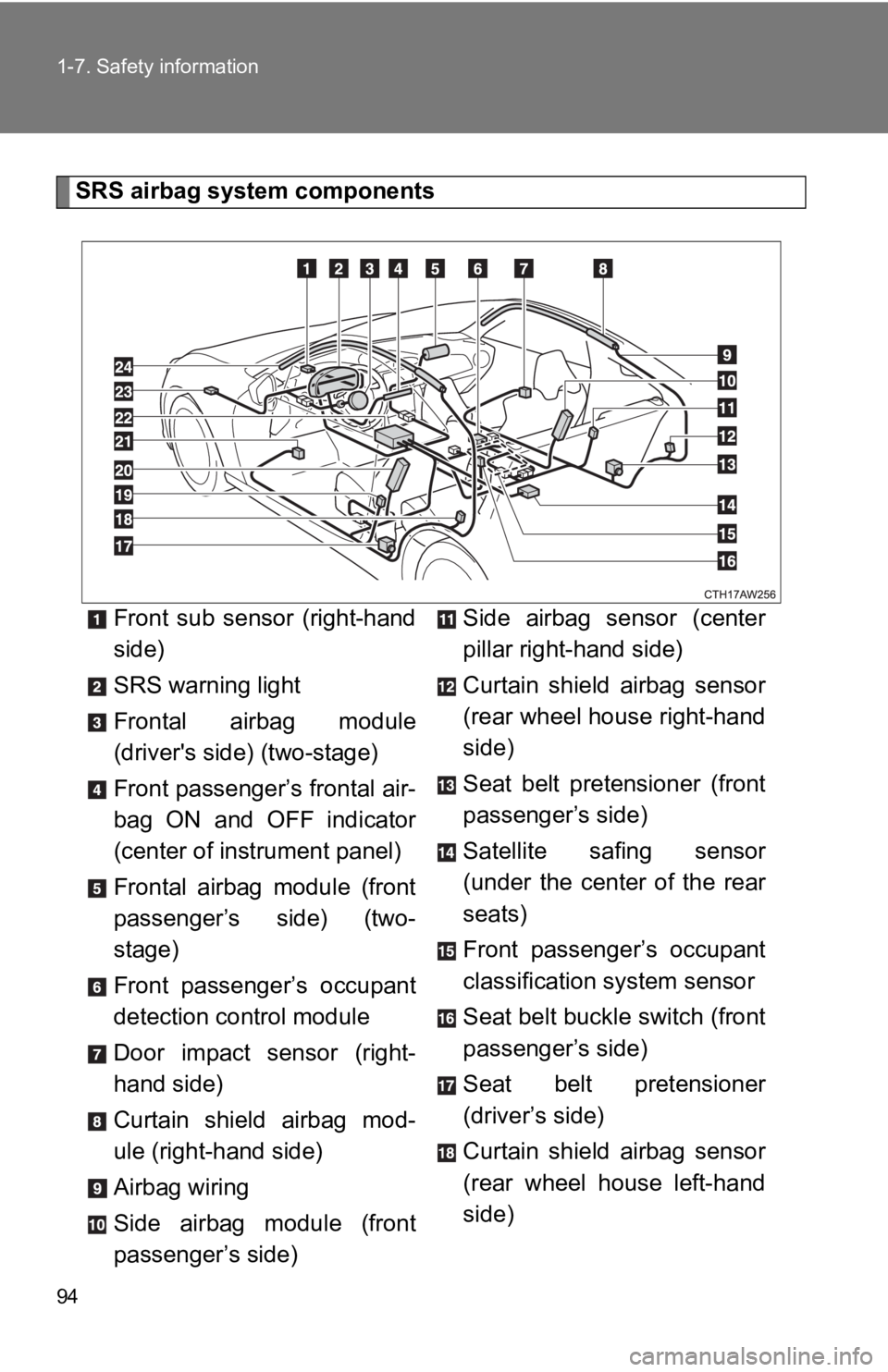
SRS airbag system componentsFront sub sensor (right-hand
side)
SRS warning light
Frontal airbag module
(driver's side) (two-stage)
Front passenger’s frontal air-
bag ON and OFF indicator
(center of instrument panel)
Frontal airbag module (front
passenger’s side) (two-
stage)
Front passenger’s occupant
detection control module
Door impact sensor (right-
hand side)
Curtain shield airbag mod-
ule (right-hand side)
Airbag wiring
Side airbag module (front
passenger’s side) Side airbag sensor (center
pillar right-hand side)
Curtain shield airbag sensor
(rear wheel house right-hand
side)
Seat belt pretensioner (front
passenger’s side)
Satellite safing sensor
(under the center of the rear
seats)
Front passenger’s occupant
classification system sensor
Seat belt buckle switch (front
passenger’s side)
Seat belt pretensioner
(driver’s side)
Curtain shield airbag sensor
(rear wheel house left-hand
side)
Page 95 of 532

95
1-7. Safety information
1
Before driving
Your vehicle is equipped with ADVANCED AIRBAGS designed based
on US motor vehicle safety standards (FMVSS208). The airbag sys
-
tem controls airbag deployment power for the driver and front p as-
senger. The front passenger's air bag system consists of the front
passenger occupant detec tion control module etc.
The main SRS airbag system components are shown above. The
SRS airbag system is controlled by the airbag control module. T he
airbag control module cons ists of an airbag sensor.
In certain types of severe front or side impacts, the SRS airba g sys-
tem triggers the airbag inflators. A chemical reaction in the inflators
quickly fills the airbags with non- toxic gas to help restrain t he motion
of the occupants.
Side airbag sensor (center
pillar left-hand side)
Side airbag module (driver’s
side)
Door impact sensor (left-
hand side) Airbag control module
(including impact sensors
and rollover sensors)
Front sub sensor (left-hand
side)
Curtain shield airbag mod-
ule (left-hand side)
■
If the SRS airbags deploy (inflate)
●Slight abrasions, burns, bruisi ng etc., may be sustained from S RS air-
bags, due to the extremely high speed deployment (inflation) by hot
gases.
● A loud noise and white powder will be emitted.
● Parts of the airbag module (steering wheel hub, airbag cover an d inflator)
as well as the front seats, parts of the front and rear pillars , and roof side
rails, may be hot for several minutes. The airbag itself may al so be hot.
● The windshield may crack.
Page 96 of 532

96 1-7. Safety information
Toyota advanced frontal airbag systemYour vehicle is equipped with a Toyota advanced frontal airbag sys-
tem that complies with the new advanced frontal airbag requirem ents
in the amended Federal Motor Vehicle Safety Standard (FMVSS) No .
208.
The Toyota advanced frontal airbag system automatically determines
the deployment force of the driv er’s SRS frontal airbag at the time of
deployment as well as whether or not to activate the front pass en-
ger’s SRS frontal airbag and, if activated, the deployment force of the
SRS frontal airbag at the time of deployment.
Your vehicle has warning labels on the driver’s and front passe nger’s
sun visors beginning with the phrase “EVEN WITH ADVANCED AIR
BAGS” and a tag attached to the glove box lid beginning with th e
phrase “Even with Advanced Air Bags”. Make sure that you carefu lly
read the instructions on the warning labels and tag.
Always wear your seat belt. The Toyota advanced frontal airbag sys-
tem is a supplemental restraint system and must be used in comb ina-
tion with a seat belt. All occupa nts should wear a seat belt or be
seated in an appropriate c hild restraint system.
The driver’s SRS frontal airbag is stowed in the center portion of the
steering wheel. The front passenger’s SRS frontal airbag is sto wed
near the top of the dashboard under an “SRS AIRBAG” mark.
In a moderate to severe frontal collision, the following compon ents
deploy.
● SRS frontal airbag for driver
● SRS frontal airbag for front passenger
These components suppl ement the seat belts by reducing the impact
to the occupant’s head and chest.
Page 109 of 532

109
1-7. Safety information
1
Before driving
WARNING
■
If the SRS airbags deploy
Do not touch the SRS airbag system components around the steeri ng wheel
and dashboard with bare hands right after deployment. Doing so can cause
burns because the components can be very hot as a result of dep loyment.
■ Child restraint precautions
NEVER INSTALL A REARWARD FACING CHILD SEAT IN THE FRONT
PASSENGER’S SEAT EVEN IF THE FRONT PASSENGER’S SRS FRON-
TAL AIRBAG IS DEACTIVATED. Be sure to install it in the REAR se at in a
correct manner. Also, it is strongly recommended that any forwa rd facing
child seat or booster seat be installed in the REAR seat, and t hat even chil-
dren who have outgrown a child restraint system be also seated in the
REAR seat. This is because children sitting in the front passen ger’s seat
may be killed or severely injured should the front passenger’s SRS frontal
airbag deploy. REAR seats are the safest place for children.
Page 111 of 532

111
1-7. Safety information
1
Before driving
■
Operation
The SRS side airbag and SRS curtain shield airbag can function only when
the engine switch is in the “ON” position (vehicles without a s mart key sys-
tem) or when the “ENGINE START ST OP” switch is in IGNITION ON mode
(vehicles with a smart key system).
The driver’s and front passenger’s SRS side airbags and SRS cur tain shield
airbags deploy independently of each other since each has its o wn impact
sensor. Therefore, they may not both deploy in the same acciden t. Also, the
SRS side airbag and SRS curtain shield airbag deploys independe ntly of the
driver’s and front passenger’s SRS front airbags in the steerin g wheel and
instrument panel.
A rollover sensor is also located inside the airbag control mod ule.
An impact sensor, which senses impact force, is located in each of the left
and right center pillars, doors and rear wheel houses. Another impact sen-
sor, which also senses impact force, is located under the center of the rear
seats.
If the impact sensor that is located under the center of the re ar seats and
one of the center pillar impact sensors or door impact sensors together
sense an impact force above a predetermined level in a side col lision, the
control module causes both the SRS side airbag and curtain shield airbag on
the impacted side to inflate regardless of whether the rear whe el house
impact sensor on the same side senses an impact.
If the impact sensor that is located under the center of the re ar seats and
one of the rear wheel house impact sensors together sense an im pact force
above a predetermined level, the control module causes only the SRS cur-
tain shield airbag on the impacted side to inflate.
If the rollover sensor detects rollover of the vehicle, the control module
inflates the SRS curtain shield airbags. At this time, the driver's and front
passenger’s seat belt pretensioners also operate at the same ti me.