wheel TOYOTA 86 2018 Workshop Manual
[x] Cancel search | Manufacturer: TOYOTA, Model Year: 2018, Model line: 86, Model: TOYOTA 86 2018Pages: 532, PDF Size: 6.48 MB
Page 249 of 532

249
2-4. Using other driving systems
2
When driving
■
Sounds and vibrations caused by the ABS, brake assist, TRAC and
VSC systems
●A sound may be heard from the engine compartment when the brake
pedal is depressed repeatedly, when the engine is started or ju st after the
vehicle begins to move. This sound does not indicate that a malfunction
has occurred in any of these systems.
● Any of the following conditions may occur when the above system s are
operating. None of these indicates that a malfunction has occur red.
• Vibrations may be felt through the vehicle body and steering.
• A motor sound may be heard after the vehicle comes to a stop.
• The brake pedal may pulsate slightly after the ABS is activated.
• The brake pedal may move down slightly after the ABS is activa ted.
■ EPS operation sound
When the steering wheel is operated, a motor sound (whirring so und) may
be heard. This does not indicate a malfunction.
■ Automatic reactivation of TRAC and VSC systems
After turning the TRAC and VSC systems off, the systems will be automati-
cally reactivated in the following situations:
● Vehicles without a smart key system: When the engine switch is turned to
“LOCK” position
● Vehicles with a smart key system: When the “ENGINE START STOP”
switch is turned off
● If only the TRAC system is turned off, the TRAC will turn on when vehicle
speed is more than approximately 31 mph (50 km/h).
If both the TRAC and VSC systems are turned off, automatic reac tivation
will not occur when vehicle speed increases.
Page 250 of 532

250 2-4. Using other driving systems
■Reduced effectiveness of the EPS system
The effectiveness of the EPS system is reduced to prevent the s ystem from
overheating when there is frequent steering input over an exten ded period of
time. The steering wheel may feel heavy as a result. Should thi s occur,
refrain from excessive steering input or stop the vehicle and turn the engine
off. The EPS system should return to normal after a little whil e.
■ Automatic deactivatio n of “TRACK” mode
Vehicles without a smart key system
When the engine switch is turned to “LOCK” position after drivi ng in
“TRACK” mode, the mode is automatically deactivated.
Vehicles with a smart key system
When the “ENGINE START STOP” switch is turned off after driving in
“TRACK” mode, the mode is automatically deactivated.
WARNING
■ The ABS does not operate effectively when
●Tires with inadequate gripping ability are used (such as excess ively worn
tires on a snow covered road).
● The vehicle hydroplanes while driving at high speed on wet or s lick roads.
■ Stopping distance when the ABS is operating may exceed that of nor-
mal conditions
The ABS is not designed to shorten the vehicle’s stopping distance. Always
maintain a safe distance from the vehicle in front of you in the following situ-
ations:
● When driving on dirt, gravel or snow-covered roads
● When driving with tire chains
● When driving over bumps in the road
● When driving over roads with potholes or uneven surfaces
Page 251 of 532

251
2-4. Using other driving systems
2
When driving
WARNING
■
TRAC may not operate effectively when
Directional control and power may not be achievable while drivi ng on slip-
pery road surfaces, even if the TRAC system is operating.
Do not drive the vehicle in conditions where stability and powe r may be lost.
■ When the VSC and/or brake LSD function is activated
The slip indicator light flashes. Always drive carefully. Reckl ess driving may
cause an accident. Exercise particular care when the indicator light flashes.
■ When the TRAC/VSC systems are turned off
Be especially careful and drive at a speed appropriate to the r oad condi-
tions. As these are the systems to help ensure vehicle stability and driving
force, do not turn the TRAC/VSC systems off unless necessary.
■ Replacing tires
Make sure that all tires are of the specified size, brand, trea d pattern and
total load capacity. In addition, make sure that the tires are inflated to the
recommended tire inflation pressure level.
The ABS, TRAC and VSC systems will not function correctly if di fferent tires
are installed on the vehicle.
Contact your Toyota dealer for further information when replaci ng tires or
wheels.
■ Handling of tires and suspension
Using tires with any kind of problem or modifying the suspensio n will affect
the driving assist systems, and may cause a system to malfuncti on.
Page 262 of 532
262 2-5. Driving information
●If a door is opened and closed wh en its side window is frozen,
the window safety device will operate and the side window
open/close function linked to door operation may not operate
correctly. If this occurs, perform the following after the ice has
melted.
Open the side window until it is approximately halfway open
with the door closed.
Fully close the window by pulling the switch up to the one-
touch closing position and cont inue holding the switch for 1
second or more after the window fully closes.
The window position is reset and the safety device operations w ill
be released.
■ When driving the vehicle
Accelerate the vehicle slowly, keep a safe distance between you
and the vehicle ahead, and drive at a reduced speed suitable to
road conditions.
■ When parking the vehicle (in the winter time or in the cold
latitudes)
Park the vehicle and move the shift lever to P (automatic trans -
mission) or 1 or R (manual transmission) without setting the
parking brake. The parking brake may freeze up, preventing it
from being released. If necessary, block the wheels to prevent
inadvertent sliding or creeping.
STEP 1
STEP 2
Page 263 of 532

263
2-5. Driving information
2
When driving
Tire chains
Tire chains cannot be used on your vehicle because of the lack of
clearance between the tires and vehicle body.
When tire chains cannot be used, use of another type of tractio n
device (such as spring chains) may be acceptable if use on your vehi-
cle is recommended by the device manufacturer, taking into acco unt
tire size and road conditions.
Follow the device manufacturer's instructions, especially regarding
maximum vehicle speed.
To help avoid damage to your vehicle, drive slowly, readjust or
remove the device if it is contacting your vehicle, and do not spin your
wheels. Damage caused to your veh icle by use of a traction device is
not covered under warranty.
Make certain that any traction device you use is an SAE class “ S”
device, and use it on the rear wheels only.
Always use the utmost care when driving with a traction device. Over-
confidence because you are using a traction device could easily lead
to a serious accident.
Selecting tire chains
We recommend that you consult your Toyota dealer for informatio n
about the chains t hat you can use.
Page 264 of 532

264 2-5. Driving information
WARNING
■Driving with snow tires
Observe the following precautions to reduce the risk of accidents.
Failure to do so may result in a loss of vehicle control and ca use death or
serious injury.
●Use tires of the specified size, and that are the same size, sa me
maker, same brand and tread pattern.
●Maintain the recommended level of air pressure.
●Do not drive in excess of 75 mph (120 km/h), regardless of the type of
snow tires being used.
●Use snow tires on all, not just some wheels.
NOTICE
■Repairing or replacing snow tires
Request repairs or replacement of snow tires from Toyota dealers or
legitimate tire retailers.
This is because the removal and a ttachment of snow tires affects the
operation of the tire pressure wa rning valves and transmitters.
■Fitting tire chains
The tire pressure warning valves and transmitters may not funct ion cor-
rectly when tire chains are fitted.
Page 265 of 532
265
2-5. Driving information
2
When driving
Trailer towing
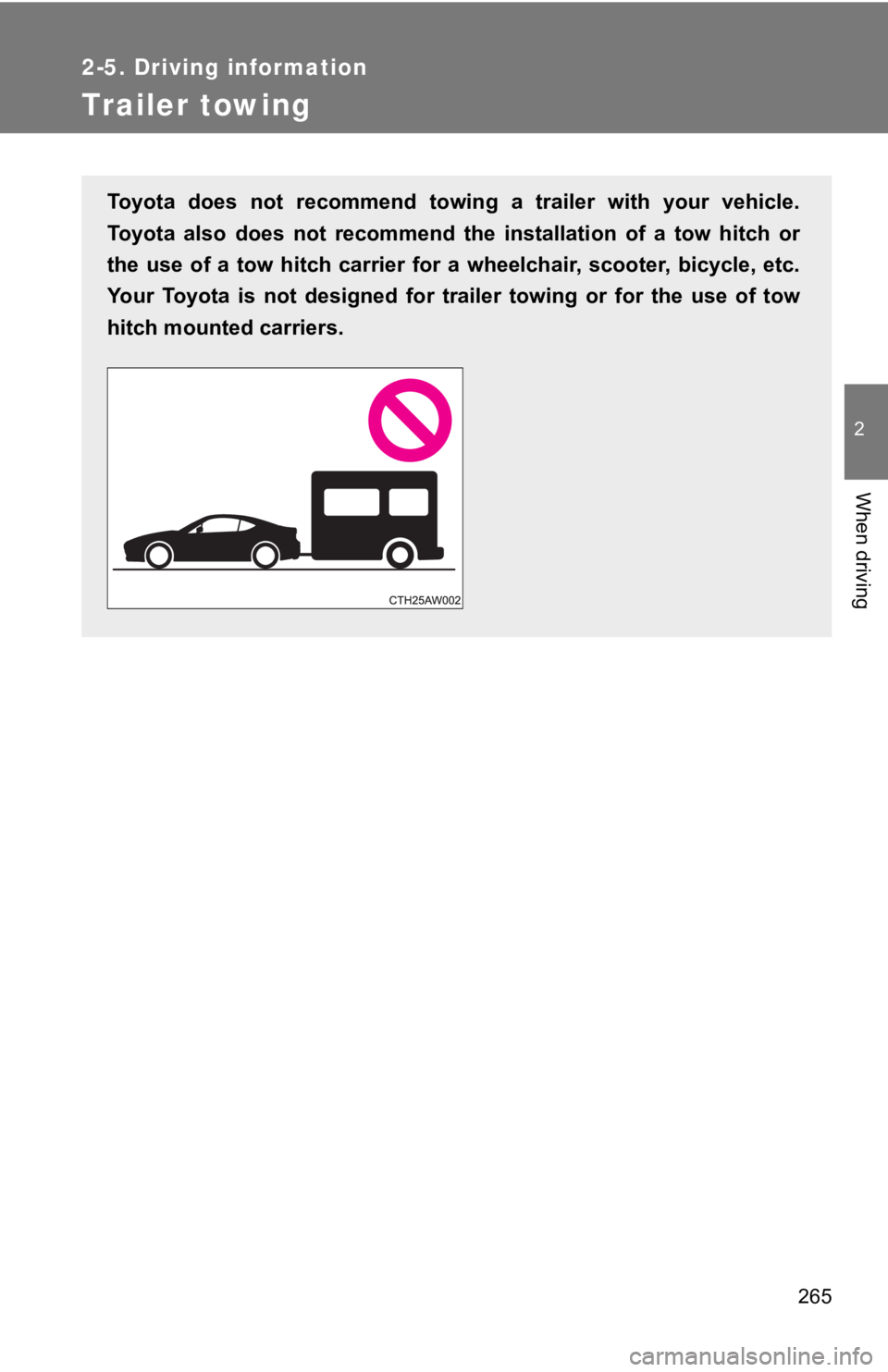
Toyota does not recommend towing a trailer with your vehicle.
Toyota also does not recommend the installation of a tow hitch or
the use of a tow hitch carrier f or a wheelchair, scooter, bicycle, etc.
Your Toyota is not designed for trailer towing or for the use o f tow
hitch mounted carriers.
Page 266 of 532
266
2-5. Driving information
Dinghy towing
NOTICE
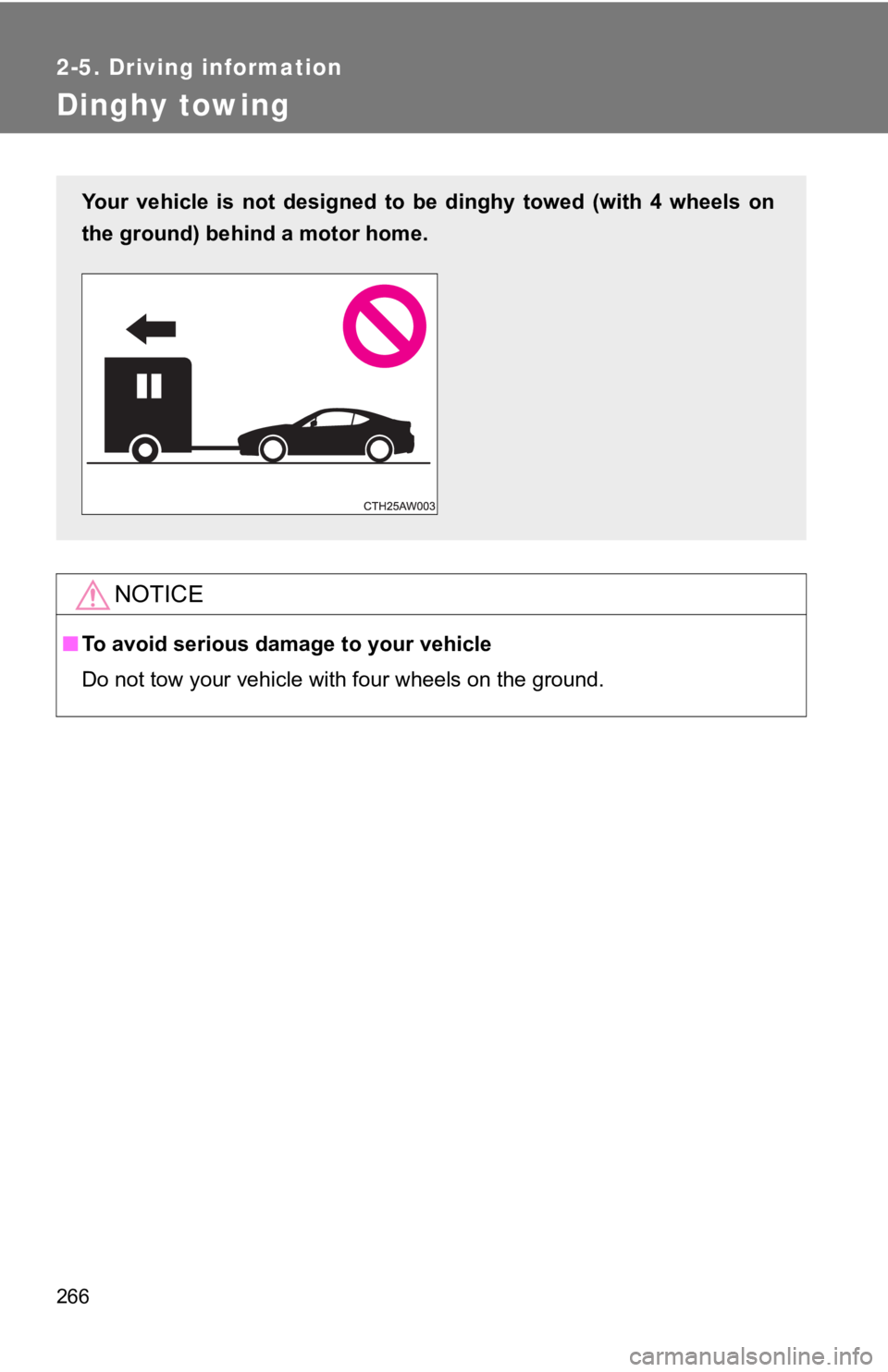
■To avoid serious damage to your vehicle
Do not tow your vehicle with four wheels on the ground.
Your vehicle is not designed to be dinghy towed (with 4 wheels on
the ground) behind a motor home.
Page 267 of 532
Interior features3
267
3-1. Using the air conditioning system
and defogger
Manual air conditioning system ........................... 268
Automatic air conditioning system ........................... 275
Rear window and outside rear view mirror
defoggers ....................... 284
3-2. Using the audio system Using the AUX/USB port ........................ 286
Steering wheel audio switches ......................... 287
Using the microphone ...... 288
3-3. Using the interior lights Interior lights list ............... 289
• Interior light .................... 290 3-4. Using the storage
features
List of storage features .... 291
• Glove box....................... 292
• Bottle holders ................. 293
• Cup holders/ console tray ................... 294
3-5. Other interior features Sun visors ........................ 296
Vanity mirrors ................... 297
Clock ................................ 298
Power outlets ................... 299
Seat heaters..................... 301
Floor mat .......................... 303
Page 287 of 532
287
3-2. Using the audio system
3
Interior features
Steering wheel audio switches
WARNING
To reduce the risk of an accident, exercise care when operating the audio
switches on the steering wheel.
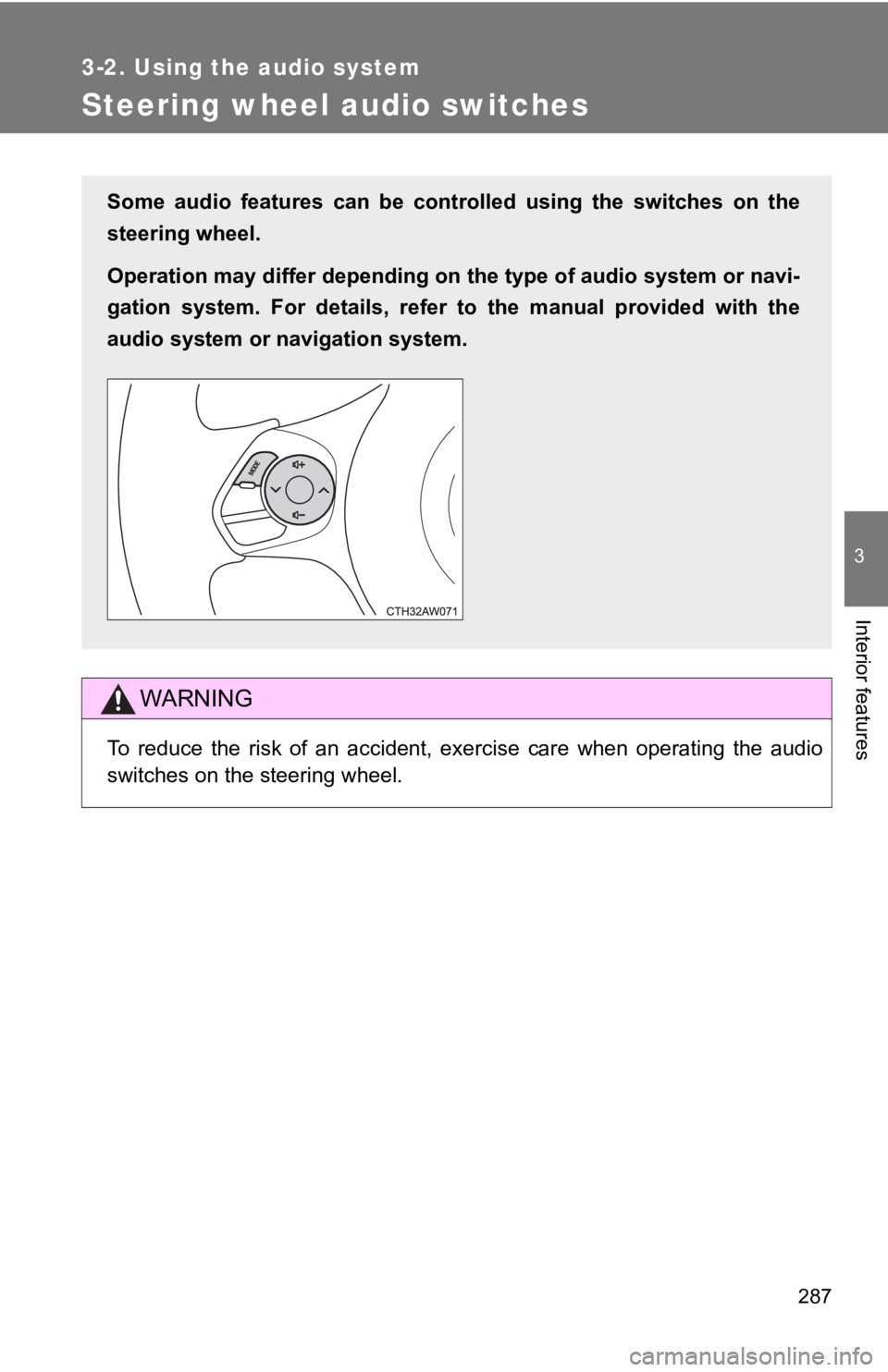
Some audio features can be controlled using the switches on the
steering wheel.
Operation may differ depending on the type of audio system or n avi-
gation system. For details, refer to the manual provided with the
audio system or navigation system.