belt TOYOTA 86 2018 Repair Manual
[x] Cancel search | Manufacturer: TOYOTA, Model Year: 2018, Model line: 86, Model: TOYOTA 86 2018Pages: 532, PDF Size: 6.48 MB
Page 164 of 532

164 2-1. Driving procedures
NOTICE
■Pre-driving check
Trapping small animals in the cooling fan and belts of the engi ne may result
in a malfunction. Check that no small animal enters the engine compartment
and under the vehicle before starting the engine.
■ When driving the vehicle
Vehicles with an automatic transmission
●Do not depress the accelerator and brake pedals at the same tim e during
driving, as this may r estrain driving torque.
● Do not use the accelerator pedal or depress the accelerator and brake
pedals at the same time to hold the vehicle on a hill.
Vehicles with a manual transmission
● Do not depress the accelerator and brake pedals at the same tim e during
driving, as this may r estrain driving torque.
● Do not shift gears unless the clutch pedal is fully depressed. After shifting,
do not release the clutch pedal abruptly. Doing so may damage t he clutch,
transmission and gears.
● Observe the following to prevent the clutch from being damaged.
• Do not rest your foot on the clutch pedal while driving.
Doing so may cause clutch trouble.
• Do not use any gear other than the 1st gear when starting off and mov-
ing forward.
Doing so may damage the clutch.
• Do not use the clutch to hold the vehicle when stopping on an uphill
grade.
Doing so may damage the clutch.
● Do not shift the shift lever to R when the vehicle is still moving. Doing so
may damage the clutch, transmission and gears.
● Do not release the clutch pedal too quickly. Doing so may damag e the
transmission.
■ When parking the vehicle (vehicl es with an automatic transmission)
Always shift the shift lever to P. Failure to do so may cause t he vehicle to
move or the vehicle may accelerate suddenly if the accelerator pedal is acci-
dentally depressed.
Page 259 of 532

259
2-5. Driving information
2
When driving
WARNING
■Storage precautions
Observe the following precautions.
Failure to do so may result i
n death or serious injury.
●Stow cargo and luggage in the trunk whenever possible.
●To prevent cargo and luggage from sliding forward during brakin g, do
not stack anything in the enlarged trunk. Keep cargo and luggag e low,
as close to the floor as possible.
●When you fold down the rear seats, long items should not be pla ced
directly behind the front seats.
●Never allow anyone to ride in the enlarged trunk. It is not des igned for
passengers. They should ride in their seats with their seat belts prop-
erly fastened. Otherwise, they are much more likely to suffer d eath or
serious bodily injury, in the event of sudden braking, sudden s werving
or an accident.
●Do not place cargo or luggage in or on the following locations as the
item may get under the clutch, brake or accelerator pedal and p revent
the pedals from being depressed properly, block the driver’s vi sion, or
hit the driver or passengers, causing an accident:
• At the feet of the driver
• On the front passenger or rear seats (when stacking items)
• On the package tray
• On the instrument panel
• On the dashboard
●Secure all items in the occupant compartment, as they may shift and
injure someone during sudden braking, sudden swerving or an acc i-
dent.
■Capacity and distribution
●Do not exceed the maximum axle weight rating or the total vehic le
weight rating.
●Even if the total load of occupant's weight and the cargo load is less
than the total load capacity, do not apply the load unevenly. I mproper
loading may cause deterioration of steering or braking control which
may cause death or serious injury.
Page 313 of 532
313
4-1. Maintenance and care
4
Maintenance and care
■
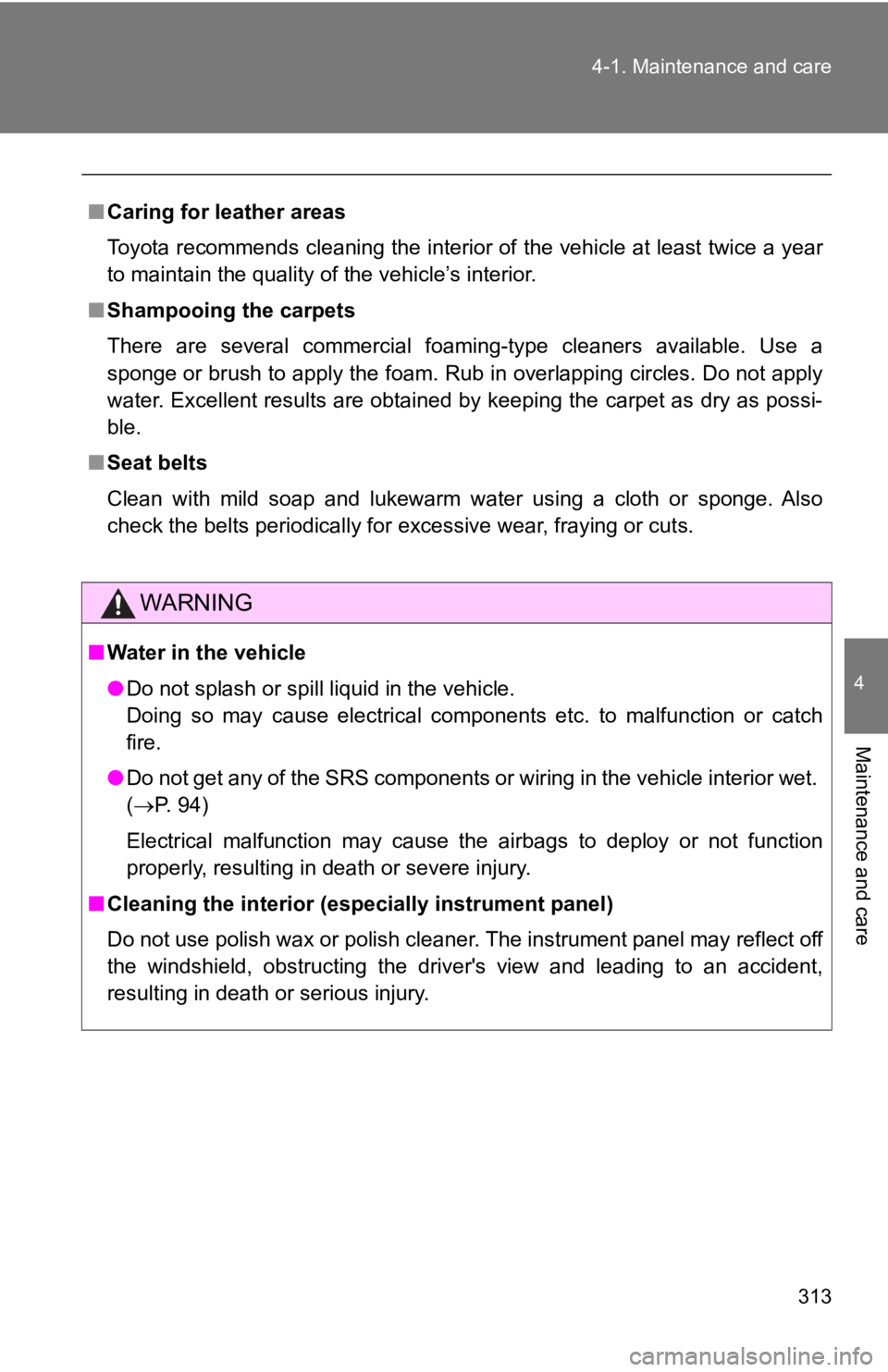
Caring for leather areas
Toyota recommends cleaning the interior of the vehicle at least twice a year
to maintain the quality of the vehicle’s interior.
■ Shampooing the carpets
There are several commercial foaming-type cleaners available. U se a
sponge or brush to apply the foam. Rub in overlapping circles. Do not apply
water. Excellent results are obtained by keeping the carpet as dry as possi-
ble.
■ Seat belts
Clean with mild soap and lukewarm water using a cloth or sponge. Also
check the belts periodically for excessive wear, fraying or cut s.
WARNING
■Water in the vehicle
●Do not splash or spill liquid in the vehicle.
Doing so may cause electrical components etc. to malfunction or catch
fire.
● Do not get any of the SRS components or wiring in the vehicle i nterior wet.
( P. 94)
Electrical malfunction may cause the airbags to deploy or not f unction
properly, resulting in death or severe injury.
■ Cleaning the interior (esp ecially instrument panel)
Do not use polish wax or polish cleaner. The instrument panel m ay reflect off
the windshield, obstructing the driver's view and leading to an accident,
resulting in death or serious injury.
Page 321 of 532
321
4-2. Maintenance
4
Maintenance and care
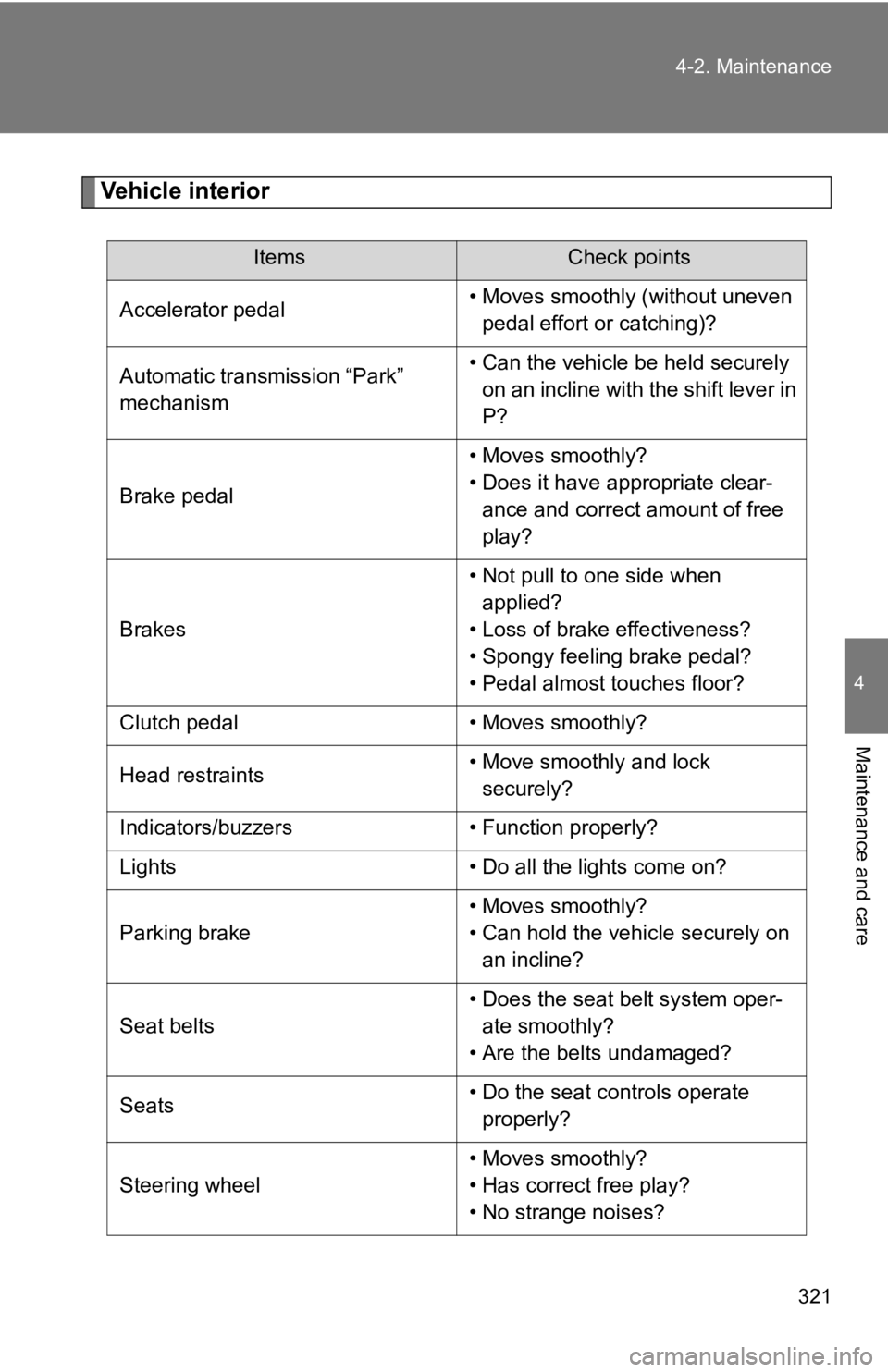
Vehicle interior
ItemsCheck points
Accelerator pedal • Moves smoothly (without uneven
pedal effort or catching)?
Automatic transmission “Park”
mechanism • Can the vehicle be held securely
on an incline with the shift lever in
P?
Brake pedal • Moves smoothly?
• Does it have appropriate clear-
ance and correct amount of free
play?
Brakes • Not pull to one side when
applied?
• Loss of brake effectiveness?
• Spongy feeling brake pedal?
• Pedal almost touches floor?
Clutch pedal • Moves smoothly?
Head restraints • Move smoothly and lock
securely?
Indicators/buzzers • Function properly?
Lights • Do all the lights come on?
Parking brake • Moves smoothly?
• Can hold the vehicle securely on
an incline?
Seat belts • Does the seat belt system oper-
ate smoothly?
• Are the belts undamaged?
Seats • Do the seat controls operate
properly?
Steering wheel • Moves smoothly?
• Has correct free play?
• No strange noises?
Page 326 of 532
326 4-3. Do-it-yourself maintenance
WARNING
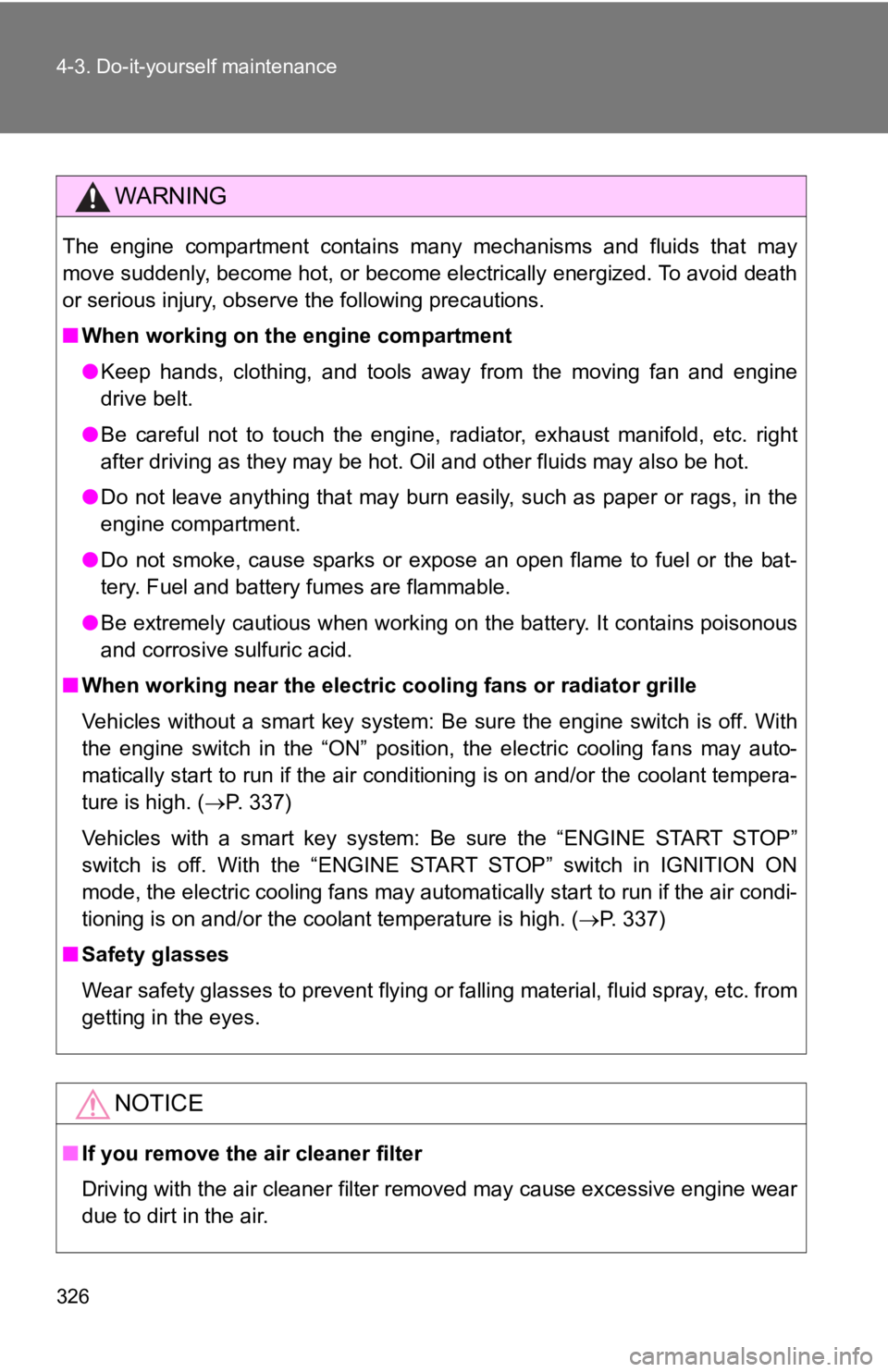
The engine compartment contains many mechanisms and fluids that may
move suddenly, become hot, or become electrically energized. To avoid death
or serious injury, observe the following precautions.
■ When working on the engine compartment
●Keep hands, clothing, and tools away from the moving fan and en gine
drive belt.
● Be careful not to touch the engine, radiator, exhaust manifold, etc. right
after driving as they may be hot. Oil and other fluids may also be hot.
● Do not leave anything that may burn easily, such as paper or ra gs, in the
engine compartment.
● Do not smoke, cause sparks or expose an open flame to fuel or t he bat-
tery. Fuel and battery fumes are flammable.
● Be extremely cautious when working on the battery. It contains poisonous
and corrosive sulfuric acid.
■ When working near the electric cooling fans or radiator grille
Vehicles without a smart key system: Be sure the engine switch is off. With
the engine switch in the “ON” position, the electric cooling fa ns may auto-
matically start to run if the air conditioning is on and/or the coolant tempera-
ture is high. ( P. 337)
Vehicles with a smart key system: Be sure the “ENGINE START STO P”
switch is off. With the “ENGINE START STOP” switch in IGNITION ON
mode, the electric cooling fans may automatically start to run if the air condi-
tioning is on and/or the coolant temperature is high. ( P. 337)
■ Safety glasses
Wear safety glasses to prevent flying or falling material, fluid spray, etc. from
getting in the eyes.
NOTICE
■If you remove the air cleaner filter
Driving with the air cleaner filter removed may cause excessive engine wear
due to dirt in the air.
Page 397 of 532
5
When trouble arises
397
5-2. Steps to take in an emergency
Have the vehicle ins
pected immediately.
Failing to investigate the cause of the following warnings may lead to
the system operating abnormally and possibly cause an accident.
Have the vehicle ins pected by your Toyota dealer immediately.
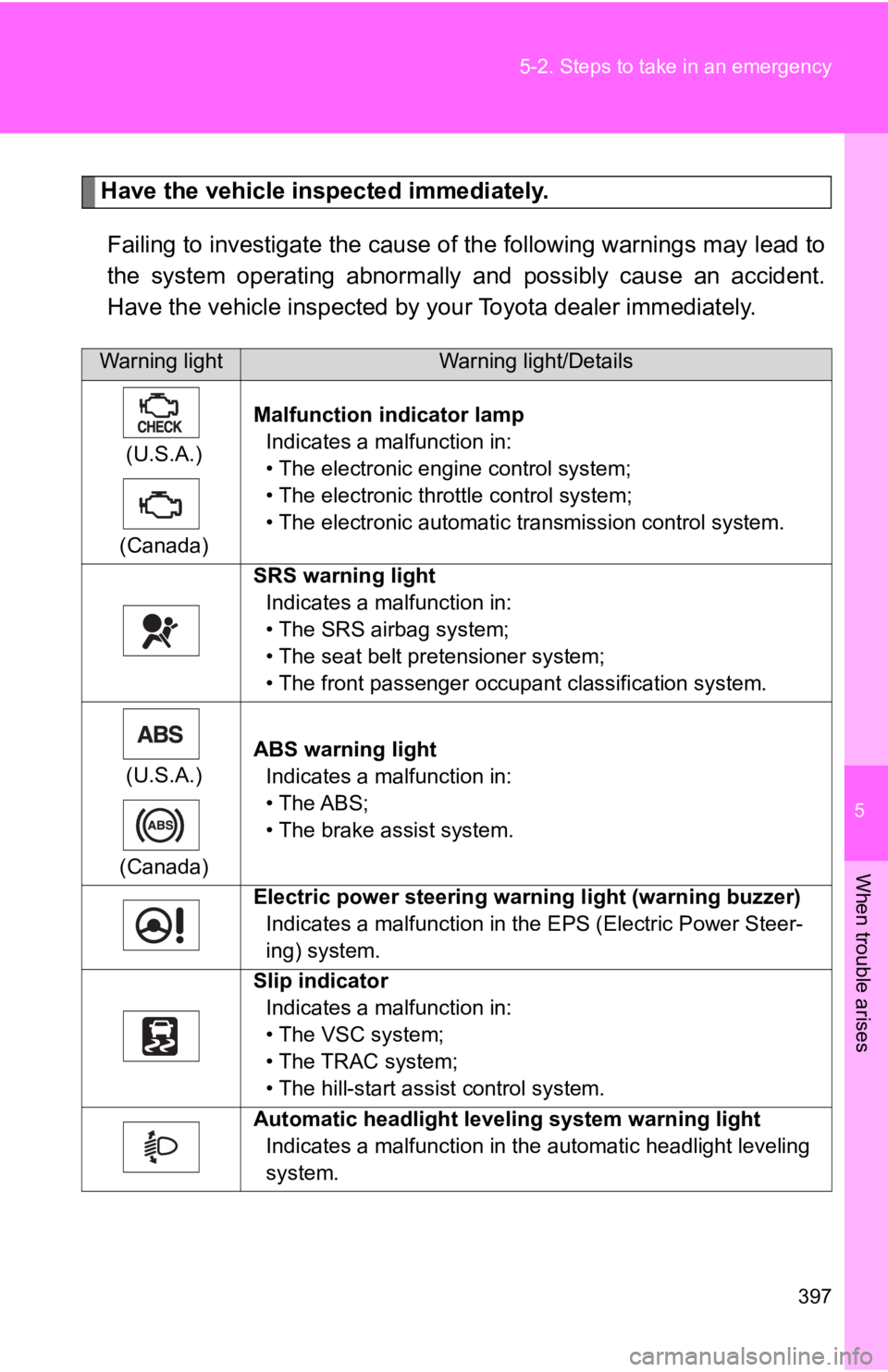
Warning lightWarning light/Details
(U.S.A.)
(Canada) Malfunction indicator lamp
Indicates a malfunction in:
• The electronic engine control system;
• The electronic throttle control system;
• The electronic automatic transmission control system.
SRS warning light Indicates a malfunction in:
• The SRS airbag system;
• The seat belt pretensioner system;
• The front passenger occupant classification system.
(U.S.A.)
(Canada) ABS warning light
Indicates a malfunction in:
• The ABS;
• The brake assist system.
Electric power steering warning light (warning buzzer) Indicates a malfunction in the EPS (Electric Power Steer-
ing) system.
Slip indicator Indicates a malfunction in:
• The VSC system;
• The TRAC system;
• The hill-start assist control system.
Automatic headlight leveling system warning light Indicates a malfunction in the automatic headlight leveling
system.
Page 399 of 532
5
When trouble arises
399
5-2. Steps to take in an emergency
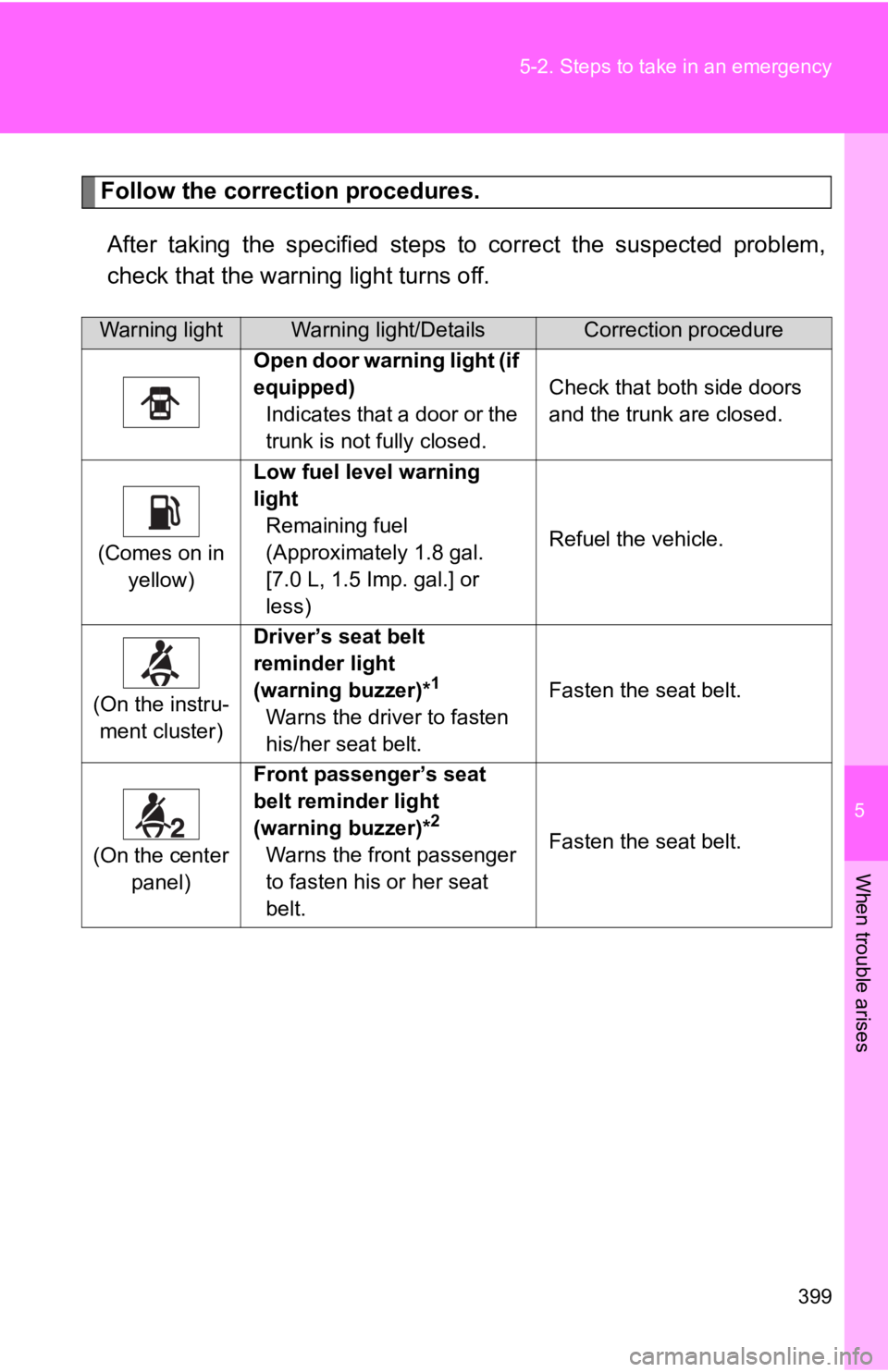
Follow the correction procedures.
After taking the specified steps to correct the suspected probl em,
check that the warning light turns off.
Warning lightWarning light/DetailsCorrection procedure
Open door warning light (if
equipped) Indicates that a door or the
trunk is not fully closed. Check that both side doors
and the trunk are closed.
(Comes on in yellow) Low fuel level warning
light
Remaining fuel
(Approximately 1.8 gal.
[7.0 L, 1.5 Imp. gal.] or
less) Refuel the vehicle.
(On the instru- ment cluster) Driver’s seat belt
reminder light
(warning buzzer)*
1
Warns the driver to fasten
his/her seat belt.
Fasten the seat belt.
(On the center panel) Front passenger’s seat
belt reminder light
(warning buzzer)*
2
Warns the front passenger
to fasten his or her seat
belt.
Fasten the seat belt.
Page 401 of 532

5
When trouble arises
401
5-2. Steps to take in an emergency
*1: Driver’s seat belt buzzer:
Vehicles without a smart key system
The driver’s seat belt buzzer sounds to alert the driver that h is or her seat
belt is not fastened. Once the engine switch is turned to the “ ON” position,
the buzzer sounds for 6 seconds. If the vehicle reaches a speed of 12 mph
(20 km/h), the buzzer sounds once. If the seat belt is still un fastened after 24
seconds, the buzzer will sound intermittently for 10 seconds. Then, if the
seat belt is still unfastened, the buzzer will sound in a different tone for 20
more seconds.
Vehicles with a smart key system
The driver’s seat belt buzzer sounds to alert the driver that h is or her seat
belt is not fastened. Once the “ENGINE START STOP” switch is turned to
IGNITION ON mode, the buzzer sounds for 6 seconds. If the vehic le
reaches a speed of 12 mph (20 km/h), the buzzer sounds once. If the seat
belt is still unfastened after 24 seconds, the buzzer will soun d intermittently
for 10 seconds. Then, if the seat belt is still unfastened, the buzzer will
sound in a different tone for 20 more seconds.
*2: Front passenger’s seat belt buzzer:
The front passenger’s seat belt buzzer sounds to alert the front passenger
that his or her seat belt is not fastened. The buzzer sounds on ce if the vehi-
cle reaches a speed of 12 mph (20 km/h). If the seat belt is st ill unfastened
after 24 seconds, the buzzer will sound intermittently for 10 s econds. Then,
if the seat belt is still unfastened, the buzzer will sound in a different tone for
20 more seconds.
Page 402 of 532

402 5-2. Steps to take in an emergency
■Front passenger detection sensor and passenger seat belt remind er
and warning buzzer
● If luggage is placed on the front passenger seat, the front passenger
detection sensor may cause the warning light to flash and warni ng
buzzer to sound, even if a passenger is not sitting in the seat.
● If a cushion is placed on the seat, the sensor may not detect a passen-
ger, and the warning light may not operate properly.
■
When the tire pressure warning light comes on
Check the tire inflation pressure and adjust to the appropriate level.
■The tire pressure warning light may turn on due to natural caus es
The tire pressure warning light may turn on due to natural caus es such
as natural air leaks or tire inflation pressure changes caused by tem-
perature. In this case, adjusting the tire inflation pressure w ill turn off the
warning light (after a few minutes).
■When a tire is replace d with a spare tire
The compact spare tire is not equipped with a tire pressure war ning
valve and transmitter. If a tire goes flat, the tire pressure w arning light will
not turn off even though the flat tire has been replaced with t he spare
tire. Replace the spare tire with the repaired tire and adjust the tire infla-
tion pressure. The tire pressure warning light will go off afte r a few min-
utes.
Page 409 of 532
5
When trouble arises
409
5-2. Steps to take in an emergency
Have the vehicle ins
pected immediately.
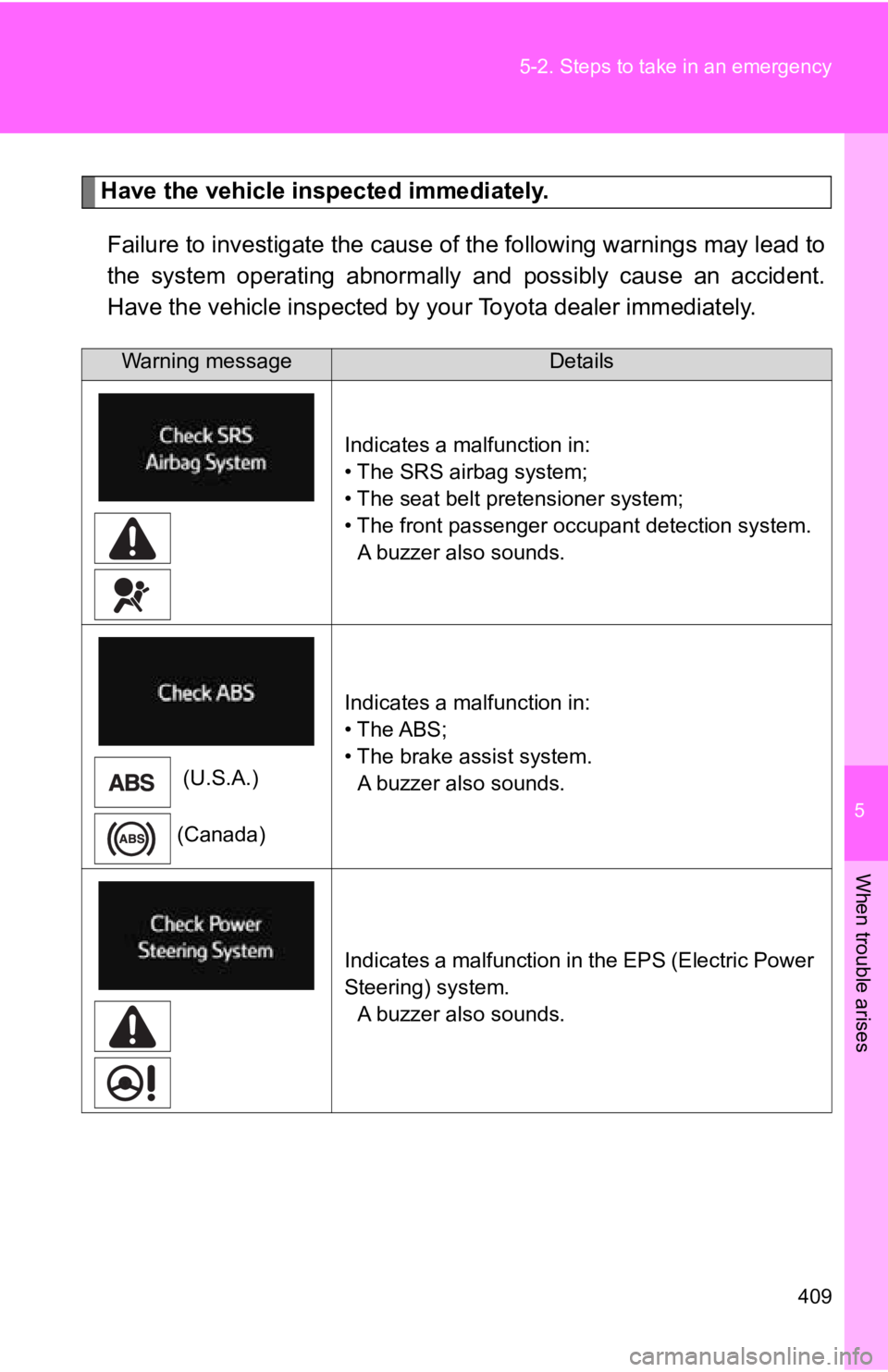
Failure to investigate the cause of the following warnings may lead to
the system operating abnormally and possibly cause an accident.
Have the vehicle ins pected by your Toyota dealer immediately.
Warning messageDetails
Indicates a malfunction in:
• The SRS airbag system;
• The seat belt pretensioner system;
• The front passenger occupant detection system. A buzzer also sounds.
(U.S.A.)
(Canada) Indicates a malfunction in:
• The ABS;
• The brake assist system.
A buzzer also sounds.
Indicates a malfunction in the EPS (Electric Power
Steering) system. A buzzer also sounds.