brake TOYOTA 86 2018 Manual PDF
[x] Cancel search | Manufacturer: TOYOTA, Model Year: 2018, Model line: 86, Model: TOYOTA 86 2018Pages: 532, PDF Size: 6.48 MB
Page 436 of 532
436 5-2. Steps to take in an emergency
Emergency start function (vehicles with a smart key system)
When the engine does not start, the following steps can be used as
an interim measure to start the engine if the “ENGINE START STO P”
switch is functioning normally:
Vehicles with an auto matic transmission
Set the parking brake.
Put the shift lever in P.
Set the “ENGINE START STOP” switch to ACCESSORY
mode.
Press and hold the “ENGINE START STOP” switch about 15
seconds while depressing the brake pedal firmly.
Even if the engine can be started using the above steps, the system
may be malfunctioning. Have the vehicle checked by your Toyota
dealer.
■ The starter motor does not turn over, the interior lights and
headlights do not turn on, or the horn does not sound.
One of the following may be the cause of the problem.
● One or both of the battery ter minals may be disconnected.
● The battery may be discharged. ( P. 444)
● There may be a malfunction in the steering lock system. (vehi-
cles with a smart key system)
Contact your Toyota dealer if the problem cannot be repaired, o r if
repair procedures are unknown.
STEP 1
STEP 2
STEP 3
STEP 4
Page 437 of 532

5
When trouble arises
437
5-2. Steps to take in an emergency
Vehicles with a manual transmission
Set the parking brake.
Put the shift lever in N.
Turn the “ENGINE START STOP” switch to ACCESSORY
mode.
Push and hold the “ENGINE START STOP” switch for about
15 seconds while depressing the brake pedal and clutch
pedal firmly.
Even if the engine can be started using the above steps, the sy stem
may be malfunctioning. Have the vehicle checked by your Toyota
dealer.
STEP 1
STEP 2
STEP 3
STEP 4
Page 438 of 532
438
5-2. Steps to take in an emergency
If the shift lever cannot be shifted from P (vehicles with an automatic transmission)
If the shift lever cannot be shifted with your foot on the brake, there
may be a problem with the shif t lock system (a system to prevent
accidental operation of the shift lever). Have the vehicle insp ected by
your Toyota dealer immediately.
The following steps may be used as an emergency measure to
ensure that the shift lever can be shifted.
Set the parking brake.
Vehicles without a smart key system: Turn the engine
switch to the “A CC” position.
Vehicles with a smart key system: Turn the “ENGINE
START STOP” switch to ACCESSORY mode.
Depress the brake pedal.
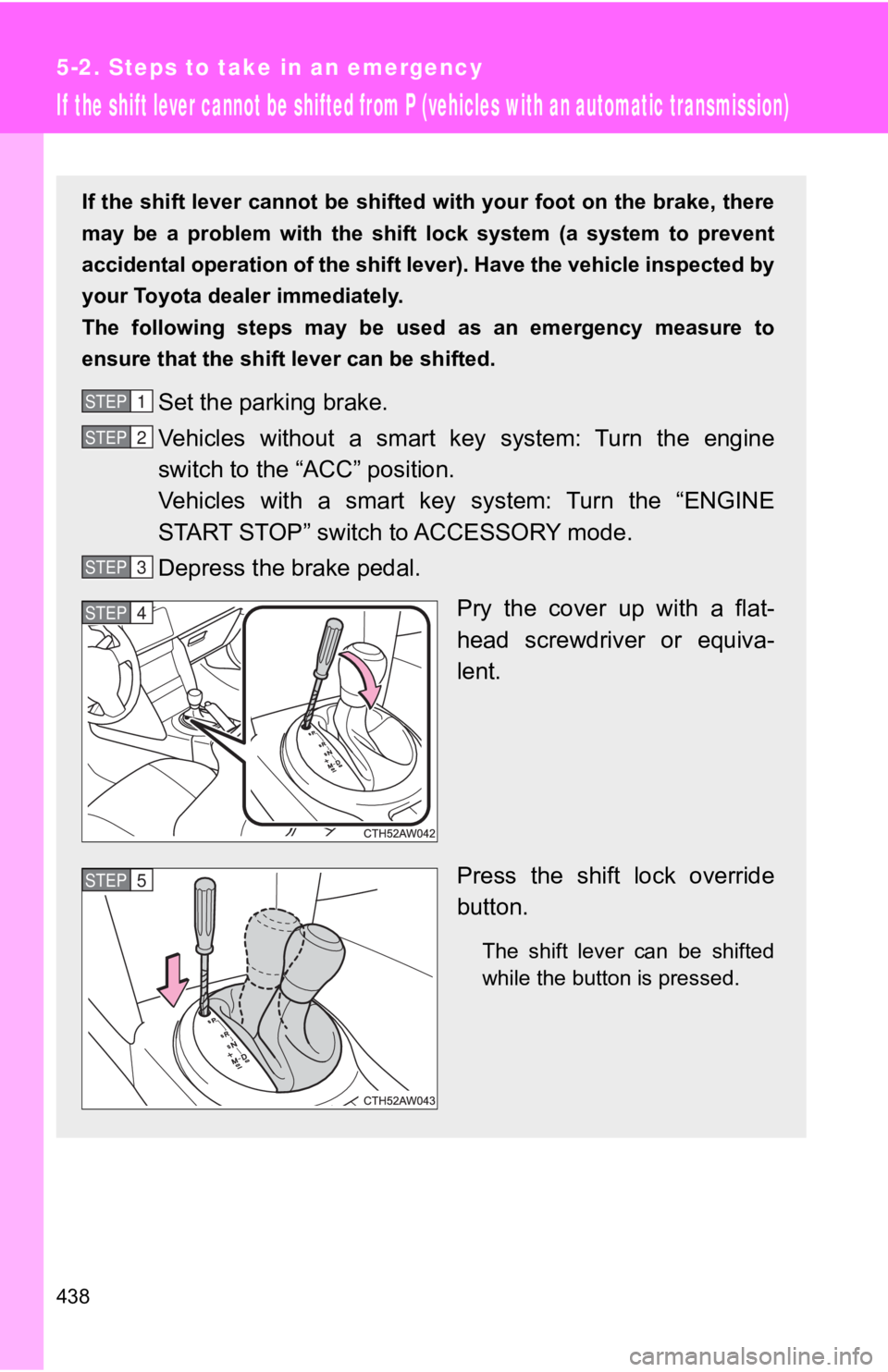
Pry the cover up with a flat-
head screwdriver or equiva-
lent.
Press the shift lock override
button.
The shift lever can be shifted
while the button is pressed.
STEP 1
STEP 2
STEP 3
STEP 4
STEP 5
Page 441 of 532
5
When trouble arises
441
5-2. Steps to take in an emergency
Starting the engine
Vehicles with an auto matic transmission
Ensure that the shift lever is in P and firmly depress the brake
pedal.
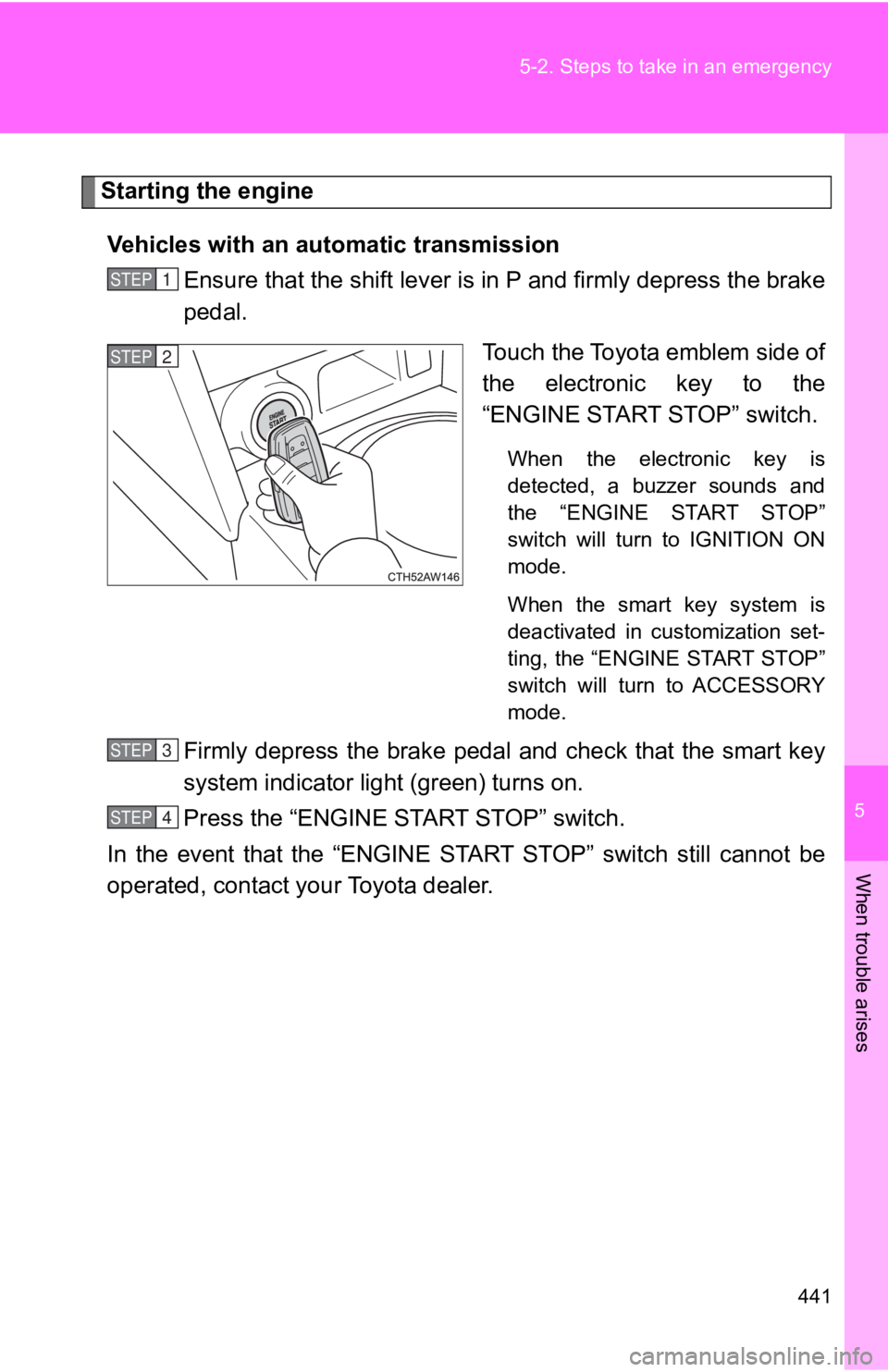
Touch the Toyota emblem side of
the electronic key to the
“ENGINE START STOP” switch.
When the electronic key is
detected, a buzzer sounds and
the “ENGINE START STOP”
switch will turn to IGNITION ON
mode.
When the smart key system is
deactivated in customization set-
ting, the “ENGINE START STOP”
switch will turn to ACCESSORY
mode.
Firmly depress the brake pedal and check that the smart key
system indicator light (green) turns on.
Press the “ENGINE START STOP” switch.
In the event that the “ENGINE START STOP” switch still cannot b e
operated, contact your Toyota dealer.
STEP 1
STEP 2
STEP 3
STEP 4
Page 443 of 532

5
When trouble arises
443
5-2. Steps to take in an emergency
■
Stopping the engine
Vehicles with an automatic transmission: Shift the shift lever to P and press
the “ENGINE START STOP” switch as you normally do when stopping the
engine.
Vehicles with a manual transmission: Shift the shift lever to N and press the
“ENGINE START STOP” switch as you normally do when stopping the
engine.
■ Replacing the key battery
As the above procedure is a temporary measure, it is recommende d that the
electronic key battery be replaced immediately when the battery depletes.
( P. 363)
■ Alarm
Using the mechanical key to lock the doors will not set the alarm system.
If a door is unlocked using the mechanical key when the alarm s ystem is set,
the alarm may be triggered. ( P. 82)
■ Changing “ENGINE START STOP” switch modes
Vehicles with an automatic transmission
Release the brake pedal and press the “ENGINE START STOP” switch in
above.The engine does not start and modes will be changed each
time the switch is pressed. ( P. 169)
Vehicles with a manual transmission
Release the clutch pedal and press the “ENGINE START STOP” swit ch in
above.The engine does not start and modes will be changed each
time the switch is pressed. ( P. 169)
■ If the doors cannot be locked or unlocked by the smart key system
Lock and unlock the doors by the mechanical key or wireless rem ote control.
STEP 3
STEP 3
Page 452 of 532
452
5-2. Steps to take in an emergency
If the vehicle becomes stuck
■When it is difficult to free the vehicle
Carry out the following procedur es if the tires spin or the vehicle
becomes stuck in mud, dirt, or snow:
Stop the engine. Set the parki ng brake and shift the shift
lever to P (vehicles with an automatic transmission) or N
(vehicles with a manual transmission).
Remove the mud, snow or sand from around the rear
wheels.
Place wood, stones or some other material under the rear
wheels to help provide traction.
Restart the engine.
Shift the shift lever to the D or R position (vehicles with an
automatic transmission) or 1 or R position (vehicles with a
manual transmission) and release the parking brake. Then,
while exercising caution, depr ess the accelerator pedal.STEP 1
STEP 2
STEP 3
STEP 4
STEP 5
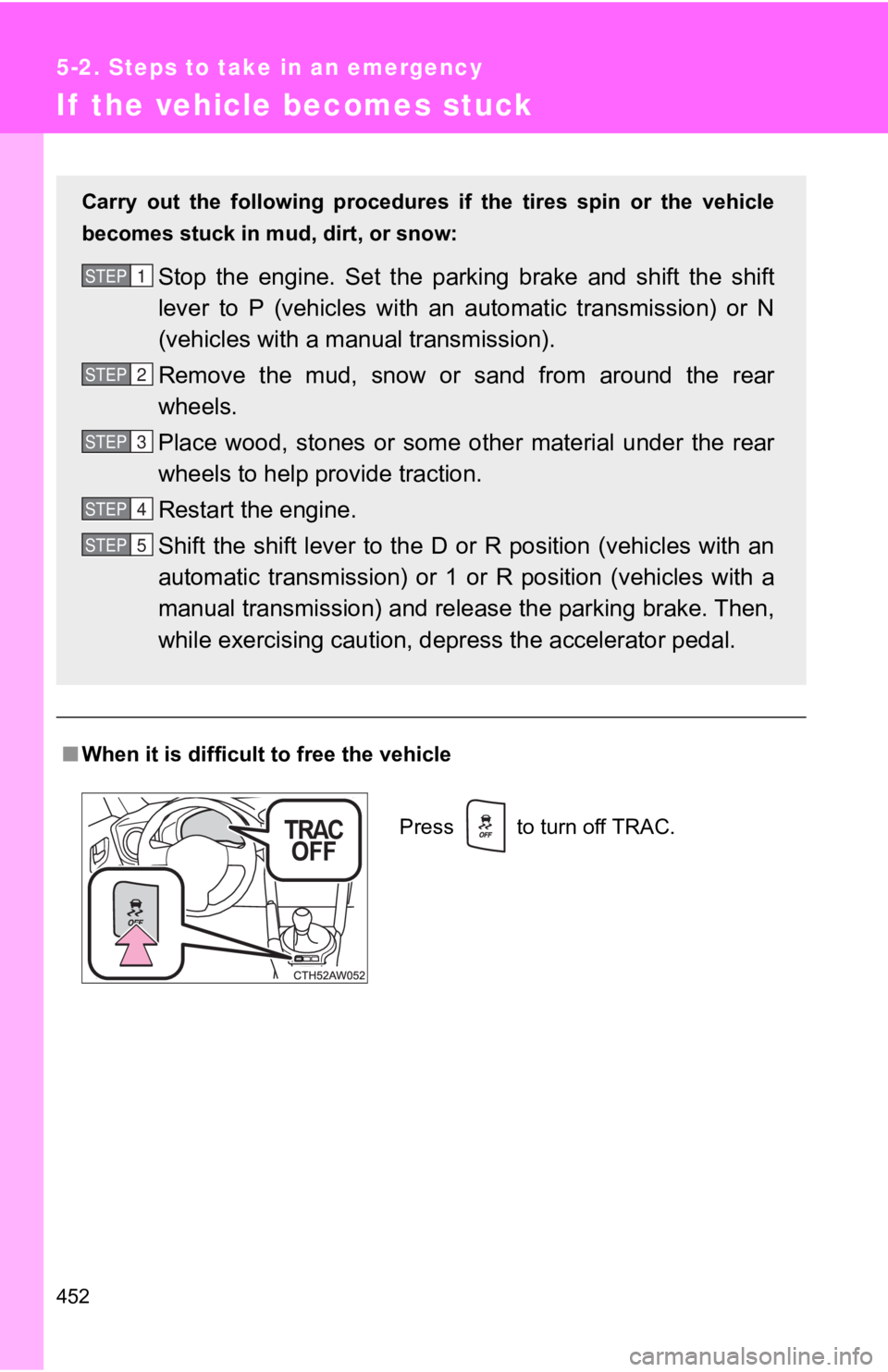
Press to turn off TRAC.
Page 454 of 532
454
5-2. Steps to take in an emergency
If your vehicle has to be stopped in an emergency
Only in an emergency, such as if it becomes impossible to stop the
vehicle in the normal way, stop the vehicle using the following pro-
cedure:
Steadily step on the brake pedal with both feet and firmly
depress it.
Do not pump the brake pedal repeatedly as this will increase th e
effort required to slow the vehicle.
Shift the shif t lever to N.
If the shift lever is shifted to N After slowing down, stop the ve hicle in a safe place by the
road.
Stop the engine.
If the shift l ever cannot be shifted to N
Keep depressing the brake pedal with both feet to reduce
vehicle speed as m uch as possible.
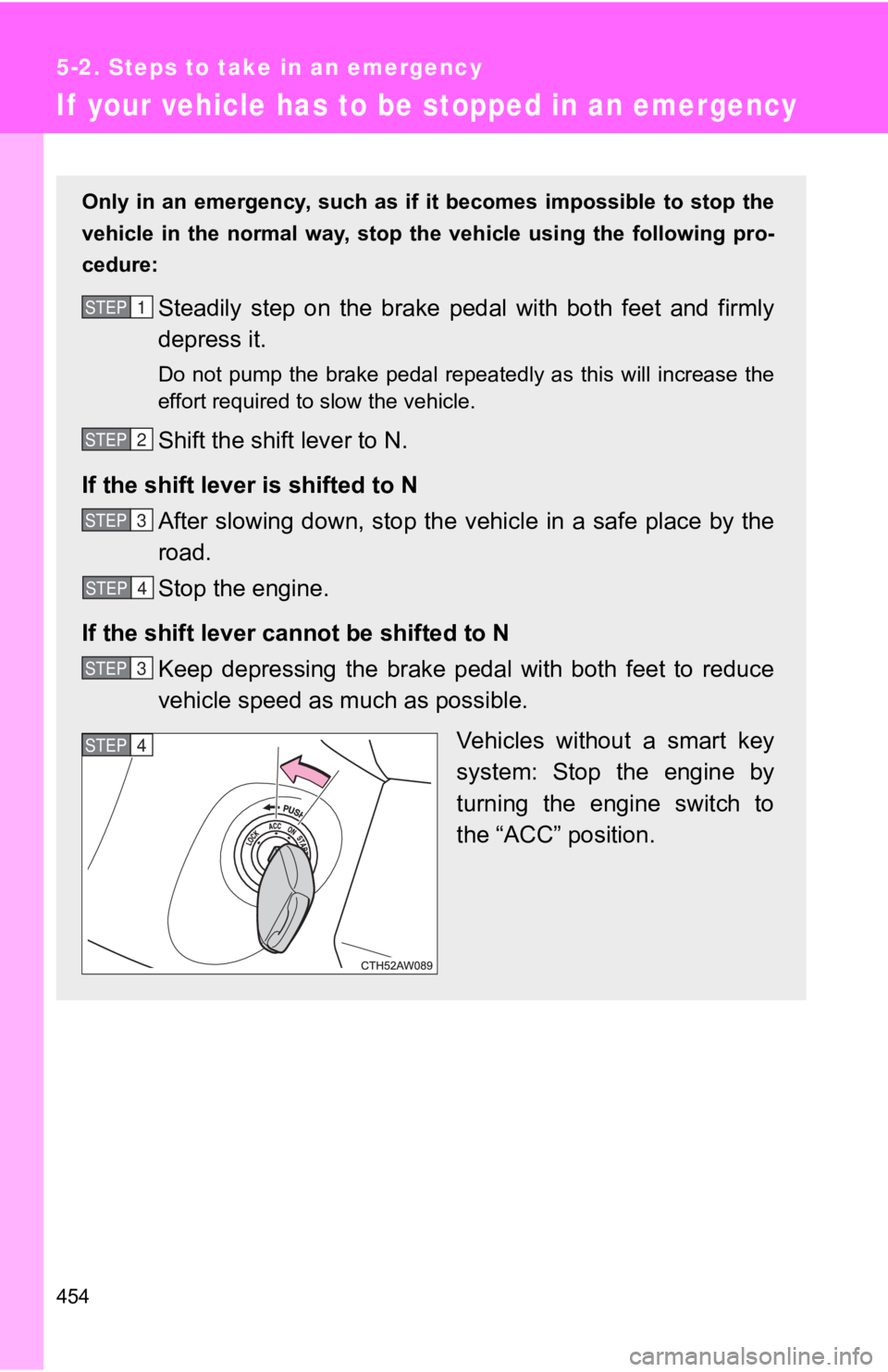
Vehicles without a smart key
system: Stop the engine by
turning the engine switch to
the “ACC” position.
STEP 1
STEP 2
STEP 3
STEP 4
STEP 3
STEP 4
Page 455 of 532
5
When trouble arises
455
5-2. Steps to take in an emergency
WARNING
■
If the engine has to be turned off while driving
● Power assist for the brakes and steering wheel will be lost, ma king the
brake pedal harder to depress and the steering wheel heavier to turn.
Decelerate as much as possible before turning off the engine.
● Vehicles without a smart key system: Never attempt to remove the key, as
doing so will lock the steering wheel.
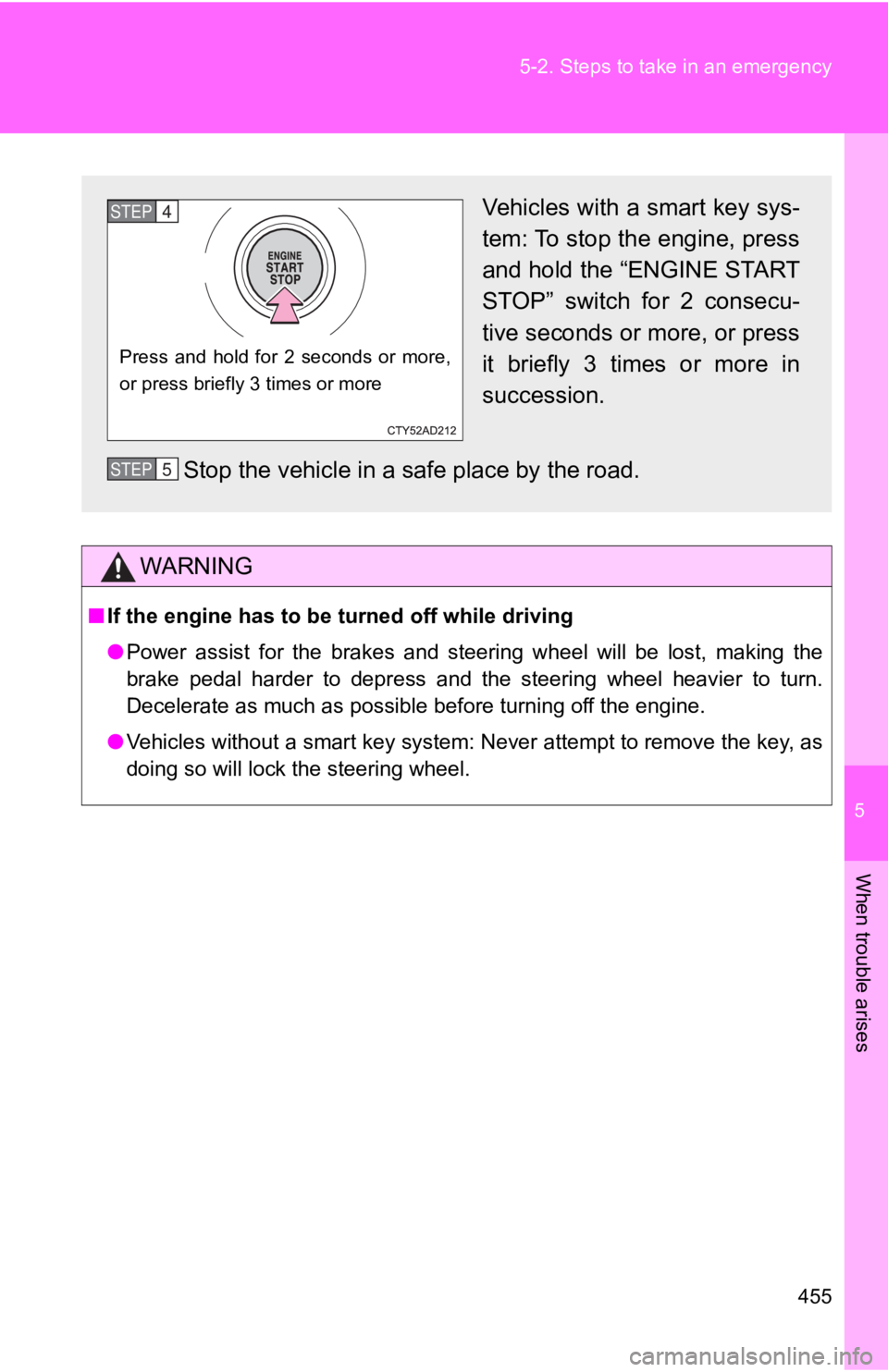
Vehicles with a smart key sys-
tem: To stop the engine, press
and hold the “ENGINE START
STOP” switch for 2 consecu-
tive seconds or more, or press
it briefly 3 times or more in
succession.
Stop the vehicle in a s afe place by the road.
Press and hold for 2 seconds or more,
or press briefly 3 times or more
STEP 4
STEP 5
Page 467 of 532
467
6-1. Specifications
6
Vehicle specifications
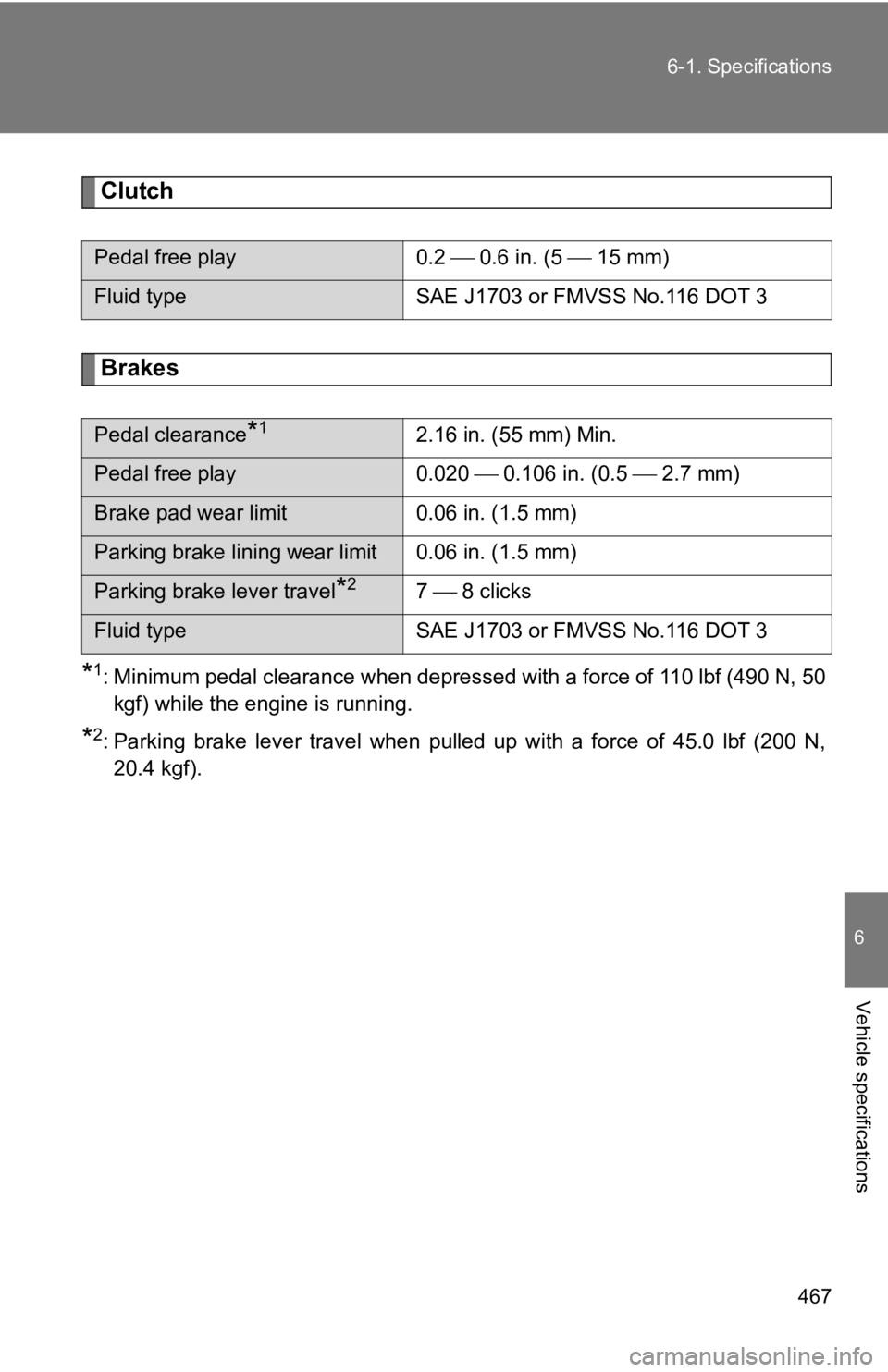
Clutch
Brakes
*1: Minimum pedal clearance when depressed with a force of 110 lbf
(490 N, 50
kgf) while the engine is running.
*2: Parking brake lever travel when pulled up with a force of 45.0 lbf (200 N,
20.4 kgf).
Pedal free play 0.2 0.6 in. (5 15 mm)
Fluid typeSAE J1703 or FMVSS No.116 DOT 3
Pedal clearance*12.16 in. (55 mm) Min.
Pedal free play0.020 0.106 in. (0.5 2.7 mm)
Brake pad wear limit0.06 in. (1.5 mm)
Parking brake lining wear limit 0.06 in. (1.5 mm)
Parking brake lever travel*27 8 clicks
Fluid type SAE J1703 or FMVSS No.116 DOT 3
Page 480 of 532

480 6-1. Specifications
Warning: The temperature grades of a tire assume that it is properly
inflated and not overloaded.
Excessive speed, underinflation, or excessive loading, either s epa-
rately or in combination, can cause heat buildup and possible t ire fail-
ure.
Glossary of tire terminology
Tire related termMeaning
Cold tire inflation
pressure Tire pressure when the vehicle has been
parked for three hours or more, or has not
been driven more than 1
mile or 1.5 km under
that condition
Maximum inflation
pressure The maximum cold inflated pressure to which a
tire may be inflated, shown on the sidewall of
the tire
Recommended
inflation pressure Cold tire inflation pressure recommended by a
manufacturer.
Accessory weight The combined weight (i
n excess of those stan-
dard items which may be replaced) of auto-
matic transmission, po wer steering, power
brakes, power windows, power seats, radio
and heater, to the exten t that these items are
available as factory-installed equipment
(whether installed or not)
Curb weight The weight of a
motor vehicle with standard
equipment, including th e maximum capacity of
fuel, oil and coolant, and if so equipped, air
conditioning and additional weight optional
engine
Maximum loaded
vehicle weight The sum of:
(a) Curb weight
(b) Accessory weight
(c) Vehicle capacity weight
(d) Production options weight