brake TOYOTA 86 2018 Workshop Manual
[x] Cancel search | Manufacturer: TOYOTA, Model Year: 2018, Model line: 86, Model: TOYOTA 86 2018Pages: 532, PDF Size: 6.48 MB
Page 324 of 532
324
4-3. Do-it-yourself maintenance
Do-it-yourself ser vice precautions
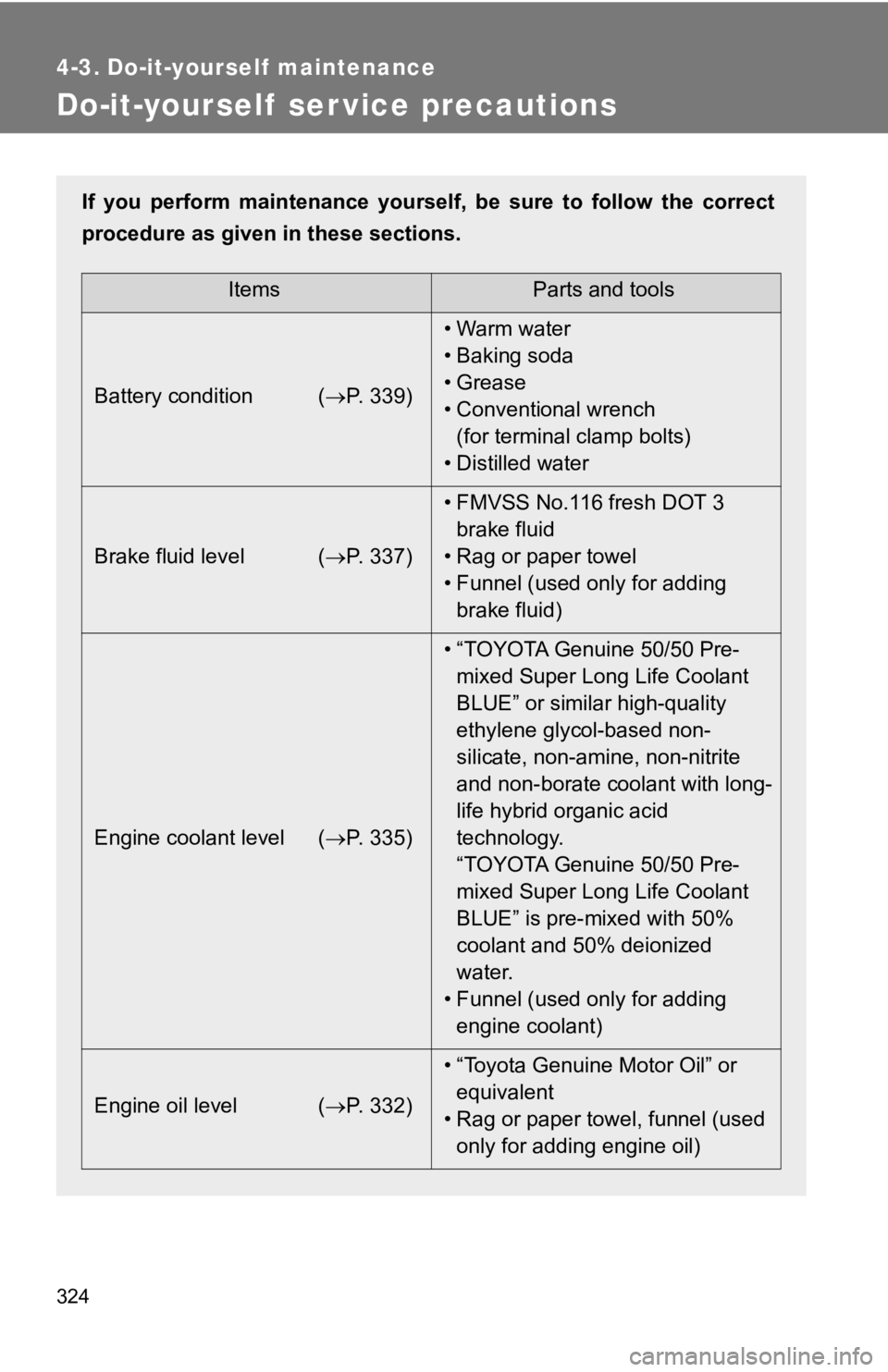
If you perform maintenance yourself, be sure to follow the correct
procedure as given in these sections.
ItemsParts and tools
Battery condition ( P. 339)•Warm water
• Baking soda
• Grease
• Conventional wrench
(for terminal clamp bolts)
• Distilled water
Brake fluid level ( P. 337)• FMVSS No.116 fresh DOT 3
brake fluid
• Rag or paper towel
• Funnel (used only for adding brake fluid)
Engine coolant level ( P. 335)• “TOYOTA Genuine 50/50 Pre-
mixed Super Long Life Coolant
BLUE” or similar high-quality
ethylene glycol-based non-
silicate, non-amine, non-nitrite
and non-borate coolant with long-
life hybrid organic acid
technology.
“TOYOTA Genuine 50/50 Pre-
mixed Super Long Life Coolant
BLUE” is pre-mixed with 50%
coolant and 50% deionized
water.
• Funnel (used only for adding engine coolant)
Engine oil level ( P. 332)• “Toyota Genuine Motor Oil” or
equivalent
• Rag or paper towel, funnel (used only for adding engine oil)
Page 330 of 532
330 4-3. Do-it-yourself maintenance
WARNING
■When raising your vehicle
Make sure to observe the following precautions to reduce the po ssibility of
death or serious injury:
● When using a floor jack, follow the instructions of the manual provided with
the jack.
● Do not use the jack that was supplied with your vehicle.
● Do not put any part of your body underneath the vehicle when it is sup-
ported only by the floor jack.
● Always use floor jack and/or automotive jack stands on a solid, flat, level
surface.
● Do not start the engine while the vehicle is supported by the floor jack.
● Stop the vehicle on level, firm ground, firmly set the parking brake and shift
the shift lever to P (vehicles with an automatic transmission) or R (vehicles
with a manual transmission).
● Make sure to set the floor jack properly at the jack point.
Raising the vehicle with an improperly positioned floor jack wi ll damage
the vehicle and may cause the vehicle to fall off the floor jac k.
● Do not raise the vehicle while someone is in the vehicle.
● When raising the vehicle, do not place any object on top of or underneath
the floor jack.
● When raising the vehicle, ensure that there is sufficient surrounding space.
The vehicle’s position may change slightly when lowered.
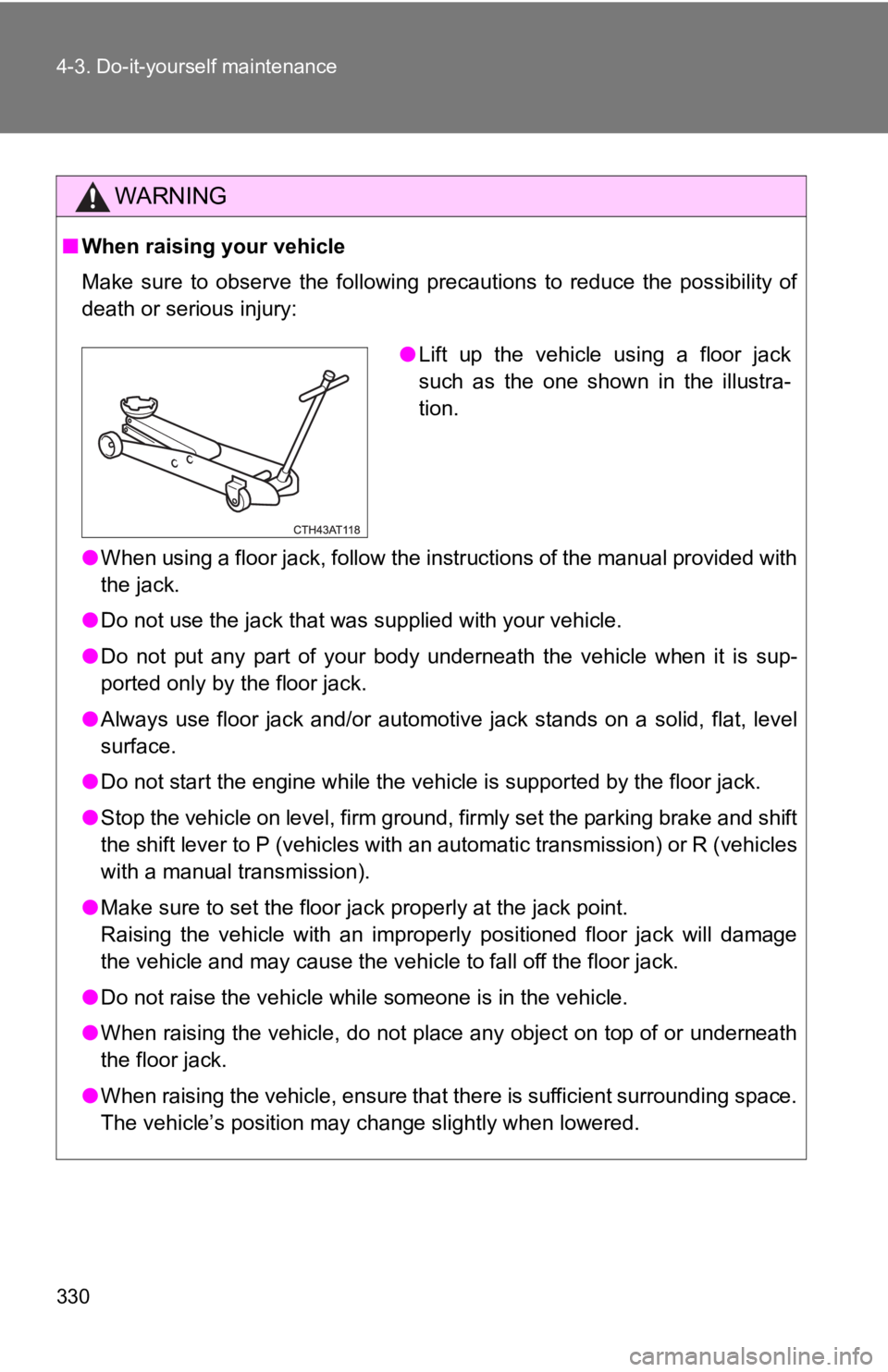
●Lift up the vehicle using a floor jack
such as the one shown in the illustra-
tion.
Page 331 of 532
331
4-3. Do-it-yourself maintenance
4
Maintenance and care
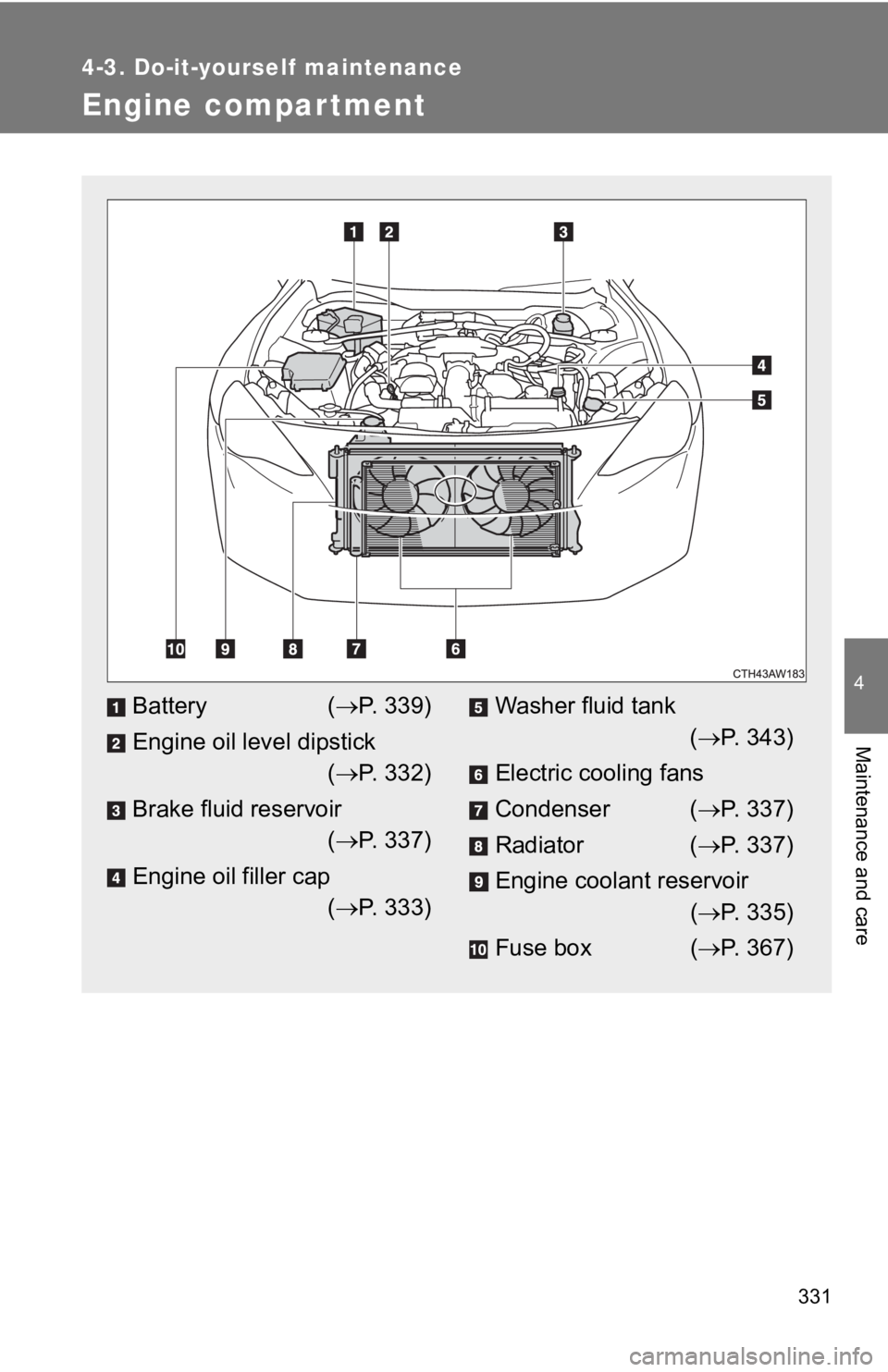
Engine compar tment
Battery( P. 3 3 9 )
Engine oil level dipstick ( P. 3 3 2 )
Brake fluid reservoir ( P. 3 3 7 )
Engine oil filler cap ( P. 3 3 3 )Washer fluid tank
( P. 3 4 3 )
Electric cooling fans
Condenser ( P. 3 3 7 )
Radiator ( P. 3 3 7 )
Engine coolant reservoir ( P. 3 3 5 )
Fuse box ( P. 3 6 7 )
Page 337 of 532
337
4-3. Do-it-yourself maintenance
4
Maintenance and care
Radiator and condenser
Check the radiator and condenser and clear away any foreign
objects.
If either of the above parts are extremely dirty or you are not sure of
their condition, have your vehicle checked by your Toyota dealer.
Brake fluid
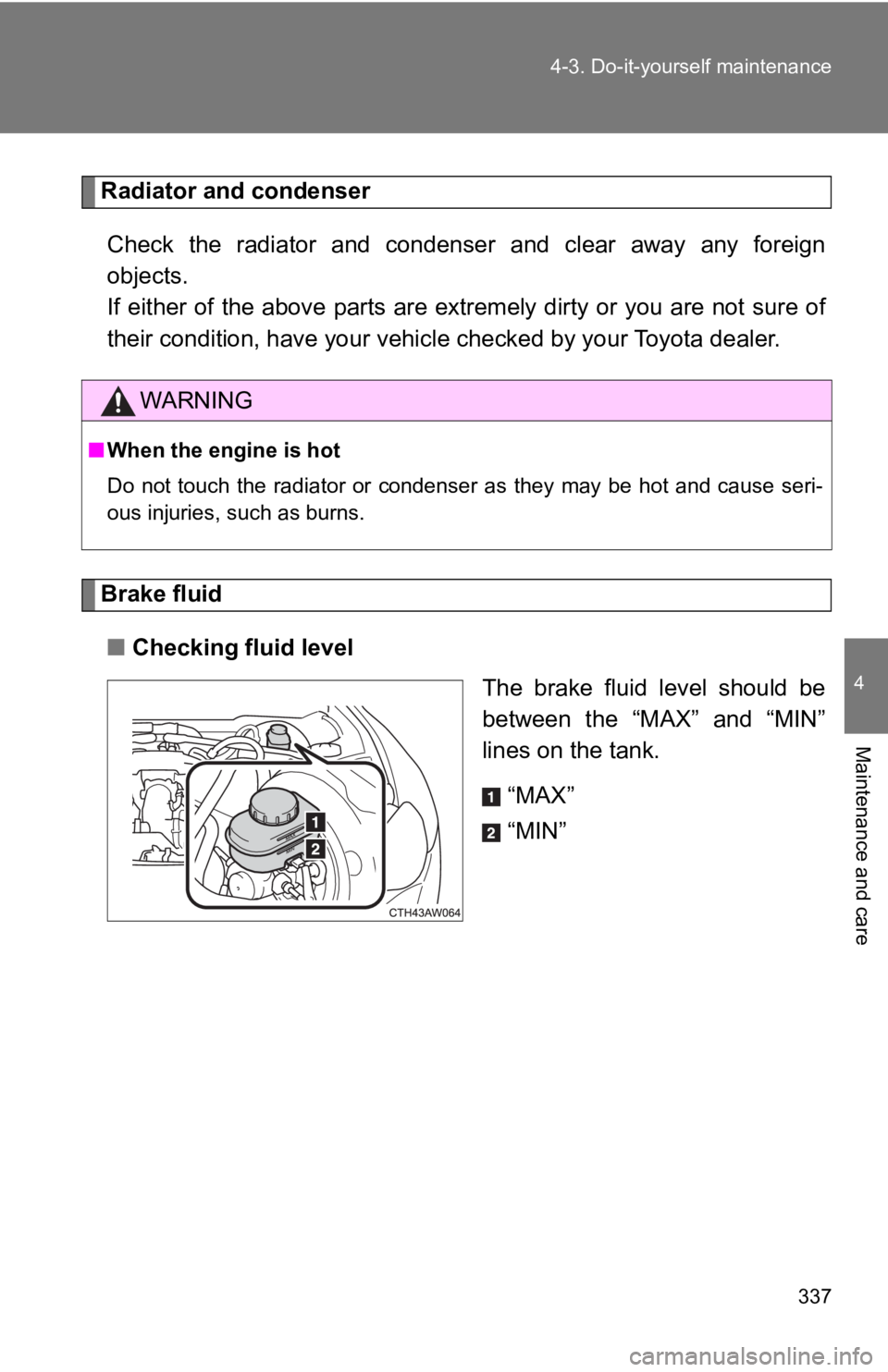
■ Checking fluid level
The brake fluid level should be
between the “MAX” and “MIN”
lines on the tank.
“MAX”
“MIN”
WARNING
■When the engine is hot
Do not touch the radiator or condenser as they may be hot and c ause seri-
ous injuries, such as burns.
Page 338 of 532
338 4-3. Do-it-yourself maintenance
■Adding fluid
Make sure to check the fluid ty pe and prepare the necessary ite ms.
Fluid type SAE J1703 or FMVSS No.116 DOT 3
Items
Clean funnel
■ Brake fluid can absorb moisture from the air
Excess moisture in the fluid can cause a dangerous loss of braking effi-
ciency. Use only newly opened brake fluid.
WARNING
■When filling the reservoir
Take care because brake fluid can harm your hands or eyes and d amage
painted surfaces.
If fluid gets in your eyes, flush your eyes with clean water im mediately.
If you still experience discomfort, see a doctor.
NOTICE
■ If the fluid level is low or high
It is normal for the brake fluid level to go down slightly as t he brake pads
wear or when the fluid level in the accumulator is high.
If the reservoir needs frequent refilling, it may indicate a serious problem.
Page 385 of 532
5
When trouble arises
385
5-1. Essential information
If your vehicle needs to be towed
Before towingThe following may indicate a problem with your transmission. Co ntact
your Toyota dealer before towing.
● The engine is running, but t he vehicle will not move.
● The vehicle makes an abnormal sound.
Emergency towing
If a tow truck is not available in an emergency, your vehicle m ay be
temporarily towed using a cable or chain secured to the emergen cy
towing eyelet. This should only be attempted on hard surfaced r oads
for short distances at low speeds.
A driver must be in the vehicle to steer and operate the brakes . The
vehicle’s wheels, drive train, axles, steering and brakes must be in
good condition.
For vehicles with an automatic transmission, only the front towing
eyelet may be used.
If towing is necessary, we recommend having your vehicle towed by
your Toyota dealer or a commerci al towing service, using a lift-type
truck or a flat bed truck.
Use a safety chain system for all towing, and abide by all stat e/pro-
vincial and local laws.
If towing from the rear, the vehicle's front wheels and axles m ust be
in good condition. ( P. 391)
If they are damaged, use a to wing dolly or flat bed truck.
Page 386 of 532
386 5-1. Essential information
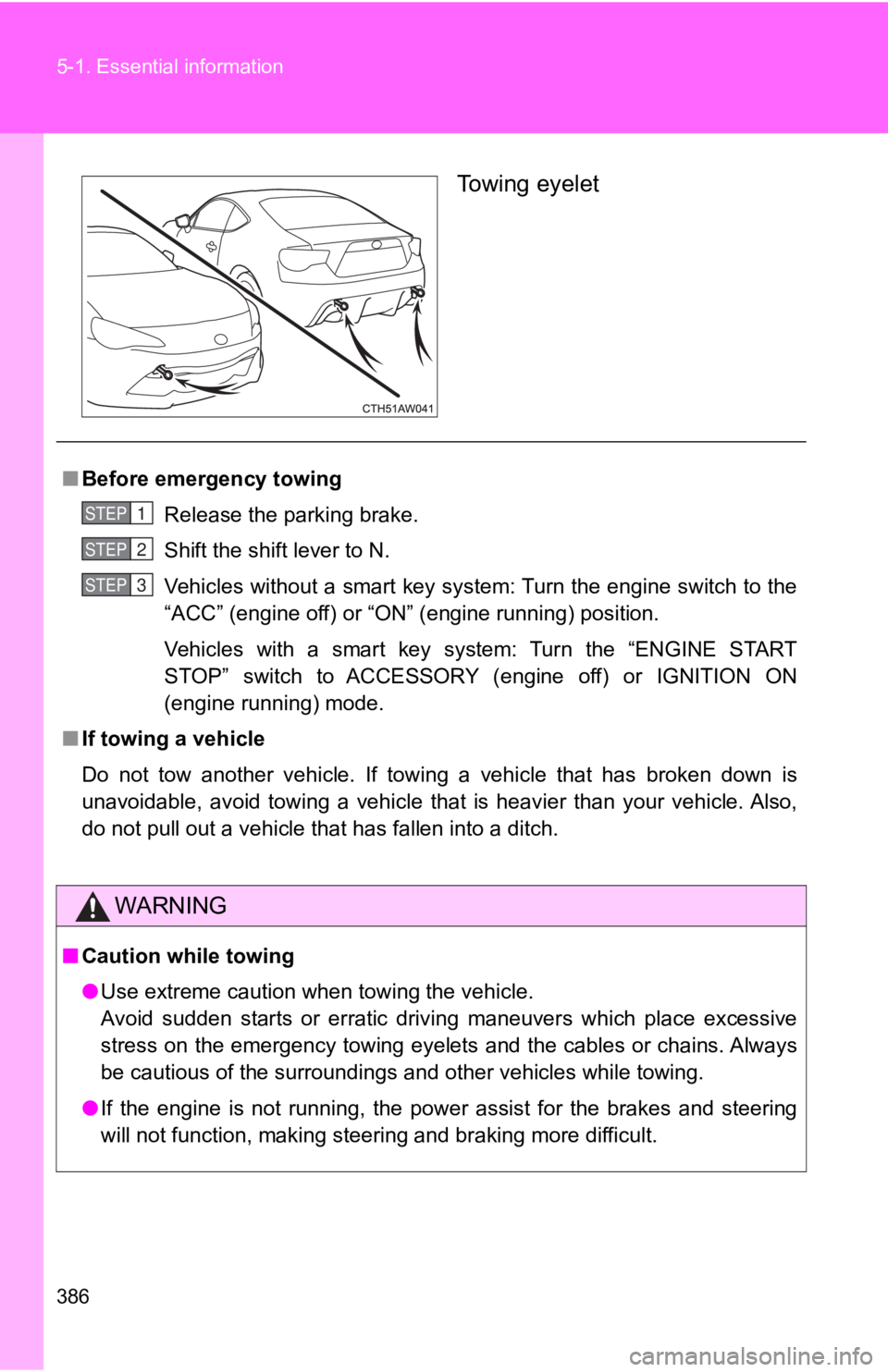
To w i n g e y e l e t
■Before emergency towing
Release the parking brake.
Shift the shift lever to N.
Vehicles without a smart key system: Turn the engine switch to the
“ACC” (engine off) or “ON” (engine running) position.
Vehicles with a smart key system: Turn the “ENGINE START
STOP” switch to ACCESSORY (engine off) or IGNITION ON
(engine running) mode.
■ If towing a vehicle
Do not tow another vehicle. If towing a vehicle that has broken down is
unavoidable, avoid towing a vehicle that is heavier than your v ehicle. Also,
do not pull out a vehicle that has fallen into a ditch.
WARNING
■ Caution while towing
●Use extreme caution when towing the vehicle.
Avoid sudden starts or erratic driving maneuvers which place excessive
stress on the emergency towing eyelets and the cables or chains. Always
be cautious of the surroundings and other vehicles while towing .
● If the engine is not running, the power assist for the brakes a nd steering
will not function, making steering and braking more difficult.
STEP 1
STEP 2
STEP 3
Page 387 of 532
5
When trouble arises
387
5-1. Essential
information
NOTICE
■To prevent causing serious damage to the transmission in emerge ncy
towing (vehicles with an a utomatic transmission)
Never tow a vehicle from the rear with four wheels on the groun d. This may
cause serious damage to the transmission.
■ To prevent damage to the vehicle
●When towing this vehicle, make sure to observe the following:
• Do not use a wire rope
• Keep vehicle speed below 20 mph (30 km/h) and do not tow for d is-
tances over 19 miles (30 km)
• Tow the vehicle in the forward direction
• Do not apply rope to the vehicle's suspension and so forth
● Do not tow another vehicle, boat (trailer) and so forth, that i s heavier than
this vehicle.
■ When towing down a long slope
Use a wheel lift-type or flat bed truck. ( P. 391, 392)
If a wheel lift-type or flat bed truck is not used, the brakes may overheat,
leading to poor brake performance.
Page 391 of 532
5
When trouble arises
391
5-1. Essential
information
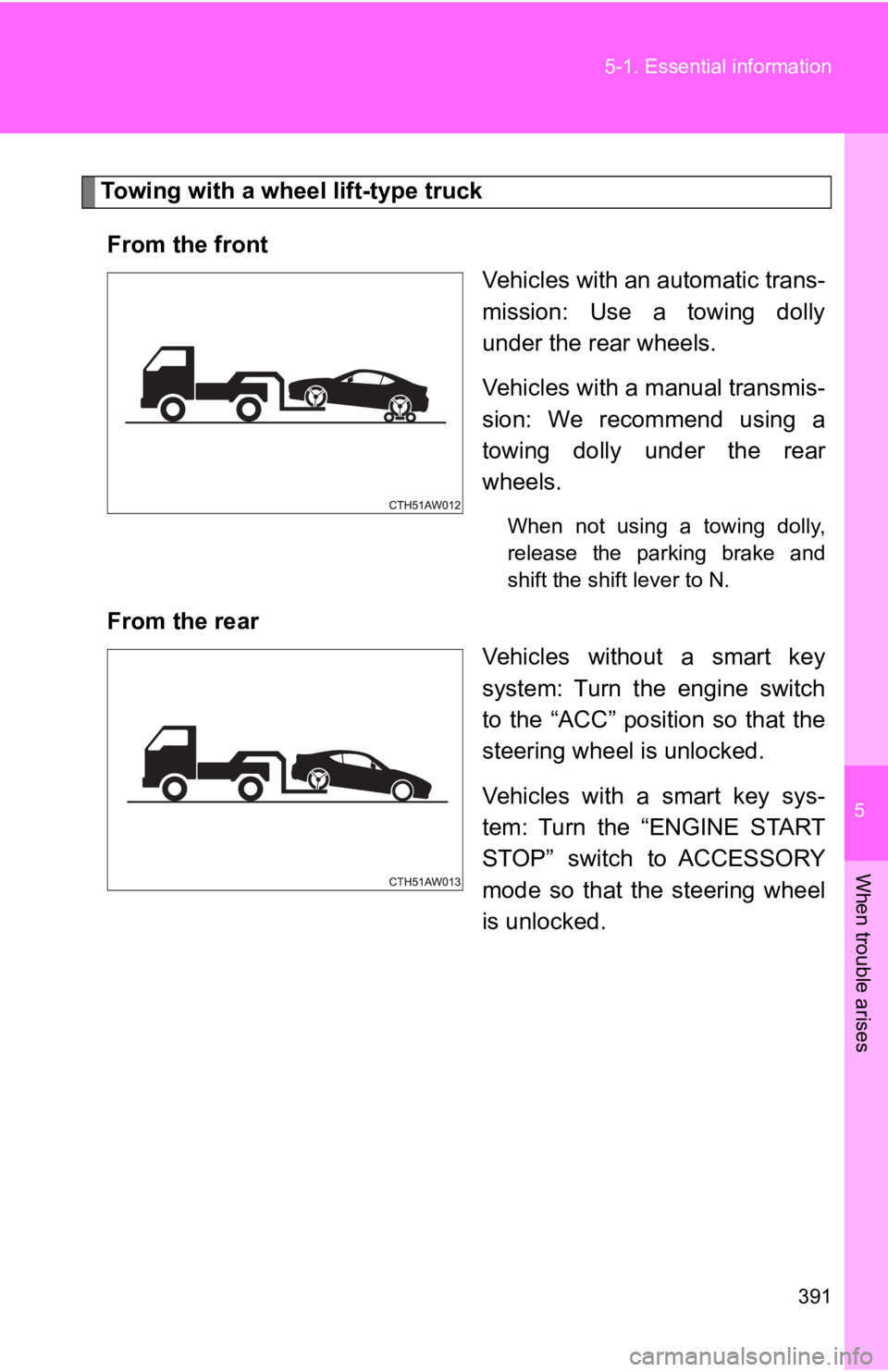
Towing with a wheel lift-type truck
From the front Vehicles with an automatic trans-
mission: Use a towing dolly
under the rear wheels.
Vehicles with a manual transmis-
sion: We recommend using a
towing dolly under the rear
wheels.
When not using a towing dolly,
release the parking brake and
shift the shift lever to N.
From the rearVehicles without a smart key
system: Turn the engine switch
to the “ACC” position so that the
steering wheel is unlocked.
Vehicles with a smart key sys-
tem: Turn the “ENGINE START
STOP” switch to ACCESSORY
mode so that the steering wheel
is unlocked.
Page 393 of 532
5
When trouble arises
393
5-1. Essential information
If you think something is wrong
If you notice any of the following symptoms, your vehicle proba bly
needs adjustment or repair. Cont act your Toyota dealer as soon as
possible.
■ Visible symptoms
●Fluid leaks under the vehicle
(Water dripping from t he air conditioning after use is normal.)
● Flat-looking tires or uneven tire wear
● Vehicles with a monochrome multi-information display: The
engine coolant temperature gauge needle continually points
higher than normal
● Vehicles with a color multi-information display: The high
engine coolant temperature wa rning light flashes or illumi-
nates
■ Audible symptoms
●Changes in exhaust sound
● Excessive tire squeal when cornering
● Strange noises related to the suspension system
● Pinging or other noises related to the engine
■ Operational symptoms
●Engine missing, stumbling or running rough
● Appreciable loss of power
● Vehicle pulls heavily to one side when braking
● Vehicle pulls heavily to one side when driving on a level road
● Loss of brake effectiveness, s pongy feeling, pedal almost
touches the floor