ESP TOYOTA 86 2019 User Guide
[x] Cancel search | Manufacturer: TOYOTA, Model Year: 2019, Model line: 86, Model: TOYOTA 86 2019Pages: 532, PDF Size: 6.89 MB
Page 121 of 532

1211-7. Safety information
1
Before driving WARNING■ SRS airbag precautions
● The SRS driver airbag deploys with considerable force, and can cause
death or serious injury especially if the driver is very close to the airbag.
The National Highway Traffic Safety Administration (“NHTSA”) ad vises:
Since the risk zone for the driver’s airbag is the first 2 - 3 in. (50 - 75 mm)
of inflation, placing yourself 10 in. (250 mm) from your driver airbag pro-
vides you with a clear margin of safety. This distance is measu red from the
center of the steering wheel to your breastbone. If you sit les s than 10 in.
(250 mm) away now, you can change your driving position in seve ral
ways:
• Move your seat to the rear as far as you can while still reaching the
pedals comfortably.
• Slightly recline the back of the seat. Although vehicle design s vary,
many drivers can achieve the 10 in. (250 mm) distance, even wit h the
driver seat all the way forward, simply by reclining the back o f the seat
somewhat. If reclining the back of your seat makes it hard to s ee the
road, raise yourself by using a firm, non-slippery cushion, or raise the
seat if your vehicle has that feature.
• If your steering wheel is adjustable, tilt it downward. This p oints the air-
bag toward your chest instead of your head and neck.
The seat should be adjusted as recommended by NHTSA above, whil e
still maintaining control of the foot pedals, steering wheel, a nd your view of
the instrument panel controls.
● The SRS front passenger airbag al so deploys with considerable f orce, and
can cause death or serious injury especially if the front passe nger is very
close to the airbag. The front passenger seat should be as far from the air-
bag as possible with the seatback adjusted, so the front passen ger sits
upright.
● Improperly seated and/or restrained infants and children can be killed or
seriously injured by a deploying airbag. An infant or child who is too small
to use a seat belt should be properly secured using a child res traint sys-
tem. Toyota strongly recommends that all infants and children be placed in
the rear seats of the vehicle and properly restrained. The rear seats are
safer for infants and children than the front passenger seat. ( P. 137)
Page 131 of 532

1311-7. Safety information
1
Before driving *1
: The occupant classification system does not operate during sel f-
checking.*2
: The system judges a person of adult size as an adult. When a
smaller adult sits in the front passenger seat, the system may not
recognize him/her as an adult depending on his/her physique and
posture.*3
: In the event the front pass enger does not wear a seat belt.*4
: The front passenger’s SRS side airbag, SRS curtain shield airb ag
and seat belt pretensioner are not controlled by the occupant
classification system.*5
: For some children, child in seat, child in booster seat or chi ld in
convertible seat, the system may not recognize him/her as a
child. Factors which may affect this can be the physique or pos -
ture.
Children who have outgrown a child restraint system should
always wear the seat belt when sitting in the seat irrespective of
whether the airbag is deactivated or activated.*6
: When a child restraint system is installed on the front passen ger
seat, do not place any article on the seat other than the child
occupant and a child restraint system.
Failure to do so may prevent the front passenger occupant class i-
fication system from functioning correctly or cause the system to
fail.*7
: Do not place more than one child on the front p assenger seat.
Failure to do so may prevent the front passenger occupant class i-
fication system from functioning correctly.*8
: Never install a rear-facing child restraint system on the fron t pas-
senger seat. See the caution that follows regarding installatio n of
a child restraint system. ( P. 1 4 1 )*9
: In case the indicator is not illuminated, consult this manual on
how to installing the child res traint system properly. ( P. 141)
Page 154 of 532
1542-1. Driving procedures
Starting off on a steep uphill
Vehicles with an auto matic transmission
Make sure that the parking brake is set and shift the shift lev er
to D.
Gently depress the accelerator pedal.
Release the parking brake.
Vehicles with a manual transmission
With the parking brake firmly set and the clutch pedal fully
depressed, shift the shift lever to 1.
Lightly depress the accelerator pedal at the same time as
gradually releasing the clutch pedal.
Release the parking brake. ■ When starting off on an uphill
When enabled, the hill-start assist control can operate. ( P. 252)
■ Driving in the rain
● Drive carefully when it is raining, because visibility will be reduced, the
windows may become fogged-up, and the road will be slippery.
● Drive carefully when it starts to rain, because the road surfac e will be
especially slippery.
● Refrain from high speeds when driving on an expressway in the r ain,
because there may be a layer of water between the tires and the road
surface, preventing the steering and brakes from operating prop erly.STEP 1
STEP 2
STEP 3
STEP 1
STEP 2
STEP 3
Page 157 of 532

1572-1. Driving procedures
2
When driving WARNING■ When driving the vehicle
● Do not drive if you are unfamiliar with the location of the brake and accel-
erator pedals to avoid depressing the wrong pedal.
• Accidentally depressing the accelerator pedal instead of the b rake
pedal will result in sudden acceleration that may lead to an accident
that could result in death or serious injury.
• When backing up, you may twist your body around, leading to a diffi-
culty in operating the pedals. Make sure to operate the pedals properly.
• Make sure to keep a correct driving posture even when moving t he
vehicle only slightly. This allows you to depress the brake and acceler-
ator pedals properly.
• Depress the brake pedal using your right foot. Depressing the brake
pedal using your left foot may delay response in an emergency, result-
ing in an accident.
● Do not drive the vehicle over or stop the vehicle near flammabl e materials.
The exhaust system and exhaust gases can be extremely hot. Thes e hot
parts may cause a fire if there is any flammable material nearb y.
● On vehicles with an automatic transmission, do not let the vehi cle roll
backward while the shift lever is in a driving position, or roll forward while
the shift lever is in R.
Doing so may cause the engine to stall or lead to poor brake an d steering
performance, resulting in an accident or damage to the vehicle.
● If the smell of exhaust is noticed inside the vehicle, open the windows and
check that the trunk is closed. Large amounts of exhaust in the vehicle can
cause driver drowsiness and an accident, resulting in death or a serious
health hazard. Have the vehicle inspected by your Toyota dealer immedi-
ately.
● On vehicles with a manual transmission, do not shift the shift lever to R
while the vehicle is moving forward.
Doing so can damage the transmission and may result in a loss o f vehicle
control.
● Do not shift the shift lever to a driving position while the ve hicle is moving
backward.
Doing so can damage the transmission and may result in a loss o f vehicle
control.
Page 201 of 532
2012-2. Instrument cluster
2
When driving Switch the display
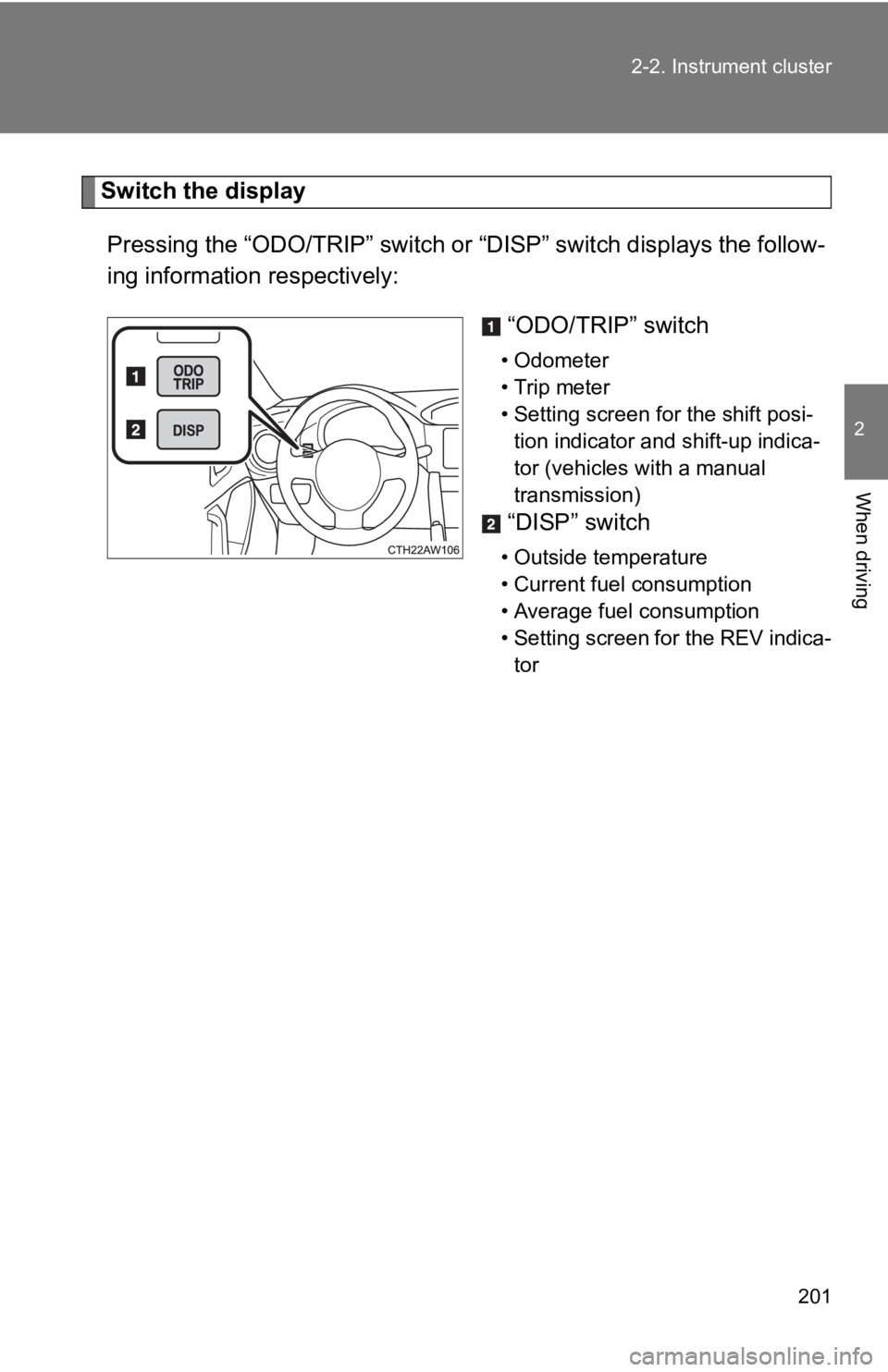
Pressing the “ODO/TRIP” switch or “DISP” switch displays the fo llow-
ing information respectively:
“ODO/TRIP” switch • Odometer
• Trip meter
• Setting screen for the shift posi-
tion indicator and shift-up indica-
tor (vehicles with a manual
transmission)
“DISP” switch • Outside temperature
• Current fuel consumption
• Average fuel consumption
• Setting screen for the REV indica-
tor
Page 206 of 532

2062-2. Instrument cluster
■ Outside temperature display
● In the following situations, the correct outside temperature ma y not be
displayed.
• When the vehicle is very hot, such as when under the sun.
• When the vehicle is idling or being driven at low speeds such as in a
traffic jam or when the engine is stopped and then restarted immedi-
ately afterward.
• When the actual outside temperature is outside of the indicato r range.
● If “ ” is displayed for approximately 1 minute or more or if the out side
temperature is not displayed, the system may be malfunctioning. Have
the vehicle inspected by your Toyota dealer.
WARNING■ The information displ ay at low temperatures
Allow the interior of the vehicle to warm up before using the liquid crystal
information display. At extremely low temperatures, the informa tion display
monitor may respond slowly, and display changes may be delayed.
For example, there is a lag between the driver's shifting and t he new shift
position number appearing on the display. In this case, wait un til the display
changes and take care not to downshift again, causing rapid and excessive
engine braking and possibly an accident resulting in death or s erious injury.
Page 214 of 532
2142-2. Instrument cluster
Scale of the G-force display The scale of the record of the
maximum G-forces and G-force
ball trace can be changed
between 1.0 G and 0.5 G by
pressing and holding while
the normal display screen is dis-
played.
Accelerator pedal input
Brake fluid pressure
Steering amount If the steering wheel is turned
completely to the left or right, the
bottom side of the gauge on the
corresponding side will be illumi-
nated in red.
This display is intended for use as a guideline. Depending on f actors such as
the road surface condition, temperature and vehicle speed, the display may
not show the actual condition of the vehicle.
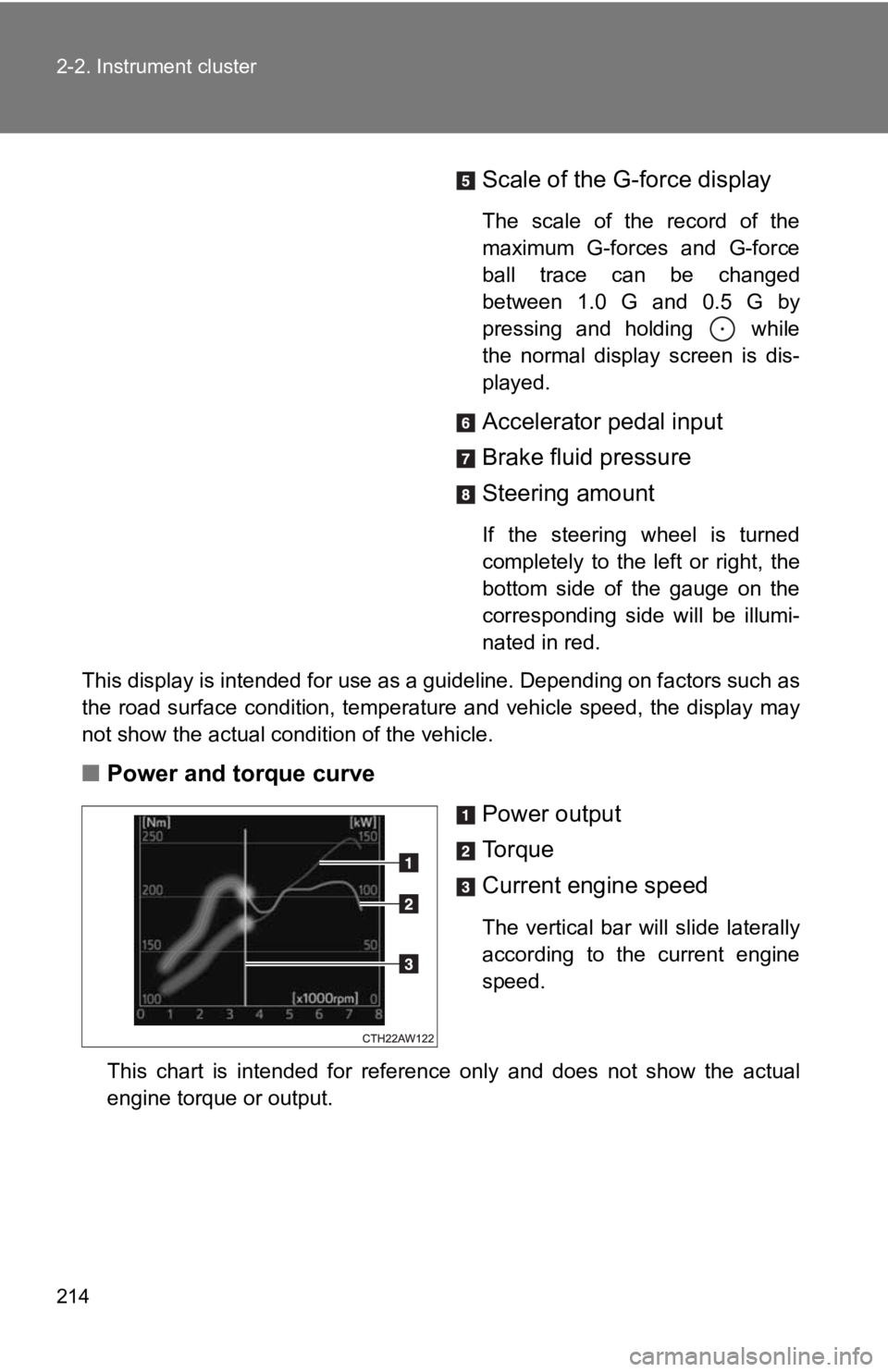
■ Power and torque curve
Power output
To r q u e
Current engine speed The vertical bar will slide laterally
according to the current engine
speed.
This chart is intended for reference only and does not show the actual
engine torque or output.
Page 221 of 532

2212-2. Instrument cluster
2
When driving WARNING■ Caution for use while driving
● When operating the multi-information display while driving, pay extra
attention to the safety of the area around the vehicle.
● Do not look continuously at the multi-information display while driving as
you may fail to see pedestrians, objects on the road, etc. ahea d of the
vehicle.
■ The information display at low temperatures
Allow the interior of the vehicle to warm up before using the liquid crystal
information display. At extremely low temperatures, the informa tion display
monitor may respond slowly, and display changes may be delayed.
For example, there is a lag between the driver’s shifting and t he new gear
number appearing on the display. This lag could cause the drive r to down-
shift again, causing rapid and excessive engine braking and pos sibly an
accident resulting in death or injury.
■ Cautions during setting up the display
As the engine needs to be running during setting up the display , ensure that
the vehicle is parked in a place with adequate ventilation. In a closed area
such as a garage, exhaust gases including harmful carbon monoxi de (CO)
may collect and enter the vehicle. This may lead to death or a serious health
hazard.
NOTICE
■ While setting up the display
To prevent battery discharge, ensure that the engine is running while setting
up the display features.
Page 245 of 532
2452-4. Using other driving systems
2
When driving
Driving assist systems To help enhance driving safety and performance, the following sys-
tems operate automatically in response to various driving situa tions.
Be aware, however, that these systems are supplementary and
should not be relied upon too heavi ly when operating the vehicl e.
■ ABS (Anti-lock Brake System) Helps to prevent wheel lock when the brakes are applied suddenl y, o r i f
the brakes are applied while driving on a slippery road surface
■ Brake assist Generates an increased level of braking force after the brake pedal is
depressed when the system detects a panic stop situation
■ VSC (Vehicle Stability Control) Helps the driver to control skidding when swerving suddenly or turning
on slippery road surfaces
■ TRAC (Traction Control) Helps to maintain drive power and prevent the drive wheels from spin-
ning when starting the vehicle or accelerating on slippery road s.
The TRAC system is also equipped with the brake LSD function.
■ Hill-start assist control
P. 252
■ EPS (Electric Po wer Steering)Employs an electric motor to reduce the amount of effort needed to turn
the steering wheel
Page 251 of 532

2512-4. Using other driving systems
2
When driving WARNING■ TRAC may not operate effectively when
Directional control and power may not be achievable while drivi ng on slip-
pery road surfaces, even if the TRAC system is operating.
Do not drive the vehicle in conditions where stability and powe r may be lost.
■ When the VSC and/or brake LSD function is activated
The slip indicator light flashes. Always drive carefully. Reckl ess driving may
cause an accident. Exercise particular care when the indicator light flashes.
■ When the TRAC/VSC systems are turned off
Be especially careful and drive at a speed appropriate to the r oad condi-
tions. As these are the systems to help ensure vehicle stability and driving
force, do not turn the TRAC/VSC systems off unless necessary.
■ Replacing tires
Make sure that all tires are of the specified size, brand, trea d pattern and
total load capacity. In addition, make sure that the tires are inflated to the
recommended tire inflation pressure level.
The ABS, TRAC and VSC systems will not function correctly if di fferent tires
are installed on the vehicle.
Contact your Toyota dealer for further information when replaci ng tires or
wheels.
■ Handling of tires and suspension
Using tires with any kind of problem or modifying the suspensio n will affect
the driving assist systems, and may cause a system to malfuncti on.