ESP TOYOTA 86 2019 Owner's Manual
[x] Cancel search | Manufacturer: TOYOTA, Model Year: 2019, Model line: 86, Model: TOYOTA 86 2019Pages: 532, PDF Size: 6.89 MB
Page 263 of 532

2632-5. Driving information
2
When driving Tire chains
Tire chains cannot be used on your vehicle because of the lack of
clearance between the tires and vehicle body.
When tire chains cannot be used, use of another type of tractio n
device (such as spring chains) may be acceptable if use on your vehi-
cle is recommended by the device manufacturer, taking into acco unt
tire size and road conditions.
Follow the device manufacturer's instructions, especially regar ding
maximum vehicle speed.
To help avoid damage to your vehicle, drive slowly, readjust or
remove the device if it is contacting your vehicle, and do not spin your
wheels. Damage caused to your veh icle by use of a traction devi ce is
not covered under warranty.
Make certain that any traction device you use is an SAE class “ S”
device, and use it on the rear wheels only.
Always use the utmost care when driving with a traction device. Over-
confidence because you are using a traction device could easily lead
to a serious accident.
Selecting tire chains
We recommend that you consult your Toyota dealer for informatio n
about the chains t hat you can use.
Page 304 of 532
3043-5. Other interior features
WARNINGObserve the following precautions.
Failure to do so may cause the driver's floor mat to slip, possibly interfering
with the pedals while driving. An unexpectedly high speed may r esult or it may
become difficult to stop the vehicle. This could lead to an acc ident, resulting in
death or serious injury.
■ When installing a floor mat
● Do not use floor mats designed for other models or different mo del year
vehicles, even if they are Toyota Genuine floor mats.
● Driver’s seat floor mat: Only use floor mats designed for the d river's seat.
● Front: Always install the floor mat securely using the retaining hooks (clips)
provided.
● Do not use two or more floor mats on top of each other.
● Do not place the floor mat bottom-side up or upside-down.
■ Before driving
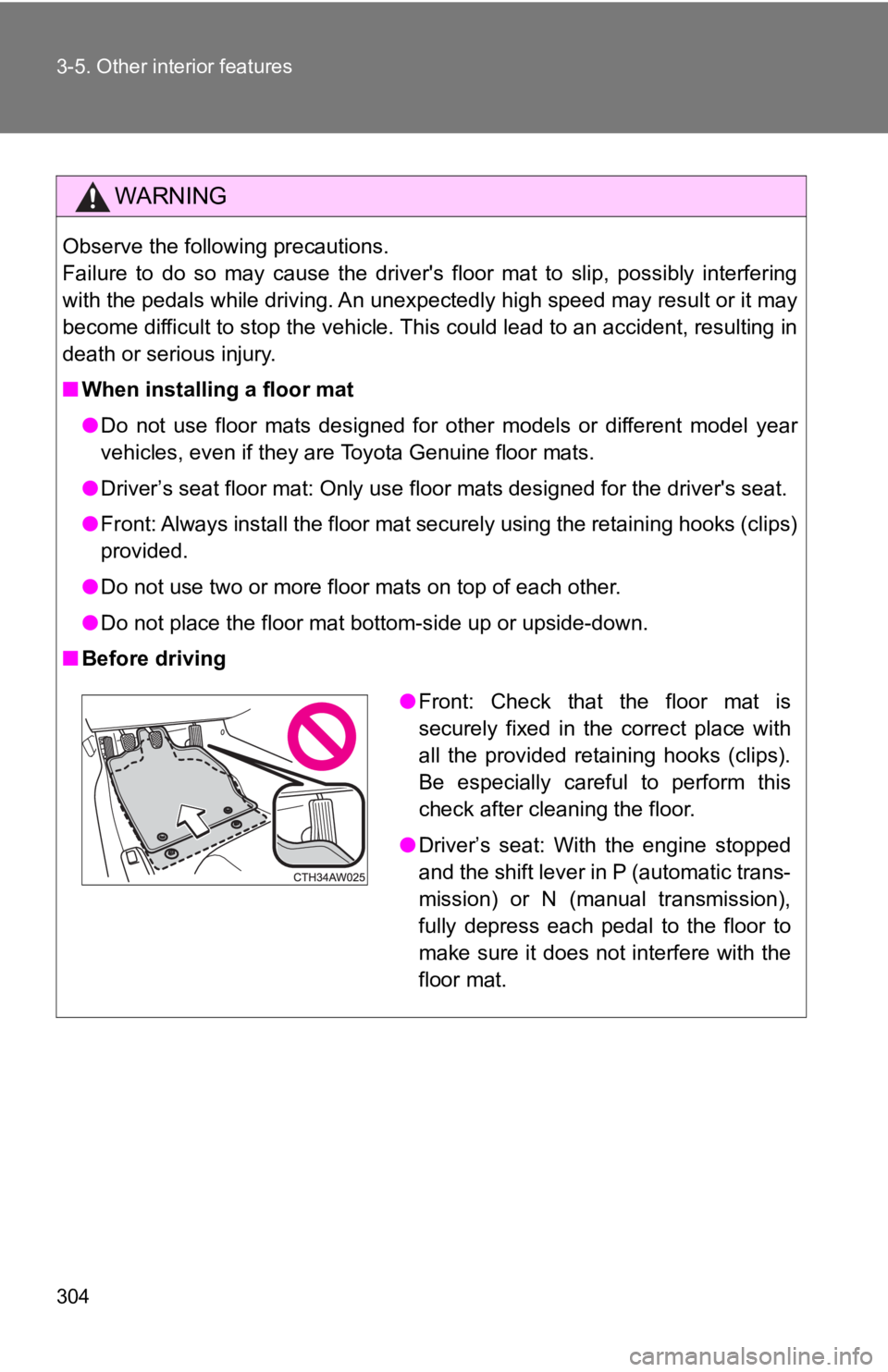
● Front: Check that the floor mat is
securely fixed in the correct place with
all the provided retaining hooks (clips).
Be especially careful to perform this
check after cleaning the floor.
● Driver’s seat: With the engine stopped
and the shift lever in P (automatic trans-
mission) or N (manual transmission),
fully depress each pedal to the floor to
make sure it does not interfere with the
floor mat.
Page 313 of 532

3134-1. Maintenance and care
4
Maintenance and care ■ Caring for leather areas
Toyota recommends cleaning the interior of the vehicle at least twice a year
to maintain the quality of the vehicle’s interior.
■ Shampooing the carpets
There are several commercial foaming-type cleaners available. U se a
sponge or brush to apply the foam. Rub in overlapping circles. Do not apply
water. Excellent results are obtained by keeping the carpet as dry as possi-
ble.
■ Seat belts
Clean with mild soap and lukewarm water using a cloth or sponge . Also
check the belts periodically for excessive wear, fraying or cut s.
WARNING■ Water in the vehicle
● Do not splash or spill liquid in the vehicle.
Doing so may cause electrical components etc. to malfunction or catch
fire.
● Do not get any of the SRS components or wiring in the vehicle i nterior wet.
( P. 94)
Electrical malfunction may cause the airbags to deploy or not f unction
properly, resulting in death or severe injury.
■ Cleaning the interior (esp ecially instrument panel)
Do not use polish wax or polish cleaner. The instrument panel m ay reflect off
the windshield, obstructing the driver's view and leading to an accident,
resulting in death or serious injury.
Page 314 of 532

3144-1. Maintenance and care
NOTICE■ Cleaning detergents
● Do not use organic substances such as benzene or gasoline, acid ic or
alkaline solutions, dye, bleach or other detergent. Doing so may discolor
the vehicle interior or cause streaks or damage to painted surfaces.
● Do not use polish wax or polish cleaner. The instrument panel's or other
interior part’s painted surface may be damaged.
● Do not use a chemical agent containing silicone (highly-polymerized sili-
con compound) when cleaning any of the electrical appliances su ch as the
air conditioning, all switches and their surrounding areas.
If silicon (highly-polymerized silicon compound) contacts these compo-
nents, it may cause the electrical appliances to malfunction.
■ Preventing damage to leather surfaces
Observe the following precautions to avoid damage to and deteri oration of
leather surfaces.
● Remove any dust, dirt, sand, oil spots etc. on leather surfaces immedi-
ately.
● Do not expose the vehicle to direct sunlight for extended perio ds of time.
Park the vehicle in the shade, especially during summer.
● Do not place items made of vinyl, plastic, or that contain wax on the uphol-
stery, as they may stick to the leather surface if the vehicle interior heats
up significantly.
■ Water on the floor
Do not wash the vehicle floor with water.
Vehicle systems such as the audio system may be damaged if wate r comes
into contact with electrical components under the floor of the vehicle, and
may also cause the body to rust.
Page 318 of 532
3184-2. Maintenance
Maintenance requirements
■ Repair and replacement
It is recommended that genuine Toyota parts be used for repair to ensure
performance of each system. If non-Toyota parts are used in replacement or
if a repair shop other than a Toyota dealer performs repairs, c onfirm the war-
ranty coverage.To ensure safe and economical dri ving, day-to-day care and regu lar
maintenance is essential. It is the owner’s responsibility to p erform
regular checks. Toyota recommends the following maintenance.
■ General maintenance
Should be performed on a daily basis. This can be done by your-
self or by a Toyota dealer.
■ Scheduled maintenance
Should be performed at specified intervals according to the
maintenance schedule. For details about maintenance items and schedules, refer to the
“Scheduled Maintenance Guide” or “Owner’s Manual Supplement”.
■ Do-it-yourself maintenance
You can perform some maint enance procedures yourself.
Please be aware that do-it-yourse lf maintenance may affect war-
ranty coverage. The use of Toyota Repair Manuals is recommended.
For details about warranty coverage, see the separate “Owner’s War-
ranty Information Booklet” or “Owner’s Manual Supplement”.
Page 446 of 532

4465-2. Steps to take in an emergency
■ Starting the engine when the battery is discharged
The engine cannot be started by push-starting.
■ Avoiding a discharged battery
● Turn off the headlights and the air conditioning system while t he engine is
off.
● Turn off any unnecessary electrical components when the vehicle is run-
ning at a low speed for an extended period, such as in heavy tr affic, etc.
■ Charging the battery
The electricity stored in the battery will discharge gradually even when the
vehicle is not in use, due to natural discharge and the draining effects of cer-
tain electrical appliances. If the vehicle is left for a long t ime, the battery may
discharge, and the engine may be unable to start. (The battery recharges
automatically during driving.)
■ Precautions when the battery is discharged (vehicles with a sma rt key
system)
● In some cases, it may not be possible to unlock the doors using the smart
key system when the battery is discharged. Use the wireless remote con-
trol or the mechanical key to lock or unlock the doors.
● The engine may not start on the first attempt after the battery has
recharged but will start normally after the second attempt. Thi s is not a
malfunction.
● The “ENGINE START STOP” switch mode is memorized by the vehicle .
When the battery is reconnected, the system will return to the mode it
was in before the battery was discharged. Before disconnecting the bat-
tery, turn the “ENGINE START STOP” switch off.
If you are unsure what mode the “ENGINE START STOP” switch was in
before the battery discharged, be especially careful when reconnecting
the battery.
Page 451 of 532
5
When trouble arises
4515-2. Steps to take in an emergency
WARNING■ To prevent an accident or injury when inspecting under the hood of
your vehicle
● If steam is seen coming from under the hood, do not open the ho od until
the steam has subsided. The engine compartment may be very hot, caus-
ing serious injuries such as burns.
● Keep hands and clothing (especially a tie, a scarf or a muffler ) away from
the fans and belts. Failure to do so may cause the hands or clothing to be
caught, resulting in serious injury.
● Do not loosen the radiator cap and the coolant reservoir cap wh ile the
engine and radiator are hot.
Serious injury, such as burns, may result from hot coolant and steam
released under pressure.
NOTICE■ When adding engine coolant
Wait until the engine has cooled down before adding engine cool ant.
When adding coolant, do so slowly. Adding cool coolant to a hot engine too
quickly can cause damage to the engine.
■ To prevent damage t o the cooling system
Observe the following precautions:
● Avoid contaminating the coolant with foreign matter (such as sa nd or dust
etc.).
● Do not use any coolant additives.
Page 479 of 532

4796-1. Specifications
6
Vehicle specifications ■ Treadwear
The treadwear grade is a comparative rating based on the wear
rate of the tire when tested under controlled conditions on a s peci-
fied government test course. For example, a tire graded 150 would wear one and a half (1 - 1 /2)
times as well on the governmen t course as a tire graded 100.
The relative performance of tires depends upon the actual condi tions
of their use. Performance may differ significantly from the nor m due
to variations in driving habits, service practices and differen ces in
road characterist ics and climate.
■ Traction AA, A, B, C
The traction grades, from highest to lowest, are AA, A, B and C ,
and they represent the tire’s ability to stop on wet pavement a s
measured under controlled cond itions on specified government
test surfaces of asphalt and concrete.
A tire marked C may have p oor traction performance.
Warning: The traction grade assigned to this tire is based on b raking
(straight ahead) traction tests and does not include cornering (turn-
ing) traction.
■ Temperature A, B, C
The temperature grades are A (the highest), B, and C, represent -
ing the tire’s resistance to the generation of heat and its abi lity to
dissipate heat when tested under controlled conditions on a spe ci-
fied indoor laboratory test wheel.
Sustained high temperature can c ause the material of the tire t o
degenerate and reduce tire life, and excessive temperature can lead
to sudden tire failure.
Grade C corresponds to a level of performance which all passeng er
car tires must meet under the Fe deral Motor Vehicle Safety Stan dard
No. 109.
Grades B and A represent higher levels of performance on the la bo-
ratory test wheel than the minimum required by law.
Page 499 of 532
499 7
For owners AT T E N T I O N■ Coussin gonflable SRS
● Les coussins gonflables SRS se déploient à une vitesse et avec une
puissance considérables. Les occupant s qui sont mal installés lorsque le
coussin gonflable SRS se déploie peuvent subir des blessures très
graves. Parce que le coussin gonflable SRS a besoin d'un espace
suffisant pour son déploiement, le conducteur doit toujours se tenir droit et
bien enfoncé dans le siège, le plus loin possible du volant, tout en
conservant le contrôle complet du véhicule, et le passager avant doit
déplacer son siège vers l'arrière aussi loin que possible, se tenir droit et
bien en arrière dans le siège.
● Ne placez pas d'objets au-dessus ou à proximité du cache du coussin
gonflable SRS ou entre vous et le coussin gonflable SRS. En cas de
déploiement du coussin gonflable SRS, ces objets pourraient interférer
avec son fonctionnement correct et pourraient être propulsés à l'intérieur
du véhicule et causer des blessures.
Page 501 of 532
501 7
For owners AT T E N T I O N■ Coussin gonflable SRS
● N'INSTALLEZ JAMAIS UN SIÈGE ENFANT DE TYPE DOS À LA ROUTE
SUR LE SIÈGE AVANT. NÉGLIGER CECI REVIENT À FAIRE COURIR
LE RISQUE À L'ENFANT DE SUBIR DE GRAVES BLESSURES, VOIRE
LA MORT, EN PLAÇANT LA TÊTE DE L'ENFANT TROP PRÈS DES
COUSSINS GONFLABLES SRS.
● Ne laissez jamais un enfant se tenir debout ou à genoux sur le siège du
passager avant et ne tenez jamais un enfant sur vos genoux ou dans vos
bras. Le coussin gonflable SRS se déploie avec une force considérable et
peut blesser ou tuer l'enfant.
● Lorsque le coussin gonflable SRS se déploie, un peu de fumée est
relâchée. Cette fumée peut causer des problèmes respiratoires pour les
personnes ayant des antécédents d'asthme ou des difficultés à respirer. Si
vous ou vos passagers éprouvez une difficulté à respirer après le
déploiement du coussin gonflable SRS, prenez ou faites-leur prendre l'air
rapidement.
● Un coussin gonflable SRS qui se déploie libère un gaz chaud. Les
occupants pourraient se brûler s'ils entrent en contact direct avec le gaz
chaud.