flat tire TOYOTA 86 2019 Owner's Manual
[x] Cancel search | Manufacturer: TOYOTA, Model Year: 2019, Model line: 86, Model: TOYOTA 86 2019Pages: 532, PDF Size: 6.89 MB
Page 359 of 532

3594-3. Do-it-yourself maintenance
4
Maintenance and care NOTICE■
Replacing tire inflation pressu re warning valves and transmitte rs●
Because tire repair or replaceme nt may affect the tire pressure warn-
ing valves and transmitters, make sure to have tires serviced b y your
Toyota dealer or other qualifie d service shop. In addition, mak e sure to
purchase your tire pressure warning valves and transmitters at your
Toyota dealer.●
Ensure that only genuine Toyota w heels are used on your vehicle .
Tire pressure warning valves and transmitters may not work prop erly
with non-genuine wheels.
Page 383 of 532
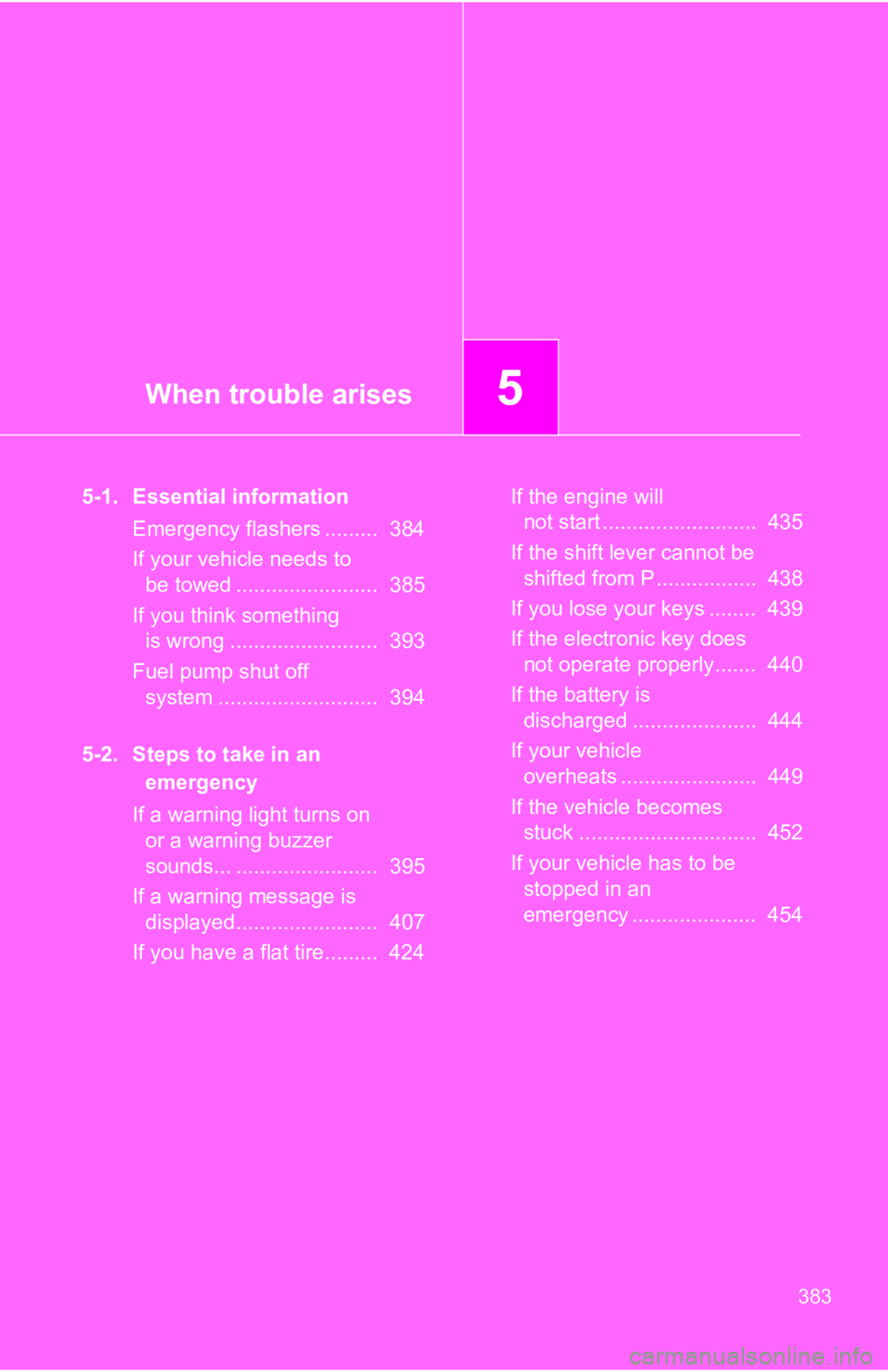
When trouble arises
5
3835-1. Essential information
Emergency flashers ......... 384
If your vehicle needs to
be towed ........................ 385
If you think something
is wrong ......................... 393
Fuel pump shut off
system ........................... 394
5-2. Steps to take in an
emergency
If a warning light turns on
or a warning buzzer
sounds... ........................ 395
If a warning message is
displayed........................ 407
If you have a flat tire......... 424 If the engine will
not start .......................... 435
If the shift lever cannot be
shifted from P................. 438
If you lose your keys ........ 439
If the electronic key does
not operate properly....... 440
If the battery is
discharged ..................... 444
If your vehicle
overheats ....................... 449
If the vehicle becomes
stuck .............................. 452
If your vehicle has to be
stopped in an
emergency ..................... 454
Page 393 of 532
5
When trouble arises
3935-1. Essential information
If you think something is wrong If you notice any of the followi ng symptoms, your vehicle proba bly
needs adjustment or repair. Cont act your Toyota d ealer as soon as
possible.
■ Visible symptoms
● Fluid leaks under the vehicle
(Water dripping from t he air conditioning after use is normal.)
● Flat-looking tires or uneven tire wear
● Vehicles with a monochrome multi-information display: The
engine coolant temperature gauge needle continually points
higher than normal
● Vehicles with a color multi-information display: The high
engine coolant temperature wa rning light flashes or illumi-
nates
■ Audible symptoms
● Changes in exhaust sound
● Excessive tire squeal when cornering
● Strange noises related to the suspension system
● Pinging or other noises related to the engine
■ Operational symptoms
● Engine missing, stumbling or running rough
● Appreciable loss of power
● Vehicle pulls heavily to one side when braking
● Vehicle pulls heavily to one side when driving on a level road
● Loss of brake effectiveness, s pongy feeling, pedal almost
touches the floor
Page 400 of 532
4005-2. Steps to take in an emergency
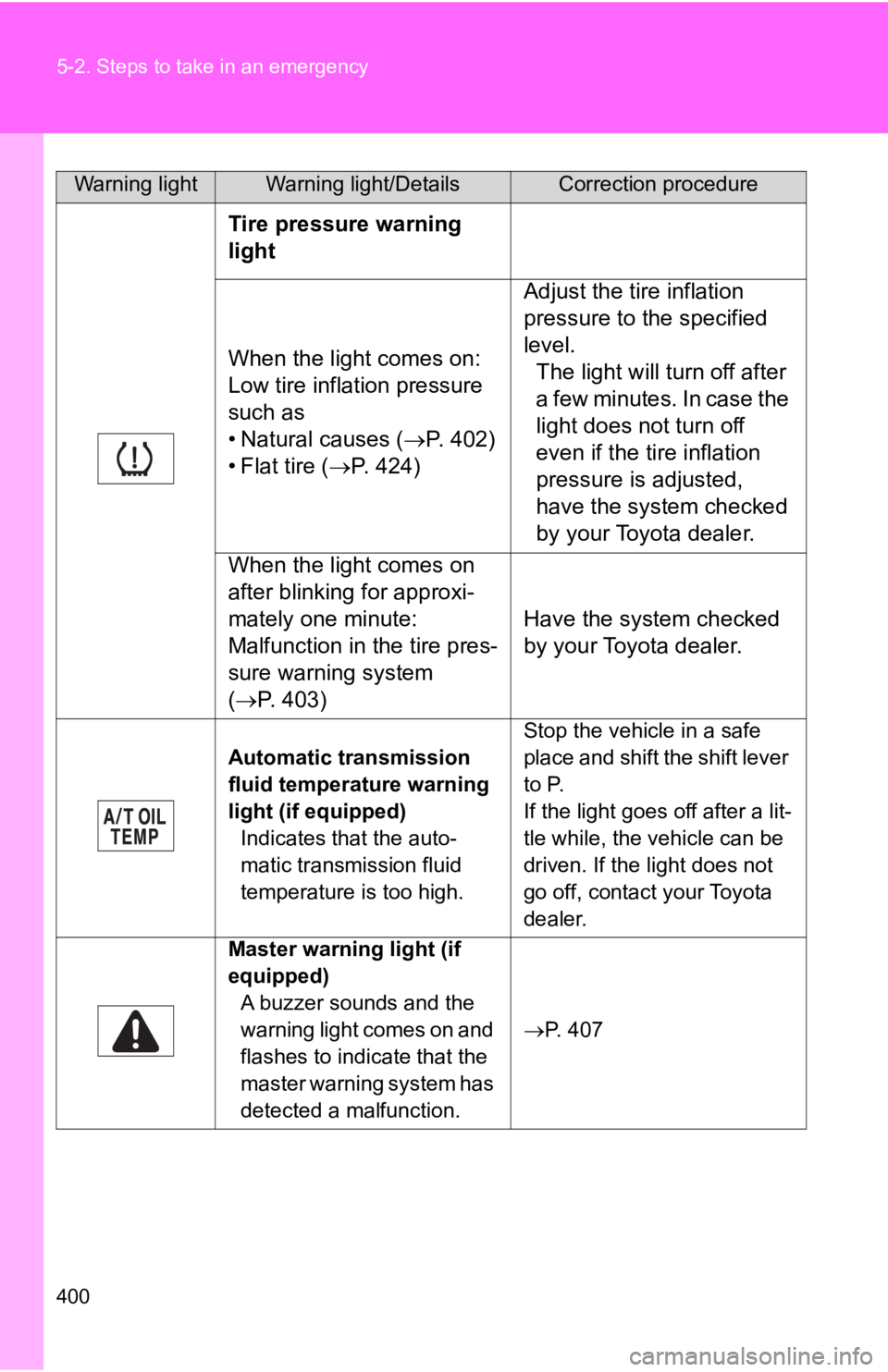
Tire pressure warning
light
When the light comes on:
Low tire inflation pressure
such as
• Natural causes ( P. 402)
• Flat tire ( P. 4 2 4 ) Adjust the tire inflation
pressure to the specified
level.
The light will turn off after
a few minutes. In case the
light does not turn off
even if the tire inflation
pressure is adjusted,
have the system checked
by your Toyota dealer.
When the light comes on
after blinking for approxi-
mately one minute:
Malfunction in the tire pres-
sure warning system
( P. 4 0 3 ) Have the system checked
by your Toyota dealer.
Automatic transmission
fluid temperature warning
light (if equipped)
Indicates that the auto-
matic transmission fluid
temperature is too high. Stop the vehicle in a safe
place and shift the shift lever
to P.
If the light goes off after a lit-
tle while, the vehicle can be
driven. If the light does not
go off, contact your Toyota
dealer.
Master warning light (if
equipped)
A buzzer sounds and the
warning light comes on and
flashes to indicate that the
master warning system has
detected a malfunction. P. 407Warning light Warning light/Details Correction procedure
Page 402 of 532

4025-2. Steps to take in an emergency
■ Front passenger detection sensor and passenger seat belt remind er
and warning buzzer
● If luggage is placed on the front passenger seat, the front passenger
detection sensor may cause the warning light to flash and warni ng
buzzer to sound, even if a passenger is not sitting in the seat .
● If a cushion is placed on the seat, the sensor may not detect a passen-
ger, and the warning light may not operate properly.
■
When the tire pressure warning light comes on
Check the tire inflation pressure and adjust to the appropriate level.■
The tire pressure warning light may turn on due to natural caus es
The tire pressure warning light may turn on due to natural caus es such
as natural air leaks or tire inflation pressure changes caused by tem-
perature. In this case, adjusting the tire inflation pressure w ill turn off the
warning light (after a few minutes).■
When a tire is replace d with a spare tire
The compact spare tire is not equipped with a tire pressure war ning
valve and transmitter. If a tire goes flat, the tire pressure w arning light will
not turn off even though the flat tire has been replaced with t he spare
tire. Replace the spare tire with the repaired tire and adjust the tire infla-
tion pressure. The tire pressure warning light will go off afte r a few min-
utes.
Page 403 of 532

5
When trouble arises
4035-2. Steps to take in an emergency
■
If the tire pressure warn ing system is inoperative
The tire pressure warning system will be disabled in the follow ing condi-
tions:
(When the condit ion becomes no rmal, the system will work proper ly.)●
If tires not equipped with tire pressure warning valves and tra nsmit-
ters are used.●
If the ID code on the tire pressure warning valves and transmit ters is
not registered in the tire pressure warning computer.●
If the tire inflation p ressure is 55 psi ( 380 kPa, 3.87 kgf/cm 2
or bar) or
higher.
The tire pressure warning system may be disabled in the followi ng condi-
tions:
(When the condit ion becomes no rmal, the system will work proper ly.)●
If electronic devices or facilities using similar radio wave fr equencies
are nearby.●
If a radio set at similar frequen cies is in use i n the vehicle.●
If a window tint that affects the radio wave signals is install ed.●
If there is a lot of snow or ice on the vehicle, in particular around the
wheels or wheel housings.
●
If non-genuine Toyota wheels are used. (Even if you use Toyota
wheels, the tire pressure warning system may not work properly with
some types of tires.)
●
If tire chains are used.
●
If a large metallic object which can interfere with signal rece ption is
put in the trunk.
■
If the tire pressure warning light frequently comes on after bl inking
for approximately one minute
If the tire pressure warning light frequently comes on after bl inking for
approximately one minute when the “ENGINE START STOP” switch is
turned to IGNITION ON mode (vehicles with a smart key system) o r the
engine switch is turned to the “ON” position (vehicles without a smart key
system), have it check ed your Toyota dealer.
Page 404 of 532

4045-2. Steps to take in an emergency
WARNING■
If the tire pressure wa rning light comes on
Be sure to observe the following precautions. Failure to do so could
cause loss of vehicle control and result in death or serious in jury.●
Stop your vehicle in a safe plac e as soon as possible. Adjust t he tire
inflation pressure immediately.●
If the tire pressure warning light comes on even after tire inf lation pres-
sure adjustment, it is probable that you have a flat tire. Chec k the tires.
If the tire is flat, change to the spare tire and have the flat tire repaired
by the nearest Toyota dealer.●
Avoid abrupt maneuvering and braking. If the vehicle tires dete riorate,
you could lose control of the s teering wheel or the brakes.■
If a blowout or sudden air leakage should occur
The tire pressure warning system may not activate immediately.
Page 405 of 532
5
When trouble arises
4055-2. Steps to take in an emergency
WARNING■
Maintenance of the tires
Each tire, including the spare (if provided), should be checked monthly
when cold and inflated to the inflation pressure recommended by the
vehicle manufacturer on the vehicle placard or tire inflation p ressure
label (tire and load information label). (If your vehicle has t ires of a differ-
ent size than the size indicated on the vehicle placard or tire inflation
pressure label [tire and load information label], you should de termine the
proper tire inflation pressure for those tires.)
As an added safety feature, your vehicle has been equipped with a tire
pressure monitoring system (TPMS -tire pressure warning system) that
illuminates a low tire pressure telltale (tire pressure warning light) when
one or more of your tires is significantly under-inflated. Acco rdingly,
when the low tire pressure telltale (tire pressure warning ligh t) illumi-
nates, you should stop and check your tires as soon as possible , and
inflate them to the proper press ure. Driving on a significantly under-
inflated tire causes the tire to overheat and can lead to tire failure.
Under-inflation also reduces fuel efficiency and tire tread lif e, and may
affect the vehicle's han dling and stopping ability.
Please note that the TPMS (tire pressure warning system) is not a sub-
stitute for proper tire maintenance, and it is the driver's res ponsibility to
maintain correct tire pressure, even if under-inflation has not reached the
level to trigger illumination of the TPMS low tire pressure tel ltale (tire
pressure warning light).
Your vehicle has also been equipped with a TPMS (tire pressure warning
system) malfunction indicator to indicate when the system is no t operat-
ing properly. The TPMS (tire pressure warning system) malfuncti on indi-
cator is combined with the low tire pressure telltale (tire pre ssure
warning light). When the system detects a malfunction, the tell tale will
flash for approximately one minut e and then remain continuously illumi-
nated. This sequence will continue upon subsequent vehicle star t-ups as
long as the malfunction exists. When the malfunction indicator is illumi-
nated, the system may not be able to detect or signal low tire pressure
as intended.
Page 424 of 532
4245-2. Steps to take in an emergency
If you have a flat tire Your vehicle is equipped with a spare tire. The flat tire can b e
replaced with the spare tire.
■ Before jacking up the vehicle
● Stop the vehicle in a safe place on a hard, flat surface.
● Set the parking brake.
● Shift the shift lever to P (vehicles with an automatic transmis -
sion) or R (vehicles with a manual transmission).
● Stop the engine.
● Turn on the emergency flashers. ( P. 3 8 4 )
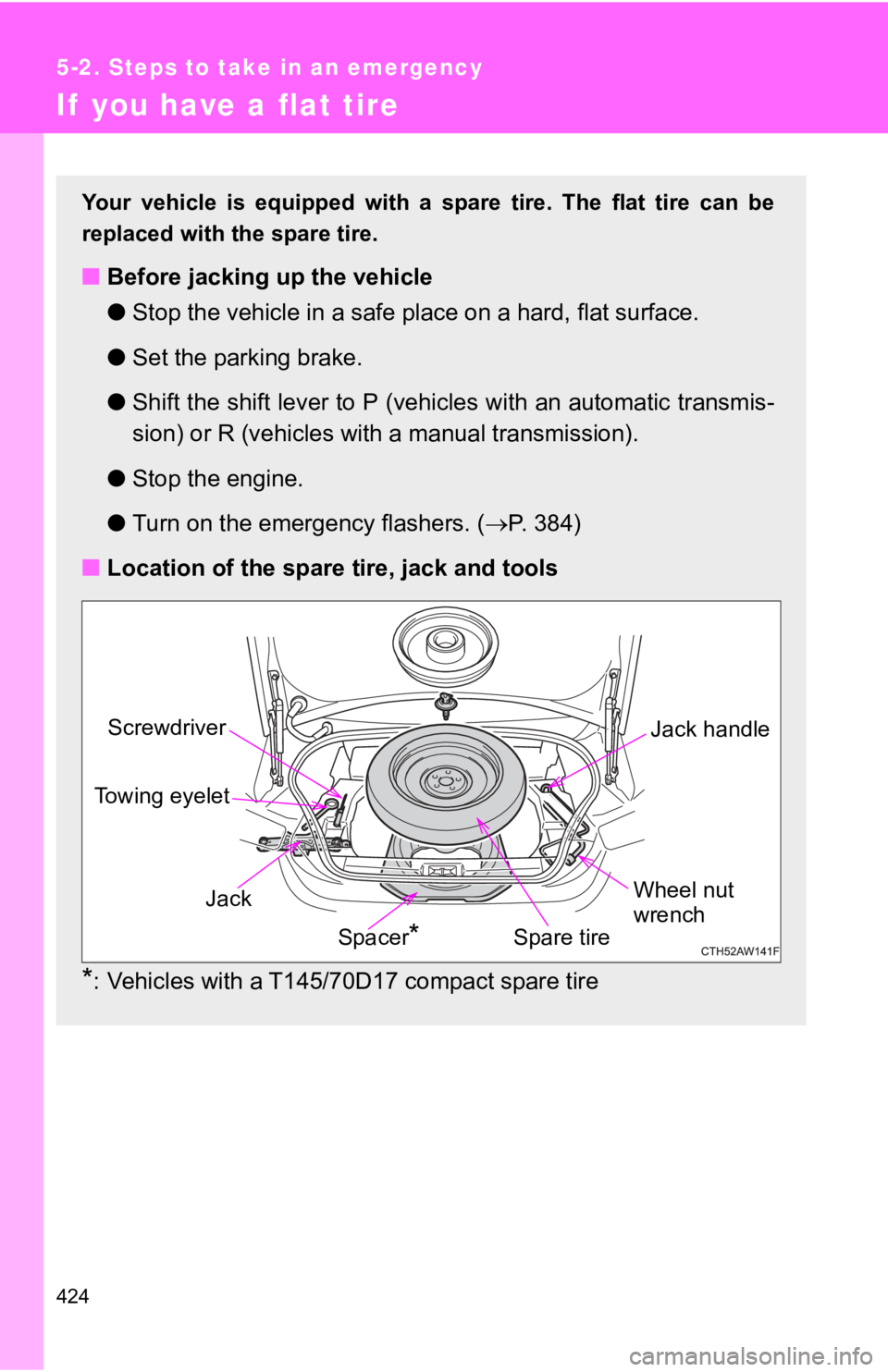
■ Location of the spare t ire, jack and tools
* : Vehicles with a T145/70D 17 compact spare tireJack Jack handle
Spare tireTowing eyelet Screwdriver
Wheel nut
wrench
Spacer
*
Page 426 of 532
4265-2. Steps to take in an emergency
Replacing a flat tire
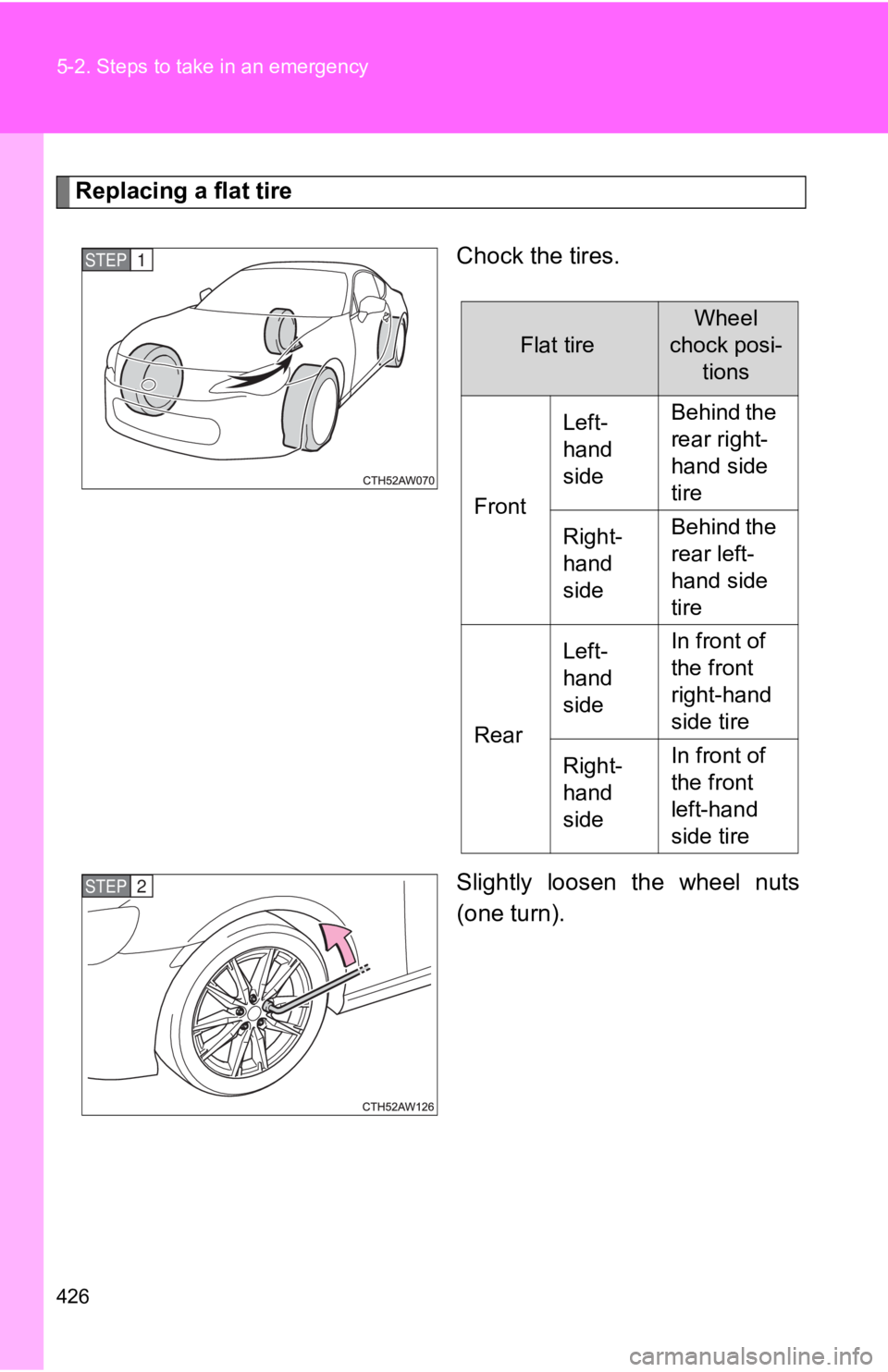
Chock the tires.
Slightly loosen the wheel nuts
(one turn).STEP 1
Flat tire Wheel
chock posi-
tions
Front Left-
hand
side Behind the
rear right-
hand side
tire
Right-
hand
side Behind the
rear left-
hand side
tire
Rear Left-
hand
side In front of
the front
right-hand
side tire
Right-
hand
side In front of
the front
left-hand
side tireSTEP 2