flat tire TOYOTA 86 2019 Owner's Guide
[x] Cancel search | Manufacturer: TOYOTA, Model Year: 2019, Model line: 86, Model: TOYOTA 86 2019Pages: 532, PDF Size: 6.89 MB
Page 429 of 532
5
When trouble arises
4295-2. Steps to take in an emergency
Stow the flat tire, tire jack and all tools. ( P. 430)■
The compact spare tire ●
The compact spare tire is identified by the label “TEMPORARY US E
ONLY” on the tire sidewall.
Use the compact spare tire tem porarily only in an emergency.●
Make sure to check the tire pre ssure of the compa ct spare tire.
( P. 468)■
When using the compact spare tire
As the compact spare tire is not equipped with the tire pressure warning
valve and transmitter, low infla tion pressure of the spare tire will not be
warned. Also, if you replace the compact spare tire after the t ire pressure
warning light comes on, the light remains on.■
If you have a flat rear tire
Install the compact spare tire on the front of the vehicle. Per form the fol-
lowing steps.
Replace a front tire with the compact spare tire.
Replace the flat rear tire with the tire removed from the front of
the vehicle.
■
After completing the tire change
The tire pressure warning system must be reset. ( P. 3 4 6 )STEP 5
STEP 1
STEP 2
Page 430 of 532
4305-2. Steps to take in an emergency
■
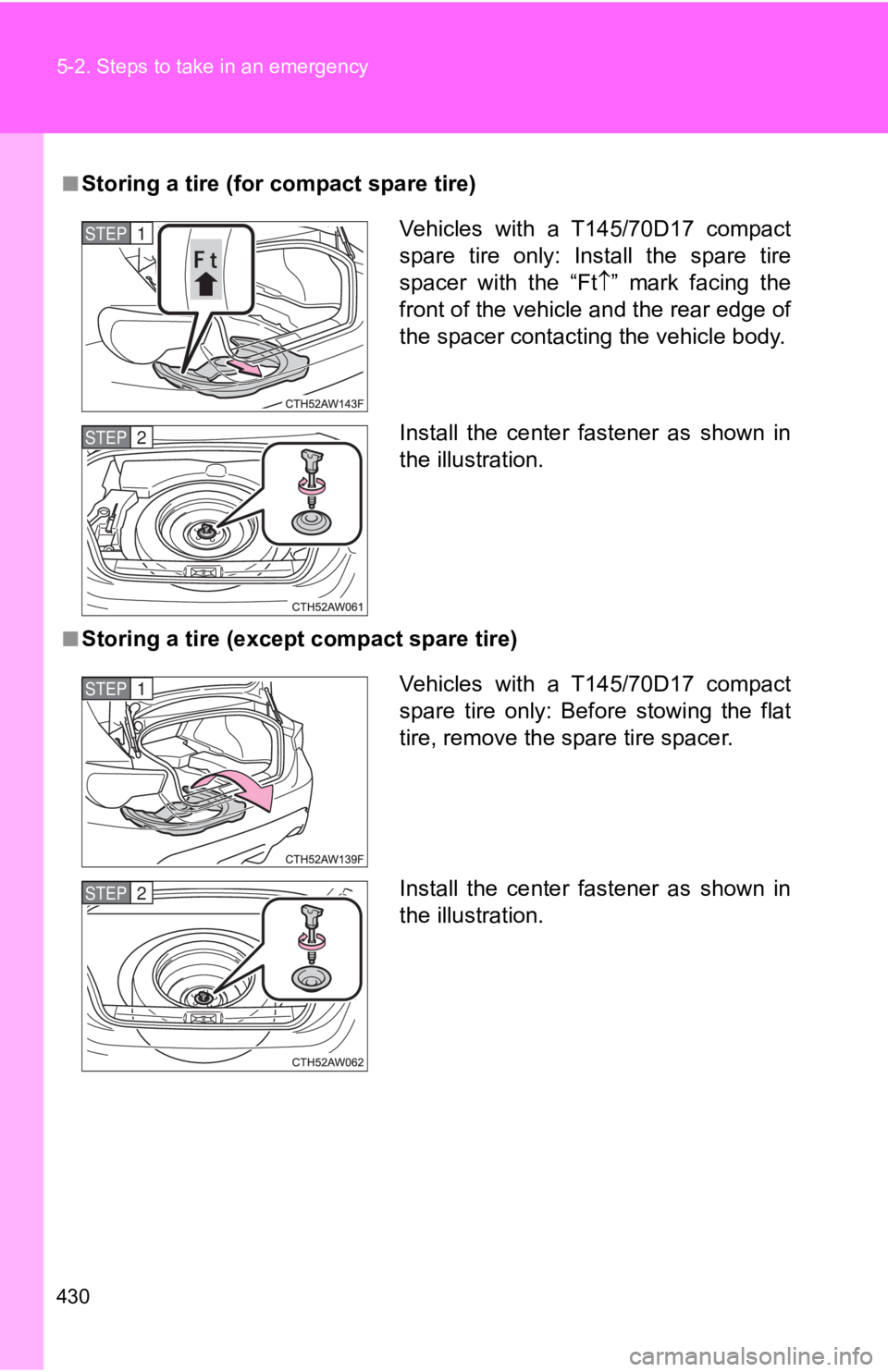
Storing a tire (for compact spare tire)
■
Storing a tire (except compact spare tire) Vehicles with a T145/70D17 compact
spare tire only: Install the spare tire
spacer with the “Ft ” mark facing the
front of the vehicle and the rear edge of
the spacer contacting the vehicle body.
Install the center fastener as shown in
the illustration.STEP 1
STEP 2
Vehicles with a T145/70D17 compact
spare tire only: Bef ore stowing the flat
tire, remove the s pare tire spacer.
Install the center fastener as shown in
the illustration.STEP 1
STEP 2
Page 431 of 532
5
When trouble arises
4315-2. Steps to take in an emergency
WARNING■
Using the tire jack
Improper use of the tire jack may lead to death or serious inju ries due to
the vehicle suddenly falling off the jack. ●
Do not use the tire jack for any purpose other than replacing t ires or
installing and removing tire chains.●
Only use the tire jack that comes with this vehicle for replacing a flat
tire.
Do not use it on other vehicles, and do not use other tire jack s for
replacing tires on this vehicle.●
Always check that the tire jack is securely set to the jack poi nt.●
Do not put any part of your body under the vehicle supported by a jack.●
Do not start or run the engine while your vehicle is supported by the
jack.
●
Do not raise the vehicle while someone is in it.
●
When raising the vehicle, do not put an object on or under the jack.
●
Do not raise the vehicle to a height greater than that required to
replace the tire.
●
Use a jack stand if it is necessary to get under the vehicle.
Take particular care when lowering the vehicle to ensure that n o one
working on or near the vehicle may be injured.
Page 432 of 532

4325-2. Steps to take in an emergency
WARNING■
Replacing a flat tire ●
Do not touch the disc wheels or the area around the brakes imme di-
ately after the vehicl e has been driven.
After the vehicle has been driven the disc wheels and the area around
the brakes will be extremely hot . Touching these areas with han ds, feet
or other body parts w hile changing a tire, e tc. may result in b urns.●
Do not attach a heavily damaged wheel ornament, as it may fly o ff the
wheel while the ve hicle is moving.●
Failure to follow these precautions could cause the wheel nuts to
loosen and the tire to fall off, resulting in death or serious injury.
• Have the wheel nuts tightened with a torque wrench to 89 ft•lb f (120
N•m, 12.2 kgf•m) as s oon as possible after changing wheels.
• When installing a tire, only use wheel nuts that have been spe cifi-
cally designed for that wheel.
• If there are any cracks or deformations in the bolt screws, nu t
threads or bolt holes of the wheel, have the vehicle inspected by
your Toyota dealer.
• When installing the wheel nuts, be sure to install them with t he
tapered ends facing inward. ( P. 358)
Page 434 of 532

4345-2. Steps to take in an emergency
NOTICE■
Do not drive the vehic le with a flat tire.
Do not continue drivi ng with a flat tire.
Driving even a short distance wi th a flat tire can damage the t ire and the
wheel beyond repair.■
Be careful when driving over bumps with the compact spare tire
installed on the vehicle.
The vehicle becomes lower when d riving with the compact spare t ire
compared to when driving with standard tires. Be careful when d riving
over uneven road surfaces.■
Driving with tire chains and the compact spare tire
Do not fit tire chains to t he compact spare tire.
Tire chains may damage the vehicle body and adversely affect dr iving
performance.■
When replacing the tires
When removing or fitting the wheels, tires or the tire pressure warning
valve and transmitter, contact yo ur Toyota dealer as the tire p ressure
warning valve and transmitter ma y be damaged if n ot handled cor rectly.
■
To avoid damage to the tire pressure warning valves and transmi t-
ters
When a tire is repaired with liquid sealants, the tire pressure warning
valve and transmitter may not operate properly. If a liquid sea lant is
used, contact your Toyota dealer or other qualified service sho p as soon
as possible. Make sure to replace the tire pressure warning val ve and
transmitter when replacing the tire. ( P. 3 4 6 )
■
Stowing the jack
When stowing the jack in the jack holder, make sure that the pa rt that the
jack handle attaches to is pointing towards the inside of the t runk. Failure
to do so may damage the vehicle body.
Page 468 of 532
4686-1. Specifications
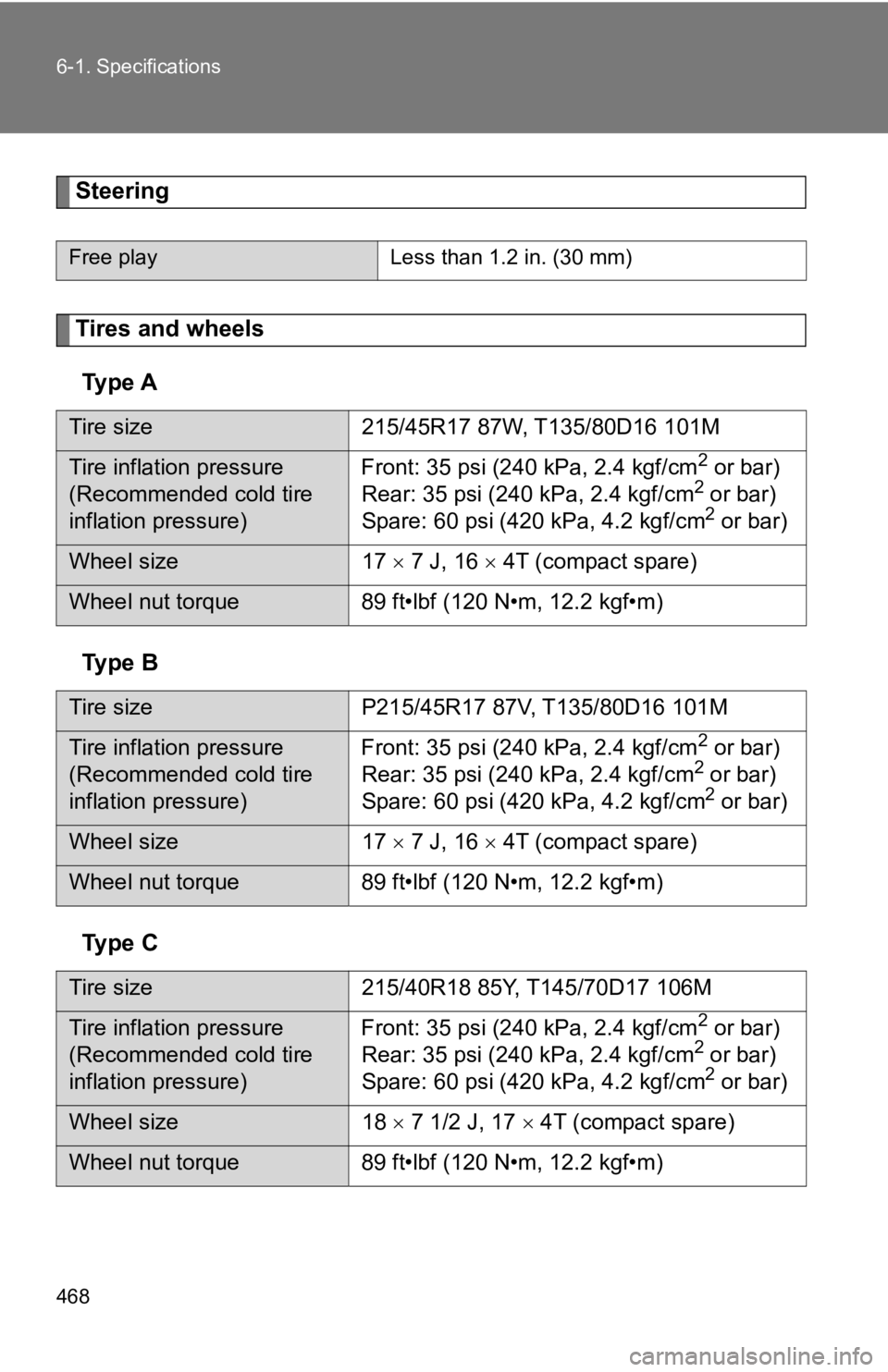
Steering
Tires and wheels
Ty p e A
Ty p e B
Ty p e CFree play Less than 1.2 in. (30 mm)
Tire size 215/45R17 87 W, T135/80D16 101M
Tire inflation pressure
(Recommended cold tire
inflation pressure) Front: 35 psi (240 kPa, 2.4 kgf/cm 2
or bar)
Rear: 35 psi (240 kPa, 2.4 kgf/cm 2
or bar)
Spare: 60 psi (420 kPa, 4.2 kgf/cm 2
or bar)
Wheel size 17 7 J, 16 4T (compact spare)
Wheel nut torque 89 ft•lbf (120 N•m, 12.2 kgf•m)
Tire size P215/45R17 87V, T135/80D16 101M
Tire inflation pressure
(Recommended cold tire
inflation pressure) Front: 35 psi (240 kPa, 2.4 kgf/cm 2
or bar)
Rear: 35 psi (240 kPa, 2.4 kgf/cm 2
or bar)
Spare: 60 psi (420 kPa, 4.2 kgf/cm 2
or bar)
Wheel size 17 7 J, 16 4T (compact spare)
Wheel nut torque 89 ft•lbf (120 N•m, 12.2 kgf•m)
Tire size 215/40R18 85 Y, T145/70D17 106M
Tire inflation pressure
(Recommended cold tire
inflation pressure) Front: 35 psi (240 kPa, 2.4 kgf/cm 2
or bar)
Rear: 35 psi (240 kPa, 2.4 kgf/cm 2
or bar)
Spare: 60 psi (420 kPa, 4.2 kgf/cm 2
or bar)
Wheel size 18 7 1/2 J, 17 4T (compact spare)
Wheel nut torque 89 ft•lbf (120 N•m, 12.2 kgf•m)
Page 475 of 532
4756-1. Specifications
6
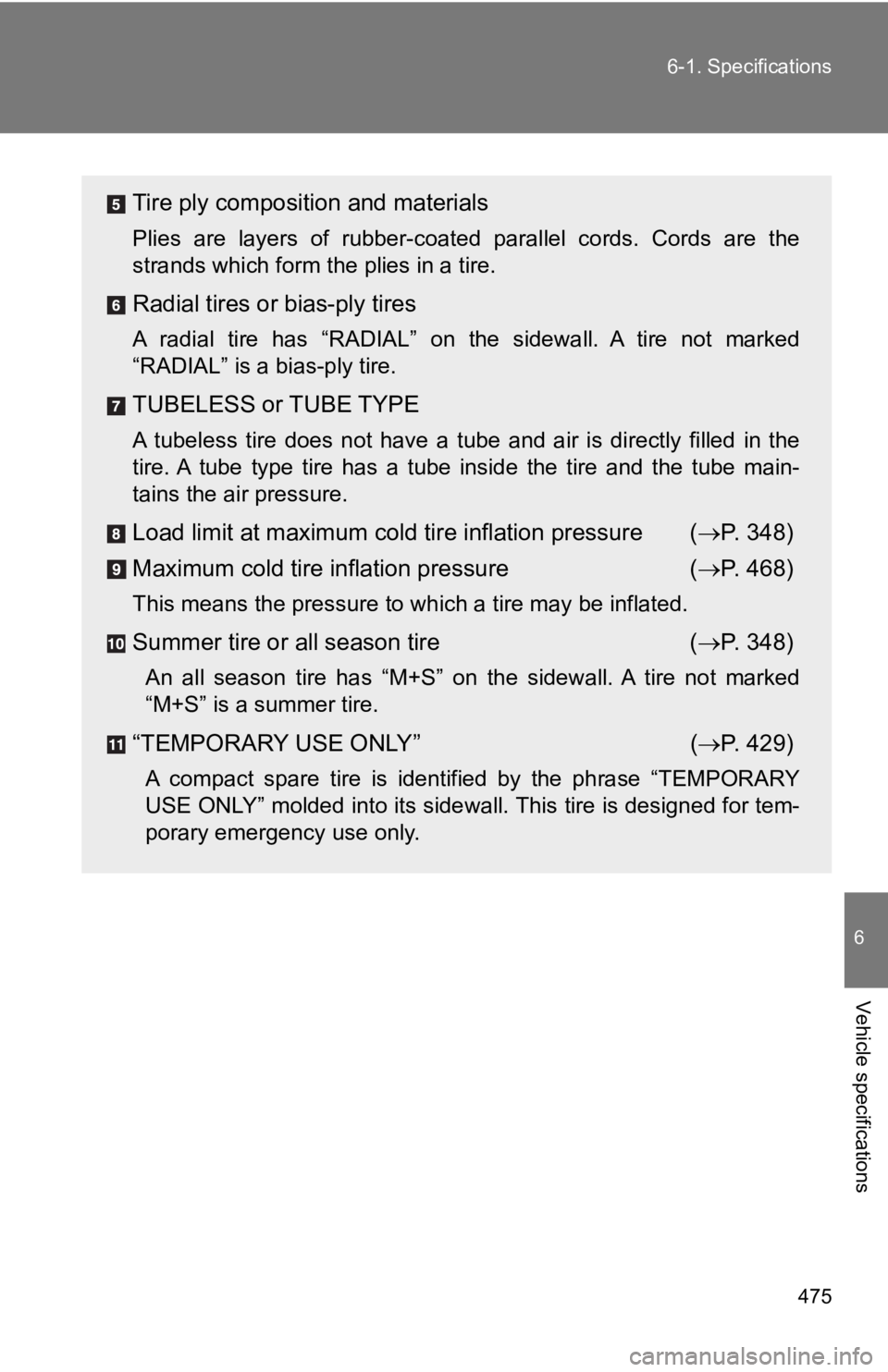
Vehicle specifications Tire ply composition and materials Plies are layers of rubber-coated parallel cords. Cords are the
strands which form the plies in a tire.
Radial tires or bias-ply tires A radial tire has “RADIAL” on the sidewall. A tire not marked
“RADIAL” is a bias-ply tire.
TUBELESS or TUBE TYPE A tubeless tire does not have a tube and air is directly filled in the
tire. A tube type tire has a tube inside the tire and the tube main-
tains the air pressure.
Load limit at maximum cold tire inflation pressure ( P. 3 4 8 )
Maximum cold tire inflation pressure ( P. 4 6 8 )This means the pres sure to which a tire may be inflated.
Summer tire or all season tire ( P. 3 4 8 )An all season tire has “M+S” on t he sidewall. A tire not marked
“M+S” is a summer tire.
“TEMPORARY USE ONLY” ( P. 4 2 9 )
A compact spare tire is identified by the phrase “TEMPORARY
USE ONLY” molded into its sidewa ll. This tire is designed for t em-
porary emergency use only.
Page 480 of 532

4806-1. Specifications
Warning: The temperature grades of a tire assume that it is pro perly
inflated and not overloaded.
Excessive speed, underinflation, or excessive loading, either s epa-
rately or in combination, can cause heat buildup and possible t ire fail-
ure.
Glossary of tire terminology
Tire related term Meaning
Cold tire inflation
pressure Tire pressure when the vehicle has been
parked for three hours or more, or has not
been driven more than 1 mile or 1.5 km under
that condition
Maximum inflation
pressure The maximum cold inflated pressure to which a
tire may be inflated, shown on the sidewall of
the tire
Recommended
inflation pressure Cold tire inflation pressure recommended by a
manufacturer.
Accessory weight The combined weight (i n excess of those stan-
dard items which may be replaced) of auto-
matic transmission, po wer steering, power
brakes, power windows, power seats, radio
and heater, to the exten t that these items are
available as factory-installed equipment
(whether installed or not)
Curb weight The weight of a motor vehicle with standard
equipment, including th e maximum capacity of
fuel, oil and coolant, and if so equipped, air
conditioning and additional weight optional
engine
Maximum loaded
vehicle weight The sum of:
(a) Curb weight
(b) Accessory weight
(c) Vehicle capacity weight
(d) Production options weight
Page 482 of 532

4826-1. Specifications
Tire related term Meaning
Vehicle normal load
on the tire The load on an individual tire that is determined
by distributing to each axle its share of curb
weight, accessory weight, and normal occu-
pant weight (distributed in accordance with
Ta b l e 1
* below), and dividing by two
Weather side The surface area of the rim not covered by the
inflated tire
Bead The part of the tire that is made of steel wires,
wrapped or reinforced by ply cords and that is
shaped to fit the rim
Bead separation A breakdown of the bond between components
in the bead
Bias ply tire A pneumatic tire in which the ply cords that
extend to the beads are laid at alternate angles
substantially less than 90 degrees to the cen-
terline of the tread
Carcass The tire structure, except tread and sidewall
rubber which, when inflated, bears the load
Chunking The breaking away of pieces of the tread or
sidewall
Cord The strands forming the plies in the tire
Cord separation The parting of cords from adjacent rubber com-
pounds
Cracking Any parting withi n the tread, sidewall, or inner-
liner of the tire extending to cord material
CT A pneumatic tire with an inverted flange tire
and rim system in which the rim is designed
with rim flanges pointed radially inward and the
tire is designed to fit on the underside of the
rim in a manner that en closes the rim flanges
inside the air cavity of the tire
Page 483 of 532
4836-1. Specifications
6
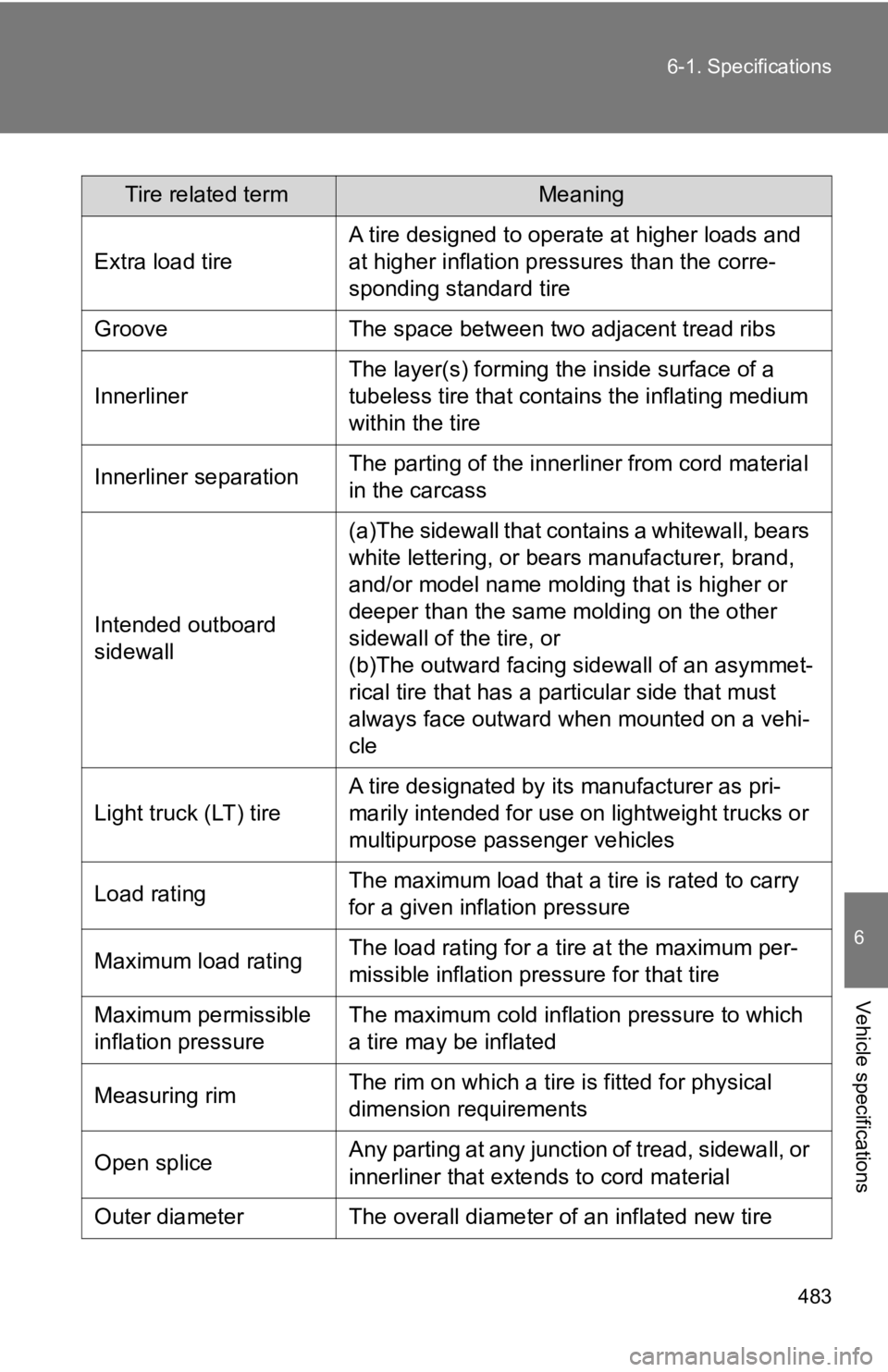
Vehicle specifications Tire related term Meaning
Extra load tire A tire designed to operate at higher loads and
at higher inflation pressures than the corre-
sponding standard tire
Groove The space between two adjacent tread ribs
Innerliner The layer(s) forming th e inside surface of a
tubeless tire that contains the inflating medium
within the tire
Innerliner separation The parting of the innerliner from cord material
in the carcass
Intended outboard
sidewall (a)The sidewall that con tains a whitewall, bears
white lettering, or bear s manufacturer, brand,
and/or model name molding that is higher or
deeper than the same molding on the other
sidewall of the tire, or
(b)The outward facing sidewall of an asymmet-
rical tire that has a particular side that must
always face outward whe n mounted on a vehi-
cle
Light truck (LT) tire A tire designated by it s manufacturer as pri-
marily intended for use on lightweight trucks or
multipurpose passenger vehicles
Load rating The maximum load that a tire is rated to carry
for a given inflation pressure
Maximum load rating The load rating for a tire at the maximum per-
missible inflation pressure for that tire
Maximum permissible
inflation pressure The maximum cold inflation pressure to which
a tire may be inflated
Measuring rim The rim on which a tire is fitted for physical
dimension requirements
Open splice Any parting at any junction of tread, sidewall, or
innerliner that extends to cord material
Outer diameter The overall diam eter of an inflated new tire