fuel TOYOTA 86 2019 Owner's Manual
[x] Cancel search | Manufacturer: TOYOTA, Model Year: 2019, Model line: 86, Model: TOYOTA 86 2019Pages: 532, PDF Size: 6.89 MB
Page 256 of 532
2562-5. Driving information
Cargo and luggage
Capacity and distribution
Cargo capacity depends on the to tal weight of the occupants.
(Cargo capacity) = (Tot al load capacity) - (Total weight of occ upants)
Steps for Determini ng Correct Load Limit
(1)Locate the statement “The co mbined weight of occupants and
cargo should never exceed XXX kg or XXX lbs.” on your vehicle's
placard.
(2)Determine the combined weight of the driver and passengers t hat
will be riding in your vehicle.
(3)Subtract the combined weight of the driver and passengers fr om
XXX kg or XXX lbs.
(4)The resulting figure equals the available amount of cargo and lug-
gage load capacity.
For example, if the “XXX” amount equals 1400 lbs. and there wil l
be five 150 lb passengers in your vehicle, the amount of availa ble
cargo and luggage load capacity is 650 lbs. (1400 - 750 (5 150) =
650 lbs.)
(5)Determine the combined wei ght of luggage and cargo being
loaded on the vehicle. That weight may not safely exceed the av ail-
able cargo and luggage load ca pacity calculated in Step 4.Take notice of the following information about storage precau-
tions, cargo capacity and load:
● Stow cargo and luggage in t he trunk whenever possible.
● Be sure all items are secured in place.
● To maintain vehicle balance while driving, position luggage
evenly within the luggage compartment.
● For better fuel economy, do no t carry unnecessary weight.
Page 309 of 532

3094-1. Maintenance and care
4
Maintenance and care ■ Automatic car washes
● Fold the mirrors before washing the vehicle. Start washing from the front
of the vehicle. Make sure to extend the mirrors before driving.
● Brushes used in automatic car washes may scratch the vehicle su rface
and harm your vehicle’s paint.
■ High pressure car washes
● Do not allow the nozzles of the car wash to come within close proximity
of the windows.
● Before using the car wash, check that the fuel filler door on y our vehicle
is closed properly.
■ Aluminum wheels
● Remove any dirt immediately by using a neutral detergent.
● Wash detergent off with water immediately after use.
● To protect the paint from damage, make sure to observe the foll owing
precautions.
• Do not use acidic, alkaline or abrasive detergent
• Do not use hard brushes
• Do not use detergent on the wheels when they are hot, such as after
driving or parking in hot weather
■ Brake (vehicles with brembo brake)
● Painted brake calipers
• When using detergent, use neutral detergent. Do not use hard b rushes
or abrasive cleaners, as they will damage the paint.
• Do not use detergent on the brake calipers when they are hot.
• Wash detergent off immediately after use.
● Rust may form if the vehicle is parked with wet brake pads or disc rotors,
causing them to stick. Before parking the vehicle after it is w ashed, drive
slowly and apply the brakes several times to dry the parts.
■ Parts containing resin such as the bumper
Do not scrub with abrasive cleaners.
Page 319 of 532

3194-2. Maintenance
4
Maintenance and care ■ Allow inspection and repairs to be performed by a Toyota dealer
● Toyota technicians are well-trained specialists and are kept up to date
with the latest service information. They are well informed abo ut the
operations of all systems on your vehicle.
● Keep a copy of the repair order. It proves that the maintenance that has
been performed is under warranty coverage. If any problem should arise
while your vehicle is under warranty, your Toyota dealer will p romptly
take care of it.
WARNING■ If your vehicle is not properly maintained
It could result in serious damage to the vehicle and possible s erious injury or
death.
■ Warning in handling of battery
● Engine exhaust, some of its constituents, and a wide variety of automobile
components contain or emit chemicals known to the State of Cali fornia to
cause cancer and birth defects and other reproductive harm. Wor k in a
well ventilated area.
● Oils, fuels and fluids contained in vehicles as well as waste p roduced by
component wear contain or emit chemicals known to the State of Califor-
nia to cause cancer and birth defects or other reproductive har m. Avoid
exposure and wash any affected area immediately.
● Battery posts, terminals and related accessories contain lead and lead
compounds which are known to cause brain damage. Wash your hand s
after handling. ( P. 339)
Page 323 of 532
3234-2. Maintenance
4
Maintenance and care
Emission inspection and maintenance (I/M) programs Some states have vehicle emissi on inspection programs which
include OBD (On Board Diagnosti cs) checks. The OBD system moni-
tors the operation of the emission control system.
■ If the malfunction i ndicator lamp comes on
The OBD system determines that a problem exists somewhere
in the emission control system. Y our vehicle may not pass the I /
M test and may need to be repaired. Contact your Toyota dealer
to service the vehicle.
■ Your vehicle may not pass the I/M test:
● When the battery is disconnected or discharged
Readiness codes that are set during ordinary driving are
erased.
Also, depending on your driving habits, the readiness codes
may not be completely set.
● When the fuel t ank cap is loose
The malfunction indicator lamp comes on as a temporary mal-
function and your vehicle m ay not pass the I/M test.
■ When the malfunction indicator lamp goes off after several
driving trips
The error code in the OBD system will not be cleared unless the
vehicle is driven 40 or more times.
■ If your vehicle does not pass the I/M test
Contact your Toyota dealer to pr epare the vehicle for re-testin g.
Page 326 of 532

3264-3. Do-it-yourself maintenance
WARNINGThe engine compartment contains many mechanisms and fluids that may
move suddenly, become hot, or become electrically energized. To avoid death
or serious injury, observe the following precautions.
■ When working on the engine compartment
● Keep hands, clothing, and tools away from the moving fan and en gine
drive belt.
● Be careful not to touch the engine, radiator, exhaust manifold, etc. right
after driving as they may be hot. Oil and other fluids may also be hot.
● Do not leave anything that may burn easily, such as paper or ra gs, in the
engine compartment.
● Do not smoke, cause sparks or expose an open flame to fuel or t he bat-
tery. Fuel and battery fumes are flammable.
● Be extremely cautious when working on the battery. It contains poisonous
and corrosive sulfuric acid.
■ When working near the electric cooling fans or radiator grille
Vehicles without a smart key system: Be sure the engine switch is off. With
the engine switch in the “ON” position, the electric cooling fa ns may auto-
matically start to run if the air conditioning is on and/or the coolant tempera-
ture is high. ( P. 337)
Vehicles with a smart key system: Be sure the “ENGINE START STO P”
switch is off. With the “ENGINE START STOP” switch in IGNITION ON
mode, the electric cooling fans may automatically start to run if the air condi-
tioning is on and/or the coolant temperature is high. ( P. 337)
■ Safety glasses
Wear safety glasses to prevent flying or falling material, flui d spray, etc. from
getting in the eyes.
NOTICE
■ If you remove the air cleaner filter
Driving with the air cleaner filter removed may cause excessive engine wear
due to dirt in the air.
Page 355 of 532
3554-3. Do-it-yourself maintenance
4
Maintenance and care ■
Effects of inco rrect tire inflation pressure
Driving with incorrect tire inflation pressure may result in th e following:●
Reduced fuel economy●
Reduced driving comfort and poor handling●
Reduced tire life due to wear●
Reduced safety●
Damage to the drive train
If a tire needs frequ ent refilling, have it checked by your Toy ota dealer.■
Instructions for checking tire inflation pressure
When checking tire inflation pressure, observe the following: ●
Check only when the tires are cold.
If your vehicle has been parked fo r at least 3 hours and has no t been
driven for more than 1 mile or 1.5 km, you will get an accurate cold
tire inflation pressure reading.
●
Always use a tire pressure gauge.
It is difficult to judge if a tir e is properly inflated based o nly on its
appearance.
●
It is normal for the tire inflation pressure to be higher after driving as
heat is generated in the tire. Do not reduce tire inflation pre ssure after
driving.
●
Never exceed the vehicle capacity weight.
Passengers and luggage weight should be placed so that the vehi cle
is balanced.
Page 371 of 532
3714-3. Do-it-yourself maintenance
4
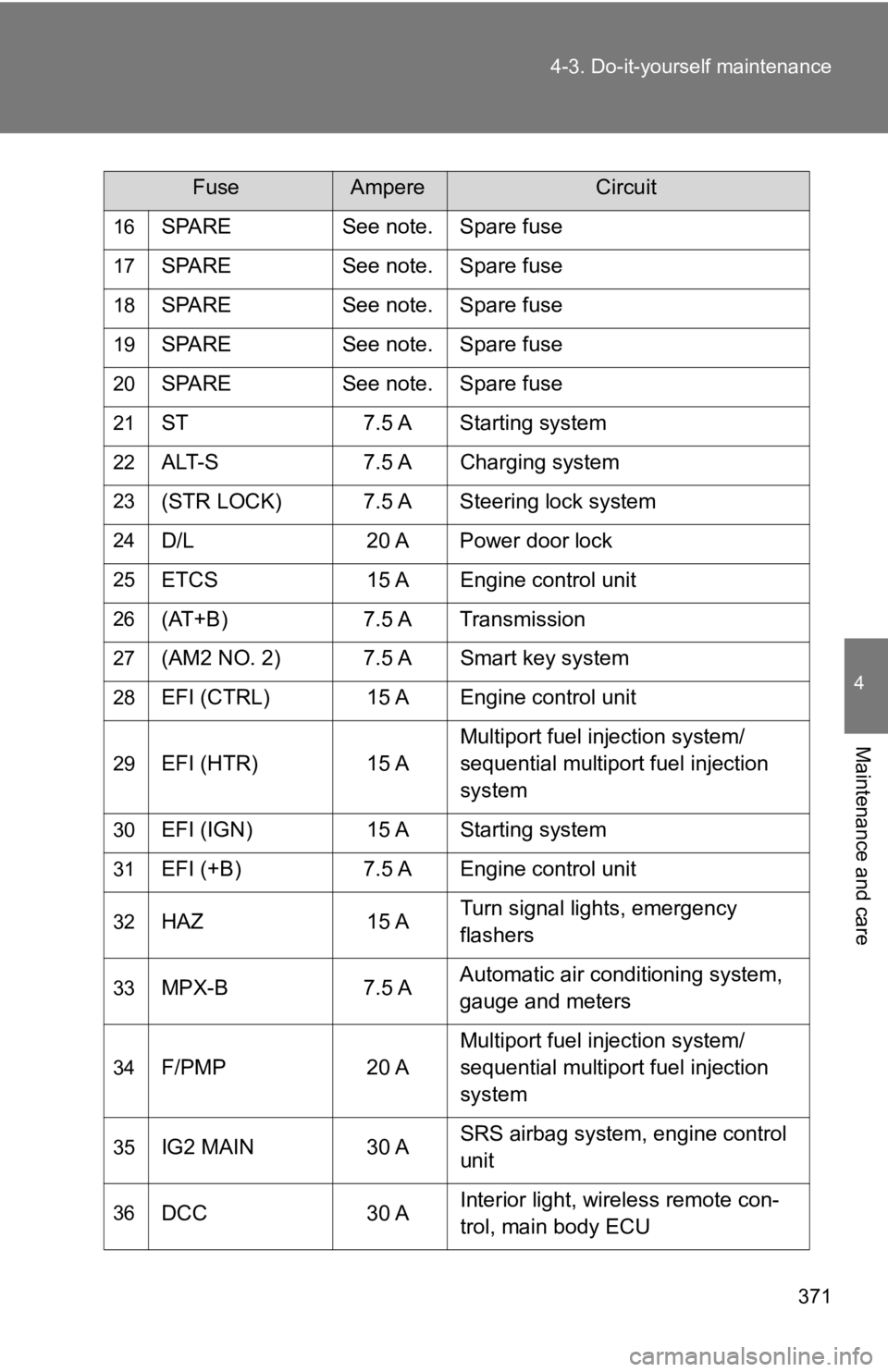
Maintenance and care 16
SPARE See note. Spare fuse17
SPARE See note. Spare fuse18
SPARE See note. Spare fuse19
SPARE See note. Spare fuse20
SPARE See note. Spare fuse21
ST 7.5 A Starting system22
ALT-S 7.5 A Charging system23
(STR LOCK) 7.5 A Steering lock system24
D/L 20 A Power door lock25
ETCS 15 A Engine control unit26
(AT+B) 7.5 A Transmission
27
(AM2 NO. 2) 7.5 A Smart key system
28
EFI (CTRL) 15 A Engine control unit
29
EFI (HTR) 15 A Multiport fuel injection system/
sequential multiport fuel injection
system
30
EFI (IGN) 15 A Starting system
31
EFI (+B) 7.5 A Engine control unit
32
HAZ 15 A Turn signal lights, emergency
flashers
33
MPX-B 7.5 A Automatic air conditioning system,
gauge and meters
34
F/PMP 20 A Multiport fuel injection system/
sequential multiport fuel injection
system
35
IG2 MAIN 30 A SRS airbag system, engine control
unit
36
DCC 30 A Interior light, wireless remote con-
trol, main body ECUFuse Ampere Circuit
Page 372 of 532

3724-3. Do-it-yourself maintenance
Note
One of each of the following spare fuses are provided: 7.5 A, 10 A, 15
A, 20 A, 25 A, 30 A. 37
HORN NO. 2 7.5 A Horn38
HORN NO. 1 7.5 A Horn39
H-LP LH LO 15 A Left-hand headlight (low beam)40
H-LP RH LO 15 A Right-hand headlight (low beam)41
H-LP LH HI 10 A Left-hand headlight (high beam)42
H-LP RH HI 10 A Right-hand headlight (high beam)
43
INJ 30 A Multiport fuel injection system/
sequential multiport fuel injection
system44
H-LP WASHER 30 A
45
AM2 NO. 1 40 A Starting system, engine control unit
46
EPS 80 A Electric power steering
47
A/B MAIN 15 A SRS airbag system
48
ECU-B 7.5 A Wireless remote control, main body
ECU
49
DOME 20 A Interior light
50
IG2 7.5 A Engine control unitFuse Ampere Circuit
Page 383 of 532
When trouble arises
5
3835-1. Essential information
Emergency flashers ......... 384
If your vehicle needs to
be towed ........................ 385
If you think something
is wrong ......................... 393
Fuel pump shut off
system ........................... 394
5-2. Steps to take in an
emergency
If a warning light turns on
or a warning buzzer
sounds... ........................ 395
If a warning message is
displayed........................ 407
If you have a flat tire......... 424 If the engine will
not start .......................... 435
If the shift lever cannot be
shifted from P................. 438
If you lose your keys ........ 439
If the electronic key does
not operate properly....... 440
If the battery is
discharged ..................... 444
If your vehicle
overheats ....................... 449
If the vehicle becomes
stuck .............................. 452
If your vehicle has to be
stopped in an
emergency ..................... 454
Page 389 of 532
5
When trouble arises
3895-1. Essential information
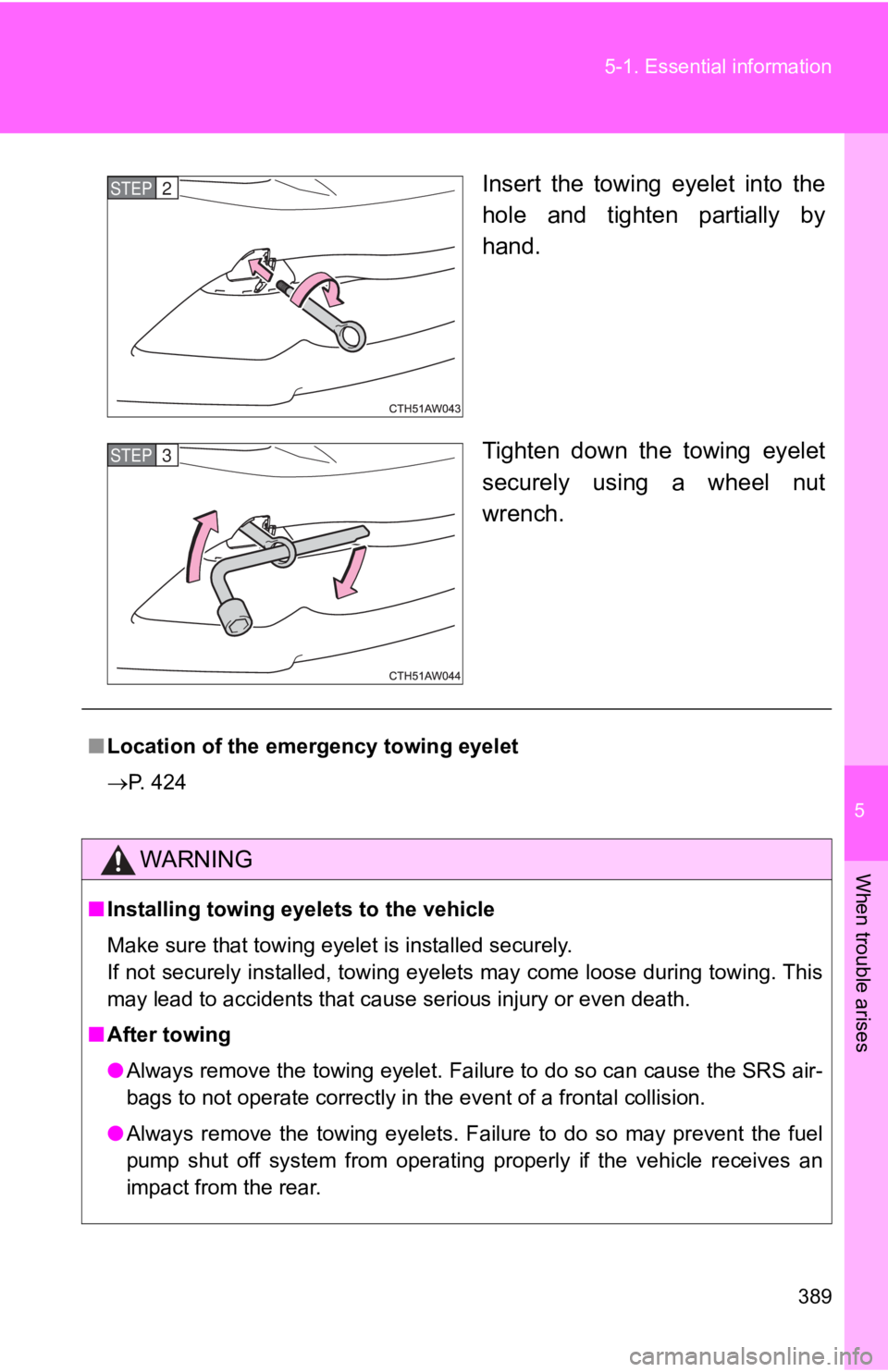
Insert the towing eyelet into the
hole and tighten partially by
hand.
Tighten down the towing eyelet
securely using a wheel nut
wrench.STEP 2
STEP 3
■ Location of the eme rgency towing eyelet
P. 424
WARNING
■ Installing towing eyelets to the vehicle
Make sure that towing eyelet is installed securely.
If not securely installed, towing eyelets may come loose during towing. This
may lead to accidents that cause serious injury or even death.
■ After towing
● Always remove the towing eyelet. Failure to do so can cause the SRS air-
bags to not operate correctly in the event of a frontal collisi on.
● Always remove the towing eyelets. Failure to do so may prevent the fuel
pump shut off system from operating properly if the vehicle receives an
impact from the rear.