fuel TOYOTA 86 2019 Owner's Guide
[x] Cancel search | Manufacturer: TOYOTA, Model Year: 2019, Model line: 86, Model: TOYOTA 86 2019Pages: 532, PDF Size: 6.89 MB
Page 394 of 532
3945-1. Essential information
Fuel pump shut off system Follow the procedure below to restart the engine after the syst em is
activated.
Vehicles without a smart key system
Turn the engine switch to t he “ACC” or “LOCK” position.
Restart the engine.
Vehicles with a smart key system
Turn the “ENGINE START STOP” switch to ACCESSORY mode
or turn it off.
Restart the engine.
NOTICE■ Before starting the engine
Inspect the ground under the vehicle.
If you find that fuel has leaked on to the ground, the fuel sys tem has been
damaged and is in need of repair. Do not restart the engine.When the vehicle sustains an impact in an accident, etc., the f uel
pump shut off system operates to stop supplying fuel in order t o
minimize fuel leakage.
STEP 1
STEP 2
STEP 1
STEP 2
Page 398 of 532
3985-2. Steps to take in an emergency
(Comes on in
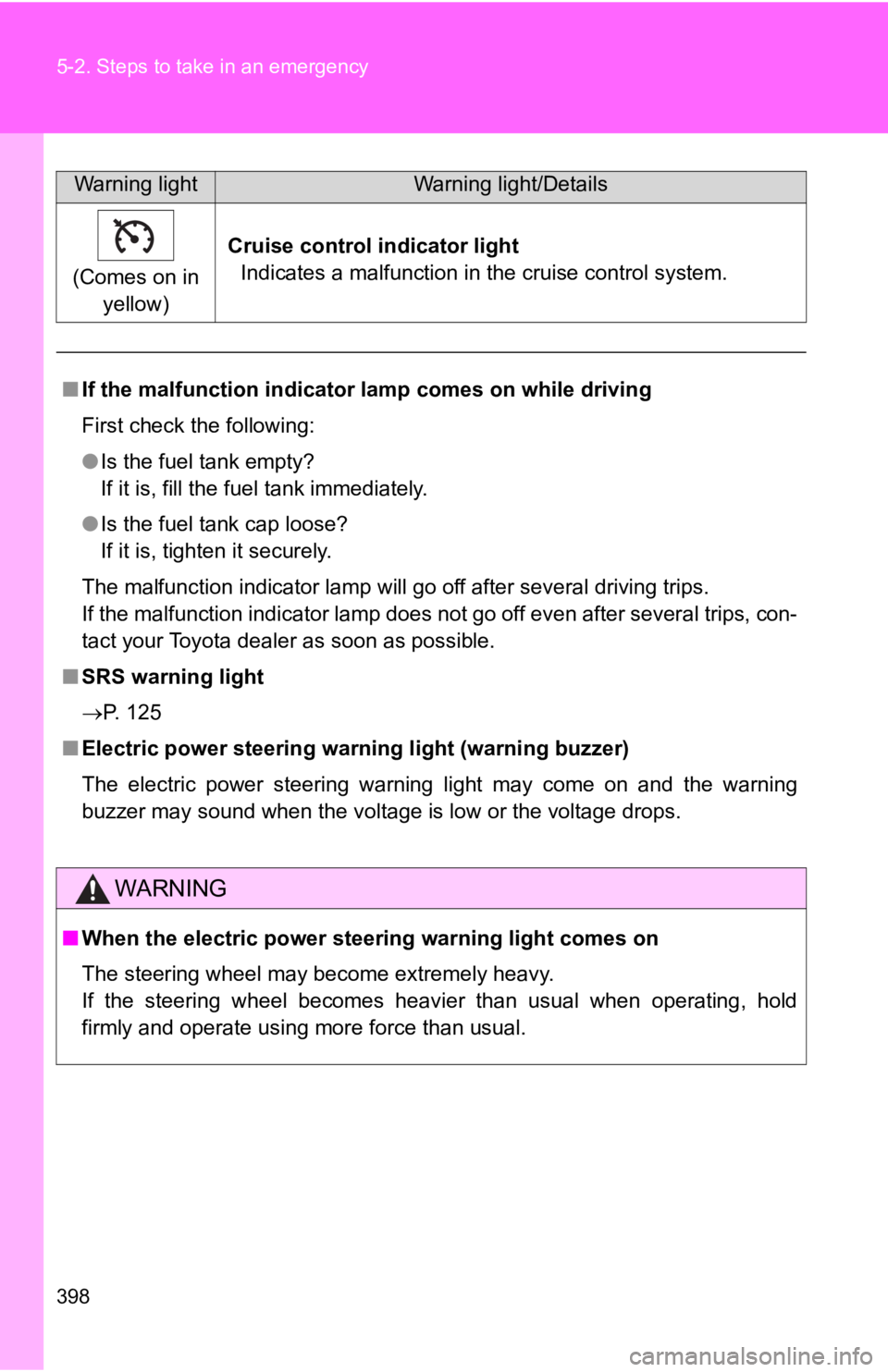
yellow) Cruise control indicator light
Indicates a malfunction in the cruise control system.
■ If the malfunction indicator lamp comes on while driving
First check the following:
● Is the fuel tank empty?
If it is, fill the fuel tank immediately.
● Is the fuel tank cap loose?
If it is, tighten it securely.
The malfunction indicator lamp will go off after several driving trips.
If the malfunction indicator lamp does not go off even after several trips, con-
tact your Toyota dealer as soon as possible.
■ SRS warning light
P. 125
■ Electric power steering warning light (warning buzzer)
The electric power steering warning light may come on and the w arning
buzzer may sound when the voltage is low or the voltage drops.
WARNING
■ When the electric power steer ing warning light comes on
The steering wheel may become extremely heavy.
If the steering wheel becomes heavier than usual when operating , hold
firmly and operate using more force than usual.Warning light Warning light/Details
Page 399 of 532
5
When trouble arises
3995-2. Steps to take in an emergency
Follow the correction procedures.
After taking the specified steps to correct the suspected probl em,
check that the warning light turns off. Warning light Warning light/Details Correction procedure
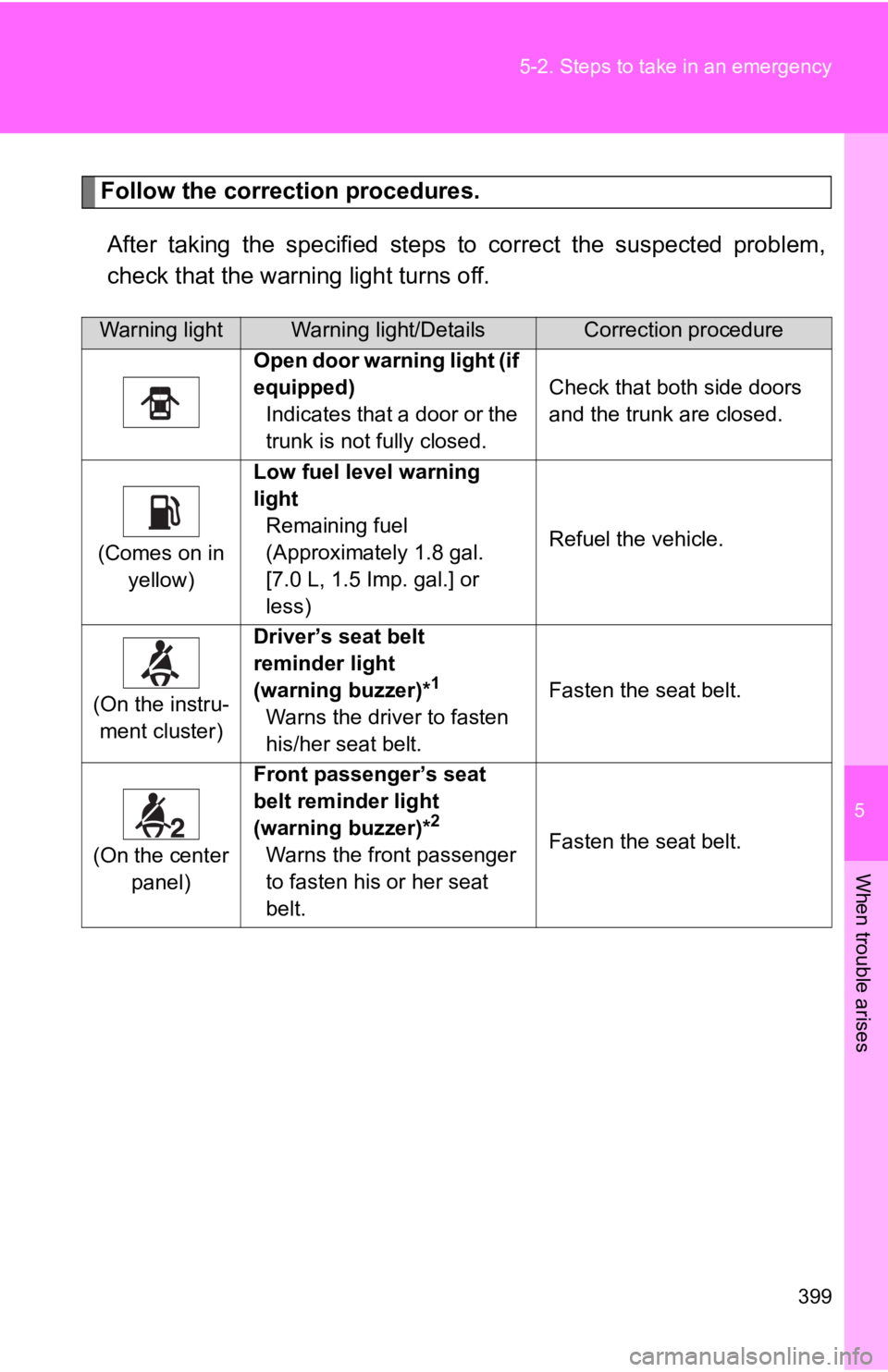
Open door warning light (if
equipped)
Indicates that a door or the
trunk is not fully closed. Check that both side doors
and the trunk are closed.
(Comes on in
yellow) Low fuel level warning
light
Remaining fuel
(Approximately 1.8 gal.
[7.0 L, 1.5 Imp. gal.] or
less) Refuel the vehicle.
(On the instru-
ment cluster) Driver’s seat belt
reminder light
(warning buzzer)* 1
Warns the driver to fasten
his/her seat belt. Fasten the seat belt.
(On the center
panel) Front passenger’s seat
belt reminder light
(warning buzzer)* 2
Warns the front passenger
to fasten his or her seat
belt. Fasten the seat belt.
Page 405 of 532
5
When trouble arises
4055-2. Steps to take in an emergency
WARNING■
Maintenance of the tires
Each tire, including the spare (if provided), should be checked monthly
when cold and inflated to the inflation pressure recommended by the
vehicle manufacturer on the vehicle placard or tire inflation p ressure
label (tire and load information label). (If your vehicle has t ires of a differ-
ent size than the size indicated on the vehicle placard or tire inflation
pressure label [tire and load information label], you should de termine the
proper tire inflation pressure for those tires.)
As an added safety feature, your vehicle has been equipped with a tire
pressure monitoring system (TPMS -tire pressure warning system) that
illuminates a low tire pressure telltale (tire pressure warning light) when
one or more of your tires is significantly under-inflated. Acco rdingly,
when the low tire pressure telltale (tire pressure warning ligh t) illumi-
nates, you should stop and check your tires as soon as possible , and
inflate them to the proper press ure. Driving on a significantly under-
inflated tire causes the tire to overheat and can lead to tire failure.
Under-inflation also reduces fuel efficiency and tire tread lif e, and may
affect the vehicle's han dling and stopping ability.
Please note that the TPMS (tire pressure warning system) is not a sub-
stitute for proper tire maintenance, and it is the driver's res ponsibility to
maintain correct tire pressure, even if under-inflation has not reached the
level to trigger illumination of the TPMS low tire pressure tel ltale (tire
pressure warning light).
Your vehicle has also been equipped with a TPMS (tire pressure warning
system) malfunction indicator to indicate when the system is no t operat-
ing properly. The TPMS (tire pressure warning system) malfuncti on indi-
cator is combined with the low tire pressure telltale (tire pre ssure
warning light). When the system detects a malfunction, the tell tale will
flash for approximately one minut e and then remain continuously illumi-
nated. This sequence will continue upon subsequent vehicle star t-ups as
long as the malfunction exists. When the malfunction indicator is illumi-
nated, the system may not be able to detect or signal low tire pressure
as intended.
Page 412 of 532
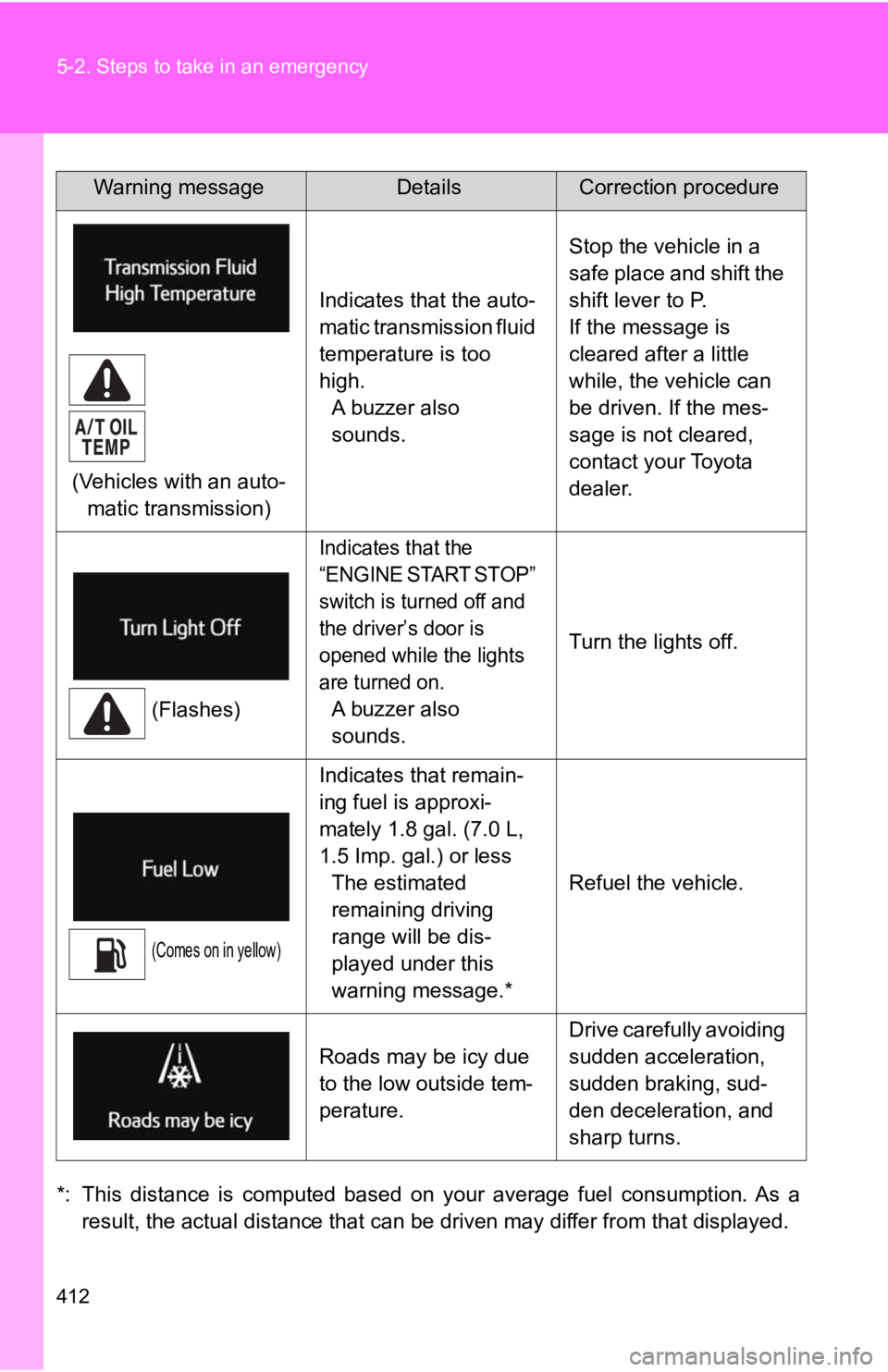
4125-2. Steps to take in an emergency
*: This distance is computed based on your average fuel consumpt ion. As a
result, the actual distance that can be driven may differ from that displayed.(Vehicles with an auto-
matic transmission) Indicates that the auto-
matic transmission fluid
temperature is too
high.
A buzzer also
sounds. Stop the vehicle in a
safe place and shift the
shift lever to P.
If the message is
cleared after a little
while, the vehicle can
be driven. If the mes-
sage is not cleared,
contact your Toyota
dealer.
(Flashes) Indicates that the
“ENGINE START STOP”
switch is tur ned off and
the driver’s door is
opened while the lights
are turned on.
A buzzer also
sounds. Turn the lights off.
(Comes on in yellow) Indicates that remain-
ing fuel is approxi-
mately 1.8 gal. (7.0 L,
1.5 Imp. gal.) or less
The estimated
remaining driving
range will be dis-
played under this
warning message.* Refuel the vehicle.
Roads may be icy due
to the low outside tem-
perature. Drive carefully avoiding
sudden acceleration,
sudden braking, sud-
den deceleration, and
sharp turns.Warning message Details Correction procedure
Page 435 of 532
5
When trouble arises
4355-2. Steps to take in an emergency
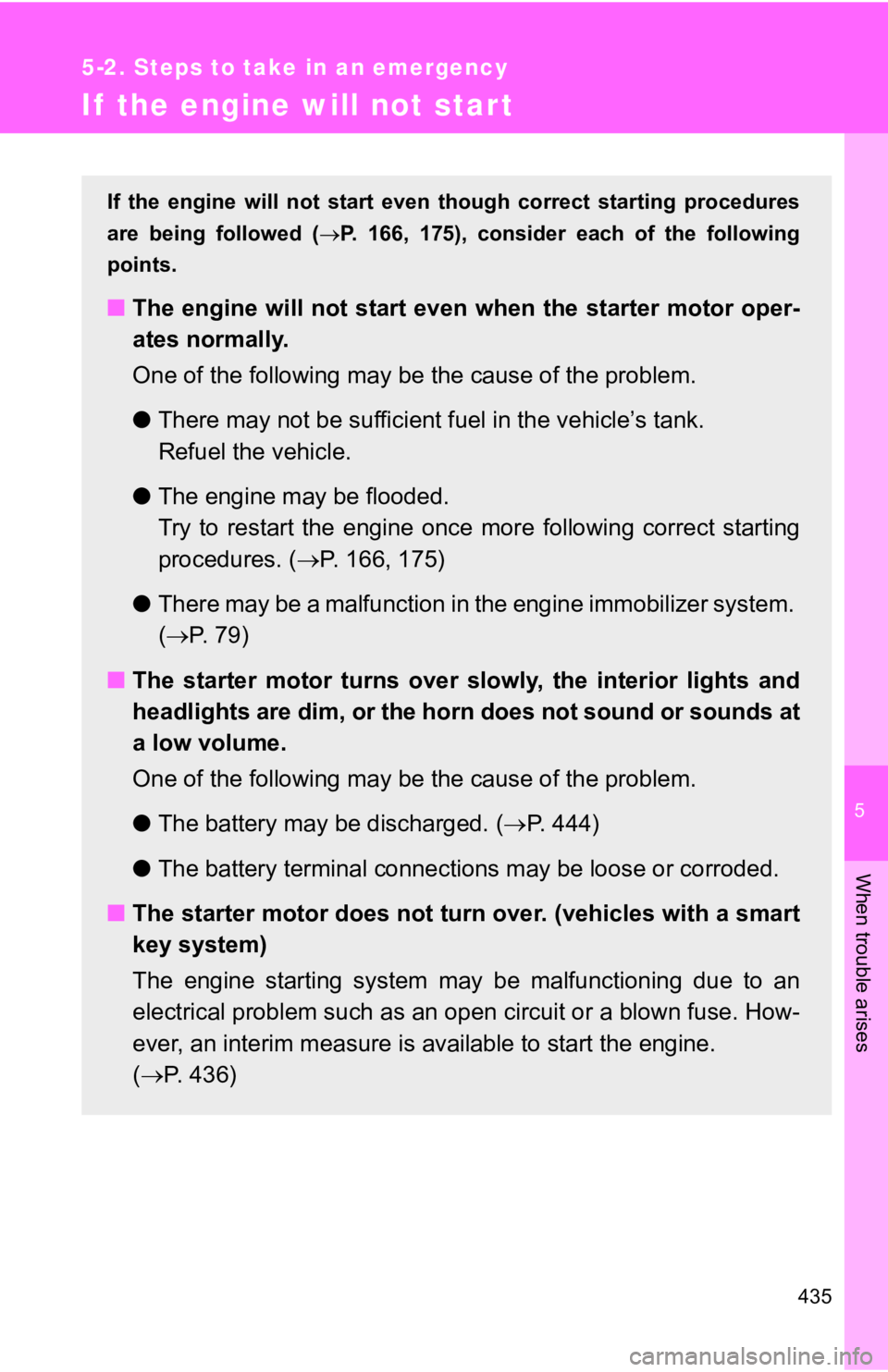
If the engine will not star t If the engine will not start even t hough correct starting proce dures
are being followed ( P. 166, 175), consider each of the following
points.
■ The engine will not start even when the starter motor oper-
ates normally.
One of the following may be the cause of the problem.
● There may not be sufficient fuel in the vehicle’s tank.
Refuel the vehicle.
● The engine may be flooded.
Try to restart the engine once more following correct starting
procedures. ( P. 166, 175)
● There may be a malfunction in t he engine immobilizer system.
( P. 7 9 )
■ The starter motor turns over slowly, the interior lights and
headlights are dim, or the horn does not sound or sounds at
a low volume.
One of the following may be the cause of the problem.
● The battery may be discharged. ( P. 444)
● The battery terminal connections may be loose or corroded.
■ The starter motor does not turn over. (vehicles with a smart
key system)
The engine starting system may be malfunctioning due to an
electrical problem such as an open circuit or a blown fuse. How -
ever, an interim measure is a vailable to start the engine.
( P. 4 3 6 )
Page 457 of 532
Vehicle specifications
6
4576-1. Specifications
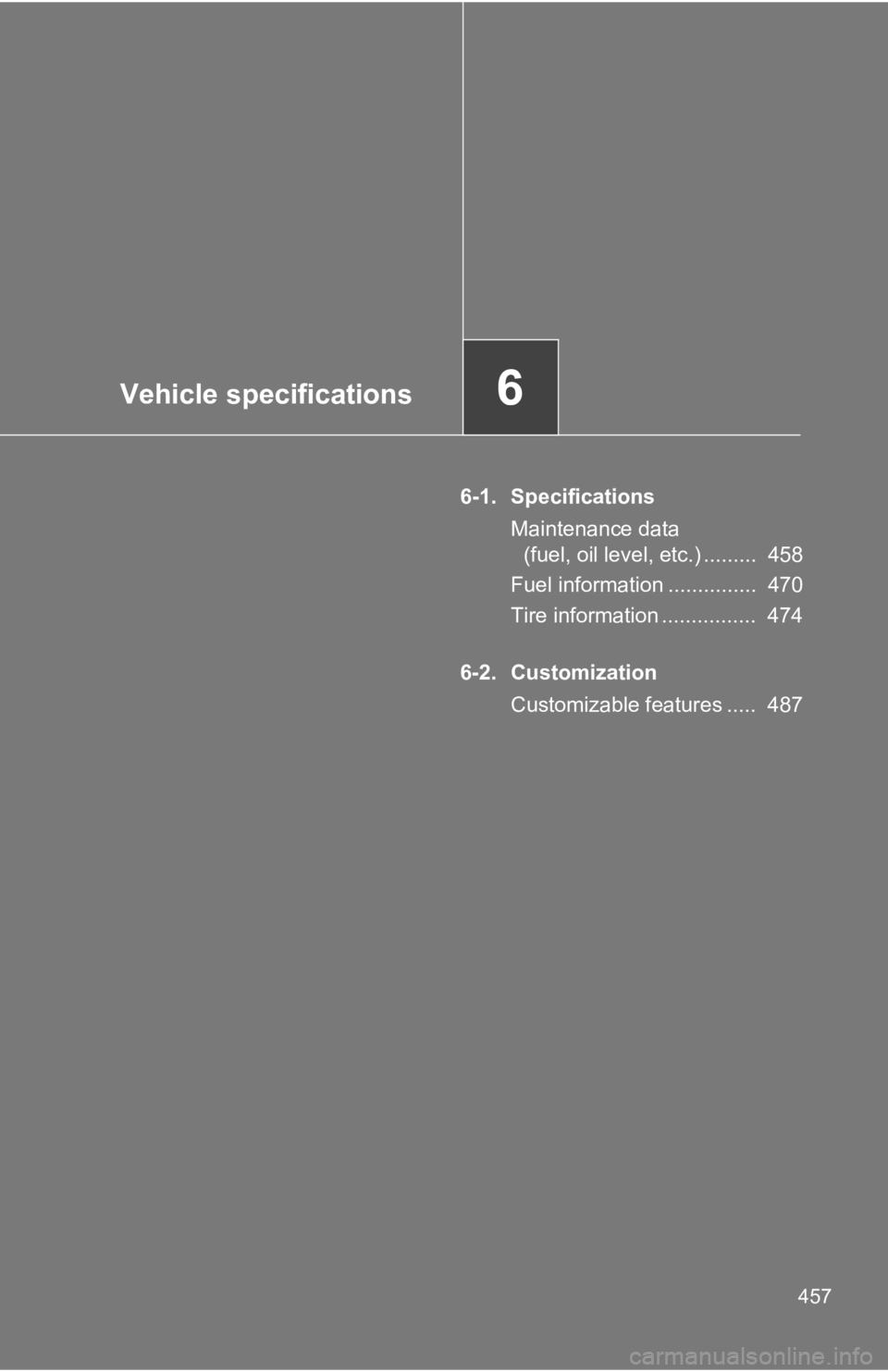
Maintenance data
(fuel, oil level, etc.) ......... 458
Fuel information ............... 470
Tire information ................ 474
6-2. Customization
Customizable features ..... 487
Page 458 of 532
4586-1. Specifications
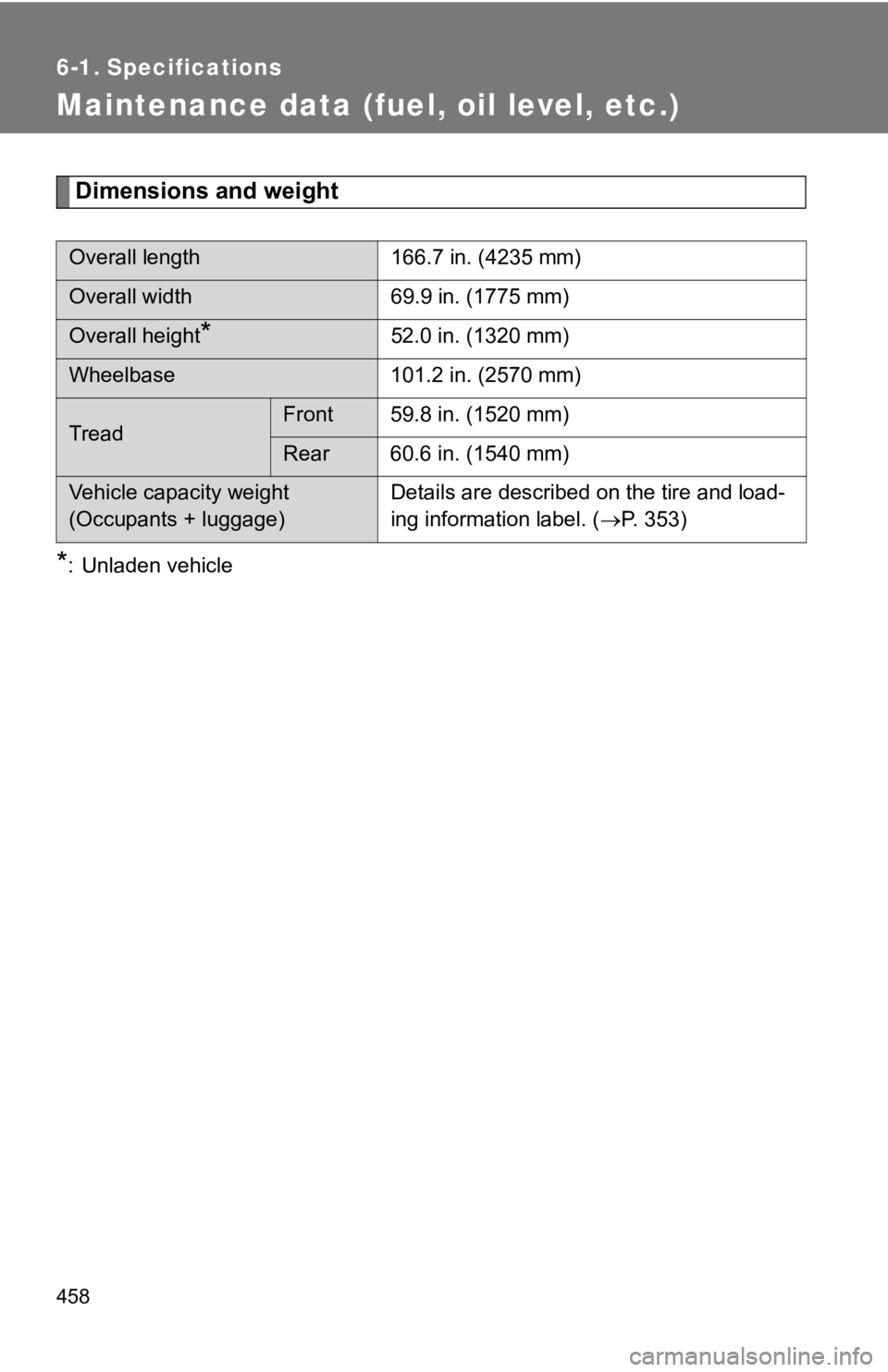
Maintenance data (fuel, oil level, etc.) Dimensions and weight
* : Unladen vehicle Overall length 166.7 in. (4235 mm)
Overall width 69.9 in. (1775 mm)
Overall height
* 52.0 in. (1320 mm)
Wheelbase 101.2 in. (2570 mm)
Tread Front 59.8 in. (1520 mm)
Rear 60.6 in. (1540 mm)
Vehicle capacity weight
(Occupants + luggage) Details are described on the tire and load-
ing information label. ( P. 353)
Page 461 of 532
4616-1. Specifications
6
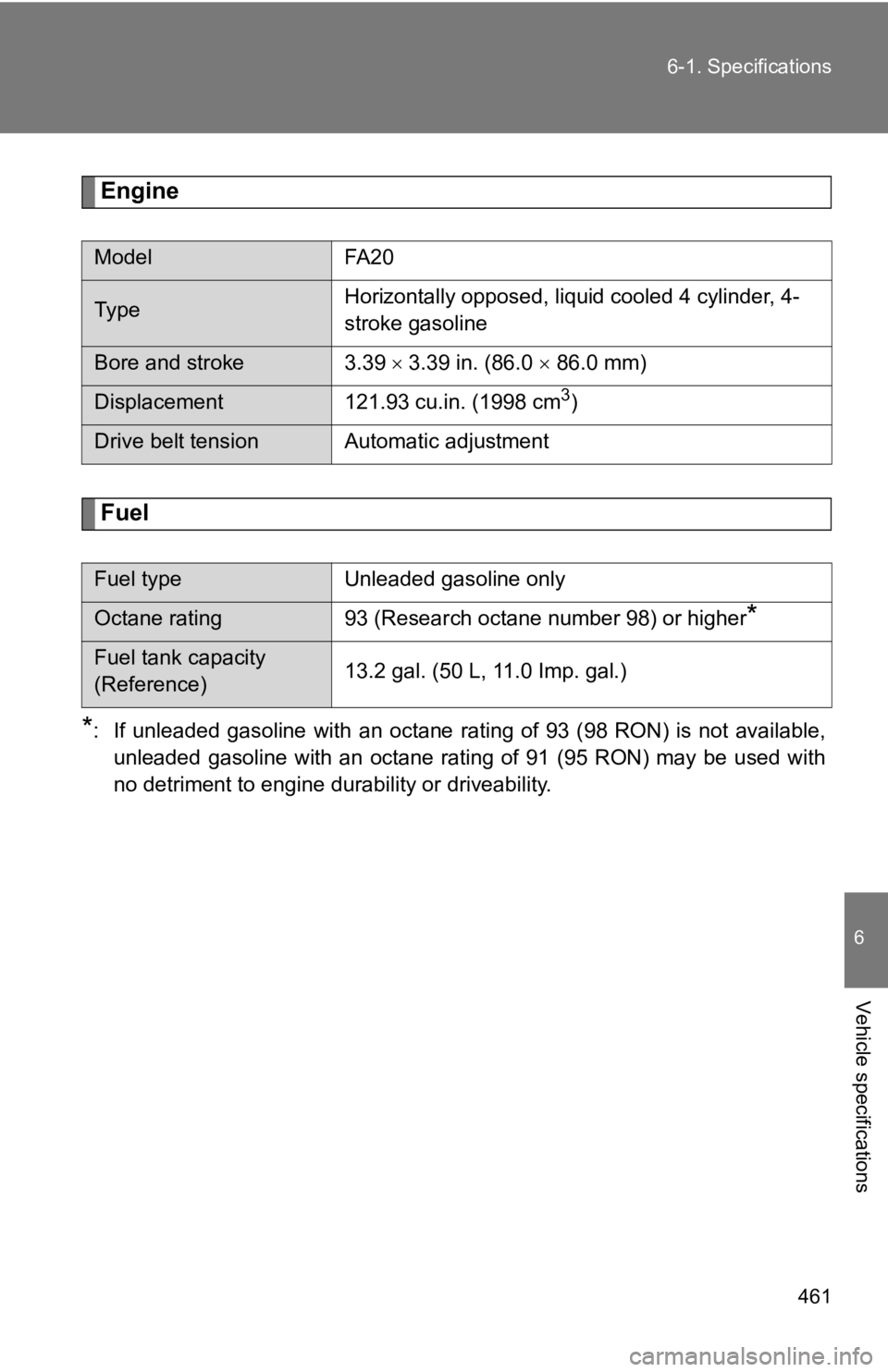
Vehicle specifications Engine
Fuel
* : If unleaded gasoline with an octane rating of 93 (98 RON) is n ot available,
unleaded gasoline with an octane rating of 91 (95 RON) may be u sed with
no detriment to engine durability or driveability.Model FA20
Ty p e Horizontally opposed, liquid cooled 4 cylinder, 4-
stroke gasoline
Bore and stroke 3.39 3.39 in. (86.0 86.0 mm)
Displacement 121.93 cu.in. (1998 cm 3
)
Drive belt tension Automatic adjustment
Fuel type Unleaded gasoline only
Octane rating 93 (Research octane number 98) or higher
*Fuel tank capacity
(Reference) 13.2 gal. (50 L, 11.0 Imp. gal.)
Page 462 of 532
4626-1. Specifications
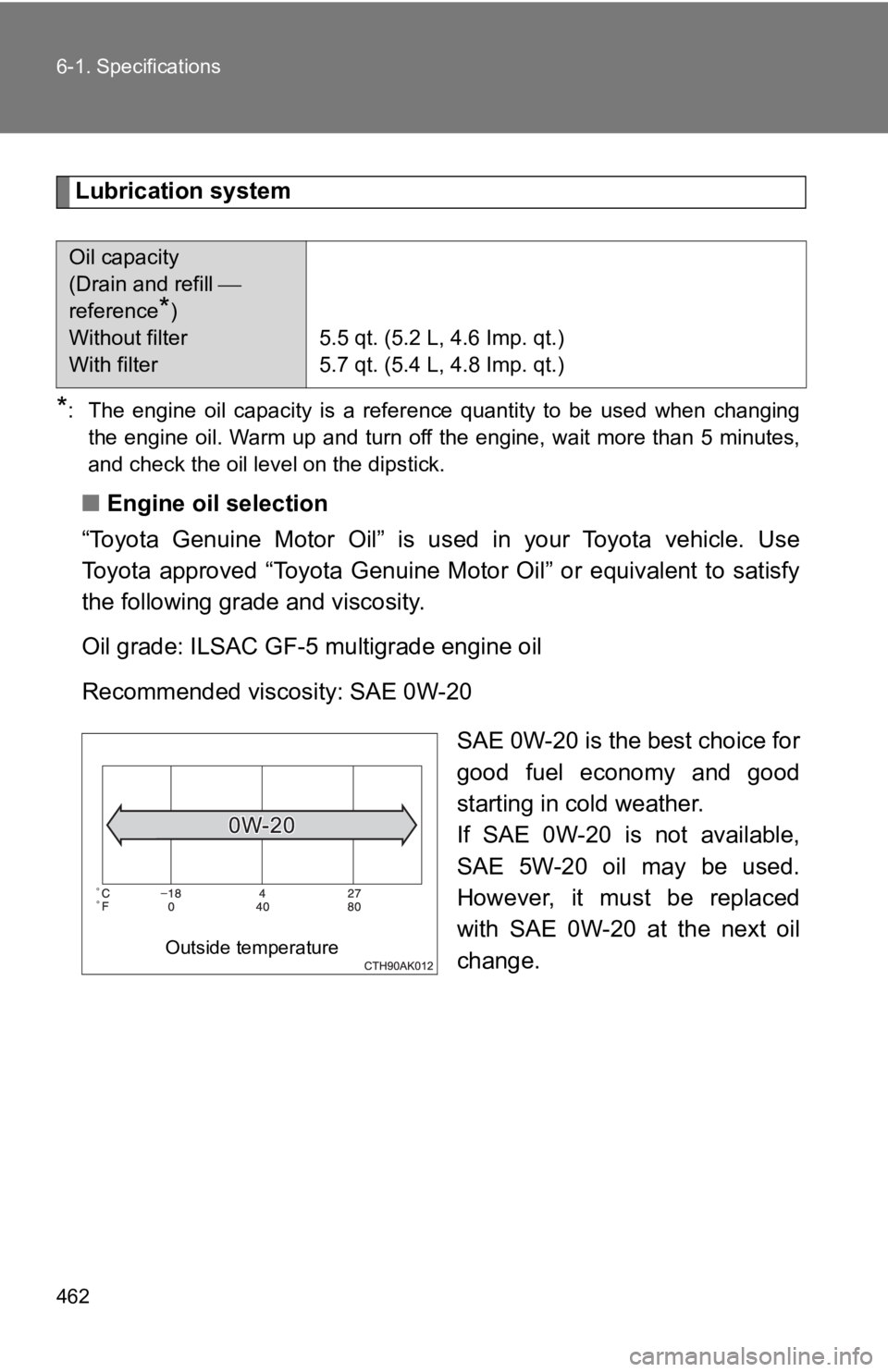
Lubrication system
* : The engine oil capacity is a reference quantity to be used when changing
the engine oil. Warm up and turn off the engine, wait more than 5 minutes,
and check the oil level on the dipstick.
■ Engine oil selection
“Toyota Genuine Motor Oil” is used in your Toyota vehicle. Use
Toyota approved “Toyota Genuine Motor Oil” or equivalent to sat isfy
the following grade and viscosity.
Oil grade: ILSAC GF-5 multigrade engine oil
Recommended viscosity: SAE 0W-20
SAE 0W-20 is the best choice for
good fuel economy and good
starting in cold weather.
If SAE 0W-20 is not available,
SAE 5W-20 oil may be used.
However, it must be replaced
with SAE 0W-20 at the next oil
change.Oil capacity
(Drain and refill
reference
* )
Without filter
With filter 5.5 qt. (5.2 L, 4.6 Imp. qt.)
5.7 qt. (5.4 L, 4.8 Imp. qt.)
Outside temperature