lights TOYOTA 86 2019 Owner's Guide
[x] Cancel search | Manufacturer: TOYOTA, Model Year: 2019, Model line: 86, Model: TOYOTA 86 2019Pages: 532, PDF Size: 6.89 MB
Page 290 of 532
2903-3. Using the interior lights
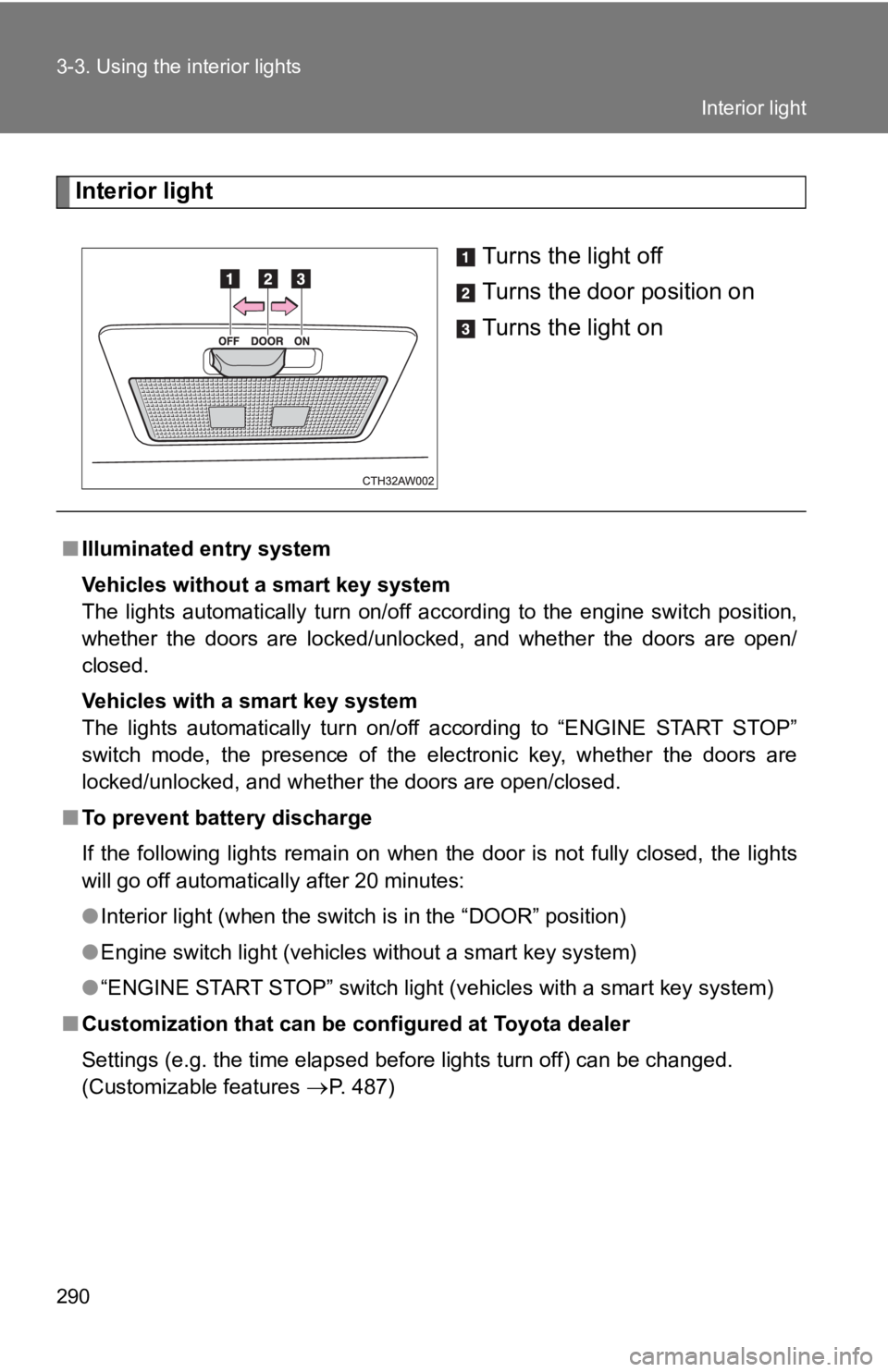
Interior light
Turns the light off
Turns the door position on
Turns the light on
■ Illuminated entry system
Vehicles without a smart key system
The lights automatically turn on/off according to the engine sw itch position,
whether the doors are locked/unlocked, and whether the doors ar e open/
closed.
Vehicles with a smart key system
The lights automatically turn on/off according to “ENGINE START STOP”
switch mode, the presence of the electronic key, whether the do ors are
locked/unlocked, and whether the doors are open/closed.
■ To prevent battery discharge
If the following lights remain on when the door is not fully cl osed, the lights
will go off automatically after 20 minutes:
● Interior light (when the switch is in the “DOOR” position)
● Engine switch light (vehicles without a smart key system)
● “ENGINE START STOP” switch light (vehicles with a smart key sys tem)
■ Customization that can be configured at Toyota dealer
Settings (e.g. the time elapsed before lights turn off) can be changed.
(Customizable features
P. 487) Interior light
Page 311 of 532
3114-1. Maintenance and care
4
Maintenance and care NOTICE■ Cleaning the exterior lights
● Wash carefully. Do not use organic substances or scrub with a h ard brush.
This may damage the surfaces of the lights.
● Do not apply wax on the surfaces of the lights.
Wax may cause damage to the lenses.
■ To prevent damage to th e windshield wiper arms
When lifting the wiper arms away from the windshield, pull the driver side
wiper arm upward first, and repeat for the passenger side. When returning
the wipers to their original position, do so from the passenger side first.
■ When using a high pressure car wash
Do not bring the nozzle tip close to boots (rubber or resin man ufactured
cover), connectors or the following parts. The parts may be damaged if they
come into contact with high-pressure water.
• Traction related parts
• Steering parts
• Suspension parts
• Brake parts
Page 321 of 532
3214-2. Maintenance
4
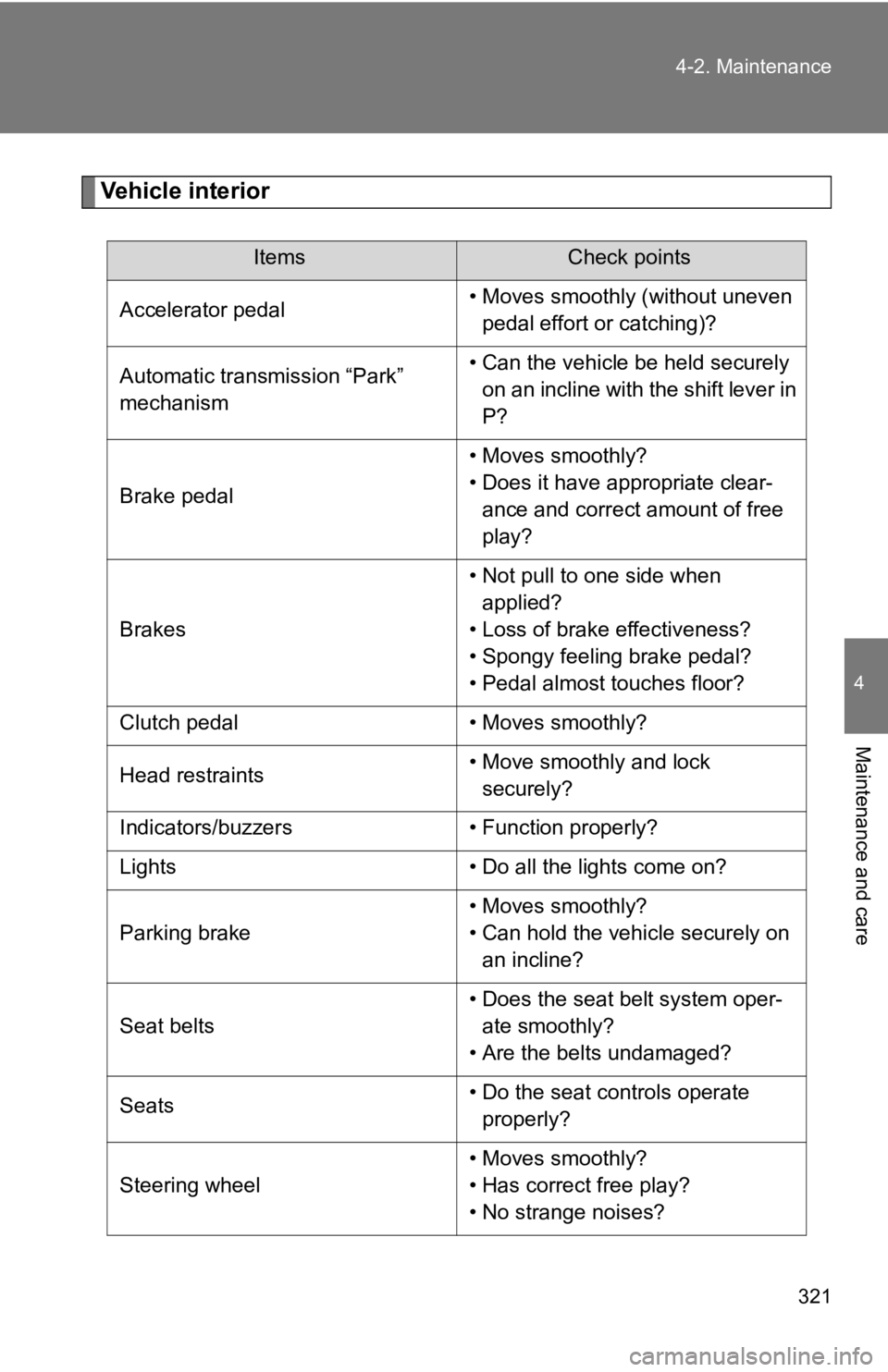
Maintenance and care Vehicle interior Items Check points
Accelerator pedal • Moves smoothly (without uneven
pedal effort or catching)?
Automatic transmission “Park”
mechanism • Can the vehicle be held securely
on an incline with the shift lever in
P?
Brake pedal • Moves smoothly?
• Does it have appropriate clear-
ance and correct amount of free
play?
Brakes • Not pull to one side when
applied?
• Loss of brake effectiveness?
• Spongy feeling brake pedal?
• Pedal almost touches floor?
Clutch pedal • Moves smoothly?
Head restraints • Move smoothly and lock
securely?
Indicators/buzzers • Function properly?
Lights • Do all the lights come on?
Parking brake • Moves smoothly?
• Can hold the vehicle securely on
an incline?
Seat belts • Does the seat belt system oper-
ate smoothly?
• Are the belts undamaged?
Seats • Do the seat controls operate
properly?
Steering wheel • Moves smoothly?
• Has correct free play?
• No strange noises?
Page 371 of 532
3714-3. Do-it-yourself maintenance
4
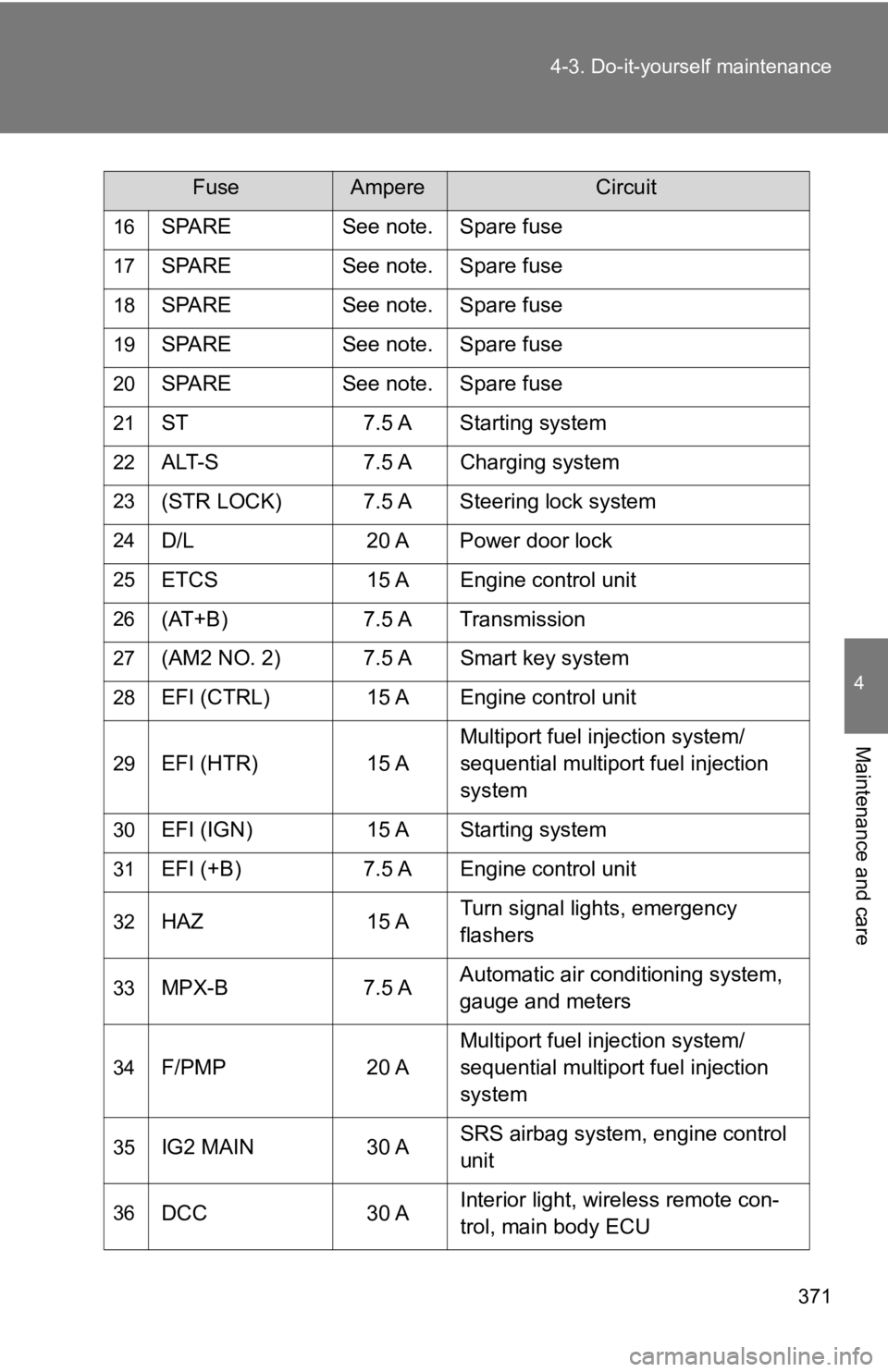
Maintenance and care 16
SPARE See note. Spare fuse17
SPARE See note. Spare fuse18
SPARE See note. Spare fuse19
SPARE See note. Spare fuse20
SPARE See note. Spare fuse21
ST 7.5 A Starting system22
ALT-S 7.5 A Charging system23
(STR LOCK) 7.5 A Steering lock system24
D/L 20 A Power door lock25
ETCS 15 A Engine control unit26
(AT+B) 7.5 A Transmission
27
(AM2 NO. 2) 7.5 A Smart key system
28
EFI (CTRL) 15 A Engine control unit
29
EFI (HTR) 15 A Multiport fuel injection system/
sequential multiport fuel injection
system
30
EFI (IGN) 15 A Starting system
31
EFI (+B) 7.5 A Engine control unit
32
HAZ 15 A Turn signal lights, emergency
flashers
33
MPX-B 7.5 A Automatic air conditioning system,
gauge and meters
34
F/PMP 20 A Multiport fuel injection system/
sequential multiport fuel injection
system
35
IG2 MAIN 30 A SRS airbag system, engine control
unit
36
DCC 30 A Interior light, wireless remote con-
trol, main body ECUFuse Ampere Circuit
Page 373 of 532
3734-3. Do-it-yourself maintenance
4
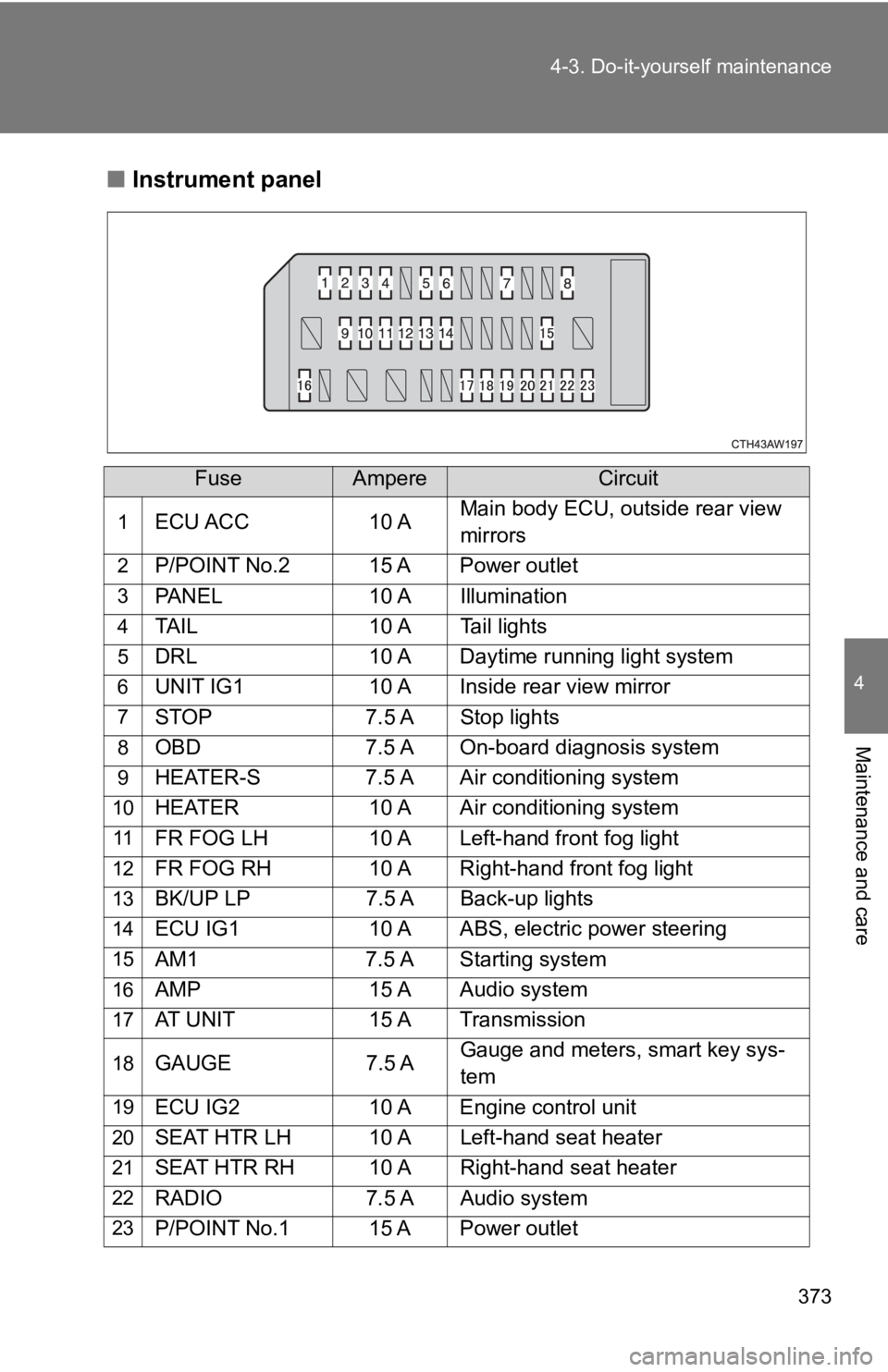
Maintenance and care ■ Instrument panel
Fuse Ampere Circuit1
ECU ACC 10 A Main body ECU, outside rear view
mirrors2
P/POINT No.2 15 A Power outlet3
PANEL 10 A Illumination4
TAIL 10 A Tail lights5
DRL 10 A Daytime running light system6
UNIT IG1 10 A Inside rear view mirror7
STOP 7.5 A Stop lights8
OBD 7.5 A On-board diagnosis system9
HEATER-S 7.5 A Air conditioning system
10
HEATER 10 A Air conditioning system
11
FR FOG LH 10 A Left-hand front fog light
12
FR FOG RH 10 A Right-hand front fog light
13
BK/UP LP 7.5 A Back-up lights
14
ECU IG1 10 A ABS, electric power steering
15
AM1 7.5 A Starting system
16
AMP 15 A Audio system
17
AT UNIT 15 A Transmission
18
GAUGE 7.5 A Gauge and meters, smart key sys-
tem
19
ECU IG2 10 A Engine control unit
20
SEAT HTR LH 10 A Left-hand seat heater
21
SEAT HTR RH 10 A Right-hand seat heater
22
RADIO 7.5 A Audio system
23
P/POINT No.1 15 A Power outlet
Page 374 of 532
3744-3. Do-it-yourself maintenance
■ After a fuse is replaced
● If the lights do not turn on even after the fuse has been repla ced, a bulb
may need replacement. ( P. 375)
● If the replaced fuse blows again, have the vehicle inspected by your
Toyota dealer.
■ If there is an overload in the circuits
The fuses are designed to blow, protecting the wiring harness from damage.
WARNING■ To prevent system breakdow ns and vehicle fire
Observe the following precautions.
Failing to do so may cause damage to the vehicle, and possibly a fire or
injury.
● Never use a fuse of a higher amperage rating than indicated, or use any
other object in place of a fuse.
● Always use a genuine Toyota fuse or equivalent.
● Do not modify the fuse or the fuse box.
NOTICE■ Before replacing fuses
Have the cause of electrical overload determined and repaired b y your
Toyota dealer.
Page 375 of 532
3754-3. Do-it-yourself maintenance
4
Maintenance and care
Light bulbs You may replace the following bulbs by yourself. The difficulty level
of replacement varies depending on the bulb. If necessary bulb
replacement seems difficult to perform, contact your Toyota dealer.
■ Preparing a replacement light bulb
Check the wattage of the light bulb being replaced. ( P. 4 6 9 )
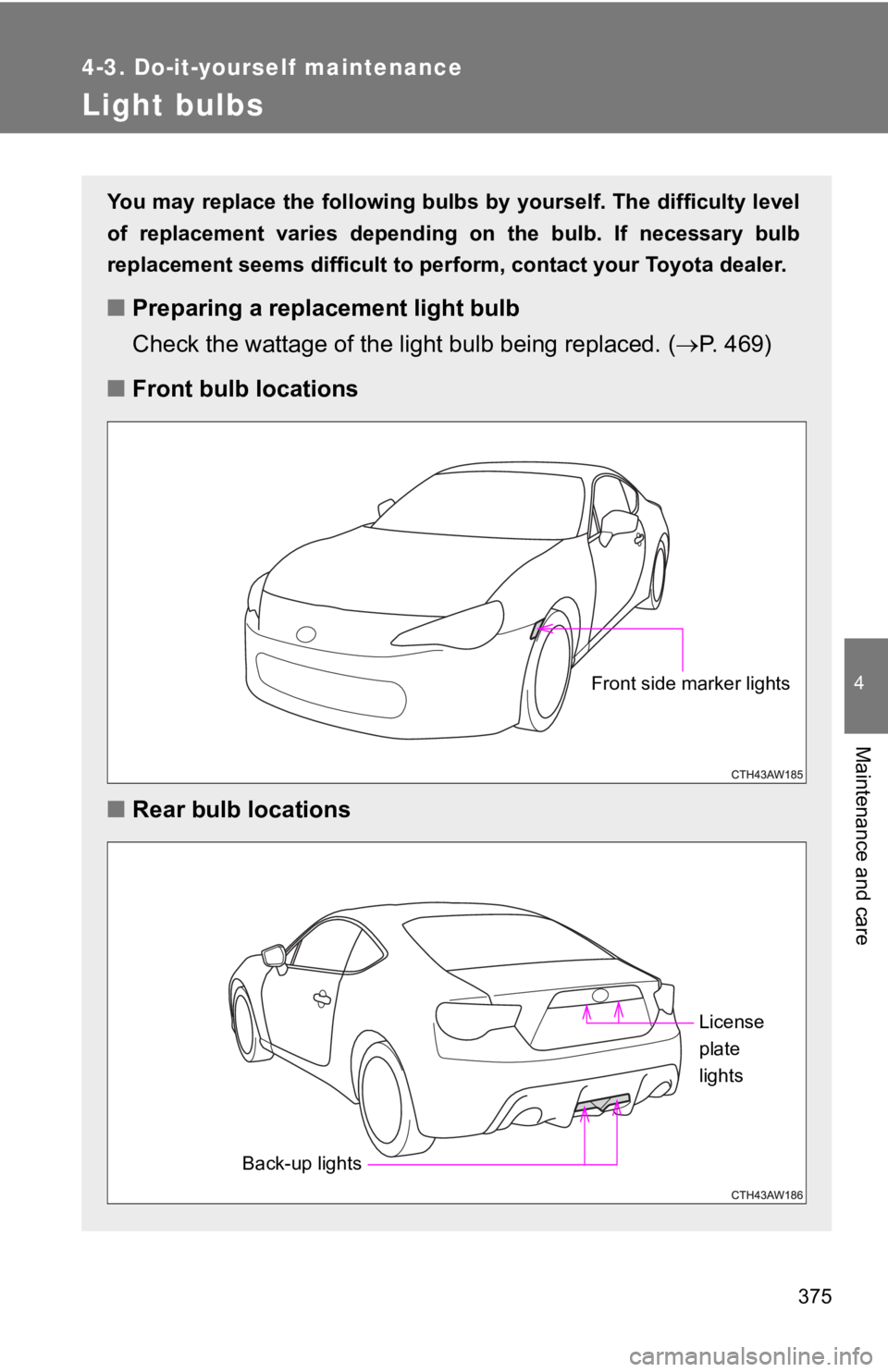
■ Front bulb locations
■ Rear bulb locations Front side marker lights
Back-up lights License
plate
lights
Page 376 of 532
3764-3. Do-it-yourself maintenance
Replacing light bulbs
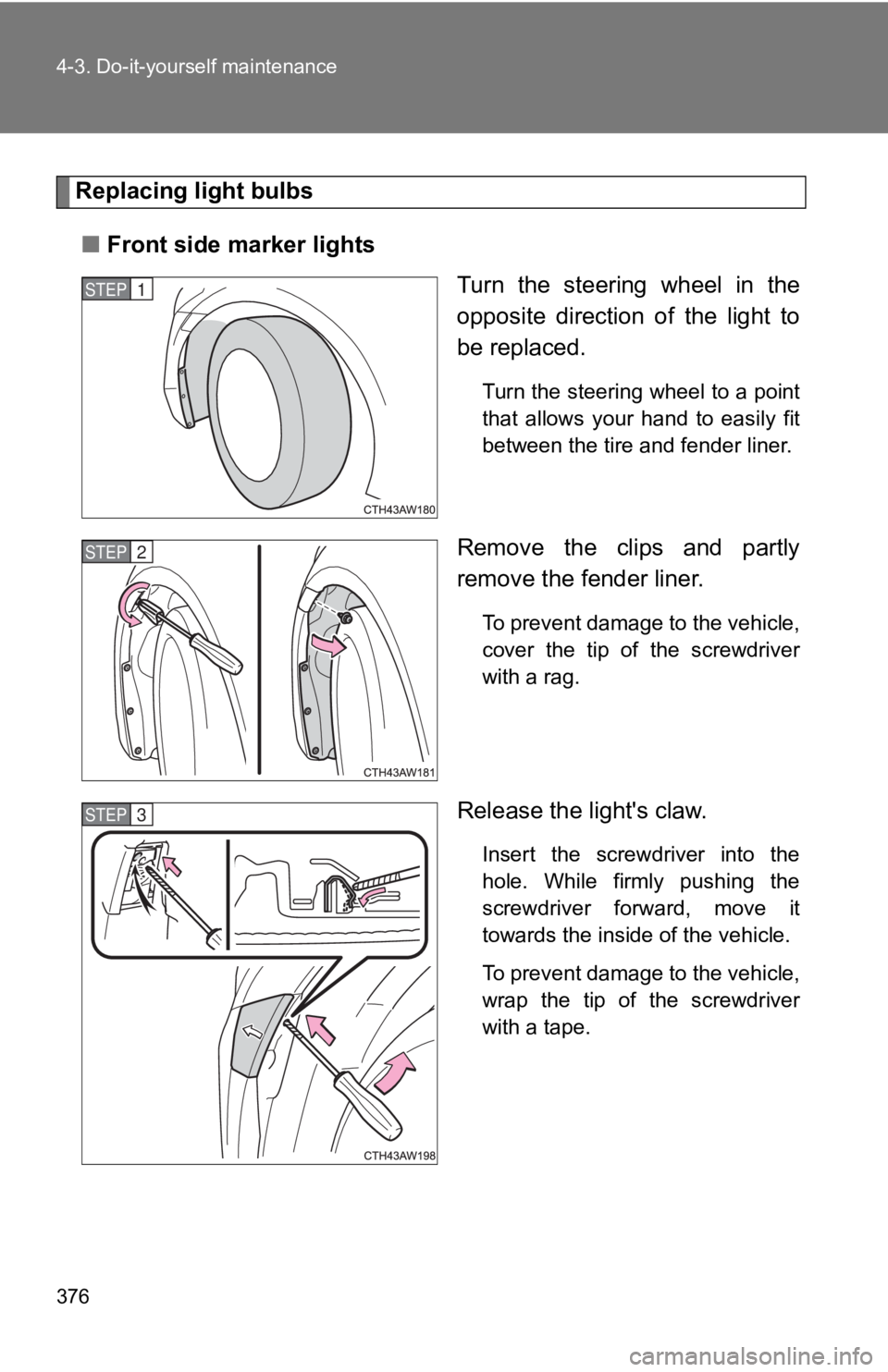
■ Front side marker lights
Turn the steering wheel in the
opposite direction of the light to
be replaced. Turn the steering wheel to a point
that allows your hand to easily fit
between the tire and fender liner.
Remove the clips and partly
remove the fender liner. To prevent damage to the vehicle,
cover the tip of the screwdriver
with a rag.
Release the light's claw. Insert the screwdriver into the
hole. While firmly pushing the
screwdriver forward, move it
towards the inside of the vehicle.
To prevent damage to the vehicle,
wrap the tip of the screwdriver
with a tape.STEP 1
STEP 2
STEP 3
Page 378 of 532
3784-3. Do-it-yourself maintenance
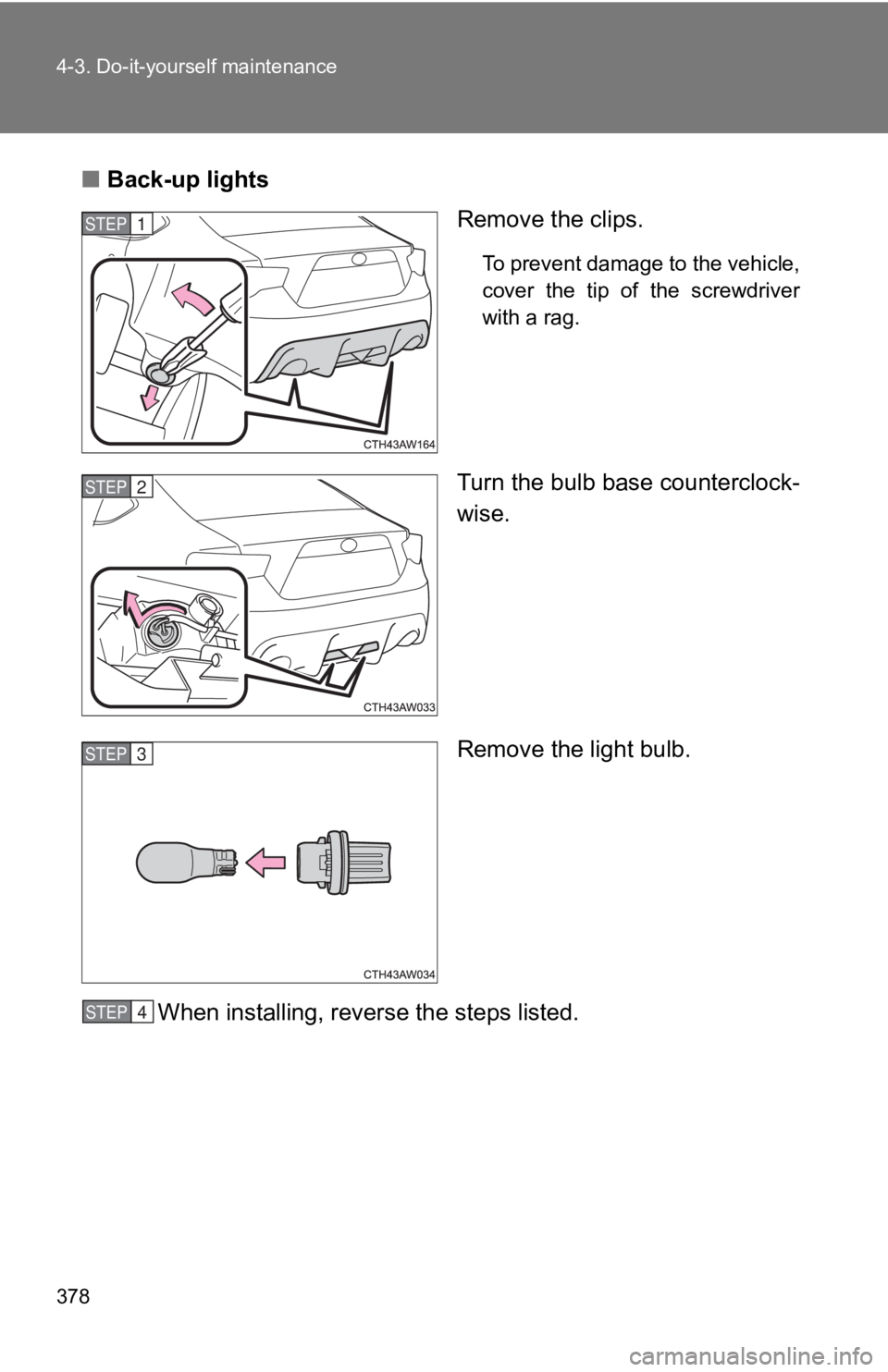
■ Back-up lights
Remove the clips. To prevent damage to the vehicle,
cover the tip of the screwdriver
with a rag.
Turn the bulb base counterclock-
wise.
Remove the light bulb.
When installing, rever se the steps listed.STEP 1
STEP 2
STEP 3
STEP 4
Page 379 of 532
3794-3. Do-it-yourself maintenance
4
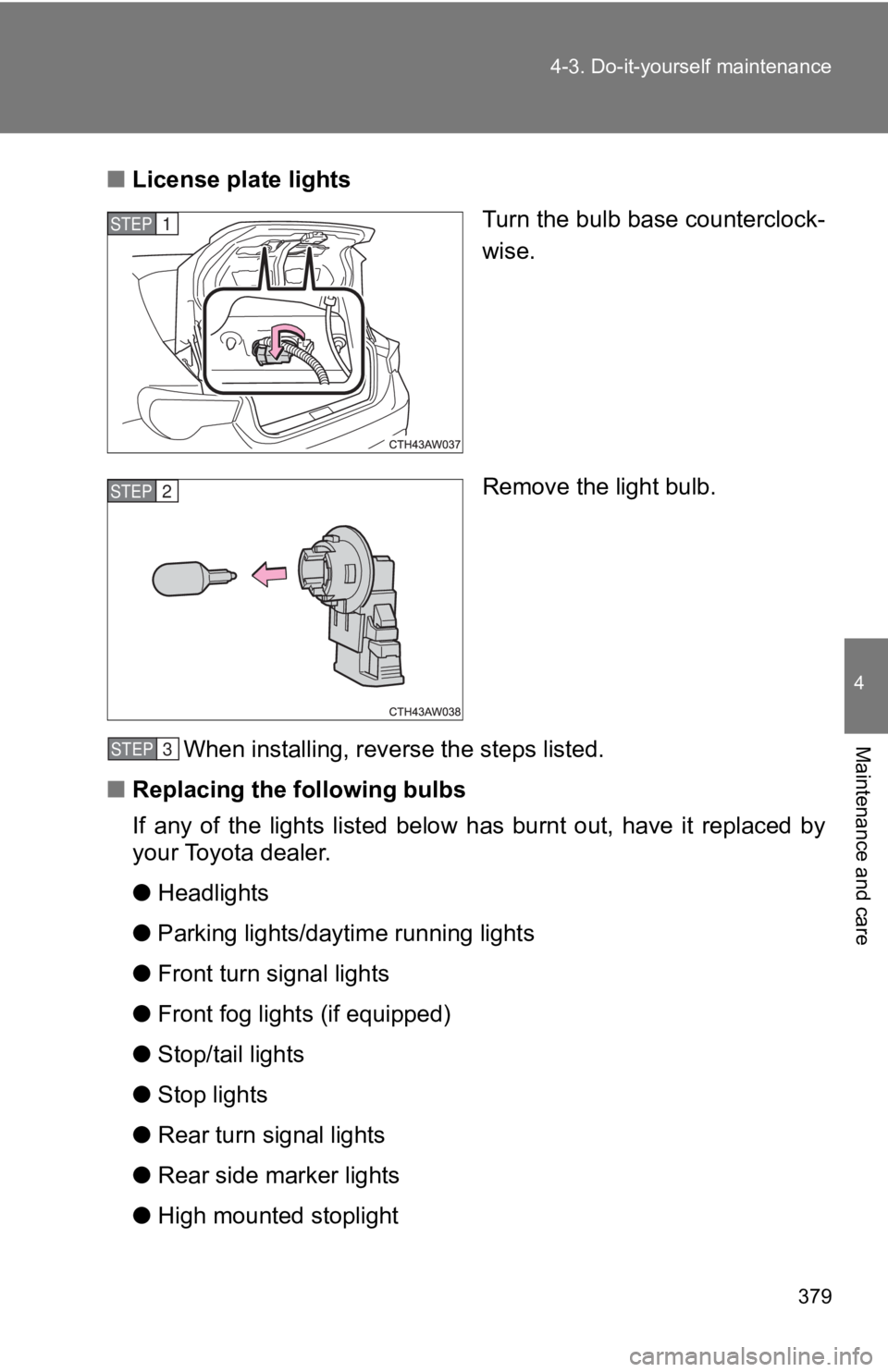
Maintenance and care ■ License pl ate lights
Turn the bulb base counterclock-
wise.
Remove the light bulb.
When installing, reverse the steps listed.
■ Replacing the following bulbs
If any of the lights listed belo w has burnt out, have it replac ed by
your Toyota dealer.
● Headlights
● Parking lights/dayti me running lights
● Front turn signal lights
● Front fog lights (if equipped)
● Stop/tail lights
● Stop lights
● Rear turn signal lights
● Rear side ma rker lights
● High mounted stoplight STEP 1
STEP 2
STEP 3