light TOYOTA 86 2019 Manual PDF
[x] Cancel search | Manufacturer: TOYOTA, Model Year: 2019, Model line: 86, Model: TOYOTA 86 2019Pages: 532, PDF Size: 6.89 MB
Page 229 of 532
2292-3. Operating the lights and windshield wipers
2
When driving
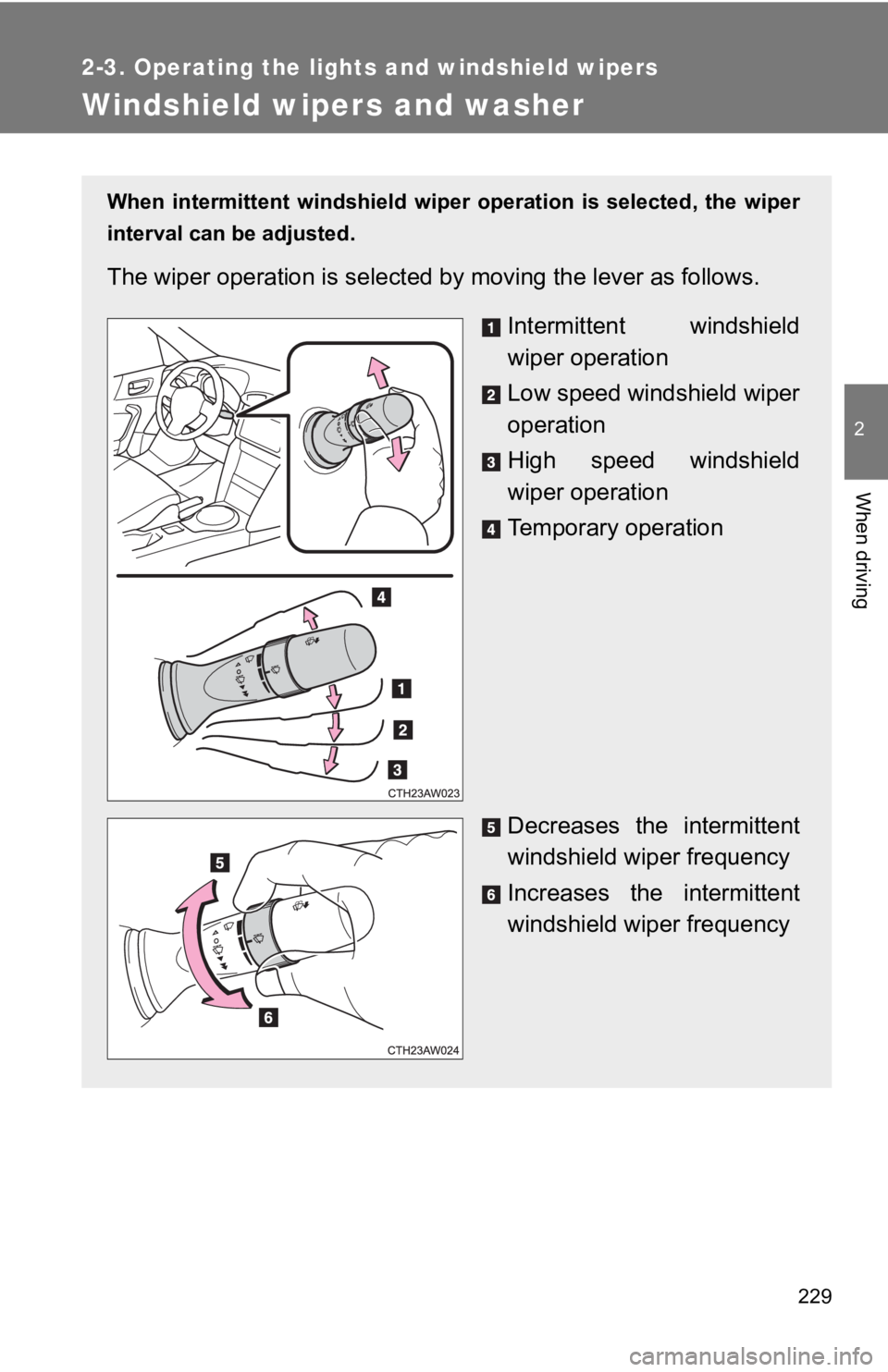
Windshield wipers and washer When intermittent windshield wiper operation is selected, the w iper
interval can be adjusted.
The wiper operation is selected by moving the lever as follows.
Intermittent windshield
wiper operation
Low speed windshield wiper
operation
High speed windshield
wiper operation
Temporary operation
Decreases the intermittent
windshield wiper frequency
Increases the intermittent
windshield wiper frequency
Page 230 of 532
2302-3. Operating the lights and windshield wipers
■ The windshield wipers and w asher can be operated when
Vehicles without a smart key system
The engine switch is in the “ON” position.
Vehicles with a smart key system
The “ENGINE START STOP” switch is in IGNITION ON mode.
■ If no windshield washer fluid sprays
Check that the washer nozzles are not blocked if there is washe r fluid in the
windshield washer fluid tank.
WARNING■ Caution regarding the use of washer fluid
When it is cold, do not use the washer fluid until the windshield becomes
warm. The fluid may freeze on the windshield and cause low visi bility. This
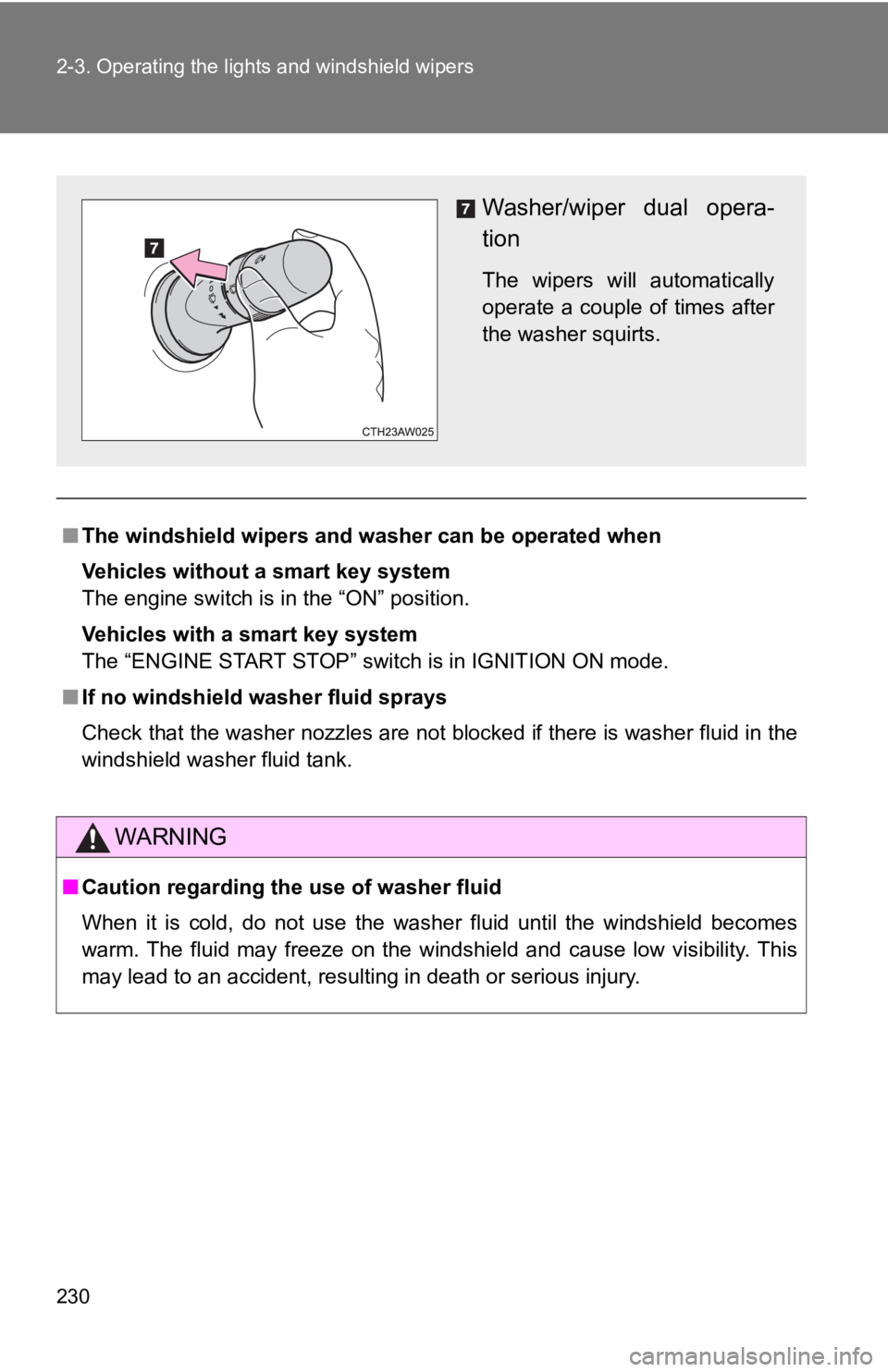
may lead to an accident, resulting in death or serious injury. Washer/wiper dual opera-
tion The wipers will automatically
operate a couple of times after
the washer squirts.
Page 231 of 532

2312-3. Operating the light s and windshield wipers
2
When driving NOTICE■ When the windshield is dry
Do not use the wipers, as they may damage the windshield.
■ When the washer fluid tank is empty
Do not operate the switch continually as the washer fluid pump may over-
heat.
■ When a nozzle becomes blocked
In this case, contact your Toyota dealer.
Do not try to clear it with a pin or other object. The nozzle w ill be damaged.
Page 235 of 532

2352-4. Using other driving systems
2
When driving ■ Accelerating after setting the vehicle speed
● The vehicle can be accelerated normally. After acceleration, the set
speed resumes.
● Even without canceling the cruise control, the set speed can be
increased by first accelerating the vehicle to the desired spee d and then
pushing the lever down to set the new speed.
■ Automatic cruise control cancelation
Cruise control will stop maintaining the vehicle speed in any of the following
situations.
● Actual vehicle speed is below approximately 20 mph (30 km/h).
● VSC is activated.
■ The system may be malfunctioning when
In the following situations, the system may be malfunctioning. Have the vehi-
cle inspected by your Toyota dealer.
● The cruise control indicator light comes on in yellow.
● The cruise control indicator does not come on even when the “ON -OFF”
button is pressed while the engine is running.
Page 241 of 532
2412-4. Using other driving systems
2
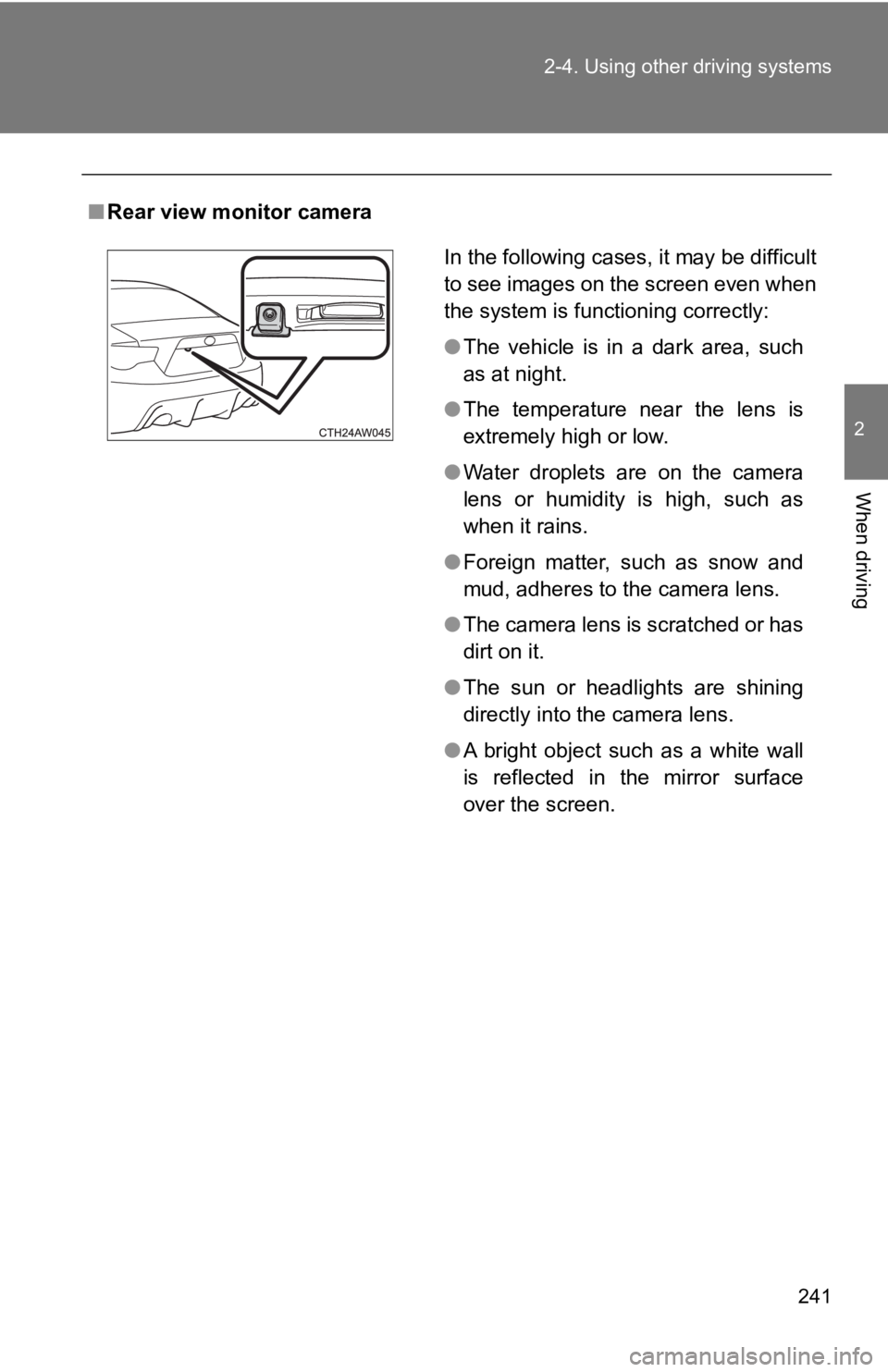
When driving ■ Rear view monitor camera
In the following cases, it may be difficult
to see images on the screen even when
the system is functioning correctly:
● The vehicle is in a dark area, such
as at night.
● The temperature near the lens is
extremely high or low.
● Water droplets are on the camera
lens or humidity is high, such as
when it rains.
● Foreign matter, such as snow and
mud, adheres to the camera lens.
● The camera lens is scratched or has
dirt on it.
● The sun or headlights are shining
directly into the camera lens.
● A bright object such as a white wall
is reflected in the mirror surface
over the screen.
Page 242 of 532
2422-4. Using other driving systems
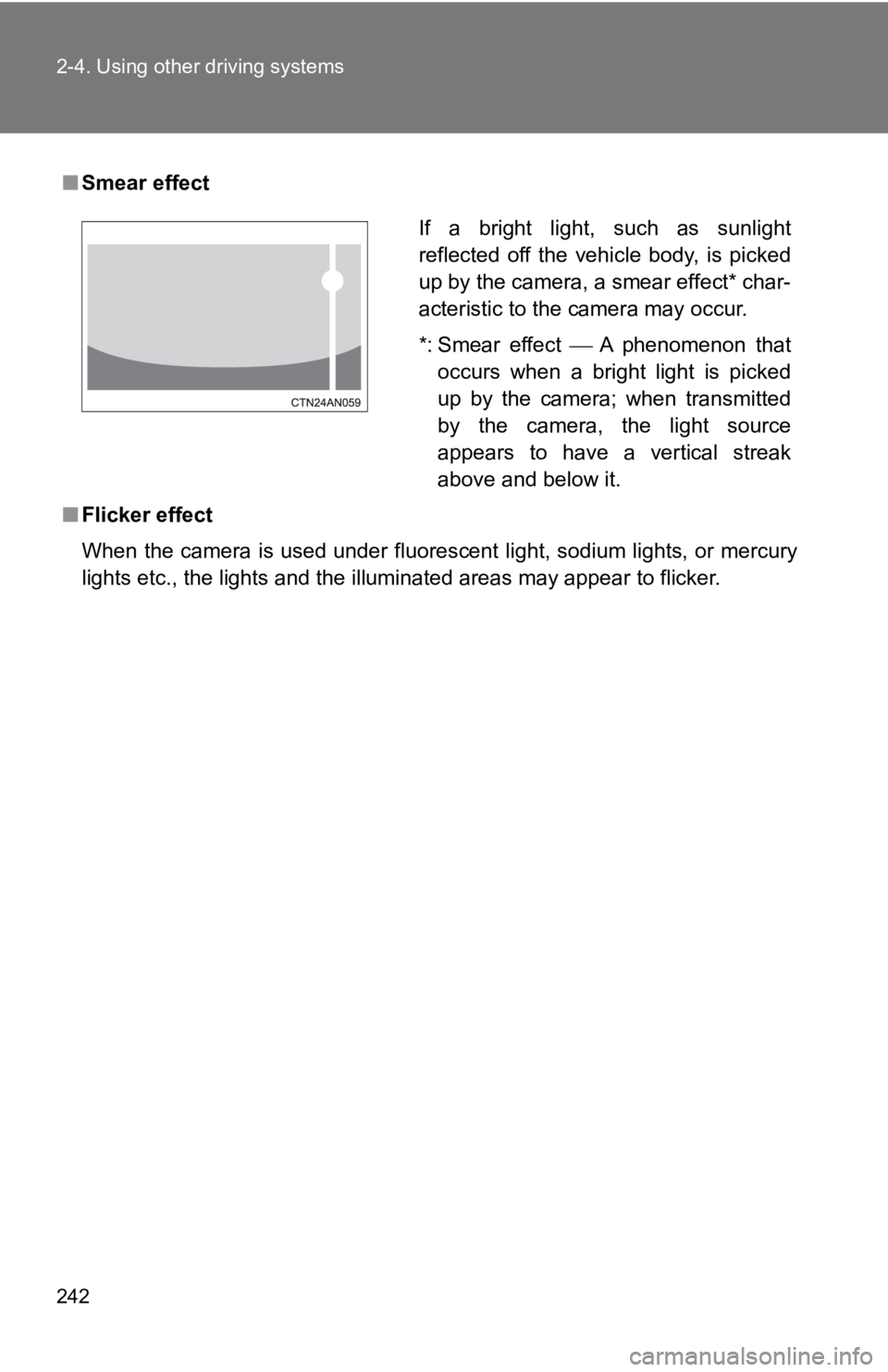
■ Smear effect
■ Flicker effect
When the camera is used under fluorescent light, sodium lights, or mercury
lights etc., the lights and the illuminated areas may appear to flicker.If a bright light, such as sunlight
reflected off the vehicle body, is picked
up by the camera, a smear effect* char-
acteristic to the camera may occur.
*: Smear effect A phenomenon that
occurs when a bright light is picked
up by the camera; when transmitted
by the camera, the light source
appears to have a vertical streak
above and below it.
Page 246 of 532
2462-4. Using other driving systems
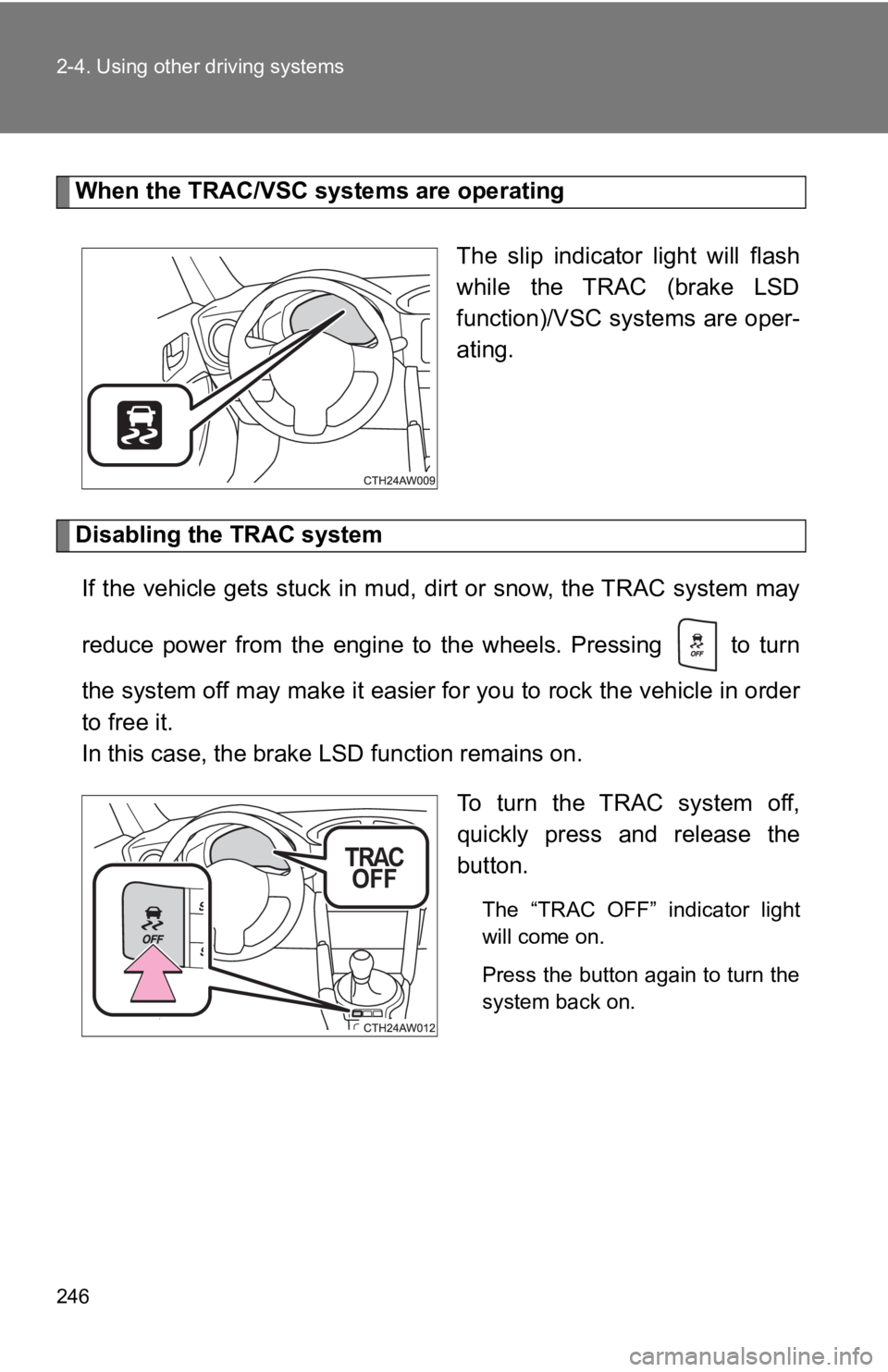
When the TRAC/VSC systems are operating
The slip indicator light will flash
while the TRAC (brake LSD
function)/VSC systems are oper-
ating.
Disabling the TRAC system
If the vehicle gets stuck in mud, dirt or snow, the TRAC system may
reduce power from the engine to the wheels. Pressing to turn
the system off may make it easier for you to rock the vehicle i n order
to free it.
In this case, the brake LSD function remains on.
To turn the TRAC system off,
quickly press and release the
button. The “TRAC OFF” indicator light
will come on.
Press the button again to turn the
system back on.
Page 247 of 532
2472-4. Using other driving systems
2
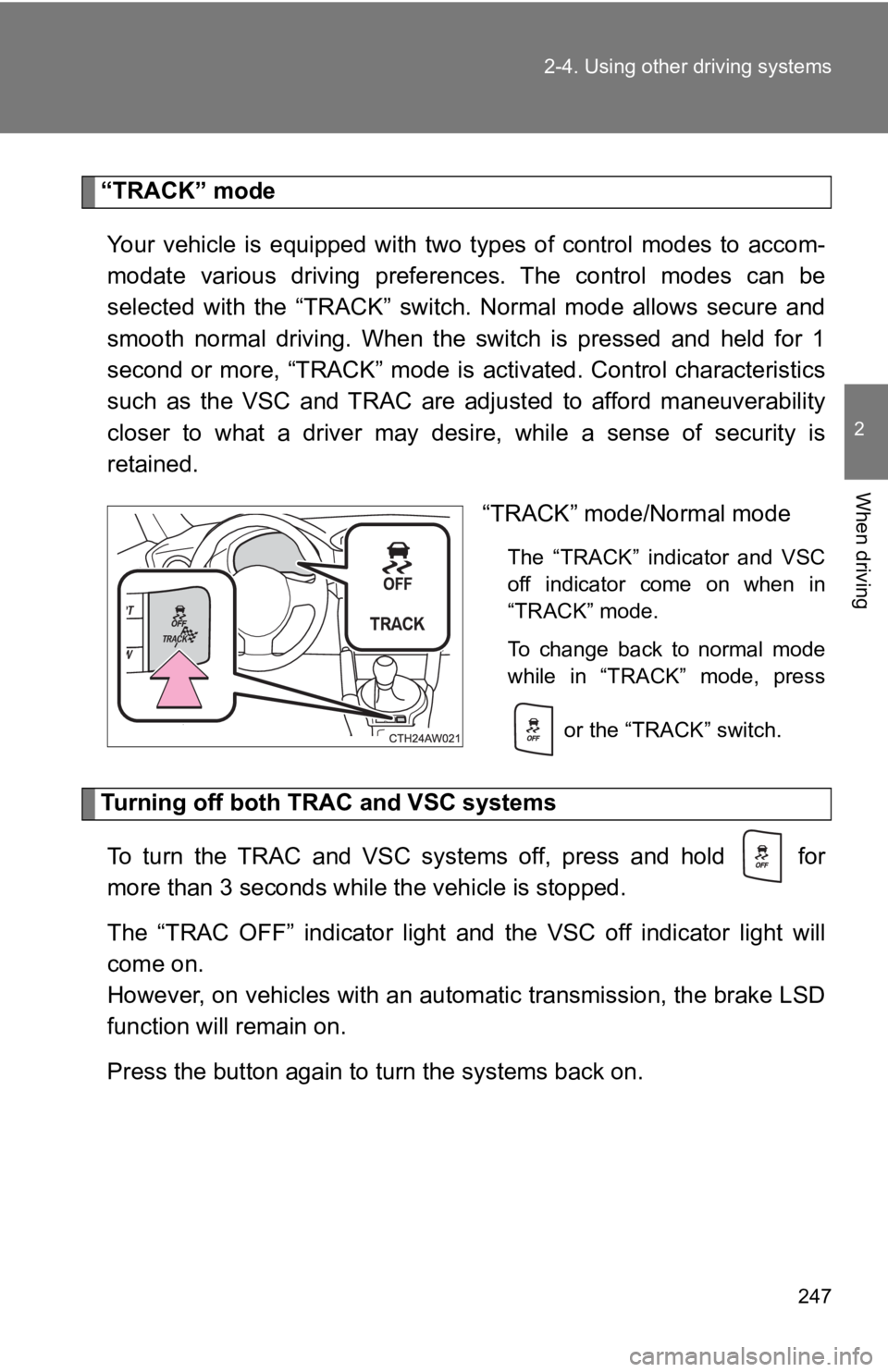
When driving “TRACK” mode
Your vehicle is equipped with two types of control modes to acc om-
modate various driving preferenc es. The control modes can be
selected with the “TRACK” switch. Normal mode allows secure and
smooth normal driving. When the switch is pressed and held for 1
second or more, “TRACK” mode is activated. Control characterist ics
such as the VSC and TRAC are adj usted to afford maneuverability
closer to what a driver may desire, while a sense of security i s
retained.
“TRACK” mode/Normal mode The “TRACK” indicator and VSC
off indicator come on when in
“TRACK” mode.
To change back to normal mode
while in “TRACK” mode, press
or the “TRACK” switch.
Turning off both TR AC and VSC systems
To turn the TRAC and VSC systems off, press and hold for
more than 3 seconds while the vehicle is stopped.
The “TRAC OFF” indicator light and the VSC off indicator light will
come on.
However, on vehicles with an aut omatic transmission, the brake LSD
function will remain on.
Press the button again to turn the systems back on.
Page 248 of 532
2482-4. Using other driving systems
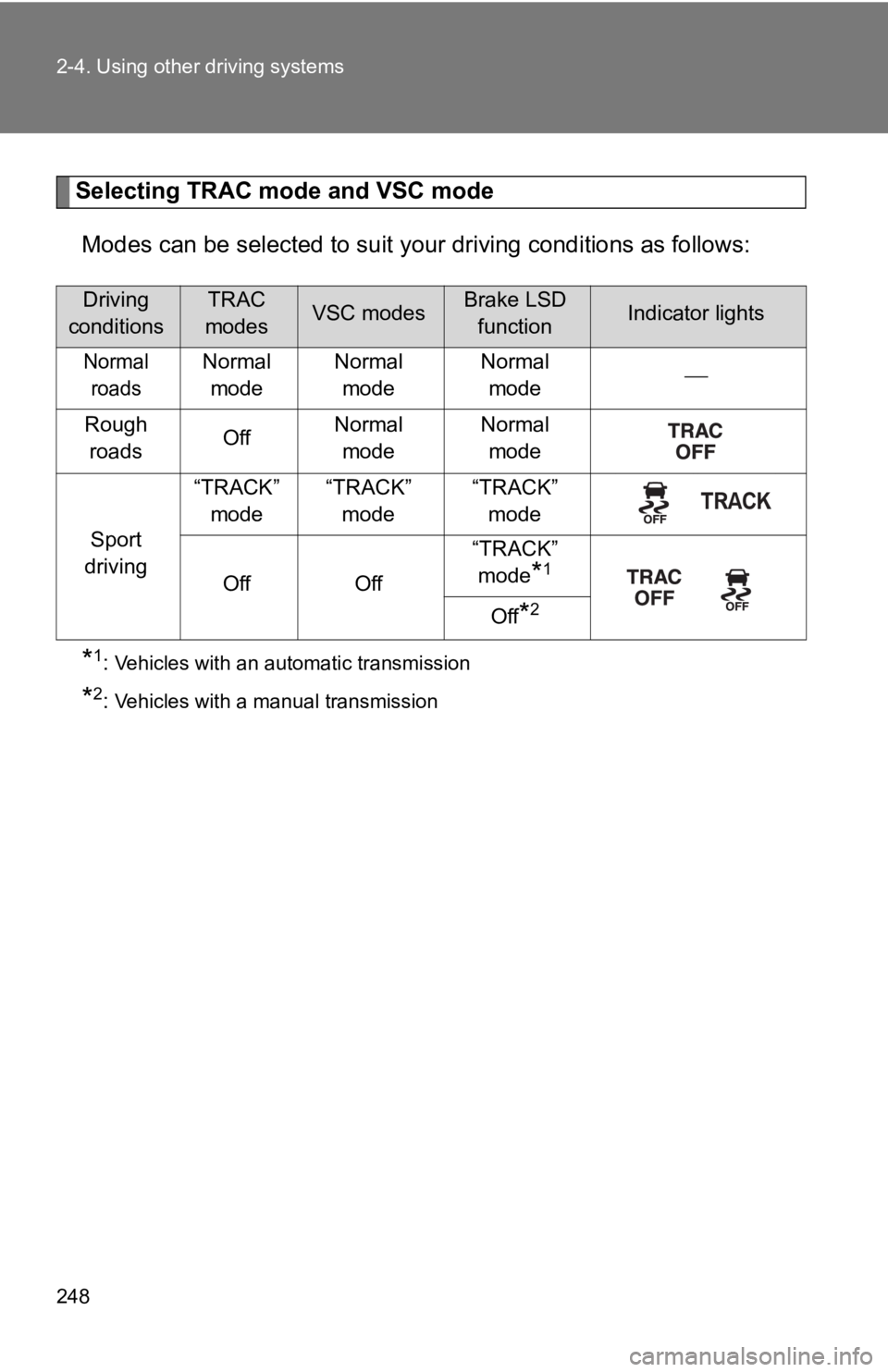
Selecting TRAC mode and VSC mode
Modes can be selected to suit y our driving conditions as follow s:
* 1
: Vehicles with an automatic transmission
* 2
: Vehicles with a manual transmissionDriving
conditions TRAC
modes VSC modes Brake LSD
function Indicator lights
Normal
roads Normal
mode Normal
mode Normal
mode
Rough
roads Off Normal
mode Normal
mode
Sport
driving “TRACK”
mode “TRACK”
mode “TRACK”
mode
Off Off “TRACK”
mode
* 1
Off
* 2
Page 249 of 532

2492-4. Using other driving systems
2
When driving ■ Sounds and vibrations caused by the ABS, brake assist, TRAC and
VSC systems
● A sound may be heard from the engine compartment when the brake
pedal is depressed repeatedly, when the engine is started or ju st after the
vehicle begins to move. This sound does not indicate that a malfunction
has occurred in any of these systems.
● Any of the following conditions may occur when the above system s are
operating. None of these indicates that a malfunction has occur red.
• Vibrations may be felt through the vehicle body and steering.
• A motor sound may be heard after the vehicle comes to a stop.
• The brake pedal may pulsate slightly after the ABS is activated.
• The brake pedal may move down slightly after the ABS is activa ted.
■ EPS operation sound
When the steering wheel is operated, a motor sound (whirring so und) may
be heard. This does not indicate a malfunction.
■ Automatic reactivation of TRAC and VSC systems
After turning the TRAC and VSC systems off, the systems will be automati-
cally reactivated in the following situations:
● Vehicles without a smart key system: When the engine switch is turned to
“LOCK” position
● Vehicles with a smart key system: When the “ENGINE START STOP”
switch is turned off
● If only the TRAC system is turned off, the TRAC will turn on when vehicle
speed is more than approximately 31 mph (50 km/h).
If both the TRAC and VSC systems are turned off, automatic reac tivation
will not occur when vehicle speed increases.