light TOYOTA 86 2019 Service Manual
[x] Cancel search | Manufacturer: TOYOTA, Model Year: 2019, Model line: 86, Model: TOYOTA 86 2019Pages: 532, PDF Size: 6.89 MB
Page 161 of 532

1612-1. Driving procedures
2
When driving WARNING■ When the vehicle is parked
● Do not leave glasses, cigarette lighters, spray cans, or soft d rink cans in
the vehicle when it is in the sun.
Doing so may result in the following:
• Gas may leak from a cigarette lighter or spray can, and may le ad to a
fire.
• The temperature inside the vehicle may cause the plastic lense s and
plastic material of glasses to deform or crack.
• Soft drink cans may fracture, causing the contents to spray ov er the
interior of the vehicle, and may also cause a short circuit in the vehi-
cle's electrical components.
● Do not leave cigarette lighters in the vehicle. If a cigarette lighter is in a
place such as the glove box or on the floor, it may be lit acci dentally when
luggage is loaded or the seat is adjusted, causing a fire.
● Do not attach suction cups to the windshield or windows. Do not place
containers such as air fresheners on the instrument panel or da shboard.
Suction cups or containers may act as lenses, causing a fire in the vehicle.
● Do not leave a door or window open if the curved glass is coate d with a
metallized film such as a silver-colored one. Reflected sunligh t may cause
the glass to act as a lens, causing a fire.
● Always apply the parking brake, shift the shift lever to P (veh icles with an
automatic transmission only), stop the engine and lock the vehi cle.
Do not leave the vehicle unattended while the engine is running .
● Do not touch the exhaust pipe while the engine is running or im mediately
after turning the engine off.
Doing so may cause burns.
● Do not leave the engine running in an area with snow build-up, or where it
is snowing. If snowbanks build up around the vehicle while the engine is
running, exhaust gases may collect and enter the vehicle. This may lead
to death or a serious health hazard.
Page 166 of 532
1662-1. Driving procedures
Engine (ignition) switch (veh icles with a smart key system)Performing the following operations when carrying the electroni c
key on your person starts the engine or changes “ENGINE START
STOP” switch modes.
■ Starting the engine
Vehicles with an auto matic transmission
Check that the parking brake is set.
Check that the shift lever is set in P. If the shift lever is not set in P, the engine may not be start ed.
( P. 178)
Firmly depress the brake pedal. The smart key system indicator light (green) will turn on. If t he
indicator light does not turn on, the engine cannot be started.
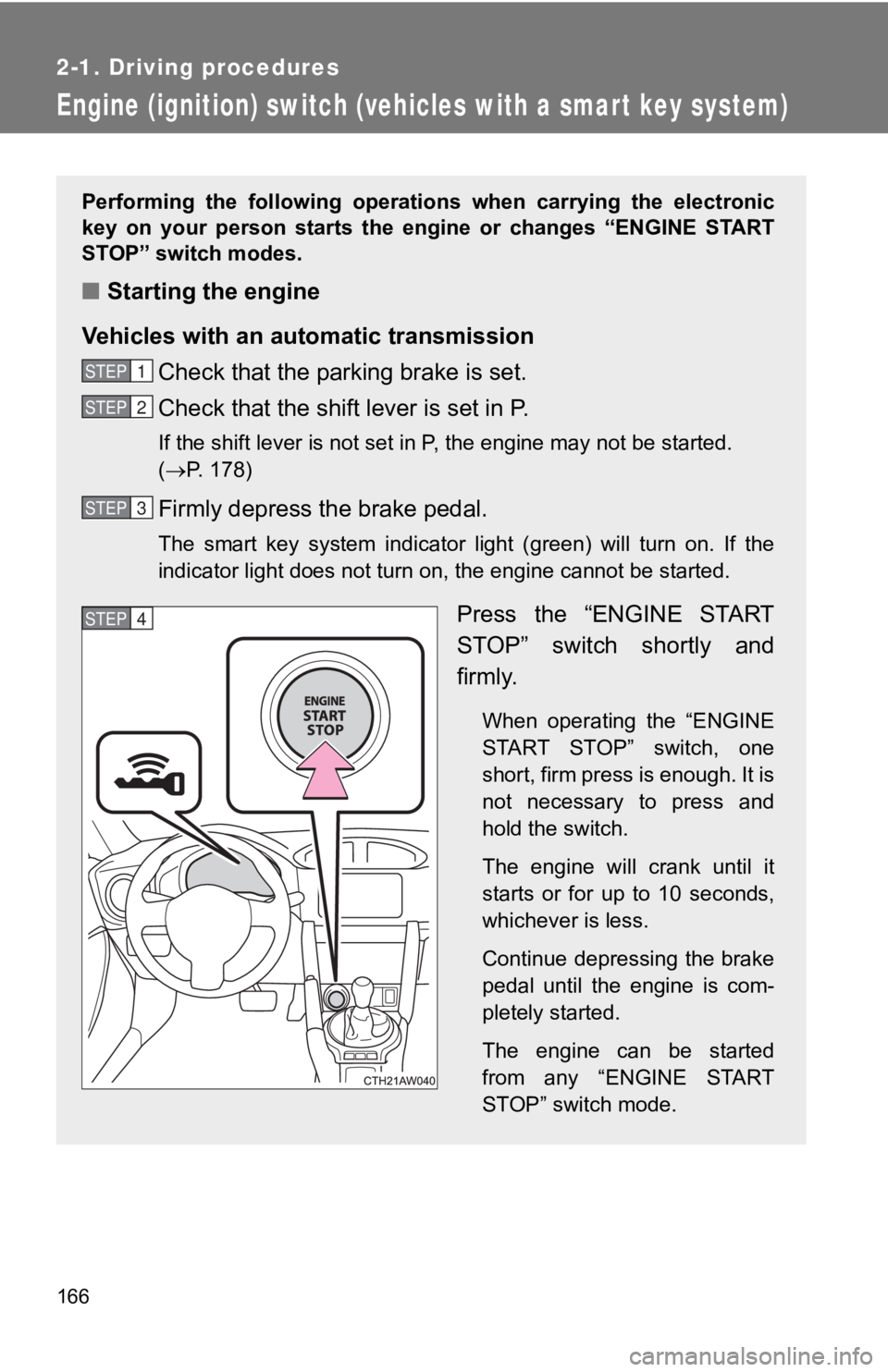
Press the “ENGINE START
STOP” switch shortly and
firmly. When operating the “ENGINE
START STOP” switch, one
short, firm press is enough. It is
not necessary to press and
hold the switch.
The engine will crank until it
starts or for up to 10 seconds,
whichever is less.
Continue depressing the brake
pedal until the engine is com-
pletely started.
The engine can be started
from any “ENGINE START
STOP” switch mode.STEP 1
STEP 2
STEP 3
STEP 4
Page 167 of 532
1672-1. Driving procedures
2
When driving Vehicles with a manual transmission
Check that the parking brake is set.
Check that the shift lever is set in N.
Firmly depress the clutch pedal. The smart key system indicator light (green) will turn on. If t he
indicator light does not turn on, the engine cannot be started.
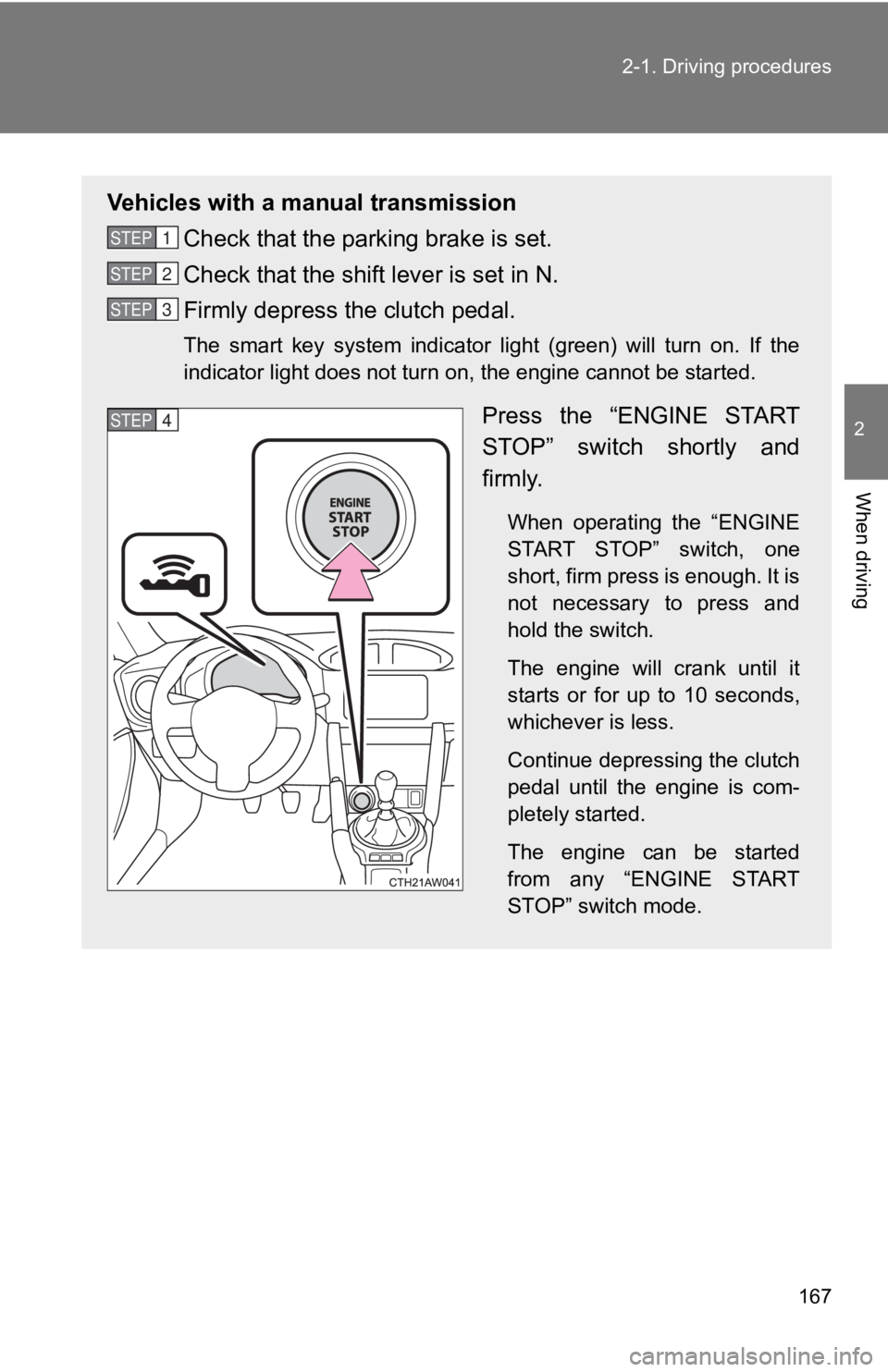
Press the “ENGINE START
STOP” switch shortly and
firmly. When operating the “ENGINE
START STOP” switch, one
short, firm press is enough. It is
not necessary to press and
hold the switch.
The engine will crank until it
starts or for up to 10 seconds,
whichever is less.
Continue depressing the clutch
pedal until the engine is com-
pletely started.
The engine can be started
from any “ENGINE START
STOP” switch mode.STEP 1
STEP 2
STEP 3
STEP 4
Page 168 of 532
1682-1. Driving procedures
■ Stopping the engine
Vehicles with an auto matic transmission
Stop the vehicle.
Shift the shift lever to P.
Set the parking brake. ( P. 1 8 9 )
Release the brake pedal.
Press the “ENGINE START STOP” switch.
Check that the smart key system indicator light (green) is
off.
Vehicles with a manual transmission
While depressing the clutch pedal, stop the vehicle.
Shift the shif t lever to N.
Set the parking brake. ( P. 1 8 9 )
Release the clutch pedal.
Press the “ENGINE START STOP” switch.
Check that the smart key system indicator light (green) is
off.STEP 1
STEP 2
STEP 3
STEP 4
STEP 5
STEP 6
STEP 1
STEP 2
STEP 3
STEP 4
STEP 5
STEP 6
Page 169 of 532
1692-1. Driving procedures
2
When driving ■ Changing “ENGINE START STOP” switch mode
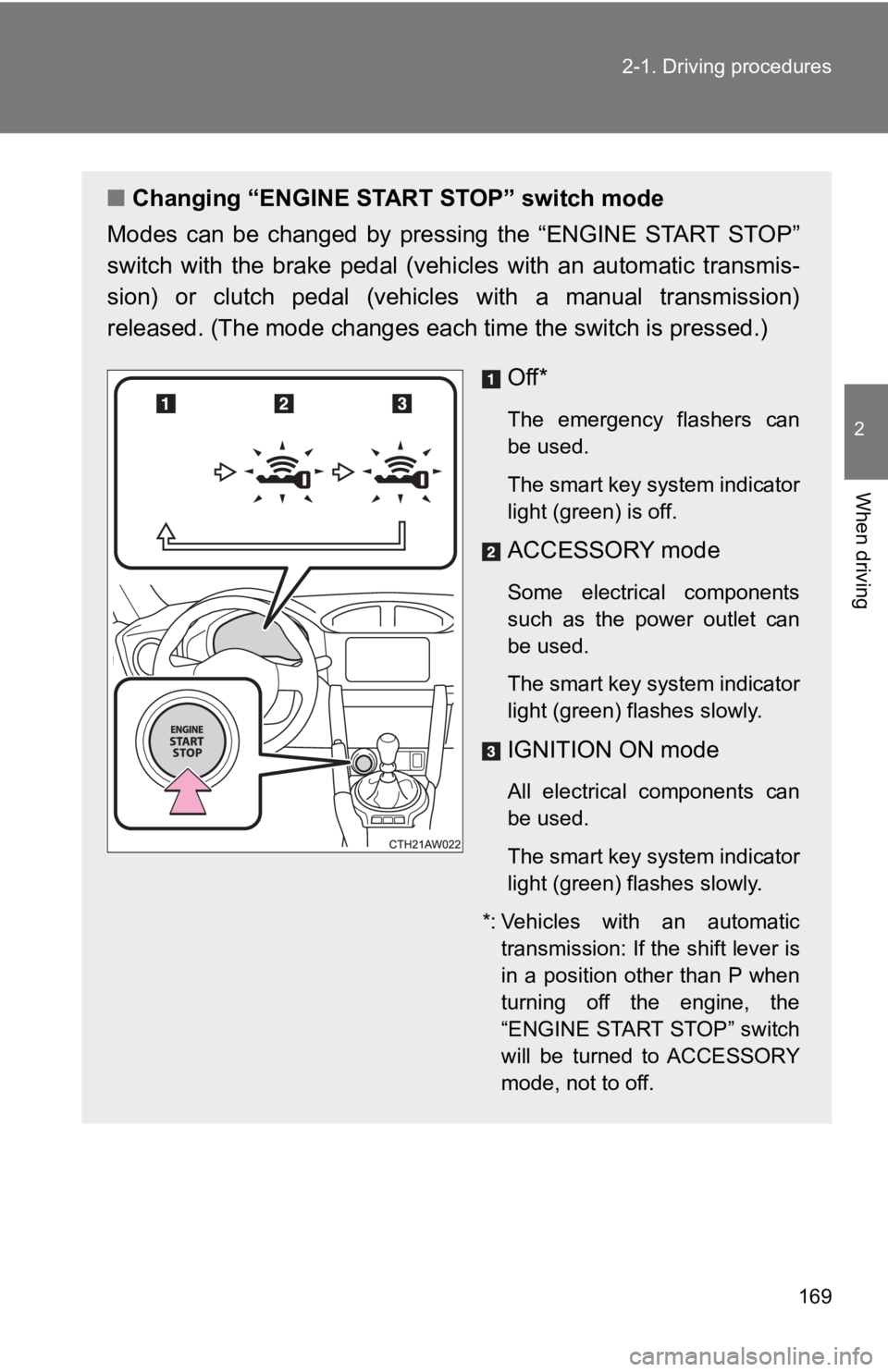
Modes can be changed by pressing the “ENGINE START STOP”
switch with the brake pedal (vehi cles with an automatic transmi s-
sion) or clutch pedal (vehicles with a manual transmission)
released. (The mode changes eac h time the switch is pressed.)
Off* The emergency flashers can
be used.
The smart key system indicator
light (green) is off.
ACCESSORY mode Some electrical components
such as the power outlet can
be used.
The smart key system indicator
light (green) flashes slowly.
IGNITION ON mode All electrical components can
be used.
The smart key system indicator
light (green) flashes slowly.
*: Vehicles with an automatic
transmission: If the shift lever is
in a position other than P when
turning off the engine, the
“ENGINE START STOP” switch
will be turned to ACCESSORY
mode, not to off.
Page 170 of 532
1702-1. Driving procedures
When stopping the engine with the shift lever in a position oth er
than P (vehicles with an automatic transmission)
If the engine is stopped with the shift lever in a position oth er than P,
the “ENGINE START STOP” switch will not be turned off but inste ad
be turned to ACCESSORY mode. Perform the following procedure to
turn the switch off:
Check that the parking brake is set.
Shift the shift lever to P.
Check that the smart key system indicator light (green)
flashes slowly and then press the “ENGINE START STOP”
switch once.
Check that the smart key system indicator light (green) is off.■ Auto power o ff function
Vehicles with an automatic transmission
If the vehicle is left in ACCESSORY mode for more than 20 minut es or IGNI-
TION ON mode (the engine is not running) for more than an hour with the
shift lever in P, the “ENGINE START STOP” switch will automatic ally turn off.
However, this function cannot entirely prevent battery discharg e. Do not
leave the vehicle with the “ENGINE START STOP” switch in ACCESS ORY
or IGNITION ON mode for long periods of time when the engine is not run-
ning.
Vehicles with a manual transmission
If the vehicle is left in ACCESSORY mode for more than 20 minut es or IGNI-
TION ON mode (the engine is not running) for more than an hour, the
“ENGINE START STOP” switch will automatically turn off. However , this
function cannot entirely prevent battery discharge. Do not leav e the vehicle
with the “ENGINE START STOP” switch in ACCESSORY or IGNITION ON
mode for long periods of time when the engine is not running. STEP 1
STEP 2
STEP 3
STEP 4
Page 171 of 532
1712-1. Driving procedures
2
When driving ■ Operation of the “EN GINE START STOP” switch
If the switch is not pressed shortly and firmly, the “ENGINE ST ART STOP”
switch mode may not change or the engine may not start.
■ Electronic key battery depletion
P. 35
■ Conditions affecting operation
P. 31
■ Note for the entry function
P. 32
■ If the engine does not start
The engine immobilizer system may not have been deactivated. ( P. 79)
Contact your Toyota dealer.
■ Steering lock
After turning the “ENGINE START STOP” switch off and opening an d closing
the doors, the steering wheel will be locked due to the steerin g lock function.
Operating the “ENGINE START STOP” switch again automatically cancels
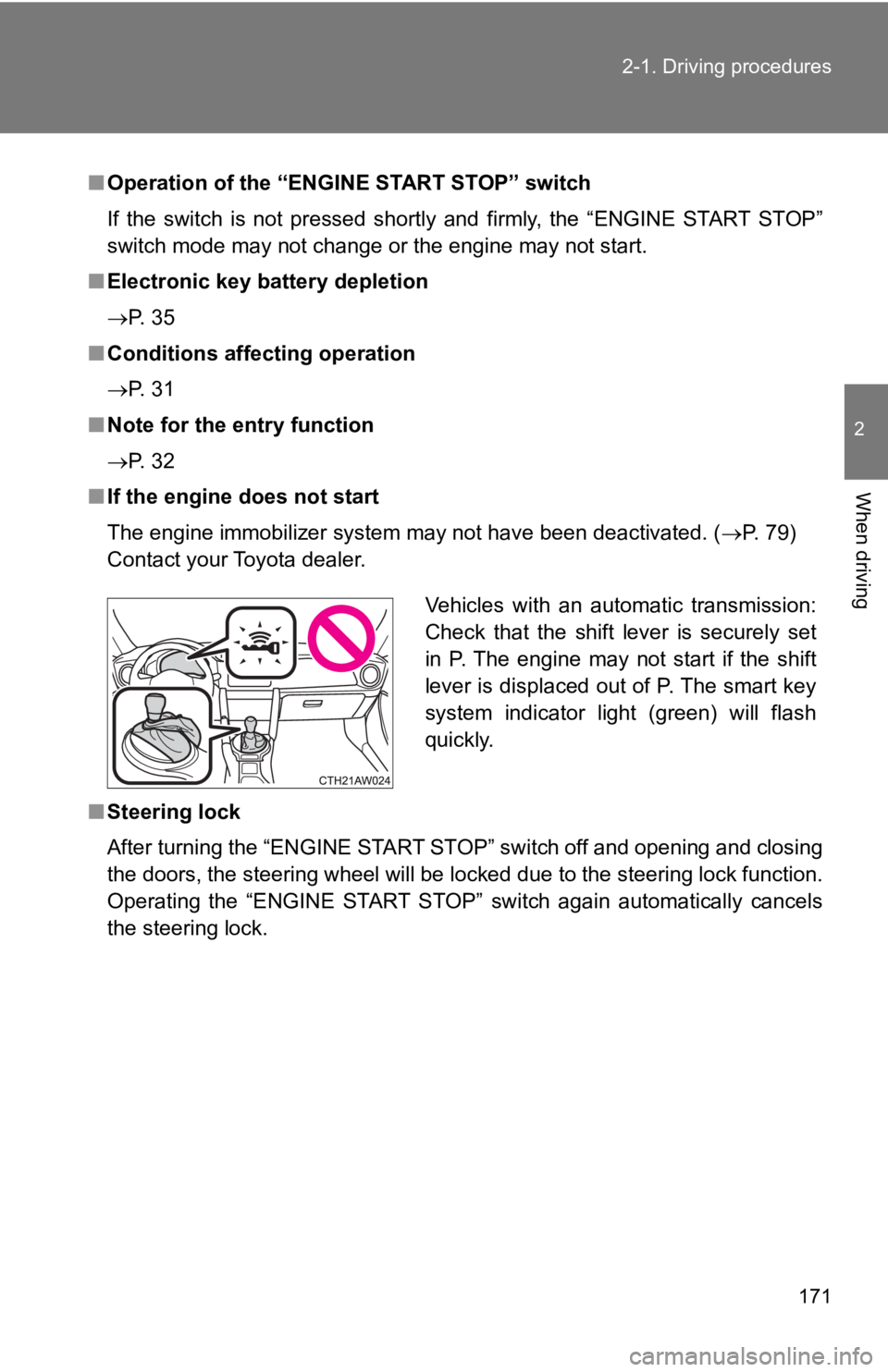
the steering lock. Vehicles with an automatic transmission:
Check that the shift lever is securely set
in P. The engine may not start if the shift
lever is displaced out of P. The smart key
system indicator light (green) will flash
quickly.
Page 172 of 532
1722-1. Driving procedures
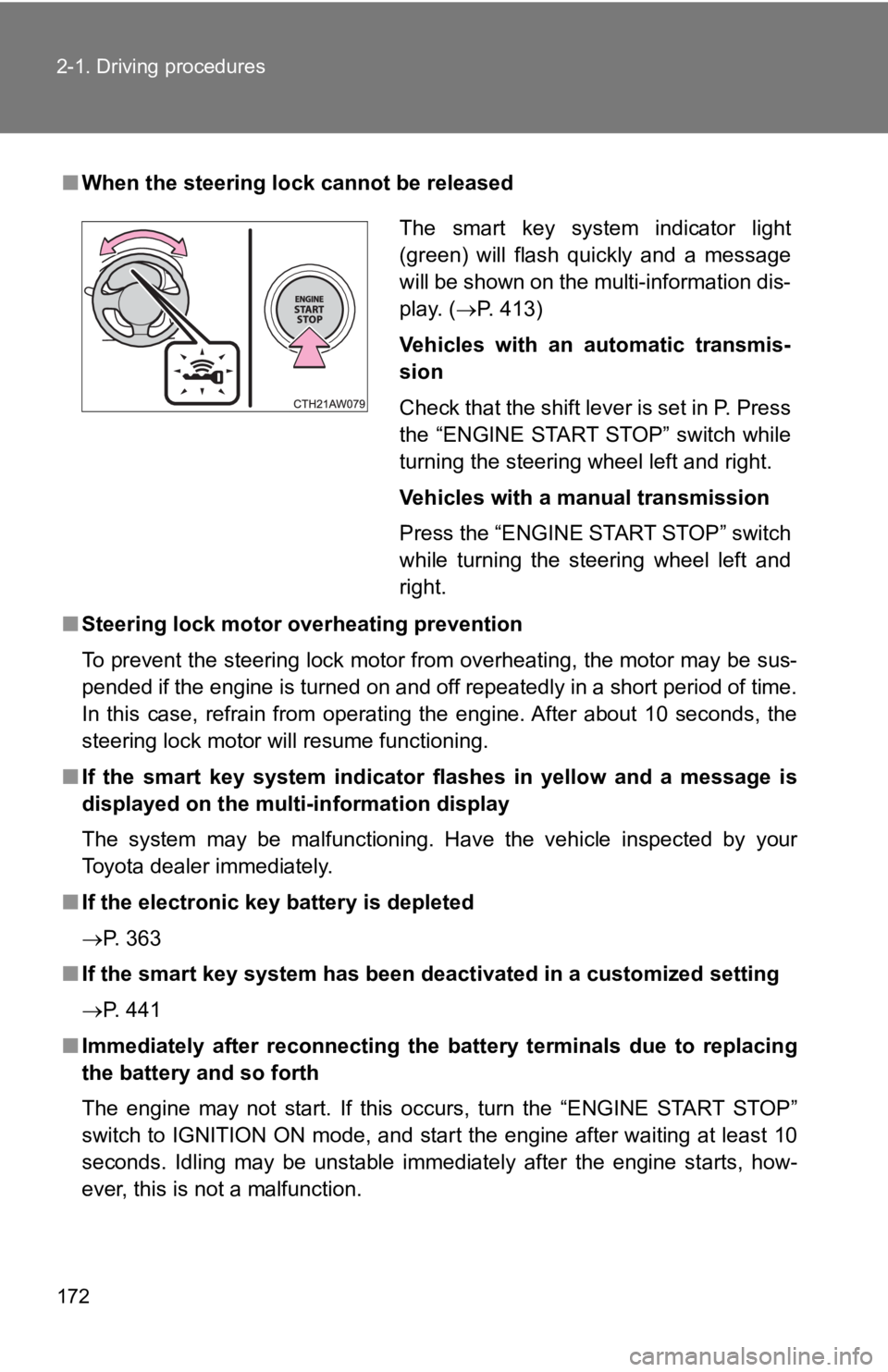
■ When the steering lock cannot be released
■ Steering lock motor o verheating prevention
To prevent the steering lock motor from overheating, the motor may be sus-
pended if the engine is turned on and off repeatedly in a short period of time.
In this case, refrain from operating the engine. After about 10 seconds, the
steering lock motor will resume functioning.
■ If the smart key system indicator flashes in yellow and a messa ge is
displayed on the multi-information display
The system may be malfunctioning. Have the vehicle inspected by your
Toyota dealer immediately.
■ If the electronic key battery is depleted
P. 363
■ If the smart key system has been deactivated in a customized se tting
P. 441
■ Immediately after reconnecting th e battery terminals due to rep lacing
the battery and so forth
The engine may not start. If this occurs, turn the “ENGINE STAR T STOP”
switch to IGNITION ON mode, and start the engine after waiting at least 10
seconds. Idling may be unstable immediately after the engine st arts, how-
ever, this is not a malfunction. The smart key system indicator light
(green) will flash quickly and a message
will be shown on the multi-information dis-
play. ( P. 413)
Vehicles with an automatic transmis-
sion
Check that the shift lever is set in P. Press
the “ENGINE START STOP” switch while
turning the steering wheel left and right.
Vehicles with a manual transmission
Press the “ENGINE START STOP” switch
while turning the steering wheel left and
right.
Page 173 of 532

1732-1. Driving procedures
2
When driving WARNING■ When starting the engine
● Always start the engine while sitting in the driver’s seat. Do not depress
the accelerator pedal while starting the engine under any circu mstances.
Doing so may cause an accident resulting in death or serious in jury.
● If the smart key system indicator light flashes in green after the engine has
started, never drive the vehicle. The steering wheel is still l ocked, and it
may result in an accident.
■ Caution while driving
If engine failure occurs while the vehicle is moving, do not lo ck or open the
doors until the vehicle reaches a safe and complete stop. Activ ation of the
steering lock in this circumstance may lead to an accident, res ulting in death
or serious injury.
■ Stopping the engine in an emergency
If you want to stop the engine in an emergency while driving th e vehicle,
press and hold the “ENGINE START STOP” switch for more than 2 s econds,
or press it briefly 3 times or more in succession. ( P. 454)
However, do not touch the “ENGINE START STOP” switch while driv ing
except in an emergency. Turning the engine off while driving wi ll not cause
loss of steering or braking control, but the power assist to these systems will
be lost. This will make it more difficult to steer and brake, s o you should pull
over and stop the vehicle as soon as it is safe to do so.
Page 174 of 532
1742-1. Driving procedures
NOTICE■ To prevent battery discharge
● Do not leave the “ENGINE START STOP” switch in ACCESSORY or IGN I-
TION ON mode for long periods of time without the engine runnin g.
● If the smart key system indicator light (green) is illuminated, the “ENGINE
START STOP” switch is not off. When exiting the vehicle, always check
that the “ENGINE START STOP” switch is off.
● Vehicles with an automatic transmission: Do not stop the engine when the
shift lever is in a position other than P. If the engine is sto pped in another
shift lever position, the “ENGINE START STOP” switch will not b e turned
off but instead be turned to ACCESSORY mode. If the vehicle is left in
ACCESSORY mode, battery discharge may occur.
■ When starting the engine
● Do not race a cold engine.
● If the engine becomes difficult to start or stalls frequently, have your vehi-
cle checked by your Toyota dealer immediately.
● Vehicles with an automatic transmission: Do not shift the shift lever while
the starter is operating.
■ Symptoms indicating a malfunction with the “ENGINE START STOP”
switch
If the “ENGINE START STOP” switch seems to be operating somewha t dif-
ferently than usual, such as the switch sticking slightly, there may be a mal-
function. Contact your Toyota dealer immediately.