battery TOYOTA 86 2020 Owner's Guide
[x] Cancel search | Manufacturer: TOYOTA, Model Year: 2020, Model line: 86, Model: TOYOTA 86 2020Pages: 532, PDF Size: 8 MB
Page 307 of 532
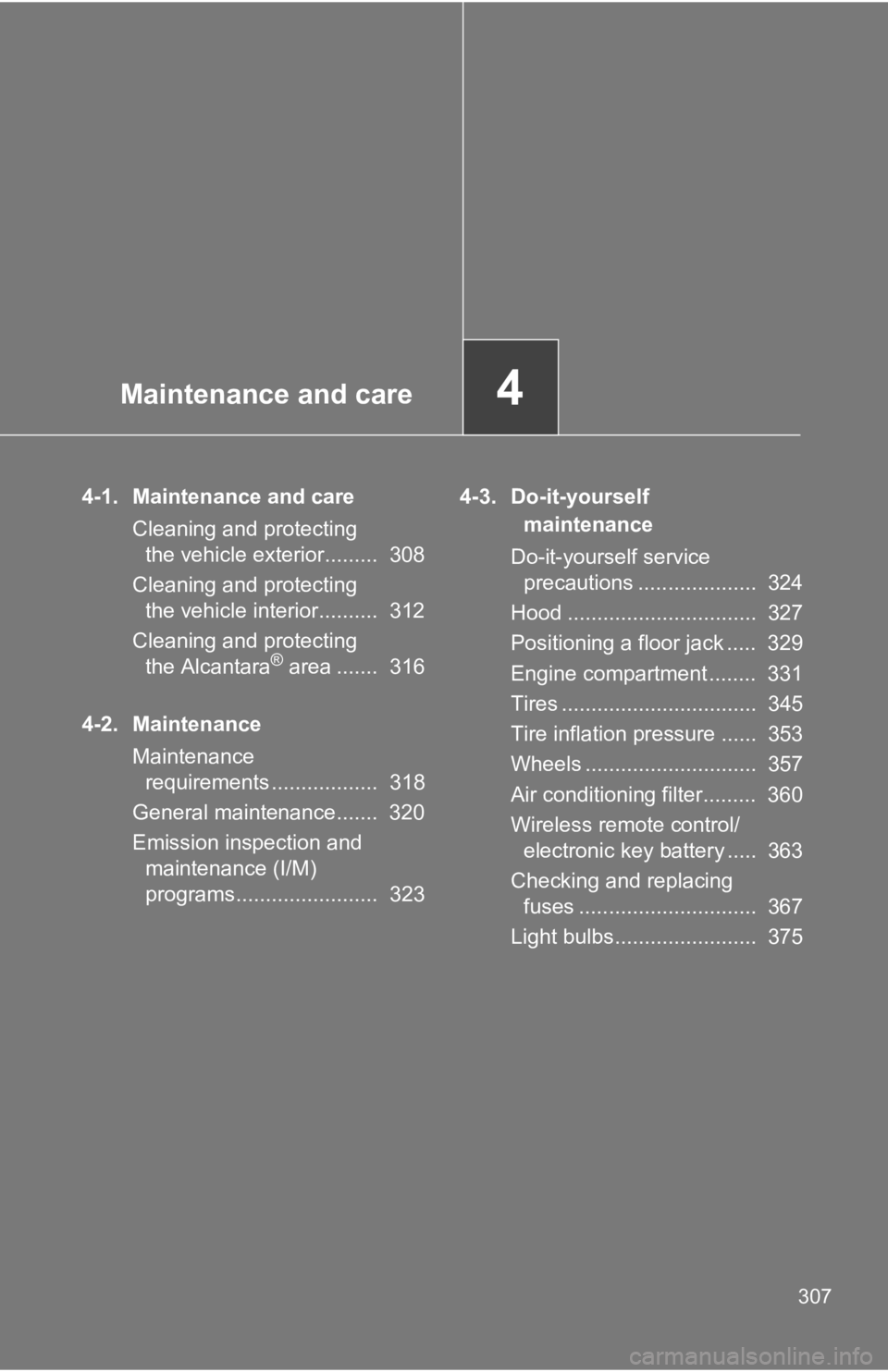
Maintenance and care4
307
4-1. Maintenance and careCleaning and protecting the vehicle exterior......... 308
Cleaning and protecting the vehicle interior.......... 312
Cleaning and protecting the Alcantara
® area ....... 316
4-2. Maintenance Maintenance requirements .................. 318
General maintenance....... 320
Emission inspection and maintenance (I/M)
programs........................ 323 4-3. Do-it-yourself
maintenance
Do-it-yourself service precautions .................... 324
Hood ................................ 327
Positioning a floor jack ..... 329
Engine compartment ........ 331
Tires ................................. 345
Tire inflation pressure ...... 353
Wheels ............................. 357
Air conditioning filter......... 360
Wireless remote control/ electronic key battery ..... 363
Checking and replacing fuses .............................. 367
Light bulbs........................ 375
Page 319 of 532
319
4-2. Maintenance
4
Maintenance and care
■
Allow inspection and repairs to be performed by a Toyota dealer
●Toyota technicians are well-trained specialists and are kept up to date
with the latest service information. They are well informed abo ut the
operations of all systems on your vehicle.
● Keep a copy of the repair order. It proves that the maintenance that has
been performed is under warranty coverage. If any problem should arise
while your vehicle is under warranty, your Toyota dealer will p romptly
take care of it.
WARNING
■ If your vehicle is not properly maintained
It could result in serious damage to the vehicle and possible s erious injury or
death.
■ Warning in handling of battery
●Engine exhaust, some of its constituents, and a wide variety of automobile
components contain or emit chemicals known to the State of California to
cause cancer and birth defects and other reproductive harm. Wor k in a
well ventilated area.
● Oils, fuels and fluids contained in vehicles as well as waste p roduced by
component wear contain or emit chemicals known to the State of Califor-
nia to cause cancer and birth defects or other reproductive har m. Avoid
exposure and wash any affected area immediately.
● Battery posts, terminals and related accessories contain lead and lead
compounds which are known to cause brain damage. Wash your hand s
after handling. ( P. 339)
Page 320 of 532
320
4-2. Maintenance
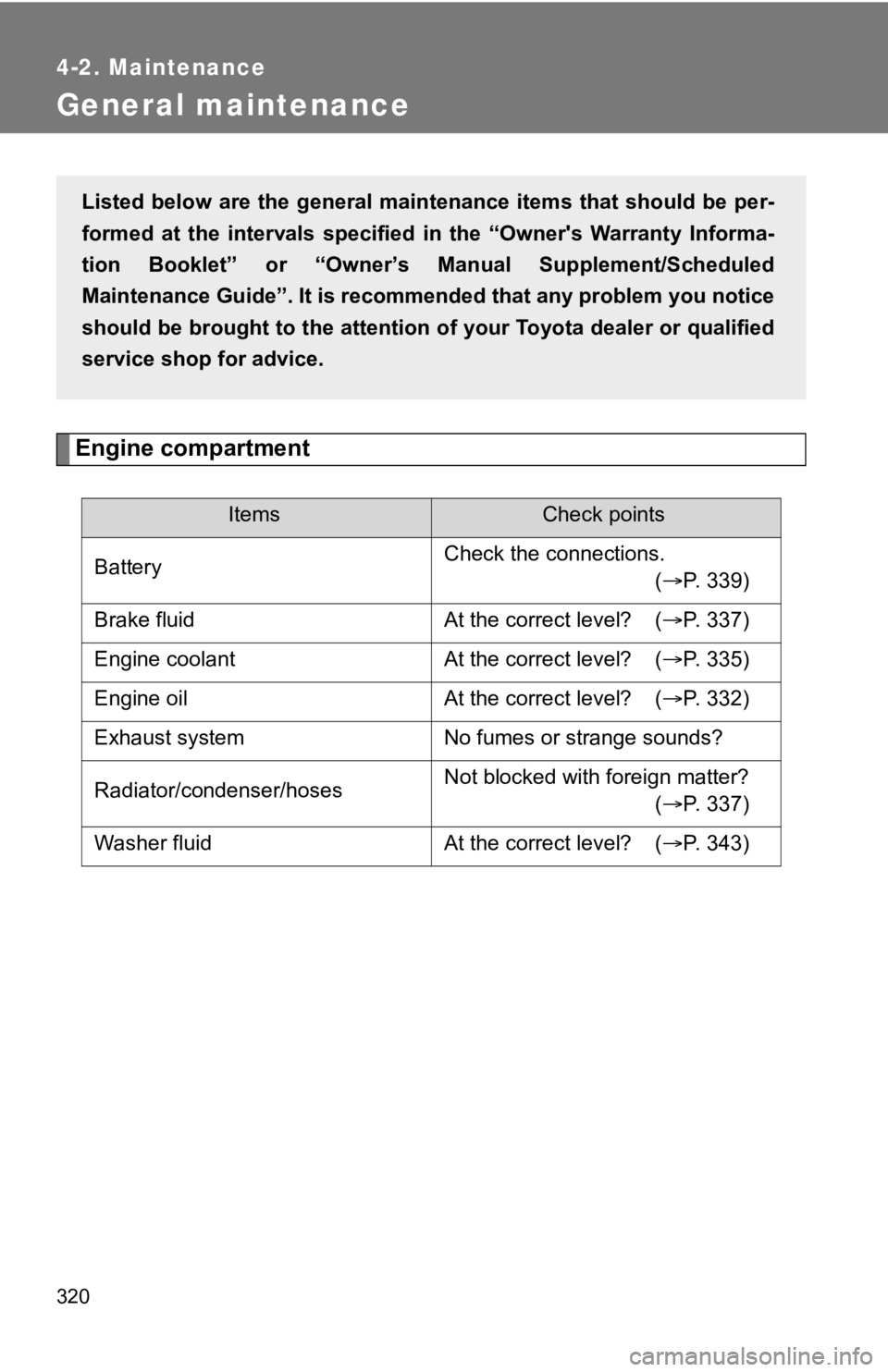
General maintenance
Engine compartment
ItemsCheck points
Battery Check the connections.
(P. 339)
Brake fluid At the correct level? ( P. 337)
Engine coolant At the correct level? ( P. 335)
Engine oil At the correct level? ( P. 332)
Exhaust system No fumes or strange sounds?
Radiator/condenser/hoses Not blocked with foreign matter?
(
P. 337)
Washer fluid At the correct level? (P. 343)
Listed below are the general maintenance items that should be p er-
formed at the intervals specifie d in the “Owner's Warranty Info rma-
tion Booklet” or “Owner’s Manual Supplement/Scheduled
Maintenance Guide”. It is recomme nded that any problem you notice
should be brought to the attention of your Toyota dealer or qua lified
service shop for advice.
Page 323 of 532
323
4-2. Maintenance
4
Maintenance and care
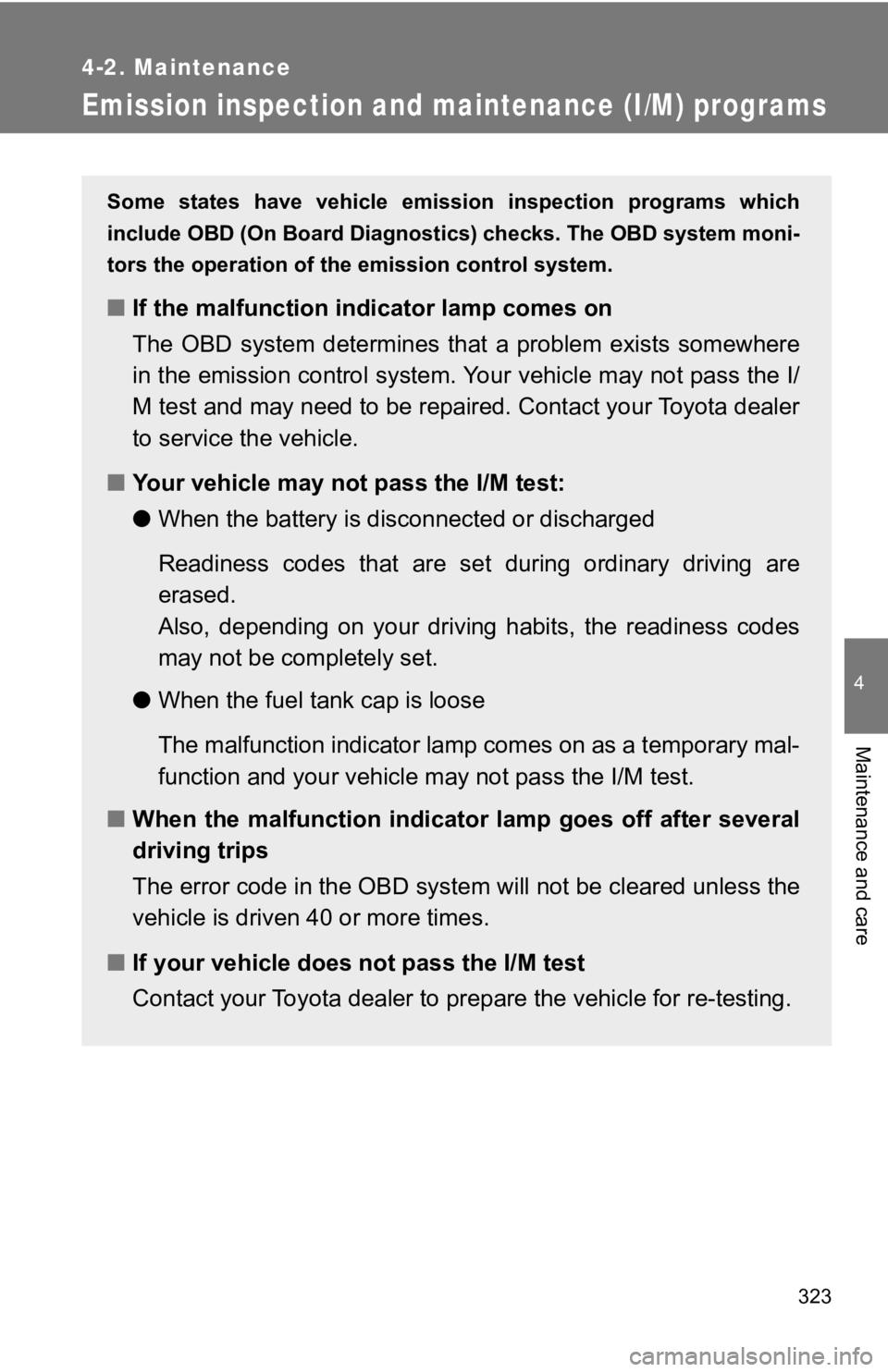
Emission inspection and maintenance (I/M) programs
Some states have vehicle emission inspection programs which
include OBD (On Board Diagnostics) checks. The OBD system moni-
tors the operation of the emission control system.
■ If the malfunction i ndicator lamp comes on
The OBD system determines that a problem exists somewhere
in the emission control system. Y our vehicle may not pass the I/
M test and may need to be repaired. Contact your Toyota dealer
to service the vehicle.
■ Your vehicle may not pass the I/M test:
●When the battery is disconnected or discharged
Readiness codes that are set during ordinary driving are
erased.
Also, depending on your driving habits, the readiness codes
may not be completely set.
● When the fuel t ank cap is loose
The malfunction indicator lamp comes on as a temporary mal-
function and your vehicle may not pass the I/M test.
■ When the malfunction indicator lamp goes off after several
driving trips
The error code in the OBD system will not be cleared unless the
vehicle is driven 40 or more times.
■ If your vehicle does not pass the I/M test
Contact your Toyota dealer to pr epare the vehicle for re-testing.
Page 324 of 532
324
4-3. Do-it-yourself maintenance
Do-it-yourself ser vice precautions
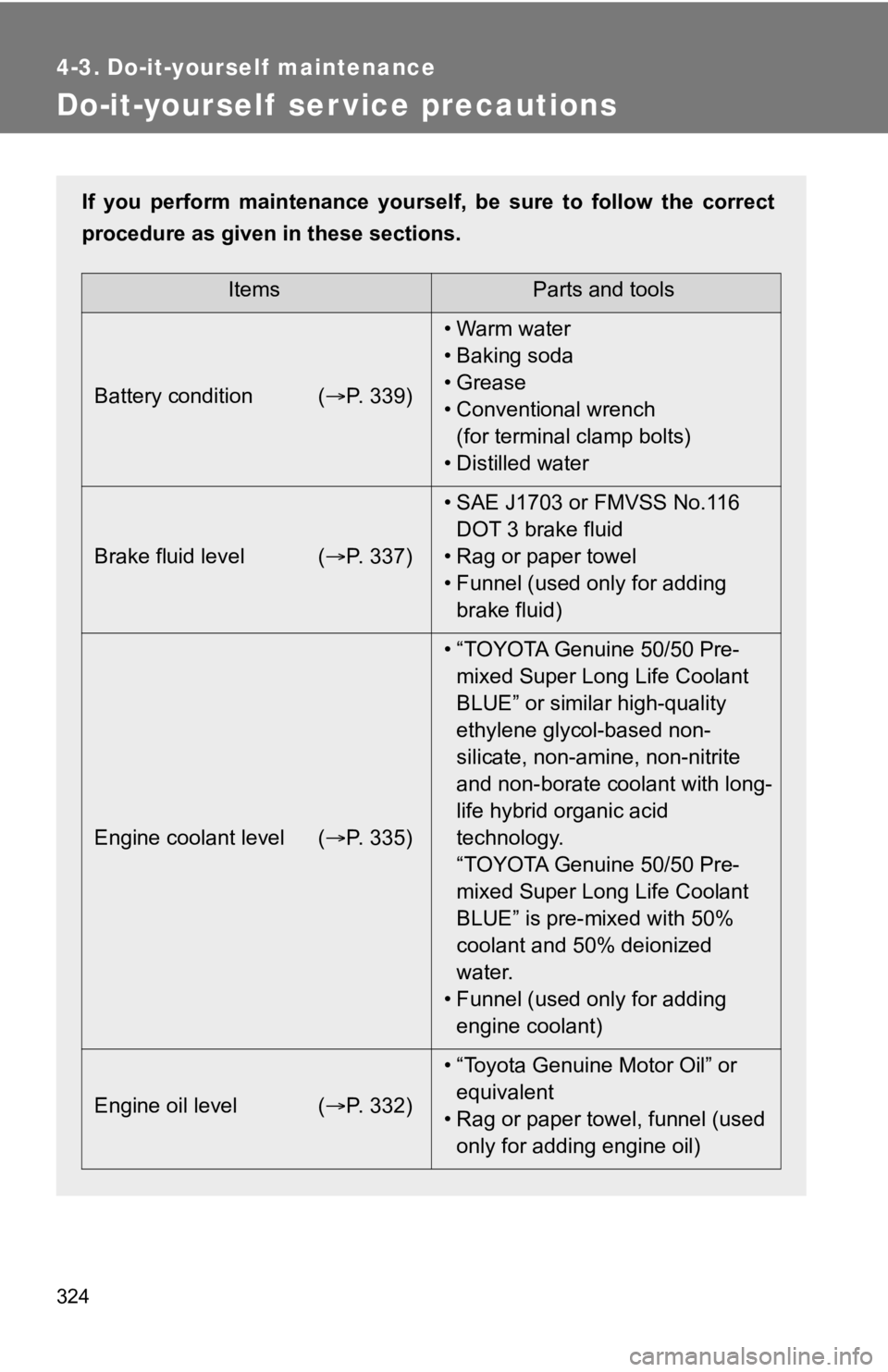
If you perform maintenance yourself, be sure to follow the correct
procedure as given in these sections.
ItemsParts and tools
Battery condition ( P. 339)•Warm water
• Baking soda
• Grease
• Conventional wrench
(for terminal clamp bolts)
• Distilled water
Brake fluid level ( P. 337)• SAE J1703 or FMVSS No.116
DOT 3 brake fluid
• Rag or paper towel
• Funnel (used only for adding brake fluid)
Engine coolant level ( P. 335)• “TOYOTA Genuine 50/50 Pre-
mixed Super Long Life Coolant
BLUE” or similar high-quality
ethylene glycol-based non-
silicate, non-amine, non-nitrite
and non-borate coolant with long-
life hybrid organic acid
technology.
“TOYOTA Genuine 50/50 Pre-
mixed Super Long Life Coolant
BLUE” is pre-mixed with 50%
coolant and 50% deionized
water.
• Funnel (used only for adding engine coolant)
Engine oil level ( P. 332)• “Toyota Genuine Motor Oil” or
equivalent
• Rag or paper towel, funnel (used only for adding engine oil)
Page 326 of 532
326 4-3. Do-it-yourself maintenance
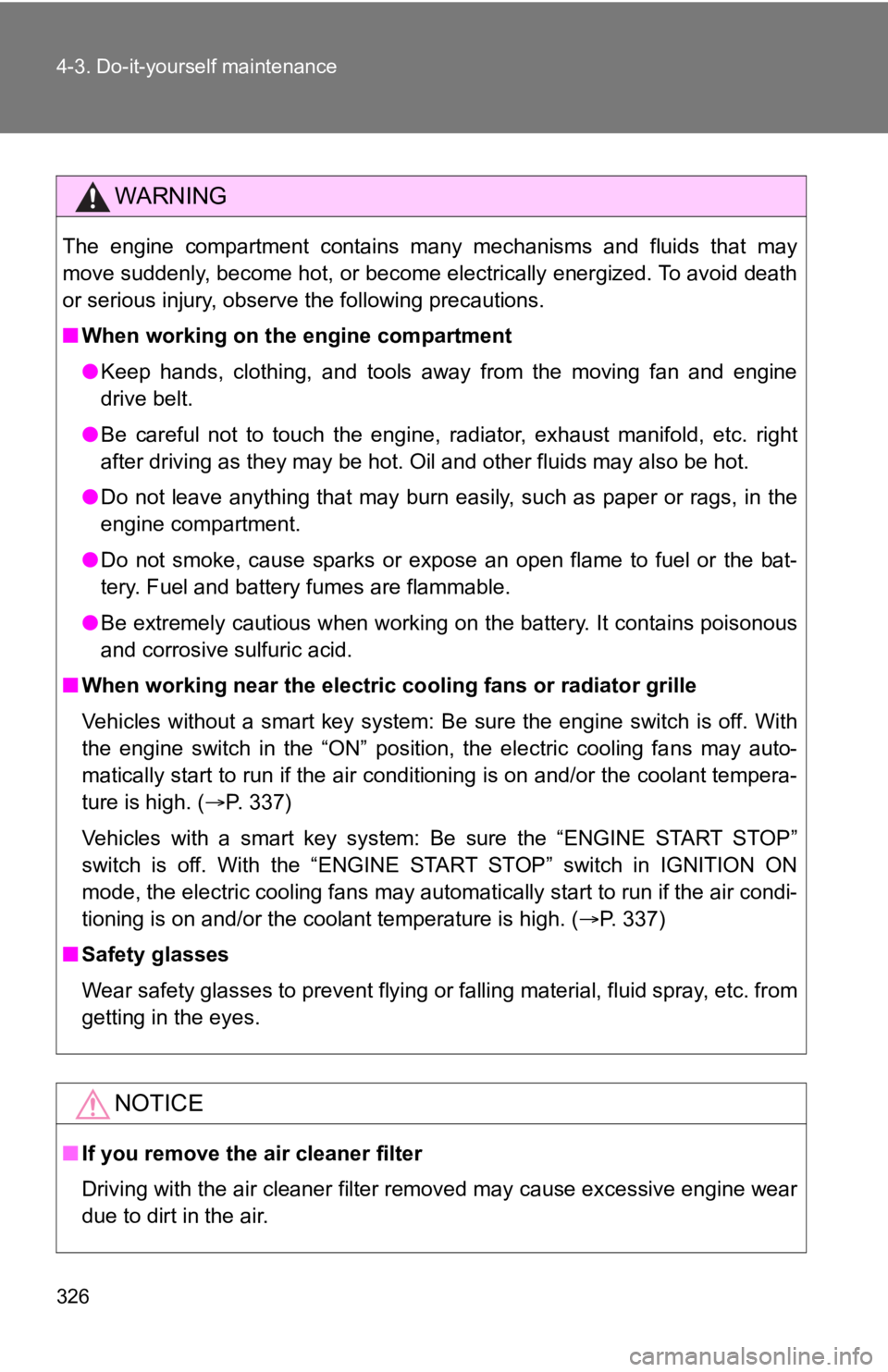
WARNING
The engine compartment contains many mechanisms and fluids that may
move suddenly, become hot, or become electrically energized. To avoid death
or serious injury, observe the following precautions.
■ When working on the engine compartment
●Keep hands, clothing, and tools away from the moving fan and engine
drive belt.
● Be careful not to touch the engine, radiator, exhaust manifold, etc. right
after driving as they may be hot. Oil and other fluids may also be hot.
● Do not leave anything that may burn easily, such as paper or ra gs, in the
engine compartment.
● Do not smoke, cause sparks or expose an open flame to fuel or t he bat-
tery. Fuel and battery fumes are flammable.
● Be extremely cautious when working on the battery. It contains poisonous
and corrosive sulfuric acid.
■ When working near the electric cooling fans or radiator grille
Vehicles without a smart key system: Be sure the engine switch is off. With
the engine switch in the “ON” position, the electric cooling fa ns may auto-
matically start to run if the air conditioning is on and/or the coolant tempera-
ture is high. ( P. 337)
Vehicles with a smart key system: Be sure the “ENGINE START STO P”
switch is off. With the “ENGINE START STOP” switch in IGNITION ON
mode, the electric cooling fans may automatically start to run if the air condi-
tioning is on and/or the coolant temperature is high. ( P. 337)
■ Safety glasses
Wear safety glasses to prevent flying or falling material, fluid spray, etc. from
getting in the eyes.
NOTICE
■If you remove the air cleaner filter
Driving with the air cleaner filter removed may cause excessive engine wear
due to dirt in the air.
Page 331 of 532
331
4-3. Do-it-yourself maintenance
4
Maintenance and care
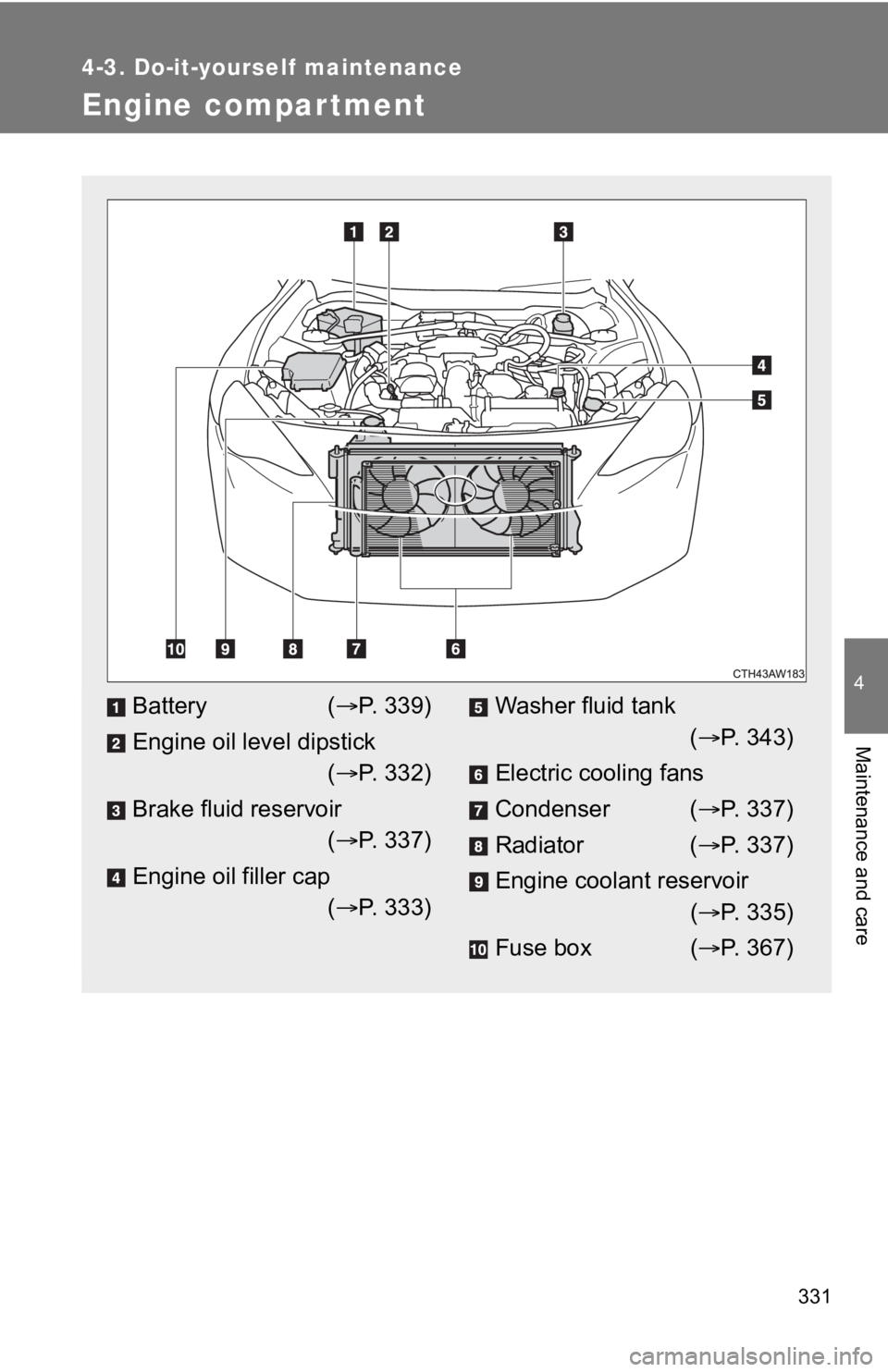
Engine compar tment
Battery( P. 3 3 9 )
Engine oil level dipstick ( P. 3 3 2 )
Brake fluid reservoir ( P. 3 3 7 )
Engine oil filler cap ( P. 3 3 3 )Washer fluid tank
( P. 3 4 3 )
Electric cooling fans
Condenser ( P. 3 3 7 )
Radiator ( P. 3 3 7 )
Engine coolant reservoir ( P. 3 3 5 )
Fuse box ( P. 3 6 7 )
Page 339 of 532
339
4-3. Do-it-yourself maintenance
4
Maintenance and care
Battery
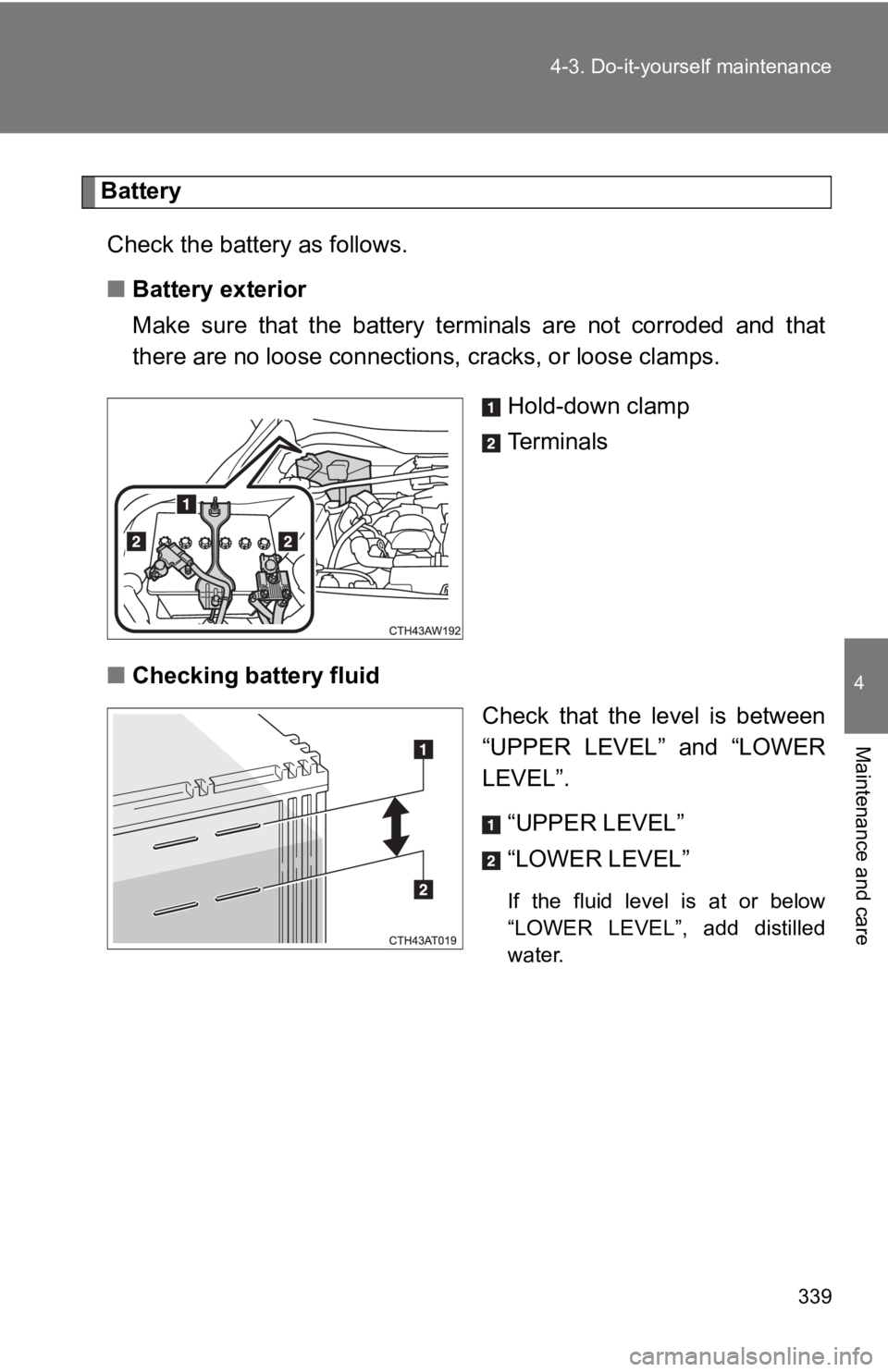
Check the battery as follows.
■ Battery exterior
Make sure that the battery terminals are not corroded and that
there are no loose connections, cracks, or loose clamps.
Hold-down clamp
Te r m i n a l s
■ Checking battery fluid
Check that the level is between
“UPPER LEVEL” and “LOWER
LEVEL”.
“UPPER LEVEL”
“LOWER LEVEL”
If the fluid level is at or below
“LOWER LEVEL”, add distilled
water.
Page 340 of 532
340 4-3. Do-it-yourself maintenance
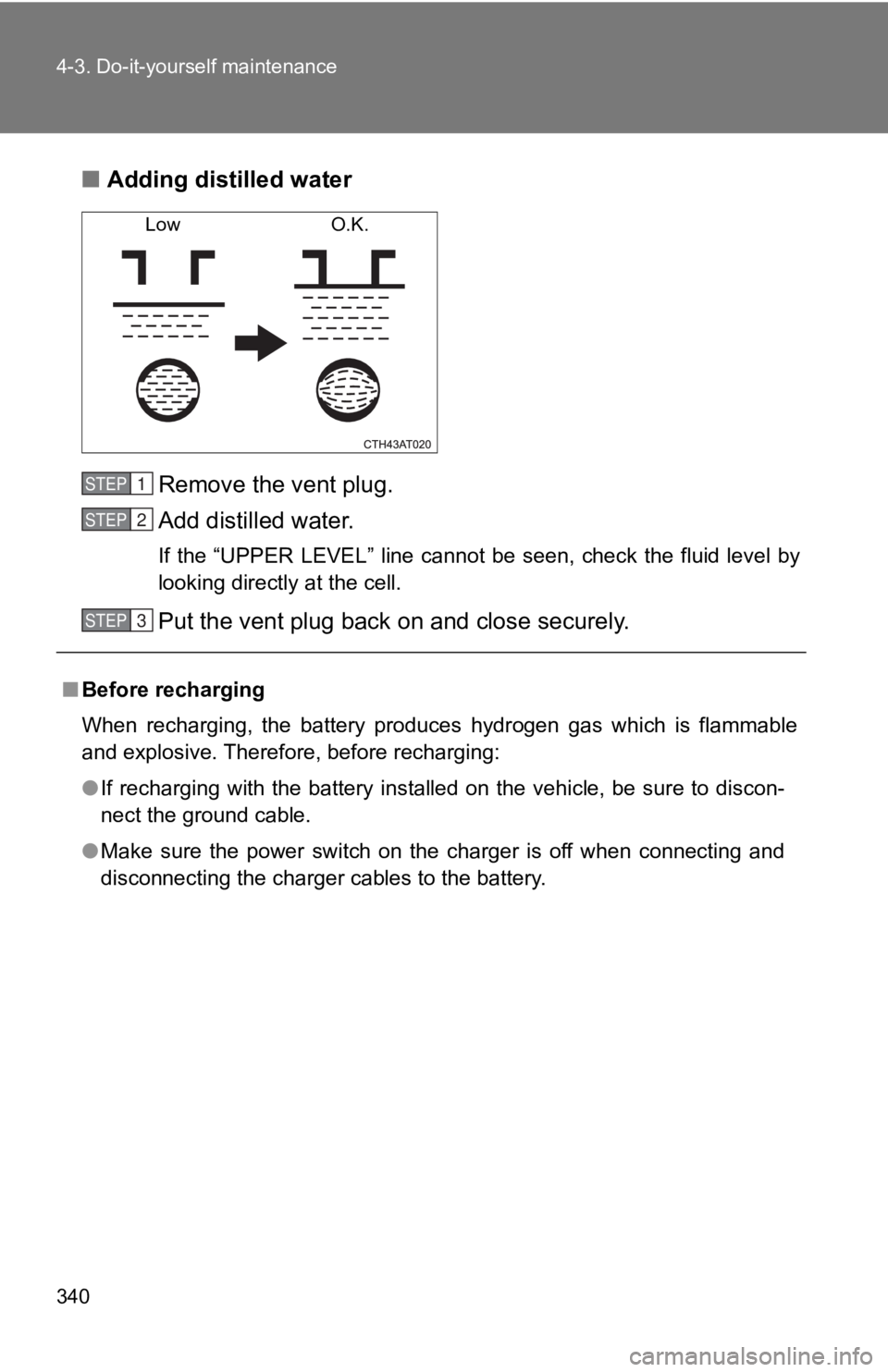
■Adding distilled water
Remove the vent plug.
Add distilled water.
If the “UPPER LEVEL” line cannot be seen, check the fluid level by
looking directly at the cell.
Put the vent plug back on and close securely.
Low O.K.
■Before recharging
When recharging, the battery produces hydrogen gas which is fla mmable
and explosive. Therefore, before recharging:
● If recharging with the battery installed on the vehicle, be sur e to discon-
nect the ground cable.
● Make sure the power switch on the charger is off when connectin g and
disconnecting the charger cables to the battery.
STEP 1
STEP 2
STEP 3
Page 341 of 532
341
4-3. Do-it-yourself maintenance
4
Maintenance and care
■
After recharging/reconnecting the battery (vehicles with a smar t key
system)
● Unlocking the doors using the smart key system may not be possi ble
immediately after reconnecting the battery. If this happens, use the wire-
less remote control or the mechanical key to lock/unlock the do ors.
● Start the engine with the “ENGINE START STOP” switch in ACCES-
SORY mode. The engine may not start with the “ENGINE START STOP ”
switch turned off. However, the engine will operate normally from the sec-
ond attempt.
● The “ENGINE START STOP” switch mode is recorded by the vehicle. If
the battery is reconnected, the vehicle will return the “ENGINE START
STOP” switch mode to the status it was in before the battery was discon-
nected. Make sure to turn off the engine before disconnect the battery.
Take extra care when connecting the battery if the “ENGINE STAR T
STOP” switch mode prior to discharge is unknown.
If the engine will not start even after multiple attempts, cont act your Toyota
dealer.