battery TOYOTA 86 2020 Workshop Manual
[x] Cancel search | Manufacturer: TOYOTA, Model Year: 2020, Model line: 86, Model: TOYOTA 86 2020Pages: 532, PDF Size: 8 MB
Page 437 of 532
5
When trouble arises
437
5-2. Steps to take in an emergency
Emergency start function (vehicles with a smart key system)
When the engine does not start, the following steps can be used
as
an interim measure to start the engine if the “ENGINE START STO P”
switch is functioning normally:
Vehicles with an automatic transmission
Set the parking brake.
Put the shift lever in P.
Set the “ENGINE START STOP” switch to ACCESSORY
mode.
Press and hold the “ENGINE START STOP” switch about 15
seconds while depressing the brake pedal firmly.
Even if the engine can be started using the above steps, the sy stem
may be malfunctioning. Have the vehicle checked by your Toyota
dealer.
■ The starter motor does not turn over, the interior lights and
headlights do not turn on, or the horn does not sound.
One of the following may be the cause of the problem.
● One or both of the battery ter minals may be disconnected.
● The battery may be discharged. ( P. 445)
● There may be a malfunction in the steering lock system. (vehi-
cles with a smart key system)
Contact your Toyota dealer if the problem cannot be repaired, o r if
repair procedures are unknown.
STEP 1
STEP 2
STEP 3
STEP 4
Page 441 of 532
5
When trouble arises
441
5-2. Steps to take in an emergency
If the electronic key does not operate properly (vehicles with a smar t key system)
Unlocking and locking the doors, unlocking the trunk
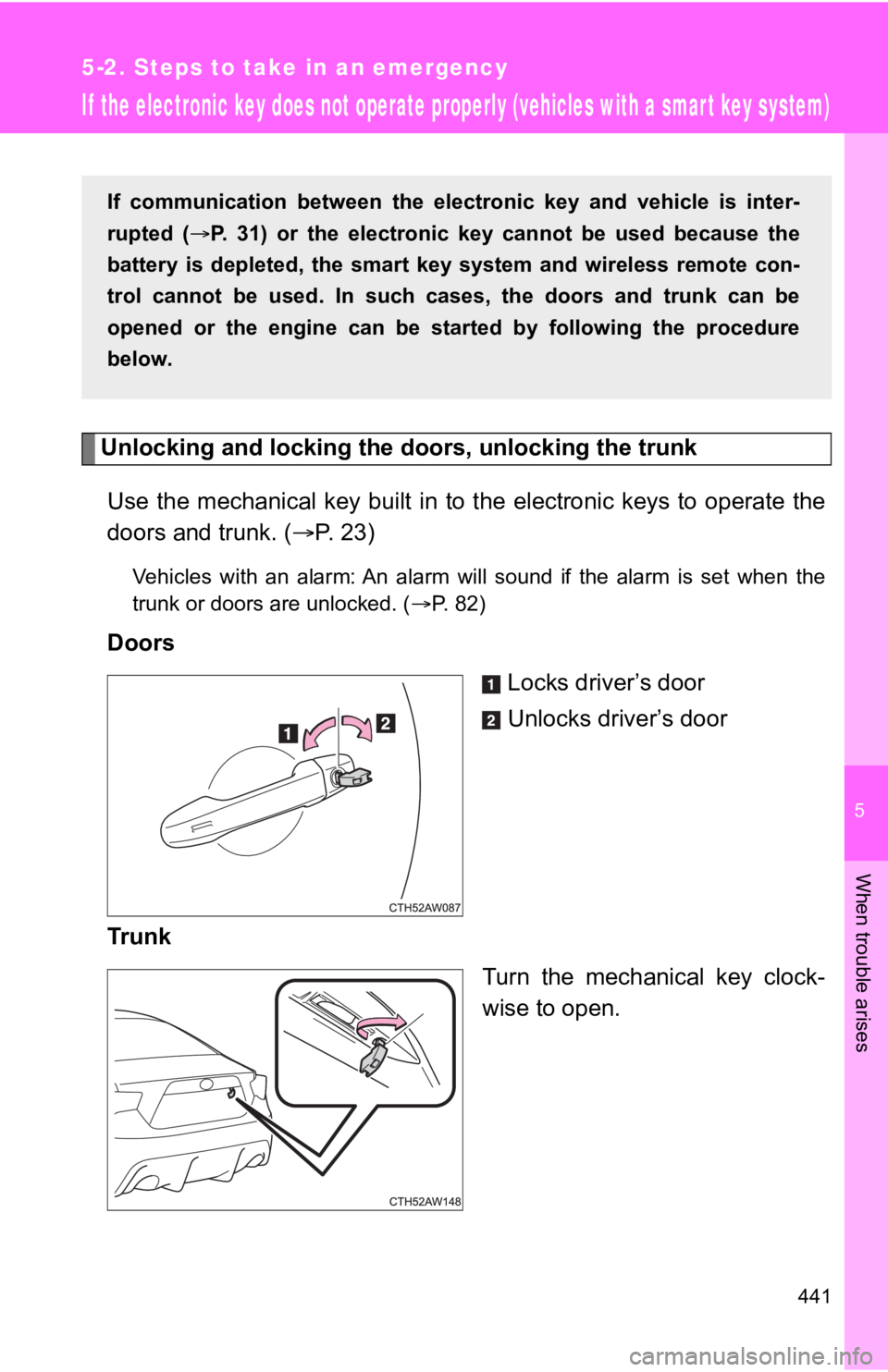
Use the mechanical key built i n to the electronic keys to opera te the
doors and trunk. ( P. 2 3 )
Vehicles with an alarm: An alarm will sound if the alarm is set when the
trunk or doors are unlocked. ( P. 82)
Doors
Locks driver’s door
Unlocks driver’s door
Trunk Turn the mechanical key clock-
wise to open.
If communication between the el ectronic key and vehicle is inter-
rupted ( P. 31) or the electronic key cannot be used because the
battery is depleted, the smart key system and wireless remote c on-
trol cannot be used. In such cases, the doors and trunk can be
opened or the engine can be star ted by following the procedure
below.
Page 444 of 532

444 5-2. Steps to take in an emergency
■Stopping the engine
Vehicles with an automatic transmission: Shift the shift lever to P and press
the “ENGINE START STOP” switch as you normally do when stopping the
engine.
Vehicles with a manual transmission: Shift the shift lever to N and press the
“ENGINE START STOP” switch as you normally do when stopping the
engine.
■ Replacing the key battery
As the above procedure is a temporary measure, it is recommended that the
electronic key battery be replaced immediately when the battery depletes.
( P. 363)
■ Alarm
Using the mechanical key to lock the doors will not set the alarm system.
If a door is unlocked using the mechanical key when the alarm s ystem is set,
the alarm may be triggered. ( P. 82)
■ Changing “ENGINE START STOP” switch modes
Vehicles with an automatic transmission
Release the brake pedal and press the “ENGINE START STOP” switch in
above.The engine does not start and modes will be changed each
time the switch is pressed. ( P. 169)
Vehicles with a manual transmission
Release the clutch pedal and press the “ENGINE START STOP” swit ch in
above.The engine does not start and modes will be changed each
time the switch is pressed. ( P. 169)
■ If the doors cannot be locked or unlocked by the smart key system
Lock and unlock the doors by the mechanical key or wireless rem ote control.
STEP 3
STEP 3
Page 445 of 532
5
When trouble arises
445
5-2. Steps to take in an emergency
If the batter y is discharged
The following procedures may be used to start the engine if the vehi-
cle's battery is discharged.
You can call your Toyota dealer or a qualified repair shop.
If you have a set of jumper (or booster) cables and a second ve hi-
cle with a 12-volt battery, you can jump start your vehicle fol lowing
the steps below.
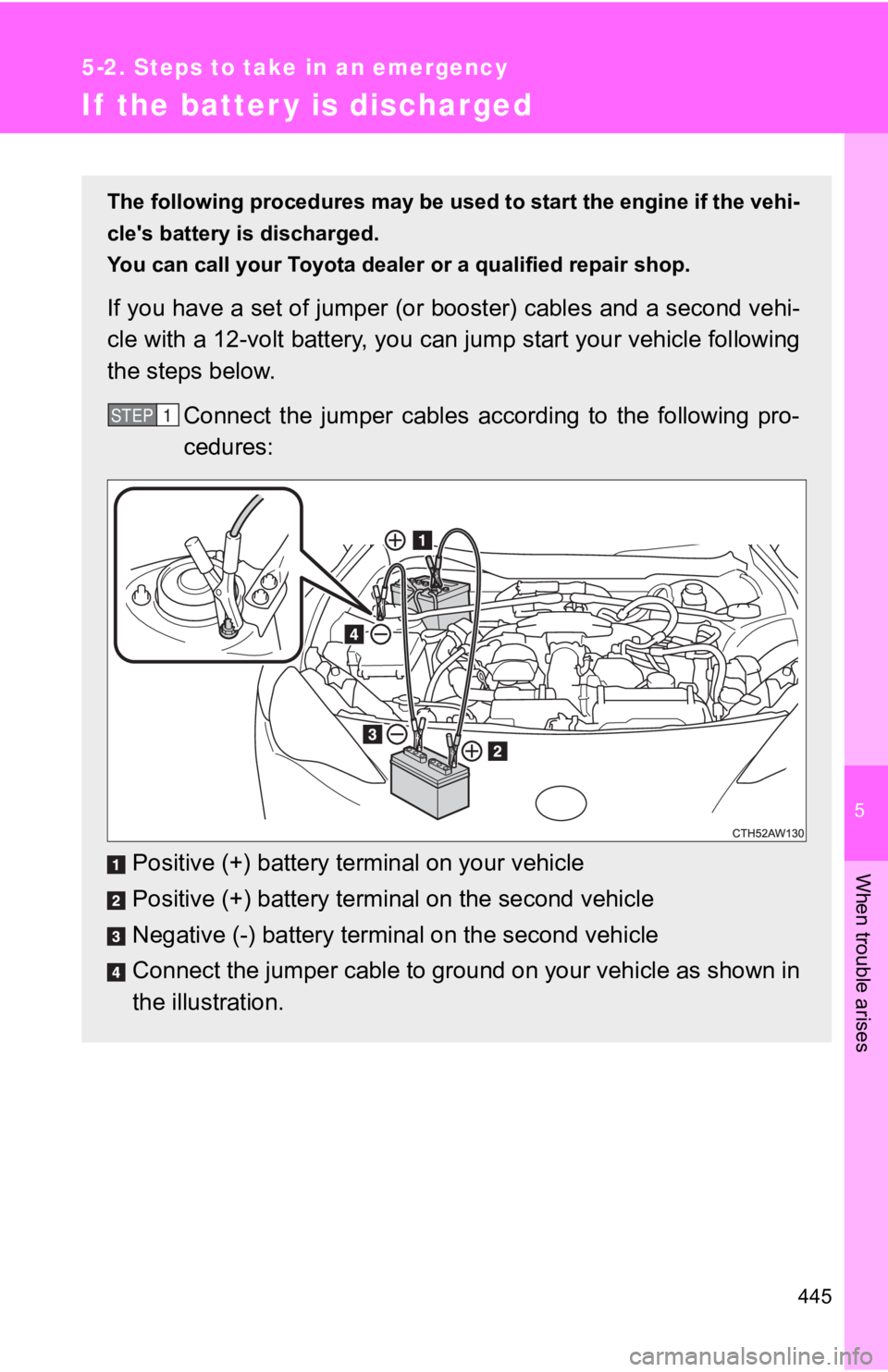
Connect the jumper cables according to the following pro-
cedures:
Positive (+) battery terminal on your vehicle
Positive (+) battery termi nal on the second vehicle
Negative (-) battery termi nal on the second vehicle
Connect the jumper cable to ground on your vehicle as shown in
the illustration.
STEP 1
Page 446 of 532
446 5-2. Steps to take in an emergency
Start the engine of the second vehicle. Increase the engine
speed slightly and maintain at that level for approximately 5
minutes to recharge the battery of your vehicle.
Vehicles with a smart key system only: Open and close any
of the doors of your vehicle with the “ENGINE START
STOP” switch off.
Vehicles without a smart key system: Maintain the engine
speed of the second vehicle and turn the engine switch to
the “ON” position, then start the vehicle's engine.
Vehicles with a smart key system: Maintain the engine
speed of the second vehicle and turn the “ENGINE START
STOP” switch to IGNITION ON mode, then start the vehi-
cle's engine.
Once the vehicle’s engine has started, remove the jumper
cables in the exact reverse order in which they were con-
nected.
Once the engine starts, have the vehicle checked at your Toyota
dealer as soon as possible.STEP 2
STEP 3
STEP 4
STEP 5
Page 447 of 532

5
When trouble arises
447
5-2. Steps to take in an emergency
■
Starting the engine when the battery is discharged
The engine cannot be started by push-starting.
■ Avoiding a discharged battery
●Turn off the headlights and the air conditioning system while the engine is
off.
● Turn off any unnecessary electrical components when the vehicle is run-
ning at a low speed for an extended period, such as in heavy tr affic, etc.
■ Charging the battery
The electricity stored in the battery will discharge gradually even when the
vehicle is not in use, due to natural discharge and the draining effects of cer-
tain electrical appliances. If the vehicle is left for a long t ime, the battery may
discharge, and the engine may be unable to start. (The battery recharges
automatically during driving.)
■ Precautions when the battery is discharged (vehicles with a smart key
system)
● In some cases, it may not be possible to unlock the doors using the smart
key system when the battery is discharged. Use the wireless remote con-
trol or the mechanical key to lock or unlock the doors.
● The engine may not start on the first attempt after the battery has
recharged but will start normally after the second attempt. Thi s is not a
malfunction.
● The “ENGINE START STOP” switch mode is memorized by the vehicle .
When the battery is reconnected, the system will return to the mode it
was in before the battery was discharged. Before disconnecting the bat-
tery, turn the “ENGINE START STOP” switch off.
If you are unsure what mode the “ENGINE START STOP” switch was in
before the battery discharged, be especially careful when recon necting
the battery.
Page 448 of 532

448 5-2. Steps to take in an emergency
WARNING
■Avoiding battery fires or explosions
Observe the following precautions to prevent accidentally ignit ing the flam-
mable gas that may be emitted from the battery.
● Make sure the jumper cable is connected to the correct terminal and that it
is not unintentionally in contact with any part other than the intended termi-
nal.
● Do not allow the jumper cables to come into contact with the “+ ” and “-” ter-
minals.
● Do not allow open flame or use matches, cigarette lighters or s moke near
the battery.
■ Battery precautions
The battery contains poisonous and corrosive acidic electrolyte , while
related parts contain lead and lead compounds. Observe the foll owing pre-
cautions when handling the battery.
● When working with the battery, always wear safety glasses and t ake care
not to allow any battery fluids (acid) to come into contact wit h skin, clothing
or the vehicle body.
● Do not lean over the battery.
● In the event that battery fluid comes into contact with the ski n or eyes,
immediately wash the affected area with water and seek medical attention.
Place a wet sponge or cloth over the affected area until medical attention
can be received.
● Always wash your hands after handling the battery support, term inals, and
other battery-related parts.
● Do not allow children near the battery.
■ To prevent damage to the vehicle
Do not pull- or push-start the vehicle as the three-way catalyt ic converter
may overheat and become a fire hazard.
Page 465 of 532
465
6-1. Specifications
6
Vehicle specifications
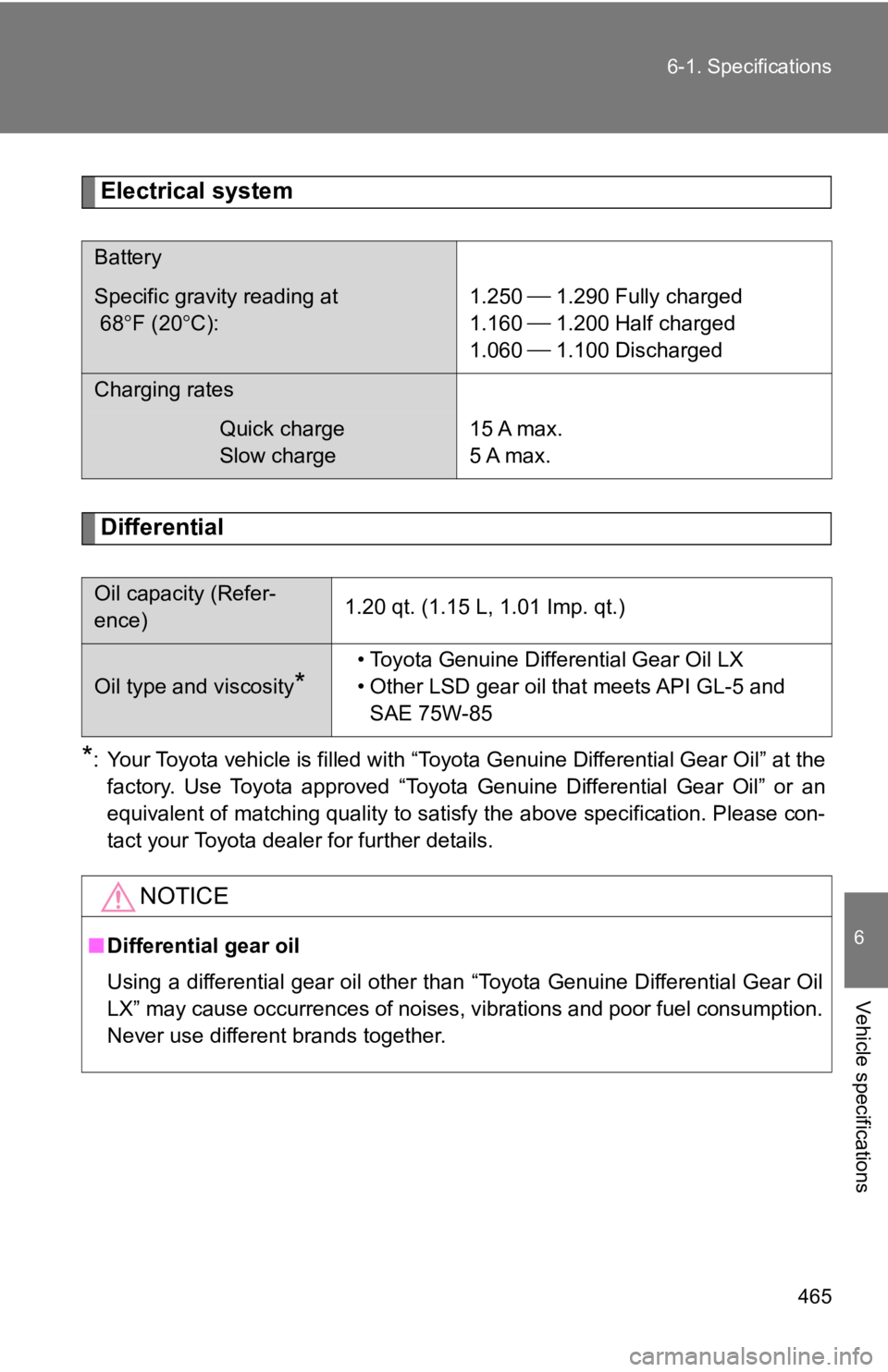
Electrical system
Differential
*: Your Toyota vehicle is filled with “Toyota Genuine Differential Gear Oil” at the
factory. Use Toyota approved “Toyota Genuine Differential Gear Oil” or an
equivalent of matching quality to satisfy the above specificati on. Please con-
tact your Toyota dealer for further details.
Battery
Specific gravity reading at
68 F (20 C): 1.250 1.290 Fully charged
1.160 1.200 Half charged
1.060 1.100 Discharged
Charging rates
Quick charge
Slow charge15 A max.
5 A max.
Oil capacity (Refer-
ence)
1.20 qt. (1.15 L, 1.01 Imp. qt.)
Oil type and viscosity*
• Toyota Genuine Differential Gear Oil LX
• Other LSD gear oil that meets API GL-5 and
SAE 75W-85
NOTICE
■ Differential gear oil
Using a differential gear oil other than “Toyota Genuine Differ ential Gear Oil
LX” may cause occurrences of noises, vibrations and poor fuel c onsumption.
Never use different brands together.
Page 481 of 532
481
6-1. Specifications
6
Vehicle specifications
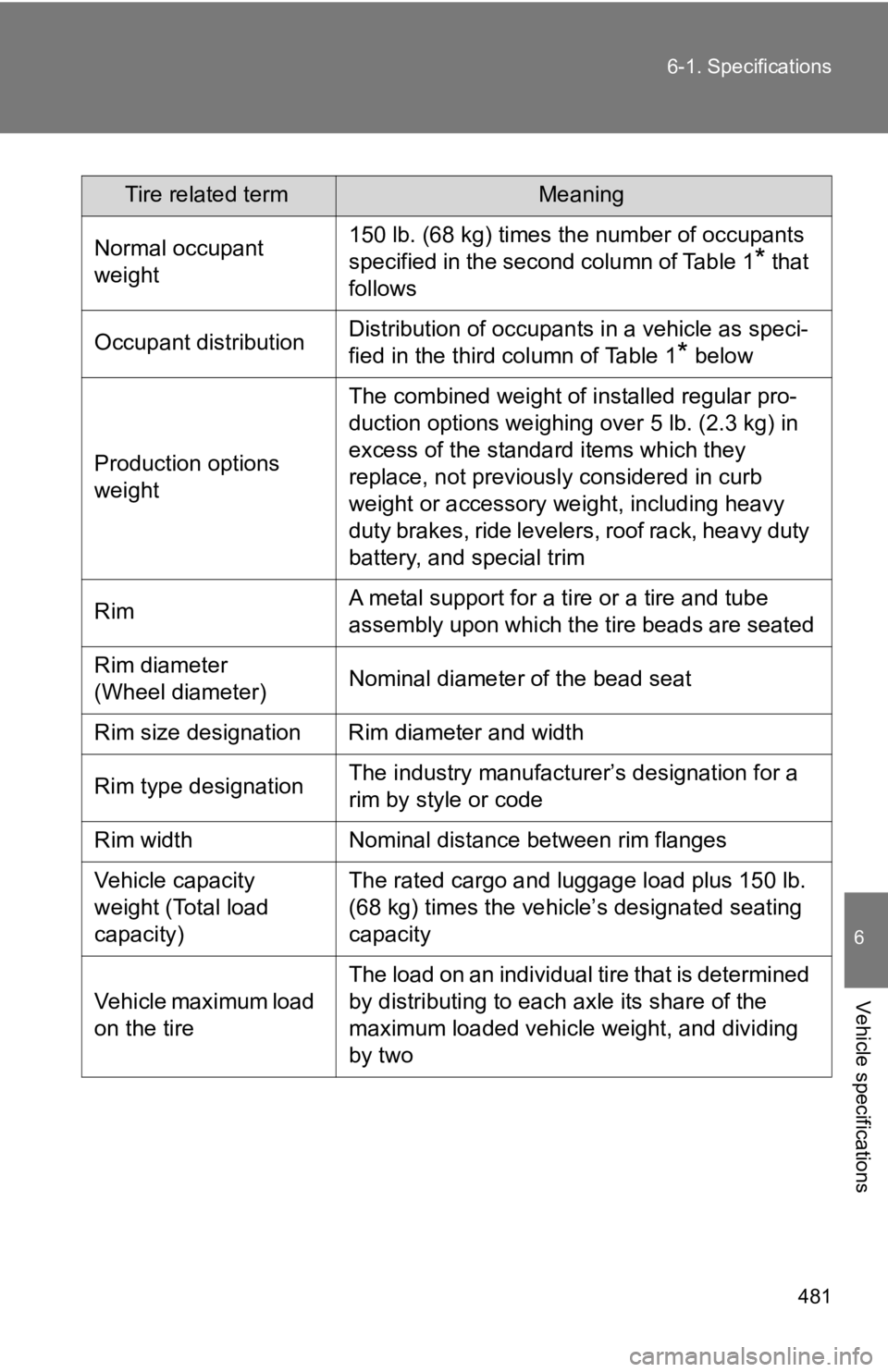
Tire related termMeaning
Normal occupant
weight 150 lb. (68 kg) times the
number of occupants
specified in the second column of Table 1
* that
follows
Occupant distribution Distribution of occupant
s in a vehicle as speci-
fied in the third column of Table 1
* below
Production options
weight The combined weight of installed regular pro-
duction options weighing over 5 lb. (2.3 kg) in
excess of the standard items which they
replace, not previously considered in curb
weight or accessory weight, including heavy
duty brakes, ride levelers, roof rack, heavy duty
battery, and special trim
Rim A metal support for a ti
re or a tire and tube
assembly upon which the tire beads are seated
Rim diameter
(Wheel diameter) Nominal diameter o
f the bead seat
Rim size designation R im diameter and width
Rim type designation The industry manufacturer’s designation for a
rim by style or code
Rim width Nominal distan ce between rim flanges
Vehicle capacity
weight (Total load
capacity) The rated cargo and luggage load plus 150 lb.
(68 kg) times the vehicl
e’s designated seating
capacity
Vehicle maximum load
on the tire The load on an individual tire that is determined
by distributing to each
axle its share of the
maximum loaded vehicle weight, and dividing
by two
Page 521 of 532

521
Alphabetical index
Alphabetical index
A/C .................................... 268, 275
ABS........................................... 245
Air conditioning filter .............. 360
Air conditioning systemAir conditioning filter ............. 360
Automatic air conditioning system................................ 275
Manual air conditioning system................................ 268
Airbags
Airbag operating conditions ................... 103, 111
Airbag precautions for
your child............................ 120
Airbag warning light .............. 398
Curtain shield airbag operating conditions ........... 111
Curtain shield airbag precautions ........................ 120
Front passenger occupant classification system .......... 128
General airbag
precautions ........................ 120
Locations of airbags ............... 89
Modification and disposal of airbags ............. 124
Proper driving posture ......................... 87, 120
Side airbag operating conditions ........................... 111
Side airbag
precautions ........................ 120
Side and curtain shield airbags operating
conditions ........................... 111
Side and curtain shield airbags precautions............ 120
SRS airbag instructions for
Canadian owners ............... 496
SRS airbags ........................... 89 Alarm ...........................................82
Anti-lock brake system............245
Audio input ...............................286
Audio system
Audio input ............................286
AUX port................................286
iPod .......................................286
Portable music player............286
Steering wheel audio switches ..............................287
USB memory .........................286
USB port................................286
Automatic air conditioning
system ....................................275
Automatic headlight leveling system ....................................226
Automatic light control system ....................................222
Automatic transmission
Automatic transmission .........178
If the shift lever cannot be shifted from P......................439
Manual mode ........................181
Mode select switch ................180
Paddle shift switches.............181
AUX port ...................................286
Back-up lights Replacing light bulbs .............375
Wattage .................................469
Battery Checking ...............................339
If the vehicle has a discharged battery ..............445
Preparing and checking before winter .......................261
Bottle holders ...........................293
Brake
Fluid ......................................337
Parking brake ........................189A
B