warning light TOYOTA 86 2022 Owners Manual
[x] Cancel search | Manufacturer: TOYOTA, Model Year: 2022, Model line: 86, Model: TOYOTA 86 2022Pages: 449, PDF Size: 8.5 MB
Page 355 of 449
3557-2. Steps to take in an emergency
7
When trouble arises
■If the tire pressure warning light
frequently comes on after blink-
ing for 1 minute
If the tire pressure warning light fre-
quently comes on after blinking for 1
minute when the engine switch is
turned to ON, have it checked by
your Toyota dealer.
■Warning buzzer
In some cases, the buzzer may not
be heard due to being in a noisy
location or audio sound.
WARNING
■If both the ABS and the brake
system warning lights remain
on
Stop your vehicle in a safe place
immediately and contact your Toy-
ota dealer. The vehicle will
become extremely unstable
during braking, and the ABS sys-
tem may fail, which could cause
an accident resulting in death or
serious injury.
■When the electric power
steering system warning light
comes on
The steering wheel may become
extremely heavy.
When steering wheel operations
are heavier than usual, grip the
steering wheel firmly and operate
it using more force than usual.
■If the tire pressure warning
light comes on
Be sure to observe the following
precautions. Failure to do so
could cause a loss of vehicle con-
trol and result in death or serious
injury.
●Stop your vehicle in a safe place
as soon as possible. Adjust the
tire inflation pressure immedi-
ately.
●If the tire pressure warning light
comes on even after tire infla-
tion pressure adjustment, it is
probable that you have a flat
tire. Check the tires. If a tire is
flat, repair the flat tire by using
emergency tire puncture repair
kit.
●Avoid abrupt maneuvering and
braking. If the vehicle tires dete-
riorate, you could lose control of
the steering wheel or the
brakes.
■If a blowout or sudden air
leakage should occur
The tire pressure warning system
may not activate immediately.
■Maintenance of the tires
Each tire, includi ng the spare (if
provided), should be checked
monthly when cold and inflated to
the inflation pressure recom-
mended by the vehicle manufac-
turer on the vehicle placard or tire
inflation pressure label (tire and
load information label). (If your
vehicle has tires of a different size
than the size indicated on the
vehicle placard or tire inflation
pressure label [tire and load infor-
mation label], you should deter-
mine the proper tire inflation
pressure for those tires.)
Page 356 of 449
3567-2. Steps to take in an emergency
WARNING
As an added safety feature, your
vehicle has been equipped with a
tire pressure m onitoring system
(TPMS-tire pressure warning sys-
tem) that illuminates a low tire
pressure telltale (tire pressure
warning light) when one or more
of your tires is significantly
under-inflated. Accordingly, when
the low tire pressure telltale (tire
pressure warning light) illumi-
nates, you should stop and check
your tires as soon as possible,
and inflate them to the proper
pressure. Driving on a signifi-
cantly under-inflated tire causes
the tire to overheat and can lead
to tire failure. Under-inflation also
reduces fuel efficiency and tire
tread life, and may affect the vehi-
cle’s handling and stopping ability.
Please note that the TPMS (tire
pressure warning system) is not a
substitute for pro per tire mainte-
nance, and it is the driver’s
responsibility to maintain correct
tire pressure, even if under-infla-
tion has not reach ed the level to
trigger illumination of the TPMS
low tire pressure telltale (tire pres-
sure warning light).
Your vehicle has also been
equipped with a TPMS (tire pres-
sure warning system) malfunc-
tion indicator to indicate when the
system is not operating properly.
The TPMS (tire pressure warning
system) malfunction indicator is
combined with the low tire pres-
sure telltale (tire pressure warning
light). When the system detects a
malfunction, the te lltale will flash
for approximately one minute and
then remain continuously illumi-
nated. This sequence will con-
tinue upon subsequent vehicle
start-ups as long as the malfunc-
tion exists. When the malfunction
indicator is illuminated, the sys-
tem may not be ab le to detect or
signal low tire pressure as
intended.
TPMS (tire pressure warning sys-
tem) malfunctions may occur for a
variety of reasons, including the
installation of replacement or
alternate tires or wheels on the
vehicle that prevent the TPMS
(tire pressure warning system)
from functioning properly. Always
check the TPMS (tire pressure
warning system) malfunction tell-
tale after replacing one or more
tires or wheels on your vehicle to
ensure that the replacement or
alternate tires and wheels allow
the TPMS (tire pressure warning
system) to continue to function
properly.
NOTICE
■To ensure the tire pressure
warning system operates
properly
Do not install tires with different
specifications or makers, as the
tire pressure warning system may
not operate properly.
Page 357 of 449
3577-2. Steps to take in an emergency
7
When trouble arises
■Warning messages
The warning messages explained
below may differ from the actual
messages according to operation
conditions and vehicle specifica-
tions.
■Warning buzzer
In some cases, the buzzer may not
be heard due to being in a noisy
location or audio sound.
■If “Check Owner’s Manual” is
displayed
●If the following messages are
shown, following the instructions,
accordingly.
• “High Coolant Temperature” ( P.374)
• “Transmission Oil Temperature” ( P.149)
●If any of the following messages
are shown on the multi-informa-
tion display, it may indicate a mal-
function. Have the vehicle
inspected by your Toyota dealer
immediately.
• “EyeSight OFF”
• “Headlights Disabled”
• “ABS”
• “Steering System”
• “Vehicle Stability Control”
• “Transmission”
• “Low Tire Pressure”
• “RAB Disabled”
• “BSD/RCTA Disabled”
• “Keyless Access System Dis- abled”
• “Auto Headlight Leveler Disabled”
• “SRH Disabled”
●If any of the following messages
are shown on the multi-informa-
tion display, it may indicate a mal-
function. Immediately stop the
vehicle and contact your Toyota
dealer.
• “Brake System”
• “Check Engine”
• “SRS Airbag System”
If a war ning message
is displayed
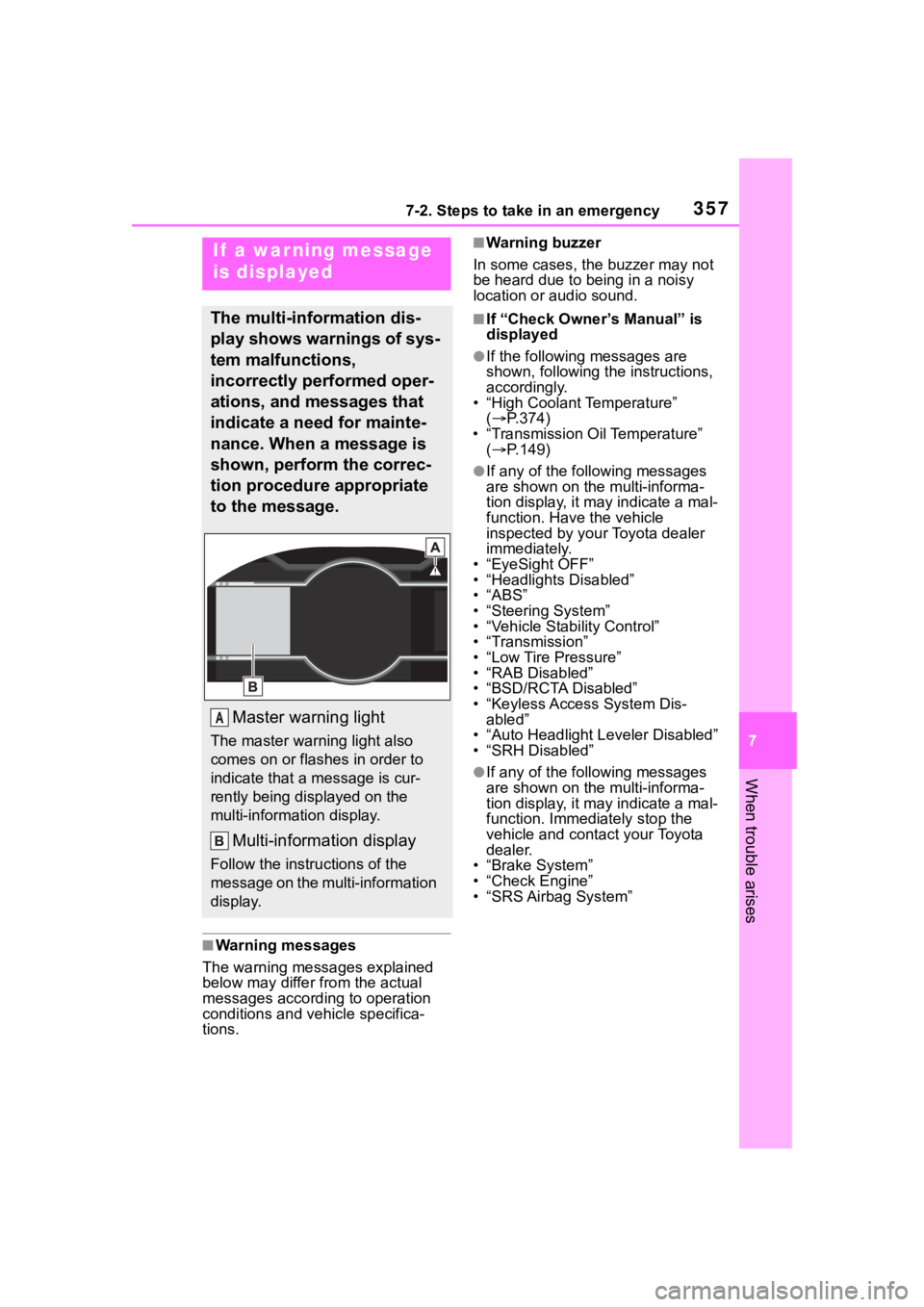
The multi-information dis-
play shows warnings of sys-
tem malfunctions,
incorrectly performed oper-
ations, and messages that
indicate a need for mainte-
nance. When a message is
shown, perform the correc-
tion procedure appropriate
to the message.
Master warning light
The master warning light also
comes on or flashes in order to
indicate that a message is cur-
rently being displayed on the
multi-information display.
Multi-information display
Follow the instru ctions of the
message on the multi-information
display.
A
Page 365 of 449
3657-2. Steps to take in an emergency
7
When trouble arises
acceleration and sharp turns,
drive carefully at under 50
mph (80 km/h) to the nearest
Toyota dealer that is less
than 124 miles (200 km)
away for tire repair or
replacement.
■After a tire is repaired with the
emergency tire puncture repair
kit
●The tire pressure warning valve
and transmitter should be
replaced.
●Even if the tire inflation pressure is
at the recommended level, the tire
pressure warning light may come
on/flash.
WARNING
■Do not drive the vehicle with
a flat tire
Do not continue driving with a flat
tire.
Driving even a short distance with
a flat tire can damage the tire and
the wheel beyond repair. Driving
with a flat tire may cause a cir-
cumferential groove on the side
wall. In such a case, the tire may
explode when using a repair kit.
■When fixing the flat tire
●Stop your vehicle in a safe and
flat area.
●Do not touch the wheels or the
area around the brakes immedi-
ately after the vehicle has been
driven.
After the vehicle has been
driven, the wheels and the area
around the brakes may be
extremely hot. Touching these
areas with hands , feet or other
body parts may result in burns.
●Connect the valve and hose
securely with the tire installed
on the vehicle.
●If the hose is not properly con-
nected to the valve, air leakage
may occur or sealant may be
sprayed out.
●If the hose comes off the valve
while inflating the tire, there is a
risk that the hose will move
abruptly due to air pressure.
●After inflation of the tire has
completed, the sealant may
splatter when the hose is dis-
connected or some air is let out
of the tire.
●Follow the operation procedure
to repair the tire. If the proce-
dure is not followed, the sealant
may spray out.
●Keep back from the tire while it
is being repaired, as there is a
chance of it bursting while the
repair operation is being per-
formed. If you notice any cracks
or deformation of the tire, turn
off the compressor switch and
stop the repair operation imme-
diately.
●The kit may overheat if operated
for a long period of time. Do not
operate the compressor contin-
uously for more than 10 min-
utes.
●Parts of the kit become hot
during operation. Be careful
handling the kit during and after
operation. Do not touch the
metal part around the connect-
ing area between the bottle and
compressor. It will be extremely
hot.
●Do not attach the vehicle speed
warning sticker to an area other
than the one indicated. If the
sticker is attached to an area
where an SRS airbag is located,
such as the pad of the steering
wheel, it may prevent the SRS
airbag from operating properly.
Page 373 of 449
3737-2. Steps to take in an emergency
7
When trouble arises
■When the battery is removed or
discharged
Information stored in the ECU is
cleared. When the battery is
depleted, have the vehicle
inspected at your Toyota dealer.
■When removing the battery ter-
minals
When the battery terminals are
removed, the information stored in
the ECU is cleared . Before remov-
ing the battery terminals, contact
your Toyota dealer.
■Charging the battery
The electricity stor ed in the battery
will discharge gradu ally even when
the vehicle is not in use, due to nat-
ural discharge and the draining
effects of certain electrical appli-
ances. If the vehicle is left for a long
time, the battery may discharge,
and the engine ma y be unable to
start. (The battery recharges auto-
matically during driving.)
■When recharging or replacing
the battery
●In some cases, it may not be pos-
sible to unlock the doors using the
smart key system when the bat-
tery is discharged. Use the wire-
less remote control or the
mechanical key to lock or unlock
the doors.
●The engine may not start on the
first attempt after the battery has
recharged but will start normally
after the second attempt. This is
not a malfunction.
●The engine switch mode is memo-
rized by the vehicle. When the
battery is reconnected, the system
will return to the mode it was in
before the battery was dis-
charged. Before disconnecting the
battery, turn the engine switch off.
If you are unsure what mode the
engine switch was in before the
battery discharged, be especially
careful when reconnecting the
battery.
WARNING
■When removing the battery
terminals
Always remove the negative (-)
terminal first. If the positive (+) ter-
minal contacts any metal in the
surrounding area when the posi-
tive (+) terminal is removed, a
spark may occur, leading to a fire
in addition to ele ctrical shocks
and death or serious injury.
■Avoiding battery fires or
explosions
Observe the following precautions
to prevent accidentally igniting the
flammable gas that may be emit-
ted from the battery:
●Make sure each jumper cable is
connected to the correct termi-
nal and that it is not unintention-
ally in contact with any other
than the intended terminal.
●Do not allow the + and - clamps
of the jumper cables to come
into contact with each other.
●Do not smoke, use matches,
cigarette lighter s or allow open
flame near the battery.
■Battery precautions
The battery contains poisonous
and corrosive acidic electrolyte,
while related parts contain lead
and lead compounds. Observe
the following precautions when
handling the battery:
●When working with the battery,
always wear safety glasses and
take care not to allow any bat-
tery fluids (acid) to come into
contact with skin, clothing or the
vehicle body.
●Do not lean over the battery.
Page 427 of 449
427What to do if... (Troubleshooting)
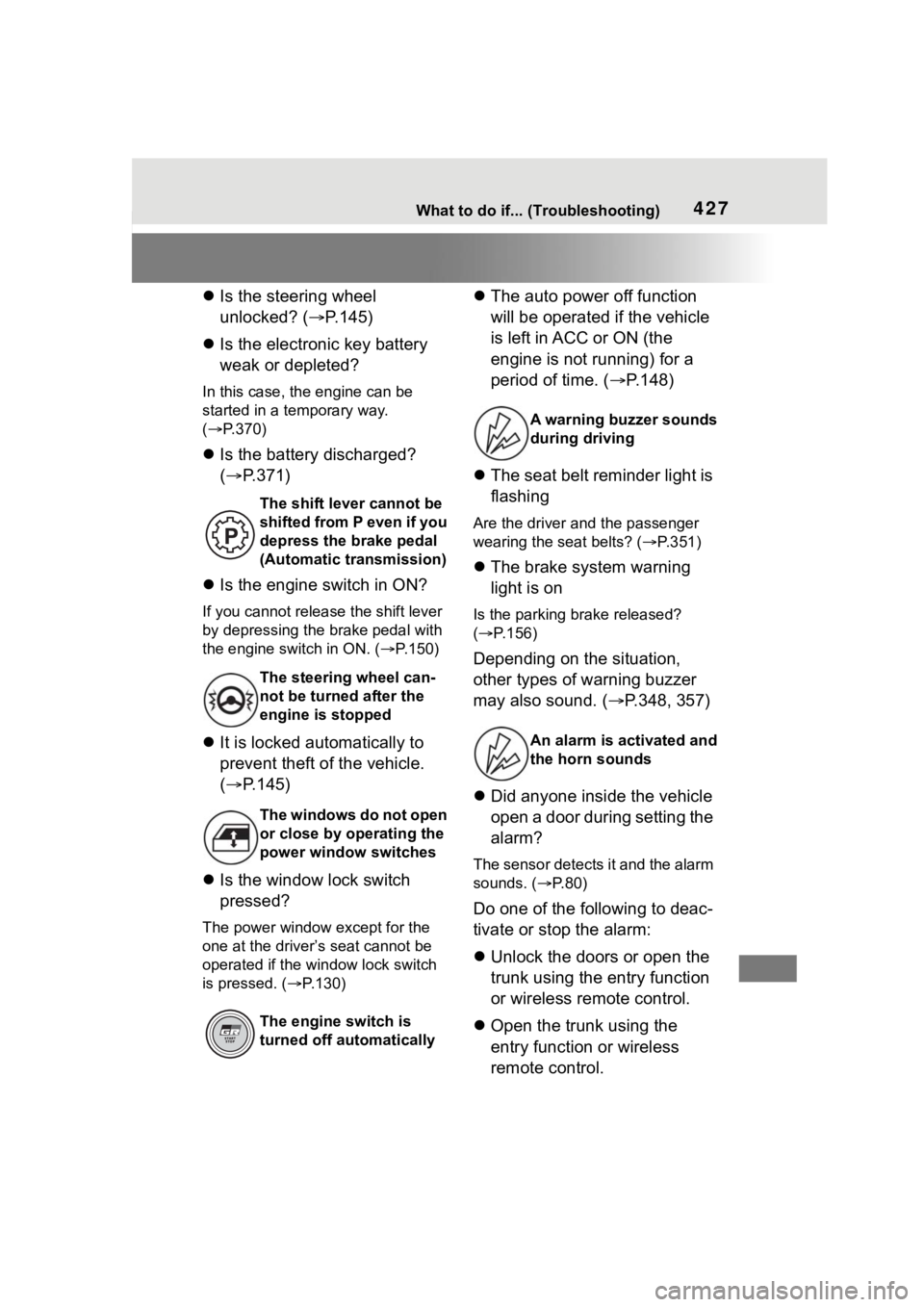
Is the steering wheel
unlocked? ( P.145)
Is the electronic key battery
weak or depleted?
In this case, the engine can be
started in a temporary way.
( P.370)
Is the battery discharged?
( P.371)
Is the engine switch in ON?
If you cannot release the shift lever
by depressing the brake pedal with
the engine switch in ON. ( P.150)
It is locked automatically to
prevent theft of the vehicle.
( P.145)
Is the window lock switch
pressed?
The power window except for the
one at the driver’s seat cannot be
operated if the win dow lock switch
is pressed. ( P.130)
The auto power off function
will be operated if the vehicle
is left in ACC or ON (the
engine is not running) for a
period of time. ( P.148)
The seat belt reminder light is
flashing
Are the driver and the passenger
wearing the seat belts? ( P.351)
The brake system warning
light is on
Is the parking br ake released?
( P.156)
Depending on the situation,
other types of warning buzzer
may also sound. ( P.348, 357)
Did anyone inside the vehicle
open a door during setting the
alarm?
The sensor detects it and the alarm
sounds. ( P. 8 0 )
Do one of the following to deac-
tivate or stop the alarm:
Unlock the doors or open the
trunk using the entry function
or wireless remote control.
Open the trunk using the
entry function or wireless
remote control.
The shift lever cannot be
shifted from P even if you
depress the brake pedal
(Automatic transmission)
The steering wheel can-
not be turned after the
engine is stopped
The windows do not open
or close by operating the
power window switches
The engine switch is
turned off automatically
A warning buzzer sounds
during driving
An alarm is activated and
the horn sounds
Page 428 of 449
428What to do if... (Troubleshooting)
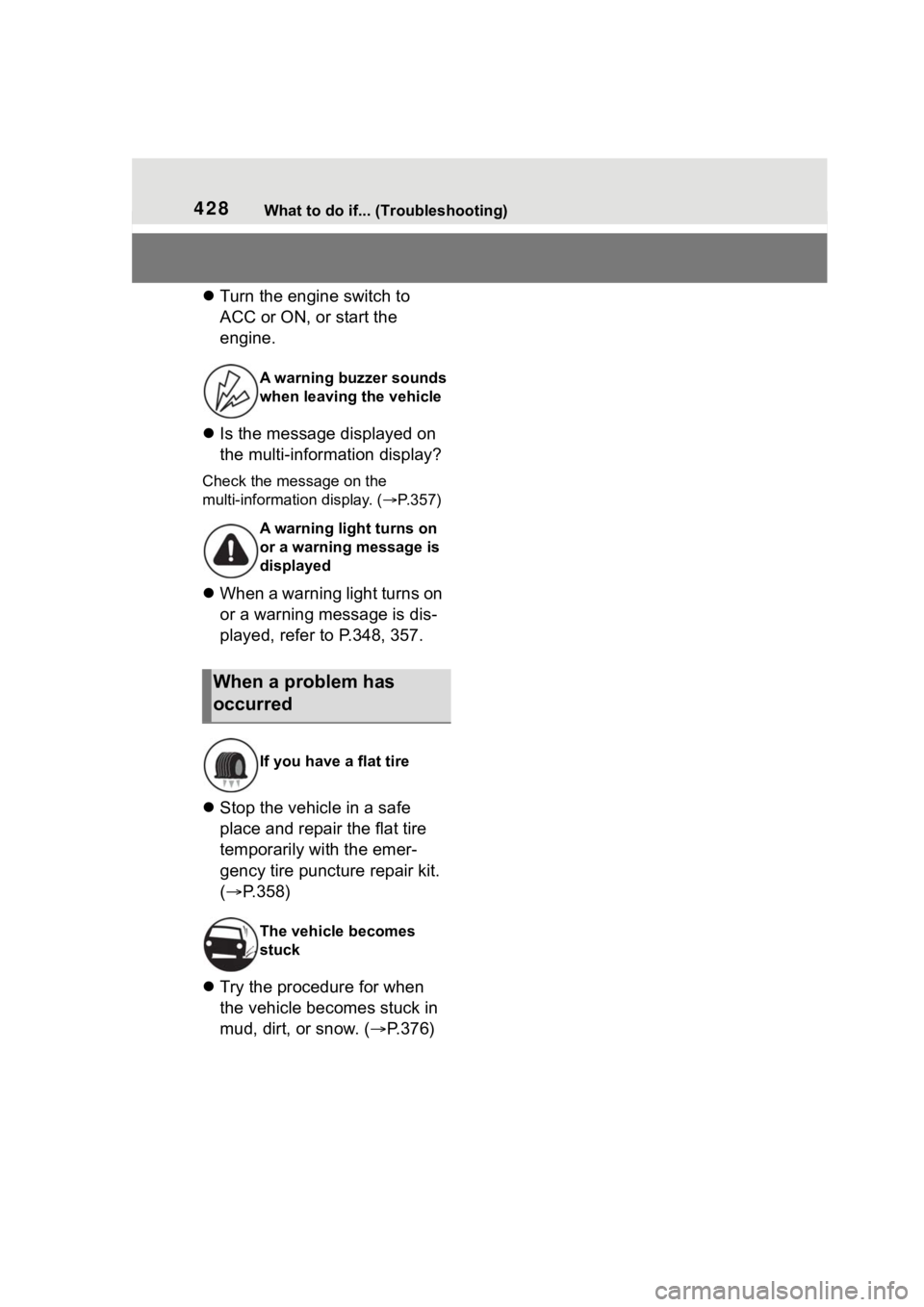
Turn the engine switch to
ACC or ON, or start the
engine.
Is the message displayed on
the multi-information display?
Check the message on the
multi-information display. ( P.357)
When a warning light turns on
or a warning message is dis-
played, refer to P.348, 357.
Stop the vehicle in a safe
place and repair the flat tire
temporarily with the emer-
gency tire puncture repair kit.
( P.358)
Try the procedure for when
the vehicle becomes stuck in
mud, dirt, or snow. ( P.376)
A warning buzzer sounds
when leaving the vehicle
A warning light turns on
or a warning message is
displayed
When a problem has
occurred
If you have a flat tire
The vehicle becomes
stuck
Page 429 of 449

429Alphabetical Index
Alphabetical Index
A
A/CAir conditioning filter ............. 327
Automatic air conditioning sys-tem ..................................... 270
ABS (Anti-lock Brake System) ............................................... 261Warning light ........................ 349
Active Sound Control (ASC).. 157
Adaptive Cruise Control ........ 190 Warning message ................ 357
Air conditioning filter ............. 327
Air conditioning system Air conditioning filter ............. 327
Automatic air conditioning sys-tem ..................................... 270
Airbags Correct driving posture ........... 21
Front passenger occupant clas-sification system ................... 55
Locations of airbags ............... 27
SRS airbags ........................... 27
SRS warning light................. 349
Alarm ......................................... 80 Warning buzzer .................... 348
Anchor brackets ................. 65, 72
Antennas (smart key system) 111
Anti-lock Brake System (ABS) ............................................... 261Warning light ........................ 349
ASC (Active Sound Control).. 157
Audio system-linked display ... 98
Automatic air conditioning sys- tem ......................................... 270
Automatic headlight leveling system ................................... 159
Automatic light control system ............................................... 159
Automatic transmission ........ 149 Manual mode ....................... 152
Paddle shift switches.... 151, 152 Auxiliary box ...........................282
Auxiliary boxes .......................281
Average fuel consumption ......94
Average vehicle speed .............94
B
Back-up light
Replacing light bulbs ............334
Wattage ................................387
Battery Battery checking ...................309
If the battery is d ischarged ...371
Preparing and checking before winter ..................................265
Warning light.........................348
Blind Spot Detection (BSD) ...231
Bottle holders .........................280
Brake Fluid......................................385
Parking brake .......................156
Warning light.........................348
Brake assist ............................261
Break-in tips ............................133
Brightness control Instrument panel light control .91
BSD (Blind Spot D etection) ...231
C
Camera
High Beam Assist system .....162
Care Exterior .................................288
Interior ..........................291, 293
Seat belts .............................291
Ultrasuede
®..........................293
Wheels and wheel ornaments ...........................................288
Cargo capacity ........................143
Chains......................................267
Child restraint system Fixed with a LATCH system ...70
Page 430 of 449

430Alphabetical Index
Fixed with a seat belt ............. 66
Front passenger occupant clas-sification system ................... 55
Points to remember ................ 63
Riding with children ................ 62
Types of child restraint system installation met hod ............... 65
Using an anchor bracket ........ 72
Child safety Battery precautions ...... 311, 373
Child restraint system............. 65
How your child should wear the seat belt................................ 24
Power window lock switch.... 130
Removed electronic key battery precautions......................... 330
Seat belt precautions ............. 62
Seat heater precautions ....... 276
Trunk precautions................. 107
Cleaning Exterior ................................. 288
Interior .......................... 291, 293
Seat belts ............................. 291
Wheels and wheel ornaments........................................... 288
Clock ................................... 88, 91
Condenser .............................. 308
Console box ............................ 280
Conventional Cruise Control207, 254
Cooling system ...................... 307 Engine overheating .............. 374
Cruise control Adaptive Cruise Control ....... 190
Conventional Cruise Control207, 254
Cup holders ............................ 281
Current fuel consumption ....... 94
Curtain shield airbags ............. 27
Customizable features ........... 400D
Daytime running light system158
Daytime running lights Replacing light bulbs ............334
Defogger Outside rear view mirrors .....272
Rear window.........................272
Windshield ............................272
Dimension ...............................380
Dinghy towing .........................144
Display Driving information .................94
Multi-information display.........93
Display change button .............90
Do-it-yourself maintenance ...296
Door courtesy lights...............277
Door lock Doors ....................................105
Smart key system ................. 111
Wireless remote control........103
Doors Door glasses ........................129
Door lock ..............................105
Open door warning buzzer ...106
Open door warning light .......351
Outside rear view mirrors .....127
Driving Break-in tips .........................133
Correct driving posture ...........21
Driving mode select switch ...257
Procedures ...........................132
Winter drive tips....................265
Driving distance........................94
Driving information ..................94
Driving information display .....94
Driving range ............................94
Driving time ...............................94
E
EDR (Event data recorder) .........7
Page 431 of 449

431Alphabetical Index
Electric Power Steering (EPS)............................................... 261Warning light ........................ 350
Electronic key ......................... 102 Battery-saving fun ction......... 112
If the electronic key does not operate properly ................. 369
Replacing the battery ........... 329
Emergency flashers ............... 338
Emergency tire puncture ....... 358
Emergency, in case of If a warning buzzer sounds .. 348
If a warning light turns on ..... 348
If a warning message is dis-played................................. 357
If the battery is discharged ... 371
If the electronic key does not operate properly ................. 369
If the engin e will not start ..... 367
If the fuel filler door cannot be opened ............................... 369
If the vehicle is submerged or water on the road is rising .. 339
If you have a flat tire ............. 358
If you lose your keys ............ 368
If you think something is wrong ........................................... 346
If your vehicle becomes stuck ........................................... 376
If your vehicle has to be stopped in an emergency................. 338
If your vehicle needs to be towed ........................................... 341
If your vehicle overheats ...... 374
Engine ACCESSORY mode ............. 147
Compartment ....................... 305
Engine switch ....................... 145
Fuel pump shut off system ... 347
Hood..................................... 302
How to start the engine ........ 145
Identification number ............ 381 If the engine will not start......367
If your vehicle has to be stopped
in an emergency .................338
Ignition switch (engine switch) ...........................................145
Overheating ..........................374
Tachometer.............................88
Engine coolant Capacity ...............................383
Checking ..............................307
Preparing and checking before winter ..................................265
Engine coolant temperature gauge .......................................88
Engine immobilizer system .....79
Engine oil Capacity ...............................382
Checking ..............................305
Preparing and checking before winter ..................................265
Warning light.........................349
Engine oil temperature gauge .94
Engine switch .........................145 Auto power off fun ction .........148
Changing the engine switch modes.................................147
If your vehicle has to be stopped in an emergency .................338
EPS (Electric Po wer Steering)
...............................................261 Warning light.........................350
Event data recorder (EDR) .........7
EyeSight ..................................170 Adaptive Cruise Control .......190
Conventional Cruise Control 207
Lane Departure Warning ......219
Lane Sway Warning .............221
Lead Vehicle Start Alert ........223
Malfunction ...........................227
Pre-Collision Braking System...........................................179