engine TOYOTA 86 2022 Owners Manual
[x] Cancel search | Manufacturer: TOYOTA, Model Year: 2022, Model line: 86, Model: TOYOTA 86 2022Pages: 449, PDF Size: 8.5 MB
Page 317 of 449
3176-3. Do-it-yourself maintenance
6
Maintenance and care
■The tire pressure warning
system must be initialized
in the following circum-
stances:
When rotating the tires.
When the tire inflation pres-
sure is changed such as
when changing traveling
speed.
When changing the tire size.
When the tire pressure warning
system is initialized, the current
tire inflation pressure is set as
the benchmark pressure.
■How to initialize the tire
pressure warning system
1 Park the vehicle in a safe
place and turn the engine
switch off.
Initialization cannot be performed
while the vehicle is moving.
2Adjust the tire inflation pres-
sure to the specified cold tire
inflation pressure level.
Make sure to adjust the tire pres-
sure to the specifie d cold tire infla-
tion pressure level. The tire
pressure warning system will oper-
ate based on this pressure level.
3Turn the engine switch to
ON.
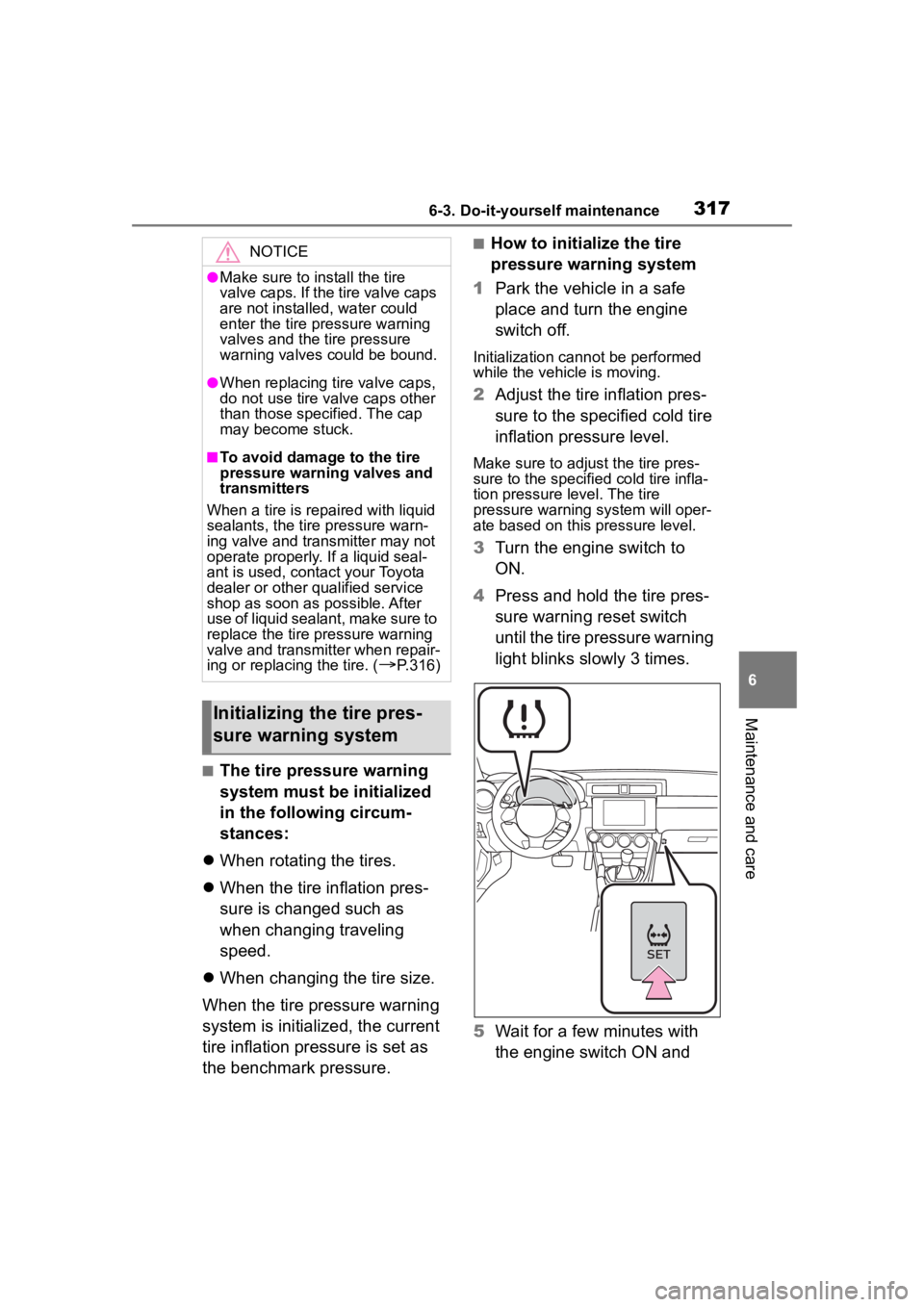
4 Press and hold the tire pres-
sure warning reset switch
until the tire pressure warning
light blinks slowly 3 times.
5 Wait for a few minutes with
the engine switch ON and
NOTICE
●Make sure to install the tire
valve caps. If the tire valve caps
are not installed, water could
enter the tire pressure warning
valves and the tire pressure
warning valves could be bound.
●When replacing ti re valve caps,
do not use tire valve caps other
than those specified. The cap
may become stuck.
■To avoid damage to the tire
pressure warning valves and
transmitters
When a tire is repaired with liquid
sealants, the tire pressure warn-
ing valve and transmitter may not
operate properly. If a liquid seal-
ant is used, contact your Toyota
dealer or other qualified service
shop as soon as possible. After
use of liquid sealant, make sure to
replace the tire pressure warning
valve and transmitter when repair-
ing or replacing the tire. (
P.316)
Initializing the tire pres-
sure warning system
Page 318 of 449
3186-3. Do-it-yourself maintenance
then turn the engine switch
off.
■If you press the tire pressure
warning reset switch acciden-
tally
If initialization is performed, adjust
the tire inflation pressure to the
specified level and initialize the tire
pressure warning system again.
■Initialization procedure
●Make sure to carry out initializa-
tion after adjusting the tire inflation
pressure.
Also, make sure the tires are cold
before carrying out initialization or
tire inflation pressure adjustment.
●If you have accidentally turned the
engine switch off during initializa-
tion, it is not necessary to press
the reset switch again as initializa-
tion will restart aut omatically when
the engine switch has been turned
to ON for the next time.
●If you accidentally press the reset
switch when initialization is not
necessary, adjust the tire inflation
pressure to the specified level
when the tires are cold, and con-
duct initialization again.
■When initialization of the tire
pressure warning system has
failed
Initialization can be completed in a
few minutes. However, in the follow-
ing cases, the set tings have not
been recorded an d the system will
not operate properly. If repeated
attempts to record tire inflation pres-
sure settings are unsuccessful,
have the vehicle inspected by your
Toyota dealer.
●When operating the tire pressure
warning reset switch, tire pressure
warning light doe s not blink 3
times.
●After carrying out the initialization
procedure, the tir e pressure warn-
ing light blinks for 1 minute then stays on after driving for 20 min-
utes.
The tire pressure warning valve
and transmitter is equipped with
a unique ID code. When replac-
ing a tire pressure warning valve
and transmitter, it is necessary
to register the ID code. Have the
ID code registered by your Toy-
ota dealer.
■Registering ID codes
The ID codes of t he tire pressure
warning valve and transmitters for
two sets of whee ls can be regis-
tered.
It is not necessary to register the ID
codes when replacing normal tires
with snow tires, if the ID codes for
the wheels of both normal tires and
snow tires are registered before-
hand.
In addition to the set of tire pressure
warning system sensor ID codes ini-
tially registered to the vehicle, a sec-
ond set of ID codes can be
registered.
A second set of tire pressure warn-
ing system sensor ID codes can be
registered at your Toyota dealer.
WARNING
■When initializing the tire pres-
sure warning system
Do not operate the tire pressure
warning reset switch without first
adjusting the tire inflation pres-
sure to the specif ied level. Other-
wise, the tire pressure warning
light may not come on even if the
tire inflation press ure is low, or it
may come on when the tire infla-
tion pressure is actually normal.
Registering ID codes
Page 319 of 449
3196-3. Do-it-yourself maintenance
6
Maintenance and care
When 2 sets of ID codes have been
registered, either ID code set can be
selected.
1Park the vehicle in a safe
place and turn the engine
switch to ON.
2 Press the tire pressure warn-
ing reset switch 3 times
within 3 seconds.
3 The tire pressure warning
light will illuminate for 3 sec-
onds and then blink 3 times.
4 The tire pressure warning
light will blink for 1 minute
and then illuminate.
5 When the ID code change
has completed, the tire pres-
sure warning light will turn off.
Check that tire pressures are dis-
played on the multi-information dis-
play.
Stop the vehicle in a safe
place on a hard, flat surface.
Set the parking brake.
Shift the shift lever to P (auto-
matic transmission) or R
(manual transmission).
Stop the engine.
■Jack and Jack handle
As your vehicle is equipped with an
emergency tire puncture repair kit, a
jack and jack handle for replacing a
tire are not include d with your vehi-
cle. To purchase a jack and jack
handle, contact your Toyota dealer.
●Jack
●Jack handle
Changing the ID code set
Replacing the tire
When raising your vehicle
with a jack, position the jack
correctly.
Improper placement may
damage your vehicle or
cause injury.
If necessary tire replace-
ment seems difficult to per-
form, contact your Toyota
dealer.
Before jacking up the
vehicle
Page 320 of 449
3206-3. Do-it-yourself maintenance
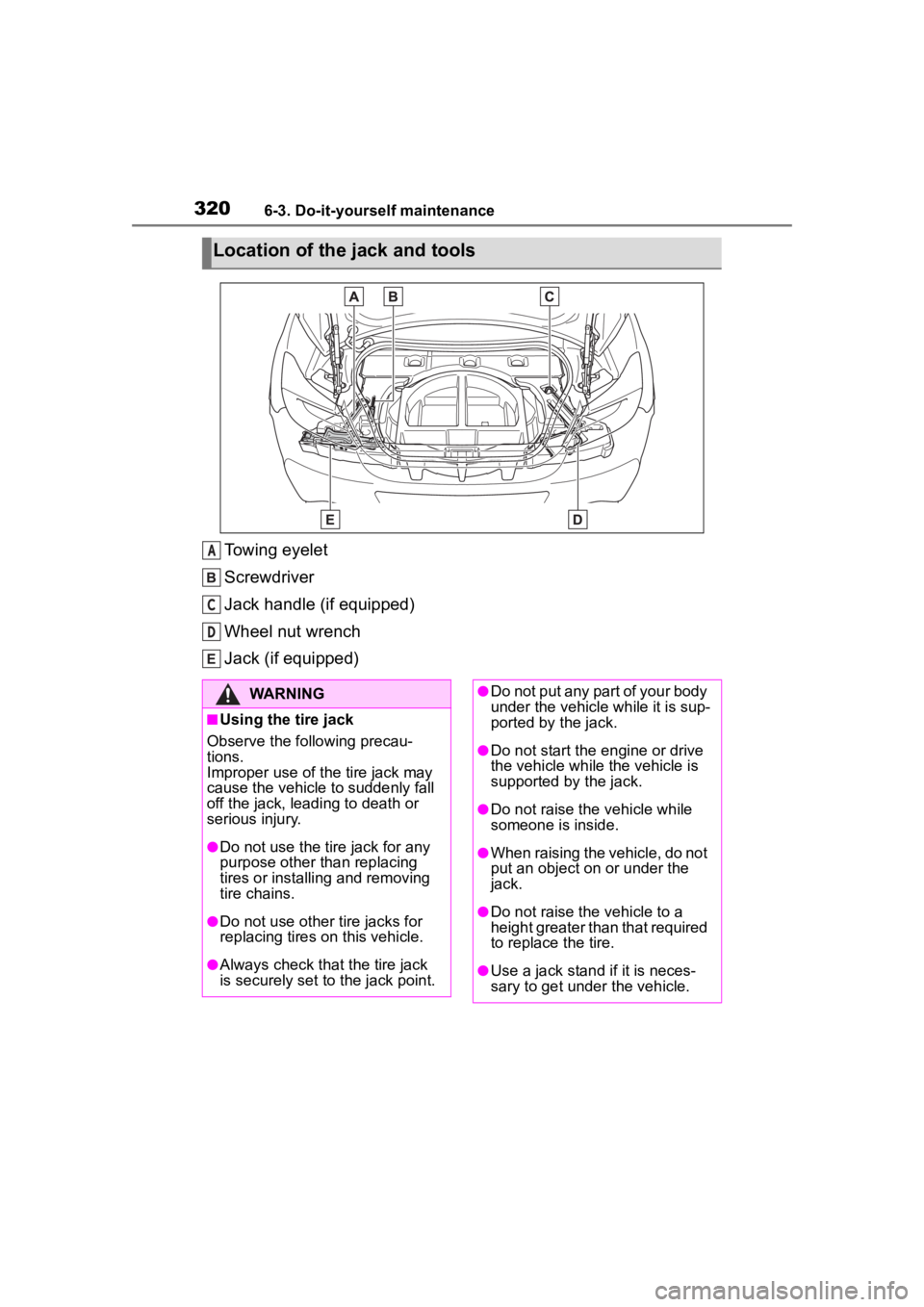
Towing eyelet
Screwdriver
Jack handle (if equipped)
Wheel nut wrench
Jack (if equipped)
Location of the jack and tools
A
C
D
WARNING
■Using the tire jack
Observe the following precau-
tions.
Improper use of the tire jack may
cause the vehicle to suddenly fall
off the jack, leading to death or
serious injury.
●Do not use the tire jack for any
purpose other than replacing
tires or installing and removing
tire chains.
●Do not use other tire jacks for
replacing tires on this vehicle.
●Always check that the tire jack
is securely set to the jack point.
●Do not put any part of your body
under the vehicle while it is sup-
ported by the jack.
●Do not start the engine or drive
the vehicle while the vehicle is
supported by the jack.
●Do not raise the vehicle while
someone is inside.
●When raising the vehicle, do not
put an object on or under the
jack.
●Do not raise the vehicle to a
height greater than that required
to replace the tire.
●Use a jack stand if it is neces-
sary to get under the vehicle.
Page 327 of 449
3276-3. Do-it-yourself maintenance
6
Maintenance and care
Use only Toyota wheel nuts
and wrenches designed for
use with your aluminum
wheels.
When rotating, repairing or
changing your tires, check
that the wheel nuts are still
tight after driving 1000 miles
(1600 km).
Be careful not to damage the
aluminum wheels when using
tire chains.
Use only Toyota genuine bal-
ance weights or equivalent
and a plastic or rubber ham-
mer when balancing your
wheels. 1
Turn the engine switch off.
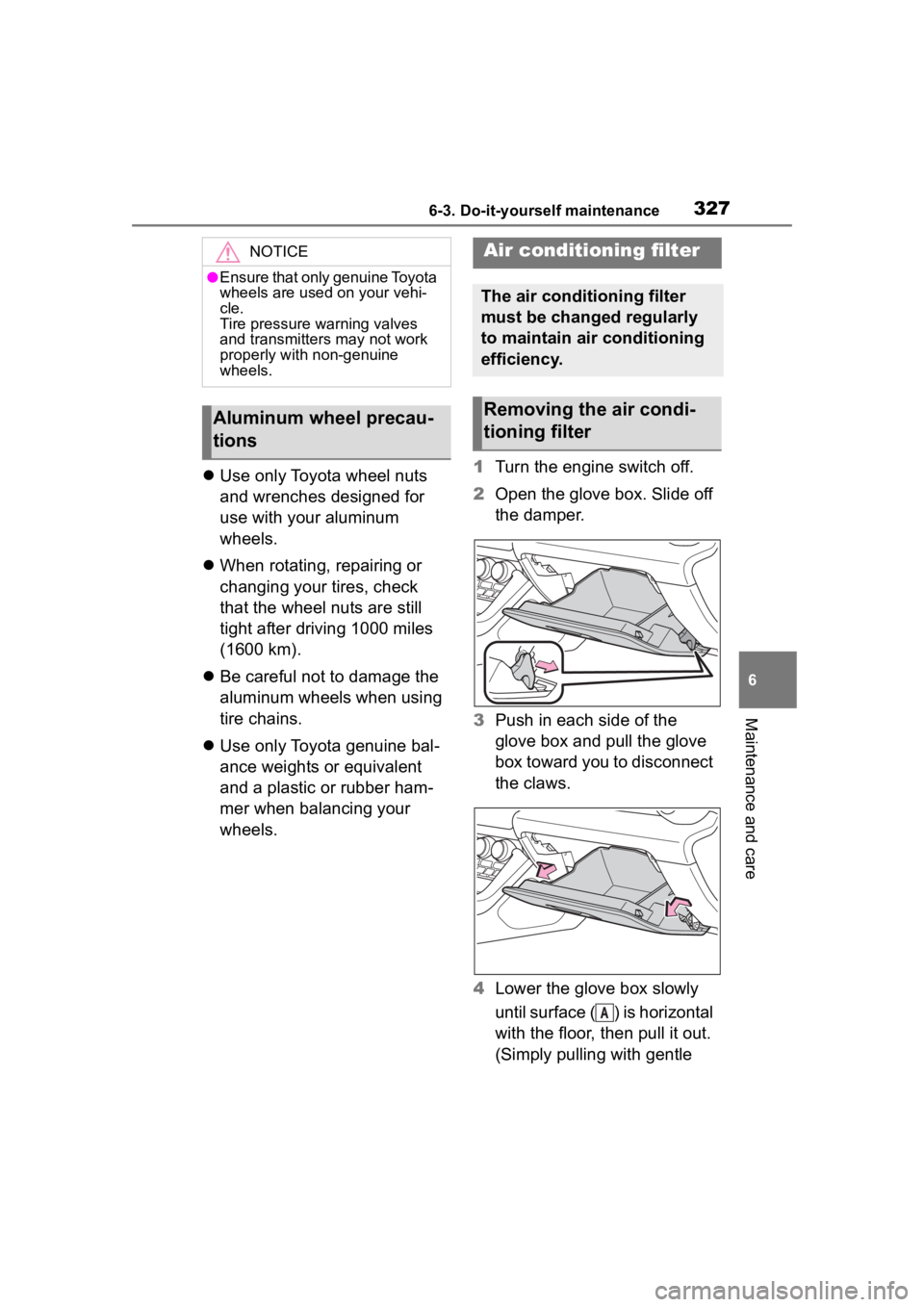
2 Open the glove box. Slide off
the damper.
3 Push in each side of the
glove box and pull the glove
box toward you to disconnect
the claws.
4 Lower the glove box slowly
until surface ( ) is horizontal
with the floor, then pull it out.
(Simply pulling with gentle
NOTICE
●Ensure that only genuine Toyota
wheels are used on your vehi-
cle.
Tire pressure warning valves
and transmitters may not work
properly with non-genuine
wheels.
Aluminum wheel precau-
tions
Air conditioning filter
The air conditioning filter
must be changed regularly
to maintain air conditioning
efficiency.
Removing the air condi-
tioning filter
A
Page 331 of 449
3316-3. Do-it-yourself maintenance
6
Maintenance and care
1Turn the engine switch off.
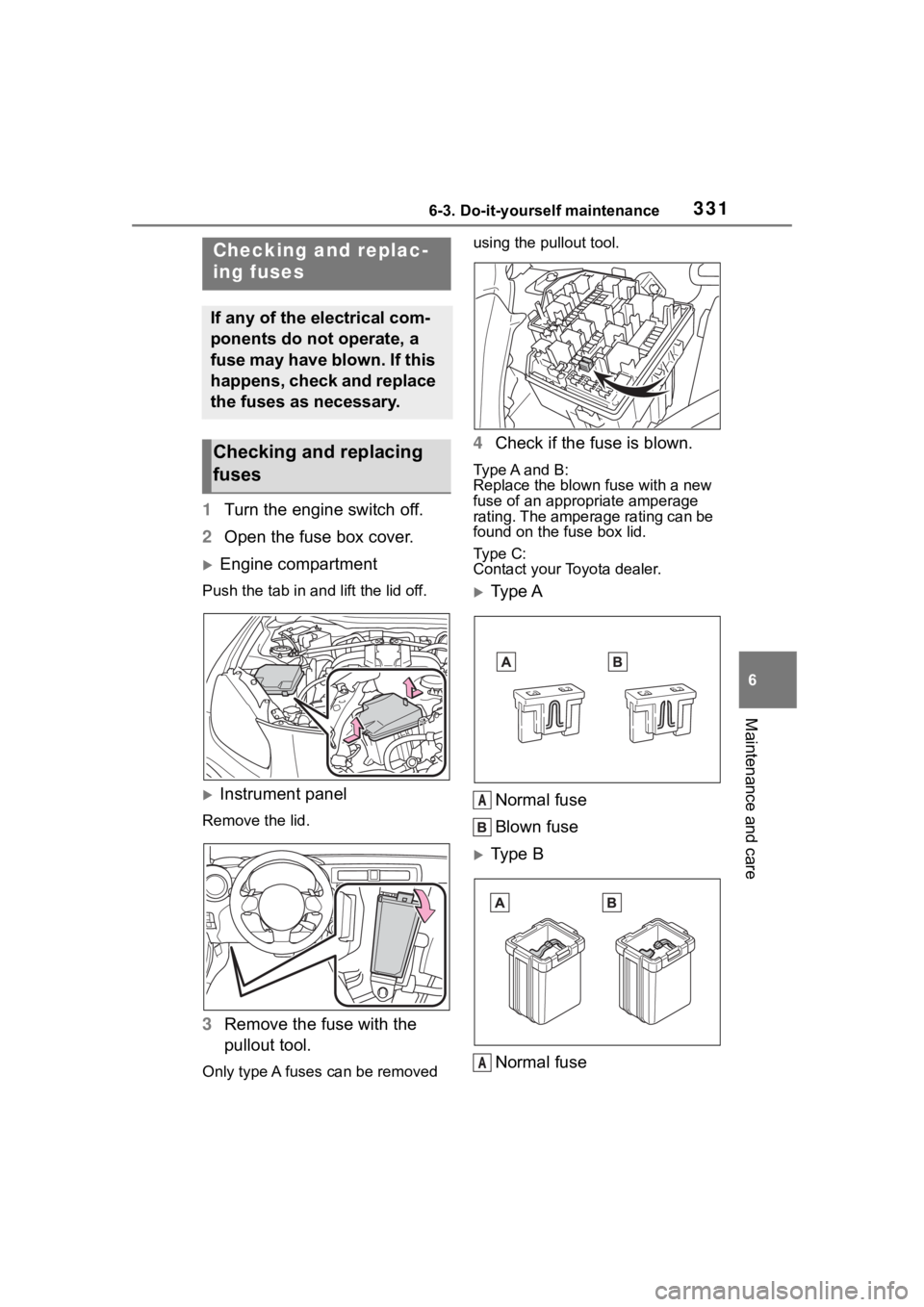
2 Open the fuse box cover.
Engine compartment
Push the tab in and lift the lid off.
Instrument panel
Remove the lid.
3Remove the fuse with the
pullout tool.
Only type A fuses can be removed using the pullout tool.
4
Check if the fuse is blown.
Type A and B:
Replace the blown fuse with a new
fuse of an appropriate amperage
rating. The amperage rating can be
found on the fuse box lid.
Ty p e C :
Contact your Toyota dealer.
Type A
Normal fuse
Blown fuse
Type BNormal fuse
Checking and replac-
ing fuses
If any of the electrical com-
ponents do not operate, a
fuse may have blown. If this
happens, check and replace
the fuses as necessary.
Checking and replacing
fuses
A
A
Page 336 of 449
3366-3. Do-it-yourself maintenance
WARNING
■Replacing light bulbs
●Turn off the lights. Do not
attempt to replace the bulb
immediately after turning off the
lights. The bulbs become very
hot and may cause burns.
●Do not touch the glass portion
of the light bulb with bare
hands. When it is unavoidable
to hold the glass portion, use
and hold with a clean dry cloth
to avoid getting moisture and
oils on the bulb. Also, if the bulb
is scratched or dropped, it may
blow out or crack.
●Fully install light bulbs and any
parts used to secure them. Fail-
ure to do so may result in heat
damage, fire, or water entering
the light unit. This may damage
the lights or cause condensa-
tion to build up on the lens.
■When changing the back-up
lights
●Stop the engine and wait until
the exhaust pi pes and sur-
rounding parts have cooled
down sufficiently. The lights are
located near the exhaust pipe
and touching a hot exhaust pipe
and surrounding parts can
cause burns.
■To prevent damage or fire
●Make sure bulbs are fully
seated and locked.
●Check the wattage of the bulb
before installing to prevent heat
damage.
Page 337 of 449
337
7
7
When trouble arises
When trouble arises
.7-1. Essential informationEmergency flashers .... 338
If your vehicle has to be stopped in an emergency.................................. 338
If the vehicle is submerged or water on the road is ris-
ing ............................. 339
7-2. Steps to take in an emer- gency
If your vehicle needs to be towed......................... 341
If you think something is wrong ........................ 346
Fuel pump shut off system .................................. 347
If a warning light turns on or a warning buzzer sounds.................................. 348
If a warning message is dis- played........................ 357
If you have a flat tire.... 358
If the engine will not start .................................. 367
If you lose your keys ... 368
If the fuel filler door cannot be opened ................. 369
If the electronic key does not operate properly .. 369
If the vehicle battery is dis- charged ..................... 371
If your vehicle overheats .................................. 374If the vehicle becomes stuck
.................................. 376
Page 338 of 449
3387-1. Essential information
7-1.Essential information
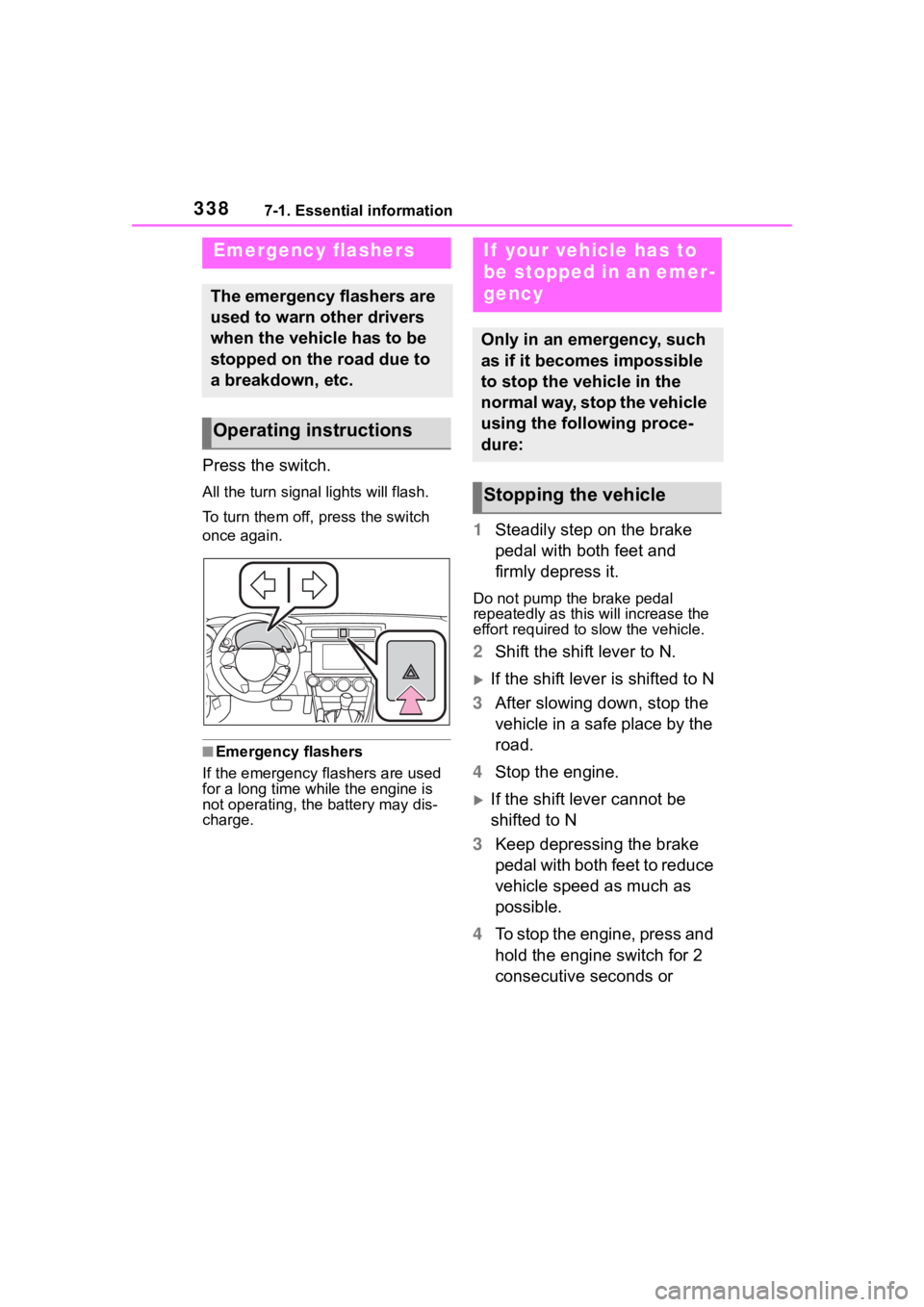
Press the switch.
All the turn signal lights will flash.
To turn them off, press the switch
once again.
■Emergency flashers
If the emergency fl ashers are used
for a long time while the engine is
not operating, the battery may dis-
charge.
1 Steadily step on the brake
pedal with both feet and
firmly depress it.
Do not pump the brake pedal
repeatedly as this will increase the
effort required to slow the vehicle.
2Shift the shift lever to N.
If the shift lever is shifted to N
3 After slowing down, stop the
vehicle in a safe place by the
road.
4 Stop the engine.
If the shift lever cannot be
shifted to N
3 Keep depressing the brake
pedal with both feet to reduce
vehicle speed as much as
possible.
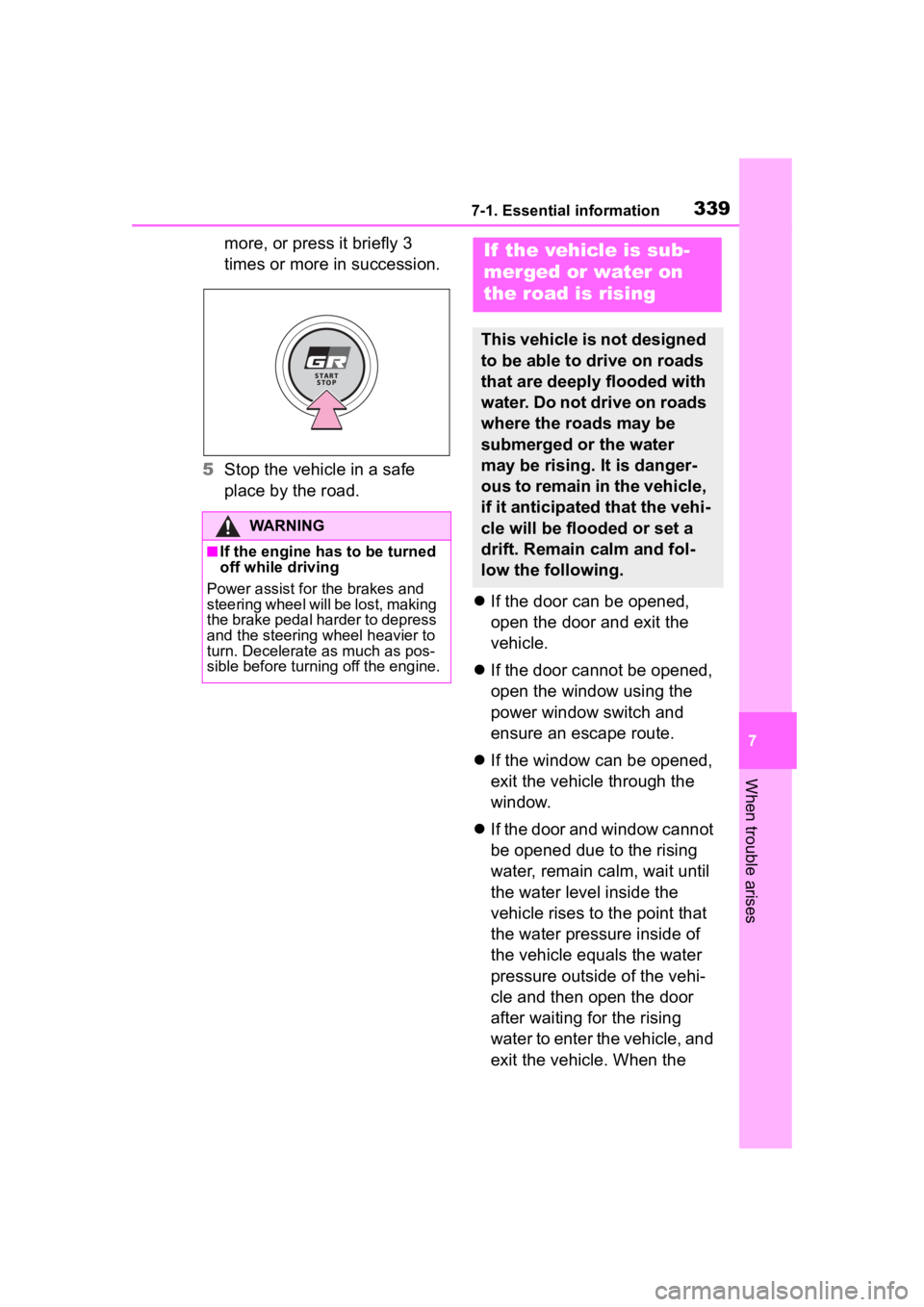
4 To stop the engine, press and
hold the engine switch for 2
consecutive seconds or
Emergency flashers
The emergency flashers are
used to warn other drivers
when the vehicle has to be
stopped on the road due to
a breakdown, etc.
Operating instructions
If your vehicle has to
be stopped in an emer-
gency
Only in an emergency, such
as if it becomes impossible
to stop the vehicle in the
normal way, stop the vehicle
using the following proce-
dure:
Stopping the vehicle
Page 339 of 449
3397-1. Essential information
7
When trouble arises
more, or press it briefly 3
times or more in succession.
5 Stop the vehicle in a safe
place by the road.
If the door can be opened,
open the door and exit the
vehicle.
If the door cannot be opened,
open the window using the
power window switch and
ensure an escape route.
If the window can be opened,
exit the vehicle through the
window.
If the door and window cannot
be opened due to the rising
water, remain calm, wait until
the water level inside the
vehicle rises to the point that
the water pressure inside of
the vehicle equals the water
pressure outside of the vehi-
cle and then open the door
after waiting for the rising
water to enter the vehicle, and
exit the vehicle. When the
WARNING
■If the engine has to be turned
off while driving
Power assist for the brakes and
steering wheel will be lost, making
the brake pedal harder to depress
and the steering wheel heavier to
turn. Decelerate as much as pos-
sible before turning off the engine.
If the vehicle is sub-
merged or water on
the road is rising
This vehicle is not designed
to be able to drive on roads
that are deeply flooded with
water. Do not drive on roads
where the roads may be
submerged or the water
may be rising. It is danger-
ous to remain in the vehicle,
if it anticipated that the vehi-
cle will be flooded or set a
drift. Remain calm and fol-
low the following.