wipers TOYOTA 86 2022 User Guide
[x] Cancel search | Manufacturer: TOYOTA, Model Year: 2022, Model line: 86, Model: TOYOTA 86 2022Pages: 449, PDF Size: 8.5 MB
Page 165 of 449
1654-3. Operating the lights and wipers
4
Driving
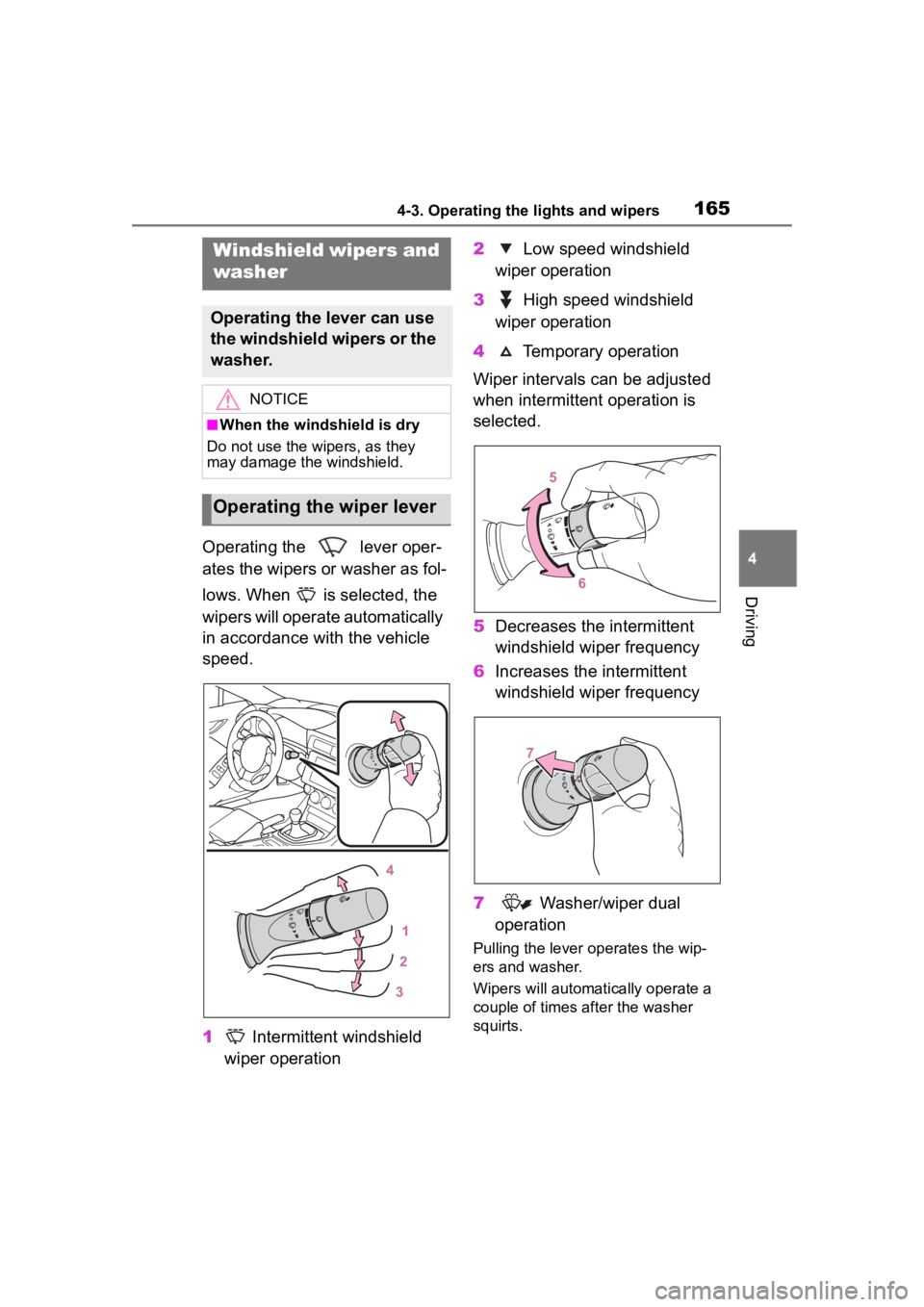
Operating the lever oper-
ates the wipers or washer as fol-
lows. When is selected, the
wipers will operate automatically
in accordance with the vehicle
speed.
1 Intermittent windshield
wiper operation 2
Low speed windshield
wiper operation
3 High speed windshield
wiper operation
4 Temporary operation
Wiper intervals can be adjusted
when intermittent operation is
selected.
5 Decreases the intermittent
windshield wiper frequency
6 Increases the intermittent
windshield wiper frequency
7 Washer/wiper dual
operation
Pulling the lever operates the wip-
ers and washer.
Wipers will automatically operate a
couple of times after the washer
squirts.
Windshield wipers and
washer
Operating the lever can use
the windshield wipers or the
washer.
NOTICE
■When the windshield is dry
Do not use the wipers, as they
may damage the windshield.
Operating the wiper lever
Page 166 of 449

1664-3. Operating the lights and wipers
■The windshield wiper and
washer can be operated when
The engine switch is in ON.
■If no windshield washer fluid
sprays
Check that the wash er nozzles are
not blocked if there is washer fluid in
the windshield washer fluid reser-
v oi r.
WARNING
■Caution regarding the use of
washer fluid
When it is cold, do not use the
washer fluid until the windshield
becomes warm. The fluid may
freeze on the windshield and
cause low visibility. This may lead
to an accident, resulting in death
or serious injury.
NOTICE
■When the washer fluid tank is
empty
Do not operate the switch continu-
ally as the washer fluid pump may
overheat.
■When a nozzle becomes
blocked
In this case, contact your Toyota
dealer. Do not try to clear it with a
pin or other object. The nozzle will
be damaged.
Page 173 of 449

1734-5. EyeSight
4
Driving
NOTICE
●Under the conditions listed
below, it will become more diffi-
cult for the system to detect the
vehicle in front, motorcycles,
bicycles, pedestrians and obsta-
cles on the road, and lane mark-
ers. Also, EyeSight may
temporarily stop operating.
However, the temporary stop
will be canceled once these
conditions have improved and
the vehicle is driven for a short
period of time.
• Bad weather (for example heavy rain, a blizzard or thick
fog). In particular, the system is
more likely to temporarily stop
operating when there is an oil
film adhering to the windshield,
a glass coating has been
applied, or poorly performing
wipers are used.
• Strong light is coming from the front (sunlight or headlight
beams of oncoming traffic, etc.).
• The windshield washer is in use.
• Raindrops, water drops, or dirt on the windshield are not wiped
off sufficiently.
• The windshield has become fogged, scratched or smeared,
or snow, dirt ,dust or frost has
adhered to it, or it is otherwise
affected. These will reduce the
stereo camera’s field of view.
Also, light is reflecting off the
dirt, etc.
• The vehicle is tilted at an extreme angle due to loaded
cargo or other factors.
• Visibility is poo r due to sand,
smoke or water vapor blowing in
the wind, or the front vision is
obscured due to water
splashes, snow, dirt or dust stir
up generated by the vehicle in
front or oncoming traffic.
• The stereo came ra’s field of
view is obstructed.
• Through the entra nce or exit of
a tunnel
• The rear aspect of the vehicle in front is low, small or irregular
(for example a low bed trailer,
etc.).
• The obstacle is a fence, a wall or a shutter, etc. with a uniform
pattern (a striped pattern, brick,
etc.) or with no pattern in front.
• The obstacle is a wall or door made of glass or a mirror in
front.
• Driving at night or in a tunnel when there is a ve hicle in front
that does not ha ve its taillights
on
• Driving through a banner or flag, low branches on a tree or
thick/tall vegetation
• On steep uphill or downhill grades
• The stereo camera is obstructed by a hand, etc. (If
even one of the lenses is
obstructed, the system does not
operate properly.)
• It is completel y dark and no
objects are detected.
• The area around the vehicle has a uniform color (such as when
completely covered in snow,
etc.).
Page 290 of 449
2906-1. Maintenance and care
NOTICE
■Protective film for side sill
plates (if equipped)
Make sure to remove the protec-
tive film. Failure to do so may
cause rust, depending on condi-
tions.
■Cleaning the exterior lights
●Wash carefully. Do not use
organic substances or scrub
with a hard brush. This may
damage the surfaces of the
lights.
●Do not apply wax to the sur-
faces of the lights.
Wax may cause damage to the
lenses.
■To prevent damage to the
windshield wiper arms
When lifting the wiper arms away
from the windshield, pull the driver
side wiper arm upward first, and
repeat for the passenger side.
When returning the wipers to their
original position, do so from the
passenger side first.
■When using a high pressure
car wash
●When washing the vehicle, do
not spray the came ra or its sur-
rounding area directly with a
high pressure washer. Shock
applied from high pressure
water may cause the device to
not operate normally.
●Do not bring the nozzle tip close
to boots (rubber or resin manu-
factured cover), connectors or
the following parts. The parts
may be damaged if they come
into contact with high-pressure
water.
• Traction related parts
• Suspension parts
• Steering parts
• Brake parts
●Keep the cleaning nozzle at
least 11.9 in. (30 cm) away from
the vehicle body. Otherwise
resin section, s uch as moldings
and bumpers, may be deformed
and damaged.
Also, do not continuously hold the
nozzle in the same place.
●Do not spray the lower part of
the windshield continuously.
If water enters the air conditioning
system intake located near the
lower part of the windshield, the
air conditioning system may not
operate correctly.
●Do not wash the underside of
the vehicle using a high pres-
sure car washer.
Page 298 of 449
2986-2. Maintenance
Parking brake
• Does the park-ing brake move
smoothly?
• When parked on a slope and the
parking brake is
on, is the vehicle
securely
stopped?
Seat belts
• Do the seat belts operate
smoothly?
• The seat belts should not be
damaged.
Seats
• Do the seat con-trols operate
properly?
Steering wheel
• Does the steer-ing wheel rotate
smoothly?
• Does the steer- ing wheel have
the correct
amount of free
play?
• There should not be any strange
sounds coming
from the steer-
ing wheel.
ItemsCheck pointsVehicle exterior
ItemsCheck points
Doors/trunk
•Do the doors/trunk oper-
ate smoothly?
Engine hood
• Does the engine hood lock system
work properly?
Fluid leaks
• There should not be any signs of
fluid leakage
after the vehicle
has been parked.
Tires
• Is the tire infla-tion pressure
correct?
• The tires should not be damaged
or excessively
worn.
• Have the tires been rotated
according to the
maintenance
schedule?
• The wheel nuts should not be
loose.
Windshield
wipers
• The wiper blades should not show
any signs of
cracking, split-
ting, wear, con-
tamination or
deformation.
• The wiper blades should clear the
windshield with-
out streaking or
skipping.
Page 303 of 449
3036-3. Do-it-yourself maintenance
6
Maintenance and care
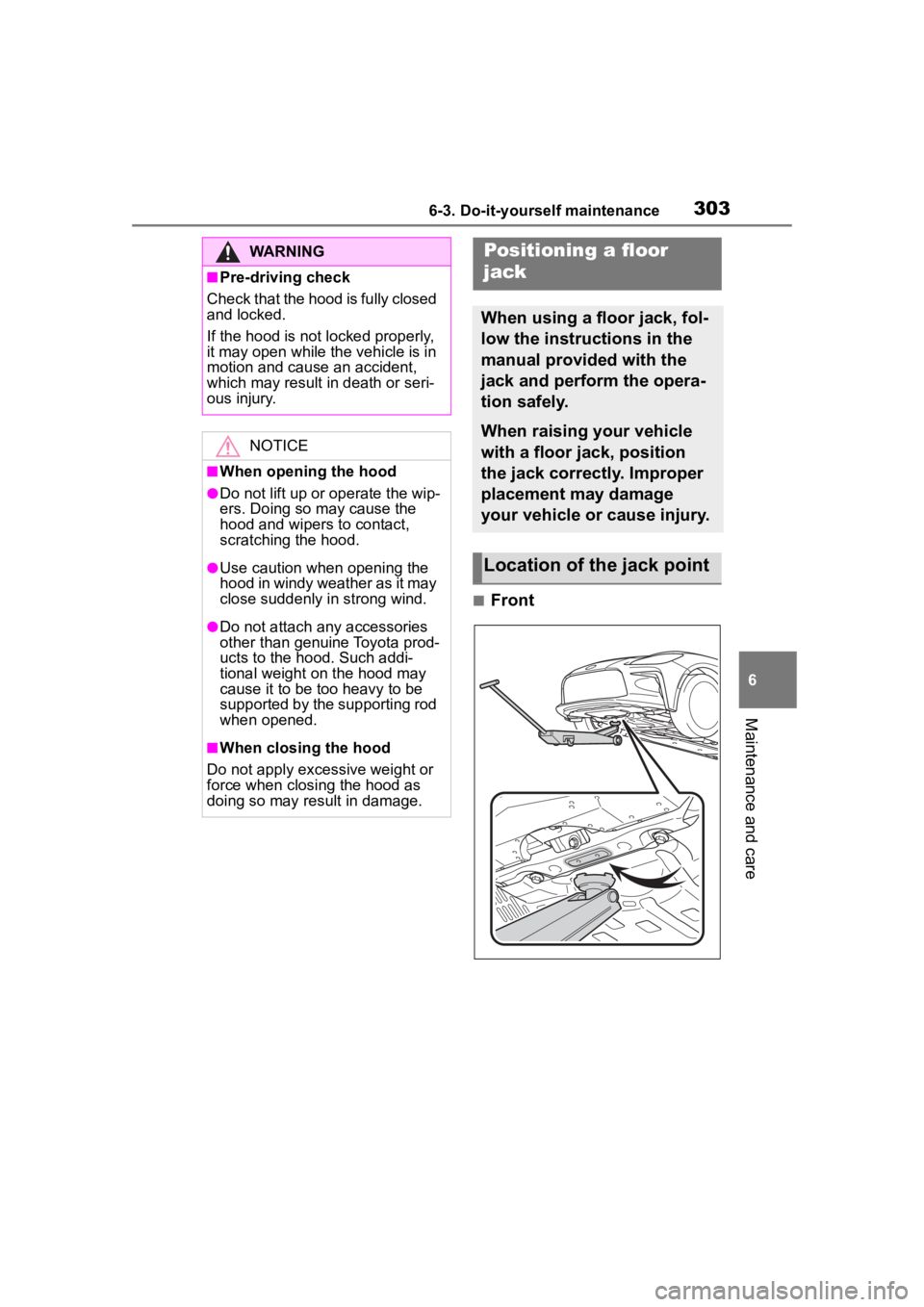
■Front
WARNING
■Pre-driving check
Check that the hood is fully closed
and locked.
If the hood is not locked properly,
it may open while the vehicle is in
motion and cause an accident,
which may result in death or seri-
ous injury.
NOTICE
■When opening the hood
●Do not lift up or operate the wip-
ers. Doing so may cause the
hood and wipers to contact,
scratching the hood.
●Use caution when opening the
hood in windy weather as it may
close suddenly in strong wind.
●Do not attach any accessories
other than genuine Toyota prod-
ucts to the hood. Such addi-
tional weight on the hood may
cause it to be too heavy to be
supported by the supporting rod
when opened.
■When closing the hood
Do not apply excessive weight or
force when closing the hood as
doing so may result in damage.
Positioning a floor
jack
When using a floor jack, fol-
low the instructions in the
manual provided with the
jack and perform the opera-
tion safely.
When raising your vehicle
with a floor jack, position
the jack correctly. Improper
placement may damage
your vehicle or cause injury.
Location of the jack point
Page 438 of 449

438Alphabetical Index
Brake system ....................... 348
BSD/RCTA warning light ...... 352
Charging system .................. 348
Conventional cruise control indi-cator ................................... 352
Electric power steering ......... 350
EyeSight warning light.......... 353
High coolant temperature ..... 348
LED headlight warning light . 353
Low engine oil pressure ....... 349
Low fuel level ....................... 351
Malfunction indicator lamp ... 349
Master warning light ............. 353
Open door warning............... 351
RAB warning light................. 353
Seat belt reminder light 351, 352
Slip indicator......................... 350
SRH warning light ................ 352
SRS ...................................... 349
Tire pressure ........................ 354
Warning messages................. 357
Warning reflector storage box ............................................... 282
Washer Checking .............................. 311
Preparing and c hecking before
winter.................................. 265
Switch................................... 165
Washing and waxing .............. 288
Weight Cargo capacity ..................... 143
Load limits ............................ 143
Weight .................................. 380
Wheels Replacing wheels ................. 319
Size ...................................... 386
Window lock switch ............... 130
Windows Power windows .................... 129
Rear window defogger ......... 272
Washer ................................. 165
Windshield wipers .................. 165 Winter driving tips ..................265
Wireless remote control
Battery-Saving Function ....... 112
Locking/Unlocking ................103
Replacing the battery ...........329