automatic transmission TOYOTA 86 2022 Owner's Manual
[x] Cancel search | Manufacturer: TOYOTA, Model Year: 2022, Model line: 86, Model: TOYOTA 86 2022Pages: 449, PDF Size: 8.5 MB
Page 153 of 449
1534-2. Driving procedures
4
Driving
Each time the shift lever or paddle
shift switches are operated, the
gear changes up or down one gear
and the selected gear, “1” through
“6”, will be set.
The selected gear, from M1 to M6,
will be fixed and displayed on the
meter.
When in manual mode, the gear
will not change unless the shift
lever or paddle shift switches
are operated.
However, even when in the
manual mode, the gears will be
automatically changed in the fol-
lowing situation:
When vehicle speed drops
(downshift only).
When engine oil temperature
is high and engine speed
rises close to the red zone.
■Downshifting restriction warn-
ing buzzer
If downshifting operations are per-
formed at a vehicle speed by which
downshifting is not possible (when
downshifting will cause the engine
speed to enter the red zone), a
buzzer will sound to w arn the driver
that downshifting cannot be per-
formed.
*: If equipped
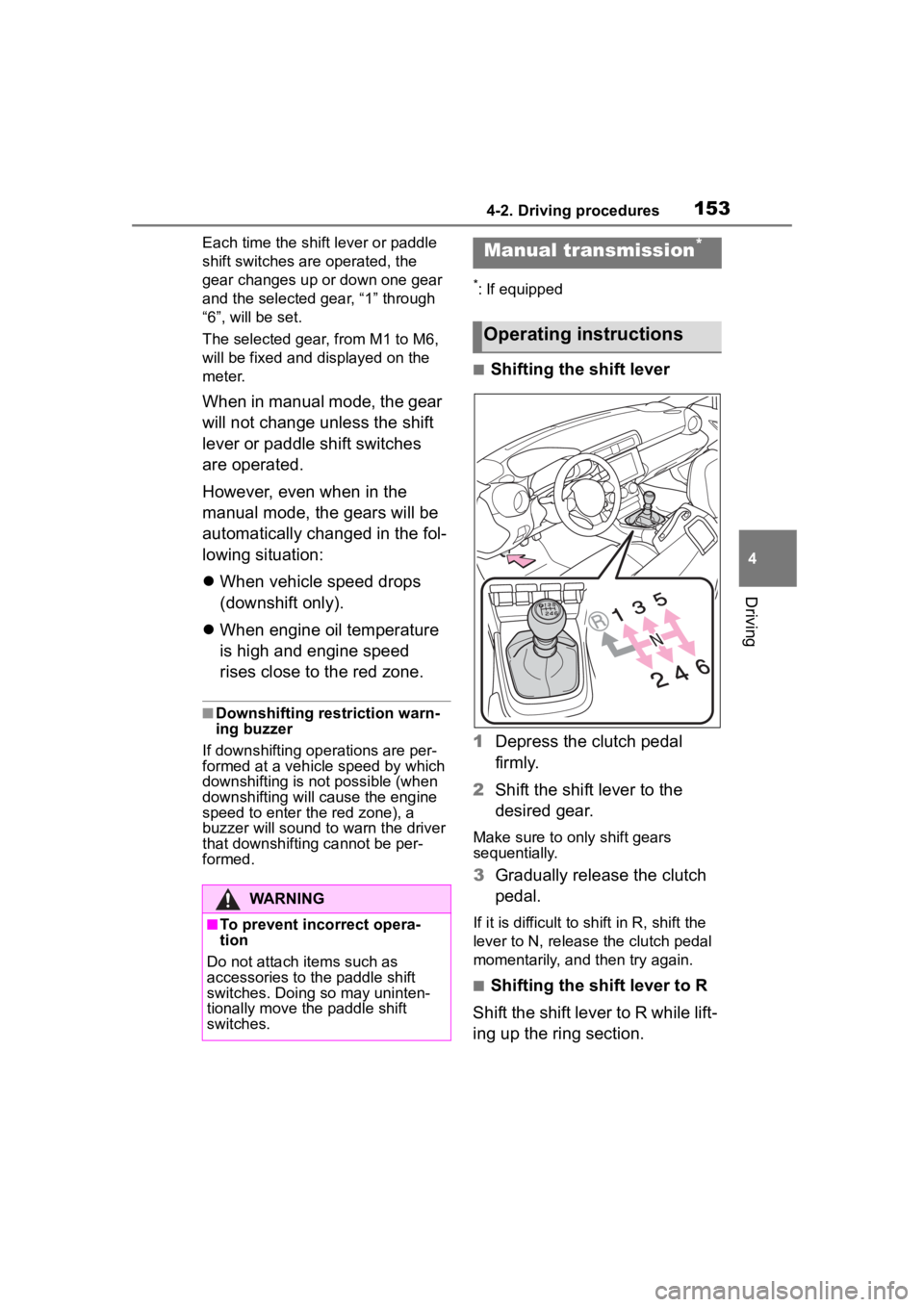
■Shifting the shift lever
1 Depress the clutch pedal
firmly.
2 Shift the shift lever to the
desired gear.
Make sure to only shift gears
sequentially.
3Gradually release the clutch
pedal.
If it is difficult to shift in R, shift the
lever to N, release the clutch pedal
momentarily, and then try again.
■Shifting the shift lever to R
Shift the shift lever to R while lift-
ing up the ring section.
WARNING
■To prevent incorrect opera-
tion
Do not attach items such as
accessories to the paddle shift
switches. Doing so may uninten-
tionally move the paddle shift
switches.
Manual transmission*
Operating instructions
Page 157 of 449
1574-2. Driving procedures
4
Driving
■When changing the driving
mode (vehicles with an auto-
matic transmission)
When the driving mode is changed,
the sound of the active sound con-
trol will be stopped for approxi-
mately 1 second, this is not a
malfunction.
■Customization
Some functions can be customized.
( P.400)
NOTICE
■When parking the vehicle
Before you leave the vehicle, set
the parking brake, shift the shift
lever to P (automatic transmis-
sion) or N (manual transmission)
and make sure that the vehicle
does not move.
■Before driving
Fully release the parking brake.
Driving the vehicle with the park-
ing brake set will lead to brake
components overheating, which
may affect braking performance
and increase brake wear.
ASC (Active Sound
Control)
The active sound control
provides dynamic engine
sounds. When driving with
sport mode
* ( P.257)
selected, the engine sounds
will be particularly loud.
*: If equipped
Page 263 of 449
2634-6. Using other driving systems
4
Driving
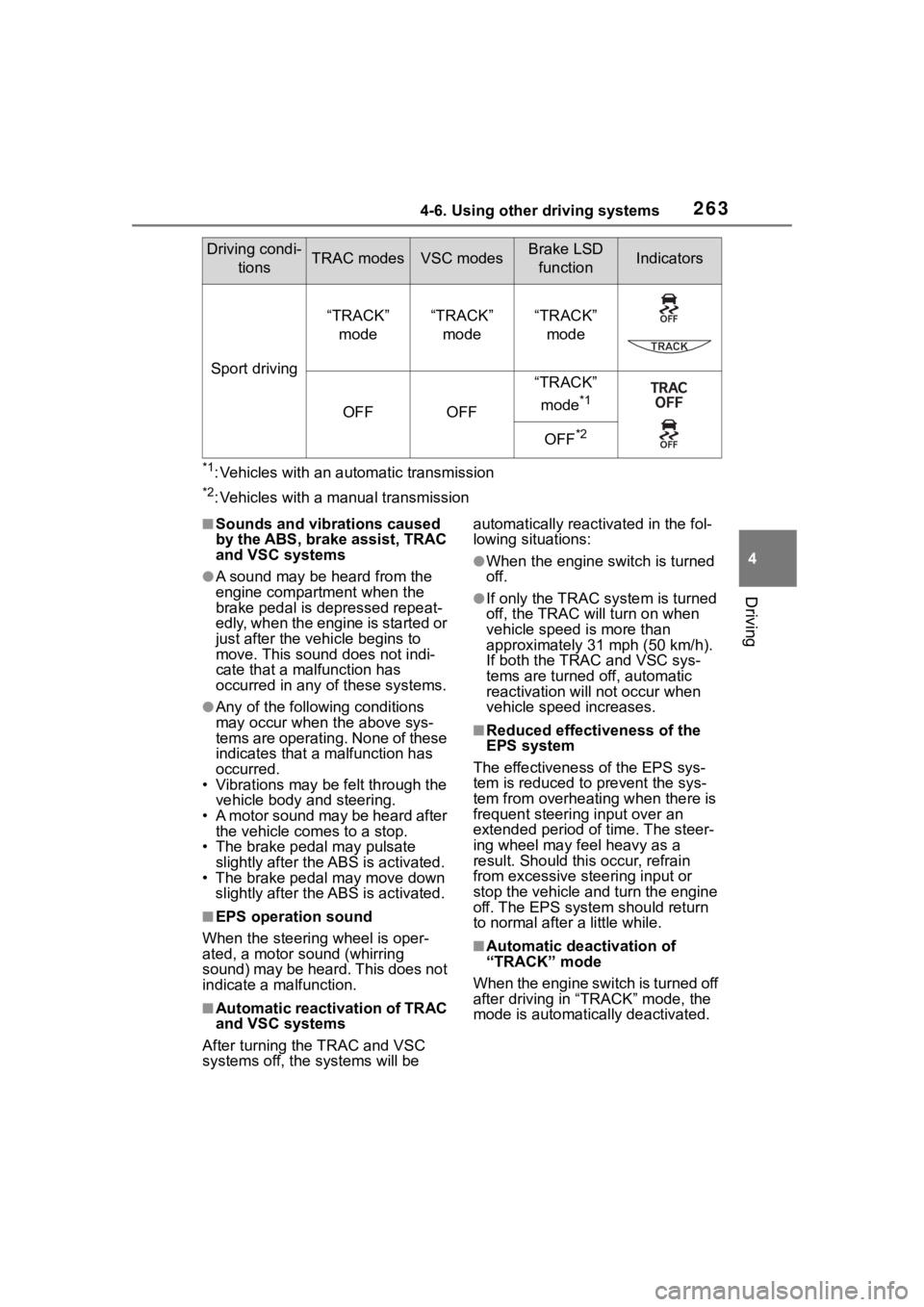
*1: Vehicles with an automatic transmission
*2: Vehicles with a manual transmission
■Sounds and vibrations caused
by the ABS, brake assist, TRAC
and VSC systems
●A sound may be heard from the
engine compartment when the
brake pedal is depressed repeat-
edly, when the engine is started or
just after the vehicle begins to
move. This sound does not indi-
cate that a malfunction has
occurred in any of these systems.
●Any of the following conditions
may occur when t he above sys-
tems are operating. None of these
indicates that a malfunction has
occurred.
• Vibrations may be felt through the vehicle body and steering.
• A motor sound may be heard after the vehicle comes to a stop.
• The brake pedal may pulsate
slightly after the ABS is activated.
• The brake pedal may move down slightly after the ABS is activated.
■EPS operation sound
When the steering wheel is oper-
ated, a motor sou nd (whirring
sound) may be heard. This does not
indicate a malfunction.
■Automatic reactivation of TRAC
and VSC systems
After turning the TRAC and VSC
systems off, the systems will be automatically reactivated in the fol-
lowing situations:
●When the engine switch is turned
off.
●If only the TRAC sy
stem is turned
off, the TRAC will turn on when
vehicle speed is more than
approximately 31 mph (50 km/h).
If both the TRAC and VSC sys-
tems are turned o ff, automatic
reactivation will not occur when
vehicle speed increases.
■Reduced effectiveness of the
EPS system
The effectiveness of the EPS sys-
tem is reduced to prevent the sys-
tem from overheating when there is
frequent steering input over an
extended period o f time. The steer-
ing wheel may f eel heavy as a
result. Should this occur, refrain
from excessive steering input or
stop the vehicle and turn the engine
off. The EPS system should return
to normal after a little while.
■Automatic deactivation of
“TRACK” mode
When the engine switch is turned off
after driving in “ TRACK” mode, the
mode is automatically deactivated.
Sport driving
“TRACK”
mode“TRACK” mode“TRACK” mode
OFFOFF
“TRACK”
mode
*1
OFF*2
Driving condi- tionsTRAC modesVSC modesBrake LSD functionIndicators
Page 266 of 449
2664-7. Driving tips
chassis, around the tires or on
the brakes.
Remove any snow or mud
from the bottom of your shoes
before getting in the vehicle.
If a door is opened and closed
when its side window is fro-
zen, the window safety device
will operate and the side win-
dow open/close function
linked to door operation may
not operate correctly. If this
occurs, perform the following
after the ice has melted.
After opening the window to the
approximately half open posi-
tion, perform initialization.
( P.129)
Accelerate the vehicle slowly,
keep a safe distance between
you and the vehicle ahead, and
drive at a reduced speed suit-
able to road conditions.
Park the vehicle and shift the
shift lever to P (automatic
transmission), or 1 or R (man-
ual transmission) without set-
ting the parking brake. The
parking brake may freeze up,
preventing it from being
released. If the vehicle is
parked without setting the parking brake, make sure to
block the wheels.
Failure to do so may be dan-
gerous because it may cause
the vehicle to move unexpect-
edly, possibly leading to an
accident.
Vehicles with an automatic
transmission: If the vehicle is
parked without setting the
parking brake, confirm that
the shift lever cannot be
moved out of P
*.
*: The shift lever will be locked if it is
attempted to be sh ifted from P to
any other position without
depressing the brake pedal. If the
shift lever can be shifted from P,
there may be a problem with the
shift lock system. Have the vehi-
cle inspected by your Toyota
dealer immediately.
Tire chains cannot be used on
your vehicle because of the lack
of clearance between the tires
and vehicle body.
When tire chains cannot be
used, use of another type of
traction device (such as spring
chains) may be acceptable if
use on your vehicle is recom-
mended by the device manufac-
turer, taking into account tire
size and road conditions. Follow
the device manufacturer's
instructions, especially regard-
ing maximum vehicle speed.
When driving the vehicle
When parking the vehicle
Tire chains
Page 281 of 449
2815-3. Using the storage features
5
Interior features
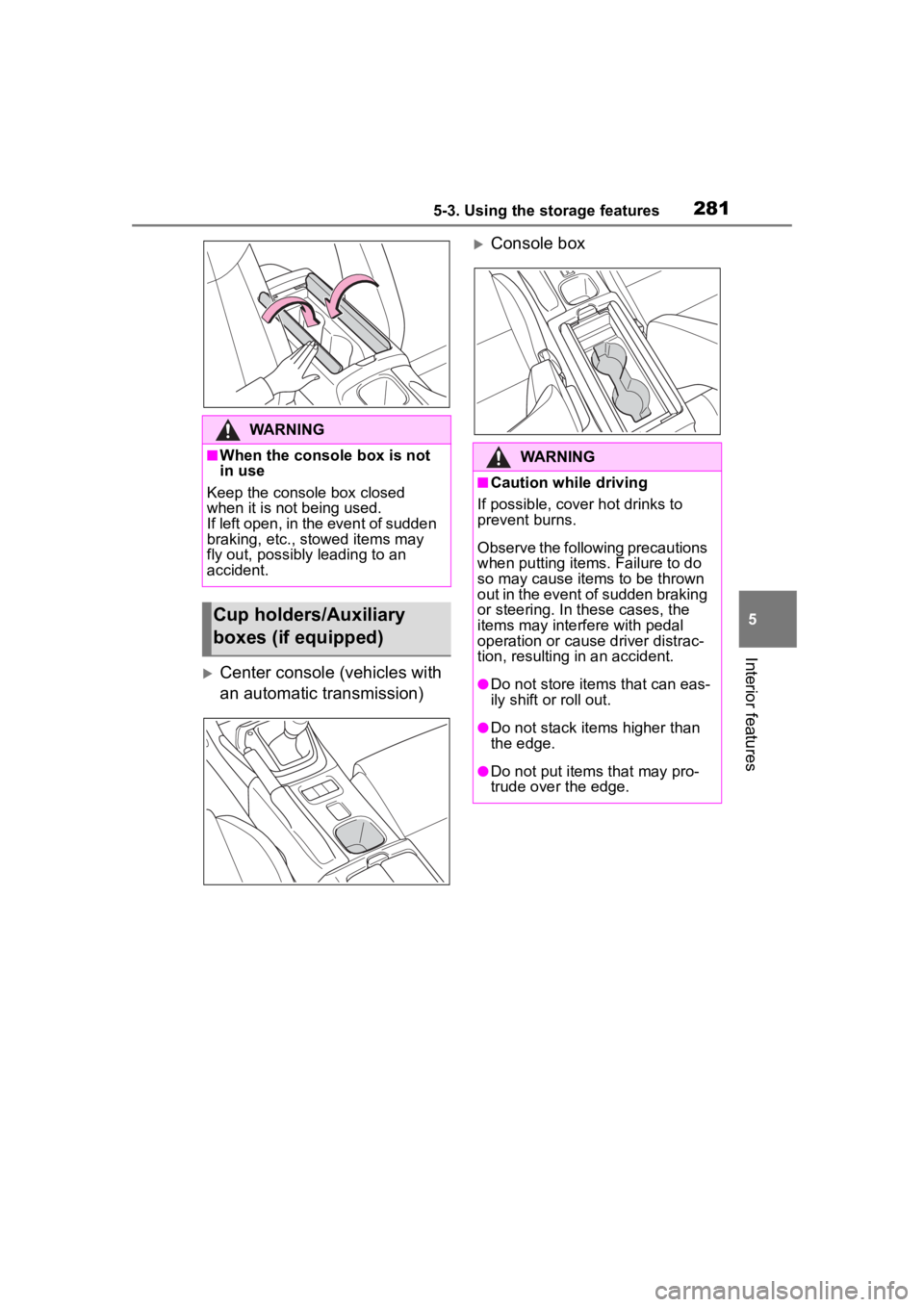
Center console (vehicles with
an automatic transmission)
Console box
WARNING
■When the console box is not
in use
Keep the console box closed
when it is not being used.
If left open, in the event of sudden
braking, etc., stowed items may
fly out, possibly leading to an
accident.
Cup holders/Auxiliary
boxes (if equipped)
WARNING
■Caution while driving
If possible, cover hot drinks to
prevent burns.
Observe the following precautions
when putting items. Failure to do
so may cause items to be thrown
out in the event of sudden braking
or steering. In these cases, the
items may interfere with pedal
operation or cause driver distrac-
tion, resulting in an accident.
●Do not store items that can eas-
ily shift or roll out.
●Do not stack items higher than
the edge.
●Do not put items that may pro-
trude over the edge.
Page 297 of 449
2976-2. Maintenance
6
Maintenance and care
Exhaust sys-
temThere should not
be any fumes or
strange sounds.
Radiator/con-
denser
The radiator and
condenser should
be free from for-
eign objects.
( P.308)
Washer fluid
Is there sufficient
washer fluid?
( P.311)
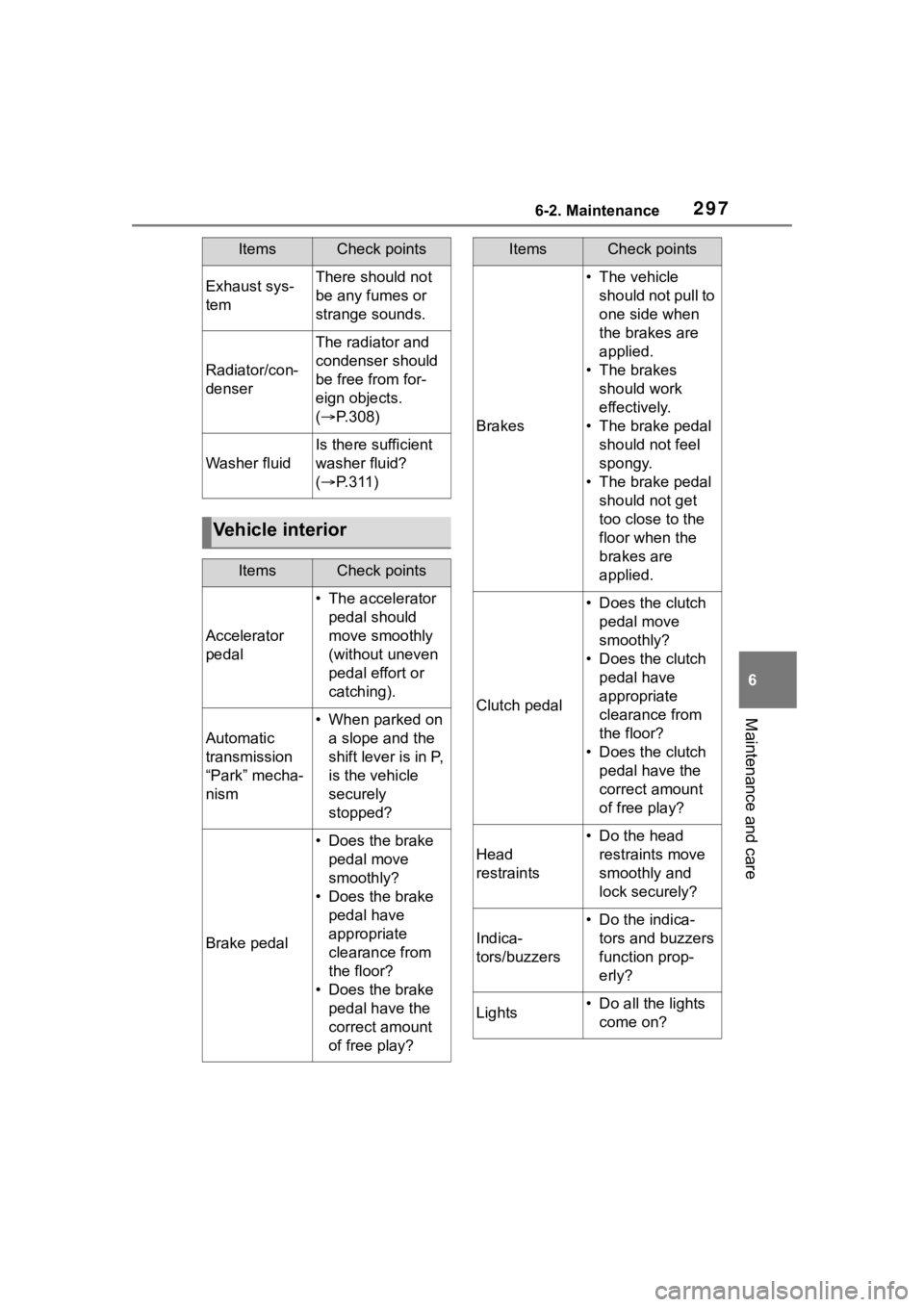
Vehicle interior
ItemsCheck points
Accelerator
pedal
• The accelerator
pedal should
move smoothly
(without uneven
pedal effort or
catching).
Automatic
transmission
“Park” mecha-
nism
• When parked on a slope and the
shift lever is in P,
is the vehicle
securely
stopped?
Brake pedal
• Does the brake pedal move
smoothly?
• Does the brake pedal have
appropriate
clearance from
the floor?
• Does the brake pedal have the
correct amount
of free play?
ItemsCheck points
Brakes
• The vehicle should not pull to
one side when
the brakes are
applied.
• The brakes should work
effectively.
• The brake pedal should not feel
spongy.
• The brake pedal should not get
too close to the
floor when the
brakes are
applied.
Clutch pedal
• Does the clutch pedal move
smoothly?
• Does the clutch pedal have
appropriate
clearance from
the floor?
• Does the clutch pedal have the
correct amount
of free play?
Head
restraints
• Do the head restraints move
smoothly and
lock securely?
Indica-
tors/buzzers
• Do the indica-tors and buzzers
function prop-
erly?
Lights• Do all the lights come on?
ItemsCheck points
Page 343 of 449
3437-2. Steps to take in an emergency
7
When trouble arises
Use a towing dolly under the
front wheels.
When using a flat-bed truck to
transport the vehicle, use tire
strapping belts. Refer to the
owner’s manual of the flat-bed
truck for the tire strapping
method.
In order to suppress vehicle
movement during transporta-
tion, set the parking brake and
turn the engine switch off.
If a tow truck is not available in
an emergency, your vehicle may
be temporarily towed using
cables or chains secured to the
emergency towing eyelets. This
should only be attempted on
hard surfaced roads for at most
19 miles (30 km) at under 18
mph (30 km/h).
A driver must be in the vehicle to steer and operate the brakes.
The vehicle’s wheels, drive train,
axles, steering and brakes must
be in good condition.
For vehicles with an automatic
transmission, only the front tow-
ing eyelets may be used.
To have your vehicle towed by
another vehicle, the towing eye-
let must be installed to your
vehicle. Install the towing eyelet
using the following procedure.
1
Take out the wheel nut
wrench, flathead screwdriver
and towing eyelet. ( P.359)
2 Remove the eyelet cover
using a flathead screwdriver.
To protect the b odywork, place a
rag between the screwdriver and
the vehicle body as shown in the
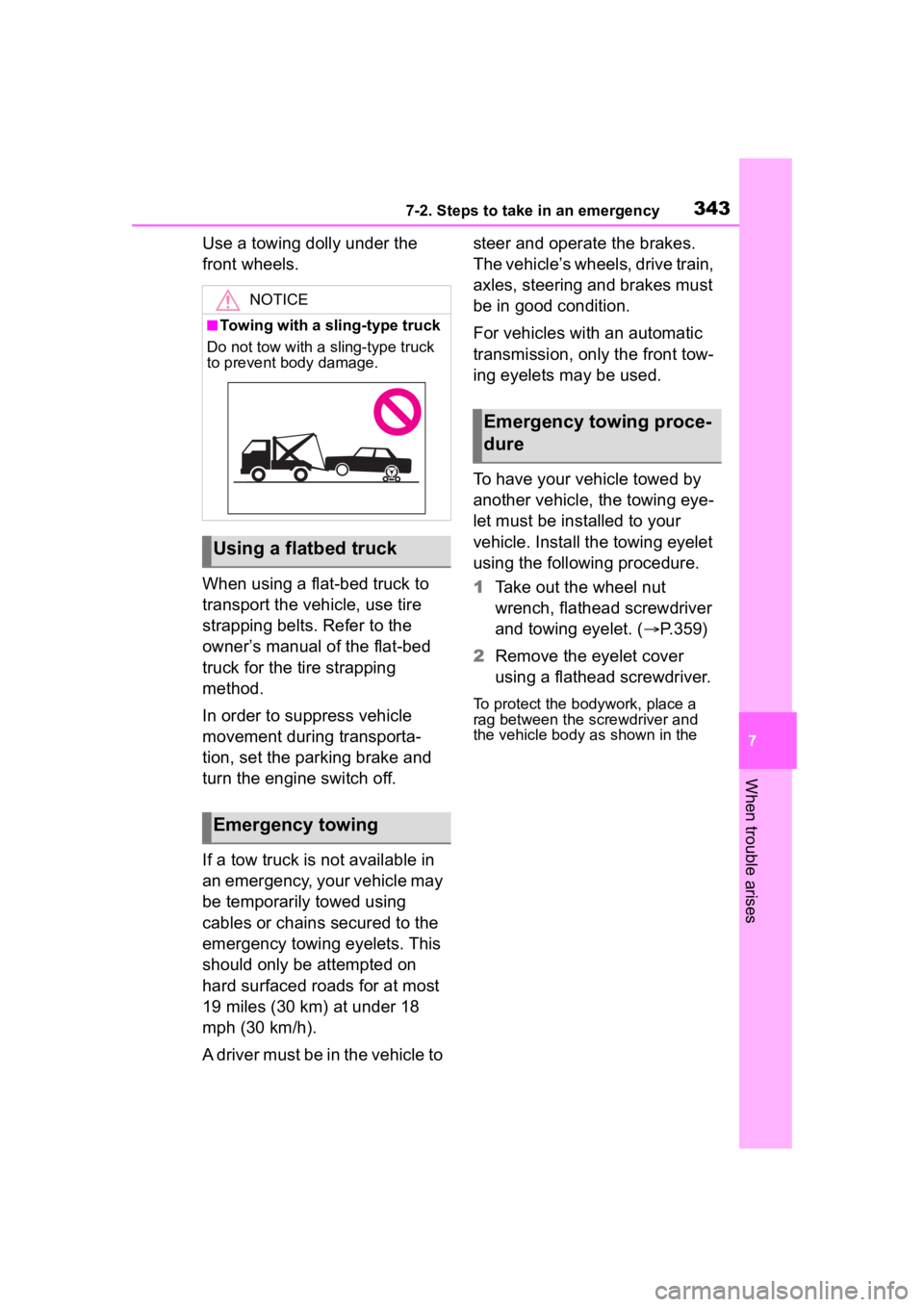
NOTICE
■Towing with a sling-type truck
Do not tow with a sling-type truck
to prevent body damage.
Using a flatbed truck
Emergency towing
Emergency towing proce-
dure
Page 349 of 449
3497-2. Steps to take in an emergency
7
When trouble arises
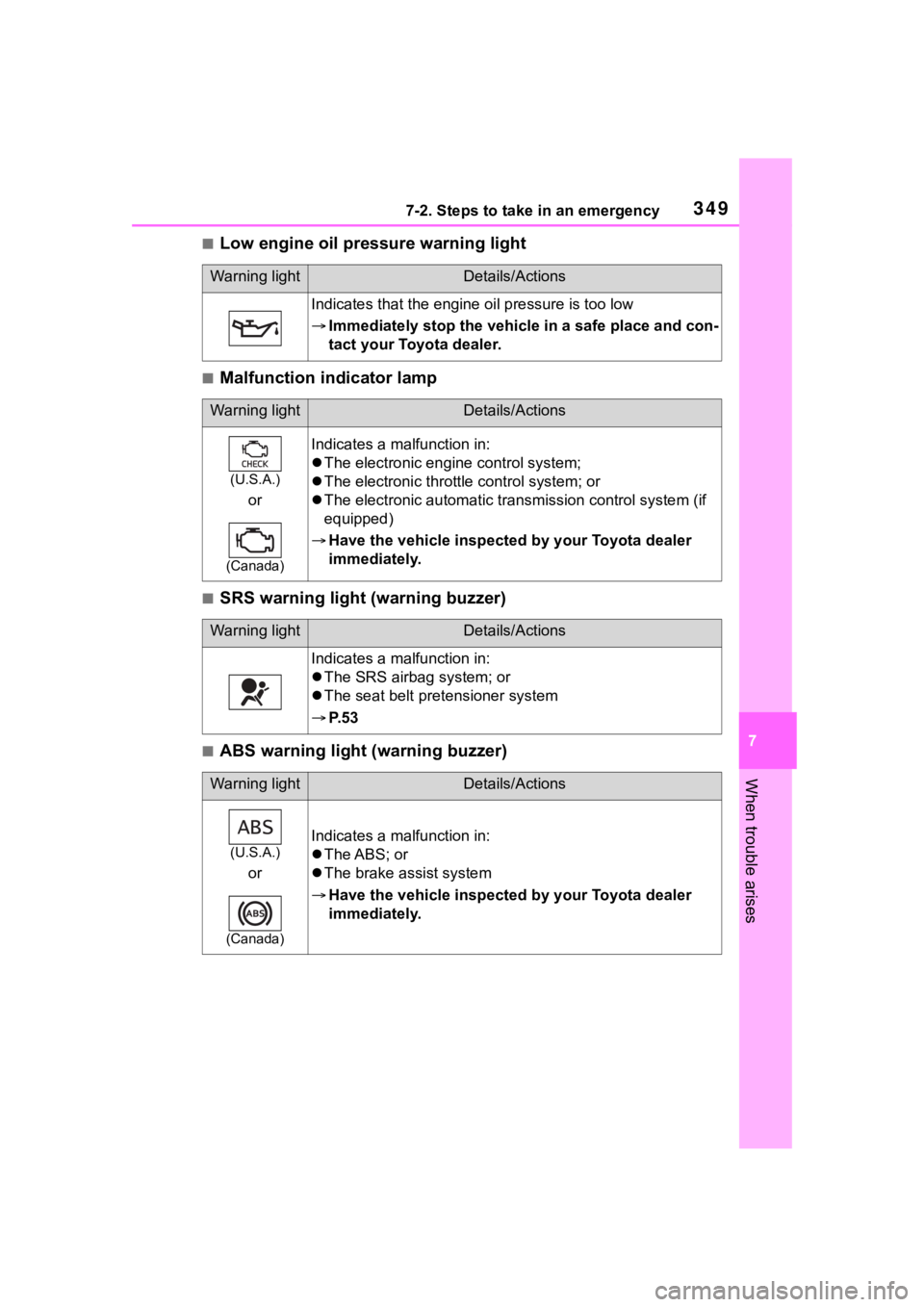
■Low engine oil pressure warning light
■Malfunction indicator lamp
■SRS warning light (warning buzzer)
■ABS warning light (warning buzzer)
Warning lightDetails/Actions
Indicates that the engine oil pressure is too low
Immediately stop the vehicle in a safe place and con-
tact your Toyota dealer.
Warning lightDetails/Actions
(U.S.A.)
or
(Canada)
Indicates a malfunction in:
The electronic engine control system;
The electronic throttle control system; or
The electronic automatic transmission control system (if
equipped)
Have the vehicle inspected by your Toyota dealer
immediately.
Warning lightDetails/Actions
Indicates a malfunction in:
The SRS airbag system; or
The seat belt pretensioner system
P. 5 3
Warning lightDetails/Actions
(U.S.A.)
or
(Canada)
Indicates a malfunction in:
The ABS; or
The brake assist system
Have the vehicle inspected by your Toyota dealer
immediately.
Page 350 of 449
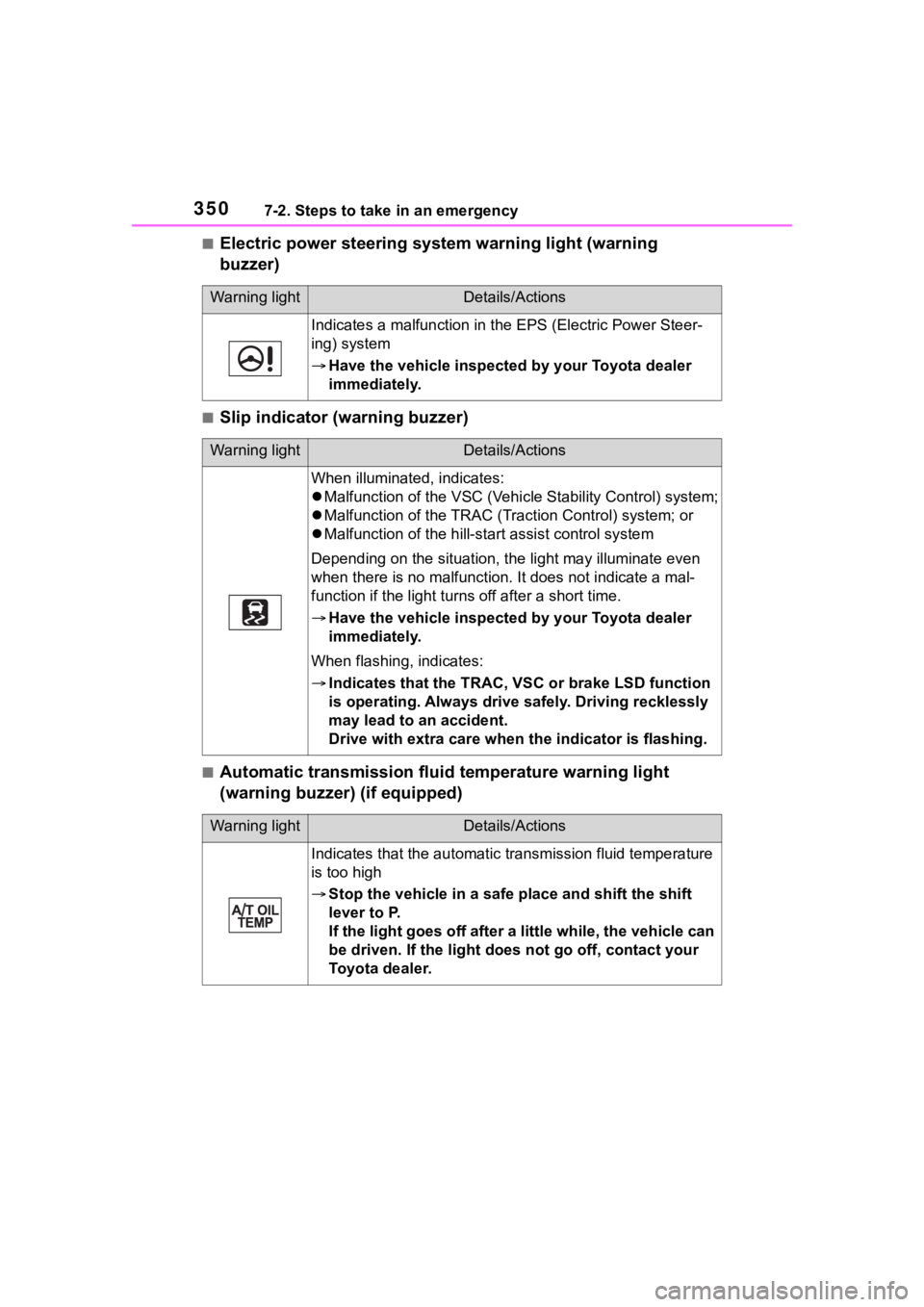
3507-2. Steps to take in an emergency
■Electric power steering system warning light (warning
buzzer)
■Slip indicator (warning buzzer)
■Automatic transmission fluid temperature warning light
(warning buzzer) (if equipped)
Warning lightDetails/Actions
Indicates a malfunction in th e EPS (Electric Power Steer-
ing) system
Have the vehicle inspected by your Toyota dealer
immediately.
Warning lightDetails/Actions
When illuminated, indicates:
Malfunction of the VSC (Vehi cle Stability Control) system;
Malfunction of the TRAC (T raction Control) system; or
Malfunction of the hill-start assist control system
Depending on the si tuation, the light may illuminate even
when there is no malfunction. It does not indicate a mal-
function if the light turns off after a short time.
Have the vehicle inspected by your Toyota dealer
immediately.
When flashing, indicates:
Indicates that the TRAC, VSC or brake LSD function
is operating. Always drive safely. Driving recklessly
may lead to an accident.
Drive with extra care when the indicator is flashing.
Warning lightDetails/Actions
Indicates that the au tomatic transmission fluid temperature
is too high
Stop the vehicle in a safe p lace and shift the shift
lever to P.
If the light goes off after a little while, the vehicle can
be driven. If the light does not go off, contact your
Toyota dealer.
Page 370 of 449
3707-2. Steps to take in an emergency
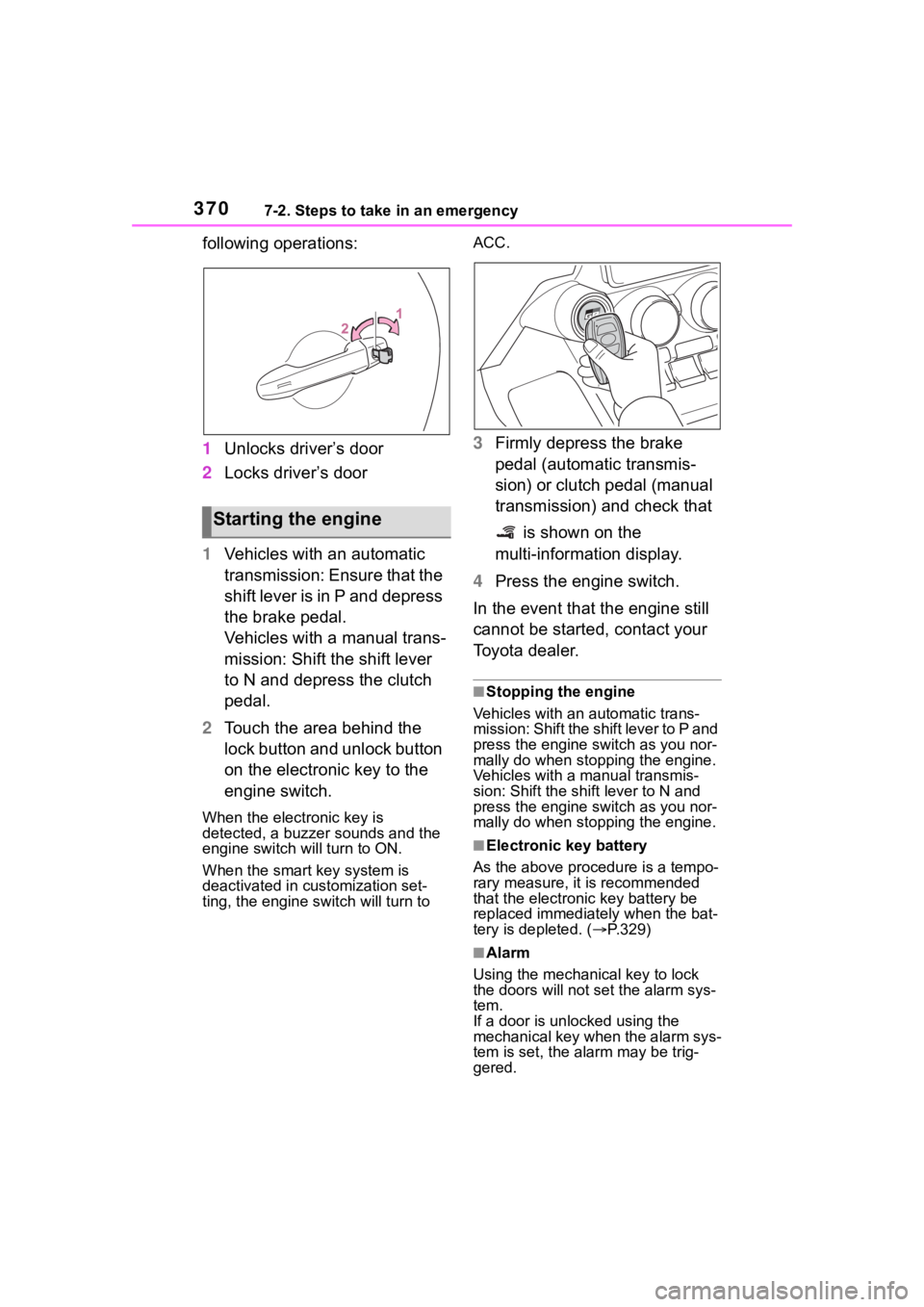
following operations:
1Unlocks driver’s door
2 Locks driver’s door
1 Vehicles with an automatic
transmission: Ensure that the
shift lever is in P and depress
the brake pedal.
Vehicles with a manual trans-
mission: Shift the shift lever
to N and depress the clutch
pedal.
2 Touch the area behind the
lock button and unlock button
on the electronic key to the
engine switch.
When the electronic key is
detected, a buzzer sounds and the
engine switch will turn to ON.
When the smart key system is
deactivated in customization set-
ting, the engine switch will turn to ACC.
3
Firmly depress the brake
pedal (automatic transmis-
sion) or clutch pedal (manual
transmission) and check that
is shown on the
multi-information display.
4 Press the engine switch.
In the event that the engine still
cannot be started, contact your
Toyota dealer.
■Stopping the engine
Vehicles with an automatic trans-
mission: Shift the shift lever to P and
press the engine switch as you nor-
mally do when stopping the engine.
Vehicles with a manual transmis-
sion: Shift the shift lever to N and
press the engine switch as you nor-
mally do when stopping the engine.
■Electronic key battery
As the above proce dure is a tempo-
rary measure, it is recommended
that the electronic key battery be
replaced immediatel y when the bat-
tery is depleted. ( P.329)
■Alarm
Using the mechanical key to lock
the doors will not set the alarm sys-
tem.
If a door is unl ocked using the
mechanical key when the alarm sys-
tem is set, the alarm may be trig-
gered.
Starting the engine