steering TOYOTA 86 2022 Workshop Manual
[x] Cancel search | Manufacturer: TOYOTA, Model Year: 2022, Model line: 86, Model: TOYOTA 86 2022Pages: 449, PDF Size: 8.5 MB
Page 357 of 449
3577-2. Steps to take in an emergency
7
When trouble arises
■Warning messages
The warning messages explained
below may differ from the actual
messages according to operation
conditions and vehicle specifica-
tions.
■Warning buzzer
In some cases, the buzzer may not
be heard due to being in a noisy
location or audio sound.
■If “Check Owner’s Manual” is
displayed
●If the following messages are
shown, following the instructions,
accordingly.
• “High Coolant Temperature” ( P.374)
• “Transmission Oil Temperature” ( P.149)
●If any of the following messages
are shown on the multi-informa-
tion display, it may indicate a mal-
function. Have the vehicle
inspected by your Toyota dealer
immediately.
• “EyeSight OFF”
• “Headlights Disabled”
• “ABS”
• “Steering System”
• “Vehicle Stability Control”
• “Transmission”
• “Low Tire Pressure”
• “RAB Disabled”
• “BSD/RCTA Disabled”
• “Keyless Access System Dis- abled”
• “Auto Headlight Leveler Disabled”
• “SRH Disabled”
●If any of the following messages
are shown on the multi-informa-
tion display, it may indicate a mal-
function. Immediately stop the
vehicle and contact your Toyota
dealer.
• “Brake System”
• “Check Engine”
• “SRS Airbag System”
If a war ning message
is displayed
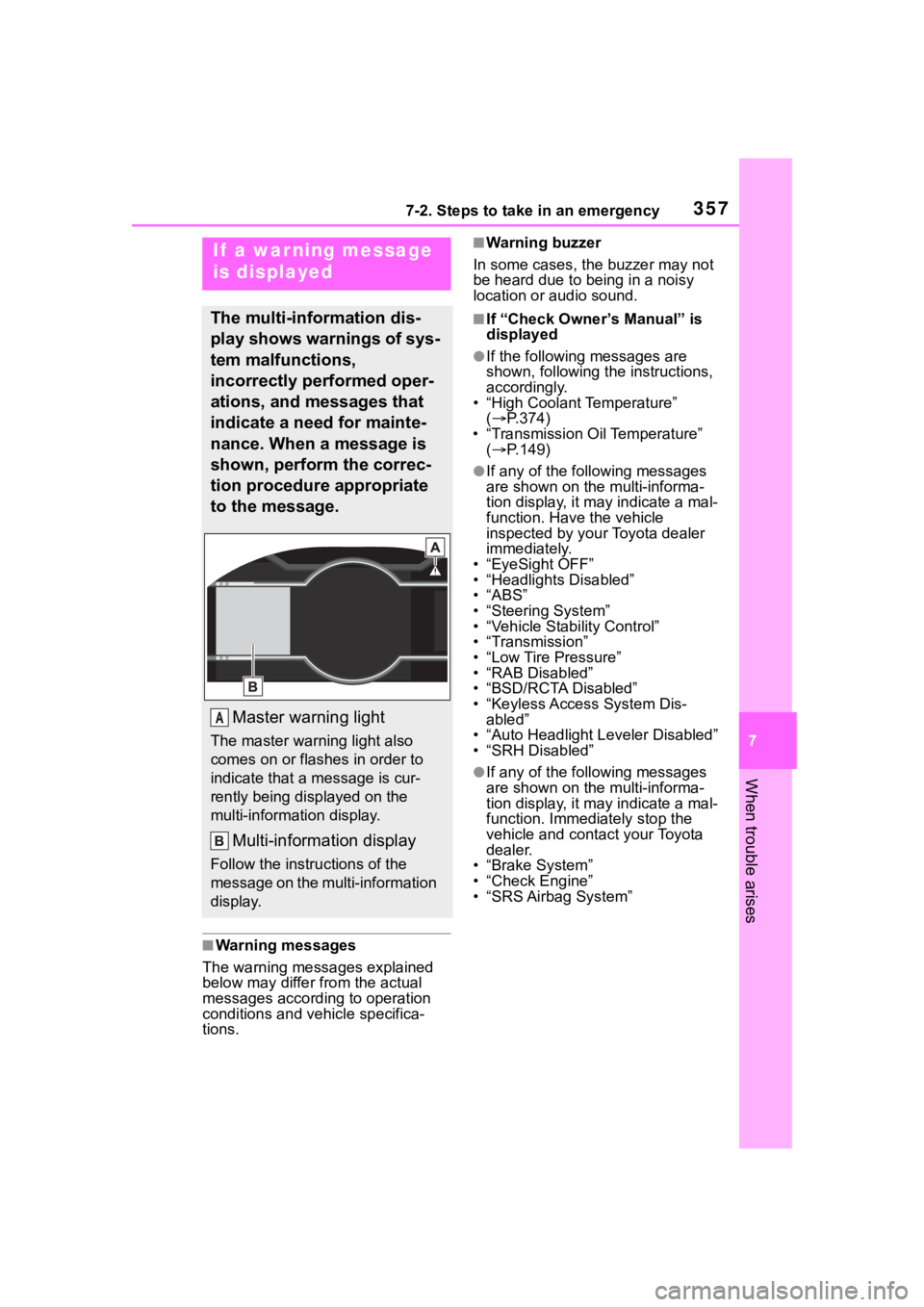
The multi-information dis-
play shows warnings of sys-
tem malfunctions,
incorrectly performed oper-
ations, and messages that
indicate a need for mainte-
nance. When a message is
shown, perform the correc-
tion procedure appropriate
to the message.
Master warning light
The master warning light also
comes on or flashes in order to
indicate that a message is cur-
rently being displayed on the
multi-information display.
Multi-information display
Follow the instru ctions of the
message on the multi-information
display.
A
Page 365 of 449
3657-2. Steps to take in an emergency
7
When trouble arises
acceleration and sharp turns,
drive carefully at under 50
mph (80 km/h) to the nearest
Toyota dealer that is less
than 124 miles (200 km)
away for tire repair or
replacement.
■After a tire is repaired with the
emergency tire puncture repair
kit
●The tire pressure warning valve
and transmitter should be
replaced.
●Even if the tire inflation pressure is
at the recommended level, the tire
pressure warning light may come
on/flash.
WARNING
■Do not drive the vehicle with
a flat tire
Do not continue driving with a flat
tire.
Driving even a short distance with
a flat tire can damage the tire and
the wheel beyond repair. Driving
with a flat tire may cause a cir-
cumferential groove on the side
wall. In such a case, the tire may
explode when using a repair kit.
■When fixing the flat tire
●Stop your vehicle in a safe and
flat area.
●Do not touch the wheels or the
area around the brakes immedi-
ately after the vehicle has been
driven.
After the vehicle has been
driven, the wheels and the area
around the brakes may be
extremely hot. Touching these
areas with hands , feet or other
body parts may result in burns.
●Connect the valve and hose
securely with the tire installed
on the vehicle.
●If the hose is not properly con-
nected to the valve, air leakage
may occur or sealant may be
sprayed out.
●If the hose comes off the valve
while inflating the tire, there is a
risk that the hose will move
abruptly due to air pressure.
●After inflation of the tire has
completed, the sealant may
splatter when the hose is dis-
connected or some air is let out
of the tire.
●Follow the operation procedure
to repair the tire. If the proce-
dure is not followed, the sealant
may spray out.
●Keep back from the tire while it
is being repaired, as there is a
chance of it bursting while the
repair operation is being per-
formed. If you notice any cracks
or deformation of the tire, turn
off the compressor switch and
stop the repair operation imme-
diately.
●The kit may overheat if operated
for a long period of time. Do not
operate the compressor contin-
uously for more than 10 min-
utes.
●Parts of the kit become hot
during operation. Be careful
handling the kit during and after
operation. Do not touch the
metal part around the connect-
ing area between the bottle and
compressor. It will be extremely
hot.
●Do not attach the vehicle speed
warning sticker to an area other
than the one indicated. If the
sticker is attached to an area
where an SRS airbag is located,
such as the pad of the steering
wheel, it may prevent the SRS
airbag from operating properly.
Page 366 of 449
3667-2. Steps to take in an emergency
WARNING
■Driving to spread the liquid
sealant evenly
Observe the following precautions
to reduce the risk of accidents.
Failing to do so may result in a
loss of vehicle control and cause
death or serious injury.
●Drive the vehicle carefully at a
low speed. Be especially careful
when turning and cornering.
●If the vehicle d oes not drive
straight or you feel a pull
through the steering wheel, stop
the vehicle and check the tire.
The tire may have separated
from the wheel.
NOTICE
■When performing an emer-
gency repair
●Perform the emergency repair
without removing the nail or
screw that has punctured the
tread of the tire. If the object
that has punctur ed the tire is
removed, repair by the emer-
gency tire puncture repair kit
may not be possible.
●The kit is not waterproof. Make
sure that the kit is not exposed
to water, such as when it is
being used in the rain.
●Do not put the kit directly onto
dusty ground such as sand at
the side of the road. If the kit
vacuums up dus t etc., a mal-
function may occur.
●Make sure to stand the kit with
the bottle vertical. The kit can-
not work properly if it is laid on
its side.
■Handling the emergency tire
puncture repair kit
●The compressor power source
should be 12 V DC suitable for
vehicle use. Do not connect the
compressor to any other
source.
●If gasoline splatters on the kit,
the kit may deteriorate. Take
care not to allow gasoline to
contact it.
●Store the emergency tire punc-
ture repair kit in the trunk. The
kit may be thrown around during
sudden braking and so forth,
damaging the kit.
Place the repair kit in a storage to
prevent it from being exposed to
dirt or water.
●Store the kit in its assigned
place out of reach of children.
●Do not disassemble or modify
the kit. Do not subject parts
such as the air pressure indica-
tor to impacts. This may cause a
malfunction.
■To avoid damage to the tire
pressure warning valves and
transmitters
When a tire is repa ired with liquid
sealants, the tire pressure warn-
ing valve and transmitter may not
operate properly. If a liquid seal-
ant is used, contact your Toyota
dealer as soon as possible. After
use of liquid sealant, make sure to
replace the tire p ressure warning
valve and transmitter when repair-
ing or replaci ng the tire. (P.316)
Page 367 of 449
3677-2. Steps to take in an emergency
7
When trouble arises
One of the following may be the
cause of the problem:
There may not be sufficient
fuel in the vehicle’s tank.
Refuel the vehicle.
The engine may be flooded.
Try to restart the engine again
following correct starting pro-
cedures. ( P.145)
There may be a malfunction
in the engine immobilizer sys-
tem. ( P. 7 9 )
One of the following may be the
cause of the problem:
The battery may be dis-
charged. ( P.371)
The battery terminal connec-
tions may be loose or cor-
roded. ( P.309)
The engine starting system may
be malfunctioning due to an
electrical problem such as elec-
tronic key battery depletion or a
blown fuse. However, an interim
measure is available to start the
engine. ( P.367)
One of the following may be the
cause of the problem:
One or both of the battery ter-
minals may be disconnected.
( P.309)
The battery may be dis-
charged. ( P.371)
There may be a malfunction
in the steering lock system.
Contact your Toyota dealer if the
problem cannot be repaired, or if
repair procedures are unknown.
When the engine does not start,
the following steps can be used
as an interim measure to start
If the engine will not
start
If the engine will not start
even though correct starting
procedures are being fol-
lowed ( P.145), consider
each of the following points:
The engine wil l not start
even though the starter
motor operates normally.
The starter motor turns
over slowly, the interior
lights and headlights are
dim, or the horn does not
sound or sounds at a low
volume.
The starter motor does
not turn over
The starter motor does
not turn over, the interior
lights and headlights do
not turn on, or the horn
does not sound.
Emergency start function
Page 386 of 449
3868-1. Specifications
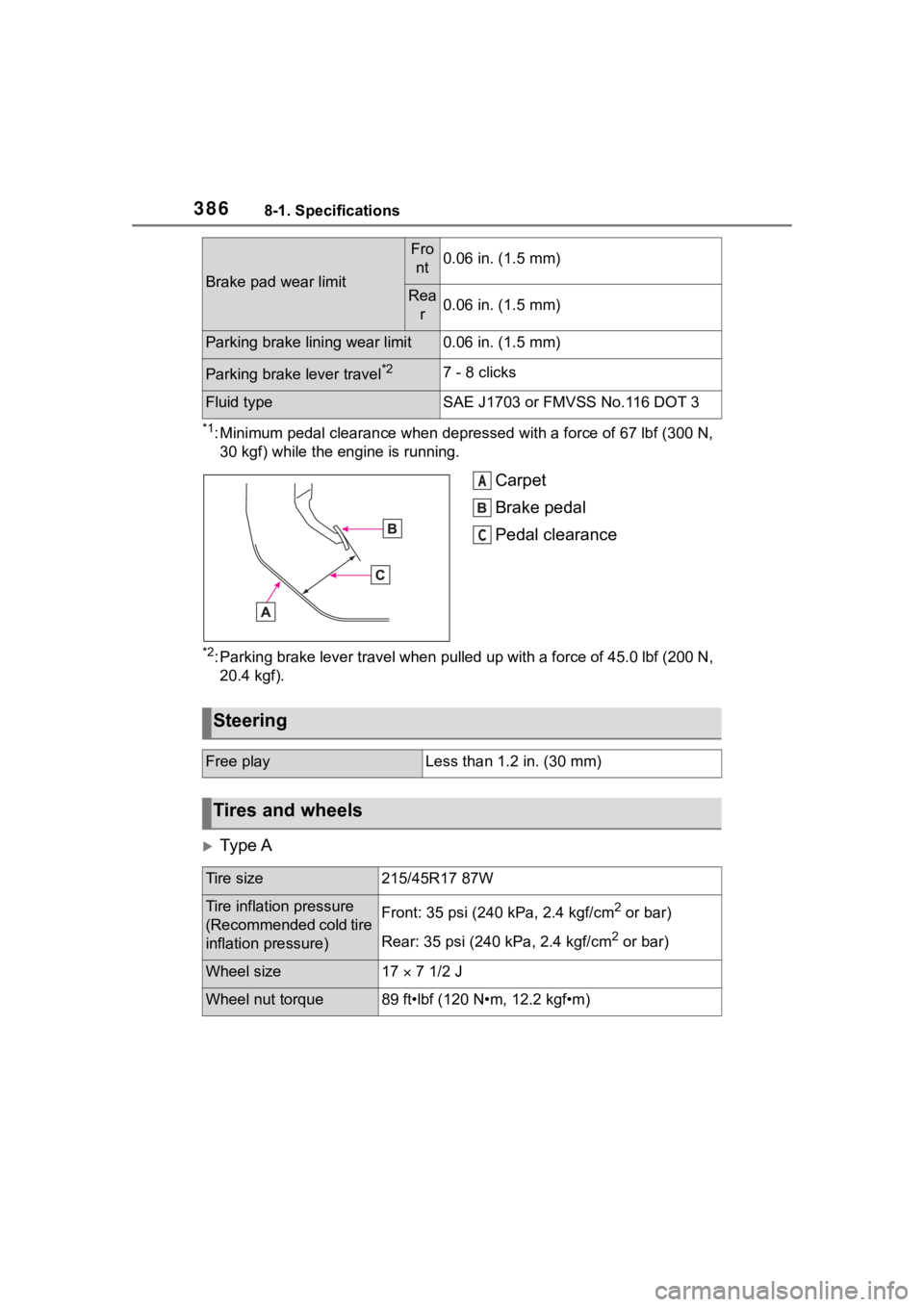
*1: Minimum pedal clearance when depressed with a force of 67 lbf (300 N,
30 kgf) while the engine is running.
Carpet
Brake pedal
Pedal clearance
*2: Parking brake lever travel when pulled up with a force of 45.0 lbf (200 N,
20.4 kgf).
Ty p e A
Brake pad wear limit
Fro nt0.06 in. (1.5 mm)
Rea r0.06 in. (1.5 mm)
Parking brake lining wear limit0.06 in. (1.5 mm)
Parking brake lever travel*27 - 8 clicks
Fluid typeSAE J1703 or FMVSS No.116 DOT 3
A
C
Steering
Free playLess than 1.2 in. (30 mm)
Tires and wheels
Tire size215/45R17 87W
Tire inflation pressure
(Recommended cold tire
inflation pressure)Front: 35 psi (240 kPa, 2.4 kgf/cm2 or bar)
Rear: 35 psi (240 kPa, 2.4 kgf/cm
2 or bar)
Wheel size17 7 1/2 J
Wheel nut torque89 ft•lbf (120 N•m, 12.2 kgf•m)
Page 394 of 449

3948-1. Specifications
Recommended inflation pres-
sureCold tire inflation pressure recommended
by a manufacturer
Accessory weight
The combined weight (in excess of those
standard items which may be replaced) of
automatic transmission, power steering,
power brakes, power windows, power
seats, radio and heater, to the extent that
these items are available as fac-
tory-installed equipment (whether installed
or not)
Curb weight
The weight of a motor vehicle with stan-
dard equipment, including the maximum
capacity of fuel, oil and coolant, and if so
equipped, air conditioning and additional
weight optional engine
Maximum loaded vehicle
weight
The sum of:
(a) Curb weight
(b) Accessory weight
(c) Vehicle capacity weight
(d) Production options weight
Normal occupant weight
150 lb. (68 kg) times the number of occu-
pants specified in the second column of
Table 1
* that follows
Occupant distribution
Distribution of occupan ts in a vehicle as
specified in the thi rd column of Table 1
*
below
Production options weight
The combined weight o f installed regular
production options weighing over 5 lb. (2.3
kg) in excess of the s tandard items which
they replace, not previously considered in
curb weight or accessory weight, including
heavy duty brakes, ride levelers, roof rack,
heavy duty battery, and special trim
Rim
A metal support for a tire or a tire and tube
assembly upon which the tire beads are
seated
Tire related termMeaning
Page 427 of 449
427What to do if... (Troubleshooting)
Is the steering wheel
unlocked? ( P.145)
Is the electronic key battery
weak or depleted?
In this case, the engine can be
started in a temporary way.
( P.370)
Is the battery discharged?
( P.371)
Is the engine switch in ON?
If you cannot release the shift lever
by depressing the brake pedal with
the engine switch in ON. ( P.150)
It is locked automatically to
prevent theft of the vehicle.
( P.145)
Is the window lock switch
pressed?
The power window except for the
one at the driver’s seat cannot be
operated if the win dow lock switch
is pressed. ( P.130)
The auto power off function
will be operated if the vehicle
is left in ACC or ON (the
engine is not running) for a
period of time. ( P.148)
The seat belt reminder light is
flashing
Are the driver and the passenger
wearing the seat belts? ( P.351)
The brake system warning
light is on
Is the parking br ake released?
( P.156)
Depending on the situation,
other types of warning buzzer
may also sound. ( P.348, 357)
Did anyone inside the vehicle
open a door during setting the
alarm?
The sensor detects it and the alarm
sounds. ( P. 8 0 )
Do one of the following to deac-
tivate or stop the alarm:
Unlock the doors or open the
trunk using the entry function
or wireless remote control.
Open the trunk using the
entry function or wireless
remote control.
The shift lever cannot be
shifted from P even if you
depress the brake pedal
(Automatic transmission)
The steering wheel can-
not be turned after the
engine is stopped
The windows do not open
or close by operating the
power window switches
The engine switch is
turned off automatically
A warning buzzer sounds
during driving
An alarm is activated and
the horn sounds
Page 431 of 449

431Alphabetical Index
Electric Power Steering (EPS)............................................... 261Warning light ........................ 350
Electronic key ......................... 102 Battery-saving fun ction......... 112
If the electronic key does not operate properly ................. 369
Replacing the battery ........... 329
Emergency flashers ............... 338
Emergency tire puncture ....... 358
Emergency, in case of If a warning buzzer sounds .. 348
If a warning light turns on ..... 348
If a warning message is dis-played................................. 357
If the battery is discharged ... 371
If the electronic key does not operate properly ................. 369
If the engin e will not start ..... 367
If the fuel filler door cannot be opened ............................... 369
If the vehicle is submerged or water on the road is rising .. 339
If you have a flat tire ............. 358
If you lose your keys ............ 368
If you think something is wrong ........................................... 346
If your vehicle becomes stuck ........................................... 376
If your vehicle has to be stopped in an emergency................. 338
If your vehicle needs to be towed ........................................... 341
If your vehicle overheats ...... 374
Engine ACCESSORY mode ............. 147
Compartment ....................... 305
Engine switch ....................... 145
Fuel pump shut off system ... 347
Hood..................................... 302
How to start the engine ........ 145
Identification number ............ 381 If the engine will not start......367
If your vehicle has to be stopped
in an emergency .................338
Ignition switch (engine switch) ...........................................145
Overheating ..........................374
Tachometer.............................88
Engine coolant Capacity ...............................383
Checking ..............................307
Preparing and checking before winter ..................................265
Engine coolant temperature gauge .......................................88
Engine immobilizer system .....79
Engine oil Capacity ...............................382
Checking ..............................305
Preparing and checking before winter ..................................265
Warning light.........................349
Engine oil temperature gauge .94
Engine switch .........................145 Auto power off fun ction .........148
Changing the engine switch modes.................................147
If your vehicle has to be stopped in an emergency .................338
EPS (Electric Po wer Steering)
...............................................261 Warning light.........................350
Event data recorder (EDR) .........7
EyeSight ..................................170 Adaptive Cruise Control .......190
Conventional Cruise Control 207
Lane Departure Warning ......219
Lane Sway Warning .............221
Lead Vehicle Start Alert ........223
Malfunction ...........................227
Pre-Collision Braking System...........................................179
Page 433 of 449

433Alphabetical Index
Vehicle.................................. 380
Ignition switch (engine switch) ............................................... 145Auto power off function ........ 148
Changing the engine switch modes ................................ 147
If your vehicle has to be stopped in an emergency................. 338
Illuminated entry system ....... 277
Indicators .................................. 85
Initialization Power windows .................... 129
Tire pressure warning system........................................... 317
Inside rear view mirror........... 126
Instrument panel light control. 91
Interior lights .......................... 277
J
Jack Positioning a floor jack ......... 303
Vehicle-equipped jack .......... 359
Jack handle ............................. 359
Jam protection function Power windows .................... 129
K
Keyless entrySmart key system................. 111
Wireless remote control ....... 103
Keys Battery-saving fun ction......... 112
Electronic key ....................... 102
Engine switch ....................... 145
If the electronic key does not operate properly ................. 369
If you lose your keys ............ 368
Key number plate ................. 102
Keyless entry................ 105, 111
Mechanical key .................... 102
Replacing the battery ........... 329 Warning buzzer .................... 111
Wireless remote control........103
Knee airbags .............................27
L
Lane Departure Warning ........219
Lane Sway Warning ................221
Language (multi-information dis- play) .........................................98
LATCH anchors.........................70
Lead Vehicle Start Alert .........223
Lever Auxiliary catch lever .............302
Hood lock release lever ........302
Shift lever .....................149, 153
Turn signal lever ...................155
Wiper lever ...........................165
License plate lights Light switch...........................158
Replacing light bulbs ............334
Light Wattage ................................387
Light bulbs Replacing .............................334
Lights Headlight switch ...................158
High Beam Assist system .....162
Interior lights .........................277
Interior lights list ...................277
Replacing light bulbs ............334
Trunk light ............................. 110
Turn signal lever ...................155
Vanity lights ..........................284
Wattage ................................387
Welcome light illumination con-trol ......................................160
Lock steering column ............145
M
Maintenance Do-it-yourself maintenance ..300
Page 434 of 449

434Alphabetical Index
General maintenance ........... 296
Maintenance date................. 380
Maintenance requirements... 295
Malfunction indicator lamp.... 349
Manual transmission ............. 153
Master warning light .............. 353
Menu icons ............................... 93
Meter Clock ...................................... 88
Indicators................................ 85
Instrument panel light control . 91
Meters .................................... 88
Multi-information display ........ 93
Settings .................................. 98
Warning lights....................... 348
Warning messages............... 357
Mirrors Inside rear view mirror.......... 126
Outside rear view mirror defog-gers .................................... 272
Outside rear view mirrors ..... 127
Vanity mirrors ....................... 284
Multi-information display......... 93 Audio system-linked display ... 98
Driving information ................. 94
Menu icons ............................. 93
Meter control switches ........... 94
Navigation system-linked display............................................. 98
Pop-up display ....................... 93
Settings .................................. 98
Sport information .................... 96
Tire pressure ........................ 315
Warning messages............... 357
N
Navigation system-linked display ................................................. 98
Noise from under vehicle .......... 5
O
Odometer...................................90
Odometer and trip meter display
Display change button ............90
Display items ..........................91
Oil Engine oil..............................382
Opener Fuel filler door.......................167
Hood .....................................302
Trunk ....................................109
Outside rear view mirrors Adjustment ...........................127
BSD (Blind Spot Detection) ..231
Folding..................................127
Outside rear view mirror defog-gers ....................................272
RCTA function.......................231
Outside temperature ................88
Overheating.............................374
P
Paddle shift switches .....151, 152
Panic mode .............................103
Parking brake Operation..............................156
Parking lights Light switch...........................158
Replacing light bulbs ............334
Power and torque curve...........96
Power outlets ..........................284
Power steering (Electric power steering system) ...................261Warning light.........................350
Power windows Jam protection function ........129
Operation..............................129
Window lock switch ..............130
Pre-Collision Braking System179 Function................................179
Warning message.................357