wheel TOYOTA 86 2023 User Guide
[x] Cancel search | Manufacturer: TOYOTA, Model Year: 2023, Model line: 86, Model: TOYOTA 86 2023Pages: 449, PDF Size: 8.5 MB
Page 47 of 449
471-1. For safe use
1
For safety and security
WARNING
■General Precautions regard-
ing front passenger’s SRS
frontal airbag
When the front passenger's seat
is occupied by an adult, observe
the following precautions. Failure
to do so may lessen the load on
the front passenger 's seat, deacti-
vating the front passenger's SRS
frontal airbag despite the fact that
the seat is occupied by an adult.
This may result in personal injury.
●Do not allow the rear seat occu-
pant to lift the front passenger's
seat cushion using his/her feet.
●Do not place any article under
the front passenger's seat, or
squeeze any article from behind
and under the seat.
●Do not squeeze any article
between the front passenger's
seat and side trim/pillar, door or
center console box. This may lift
the seat cushion.
■When a small a dult is seated
in the front passenger’s seat
When a small adult is seated in
the front passeng er’s seat, the
Toyota advanced frontal airbag
system may or may not activate
the front passenger’s SRS frontal
airbag depending on the occu-
pant’s seating posture. If the OFF
indicator remains illuminated
while the ON indi cator turns off
when a small adult is seated in
the front passenger's seat, refer to
P. 4 5 .
■General Precautions regard-
ing occupant detection sys-
tem
Do not kick the front passenger
seat or subject it to severe impact.
Otherwise, the SRS warning light
may illuminate to indicate a mal-
function of the front passenger
occupant detection system. In this
case, contact your Toyota dealer
immediately.
■After deployment
Do not touch the SRS airbag sys-
tem components around the
steering wheel and dashboard
with bare hands right after deploy-
ment. Doing so can cause burns
because the components can be
very hot as a result of deploy-
ment.
NOTICE
■Toyota advanced frontal air-
bag system precautions
Observe the following precau-
tions. Failure to do so may pre-
vent the Toyota advanced frontal
airbag system from functioning
correctly or cause the system to
fail.
●Do not apply any strong impact
to the front passenger’s seat
such as by kicking.
●Do not let rear passengers rest
their feet between the front
seatback and seat cushion.
●Do not spill liquid on the front
passenger’s seat. If liquid is
spilled, wipe it o ff immediately.
●Do not remove or disassemble
the front passenger’s seat.
Page 49 of 449

491-1. For safe use
1
For safety and security
on each side of the cabin is
stored in the roof side (between
the front pillar and a point over
the rear seat). An “SRS AIR-
BAG” mark is located at the top
of each center pillar.
In a moderate to severe side
i m p a c t c o l l i s i o n , t h e S R S c u r t a i n
shield airbag on the impacted
side of the vehicle deploys
between the occupant and the
side window and supplements
the seatbelt by reducing the
impact on the occupant’s head.
In a rollover, SRS curtain shield
airbags on both sides of the
vehicle deploy between the
occupant and the side window
and supplement the seatbelt by
reducing the impact to the occu-
pant’s head.
In an offset frontal collision, SRS
curtain shield airbags on both
sides of the vehicle deploy
between the occupant and the
side window and supplement
the seatbelt by reducing the
impact to the occupant’s head
and chest.
■Operation
The SRS side airbag and SRS
curtain shield airbag can func-
tion only when the engine switch
is in ON.
The following airbags deploy
independently of each other
since each has its own impact
sensor.
Driver’s SRS side airbag
Front passenger’s SRS side
airbag
SRS curtain shield airbag
(right-hand side)
SRS curtain shield airbag
(left-hand side)
Therefore, they may not both
deploy in the same accident.
Also, the SRS side airbag and
SRS curtain shield airbag
deploys independently of the
driver’s and front passenger’s
SRS frontal airbags in the steer-
ing wheel and instrument panel.
For the locations of the sensors
and control modules, refer to
P. 2 9 .
■After deployment
After the deployment, the SRS
side airbag immediately starts to
deflate. The time required from
detection of an impact to defla-
tion of an SRS side airbag after
deployment is shorter than the
blink of an eye.
The SRS curtain shield airbag
remains inflated for a while fol-
lowing deployment then slowly
deflates.
The SRS side airbag and SRS
curtain shield airbag deploy
even when no one occupies the
seat on the side on which an
impact is applied.
When the SRS side airbag and
SRS curtain shield airbag
Page 55 of 449
551-1. For safe use
1
For safety and security
Front impact sensor
• Right-hand side
• Left-hand side
Airbag control module (includ-
ing impact sensor and rollover
sensor)
Frontal airbag module
• Driver’s side
• Front passenger’s side
Knee airbag module
• Driver’s side
Side impact sensor
• Center pillar left-hand side
• Center pillar right-hand side
• Forward of rear wheel house
left-hand side
• Forward of rear wheel house right-hand side
• Door left-hand side
• Door right-hand side
Side airbag module
• Driver’s side
• Front passenger’s side
Curtain shield airbag module
• Right-hand side
• Left-hand side
Seatbelt pretensioner
• Driver’s side
Seatbelt pretensioner and
adaptive force limiter
• Front passenger’s side
Seatbelt buckle switch
• Front passenger’s side
Front passenger’s occupant detection system sensors
Front passenger’s frontal air-
bag ON and OFF indicator
All related wiring
■SRS warning light
Have the system inspected by your
Toyota dealer i mmediately if the
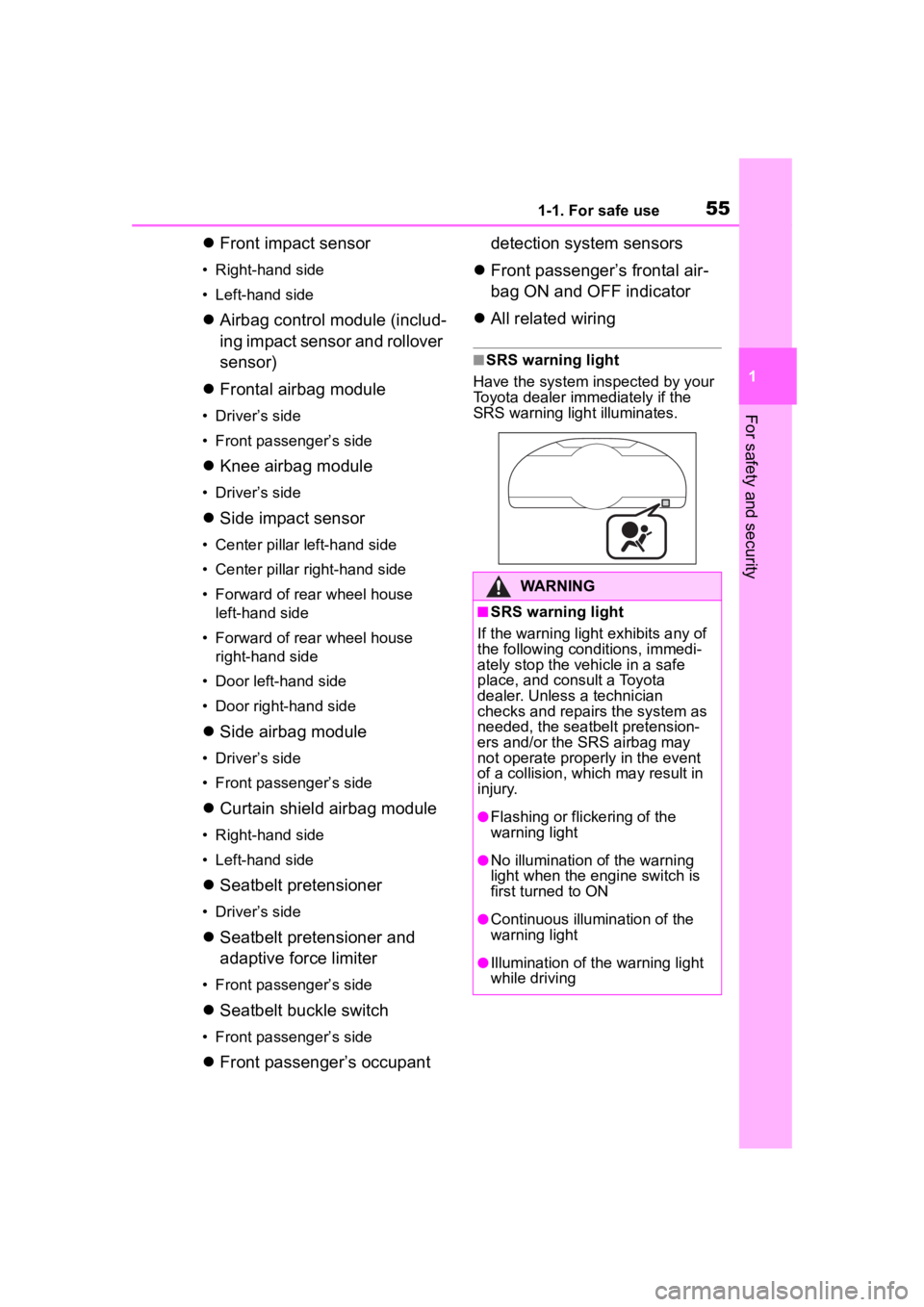
SRS warning light illuminates.
WARNING
■SRS warning light
If the warning light exhibits any of
the following conditions, immedi-
ately stop the vehicle in a safe
place, and consult a Toyota
dealer. Unless a technician
checks and repairs the system as
needed, the seatbelt pretension-
ers and/or the SRS airbag may
not operate properl y in the event
of a collision, which may result in
injury.
●Flashing or flickering of the
warning light
●No illumination of the warning
light when the engine switch is
first turned to ON
●Continuous illumination of the
warning light
●Illumination of the warning light
while driving
Page 58 of 449
581-1. For safe use
■Adult*2
■Child*5, *6
WARNING
●Modifications for persons with
disabilities that may affect the
front passenger occupant clas-
sification system. (U.S. only)
Removing, replacing or modify-
ing any parts of the front seats,
seat belts, front bumper, front
side frame, instrument panel,
meter, steering wheel, steering
column, tires, suspension or
floor panel can affect the opera-
tion of the Toyota front passen-
ger occupant classification
system.
Condition and operation in the front passenger occupant
classification system
*1
Indicator/warning light
“AIR BAG ON” and “AIR BAG OFF” indicator lights“AIR BAG ON”
SRS warning lightOff
Front passenger’s seat belt reminder lightFlashing*3
Devices
Front passenger airbag
On
Front side airbag*4
Front curtain shield airbag*4
Front passenger’s seat belt preten-
sioner
*4
Indicator/warning light
“AIR BAG ON” and “AIR BAG OFF” indicator lights“AIR BAG OFF”*5
SRS warning lightOff
Front passenger’s seat belt reminder lightFlashing*3
Page 101 of 449
101
3
3
Before driving
Before driving
.3-1. Key informationKeys ............................ 102
3-2. Opening, closing and locking the doors and
trunk
Doors .......................... 105
Trunk ........................... 107
Smart key system ....... 111
3-3. Adjusting the seats Front seats .................. 119
Rear seats................... 121
Head restraints............ 123
3-4. Adjusting the steering wheel and mirrors
Steering wheel ............ 125
Inside rear view mirror .................................. 126
Outside rear view mirrors .................................. 127
3-5. Opening, closing the win- dows
Power windows ........... 129
Page 125 of 449
1253-4. Adjusting the steering wheel and mirrors
3
Before driving
3-4.Adjusting the steering wheel and mirrors
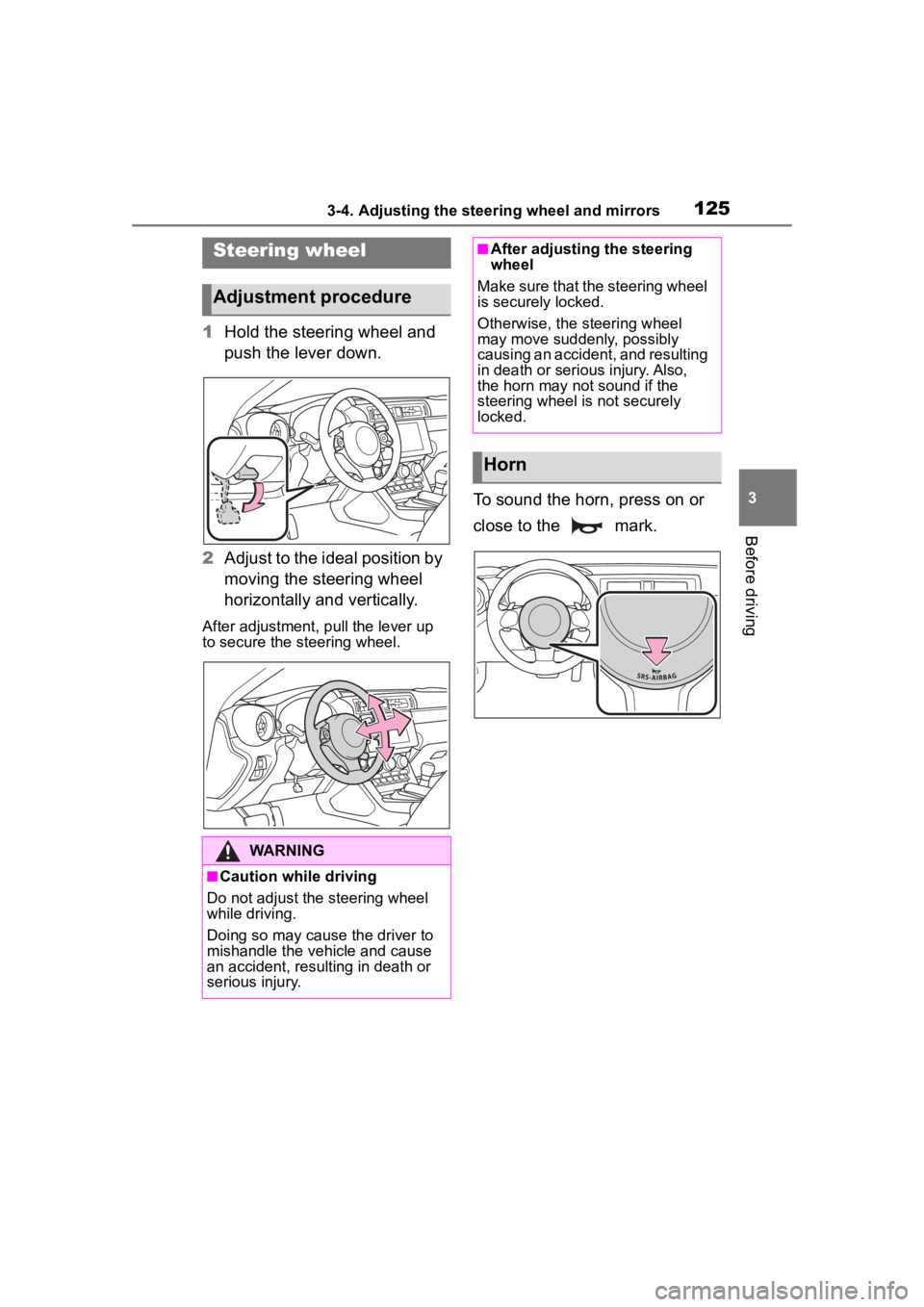
1Hold the steering wheel and
push the lever down.
2 Adjust to the ideal position by
moving the steering wheel
horizontally and vertically.
After adjustment, pull the lever up
to secure the steering wheel.
To sound the horn, press on or
close to the mark.
Steering wheel
Adjustment procedure
WARNING
■Caution while driving
Do not adjust the steering wheel
while driving.
Doing so may cause the driver to
mishandle the vehicle and cause
an accident, resul ting in death or
serious injury.
■After adjusting the steering
wheel
Make sure that the steering wheel
is securely locked.
Otherwise, the steering wheel
may move suddenly, possibly
causing an accident, and resulting
in death or serious injury. Also,
the horn may not sound if the
steering wheel is not securely
locked.
Horn
Page 126 of 449
1263-4. Adjusting the steering wheel and mirrors
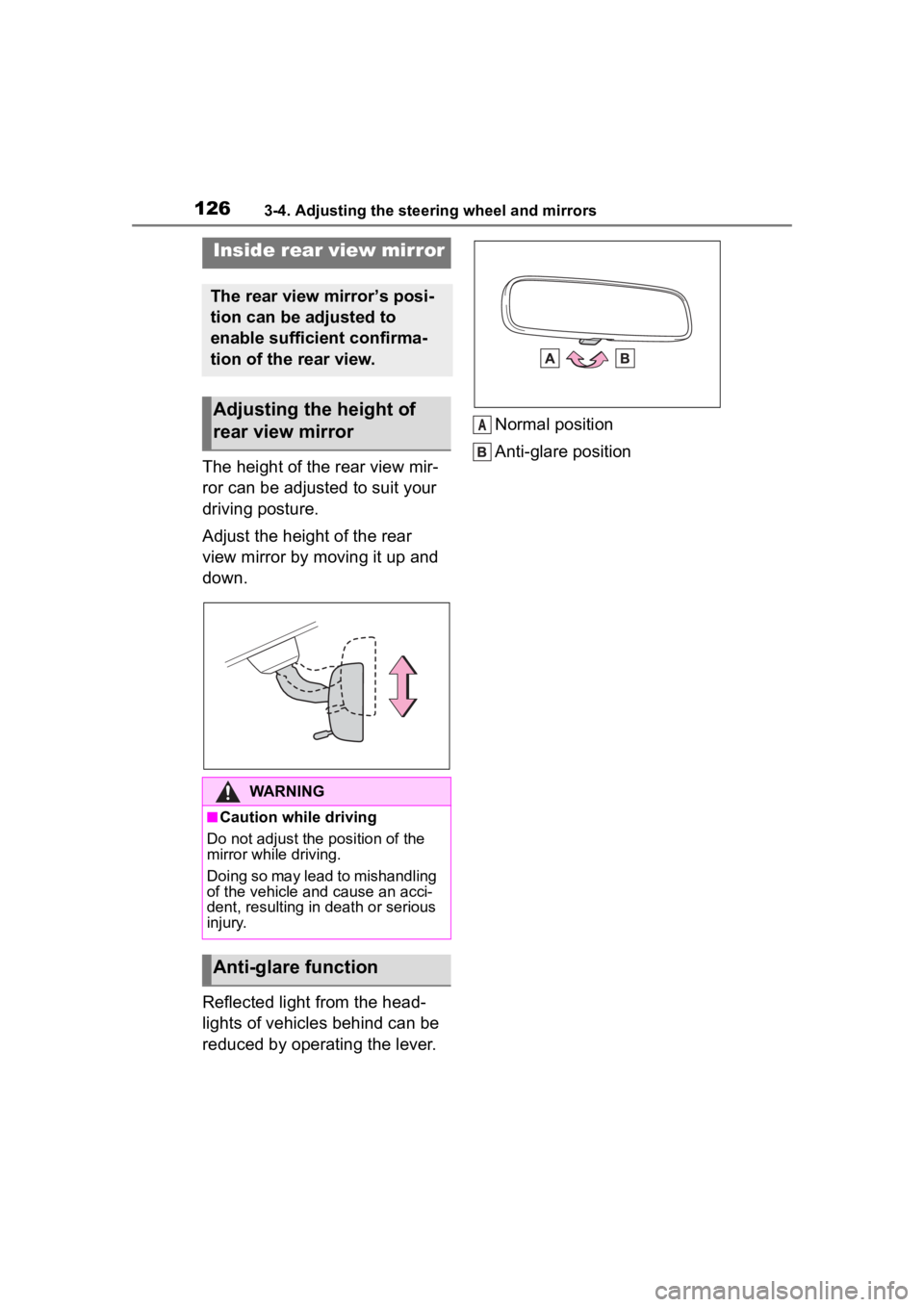
The height of the rear view mir-
ror can be adjusted to suit your
driving posture.
Adjust the height of the rear
view mirror by moving it up and
down.
Reflected light from the head-
lights of vehicles behind can be
reduced by operating the lever.Normal position
Anti-glare position
Inside rear view mirror
The rear view mirror’s posi-
tion can be adjusted to
enable sufficient confirma-
tion of the rear view.
Adjusting the height of
rear view mirror
WARNING
■Caution while driving
Do not adjust the position of the
mirror while driving.
Doing so may lead to mishandling
of the vehicle and cause an acci-
dent, resulting in death or serious
injury.
Anti-glare function
A
Page 127 of 449
1273-4. Adjusting the steering wheel and mirrors
3
Before driving
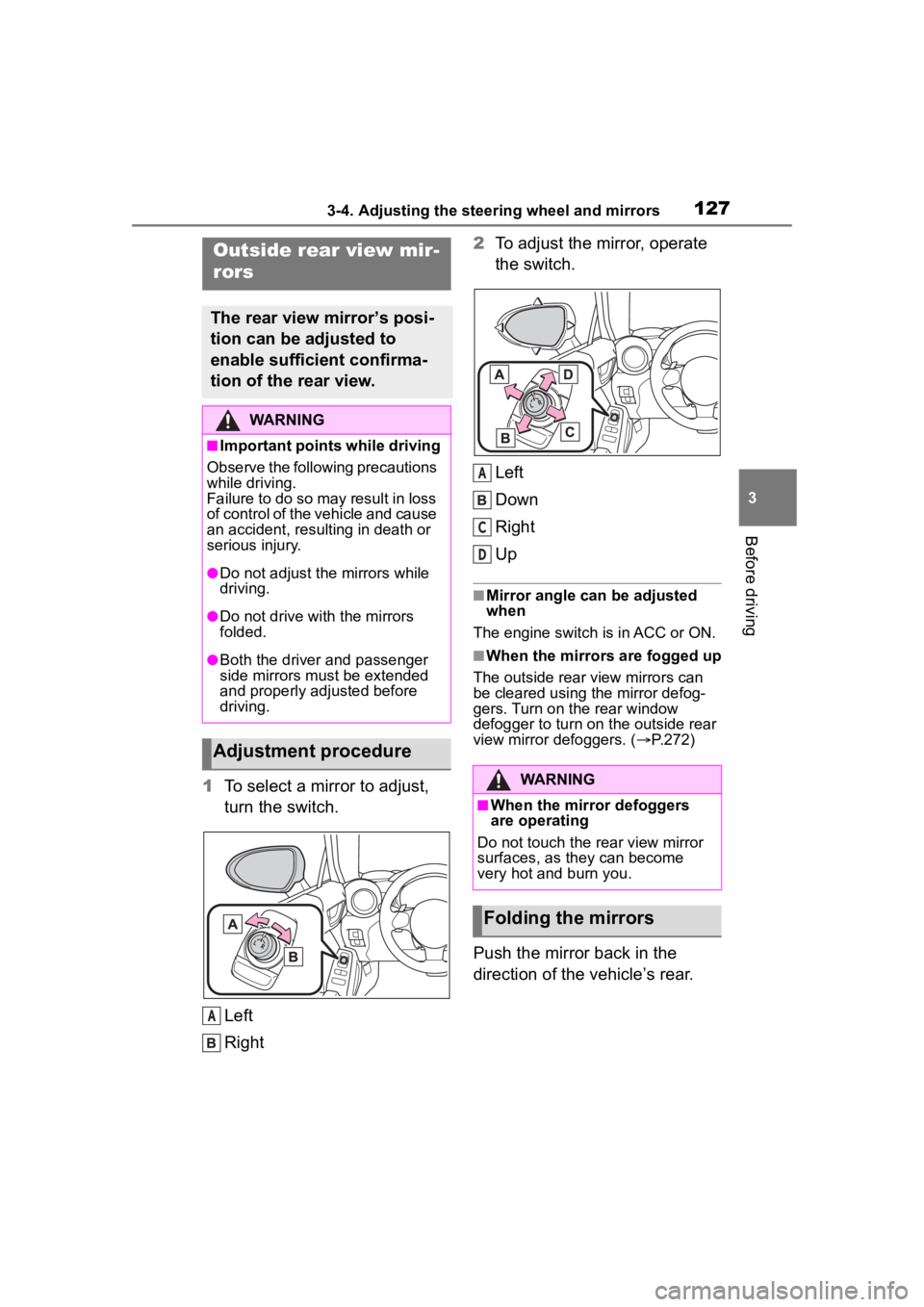
1To select a mirror to adjust,
turn the switch.
Left
Right 2
To adjust the mirror, operate
the switch.
Left
Down
Right
Up
■Mirror angle can be adjusted
when
The engine switch i s in ACC or ON.
■When the mirrors are fogged up
The outside rear view mirrors can
be cleared using the mirror defog-
gers. Turn on the rear window
defogger to turn on the outside rear
view mirror defoggers. ( P.272)
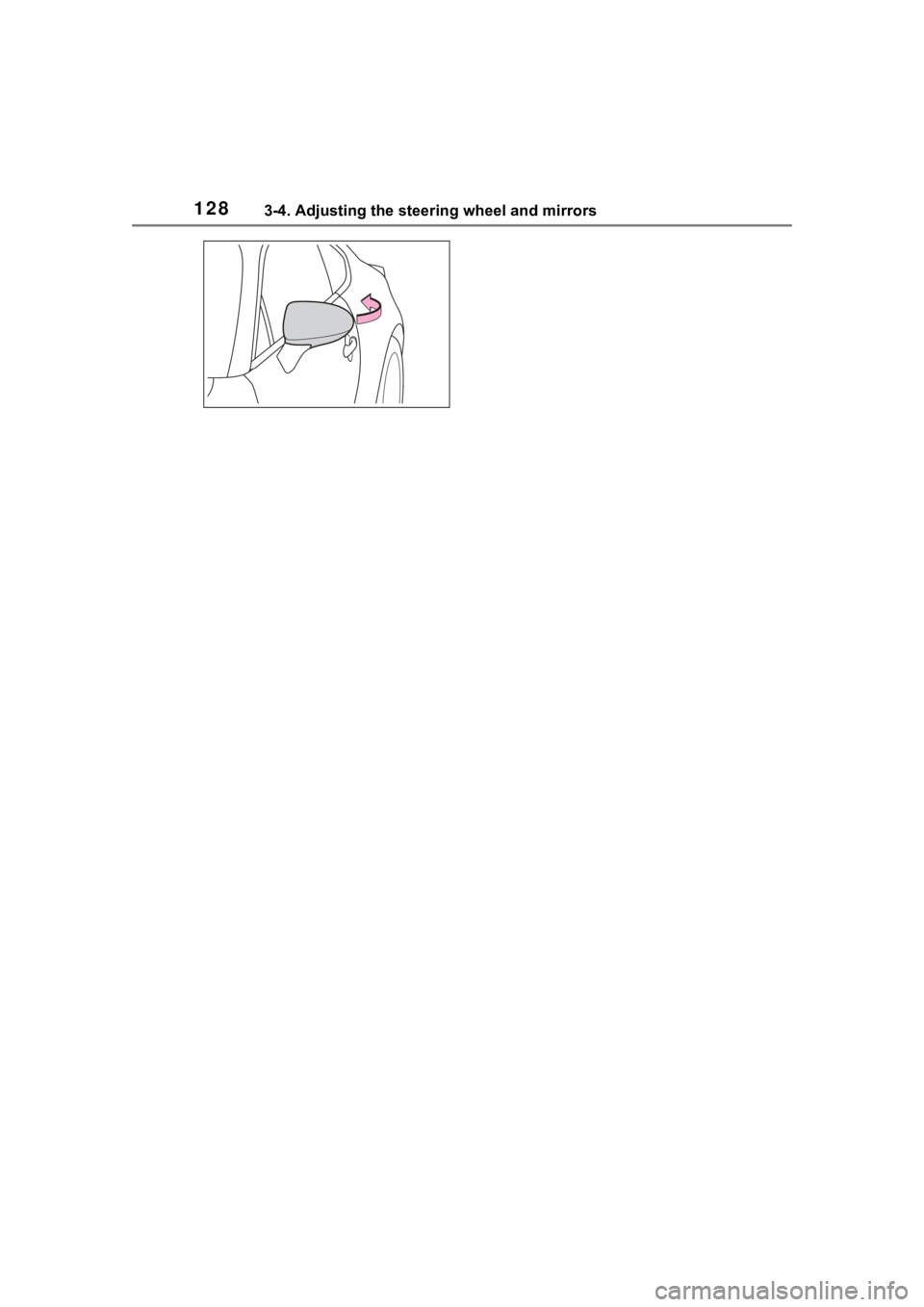
Push the mirror back in the
direction of the vehicle’s rear.
Outside rear view mir-
rors
The rear view mirror’s posi-
tion can be adjusted to
enable sufficient confirma-
tion of the rear view.
WARNING
■Important points while driving
Observe the following precautions
while driving.
Failure to do so may result in loss
of control of the vehicle and cause
an accident, resul ting in death or
serious injury.
●Do not adjust the mirrors while
driving.
●Do not drive with the mirrors
folded.
●Both the driver and passenger
side mirrors must be extended
and properly adjusted before
driving.
Adjustment procedure
A
WARNING
■When the mirror defoggers
are operating
Do not touch the rear view mirror
surfaces, as they can become
very hot and burn you.
Folding the mirrors
A
C
D
Page 128 of 449
1283-4. Adjusting the steering wheel and mirrors
Page 132 of 449
1324-1. Before driving
4-1.Before driving
■Starting the engine
P. 1 4 5
■Driving
Automatic transmission
1 With the brake pedal
depressed, shift the shift
lever to D. ( P.149)
2 Release the parking brake.
( P.156)
3 Gradually release the brake
pedal and gently depress the
accelerator pedal to acceler-
ate the vehicle.
Manual transmission
1 While depressing the clutch
pedal, shift the shift lever to
1. ( P.153)
2 Release the parking brake.
( P.156)
3 Gradually release the clutch
pedal. At the same time, gen-
tly depress the accelerator
pedal to accelerate the vehi-
cle.
■Stopping
Automatic transmission
1 With the shift lever in D,
depress the brake pedal. 2
If necessary, set the parking
brake.
If the vehicle is to be stopped for an
extended period of time, shift the
shift lever to P. ( P.149)
Manual transmission
1 While depressing the clutch
pedal, depress the brake
pedal.
2 If necessary, set the parking
brake.
If the vehicle is to be stopped for an
extended period of time, shift the
shift lever to N. ( P.153)
■Parking the vehicle
Automatic transmission
1 With the shift lever in D,
depress the brake pedal to
stop the vehicle completely.
2 Set the parking brake
( P.156), shift the shift lever
to P. ( P.149)
Check the parking brake indicator
is illuminated.
3 Press the engine switch to
stop the engine.
4 Slowly release the brake
pedal.
5 Lock the door, making sure
that you have the key on your
person.
If parking on a hill, block the wheels
as needed.
Manual transmission
1 While depressing the clutch
pedal, depress the brake
pedal to stop the vehicle
completely.
Driving the vehicle
The following procedures
should be observed to
ensure safe driving:
Driving procedure