child restraint TOYOTA 86 2023 Owners Manual
[x] Cancel search | Manufacturer: TOYOTA, Model Year: 2023, Model line: 86, Model: TOYOTA 86 2023Pages: 449, PDF Size: 8.5 MB
Page 2 of 449
2TABLE OF CONTENTS
For your information ........................5
Reading this manual ...................... 10
How to search ................................ 11
Pictorial index ................................ 12
1-1. For safe use Before driving ........................ 22
For safe driving ..................... 23
Seat belts .............................. 25
SRS airbags .......................... 29
Front passenger occupant clas- sification system.................. 56
Exhaust gas precautions....... 62
1-2. Child safety Riding with children ............... 63
Child restraint systems .......... 64
1-3. Emergency assistance Safety Connect ..................... 75
1-4. Theft deterrent system Engine immobilizer system ... 80
Alarm ..................................... 81
2-1. Instrument cluster Warning lights and indicators............................................ 84
Gauges and meters .............. 88
Multi-information display ....... 93
3-1. Key information Keys ................................... 102
3-2. Opening, closing and locking the doors and trunk
Doors ................................. 105
Trunk .................................. 107Smart key system ..............
111
3-3. Adjusting the seats Front seats ......................... 119
Rear seats.......................... 121
Head restraints................... 123
3-4. Adjusting the steering wheel and mirrors
Steering wheel ................... 125
Inside rear view mirror ....... 126
Outside rear view mirrors ... 127
3-5. Opening, closing the windows Power windows .................. 129
4-1. Before driving Driving the vehicle.............. 132
Cargo and luggage ............ 140
Vehicle load limits .............. 143
Trailer towing...................... 143
Dinghy towing .................... 144
4-2. Driving procedures Engine (ignition) switch ...... 145
Automatic transmission ...... 149
Manual transmission .......... 153
Turn signal lever................. 155
Parking brake ..................... 156
ASC (Active Sound Control) ......................................... 157
4-3. Operating the lights and wip- ers
Headlight switch ................. 158
High Beam Assist ............... 16
2
Windshield wipers an
d washer
......................................... 165
4-4. Refueling Opening the fuel tank cap .. 167
4-5. EyeSight EyeSight............................. 170
1For safety and security
2Vehicle status information
and indicators
3Before driving
4Driving
Page 21 of 449

21
1
1
For safety and security
For safety and security
.1-1. For safe useBefore driving ................. 22
For safe driving .............. 23
Seat belts ....................... 25
SRS airbags ................... 29
Front passenger occupant classification system .... 56
Exhaust gas precautions ..................................... 62
1-2. Child safety Riding with children ........ 63
Child restraint systems... 64
1-3. Emergency assistance Safety Connect .............. 75
1-4. Theft deterrent system Engine immobilizer system..................................... 80
Alarm.............................. 81
Page 24 of 449

241-1. For safe use
Make sure that all occupants are
wearing their seat belts before
driving the vehicle. (P.25)
Use a child restraint system
appropriate for the child until the child becomes large enough to
properly wear the vehicle’s seat
belt. (
P.64)
Make sure that you can see
backward clearly by adjusting
the inside and outside rear view
mirrors properly. ( P.126, 127)
WARNING
■For safe driving
Observe the following precau-
tions.
Failure to do so m ay result in
death or serious injury.
●Do not adjust the position of the
driver’s seat while driving.
Doing so could cause the driver
to lose control of the vehicle.
●Do not place a cushion between
the driver or passenger and the
seatback.
A cushion may prevent correct
posture from being achieved,
and reduce the effectiveness of
the seat belt and head restraint.
●Do not place anything under the
front seats.
Objects placed under the front
seats may become jammed in
the seat tracks and stop the
seat from locking in place. This
may lead to an accident and the
adjustment mechanism may
also be damaged.
●Always observe the legal speed
limit when driving on public
roads.
●When driving over long dis-
tances, take regular breaks
before you start to feel tired.
Also, if you feel tired or sleepy
while driving, do not force your-
self to continue driving and take
a break immediately.
Correct use of the seat
belts
Adjusting the mirrors
Page 25 of 449
251-1. For safe use
1
For safety and security
Seat belts
Make sure that all occu-
pants are wearing their seat
belts before driving the
vehicle.
WARNING
Observe the following precautions
to reduce the risk of injury in the
event of sudden braking, sudden
swerving or an accident.
Failure to do so may cause death
or serious injury.
■Wearing a seat belt
●Ensure that all passengers wear
a seat belt.
●Always wear a seat belt prop-
erly.
●Each seat belt should be used
by one person only. Do not use
a seat belt for more than one
person at once, including chil-
dren.
●Toyota recommends that chil-
dren be seated in the rear seat
and always use a seat belt
and/or an appropriate child
restraint system.
●To achieve a proper seating
position, do not recline the seat
more than necessary. The seat
belt is most effective when the
occupants are sitting up straight
and well back in the seats.
●Do not wear the shoulder belt
under your arm.
●Always wear your seat belt low
and snug across your hips.
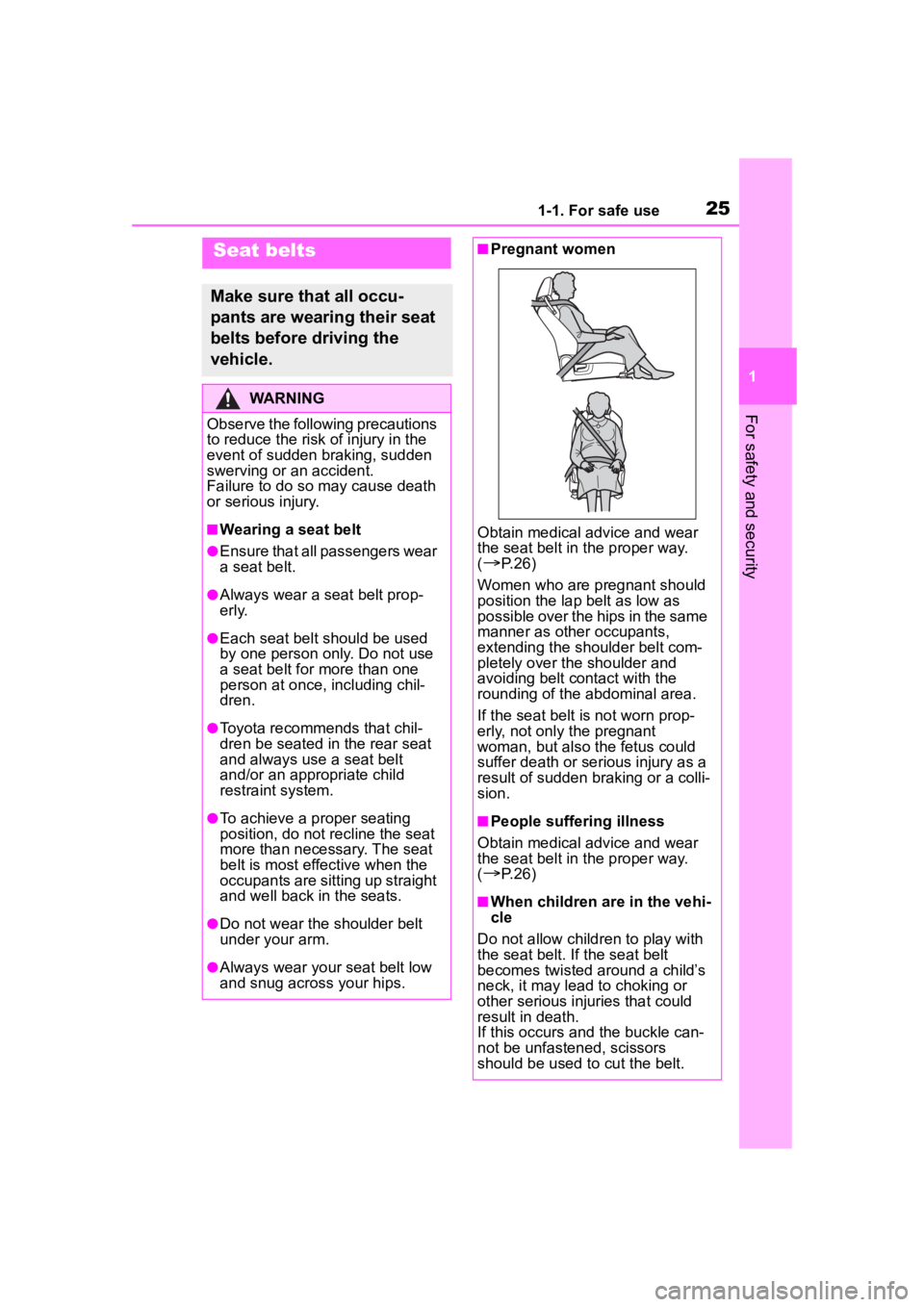
■Pregnant women
Obtain medical advice and wear
the seat belt in the proper way.
(
P. 2 6 )
Women who are pregnant should
position the lap belt as low as
possible over the hips in the same
manner as other occupants,
extending the shoulder belt com-
pletely over the shoulder and
avoiding belt contact with the
rounding of the abdominal area.
If the seat belt is not worn prop-
erly, not only the pregnant
woman, but also the fetus could
suffer death or serious injury as a
result of sudden braking or a colli-
sion.
■People suffering illness
Obtain medical advice and wear
the seat belt in the proper way.
(
P. 2 6 )
■When children are in the vehi-
cle
Do not allow children to play with
the seat belt. If the seat belt
becomes twisted around a child’s
neck, it may lead to choking or
other serious injuries that could
result in death.
If this occurs and the buckle can-
not be unfastened, scissors
should be used to cut the belt.
Page 26 of 449
261-1. For safe use
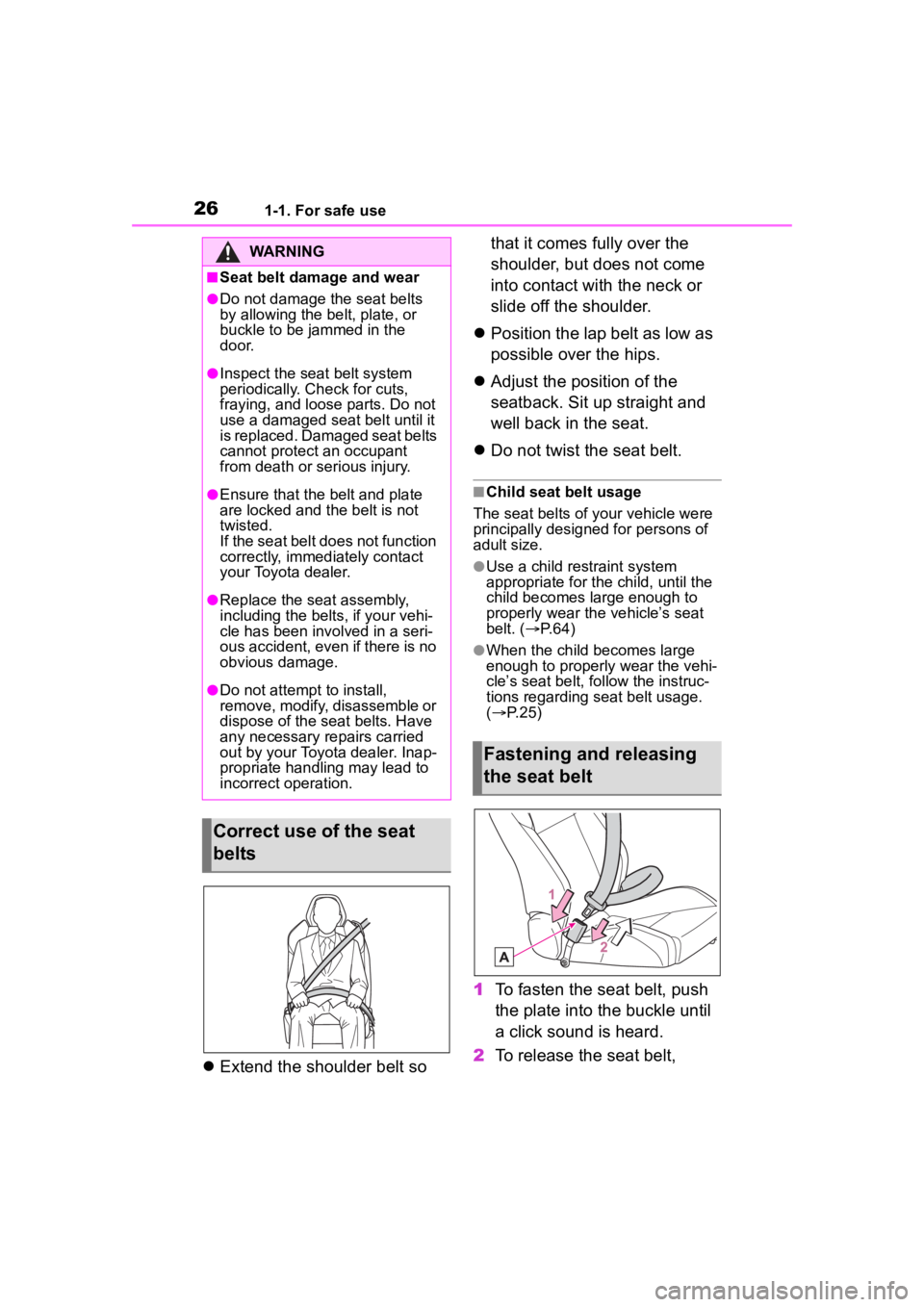
Extend the shoulder belt so that it comes fully over the
shoulder, but does not come
into contact with the neck or
slide off the shoulder.
Position the lap belt as low as
possible over the hips.
Adjust the position of the
seatback. Sit up straight and
well back in the seat.
Do not twist the seat belt.
■Child seat belt usage
The seat belts of your vehicle were
principally designed for persons of
adult size.
●Use a child restraint system
appropriate for the child, until the
child becomes large enough to
properly wear the vehicle’s seat
belt. ( P. 6 4 )
●When the child becomes large
enough to properl y wear the vehi-
cle’s seat belt, follow the instruc-
tions regarding seat belt usage.
( P. 2 5 )
1 To fasten the seat belt, push
the plate into the buckle until
a click sound is heard.
2 To release the seat belt,
WARNING
■Seat belt damage and wear
●Do not damage the seat belts
by allowing the belt, plate, or
buckle to be jammed in the
door.
●Inspect the seat belt system
periodically. Check for cuts,
fraying, and loose parts. Do not
use a damaged sea t belt until it
is replaced. Damaged seat belts
cannot protect an occupant
from death or serious injury.
●Ensure that the belt and plate
are locked and the belt is not
twisted.
If the seat belt does not function
correctly, immediately contact
your Toyota dealer.
●Replace the seat assembly,
including the belts, if your vehi-
cle has been involved in a seri-
ous accident, even if there is no
obvious damage.
●Do not attempt to install,
remove, modify, disassemble or
dispose of the seat belts. Have
any necessary repairs carried
out by your Toyota dealer. Inap-
propriate handling may lead to
incorrect operation.
Correct use of the seat
belts
Fastening and releasing
the seat belt
Page 27 of 449
271-1. For safe use
1
For safety and security
press the release button .
■Emergency locking retractor
(ELR)
The retractor will lock the belt during
a sudden stop or on impact. It may
also lock if you lean forward too
quickly. When the seat belt locks,
pull the belt str ongly and then
release the belt, then a slow and
easy pulling will allow the belt to
extend.
■Automatic locking retractor
(ALR)
When a passenger’s shoulder belt is
completely extended and then
retracted even slightly, the belt is
locked in that position and cannot
be extended. This feature is used to
hold a child restraint system (CRS)
firmly. To free the belt again, fully
retract the belt and then pull the belt
out once more. ( P. 6 4 )
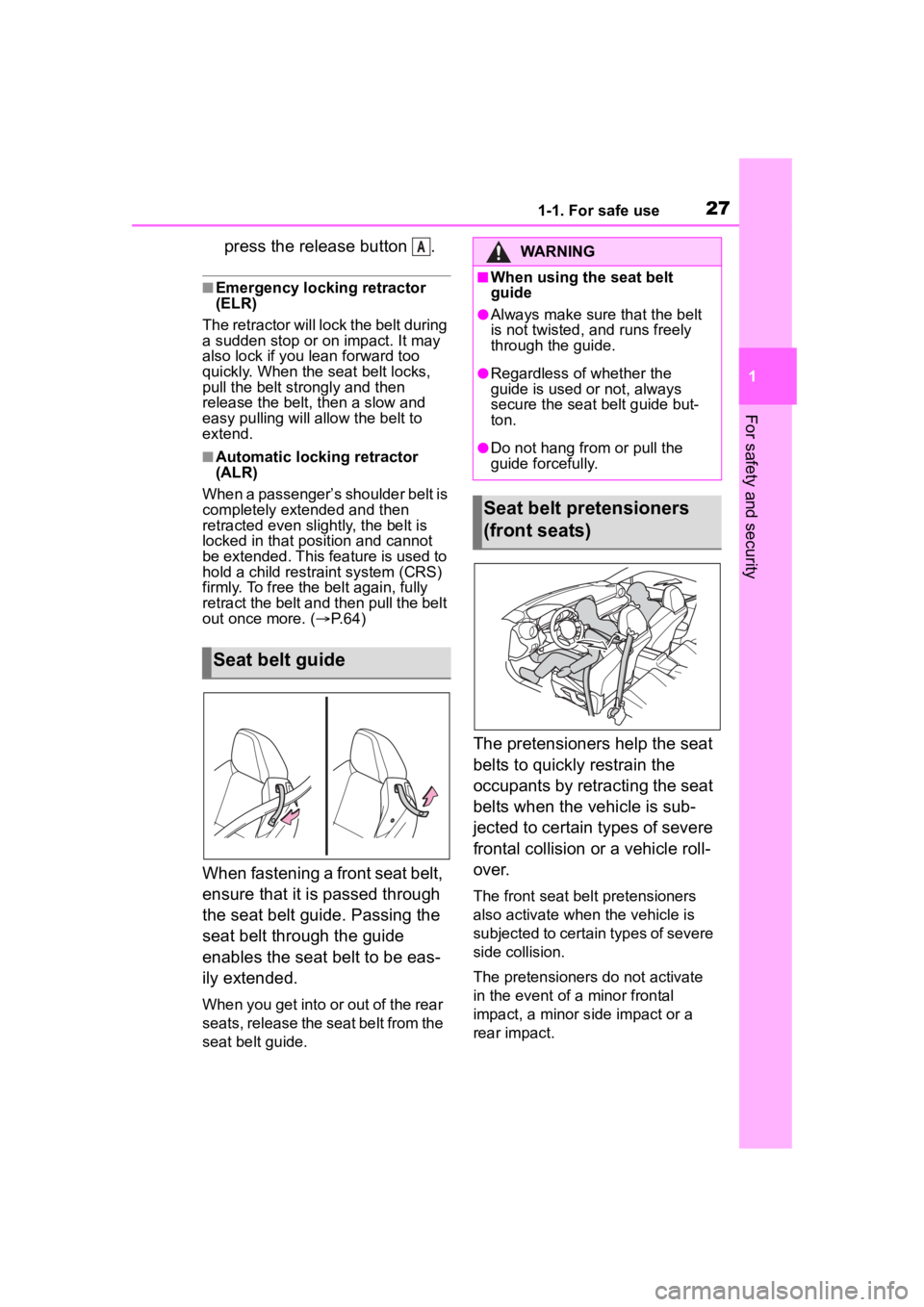
When fastening a front seat belt,
ensure that it is passed through
the seat belt guide. Passing the
seat belt through the guide
enables the seat belt to be eas-
ily extended.
When you get into or out of the rear
seats, release the seat belt from the
seat belt guide.
The pretensioners help the seat
belts to quickly restrain the
occupants by retracting the seat
belts when the vehicle is sub-
jected to certain types of severe
frontal collision or a vehicle roll-
over.
The front seat belt pretensioners
also activate when the vehicle is
subjected to certain types of severe
side collision.
The pretensioners do not activate
in the event of a minor frontal
impact, a minor s ide impact or a
rear impact.
Seat belt guide
AWARNING
■When using the seat belt
guide
●Always make sure that the belt
is not twisted, and runs freely
through the guide.
●Regardless of whether the
guide is used or not, always
secure the seat belt guide but-
ton.
●Do not hang fr om or pull the
guide forcefully.
Seat belt pretensioners
(front seats)
Page 36 of 449
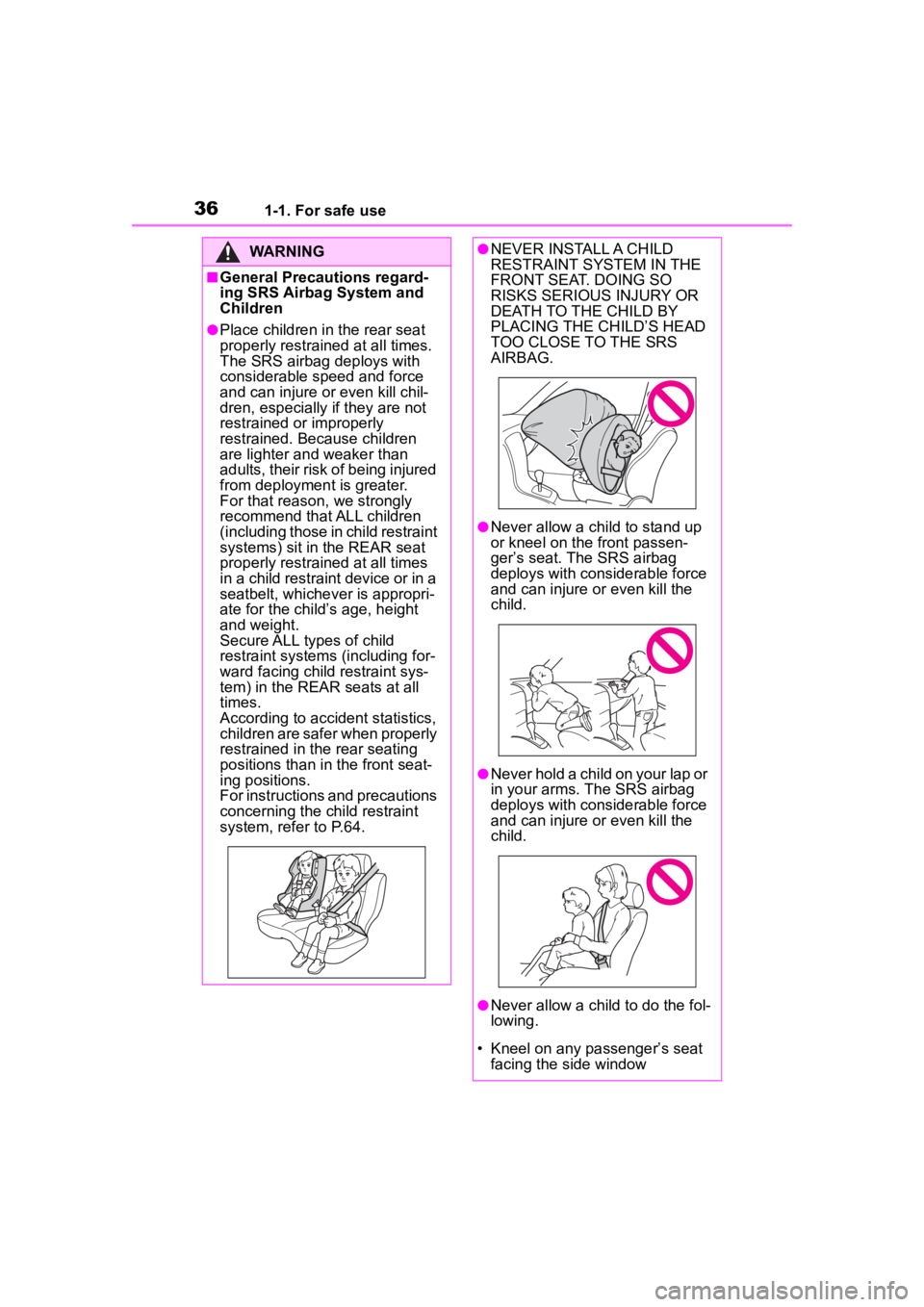
361-1. For safe use
WARNING
■General Precautions regard-
ing SRS Airbag System and
Children
●Place children in the rear seat
properly restrained at all times.
The SRS airbag deploys with
considerable speed and force
and can injure or even kill chil-
dren, especially if they are not
restrained or improperly
restrained. Because children
are lighter and weaker than
adults, their risk of being injured
from deployment is greater.
For that reason, we strongly
recommend that ALL children
(including those in child restraint
systems) sit in the REAR seat
properly restrained at all times
in a child restraint device or in a
seatbelt, whichever is appropri-
ate for the child’s age, height
and weight.
Secure ALL types of child
restraint systems (including for-
ward facing child restraint sys-
tem) in the REAR seats at all
times.
According to accident statistics,
children are safer when properly
restrained in the rear seating
positions than in the front seat-
ing positions.
For instructions and precautions
concerning the child restraint
system, refer to P.64.
●NEVER INSTALL A CHILD
RESTRAINT SYSTEM IN THE
FRONT SEAT. DOING SO
RISKS SERIOUS INJURY OR
DEATH TO THE CHILD BY
PLACING THE CHILD’S HEAD
TOO CLOSE TO THE SRS
AIRBAG.
●Never allow a child to stand up
or kneel on the front passen-
ger’s seat. The SRS airbag
deploys with considerable force
and can injure o r even kill the
child.
●Never hold a child on your lap or
in your arms. The SRS airbag
deploys with considerable force
and can injure o r even kill the
child.
●Never allow a child to do the fol-
lowing.
• Kneel on any passenger’s seat facing the side window
Page 39 of 449

391-1. For safe use
1
For safety and security
This vehicle is equipped with a
Toyota advanced frontal airbag
system that complies with the
advanced frontal airbag require-
ments in the amended Federal
Motor Vehicle Safety Standard
(FMVSS) No. 208.
The Toyota advanced frontal air-
bag system automatically deter-
mines the deployment force of
the driver’s SRS frontal airbag at
the time of deployment as well
as whether or not to activate the
front passenger’s SRS frontal
airbag and, if activated, the
deployment force of the SRS
frontal airbag at the time of
deployment.
Always wear your seatbelt. The
Toyota advanced frontal airbag
system is a supplemental
restraint system and must be
used in combination with a seat-
belt. All occupants should wear
a seatbelt or be seated in an appropriate child restraint sys-
tem.
For the locations of the SRS air-
bags, refer to P.29.
In a moderate to severe frontal
collision, the following compo-
nents deploy.
SRS frontal airbag for driver
SRS frontal airbag for front
passenger
SRS curtain shield airbag
*
SRS knee airbag for driver
*: When an offset frontal collision
that is severe enough to deploy
the front airbag occurs.
These components supplement
the seatbelts by reducing the
impact to the occupant’s head,
chest and knees.
■Driver’s SRS frontal airbag
The driver’s SRS frontal airbag
uses a dual stage inflator. The
inflator operates in different
ways depending on the severity
of impact.
■Front passenger’s SRS
frontal airbag
The front passenger’s SRS fron-
tal airbag uses a dual stage
inflator. The inflator operates in
different ways depending on the
severity of impact.
■Occupant detection system
The occupant detection system
sensors are installed between
the seat and seat rails, and
NOTICE
• Between the rear seat cushion and rear wheel house on each
side
●In the event that the SRS airbag
is deployed, replacement of the
system should be performed
only by an auth orized Toyota
dealer. When the components
of the SRS airbag system are
replaced, use only genuine Toy-
ota parts.
Toyota Advanced Frontal
Airbag System
Page 45 of 449

451-1. For safe use
1
For safety and security
■Warning labels and tag
This vehicle has warning labels on
the driver’s and front passenger’s
sun visors beginning with the
phrase “EVEN WITH ADVANCED
AIR BAGS” and a tag attached to
the glove box lid beginning with the
phrase “Even with Advanced Air
Bags”. Make sure that you carefully
read the instructions on the warning
labels and tag.
■Toyota advanced frontal airbag
system
●The SRS side airbag and seatbelt
pretensioner are not controlled by
the Toyota advanced frontal air-
bag system.
●The front passenger’s SRS side
airbag and SRS curtain shield air-
bag are not controlled by the Toy-
ota advanced frontal airbag
system.
■Conditions in which front pas-
senger’s SRS frontal airbag is
not activated
The front passenger’s SRS frontal
airbag will not be activated when
any of the following conditions are
met regarding the front passenger’s
seat:
●The seat is empty.
●The seat is equipped with an
appropriate child restraint system
and an infant or a child is
restrained in i t. (See WARNING
that follows.)
●The front passenger’s occupant
detection system is malfunction-
ing.
■Conditions in which front pas-
senger’s SRS frontal airbag is
activated
The front passenge r’s SRS frontal
airbag will be activ ated for deploy-
ment upon impact when any of the
following conditions are met regard-
ing the front passenger’s seat.
●When the seat is occupied by an
adult.
●When certain items (e.g. jug of
water) are plac ed on the seat.
■If the front passenger’s frontal
airbag ON indicator illuminates
and the OFF indicator turns off
If you think that the Front passen-
ger's frontal airb ag ON/OFF indica-
tor is incorrect, take the following
actions.
●Ensure that no article is placed on
the seat other than the occupant.
●Ensure that the backward-forward
position and seatback of front pas-
senger’s seat are locked into
place securely by moving the seat
back and forth.
If the ON indicator still remains illu-
minated while the OFF indicator
turns off after taking relevant correc-
tive actions descr ibed above, imme-
diately contact your Toyota dealer
for an inspection.
Even if the system has passed the
dealer inspection, it is recom-
mended that on subsequent trips
the small adult alwa ys take the rear
seat.
Page 46 of 449

461-1. For safe use
■If the passenger’s frontal airbag
OFF indicator illuminates and
the ON indicator turns off even
when the front passenger’s seat
is occupied by an adult
This can be caused by the adult
incorrectly sitting in the front pas-
senger’s seat.
1 Turn the engine switch off.
2 Ask the front passenger to set
the seatback to the upright posi-
tion, sit up straight in the center
of the seat cushion, correctly fas-
ten the seatbelt, position his/her
legs out forward, and adjust the
seat to the rearmost position.
3 Turn the engine switch to ON.
If the OFF indicator remains illumi-
nated while the ON indicator
remains off, take the following
actions.
1 Turn the engine switch off.
2 Make sure that the front passen-
ger does not use a blanket, extra
seat cushion, sea t cover, extra
seat heater or massager, etc.
3 If wearing excessive layers of
clothing, the front passenger
should remove any unnecessary
items before sitting in the front
passenger’s seat, or should sit in
a rear seat.
4 Turn the engine switch to ON
and wait 6 seconds to allow the
system to complete self-check-
ing. Following the system check,
both indicators turn off for 2 sec-
onds. Now, the ON indicator
should illuminate while the OFF
indicator remains off.
If the OFF indicator still remains illu-
minated while the ON indicator
remains off, ask the occupant to
move to the rear seat and immedi-
ately contact your Toyota dealer for
an inspection.■If the seatbelt buckle switch
and/or front passenger’s occu-
pant detection system have
failed
If the seatbelt buckle switch and/or
front passenger’s occupant detec-
tion system have failed, the SRS
warning light will illuminate. Have
the system inspected by your Toyota
dealer immediately if the SRS warn-
ing light illuminates.
■When to contact your Toyota
dealer
If your vehicle has sustained impact,
this may affect the proper function of
the Toyota advanced frontal airbag
system. Have your vehicle
inspected at your Toyota dealer. Do
not use the front passenger’s seat
while driving the vehicle to your Toy-
ota dealer.
WARNING
■When using a child restraint
system
NEVER INSTALL A CHILD
RESTRAINT SYSTEM IN THE
FRONT PASSENGER’S SEAT
EVEN IF THE FRONT PASSEN-
GER’S SRS FRONTAL AIRBAG
IS DEACTIVATED. Be sure to
install it in the REAR seat in a cor-
rect manner. Also, it is strongly
recommended that any forward
facing child seat or booster seat
be installed in the REAR seat, and
that even children who have out-
grown a child restraint system be
also seated in the REAR seat.
This is because children sitting in
the front passenger’s seat may be
killed or severely injured should
the front passenger’s SRS frontal
airbag deploy. REAR seats are
the safest place for children.