sensor TOYOTA AURIS 2012 (in English) Owner's Manual
[x] Cancel search | Manufacturer: TOYOTA, Model Year: 2012, Model line: AURIS, Model: TOYOTA AURIS 2012Pages: 750, PDF Size: 20.05 MB
Page 311 of 750
3094-3. Operating the lights and wipers
UK_AURIS/AURIS_HV_EE (OM12E33E)
4
Driving
CAUTION
Limitations of the Automatic High Beam
Do not rely on the Automatic High Beam. Always drive safely, taking care to
observe your surroundings and turning high beam on or off manually if nec-
essary.
NOTICE
Notes when using the Automatic High Beam system
Do not touch the camera sensor.
Do not subject the inside rear view mirror or the camera sensor to a strong
impact.
Do not disassemble the camera sensor.
Do not spill liquid onto the inside rear view mirror or the camera sensor.
Do not apply window tinting or stickers to the camera sensor or the area of
windshield near the camera sensor.
Do not place items on the dashboard. There is a possibility that the cam-
era sensor will mistake items reflected in the windshield for streetlights,
the headlights of other vehicles, etc.
Do not install a parking tag or any other accessories near or around the
inside rear view mirror and the camera sensor.
Do not overload the vehicle.
Do not modify the vehicle.
Do not replace windshield with non-genuine windshield.
Contact any authorized Toyota dealer or repairer, or another duly qualified
and equipped professional.
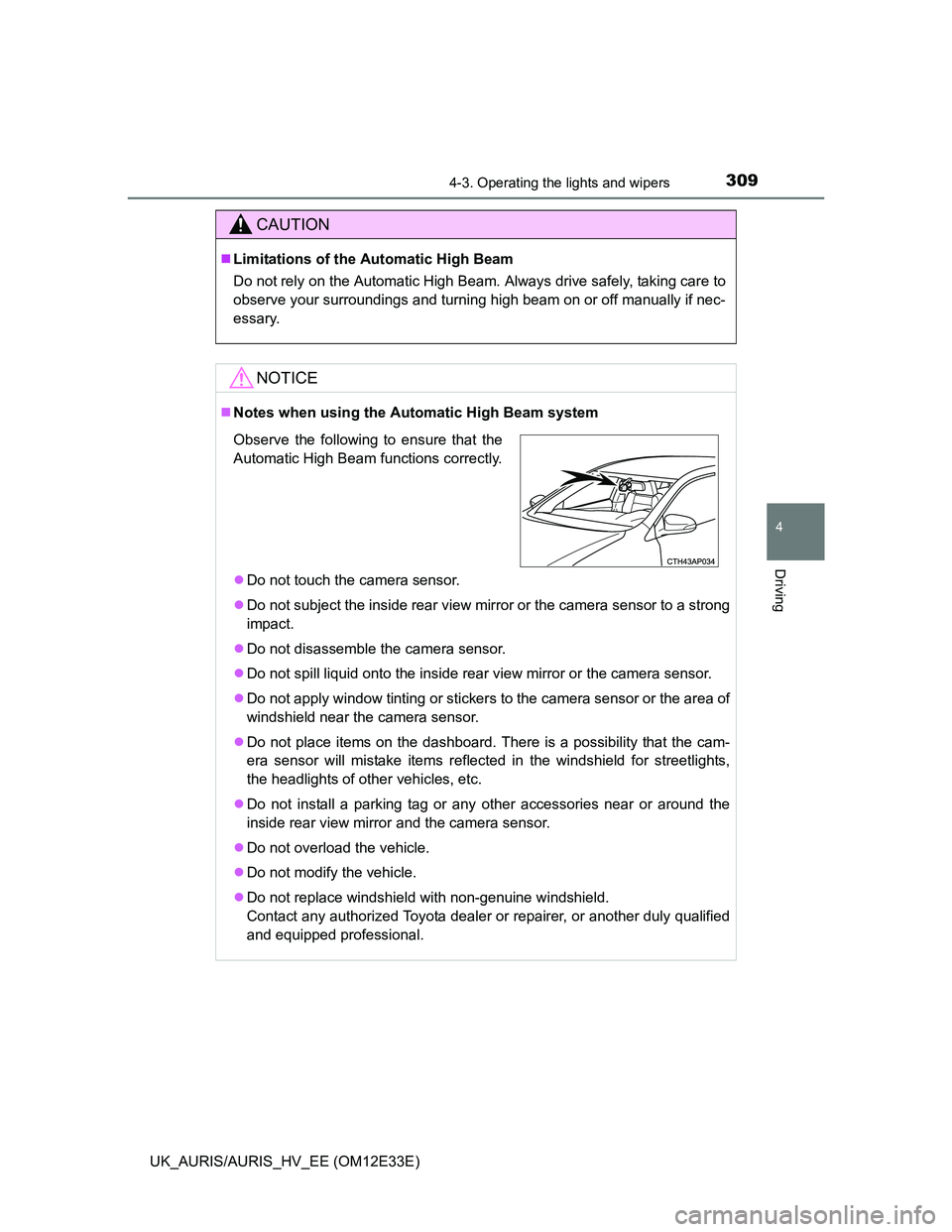
Observe the following to ensure that the
Automatic High Beam functions correctly.
Page 315 of 750
3134-3. Operating the lights and wipers
UK_AURIS/AURIS_HV_EE (OM12E33E)
4
Driving
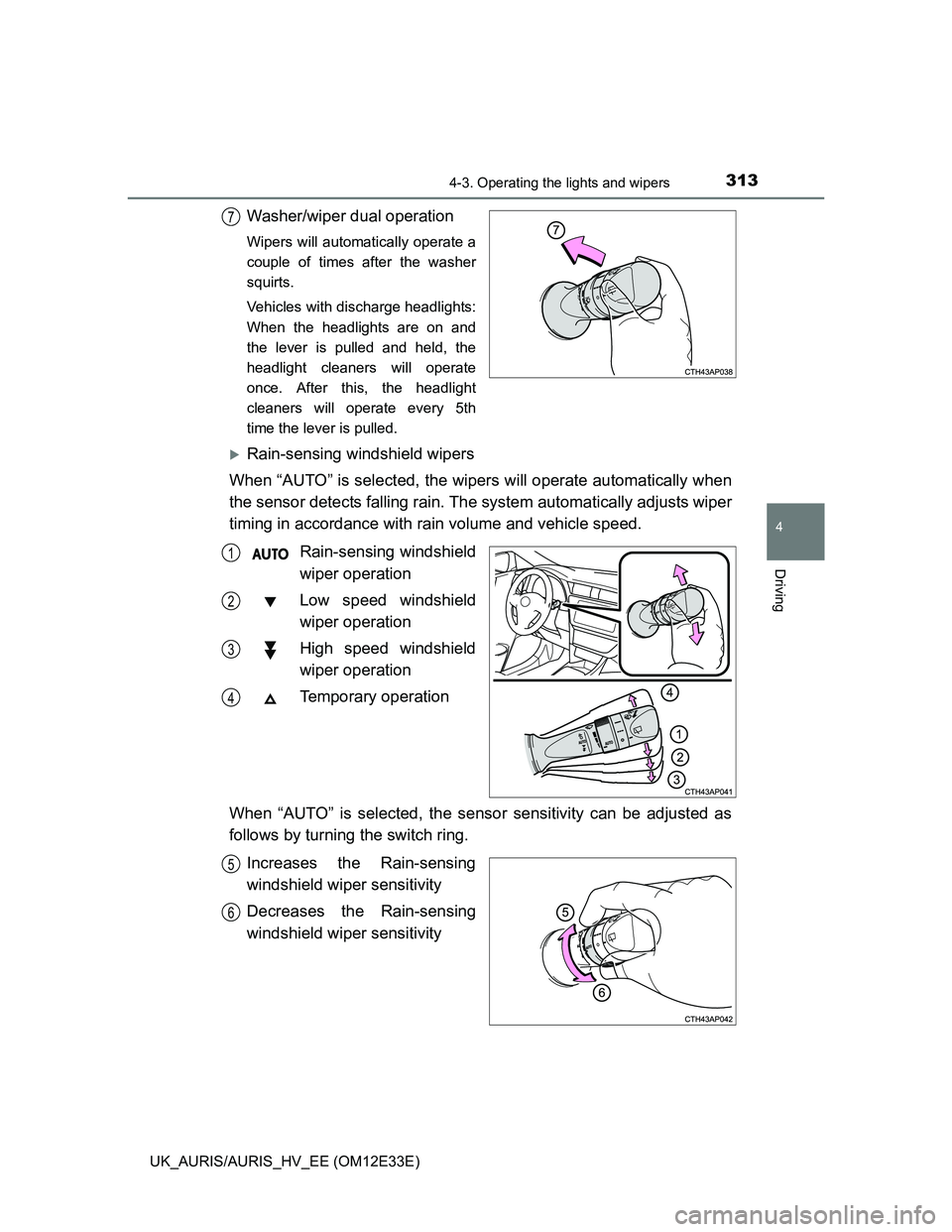
Washer/wiper dual operation
Wipers will automatically operate a
couple of times after the washer
squirts.
Vehicles with discharge headlights:
When the headlights are on and
the lever is pulled and held, the
headlight cleaners will operate
once. After this, the headlight
cleaners will operate every 5th
time the lever is pulled.
Rain-sensing windshield wipers
When “AUTO” is selected, the wipers will operate automatically when
the sensor detects falling rain. The system automatically adjusts wiper
timing in accordance with rain volume and vehicle speed.
Rain-sensing windshield
wiper operation
Low speed windshield
wiper operation
High speed windshield
wiper operation
Temporary operation
When “AUTO” is selected, the sensor sensitivity can be adjusted as
follows by turning the switch ring.
Increases the Rain-sensing
windshield wiper sensitivity
Decreases the Rain-sensing
windshield wiper sensitivity
7
1
2
3
4
5
6
Page 316 of 750
3144-3. Operating the lights and wipers
UK_AURIS/AURIS_HV_EE (OM12E33E)
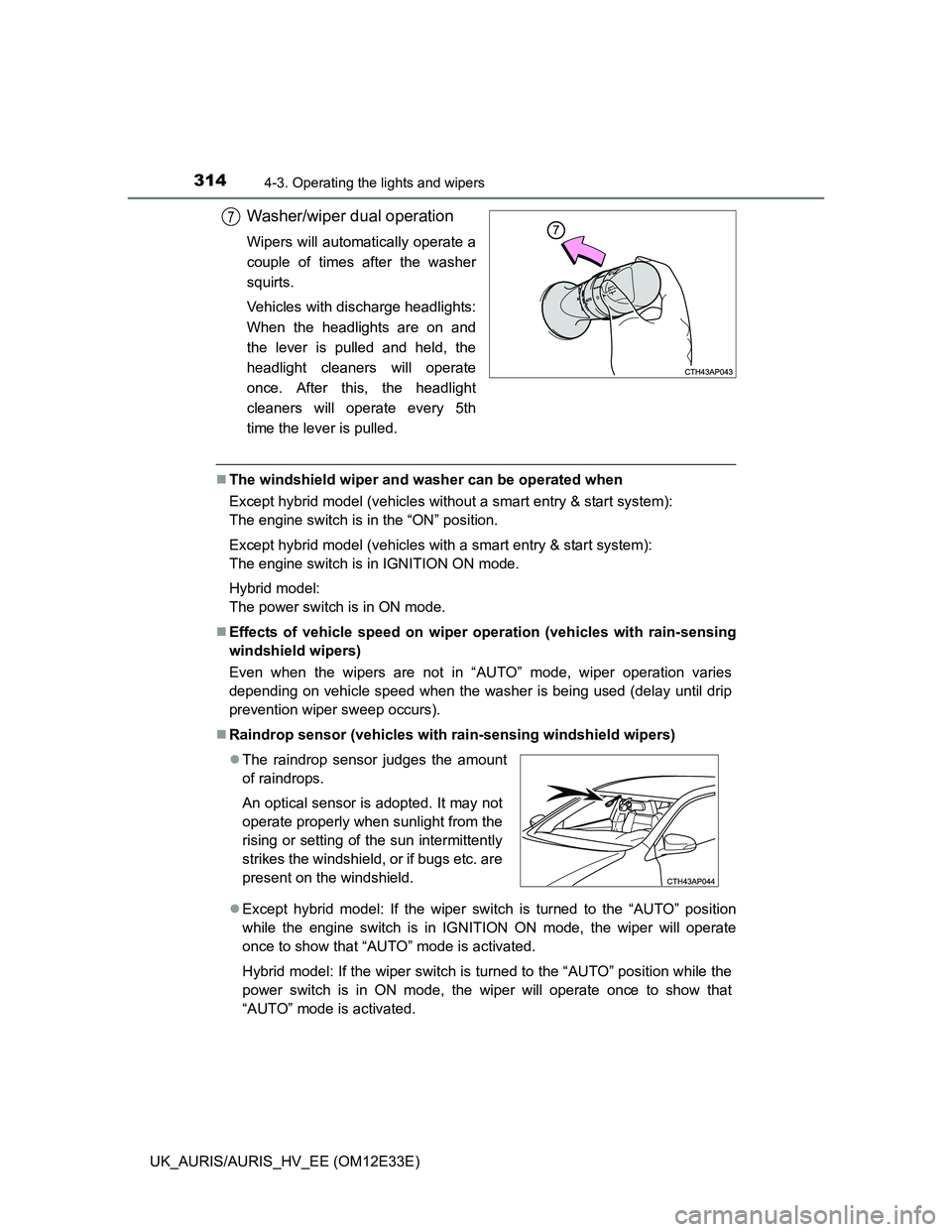
Washer/wiper dual operation
Wipers will automatically operate a
couple of times after the washer
squirts.
Vehicles with discharge headlights:
When the headlights are on and
the lever is pulled and held, the
headlight cleaners will operate
once. After this, the headlight
cleaners will operate every 5th
time the lever is pulled.
The windshield wiper and washer can be operated when
Except hybrid model (vehicles without a smart entry & start system):
The engine switch is in the “ON” position.
Except hybrid model (vehicles with a smart entry & start system):
The engine switch is in IGNITION ON mode.
Hybrid model:
The power switch is in ON mode.
Effects of vehicle speed on wiper operation (vehicles with rain-sensing
windshield wipers)
Even when the wipers are not in “AUTO” mode, wiper operation varies
depending on vehicle speed when the washer is being used (delay until drip
prevention wiper sweep occurs).
Raindrop sensor (vehicles with rain-sensing windshield wipers)
Except hybrid model: If the wiper switch is turned to the “AUTO” position
while the engine switch is in IGNITION ON mode, the wiper will operate
once to show that “AUTO” mode is activated.
Hybrid model: If the wiper switch is turned to the “AUTO” position while the
power switch is in ON mode, the wiper will operate once to show that
“AUTO” mode is activated.
7
The raindrop sensor judges the amount
of raindrops.
An optical sensor is adopted. It may not
operate properly when sunlight from the
rising or setting of the sun intermittently
strikes the windshield, or if bugs etc. are
present on the windshield.
Page 317 of 750
3154-3. Operating the lights and wipers
UK_AURIS/AURIS_HV_EE (OM12E33E)
4
Driving
If the temperature of the raindrop sensor is 90C (194F) or higher, or -15C
(5F) or lower, automatic operation may not occur. In this case, operate the
wipers in any mode other than “AUTO”.
If no windshield washer fluid sprays
Check that the washer nozzles are not blocked if there is washer fluid in the
windshield washer fluid reservoir.
CAUTION
Caution regarding the use of washer fluid
When it is cold, do not use the washer fluid until the windshield becomes
warm. The fluid may freeze on the windshield and cause low visibility. This
may lead to an accident, resulting in death or serious injury.
Caution regarding the use of windshield wipers in “AUTO” mode (vehi-
cles with rain-sensing windshield wipers)
The windshield wipers may operate unexpectedly if the sensor is touched or
the windshield is subject to vibration in “AUTO” mode. Take care that your
fingers etc. do not become caught in the windshield wipers.
NOTICE
When the windshield is dry
Do not use the wipers, as they may damage the windshield.
When there is no washer fluid spray from the nozzle
Damage to the washer fluid pump may be caused if the lever is pulled
toward you and held continually.
When a nozzle becomes blocked
In this case, contact any authorized Toyota dealer or repairer, or another
duly qualified and equipped professional.
Do not try to clear it with a pin or other object. The nozzle will be damaged.
Page 332 of 750
3304-5. Using the driving support systems
UK_AURIS/AURIS_HV_EE (OM12E33E)
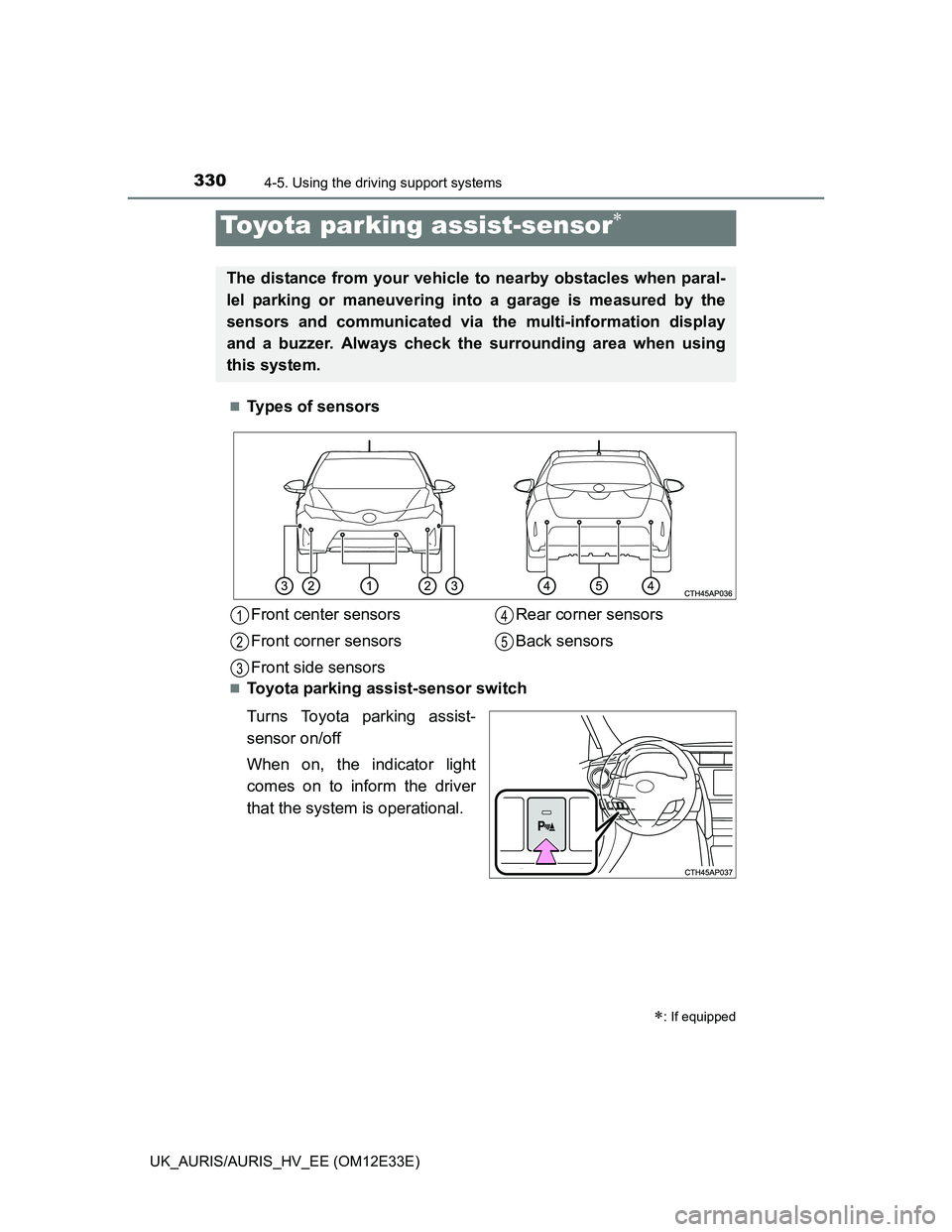
Types of sensors
Toyota parking assist-sensor switch
Turns Toyota parking assist-
sensor on/off
When on, the indicator light
comes on to inform the driver
that the system is operational.
Toyota parking assist-sensor
: If equipped
The distance from your vehicle to nearby obstacles when paral-
lel parking or maneuvering into a garage is measured by the
sensors and communicated via the multi-information display
and a buzzer. Always check the surrounding area when using
this system.
Front center sensors
Front corner sensors
Front side sensorsRear corner sensors
Back sensors1
2
3
4
5
Page 333 of 750
3314-5. Using the driving support systems
UK_AURIS/AURIS_HV_EE (OM12E33E)
4
Driving
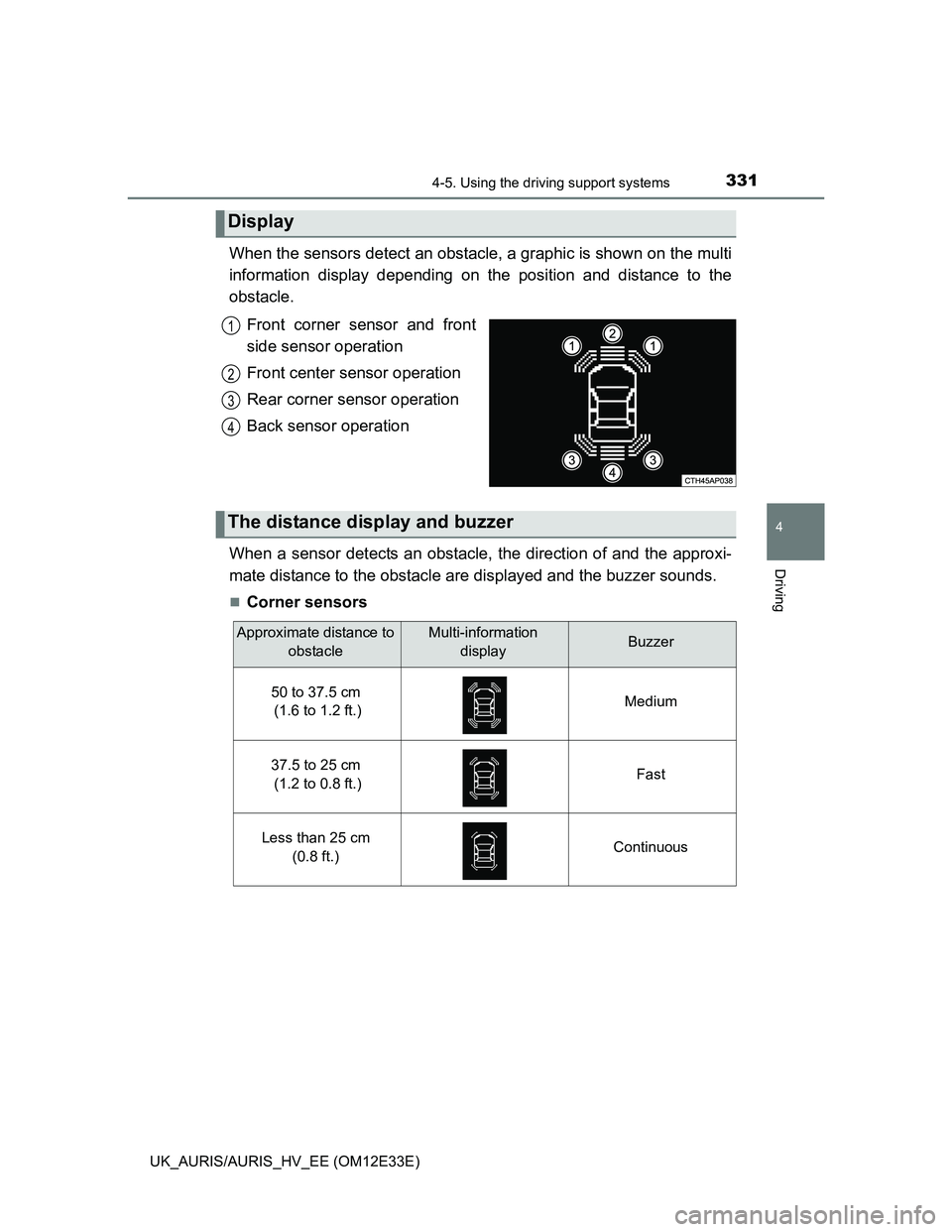
When the sensors detect an obstacle, a graphic is shown on the multi
information display depending on the position and distance to the
obstacle.
Front corner sensor and front
side sensor operation
Front center sensor operation
Rear corner sensor operation
Back sensor operation
When a sensor detects an obstacle, the direction of and the approxi-
mate distance to the obstacle are displayed and the buzzer sounds.
Corner sensors
Display
1
2
3
4
The distance display and buzzer
Approximate distance to
obstacleMulti-information
displayBuzzer
50 to 37.5 cm
(1.6 to 1.2 ft.)Medium
37.5 to 25 cm
(1.2 to 0.8 ft.)Fast
Less than 25 cm
(0.8 ft.)Continuous
Page 334 of 750
3324-5. Using the driving support systems
UK_AURIS/AURIS_HV_EE (OM12E33E)
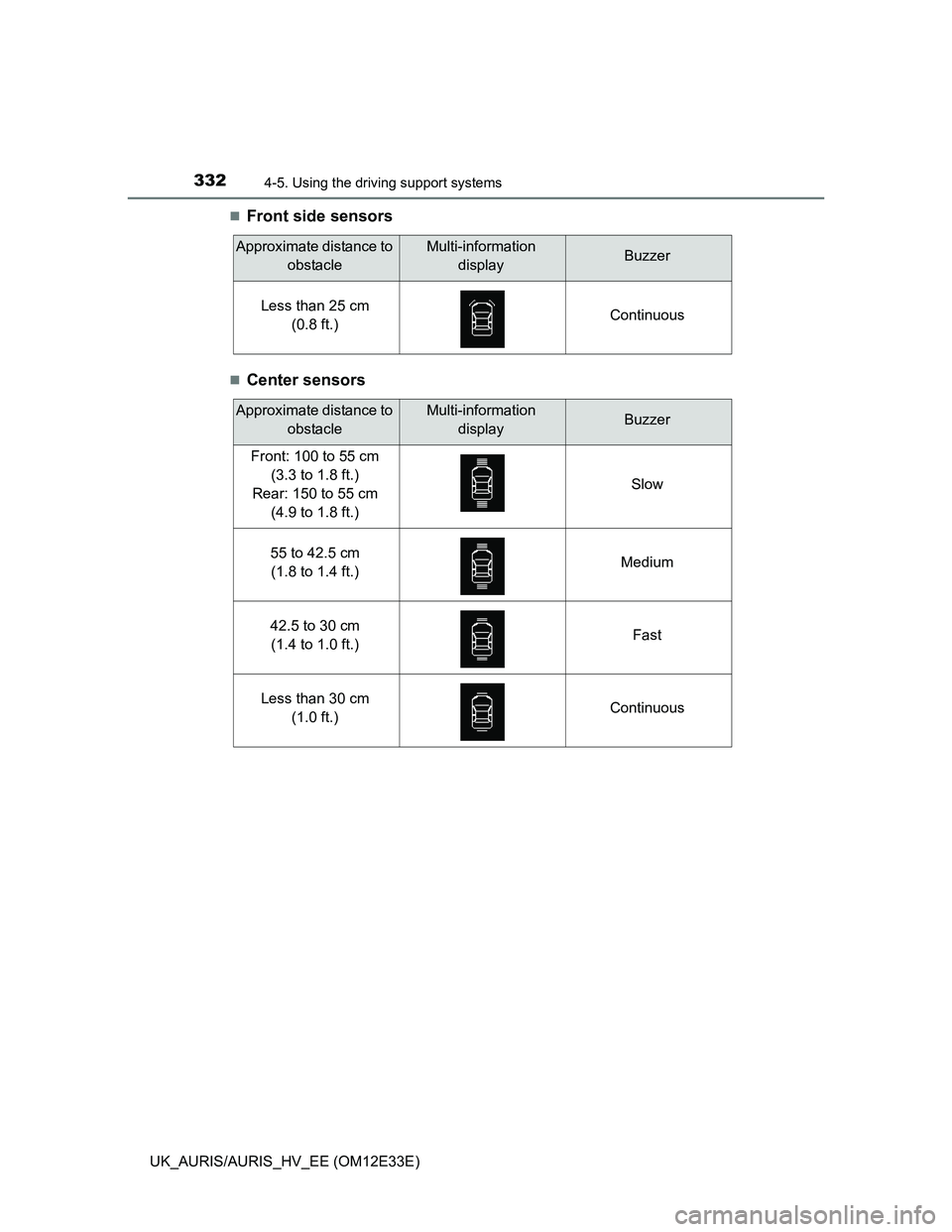
Front side sensors
Center sensors
Approximate distance to
obstacleMulti-information
displayBuzzer
Less than 25 cm
(0.8 ft.)Continuous
Approximate distance to
obstacleMulti-information
displayBuzzer
Front: 100 to 55 cm
(3.3 to 1.8 ft.)
Rear: 150 to 55 cm
(4.9 to 1.8 ft.)Slow
55 to 42.5 cm
(1.8 to 1.4 ft.)Medium
42.5 to 30 cm
(1.4 to 1.0 ft.)Fast
Less than 30 cm
(1.0 ft.)Continuous
Page 335 of 750
3334-5. Using the driving support systems
UK_AURIS/AURIS_HV_EE (OM12E33E)
4
Driving
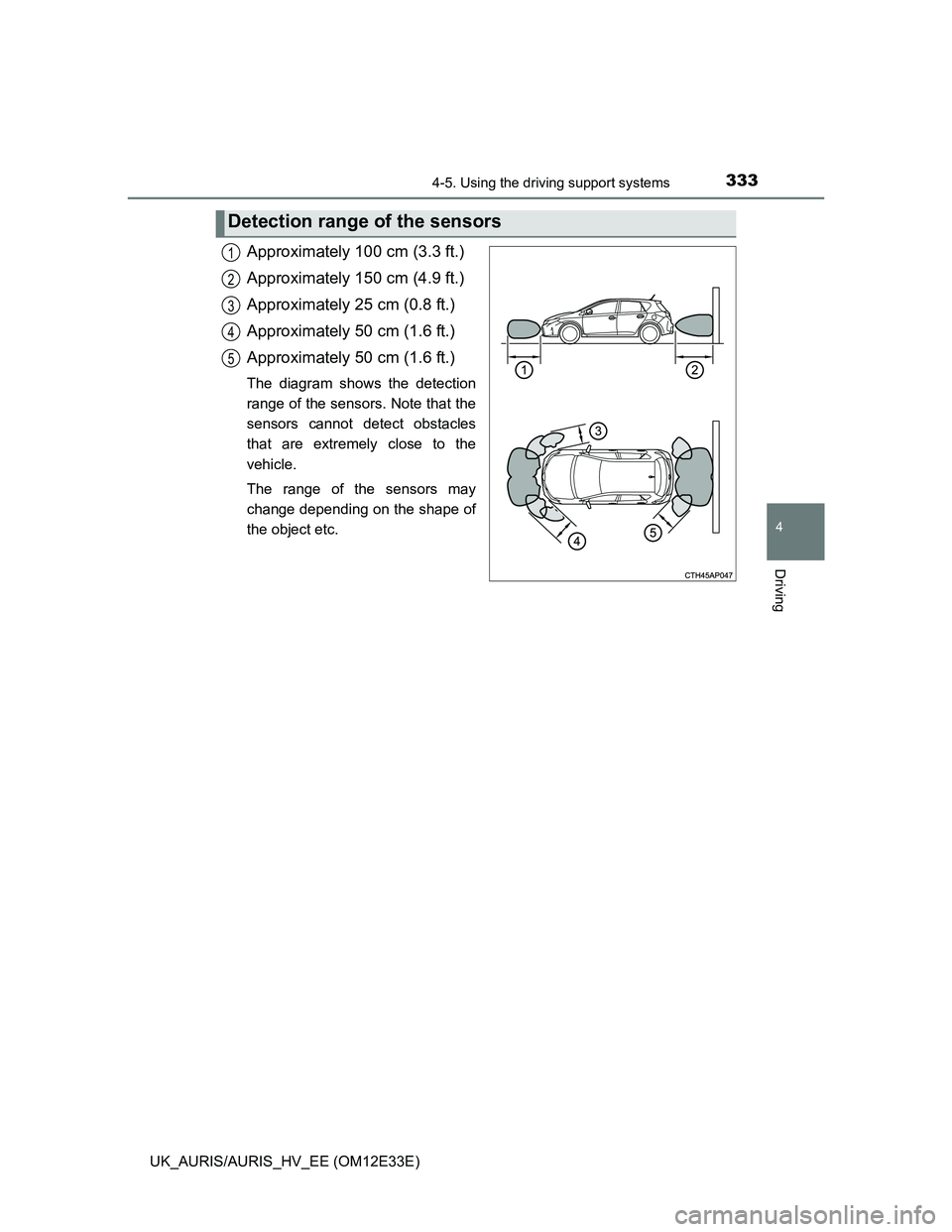
Approximately 100 cm (3.3 ft.)
Approximately 150 cm (4.9 ft.)
Approximately 25 cm (0.8 ft.)
Approximately 50 cm (1.6 ft.)
Approximately 50 cm (1.6 ft.)
The diagram shows the detection
range of the sensors. Note that the
sensors cannot detect obstacles
that are extremely close to the
vehicle.
The range of the sensors may
change depending on the shape of
the object etc.
Detection range of the sensors
1
2
3
4
5
Page 336 of 750
3344-5. Using the driving support systems
UK_AURIS/AURIS_HV_EE (OM12E33E)
Sensor detection information
Certain vehicle conditions and the surrounding environment may affect the
ability of the sensor to correctly detect obstacles. Particular instances where
this may occur are listed below.
• There is dirt, snow or ice on the sensor.
• A sensor is frozen.
• A sensor is covered in any way.
• The vehicle is leaning considerably to one side.
• On an extremely bumpy road, on an incline, on gravel, or on grass.
• The vicinity of the vehicle is noisy due to vehicle horns, motorcycle
engines, air brakes of large vehicles, or other loud noises producing ultra-
sonic waves.
• There is another vehicle equipped with parking assist sensors in the
vicinity.
• A sensor is coated with a sheet of spray or heavy rain.
• The vehicle is equipped with a fender pole or wireless antenna.
• Towing eyelet is installed.
• A bumper or sensor receives a strong impact.
• The vehicle is approaching a tall or curved curb.
• In harsh sunlight or intense cold weather.
• A non-genuine Toyota suspension (lowered suspension etc.) is installed.
In addition to the examples above, there are instances in which, because of
their shapes, signs and other objects may be judged by the sensor to be
closer than they are.
The shape of the obstacle may prevent the sensor from detecting it. Pay
particular attention to the following obstacles:
• Wires, fences, ropes, etc.
• Cotton, snow and other materials that absorb sound waves
• Sharply-angled objects
• Low obstacles
• Tall obstacles with upper sections projecting outwards in the direction of
your vehicle
If a message is displayed
P. 599
Page 337 of 750
3354-5. Using the driving support systems
UK_AURIS/AURIS_HV_EE (OM12E33E)
4
Driving
CAUTION
Caution when using the Toyota parking assist-sensor
Observe the following precautions.
Failing to do so may result in the vehicle being unable to be driven safely
and possibly cause an accident.
Do not use the sensor at speeds in excess of 10 km/h (6 mph).
Do not attach any accessories within the sensor range.
NOTICE
Notes on the Toyota parking assist-sensor
Do not apply intensive bursts of water or steam to the sensor area.
Doing so may result in the sensor malfunctioning.
If your vehicle is involved in an accident, it will affect the sensors and may
result in a system failure.
Contact any authorized Toyota dealer or repairer, or another duly qualified
and equipped professional.